
Editorial Article
Seventeen Countries Removed the Tampon Tax. The Shelf Price Barely Moved.
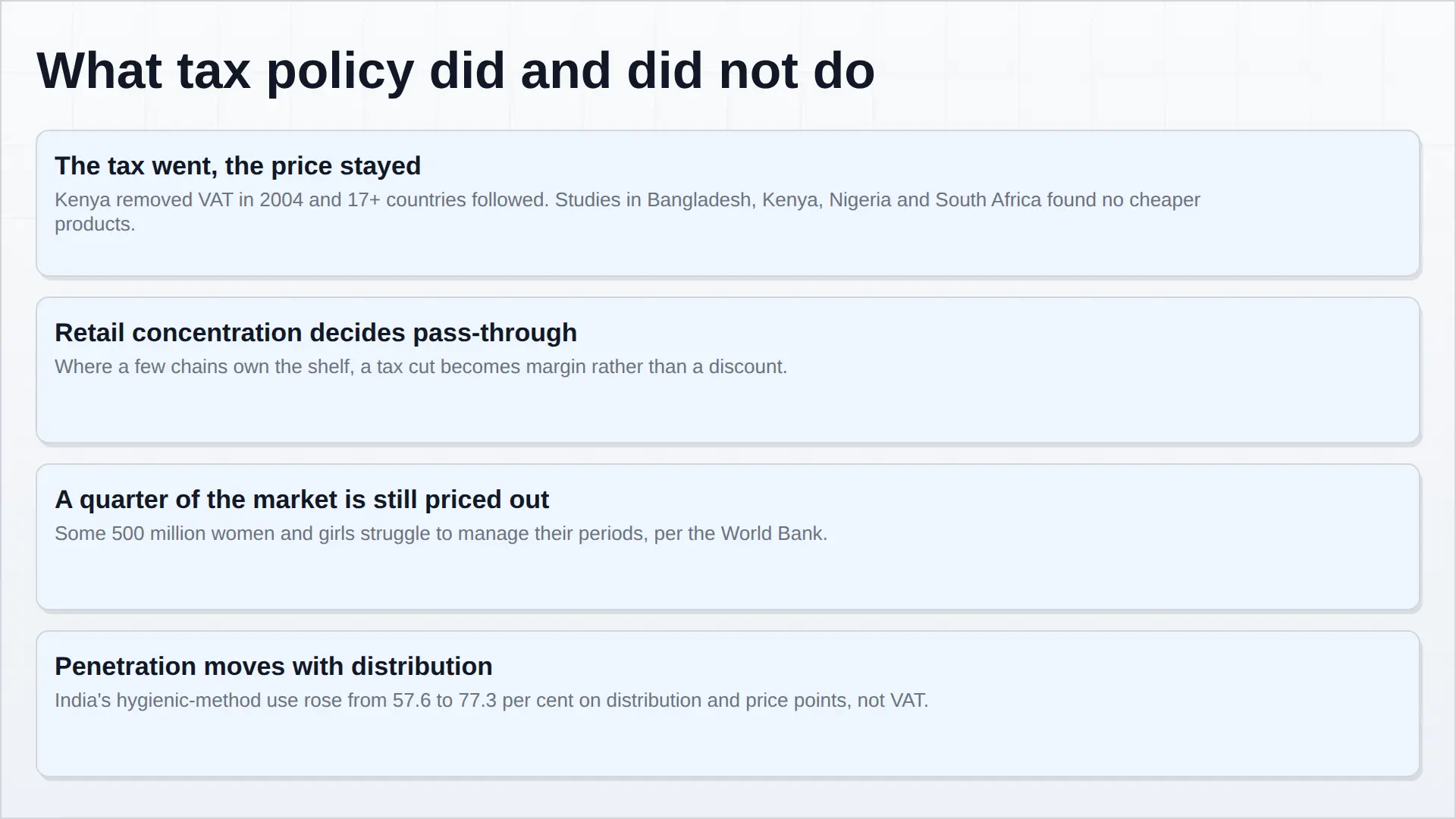
Few policies in consumer health have travelled as fast as the removal of value-added tax on menstrual products. Fewer still have delivered so little of what they promised. More than a quarter of menstruating women and girls worldwide — some 500 million people, by the World Bank’s estimate — struggle to manage their periods, and governments have spent two decades treating the tax line as the lever that would fix it.
The wave was real
Kenya went first, removing taxes on menstrual products from 2004 and, by 2016, eliminating VAT on imported products and on the raw materials used to make them. At least seventeen countries have since removed or cut consumption tax on sanitary pads, tampons, liners and menstrual cups. Malaysia, Lebanon, Tanzania, Ireland, Colombia and Mexico have taken the tax to zero. Bangladesh temporarily removed VAT on raw materials to encourage domestic production; Nigeria removed VAT from locally manufactured products. The political logic was straightforward and the symbolism was powerful: if toilet paper and over-the-counter medicines are essential, so is this.
The price evidence is the problem
The World Bank’s own assessment of the evidence is the least quoted part of the story. Studies across Bangladesh, Kenya, Nigeria and South Africa found that removing the tax did not lead to cheaper products. The reason is structural rather than conspiratorial. A tax cut hands margin to whoever sets the shelf price, and in a category where a handful of brand owners negotiate the facings and a handful of retail chains own the shelf, the default outcome is that the margin is retained. Pass-through requires competition at the point of sale; where there is little, a ten-point tax reduction has three places to hide — in the brand’s gross margin, in the retailer’s margin, and in the trade spend that buys the position that made the brand worth buying in the first place.
The arithmetic of a pad explains why. In our model of a mainstream branded pad sold through grocery in a high-income market, the retailer takes 27 of every 100 units of shelf price and the brand’s entire cost of goods is 37. Those are the two places a tax reduction lands. The consumer sees a change only if one of them chooses to give it up.
What the category did with the money instead
This is not a story about a category that needed the cash. Our modelling of the global feminine hygiene market puts value at USD 39,800 million in 2025 rising to USD 53,650 million in 2033 — 3.80 per cent a year — against unit volume growth of just 0.80 per cent. Realisation per unit rises from 12.41 US cents to 15.70 cents, which means 78.4 per cent of the value growth is price and mix rather than more product. Fluff pulp and superabsorbent polymer costs normalised after 2022; shelf prices did not follow them down. In that context, expecting a tax cut to reach the consumer was always optimistic.
What actually moved penetration
India is the counter-example that shows what does work. NFHS-5 recorded 77.3 per cent of women aged 15–24 using a hygienic method of menstrual protection, up from 57.6 per cent in NFHS-4. That is a 19.7 point move in roughly five years, and it happened in a market where the binding constraint was never the tax rate — it was whether a pad was on a shelf within reach and priced at a point a first-time buyer would try. The gap that remains tells you where the work is: 72.3 per cent of rural women against 89.4 per cent of urban women. Among adolescent girls, 64.5 per cent use sanitary napkins and 78 per cent use some hygienic method.
The supply response to that gap has been price architecture, not policy. Unicharm’s Indian business introduced flat packs that omit individual wrapping, smaller pack sizes and an antibacterial proposition aimed at urban first-time buyers, and the company credits the approach with high sales growth and margin improvement in a year when its overall Personal Care core operating income fell 25.0 per cent. That is what penetration looks like when it is won: fewer millimetres of packaging, a lower entry price, and more shops carrying the product.
The uncomfortable conclusion
Tax removal is popular because it is legible, cheap to announce and morally unimpeachable. Distribution is harder: it requires reaching the 27 per cent of Indian women who still use cloth, the shops that do not stock the product, and the price points that make a first purchase possible. School programmes and public procurement — Scotland’s statutory free-provision scheme, India’s menstrual hygiene schemes — do more per rupee than a VAT line, because they buy the product and place it in front of the user rather than betting on a retailer to pass on a saving.
There is one reason to expect better pass-through in future, and it is not policy. E-commerce is moving from 20 to 32 per cent of feminine hygiene value by 2033 in our model, and online the shelf owner’s 27 points collapse into a fulfilment fee and an advertising bid. A channel with lower structural margin has less room to absorb a tax cut quietly. If the next round of tax reform is judged by whether prices actually fall, the most useful thing a government can do is watch the online price of a ten-pack, not the statute book.
The full market analysis, including the value chain, the cost stack and the scenarios to 2033, is in the Global Feminine Hygiene Products Market Report, Size, Share and Forecast 2026–2033. The measurement problem behind the 2024 Chinese pad controversy is covered in The Pad Got Shorter Because Nobody Measures the Absorbent Core.
Frequently Asked Questions
Which countries have removed the tampon tax?
Kenya began in 2004 and by 2016 had removed VAT on imported menstrual products and on the raw materials used to make them. At least seventeen countries have since removed or cut consumption tax, including Malaysia, Lebanon, Tanzania, Ireland, Colombia and Mexico.
Did removing the tax make menstrual products cheaper?
The World Bank's assessment of the evidence found that studies across Bangladesh, Kenya, Nigeria and South Africa did not show cheaper products after tax removal. Pass-through depends on competition at the point of sale, and where a few brand owners and retail chains set the shelf, the tax cut is retained as margin.
How many women still cannot afford menstrual products?
Some 500 million women and girls — more than a quarter of those menstruating worldwide — struggle to manage their periods, according to the World Bank. The binding constraint is usually distribution and entry price rather than the tax line.
What actually increases penetration?
India's NFHS-5 recorded 77.3 per cent of women aged 15–24 using a hygienic method, up from 57.6 per cent in NFHS-4, with rural usage at 72.3 per cent against 89.4 per cent urban. Most of that move came from distribution and lower entry price points, such as flat packs without individual wrapping, not from tax policy.