
Editorial Article
The Pad Got Shorter Because Nobody Measures the Absorbent Core
The Chinese sanitary pad scandal of November 2024 is usually described as a quality story. It was not. Nothing in those products failed a test, because there was no test to fail. It was a measurement story, and that is why it has changed the category in a way that a defect recall never would.
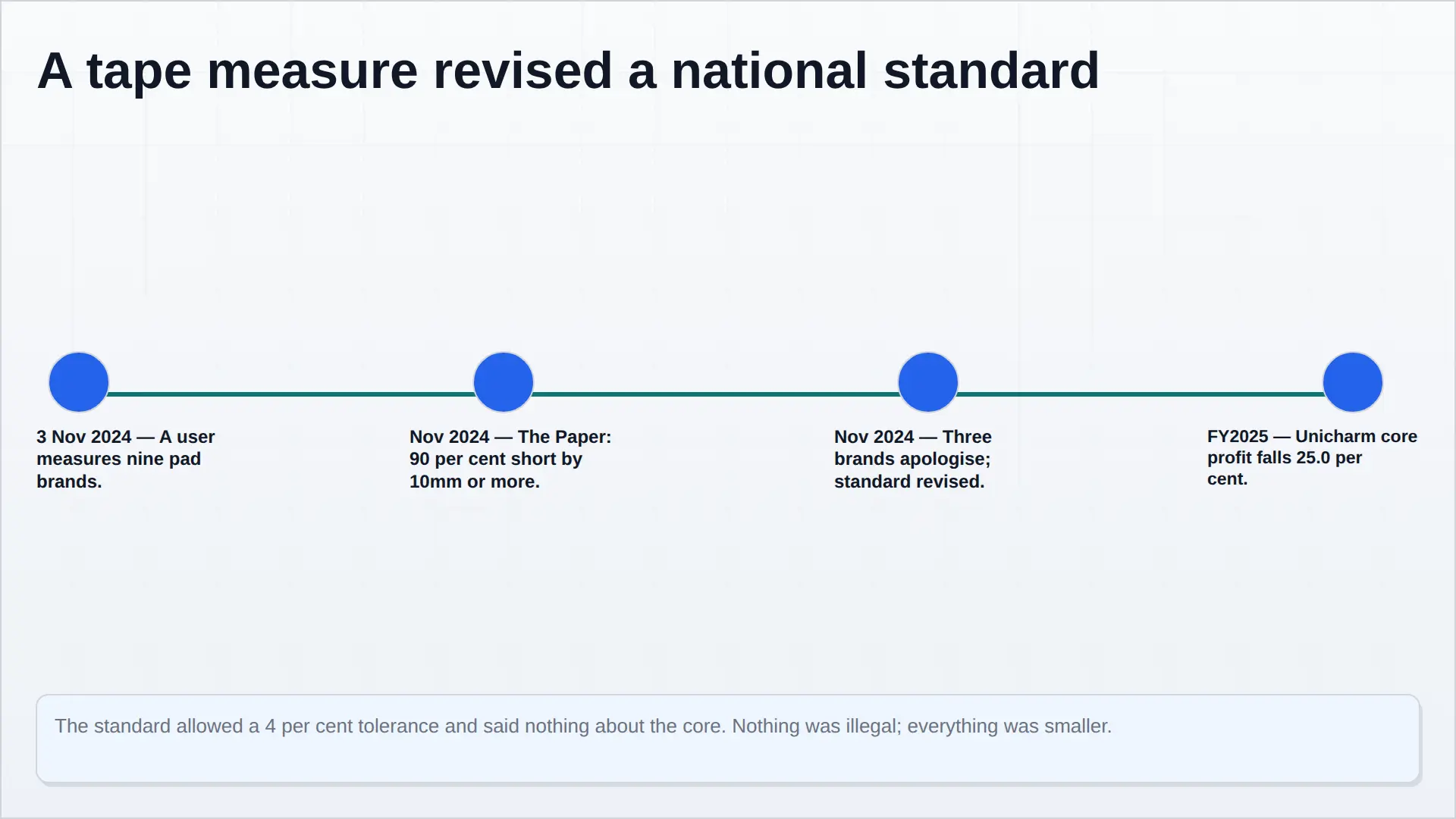
On 3 November 2024 a user on the social platform Xiaohongshu posted a video in which she laid nine brands of sanitary pad on a table and measured them against a tape. Most came up short of the length printed on the pack. The video travelled. Within days, The Paper, a Chinese news outlet, had tested more than twenty products and reported that nearly 90 per cent of them measured at least 10mm shorter than claimed — and that inside most of them sat an absorbent core shorter again than the pad itself. The part of the product that does the work was the part with the least material in it.
The rule permitted it
China’s national standard for sanitary napkins allows a product to measure within 4 per cent of its advertised length. It says nothing about the length of the absorbent core. Those two facts together are the whole scandal. A pad can be legally compliant, honestly labelled by the letter of the rule, and still deliver materially less absorbent material than the pack implies — and a consumer has no way to know without a ruler and a pair of scissors. The category had spent years competing on absorption claims in advertising while the specification that determined absorption sat outside the standard entirely.
The commercial reaction was as instructive as the disclosure. ABC, one of the brands caught in the videos, initially responded to a customer complaint by saying that if she could not accept the difference she could choose not to buy the product. It then issued a statement saying it was “deeply sorry” for the “inappropriate” response and promised to improve products toward “zero deviation”. Shecare and Beishute also apologised. Xinhua weighed in, noting that the quality of sanitary pads “is directly related to the health and comfort of the user”. Chinese authorities confirmed the national standard was being revised.
What it cost the category leader
Unicharm’s fiscal 2025 results, filed in February 2026, are the clearest financial record of what a trust shock does to a mature brand. Personal Care net sales fell 6.3 per cent to JPY 774,428 million and core operating income fell 25.0 per cent to JPY 83,197 million — a 10.7 per cent margin against 13.4 per cent the year before. The company’s own commentary attributes part of the sales decline to the effect of “rumours reported in November 2024, March and October 2025 regarding the quality of sanitary products and waste management”, and describes its response as strengthened e-commerce marketing plus a deliberate campaign to rebuild a brand image of safety and trust. Its China business had already been trading down as younger consumers chose cheaper products.
This is the important asymmetry in feminine hygiene. The category’s growth is now carried overwhelmingly by price and mix rather than volume: our modelling of the market puts value growth at 3.80 per cent a year to 2033 against 0.80 per cent unit growth, with 78.4 per cent of the value increase coming from realisation. Premium tiers — ultra-thin cores, shorts-shaped napkins, organic cotton, period underwear — are growing at 7.0 to 7.1 per cent against 3.5 per cent for the pad base. Every one of those tiers is sold on a claim about what is inside the product. If claims cannot be verified, the premium has nothing to stand on, and the whole price-led growth model becomes a bet on consumer ignorance that a single viral video can end.
The next fight is metrology
Which is why the revision of a Chinese national standard matters well beyond China. Converting an invisible specification into a testable one changes three things at once. It turns in-line vision and core-weight measurement from a quality-control nicety into a compliance cost, which favours the larger converters who already run it. It makes the absorbent core a marketing claim rather than an engineering secret, which favours whoever is willing to publish a number. And it gives retailers a specification to buy against, which is exactly what a private-label programme needs in order to close the gap to the brand.
In our conversations with converters across Europe and Asia, the manufacturers who already monitor core weight continuously described the change as an advantage rather than a burden — not because compliance is cheap, but because it creates a claim competitors cannot copy without the same instrumentation. That is an unusual thing in a category where the physical product has been effectively commoditised for twenty years.
What to watch
Three things will tell you whether the lesson stuck. The first is whether the revised standard specifies a minimum absorbent-core length or only tightens the outer tolerance — a tighter tape measure on the same hollow product would change nothing. The second is whether any major brand publishes a core specification voluntarily, which would force the rest. The third is whether the next wave of premium launches sells absorption as a measured number or as an adjective.
The full analysis — market size, the six-chapter rebuild, the competitive landscape, the cost stack and the scenarios to 2033 — is in the Global Feminine Hygiene Products Market Report, Size, Share and Forecast 2026–2033.
Frequently Asked Questions
What happened in the 2024 Chinese sanitary pad scandal?
In November 2024 a Chinese social-media user measured nine brands of sanitary pad on video and found most shorter than the pack claimed. A follow-up investigation by The Paper tested more than twenty products and reported that nearly 90 per cent measured at least 10mm shorter than advertised, with even shorter absorbent cores inside.
Why did the standard allow pads to be shorter than advertised?
China's national standard for sanitary napkins permits a length tolerance of 4 per cent and specifies no minimum length for the absorbent core. A product could therefore be fully compliant while delivering materially less absorbent material than the pack implied, and consumers had no way to detect it without measuring.
What did the scandal cost Unicharm?
Unicharm's Personal Care segment net sales fell 6.3 per cent to JPY 774,428 million and core operating income fell 25.0 per cent to JPY 83,197 million, a 10.7 per cent margin against 13.4 per cent. The company attributes part of the decline to the sales effect of quality and waste-management rumours reported in November 2024, March 2025 and October 2025.
Why does a measurement standard matter commercially?
Because premium tiers — ultra-thin cores, shorts-shaped napkins, organic cotton and period underwear, growing at 7.0 to 7.1 per cent a year — are sold on claims about what is inside the product. With 78.4 per cent of the market's value growth coming from price and mix rather than volume, verifiable product claims are what the price ladder rests on.