
Global Foodservice Trays, Plates & Bowls Market Report, Size, Share and Forecast 2026–2033: Moulded Fibre Takes 40 Per Cent of the Growth on 22 Per Cent of the Market, and a 283 Per Cent Duty Decided Where It Gets Made
Coverage. Trays, plates and bowls used to serve, sell, deliver or carry food away from the point at which it is prepared — moulded fibre and bagasse, polypropylene and PET thermoformed, coated paperboard, aluminium foil, expanded polystyrene, and the small wood, bamboo, PLA and reusable segment. Retail dinnerware sold for home use is out of scope, and so are cups and lids (report 114783), hinged containers and clamshells (114807) and flexible foodservice formats (114828). This is the sixth report in the foodservice packaging spine and it closes it.
1. Executive summary
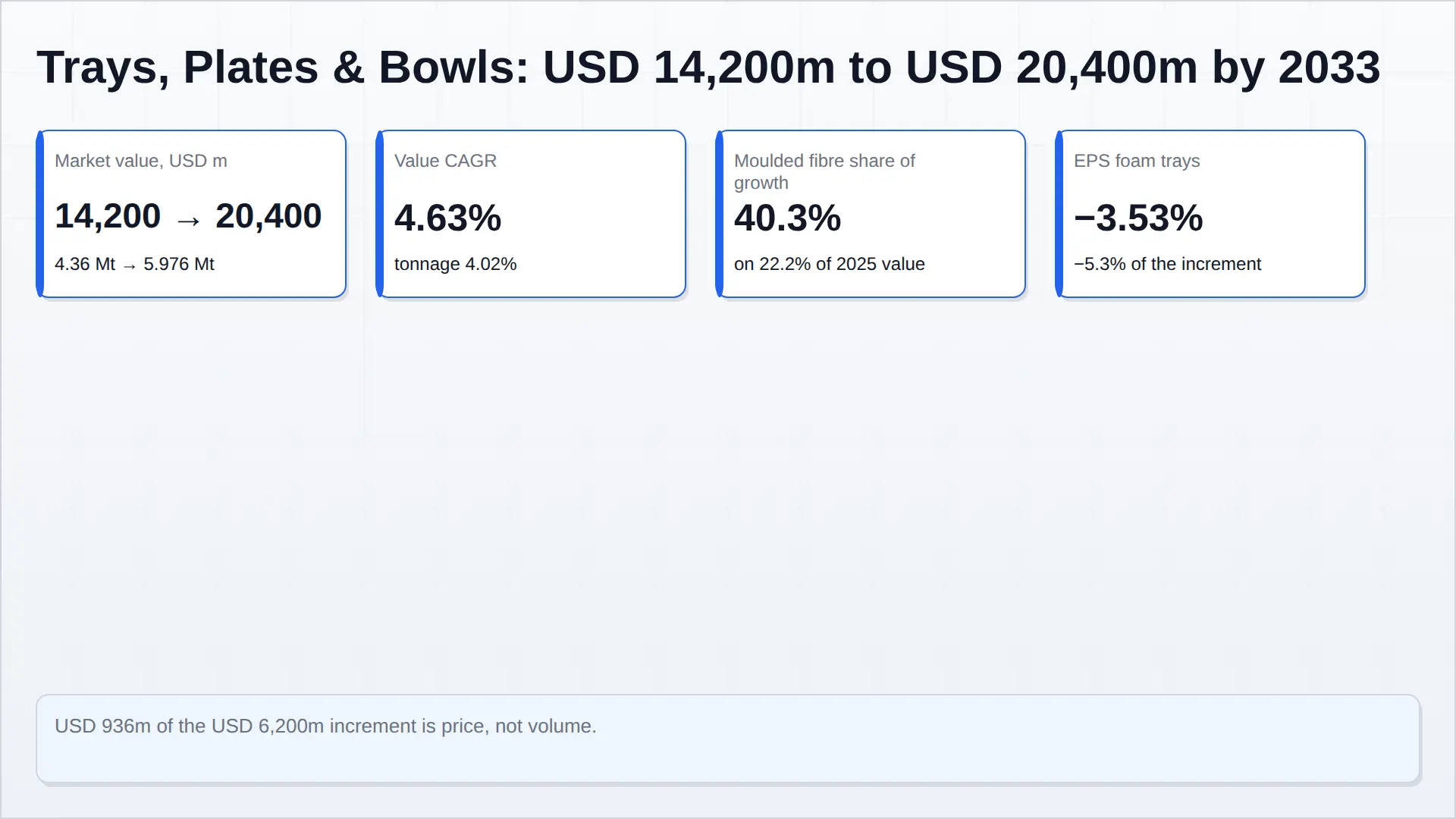
The global market for foodservice trays, plates and bowls is USD 14,200 million across 4.36 million tonnes in 2025, and it reaches USD 20,400 million across 5.976 million tonnes in 2033. That is 4.63 per cent by value and 4.02 per cent by tonnage, with realisation moving from USD 3,257 to USD 3,414 a tonne — 0.59 per cent a year. In units the market runs from 236 billion pieces to 330.6 billion, 4.30 per cent a year, and average selling price from 6.02 cents to 6.17 cents.
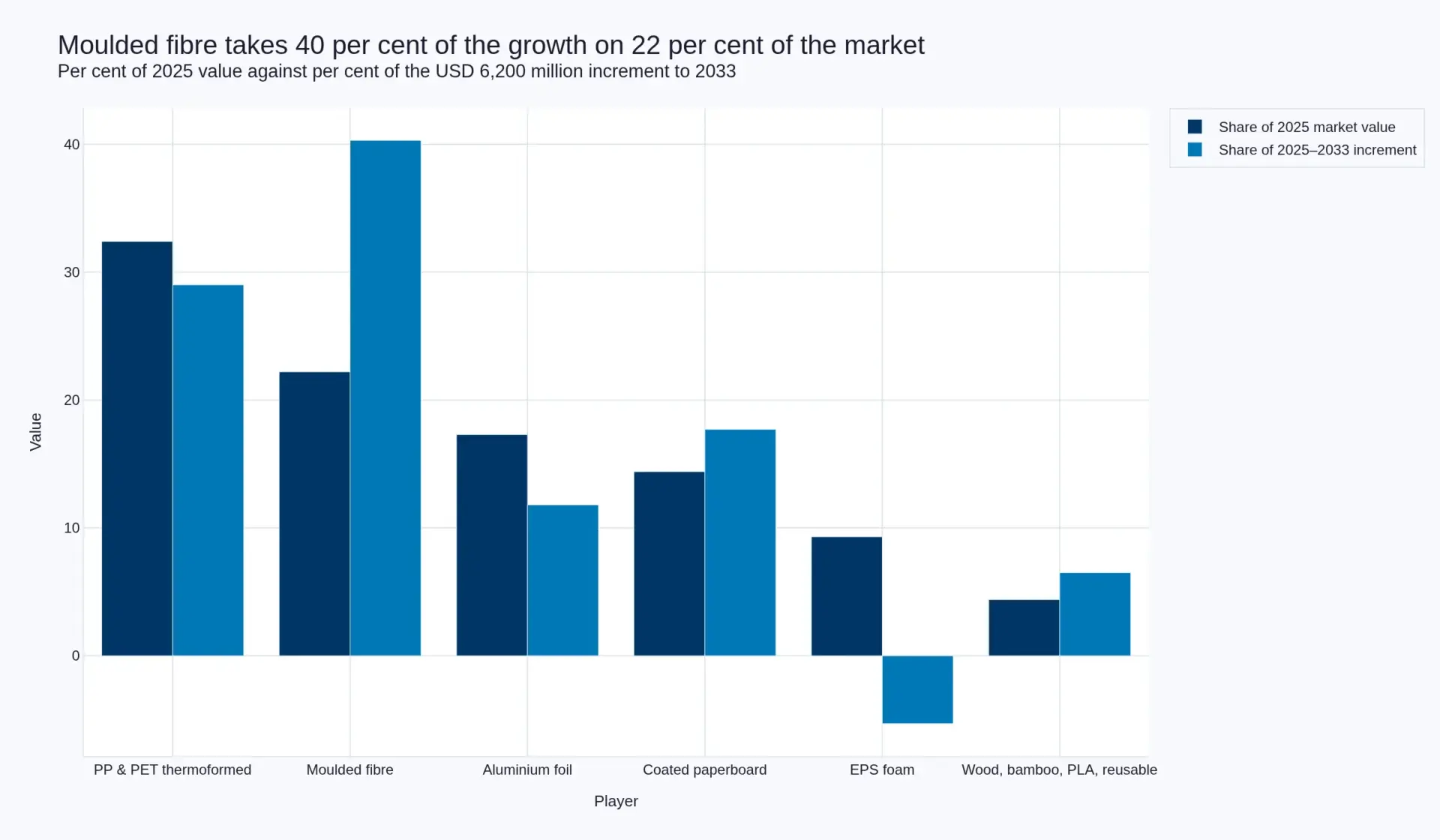
The headline is arithmetic, not opinion. Moulded fibre plates, bowls and trays carry 22.2 per cent of the 2025 value and take 40.3 per cent of the USD 6,200 million increment. They grow 7.58 per cent by value and 6.02 per cent by tonnage against a market at 4.63 and 4.02. Expanded polystyrene carries 9.3 per cent of today's value, shrinks 3.53 per cent a year, and subtracts 5.3 per cent from the increment. Polypropylene and PET thermoforming is the largest single line at 32.4 per cent of the market and grows 4.21 per cent, which means it loses share to fibre while still adding 29.0 per cent of the growth.
Eighty-five per cent of this market's growth is volume and 15.0 per cent is realisation. Hold the 2025 substrate mix, grow tonnage to 5.976 million tonnes, and 2033 is worth USD 19,464 million. The model has USD 20,400 million. The USD 936 million gap is price — and it is concentrated, not spread: moulded fibre's realisation rises 12.3 per cent over the window while polypropylene gains 4.2 per cent and foil 5.1 per cent. The one line where the customer is buying a compliance attribute rather than a vessel is the one line where the price moves.
The economics of the market are visible inside one company. Huhtamäki reported three relevant businesses for 2025: Foodservice Packaging, net sales EUR 936.2 million, adjusted EBIT 9.3 per cent, adjusted return on net assets 10.3 per cent; North America, which sells Chinet retail tableware and foodservice formats, EUR 1,405.3 million at 11.6 per cent and 15.2 per cent; and Fiber Packaging, EUR 379.7 million at 13.3 per cent and 18.4 per cent. The business that makes the fibre blank earns nearly double the return on net assets of the business that forms it into a plate, in the same year, from the same group. Capital followed: Foodservice capital expenditure fell 56 per cent to EUR 29.1 million while Fiber Packaging rose 87 per cent to EUR 52.7 million.
Three numbers define the cost structure. Aluminium is 36.5 per cent of a foil tray's USD 7,206 a tonne realisation, at an LME 2025 average of USD 2,632 a tonne. Recovered paper is roughly 6 to 7 per cent of a moulded fibre plate's USD 2,763 a tonne. The distributor takes 18.4 per cent of what an operator spends, per the value chain in our foodservice packaging hub. The highest-value format in this market is a commodity with a thin conversion margin bolted on; the fastest-growing one is a drying business that buys waste paper at EUR 125–150 a tonne.
And the number this report will defend hardest: moulded fibre realisation is triangulated three ways and all three agree. Our model puts the 2025 average at USD 2,763 a tonne. Chinese customs data, cited in Zhejiang Zhongxin's 2025 annual report, shows moulded pulp exports of 254,000 tonnes worth RMB 5.06 billion in 2024 — USD 2,806 a tonne. UN Comtrade HS 4823.70 shows US imports of moulded pulp articles from China at USD 391.9 million for 146,400 tonnes in 2024 (USD 2,677) and USD 119.0 million for 47,200 tonnes in 2025 (USD 2,521). Three independent routes, one price, within 11 per cent of each other across the top and bottom of the band.
The trade shock is the other story. On 25 September 2025 the US Department of Commerce set final anti-dumping and countervailing duties on thermoformed moulded fibre products from China and Vietnam. Zhongxin, a mandatory respondent, received 283.89 per cent anti-dumping and 97.82 per cent countervailing; other Chinese exporters were assigned 49.08 to 477.97 per cent and 7.56 to 319.92 per cent. US imports of moulded pulp articles from China fell from 146,400 tonnes in 2024 to 47,200 tonnes in 2025 — a hole of 99,200 tonnes. Thailand filled 32,400 tonnes of it, 32.7 per cent, and Zhongxin's own Thai plant, started in April 2025, reached 75,000 tonnes of capacity with a target of 100,000. A 7.58 per cent growth rate on the fibre line is not a preference curve. It is a capacity map with a tariff drawn on it.
Regulation is the third force, and it is on a calendar. California's EPS food service ware restriction took effect on 1 January 2025 and covers plates, bowls, trays, hinged containers and lids, because producers could not demonstrate the 25 per cent recycling rate the statute requires. Regulation (EU) 2025/40 requires all packaging to be recyclable by 2030, sets 30 per cent recycled content for PET contact-sensitive packaging by 2030, obliges takeaway operators to offer 10 per cent of products in a reusable format and to accept customer-supplied containers at no charge, and caps PFAS at 25 parts per billion for any single substance, 250 for a group and 50 parts per million in total, 18 months from entry into force. Every one of those dates lands inside this forecast window.
The market in one line of transaction economics: a tray, plate or bowl is 2.33 cents of every away-from-home food transaction in 2025, rising to 2.74 cents in 2033. It is 14.79 per cent of the USD 96,000 million foodservice packaging market. It is small enough per meal that no operator will change an occasion over it, and large enough in aggregate that a substrate shift inside it is worth billions.
2. Market definition, size and forecast
The market is defined by the vessel, not the venue. A tray is in scope when it is the primary container in which food is presented or delivered — an aluminium catering tray, a thermoformed PP ready-meal tray, a bagasse school-meal tray, a moulded fibre meat tray sold through a butcher counter. It is out of scope when it is secondary packaging wrapping a primary container. The same physical object can sit either side of the line, so the model classifies by function and states the convention once.
The headline
| Global market | 2025 | 2033 | CAGR |
|---|---|---|---|
| Market value, USD million | 14,200 | 20,400 | 4.63% |
| Volume, million tonnes | 4.360 | 5.976 | 4.02% |
| Realisation, USD per tonne | 3,257 | 3,414 | 0.59% |
| Units, billion pieces | 236.0 | 330.6 | 4.30% |
| Average selling price, USD per piece | 0.0602 | 0.0617 | 0.31% |
The format ladder
| Format | 2025 USD m | 2025 Mt | USD/t 2025 | 2033 USD m | 2033 Mt | USD/t 2033 | Value CAGR | Tonnage CAGR | Share of increment |
|---|---|---|---|---|---|---|---|---|---|
| Aluminium foil trays and containers | 2,450 | 0.340 | 7,206 | 3,180 | 0.420 | 7,571 | 3.31% | 2.68% | 11.8% |
| PP and PET thermoformed trays and bowls | 4,600 | 1.720 | 2,674 | 6,400 | 2.296 | 2,787 | 4.21% | 3.68% | 29.0% |
| Moulded fibre plates, bowls and trays | 3,150 | 1.140 | 2,763 | 5,650 | 1.820 | 3,104 | 7.58% | 6.02% | 40.3% |
| Coated paperboard plates and bowls | 2,050 | 0.720 | 2,847 | 3,150 | 1.040 | 3,029 | 5.52% | 4.70% | 17.7% |
| EPS foam trays | 1,320 | 0.330 | 4,000 | 990 | 0.225 | 4,400 | −3.53% | −4.67% | −5.3% |
| Wood, bamboo, PLA and reusable | 630 | 0.110 | 5,727 | 1,030 | 0.175 | 5,886 | 6.34% | 5.98% | 6.5% |
| Total | 14,200 | 4.360 | 3,257 | 20,400 | 5.976 | 3,414 | 4.63% | 4.02% | 100% |
Two things in that table are worth stopping on. First, the two formats furthest apart on realisation per tonne — foil at USD 7,206 and PP/PET at USD 2,674 — are 2.7 times apart, and the gap does not close: foil reaches USD 7,571 and PP/PET USD 2,787. A tonne of aluminium tray is worth more than two and a half tonnes of plastic tray and stays that way, because the metal is 36.5 per cent of the price and it is quoted on an exchange. Second, EPS has the second highest realisation in the market at USD 4,000 a tonne and is the only line that shrinks. Foamed polystyrene sells at a premium per tonne because a tonne of it is a very large number of very cheap pieces — and that is precisely the format that regulation removes first, because the arithmetic of collection does not work on a product that is 98 per cent air.
Mix-neutral decomposition
Hold the 2025 substrate mix and grow tonnage to 5.976 million tonnes: 5.976 × 3,257 = USD 19,464 million. The model returns USD 20,400 million. The USD 936 million difference is realisation, 15.0 per cent of the increment, and its distribution is the finding:
| Format | Realisation 2025 | Realisation 2033 | Change |
|---|---|---|---|
| Moulded fibre plates, bowls and trays | 2,763 | 3,104 | +12.3% |
| Coated paperboard plates and bowls | 2,847 | 3,029 | +6.4% |
| Aluminium foil trays and containers | 7,206 | 7,571 | +5.1% |
| PP and PET thermoformed | 2,674 | 2,787 | +4.2% |
| EPS foam trays | 4,000 | 4,400 | +10.0% |
| Wood, bamboo, PLA and reusable | 5,727 | 5,886 | +2.8% |
| Market | 3,257 | 3,414 | +4.8% |
The fibre line takes three times the price the plastic line takes. That is not a materials-science fact — a bagasse plate is not harder to make in 2033 than in 2025. It is a market-structure fact: fibre capacity in the West is being built behind a duty wall, into a compliance-driven demand pool, by suppliers who are capacity-short. Price follows scarcity, and scarcity in this market is currently manufactured by trade policy as much as by physics.
Transaction economics
| Per away-from-home food transaction | 2025 | 2033 |
|---|---|---|
| Away-from-home transactions, billion | 610 | 745 |
| Total foodservice packaging spend, USD cents | 15.74 | 16.98 |
| of which trays, plates and bowls, USD cents | 2.33 | 2.74 |
| Trays, plates and bowls as share of the packaging bill | 14.79% | 16.14% |
Two and a third cents a transaction is why substrate conversion in this category is legislated rather than bought. An operator facing a 25 per cent rise in what it pays for a tray is facing 0.58 cents on a transaction — the same order of magnitude as the rounding on a menu price, and far below the attention threshold of a procurement team that is also buying food. Compliance is binary; price exposure is fractional. That asymmetry, not relative cost, is what moves this market.
Scenarios
| Scenario | Value CAGR | 2033 value, USD m | Condition |
|---|---|---|---|
| Conservative | 3.60% | 18,844 | Duties are unwound or bypassed at scale; fibre capacity arrives faster than demand and the price premium compresses. |
| Base | 4.63% | 20,400 | Duty regime holds; fibre capacity grows 6.02 per cent a year by tonnage; EPS decline continues on the state calendar. |
| Optimistic | 5.80% | 22,293 | PPWR design rules force mono-material conversion faster than expected and fibre premium holds through the window. |
Forecast band ±12 per cent on the 2033 value, which is wider than the ±10 per cent we apply to structurally stable categories and narrower than the ±15 per cent on early-stage ones. The width reflects two genuine uncertainties: whether the US duty regime survives review, and whether moulded fibre capacity outside China ramps at the rate announced.
Table des matières
Paysage concurrentiel
3. Competitive landscape
This market has no global share leader and cannot easily acquire one, because the asset that makes a tray has an economic radius rather than a market share. A thermoformer or a moulded fibre machine serves a 300 to 600 kilometre catchment before freight per unit exceeds the conversion margin per unit. The product is mostly air: a bagasse plate, an EPS tray and a thin-wall PP bowl all move a great deal of volume for very little mass, which is the opposite of the economics that made the corrugated and containerboard industries consolidate around mills. The result is dozens of regional leaders and a long tail of single-plant converters, and a top five that is large only by aggregation.
Measured concentration is therefore a description of geography, not of power. We estimate the five largest participants at 31 to 35 per cent of global value, weighted towards North America and Western Europe, and the figure is an estimate rather than a disclosure because three of the five do not report a like-for-like segment.
What the named participants actually disclose
| Participant | Latest disclosed position | Relevance to this market |
|---|---|---|
| Novolex (with Pactiv Evergreen) | Combination completed 1 April 2025, transaction valued at approximately USD 6.7 billion including Pactiv Evergreen’s net debt at 30 September 2024; shareholders received USD 18.00 a share, a 49 per cent premium; more than 250 brands and 39,000 combined SKUs; manufacturing across the US, Canada, Mexico and Europe | The broadest substrate set in the category — fibre, foam, PP, PET and paperboard trays, plates and bowls under one owner. Private, so no segment margin is disclosed |
| Graphic Packaging | FY2025 net sales USD 8,617 million, down 2 per cent; net income USD 444 million, 5.15 per cent of sales; Q4 net sales USD 2,103 million, flat, with an approximately 1 per cent decline in price and volume | The foodservice franchise is a coated-recycled-board business first, and a plate and bowl business second. Its margin is set by board, not by converting |
| Huhtamäki | Foodservice Packaging FY2025 net sales EUR 936.2 million, adjusted EBIT 9.3 per cent, adjusted RONA 10.3 per cent; North America EUR 1,405.3 million, 11.6 per cent, RONA 15.2 per cent; Fiber Packaging EUR 379.7 million, 13.3 per cent, RONA 18.4 per cent | The only participant that discloses the fibre blank business separately from the converting business, and therefore the only clean read on where the margin in this market sits |
| Zhejiang Zhongxin | 2025 output 88,100 tonnes, down 19.76 per cent; Thai plant 75,000 tonnes of capacity at year end against a 100,000-tonne target; that unit earned RMB 431.8 million of revenue and RMB 162.6 million of net profit in its first year; 2022 output of 77,900 tonnes against a Chinese moulded pulp tableware industry the China Pulp and Paper Research Institute put at about 440,000 tonnes | The clearest evidence that a duty wall, not a technology gap, is what determines where moulded fibre tableware capacity is built |
| Dart Container, Sabert, Genpak, D&W Fine Pack, Huhtamaki’s Chinet and the Pactiv brands | Privately held or not separately disclosed for these formats | Meaningful volume in foam, PP and PET; no reliable published segment economics, so we do not attribute any |
Why the consolidation is buying geography
The Novolex and Pactiv Evergreen combination is the most informative transaction in the category and it is informative precisely because of what it was not. It did not buy a share position in a national market, because no such position existed. It bought overlapping plant footprints across four countries and 39,000 SKUs, which is a way of buying the ability to serve a national distributor from fewer, larger sites while holding every substrate a customer might specify. The same logic explains Graphic Packaging’s decision in February 2026 to initiate a comprehensive review of its organisation, operations, footprint and portfolio, and Huhtamäki’s decision to separate Fiber Packaging from Foodservice Packaging as reporting segments from 1 April 2025 — the group concluded that the blank and the forming process have different economics and should be held to different returns.
The constraint on converter pricing power is not rivalry. It is the distributor. At 18.4 per cent of operator packaging spend, the distributor holds the account and takes a margin larger than the converter’s own EBITDA per unit in the foodservice chain. A converter that wins a national foodservice account has won the right to supply a specification at a price set through an intermediary, on volumes the intermediary controls. That is why the highest returns in this market are earned by the participants who make the input rather than the finished article.
And the demand side is not growing the way the participant list implies. Huhtamäki’s chief executive described consumer cautiousness, geopolitical tension and the US tariff situation as the forces behind the year, and reported that demand in the Foodservice Packaging segment remained muted for the whole of 2025, with comparable net sales down 4 per cent. Graphic Packaging’s chief executive opened his 2025 results with consumer affordability creating a challenging market for its customers. A 4.63 per cent value forecast on a market whose largest disclosed participants are reporting flat-to-down volumes is not a contradiction — it is what a substrate substitution looks like from inside an incumbent that is on the wrong side of it.
Chaîne de valeur
4. Value chain and cost structure
The value chain in this market is not one chain. It is two, running in opposite directions, and the difference between them explains the entire margin structure.
Chain one buys a commodity and forms it. An aluminium foil tray starts as metal quoted on the London Metal Exchange, which averaged USD 2,632 a tonne in 2025, up 8.8 per cent on 2024 and closing the year at USD 2,972. Rolled to container gauge, pressed, coated where required and packed, it realises USD 7,206 a tonne. The metal is 36.5 per cent of the price before a single tray is formed. A polypropylene tray is the same structure with a different index: resin bought against a published contract price, sheet extruded or bought in, thermoformed, and sold at USD 2,674 a tonne. In both, the converter’s contribution is a conversion margin on a priced input it does not control, and the customer can see the index.
Chain two buys waste and dries it. A moulded fibre plate starts as recovered paper at roughly EUR 125–150 a tonne delivered to a German mill. At about 1.15 tonnes of fibre per tonne of product, the material in a tonne of plates costs EUR 144–173, or roughly 6 to 7 per cent of a USD 2,763 a tonne realisation. Everything else — the forming machine, the drying energy, the tooling, the hall, the labour, the truck — is the other 93 per cent. It is a manufacturing business with a very low material share and a very high fixed-cost share, which is why its returns are excellent when the line is full and catastrophic when it is not.
The cost stack, three ways
| Format | Bought-in material | Material as share of realisation | What the rest of the price is |
|---|---|---|---|
| Aluminium foil tray | LME aluminium at USD 2,632/t, plus rolling premium | 36.5% at the metal line alone | Pressing, tooling, coating, internal scrap recovery on the skeleton, freight, distributor |
| PP and PET thermoformed tray | Polymer at contract index, or purchased sheet | The dominant input, and the reason this line’s margin is thinnest | Thermoforming, tooling, printing and labelling, freight, distributor |
| Moulded fibre plate | Recovered paper at EUR 125–150/t | 6 to 7% | Forming, drying energy, tooling, hall, labour, freight, distributor |
| Coated paperboard plate | Virgin coated board | Substantially higher than recovered fibre — it is a virgin coated stock, not a waste grade | Pressing or forming, barrier coating, printing, freight, distributor |
| EPS foam tray | Polystyrene at contract index | Low in absolute terms; the format is 98 per cent air | Expansion, moulding, very high cube per unit of value, freight |
The distributor takes more per unit than the manufacturer earns
Our foodservice packaging hub values operator packaging spend at 15.74 cents a transaction, of which the distributor takes 2.90 cents, 18.4 per cent, on Sysco’s FY25 disclosed economics. Trays, plates and bowls are 2.33 cents of that transaction. Work the same chain down to the converter and the pattern inverts: the intermediary’s cents per unit exceed the manufacturer’s EBITDA per unit. The mechanism is not a secret and it is not new — our hub recorded Pactiv’s foodservice disclosure showing price and mix up 1 per cent, volume down 1 per cent, revenue flat at USD 2,572 million and EBITDA down 8 per cent. When the input index rises, the converter recovers part of it through price and loses part of it through volume, and the distributor’s percentage of a rising bill rises with it.
Where the margin actually sits, in one company’s own numbers
Huhtamäki’s 2025 segment disclosure is the cleanest available read on this question because the group reports the blank and the forming separately for the first time:
| Huhtamäki segment, FY2025 | Net sales, EUR m | Adjusted EBIT, EUR m | Adjusted EBIT margin | Adjusted RONA | Capital expenditure, EUR m |
|---|---|---|---|---|---|
| Foodservice Packaging — forms board and fibre into plates, bowls, trays, cups | 936.2 | 86.7 | 9.3% | 10.3% | 29.1 |
| North America — Chinet retail tableware plus foodservice formats | 1,405.3 | 163.1 | 11.6% | 15.2% | 55.2 |
| Fiber Packaging — makes the moulded fibre blank | 379.7 | 50.4 | 13.3% | 18.4% | 52.7 |
| Group | 3,960.2 | 405.1 | 10.2% | — | 171.9 |
The asset-light, high-service converting business earns 10.3 per cent on net assets. The business that owns the forming machines earns 18.4 per cent. The converting business spent EUR 29.1 million of capital and the fibre business spent EUR 52.7 million — nearly twice as much, on 40 per cent of the sales. That is not a company making a mistake. It is a company reading the same signal this report does: the margin in a substrate transition accrues to whoever owns the constrained input, and in moulded fibre the constrained input is the drying and forming capacity, not the customer relationship.
The Foodservice Packaging segment also carries the restructuring. Huhtamäki recorded a net impairment of EUR 39 million in Q2 2025, including contractual compensation, related to consolidating production in that segment, and the segment absorbed EUR 48.6 million of items affecting comparability against EUR 15.1 million the year before. A business with a 9.3 per cent margin that is closing capacity is a business in which the marginal plant does not earn its cost of capital. That is the definition of an industry in transition, and it is happening in the format that currently holds the largest share of this market.
Activité d'investissement
5. Investment activity
Capital in this market has changed direction, and 2025 is the year the change became visible in disclosed numbers rather than in announcements.
Capital is leaving converting and entering the blank
| Huhtamäki capital expenditure, EUR m | 2025 | 2024 | Change |
|---|---|---|---|
| Foodservice Packaging | 29.1 | 66.3 | −56% |
| Fiber Packaging | 52.7 | 28.1 | +87% |
| North America | 55.2 | 83.9 | −34% |
| Flexible Packaging | 34.4 | 69.0 | −50% |
| Group | 171.9 | 247.9 | −31% |
Group capital expenditure fell 31 per cent and free cash flow rose 44 per cent to EUR 311.2 million, so this is not a company short of capital. It is a company reallocating it: the group explicitly stated that its largest investments for business expansion were directed to increase capacity in Fiber Packaging, and that the North America segment absorbed cost for capacity expansion at the egg carton line in Hammond, Indiana and at Paris, Texas. When a converter cuts its own segment’s capital by more than half and nearly doubles the capital going into the substrate it buys, it has told you where it believes the return is.
The transactions
- Novolex and Pactiv Evergreen, completed 1 April 2025. Approximately USD 6.7 billion including net debt, USD 18.00 a share in cash, a 49 per cent premium to the unaffected price. The combined business carries more than 250 brands and 39,000 SKUs across the US, Canada, Mexico and Europe. This is the largest single repositioning of substrate capability in the category and it was financed into a market where neither party disclosed a segment margin.
- Huhtamäki and Zellwin Farms, announced 24 April 2025. A privately held moulded fibre business in Zellwood, Florida, with approximately USD 20 million of annual net sales, acquired specifically to grow moulded fibre for egg cartons and flats. Small in value, unambiguous in direction.
- Graphic Packaging’s Waco project. Total projected spend of USD 1.67 billion, of which USD 1.58 billion had been spent through year-end 2025, described as substantially complete. This is board capacity, not converting capacity, and it is the reason the group’s foodservice franchise is a paperboard story rather than a tray story.
The capacity being built is not where the demand is
The most consequential investment in this market during 2025 was not a Western acquisition. It was Zhejiang Zhongxin’s Thai plant, commissioned in April 2025, which reached 75,000 tonnes of capacity at year end against a 100,000-tonne target and earned RMB 431.8 million of revenue and RMB 162.6 million of net profit in its first year of operation. In the same period Zhongxin’s group output fell 19.76 per cent to 88,100 tonnes, which the company attributed to lower Chinese output following the US duties and to the Thai ramp.
Read those two facts together and the investment logic of this market is fully exposed. A duty wall of 283.89 per cent anti-dumping and 97.82 per cent countervailing on Chinese thermoformed moulded fibre destroyed the economics of exporting from China to the United States in a single administrative act. The response was not to exit the trade. It was to build 75,000 tonnes of capacity in a jurisdiction that is not subject to the order, and to earn, in the first year of a new plant, a net margin better than any disclosed margin in the incumbent Western converters. That is what a tariff does: it does not remove a supply chain, it relocates it, and it transfers the relocation rent to whoever moves first.
For anyone planning capacity, the implication is uncomfortable. The 7.58 per cent value growth this report forecasts for moulded fibre assumes that non-Chinese capacity ramps fast enough to serve Western demand at a premium. If it ramps faster than that, the premium compresses and the growth lands in volume rather than value. The announced pipeline — 100,000 tonnes from one Chinese-owned Thai site alone — is a meaningful fraction of the 99,200-tonne hole the duties opened in US imports. Two more projects of that size and the scarcity that justifies the current price is gone.
Technologie et innovation
6. Technology and innovation
Nothing in this market is technologically difficult. A thermoformer is a mature machine, a moulded fibre line is a hundred years old in principle, and a foil tray is a press tool. Innovation in this market is not about making a better vessel — it is about making a compliant vessel at a cost the operator will not notice. That reframing explains almost every technical decision taken in the category since 2020.
Thin-wall thermoforming: the design-for-recycling problem
Polypropylene and PET trays are the largest format in this market and the one with the hardest regulatory path, because the formats that perform best are the ones that recycle worst. A mono-material PP tray with an EVOH barrier layer is recyclable in principle and marginal in practice; a multi-layer, multi-material structure with a PE seal layer, an EVOH barrier and a PP bulk layer is difficult to sort and worse to reprocess. The evidence is in the collection rate: 1,070,000 tonnes of PET went into trays in Europe in 2022 and 300,000 tonnes were collected for recycling — 28 per cent, against a PPWR recycled-content requirement of 30 per cent for PET contact-sensitive packaging by 2030. The design and the target are moving in opposite directions, and the gap is closed by purchasing recyclate, not by designing it out.
The technical work in progress is unglamorous and decisive: monolayer structures where the barrier can be carried by the polymer itself, opaque and coloured trays eliminated so near-infrared sorting can see them, and food-contact versus non-food separation established at the sorting line rather than at the design stage. All of it reduces performance slightly. The market has to decide whether a slightly worse tray that meets a 2030 rule is better than a better tray that does not.
Moulded fibre: the barrier is the whole problem
A moulded fibre plate is easy to form and hard to seal. Grease and water resistance require chemistry, and until recently the chemistry of choice was fluorinated. Regulation (EU) 2025/40 caps PFAS at 25 parts per billion for any single substance, 250 parts per billion for a group, and 50 parts per million in total, from 18 months after entry into force. That is not a design guideline; it is a cliff. The replacement chemistries — acrylic dispersions, starch and protein coatings, and surface treatments applied at the forming stage — all work, and all add cost and coat weight.
Coat weight is now the central process variable in moulded fibre. Our moulded fibre packaging report established the mass arithmetic that governs this market: a 42 gram fibre container replaces a 13 gram EPS container of the same function. Every additional gram of barrier adds to a mass penalty that already runs at roughly three to one. The engineering objective is therefore a barrier that meets the grease test at the lowest possible dry coat weight, applied in-line, on a machine whose drying capacity is the binding constraint. Aqueous acrylic dispersion remains legally a plastic under the EU Single-Use Plastics Directive, which means the coating choice also determines which regulatory regime the finished article sits in — a detail that catches converters who assume that a water-based coating is automatically outside the plastics rules.
Aluminium: the format that has nothing to prove
Foil trays do not have a recyclability problem, a PFAS problem or a recycled-content problem in the way the other formats do. They have a cost problem, and the response has been mechanical: gauge has come down, wrinkle-free pressing has improved so that thinner stock holds a rigid wall, and the internal scrap loop on the forming skeleton — the trim that never leaves the plant — recovers a meaningful share of the metal. The format’s exposure is the LME, and the LME rose 8.8 per cent in 2025. At 36.5 per cent material share, a 10 per cent move in the metal is a 3.6 per cent move in the selling price of a tray before any negotiation, which is why foil converters index rather than hedge and why the format’s growth, at 3.31 per cent, is the slowest of the non-declining lines.
Reuse: real, small, and mostly a compliance artefact
Regulation (EU) 2025/40 obliges takeaway operators to offer 10 per cent of products in a reusable packaging format and to accept customer-supplied containers at no charge. Both obligations are administrative and cheap; neither requires a new technology. The constraint is washing logistics — a reusable tray needs a collection point, a wash line, a return rate high enough to beat single-use on emissions, and an operator willing to hold inventory it used to buy daily. Our estimate of the reusable segment inside this market is USD 630 million in 2025 in the combined wood, bamboo, PLA and reusable line, of which the genuinely reusable pool is a fraction. It grows 6.34 per cent, and it will be a compliance segment for the whole of this forecast window rather than a substitution one.
The honest technical conclusion: no available technology reduces the mass of a fibre tray to the mass of an EPS tray, so any fee, levy or EPR charge applied per tonne will continue to penalise the compliant substitute. That is not a technology gap. It is a policy instrument measuring the wrong variable, and it is the single most under-discussed fact in this market.
Risque de marché
7. Market risk and scenarios
The base case is USD 14,200 million growing to USD 20,400 million at 4.63 per cent, with tonnage at 4.02 per cent and realisation contributing 0.59 per cent a year. The band is ±12 per cent on the 2033 value.
| Scenario | Value CAGR | 2033 value, USD m | What has to be true |
|---|---|---|---|
| Conservative | 3.60% | 18,844 | The duty regime is unwound or circumvented at scale, non-Chinese fibre capacity arrives ahead of demand, and the fibre premium compresses to the plastic level. |
| Base | 4.63% | 20,400 | Duties hold through the window, fibre capacity grows 6.02 per cent a year, and the EPS decline follows the state-by-state calendar. |
| Optimistic | 5.80% | 22,293 | PPWR design rules force mono-material conversion faster than expected and the fibre premium holds to 2033. |
Risk 1 — the trade remedy is a policy, not a physical constraint
Duties of 283.89 and 97.82 per cent are set by administrative review and can be lowered, revoked, or circumvented through transhipment and downstream assembly. Every tonne of non-Chinese moulded fibre capacity announced is a bet that the order survives; every tonne of Chinese capacity idled is a bet that it does not come back. The 99,200-tonne swing in one year shows how fast the trade can move in one direction. It can move back, and the base case assumes it does not.
Risk 2 — PFAS compliance in fibre and board
The European PFAS caps take effect 18 months from entry into force and apply to every food-contact fibre and paperboard surface in the market. The substitute chemistries exist; the qualified supply of them is narrow. A converter that cannot qualify a compliant barrier on time does not lose a share point — it loses the right to sell into the European market. This is the only risk in this report that is binary at the participant level.
Risk 3 — the recycled-content shortfall in PET
A 30 per cent recycled-content requirement in 2030 against 28 per cent collection of the 1.07 million tonnes of PET that went into European trays in 2022 is a gap that cannot be closed by design alone. It is closed by importing recyclate, by diverting material from bottle streams, or by paying more. All three raise the cost of the format that currently holds the largest share of this market, which is a demand risk for PP and PET and a share opportunity for fibre — but only if fibre can also solve its own compliance problem, which is PFAS.
Risk 4 — feedstock and consumer affordability
Aluminium averaged USD 2,632 a tonne in 2025 and closed the year at USD 2,972, a 8.8 per cent annual increase with a 41 per cent range between the low and the high. At a 36.5 per cent material share, that range is a live margin risk for every foil converter in the market. On the demand side, Graphic Packaging’s chief executive opened his 2025 results by describing consumer affordability as having created a challenging market for the company’s customers, and Huhtamäki reported foodservice demand muted for the full year. A market whose growth depends on away-from-home transaction count is a market that falls when the consumer stops eating out.
Three falsifiers
One. If moulded fibre realisation does not hold above USD 2,900 a tonne through 2028, the premium is a tariff artefact rather than a value proposition, and the 7.58 per cent value growth in this forecast is wrong in the direction of the conservative scenario. Watch the realised price, not the volume.
Two. If US imports of moulded pulp articles from origins other than China do not exceed 120,000 tonnes a year by 2028, the fibre line is capacity-bound rather than demand-bound, and the growth will be rationed by availability instead of earned by substitution. The 2025 figure was 32,400 tonnes from Thailand against a 99,200-tonne hole.
Three. If PP and PET thermoformed tonnage grows faster than 3.68 per cent through 2028, then the design-for-recycling problem has been solved faster than the regulation required, mono-material conversion is working, and the EPS-to-fibre substitution is not the dominant swap in this market after all.
What would make us revise upward: a European implementing act that modulates EPR fees by recyclability rather than mass, which would move the fee structure decisively in favour of the lighter incumbent rather than the heavier substitute, and would accelerate fibre substitution at the price-sensitive end faster than the current calendar implies. What would make us revise downward: a successful administrative review of the US moulded fibre duties combined with a Chinese capacity restart into export markets, which would compress the fibre premium across the whole window.
Paysage réglementaire
8. Regulatory landscape
Three regulatory instruments determine the shape of this market inside the forecast window, and they operate on three different mechanisms: a state-level product restriction, a European design and content regulation, and a trade remedy. Only one of them is about the environment.
The compliance calendar
| Instrument | In force or effective | What it does to trays, plates and bowls |
|---|---|---|
| California EPS food service ware restriction, Public Resources Code 42057(i) | 1 January 2025, statewide | Producers may not sell, offer for sale, distribute or import EPS food service ware into California unless the 25 per cent recycling rate is demonstrated. It has not been. The definition explicitly covers plates, bowls, hinged containers, clamshells, trays and lidded containers |
| Regulation (EU) 2025/40 (PPWR), adopted 19 December 2024, OJ 22 January 2025 | Recyclability 2030; PET contact-sensitive recycled content 30 per cent by 2030; reusable offer obligations and PFAS limits from entry into force plus 18 months | All packaging recyclable by design by 2030; 30 per cent recycled content in PET contact-sensitive packaging; takeaway operators must offer 10 per cent of products in a reusable format and accept customer containers free; single-use plastic packaging banned for food and beverages consumed within hotels, bars and restaurants; PFAS capped at 25 ppb single substance, 250 ppb group, 50 ppm total |
| US anti-dumping and countervailing orders on thermoformed moulded fibre from China and Vietnam | Final determinations 25 September 2025 | Zhongxin 283.89 per cent anti-dumping and 97.82 per cent countervailing; other Chinese exporters 49.08 to 477.97 per cent and 7.56 to 319.92 per cent. Determines where the capacity serving Western fibre demand is built |
The California mechanism is the one to study
California did not ban expanded polystyrene. It set a recycling rate the material could not meet and let the consequence follow. CalRecycle states plainly that the 25 per cent requirement has not been met, that producers are therefore restricted from selling, offering for sale, distributing or importing EPS food service ware in or into the state, and that the required rates rise over the next several years. Notifications went out to potential producers in August 2025, and there is a public reporting system for members of the public to report non-compliance.
This design is more consequential than a ban because it is self-tightening. A ban is a fixed line that a product can be reformulated to sit outside. A rate schedule is a moving line that a material has to keep meeting, and expanded polystyrene has no plausible route to a rising collection rate: it is 98 per cent air, it fragments, it contaminates other streams and its collection economics do not work at any realistic density. Other states watching the same arithmetic will reach the same conclusion, and they will not need to legislate a ban to do it.
PPWR: the obligations that actually land on this category
Four provisions of Regulation (EU) 2025/40 bear directly on trays, plates and bowls. The recyclability requirement — all packaging recyclable by design by 2030 — forces the mono-material question that the 28 per cent PET tray collection rate already makes urgent. The 30 per cent recycled-content requirement for PET contact-sensitive packaging by 2030 sets a floor the current collection system does not reach. The reusable-format obligation on takeaway operators creates a segment that must exist regardless of whether it is economic. And the PFAS caps force a reformulation of every fibre and paperboard food-contact surface in the European market within 18 months of entry into force.
The fourth provision is the one with the shortest runway and the least capacity behind it. A fibre plate without a fluorinated barrier needs a substitute that meets the same grease resistance at a coat weight the machine can dry. That is a chemistry problem with a small number of qualified suppliers, and it arrives on a fixed date for every converter in Europe at once. Converters who qualified a PFAS-free barrier before 2026 have a defensible position; those who did not are buying the same chemistry from the same few suppliers at the same time as their competitors.
The trade remedy is doing more work than either regulation
The numbers in chapter one are worth restating as a regulatory fact rather than a market fact. In one administrative action, the United States reset the cost of moulded fibre tableware entering its market from China: US imports of moulded pulp articles under HS 4823.70 from China fell from 146,400 tonnes in 2024 to 47,200 tonnes in 2025, while imports from Thailand rose from USD 8.4 million to USD 81.5 million and 32,400 tonnes, taking Thailand’s share of US imports from 1.2 per cent to 15.1 per cent and cutting China’s from 58.1 per cent to 22.1 per cent. A 99,200-tonne hole was opened and 32.7 per cent of it was filled from a single alternative origin in the first year.
For buyers, that means the invoice price of a moulded fibre plate in the United States currently contains a policy premium that has nothing to do with the cost of making it. For converters, it means the security of a fibre supply contract depends on which jurisdiction the tonnage is made in, and that the answer can change by administrative review. Nothing in the environmental regulation described above is as powerful a determinant of this market’s price level as that single order.
Extended producer responsibility is the quiet instrument
Packaging EPR schemes now operate across seven US states and every EU member state, and their fee structures are predominantly weight-based. In a market defined by a three-to-one mass ratio between the compliant substitute and the incumbent, a per-tonne fee is a subsidy to the material it is meant to displace. A fibre plate displacing an EPS tray moves 42 grams into the fee base where 13 grams came out. Until fees are modulated by unit, by recyclability or by end-of-life performance rather than by mass, EPR in this category will do the opposite of what it is designed to do — and that is a structural reason to expect fee modulation, not a reason to expect the current design to persist.
Articles on this market
- 18.4 Per Cent Making the Fibre Blank, 10.3 Per Cent Forming It Into a Plate — Huhtamäki Published the Answer in One Table — why the margin in a substrate transition accrues to whoever owns the constrained input, in one company’s own segment disclosure.
- A 283 Per Cent Duty Moved the World’s Moulded Fibre Trays to Thailand, and Bangkok Is Now the Price-Setter — the 99,200-tonne hole, the 32,400-tonne Thai answer, and four independent measurements of the same realised price.