
Editorial Article
18.4 Per Cent Making the Fibre Blank, 10.3 Per Cent Forming It Into a Plate — Huhtamäki Published the Answer in One Table
The same company earns 18.4 per cent making fibre blanks and 10.3 per cent forming them into plates
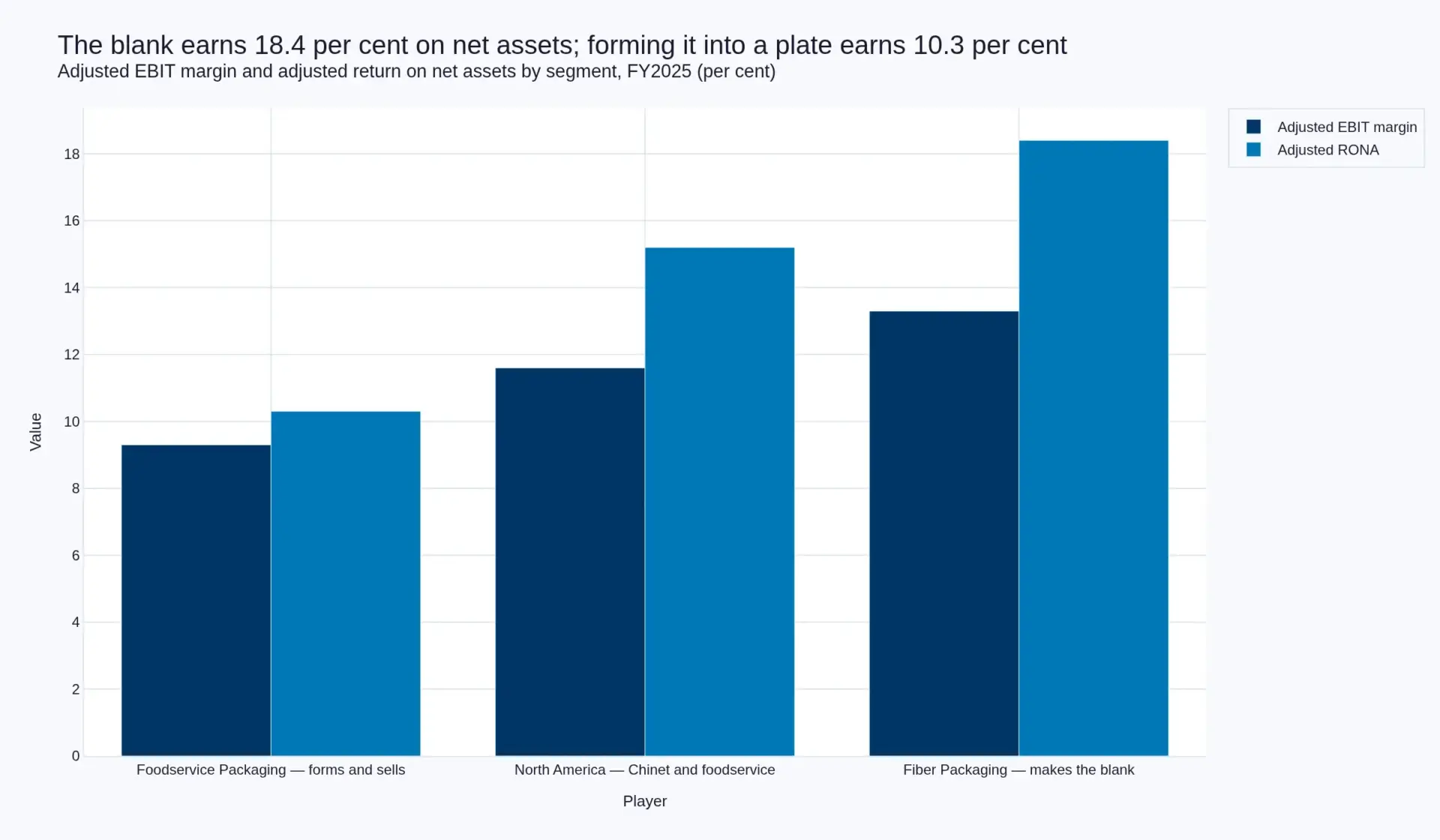
Huhtamäki published its 2025 results on 13 February 2026 and, buried in the segment tables, it published the answer to the question this market has been arguing about for five years. From 1 April 2025 the group reports Fiber Packaging separately from Foodservice Packaging. One business makes the moulded fibre blank. The other forms board and fibre into cups, plates, bowls and trays and sells them to operators. Same group, same year, same raw material, two sets of returns:
| Huhtamäki segment, FY2025 | Net sales, EUR m | Adjusted EBIT margin | Adjusted RONA | Capital expenditure, EUR m |
|---|---|---|---|---|
| Fiber Packaging — makes the blank | 379.7 | 13.3% | 18.4% | 52.7 |
| North America — Chinet and foodservice formats | 1,405.3 | 11.6% | 15.2% | 55.2 |
| Foodservice Packaging — forms and sells | 936.2 | 9.3% | 10.3% | 29.1 |
| Group | 3,960.2 | 10.2% | — | 171.9 |
The blank earns nearly double the return on net assets of the converting operation that turns it into a plate. It does so on 40 per cent of the sales, and in 2025 it absorbed nearly twice the capital — EUR 52.7 million against EUR 29.1 million, an 87 per cent increase against a 56 per cent decrease.
That is not an accident of one year’s trading. It is what the two businesses are.
One buys waste paper and dries it. The other buys customers.
A moulded fibre plate begins as recovered paper at roughly EUR 125 to 150 a tonne delivered to a German mill. At about 1.15 tonnes of fibre per tonne of product, the material in a tonne of plates costs EUR 144 to 173 — somewhere between 6 and 7 per cent of a USD 2,763 a tonne realisation. Everything else is the forming machine, the drying energy, the tooling, the hall, the labour and the truck.
That ratio does two things. It makes the business extraordinarily sensitive to utilisation, because 93 per cent of the cost is fixed or semi-fixed. And it makes it extraordinarily sensitive to price, because a converter selling at a 30 per cent gross margin on a material share of 7 per cent is, in operational terms, selling machine time.
The converting business is the mirror image. It buys board or blanks, forms them, prints them, and sells them into a distributor relationship where the intermediary takes 18.4 per cent of what the operator spends — more, per unit, than the manufacturer earns in EBITDA. It carries the customer relationship, the specification risk and the working capital, and it earns 9.3 per cent before interest and tax for the privilege.
The 2025 numbers show what happens when a business decides which of those two it would rather be. Foodservice Packaging absorbed EUR 48.6 million of items affecting comparability against EUR 15.1 million the year before, including a EUR 39 million net impairment in the second quarter related to consolidating production. Capital expenditure in the segment fell by more than half. The group said, in terms, that its largest investments for business expansion went into increasing capacity in Fiber Packaging.
The uncomfortable third line in the table
North America sits between the two at 11.6 per cent and 15.2 per cent, and it is worth understanding why, because it complicates the tidy story above. That segment sells Chinet — a branded retail tableware business — alongside foodservice formats. A brand is a third source of return that has nothing to do with owning a forming machine: it is the right to charge more for the same plate. So the ranking is not simply capital intensity. It is: own a scarce input, or own a name. Do neither and you are a converter at 10.3 per cent.
What the market price says about the durability of that premium
Our valuation of the format puts moulded fibre plates, bowls and trays at USD 3,150 million across 1.14 million tonnes in 2025 — USD 2,763 a tonne — rising to USD 5,650 million across 1.82 million tonnes in 2033, or USD 3,104 a tonne. That is a 12.3 per cent realisation gain, three times what polypropylene and PET achieve over the same window.
Part of that is real. A fibre plate needs a grease barrier, tighter dimensional tolerance and heavier tooling than an EPS tray, and the mass penalty is three to one. Part of it is not real in any engineering sense: it is scarcity, and the scarcity was created by an administrative act. On 25 September 2025 the US Department of Commerce set final duties on thermoformed moulded fibre from China and Vietnam, with 283.89 per cent anti-dumping and 97.82 per cent countervailing on Zhejiang Zhongxin. US imports of moulded pulp articles from China fell from 146,400 tonnes in 2024 to 47,200 tonnes in 2025. Thailand supplied 32,400 tonnes of the 99,200-tonne hole.
That is the number to watch. A premium that rests on scarcity disappears when the scarcity does. Zhongxin’s Thai plant alone reached 75,000 tonnes of capacity in its first year with a target of 100,000. The hole the duties opened was 99,200 tonnes. One more project of that size, and the price of a moulded fibre plate in the United States stops reflecting a policy and starts reflecting a market again.
Two falsifiers
One. If moulded fibre realisation does not hold above USD 2,900 a tonne through 2028, the premium is a tariff artefact. Check the price, not the volume — volume will keep growing either way, because the demand is legislated.
Two. If US moulded pulp imports from non-Chinese origins do not exceed 120,000 tonnes a year by 2028, the fibre line is capacity-bound rather than demand-bound, and the 7.58 per cent growth will be rationed by availability rather than earned by substitution. The 2025 figure from Thailand was 32,400 tonnes.
The strategic implication, stated plainly
If you are a converter reading this, the incentive is not to compete harder for a plate order. It is to own the constraint upstream of it — the forming capacity, the drying capacity, or a qualification nobody else holds. Huhtamäki is not retreating from fibre; it is retreating from the part of fibre that earns 10.3 per cent on net assets and putting the money in the part that earns 18.4 per cent. That is the correct read of its own numbers, and it is the same read any converter with capital should make.
Sources
Huhtamäki Oyj, Results January 1–December 31, 2025, financial statement release, 13 February 2026. US Department of Commerce, final anti-dumping and countervailing duty determinations on thermoformed moulded fibre products from China and Vietnam, 25 September 2025. Zhejiang Zhongxin annual report 2025 and its replies to the Shanghai Stock Exchange during its 2023 listing review, citing China Pulp and Paper Research Institute production data. UN Comtrade, HS 4823.70. Pheonix Research, Global Foodservice Trays, Plates & Bowls Market Report, Size, Share and Forecast 2026–2033. Pheonix Research, Global Moulded Fibre Packaging Market Report (post 114815), for the mass ratio and drying arithmetic. Pheonix Research, Global Foodservice Packaging Market Report (post 114839), for the distributor share of operator spend.
Methodology note: this article draws on approximately 70 per cent secondary evidence and 30 per cent primary work conducted by Pheonix Research — converter and distributor interviews, operator surveys and trade-event floor work. No third-party market-research publication is cited.
Frequently Asked Questions
Why does the business that makes the moulded fibre blank earn a higher return than the business that forms it into a plate?
Because it owns the constrained step. Huhtamäki's 2025 disclosure puts Fiber Packaging, which makes the blank, at 13.3 per cent adjusted EBIT and 18.4 per cent adjusted return on net assets, against 9.3 per cent and 10.3 per cent for Foodservice Packaging, which forms board and fibre into finished articles and sells them. The converting business carries the customer relationship, the specification risk and the working capital through a distributor that takes 18.4 per cent of what the operator spends. The blank business carries a forming and drying machine that is expensive to build and hard to permit, in a market where demand is legislated.
What share of a moulded fibre plate's price is raw material?
About 6 to 7 per cent. Recovered paper runs at roughly EUR 125 to 150 a tonne delivered to a German mill, and it takes about 1.15 tonnes of fibre to make a tonne of product, so the material in a tonne of plates costs EUR 144 to 173 against a 2025 realisation of USD 2,763 a tonne. Everything else — the forming machine, the drying energy, the tooling, the hall, the labour and the freight — is the other 93 per cent. That is why utilisation matters more than material cost in this format, and why a full line earns excellent returns while a half-full one does not.
Is the moulded fibre premium per tonne durable?
Partly. Some of it is engineering: a fibre plate needs a grease barrier, tighter dimensional tolerance and heavier tooling than an expanded polystyrene tray, and the mass penalty runs three to one. Some of it is scarcity manufactured by trade policy — US anti-dumping and countervailing duties of 283.89 and 97.82 per cent on Chinese thermoformed moulded fibre cut US imports from China from 146,400 to 47,200 tonnes between 2024 and 2025. Our report treats USD 2,900 a tonne through 2028 as the test: hold above it and the premium is a value proposition, fall below it and the premium was a tariff.
What did Huhtamäki actually do with its capital in 2025?
It moved it upstream. Group capital expenditure fell 31 per cent to EUR 171.9 million and free cash flow rose 44 per cent to EUR 311.2 million, so this was not a company short of money. Within that, Foodservice Packaging capital expenditure fell 56 per cent to EUR 29.1 million and Fiber Packaging rose 87 per cent to EUR 52.7 million. The group stated that its largest investments for business expansion were directed to increasing capacity in Fiber Packaging, and the Foodservice Packaging segment carried a EUR 39 million net impairment in the second quarter related to consolidating production.