
Global Moulded Fibre Packaging Market Report, Size, Share and Forecast 2026–2033: The Half That Earns 16 Per Cent Grows 2.6 Per Cent
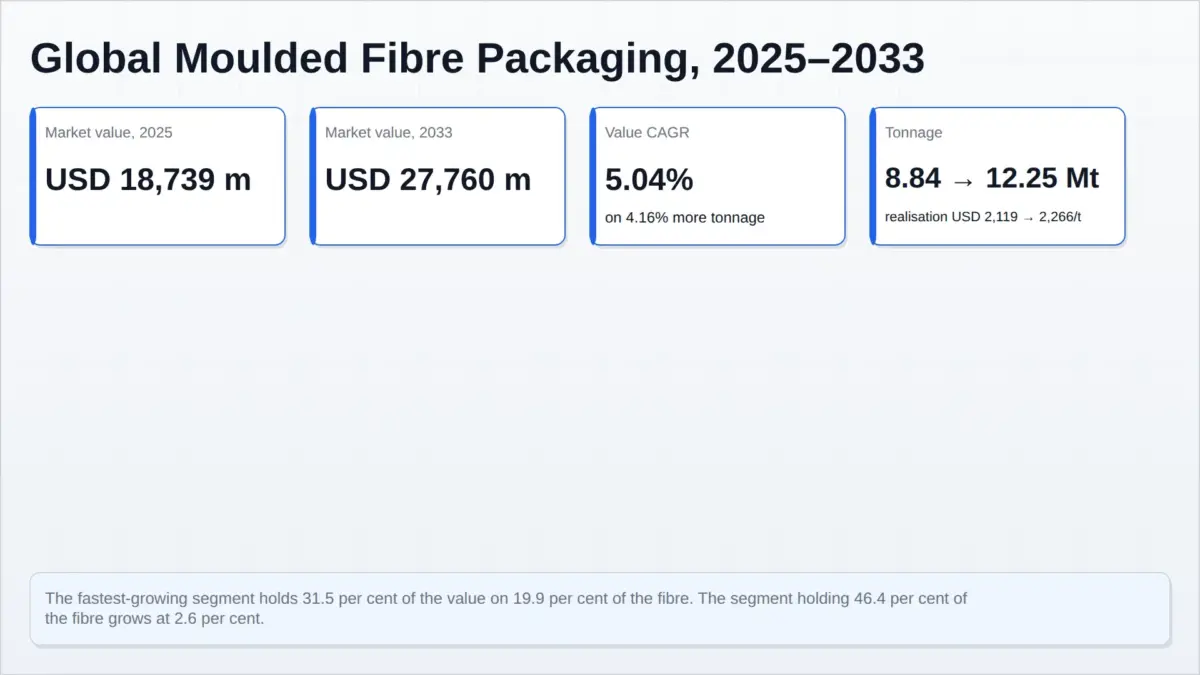
Moulded fibre is a USD 18,739 million, 8.84 million tonne market in 2025, reaching USD 27,760 million and 12.25 million tonnes by 2033 — value growing 5.04 per cent a year on 4.16 per cent more tonnage.
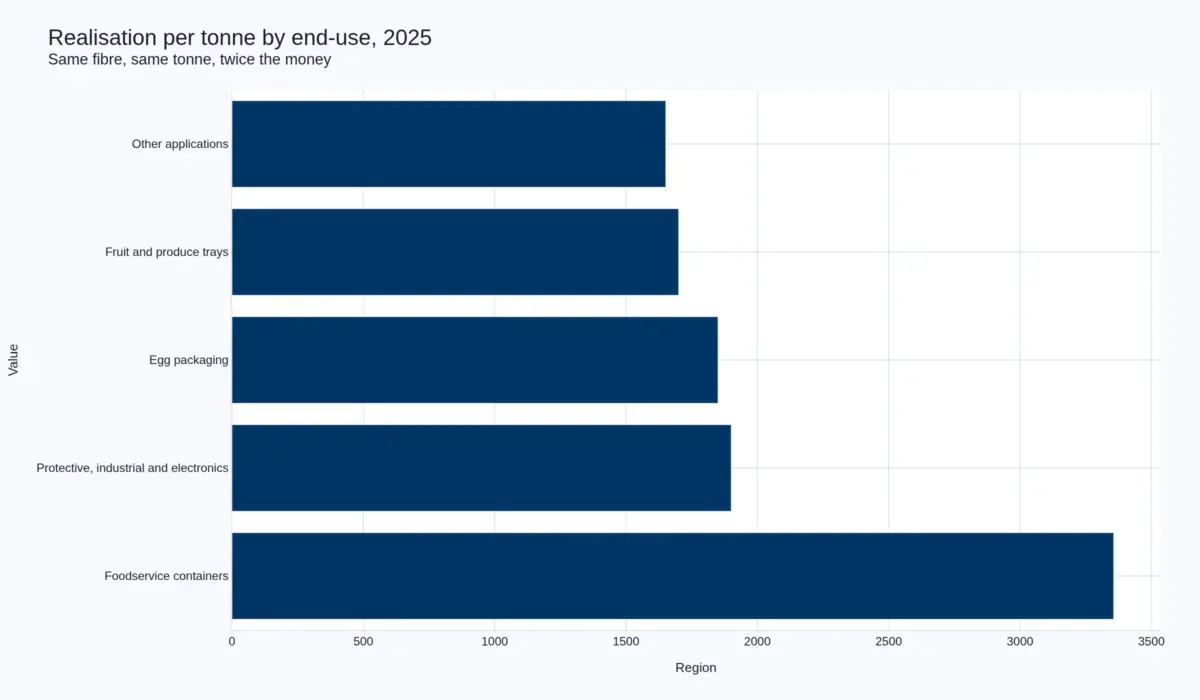
The market does not behave as one material. Egg packaging is 46.4 per cent of the tonnage and 40.5 per cent of the value and grows 2.6 per cent a year. Foodservice containers are 19.9 per cent of the tonnage and 31.5 per cent of the value and grow 8.0 per cent. By 2033 foodservice carries 39.3 per cent of the value on 26.5 per cent of the fibre. A tonne of moulded fibre is worth USD 3,356 in foodservice and USD 1,850 in eggs, and the difference is not the fibre — it is the barrier coating, the tooling and the shape.
Yet the profit sits in the slow half. Hartmann, the pure-play egg-packaging leader, earned a 16.1 per cent operating margin and a 30.3 per cent return on invested capital in 2025 on production costs of 67.5 per cent of revenue. Huhtamäki, whose fibre and foodservice portfolio spans the fast segments, earned 10.1 per cent adjusted EBIT in the first half of 2026.
The reason is arithmetic. Recovered paper at EUR 132 to 145 per tonne puts fibre at about 10 per cent of the price of a moulded-fibre product, and drying that fibre takes about 4 gigajoules a tonne, worth another 2.8 per cent. Two-thirds of the price is conversion — labour, depreciation, maintenance, the drying hall and the truck. This is a manufacturing business wearing a materials label, which is why utilisation and radius decide profitability, and why dry forming's real innovation is that it deletes the dryer rather than that it saves water.
The money in this market is not where the growth is
Moulded fibre is the only packaging format in which the product and the factory are the same thing. You cannot form a pulp tray in one place and ship it to another to be filled, the way you ship a reel of board to a carton plant. You form the shape within a few hundred kilometres of the customer, dry it, and then truck what is mostly air. Every structural fact about this industry follows from that one constraint — its fragmentation, its 16 per cent margins, its dependence on natural gas, and the fact that no converter has ever held a global share worth reporting.
We size the market at USD 18,739 million across 8.84 million tonnes of converter realisation in 2025, reaching USD 27,760 million across 12.25 million tonnes by 2033. Value grows 5.04 per cent a year and tonnage 4.16 per cent. Realisation per tonne therefore rises from USD 2,119 to USD 2,266, at 0.84 per cent a year — and, as in the container market next door, not because anyone is winning a price increase.
| Headline | 2025 | 2033 | CAGR |
|---|---|---|---|
| Market value, converter realisation | USD 18,739 m | USD 27,760 m | 5.04% |
| Volume | 8.84 m tonnes | 12.25 m tonnes | 4.16% |
| Realisation per tonne | USD 2,119 | USD 2,266 | +0.84% |
| Value multiple over the forecast | 1.48× | — | |
| Scenario band, 2033 | USD 24.4 bn – 31.1 bn | — | |
The decomposition is the report
Moulded fibre is not one market and does not behave like one. Five end-uses share a material and nothing else: not a demand driver, not a buyer, not a price per tonne, and not a growth rate.
| Segment | 2025 value, USD m | 2025 tonnes, m | Realisation USD/t | 2033 value, USD m | 2033 tonnes, m | Value CAGR |
|---|---|---|---|---|---|---|
| Egg packaging | 7,594 | 4.11 | 1,850 | 9,325 | 4.85 | 2.6% |
| Fruit and produce trays | 1,921 | 1.13 | 1,700 | 2,433 | 1.35 | 3.0% |
| Foodservice containers | 5,896 | 1.76 | 3,356 | 10,913 | 3.25 | 8.0% |
| Protective, industrial and electronics | 2,090 | 1.10 | 1,900 | 3,459 | 1.82 | 6.5% |
| Other applications | 1,238 | 0.75 | 1,651 | 1,630 | 0.99 | 3.5% |
| Total | 18,739 | 8.84 | 2,119 | 27,760 | 12.25 | 5.04% |
Read the tonnage column against the realisation column and the market explains itself. Egg packaging is 46.4 per cent of the fibre and sells at USD 1,850 a tonne. Foodservice containers are 19.9 per cent of the fibre and sell at USD 3,356. The fibre is the same fibre, bought from the same recovered-paper market at the same price. The gap is the coating, the tooling and the tolerance.
By 2033 foodservice carries 39.3 per cent of the value on 26.5 per cent of the tonnage. It is also the only segment with a regulatory deadline behind it.
One material, two businesses
Now put the profit beside the growth, because they are not in the same place. Hartmann Packaging, the world's leading moulded-fibre egg packaging maker, reported 2025 revenue of DKK 4,145.0 million, production costs of DKK 2,798.3 million, operating profit of DKK 665.9 million — a 16.1 per cent margin — and a 30.3 per cent return on invested capital. It runs 17 factories and sources 97 per cent of its fibre from recycled paper.
Huhtamäki, whose portfolio spans the fibre and foodservice formats where the growth is, reported first-half 2026 net sales of EUR 1,955.8 million and adjusted EBIT of EUR 198.2 million — 10.1 per cent. That is a group number covering several formats and is not a moulded-fibre margin; it is included because it is the best disclosed read on the margin available in the fast segments, and because the gap is too large to be an artefact of portfolio mix alone.
So the market's largest, slowest segment earns roughly three times the return on capital of the portfolio that owns the fast ones. That is not a management story. It is a structural one, and the value chain chapter shows why: fibre and fuel together are 12.9 per cent of what a moulded-fibre product sells for. The other 87 per cent is conversion — labour, depreciation, tooling, maintenance and the truck.
A business in which 87 per cent of the price is conversion is a business where utilisation and radius decide profitability. Egg cartons run in a handful of standard formats for months at a time, sold within a few hundred kilometres, to buyers who specify tray weight to within a five-gramme band. Foodservice runs cups, bowls, lids and clamshells, each needing its own tool, each changed over at a frequency that eats the line. Same material. Different industry.
What is actually being disrupted
Wet moulded pulp leaves the press at 40 to 65 per cent dryness, measured in published work from the Technical University of Denmark. Take the midpoint and one tonne of product carries roughly one tonne of water that must be evaporated — 2.3 gigajoules of latent heat before any dryer inefficiency, so perhaps 4 gigajoules in practice, about 2.8 per cent of the price and a much larger share of the fixed cost.
Dry forming — the air-laid and hot-pressed process commercialised by PulPac and machinery partners such as Kiefel — is usually described as a water-saving technology. It is not. It is a technology that deletes the dryer, and with it the largest capital item and the largest fixed energy cost in a wet plant. That is why it matters, and why the 2026 milestones are worth recording: a Kiefel Natureformer KFD 75 converting paperboard at reel speeds above 150 metres a minute with a single line quoted at more than 80 million inserts a year, and two PulPac Scala machines ordered in April 2026 for a fibre snus can in Sweden.
Against 8.84 million tonnes of installed wet capacity, that is a demonstration. It is not yet a substitution.
Articles on this market
- A Tenth of the Price Is Fibre and Two-Thirds Is the Machine. That Is the Whole Moulded-Fibre Business.
- The Same Tonne of Fibre Is Worth USD 3,356 in Foodservice and USD 1,850 in Eggs
What this number is, and is not
Our figure is higher than the range usually quoted for ‘moulded pulp packaging’, and deliberately so: narrower definitions count egg and fruit trays and stop, which excludes the two segments that carry most of the growth and 43 per cent of the 2033 value. The foodservice line is not a free estimate — it is the same moulded-fibre line carried in our foodservice rigid container report at USD 5,896 million and 41.82 billion units in 2025, converted to mass at 42 grammes per unit. A reader who wants the narrow reading can take the first two rows of the table above and stop.
The level carries a band of about plus or minus 12 per cent. The direction and the segment ordering do not, because both are visible in three sets of published accounts — and the segment ordering is what this report is actually about.
Table des matières
Paysage concurrentiel
Competitive landscape: why no one holds this market
The competition in moulded fibre is not between companies so much as between catchment areas. Every plant has a radius, and inside that radius a converter with a loaded line and a working drying hall is close to unassailable; outside it, it is not present at all. This is why the concentration measures that apply to cartons or cans do not apply here, and why the market can support a 16 per cent operating margin in a segment that has been called a commodity for eighty years.
The only clean read in the public record
Hartmann is the rare operator whose disclosures isolate the business. In 2025 it reported revenue of DKK 4,145.0 million, production costs of DKK 2,798.3 million (67.5 per cent of revenue), operating profit of DKK 665.9 million (16.1 per cent), profit before tax of DKK 601.9 million, property, plant and equipment investment of DKK 521.5 million — 12.6 per cent of revenue — and a return on invested capital of 30.3 per cent. It runs 17 factories across Europe, North and South America, Israel, India, China and Malaysia, employs 3,296 people, and sources 97 per cent of its fibre from recycled paper. Its own risk disclosure names the four things that actually threaten a moulded-fibre business: fire at a factory, recovered-paper and energy price volatility, disease outbreaks among laying hens, and trade policy.
That list is worth reading twice, because it contains no competitive risk. In a market with a transport radius, the threat is never the rival down the road; it is the loss of a plant, the cost of gas, the loss of the hen flock that buys the carton, and the tariff that redraws the radius.
The portfolio operators
| Operator | Position | What it tells you |
|---|---|---|
| Hartmann Packaging | World’s leading moulded-fibre egg packaging maker; also sells the machinery | 16.1% operating margin, 30.3% ROIC, 67.5% production cost ratio — the ceiling of what this format can earn |
| Huhtamäki | Broad fibre, foodservice and food-on-the-move portfolio | EUR 1,955.8 m half-year net sales, adjusted EBIT EUR 198.2 m at 10.1% — a group number spanning several formats, not a moulded-fibre margin |
| Cascades | Integrated recovered-fibre converter with moulded-pulp capacity | Vertical integration into the raw material is a strategy here, because the raw material is waste paper |
| Sonoco | Protective and consumer packaging, moulded fibre within a wider portfolio | The protective and electronics end is where non-food moulded fibre is actually commercialised at scale |
| Graphic Packaging | Coated recycled board and folding cartons, adjacent rather than direct | The substitution pressure on moulded fibre comes from board-based formats as much as from plastic |
Read those five together and the structure is obvious. The pure-play in the slow segment earns three times the return on capital of the diversified operator in the fast segments. That is not an argument that Hartmann is better managed; it is an argument that the two are in different businesses, and that the packaging market as a whole prices them as if they were one.
The regional layer
Beneath the listed names sits the layer that actually makes most of the tonnage: several hundred independent moulded-fibre plants, most of them family-owned, most of them within a day’s drive of their customers, many of them running a single machine on regional waste paper. They set the price floor in commodity trays, and their capacity decisions — not the listed companies’ — determine what happens to the egg-tray price in any given year. When Hartmann reported that intensified competition and excess capacity in Brazil reduced utilisation across its plants, that is the regional layer moving.
Capacity concentration is a European and North American fact
The Asian market is the opposite. Hartmann describes it directly: fragmented, commodity-driven, numerous local players, with strong growth expected over the next decade on demographics, egg production and urbanisation. That is the shape of a market where the incumbent advantage is not brand or scale but proximity — and it is why a single global share figure for moulded fibre is not a meaningful number.
Chaîne de valeur
Value chain: a tenth of the price is fibre, two-thirds is the machine
The value chain begins with a waste-collection system and ends with a truck. In between sits a manufacturing step that most descriptions of this industry get wrong, because most descriptions treat it as a materials business. It is not. It is a forming and drying business that happens to consume paper.
What the fibre costs
Recovered paper delivered to German mills in June 2026 traded at EUR 125 to 150 per tonne, with EUWID contract settlements between EUR 132 and 145 and mixed paper at EUR 115 to 128. Moulded-fibre production consumes roughly 1.1 to 1.2 tonnes of recovered paper per tonne of product once forming losses are counted. At EUR 140 per tonne, that is EUR 161 of fibre per tonne of product.
Set that against realisation. The egg-packaging segment realises USD 1,850 per tonne in 2025; foodservice realises USD 3,356. Fibre is therefore 8.7 per cent of the price of an egg tray and about 4.8 per cent of a foodservice container. Even if our realisation estimate were wrong by a third, fibre would still be under a fifth of the price. No plausible movement in recovered-paper prices explains the difference between a converter earning 16 per cent and one earning 10.
What the drying costs
Moulded pulp leaves the forming press wet. Work at the Technical University of Denmark measured final dryness after pressing at 40 to 65 per cent across a press cycle of up to 15 seconds at 80 to 120 degrees Celsius. Take the midpoint and the arithmetic is stark: one tonne of product leaves the press carrying roughly one tonne of water that has to be evaporated. The latent heat alone is about 2.3 gigajoules per tonne; a dryer at realistic efficiency takes perhaps 4. So a plant making 5,000 tonnes a year evaporates 5,000 tonnes of water and spends something like 20,000 gigajoules doing it. At EUR 40 per megawatt-hour that is EUR 44 per tonne, or 2.8 per cent of the price — small in percentage terms, but it is a gas bill in a market that sells sustainability.
The cost stack, reconciled
The split below is calibrated to Hartmann’s disclosed ratios for 2025 — production costs at 67.5 per cent of revenue, selling and distribution at 10.7, administrative at 5.7, operating profit at 16.1 — with our own input prices used to allocate the production-cost block. The totals are disclosed; the allocation inside the block is ours, and it is shown so it can be argued with.
| Line, per tonne realising USD 1,850 | USD | % of price |
|---|---|---|
| Recovered paper, 1.15 t at EUR 140 | 187 | 10.1% |
| Energy, forming and drying, ~4 GJ | 51 | 2.8% |
| Other materials, chemicals and packaging | 111 | 6.0% |
| Labour, direct and indirect | 389 | 21.0% |
| Depreciation and amortisation | 93 | 5.0% |
| Maintenance, tooling and external services | 185 | 10.0% |
| Internal logistics and other production cost | 233 | 12.6% |
| Production costs | 1,249 | 67.5% |
| Selling and distribution | 198 | 10.7% |
| Administrative | 105 | 5.7% |
| Operating profit | 298 | 16.1% |
Fibre and fuel together are 12.9 per cent of what the product sells for. Everything else — the machine, the hall, the people, the tooling, the truck — is 87.1 per cent. This single line explains the industry. It explains why utilisation decides profitability rather than raw-material access. It explains why the plants are built where the customers are rather than where the paper is. And it explains why a company can describe itself as a recycled-paper business for eighty years while actually being a manufacturing business with a gas contract.
Where the margin actually comes from
If conversion is 87 per cent of the price, then the levers are tooling life, cycle time, uptime and freight — and the operators who win are the ones who keep a line running on one product family for weeks rather than days. This is the finding our primary layer kept returning: in foodservice, the binding constraint on conversion is not fibre supply or drying capacity but tooling changeover, because every cup diameter, every bowl depth and every lid fit needs its own tool, and a line that changes tools three times a day loses the economics that made the substitution look attractive. Egg cartons are the opposite: a small number of standard formats, run for months, in a market where the buyer specifies tray weight to within a five-gramme band and the same tray serves a continent.
That is the whole difference between 16.1 per cent and 10.1 per cent, and it has nothing to do with fibre.
Activité d'investissement
Investment activity: EUR 6 million to double a plant
Capital in this industry is spent in small, plant-level increments, and the size of those increments is the most underrated fact about it. Rondo Ganahl’s 2026 expansion is the clearest disclosed example: around EUR 6 million to install a new moulded-fibre line at Frastanz in Vorarlberg, in a hall of roughly 1,200 square metres, which doubled the plant’s capacity for conventional moulded-fibre products. Construction began at the end of August 2025, the shell was complete by the end of January 2026, the machine was delivered in July 2026 and commissioned two weeks ahead of plan, with an additional press to follow and the existing machine relocated into the new hall by year end.
Six million euros is not a paper machine. It is a line, and it doubles a plant. Compare that with the capital required to enter thermoforming at scale, or with a single recycled board machine, and the fragmentation of this market stops looking like a market failure and starts looking like a consequence of the entry price.
What six million euros has to earn
Run the payback. At Hartmann’s disclosed 16.1 per cent operating margin, EUR 6 million of capital needs EUR 37.3 million of new revenue to repay itself in ten years. At the egg-tray realisation of USD 1,850 a tonne — about EUR 1,595 at 1.16 dollars to the euro — that is roughly 23,000 tonnes of annual output.
That is a very large single plant. So one of three things is true, and all three are instructive. Either Frastanz is a substantially larger site than a mid-sized moulded-fibre plant, or the margin on new capacity is above the group average at the market leader, or the payback is longer than ten years and the investment is being made for a reason other than near-term return — most likely customer retention in a market where the alternative is losing the account to a competitor with spare capacity. Our reading is the third, and it is the same conclusion the paper cup report reached from a different direction: in packaging formats where the product is cheap and the plant is not, capacity is built to defend position, and the return arrives through utilisation rather than through price.
The disclosed capital ratios
| Measure | 2025 | Comment |
|---|---|---|
| Hartmann PPE investment | DKK 521.5 m | Up from DKK 417.1 m in 2024 |
| As a share of revenue | 12.6% | High for a converter; consistent with a format that is still adding capacity |
| Depreciation and amortisation | DKK 209.0 m | 5.0% of revenue |
| Invested capital | DKK 2,315 m | Return on invested capital 30.3% |
| Plant under construction | DKK 287.2 m | Up from DKK 174.3 m — the pipeline is real |
A company investing 12.6 per cent of revenue while earning 30.3 per cent on invested capital is doing the thing this industry rewards: adding capacity into a catchment where it already has utilisation, at a margin that pays for the plant. The same 12.6 per cent spent by a converter entering foodservice, where tooling changeover eats the line, produces a different outcome entirely.
Consolidation and the machinery trade
Merger activity is present but modest, and its character is regional rather than strategic. Hartmann’s 2025 revenue benefited from the full-year effect of companies acquired during 2024, which contributed only from 30 June in the prior year — the shape of a bolt-on programme inside existing geographies rather than a consolidation play. Where the strategic value sits is in the machinery: Hartmann is also the world’s largest manufacturer of technology for moulded-fibre production, and sells that technology into the same markets it competes in. That is a genuinely unusual position, and it means the incumbent with the best cost curve also sells the equipment that determines everyone else’s.
Where the next euro goes
Three destinations. Foodservice capacity in North America and Europe, where substitution has a regulatory deadline behind it. Protective and electronics capacity, where dry forming is beginning to make a genuine cost case. And drying capacity that can run on something other than gas, which no one has yet bought at scale and which is the investment that would change the industry’s cost floor rather than its volume.
Technologie et innovation
Technology and innovation: the dryer is the moat, until it is deleted
There are four conventional moulded-fibre processes, and the industry body that represents them describes the range plainly: thick-wall, transfer-moulded precision, thermoformed, and processed or after-pressed grades. They differ in tooling, in surface finish and in how tight a tolerance the part can hold — which is why the same material supplies an egg tray at 1,850 dollars a tonne and an electronics insert that will not be priced that way.
The wet process and its ceiling
Wet forming makes a shape from a dilute pulp slurry on a wire mesh, presses it, and dries it. The published physics sets the ceiling: final dryness of 40 to 65 per cent after pressing, achieved in cycles of up to 15 seconds at 80 to 120 degrees Celsius. Everything the industry has done for eighty years has been an attempt to manage the consequence — that you must evaporate roughly a tonne of water per tonne of product, and that the equipment to do it is the largest capital item and the largest energy user in the plant.
The improvements have been real and incremental: better vacuum, higher pressing pressures, waste-heat recovery, and above all the shift to gas-fired and then multi-fuel drying halls. None of them change the physics. A moulded-fibre line is still, fundamentally, a machine for removing water from paper, and it is priced accordingly.
Dry forming, and why the water claim misses the point
Dry moulded fibre, developed by PulPac and commercialised through machinery partners, combines an air-laid fibre deposition station with an isostatic hot-forming press. The technology’s own partners describe the benefits as lower carbon emissions, almost no water in production, materially less energy because no drying is required, and throughput faster than conventional wet moulding. The water claim is the one that gets repeated in press coverage; it is the least important of the four. The important one is that the dryer disappears, and with it the largest capital item and the largest fixed energy cost in a wet plant. That is a cost-curve change, not a sustainability claim, and it is the only thing in this industry’s technology pipeline that could reset the economics rather than improve them.
The 2026 evidence is that this has moved from laboratory to industrial but not to market share. In July 2026, Fiberdom and Kiefel reported converting paperboard reels into three-dimensional moulded packaging at full production speed on a Kiefel Natureformer KFD 75, at reel speeds above 150 metres per minute, with a single line quoted at a potential more than 80 million packaging inserts a year. In April 2026, Future Materials Sweden ordered two PulPac Scala machines for a new production site at Ljungby, initially for fibre-based snus cans — a genuinely demanding, high-volume category and a good indicator of whether fibre can hold a lid fit at speed.
Set those against 8.84 million tonnes of installed wet capacity. A line making 80 million inserts, at perhaps 20 to 30 grammes each, is between 1,600 and 2,400 tonnes a year. The technology is real, it is industrial, and it is still a rounding error on the base.
Barrier chemistry is the constraint, not the forming
For foodservice, the technical problem was never the shape. It was grease resistance, and the industry solved it for thirty years with fluorochemistry that is now being removed. The replacement contest is not between chemistries but between a coating and a legal definition. An acrylic dispersion is repulpable and applies at low coat weight, and it is still a polymer — which means a cup or a container sold as plastic-free may, under the EU Single Use Plastics Directive, be a plastic-coated article carrying the marking and the fee band. Material suppliers have responded by engineering the substrate instead: Huhtamäki specifies its lower-plastic board to reach at least 95 per cent fibre by weight, which is a threshold chosen to clear a legal test, not a chemistry one.
That is why the barrier question is decided in the regulatory chapter rather than this one, and why our European PFAS-free food contact report is the more useful companion to this section than any technology review.
What innovation is actually being bought
Three things, in order of money committed: capacity that can make a foodservice container at all, tooling that reduces changeover, and drying capacity that can run on something other than gas. The first two are where the disclosed capital is going. The third is where the interesting engineering is, and it is the one an operator cannot buy from a catalogue.
Risque de marché
Market risk: three scenarios and three falsifiers
The risks that matter in this market are not competitive. They are biological, thermal, and political — a hen flock, a gas price, and a definition. Each one moves the number by more than any rival could.
Three scenarios for 2033
| Scenario | 2033 value | Assumptions |
|---|---|---|
| Conservative | USD 24.4 bn | Egg volumes flat through a prolonged avian-flu cycle, foodservice substitution capped by tooling and barrier cost, protective growth held to GDP |
| Base | USD 27.8 bn | Egg volumes at FAO trend plus conversion, foodservice at 8.0 per cent, protective at 6.5 per cent, realisation up 0.84 per cent a year on mix |
| Optimistic | USD 31.1 bn | Faster state-level foam bans, dry forming reaching cost parity in protective, gas prices low through the decade |
Sensitivities
| Movement | Effect on 2033 value |
|---|---|
| Egg packaging volume 100 bp lower a year | About USD 0.9 bn |
| Foodservice value CAGR 200 bp lower | About USD 2.0 bn |
| Recovered paper price 20 per cent higher, passed through with a lag | Under USD 0.4 bn on value, but a margin hit of roughly 2 percentage points at the converter |
The asymmetry is worth stating plainly. Egg volumes are 46.4 per cent of the tonnage and move the total less than foodservice does, because foodservice carries twice the revenue per tonne. But foodservice is also where the margin is thinnest and where tooling changeover caps conversion. The market’s growth and its profitability are attached to different variables, which is why a single forecast number is less useful here than the segment split above.
Four risks, in order of severity
One: the hen flock. Egg packaging is a derivative of egg production, and egg production is exposed to avian influenza. Hartmann’s own 2025 narrative is the case study — outbreaks across Europe and North America tightened supply, North American egg prices surged, promotional activity was curtailed and consumption fell as retailers and consumers adjusted. A packaging market cannot hedge a flock. It can only diversify geography, which is exactly why the leader runs 17 factories.
Two: gas. With drying at roughly 2.8 per cent of the price and a much larger share of the fixed cost base, a sustained energy shock compresses converter margins before it reaches the customer. Moulded fibre has no equivalent of the aluminium can’s light-weighting escape route; the tonnage is the product.
Three: the definition. A change in how a coating is classified under the Single Use Plastics Directive would reprice a large share of foodservice fibre overnight, in either direction. This is the highest-variance item in the report and it is decided by regulators, not by demand.
Four: dry forming arriving faster than the base assumes. This is a risk to the incumbents’ capital, not to the market. A dry line that holds a lid fit at industrial speed would strand wet capacity in exactly the segment the growth is in.
Three falsifiers
If foodservice moulded-fibre realisation per tonne falls below USD 2,600 by 2029 while tonnage keeps growing, the value-density argument in this report is wrong and the segment is a volume business with a commodity price.
If a listed converter discloses a moulded-fibre segment operating margin above 16.1 per cent in the foodservice-heavy portfolio, then the profit-split finding is an artefact of portfolio mix rather than of the format, and the central claim collapses.
If recovered-paper prices double and converter margins do not move, then fibre is a smaller share of the cost base than we model and the whole cost-stack chapter needs re-weighting.
Each of these is observable from public disclosure within two reporting cycles. We would rather state them than defend the number.
Paysage réglementaire
Regulatory landscape: recycled content as a structural advantage
Moulded fibre is unusually well placed under the current generation of packaging regulation, and unusually exposed. The instrument that rewards it is recycled content: the format has been made from waste paper since 1936, and Hartmann’s 97 per cent recycled input is not an initiative, it is the process. The instrument that exposes it is food contact, where the same recycled fibre that satisfies a content target is the material most difficult to clear for direct food use.
The instruments that matter
| Instrument | What it does | Effect on moulded fibre |
|---|---|---|
| EU Packaging and Packaging Waste Regulation, Regulation (EU) 2025/40 | Recyclability requirements and recycled-content targets for packaging placed on the EU market, plus restrictions on certain single-use formats in hospitality | Structurally favourable: the material is already recycled and already repulpable. Binding constraint is food-contact clearance for recycled fibre, not recyclability |
| EU Single Use Plastics Directive, 2019/904 | Defines plastic to include polymeric coatings; imposes marking and fee obligations on single-use plastic items | A coating can convert a fibre article into a regulated plastic item. This is why material suppliers engineer to a fibre-weight threshold rather than to a chemistry claim |
| PFAS restrictions, EU and US | Removal of fluorinated grease-proofing from food contact. The US Food and Drug Administration announced the voluntary phase-out of PFAS grease-proofers for food packaging in February 2024, and 35 food-contact notifications became ineffective from January 2025 | Removes the cheap barrier. Raises the cost of a foodservice conversion and pushes volume toward uncoated or dispersion-coated fibre and toward higher-fibre-weight substrates |
| US state EPS and foam bans | Twelve states now restrict expanded polystyrene foodservice containers, as set out in the regulatory chapter of our foodservice container report | The single largest demand driver for moulded-fibre foodservice capacity in North America |
| US state packaging extended producer responsibility | Seven states operate packaging EPR schemes, with producer fees per tonne modulated by recyclability and recycled content | A fee levied on mass rewards the lightest material and a fee modulated by recyclability rewards fibre — two incentives on the same object that do not point the same way |
The recycled-content advantage is real and conditional
Under PPWR, a format that is already 97 per cent recycled has nothing to prove on content and everything to prove on safety. Food-contact recycled fibre requires de-inking and contaminant control, and the clearance pathway is slower and more expensive than for virgin pulp. That is why the industry’s response has been to grade the input rather than to abandon the recycled claim, and why the European PFAS-free food contact market has developed as a separate regulatory story with its own economics.
The conditional part matters commercially. A converter who can document recycled content, food-contact clearance and repulpability in one specification sells into a compliance budget. A converter who can document two of the three sells into a price negotiation. The difference between those two conversations is most of the margin in the foodservice segment.
Where the regulatory risk actually sits
Not in recyclability. Moulded fibre is repulpable in the existing waste-paper stream and benefits from every measure that penalises multi-material laminates. The risk sits in three places: the coating definition, because a dispersion coating may make a fibre article a plastic one; the food-contact pathway for recycled fibre, because a tightening there would hit the cost base of the entire format; and the possibility that policy attention shifts from material substitution to absolute packaging reduction, in which case the heaviest compliant substitute — and a moulded-fibre container is two to three times the mass of the foam one it replaces — becomes the target rather than the solution.
That last risk is the one to watch, and it is the reason we treat the mass consequence of substitution as a central finding rather than a footnote. A regulatory regime that starts measuring kilos rather than items would find that this market’s growth is partly its problem.
Questions fréquemment posées
How big is the global moulded fibre packaging market?
USD 18,739 million across 8.84 million tonnes of converter realisation in 2025, reaching USD 27,760 million across 12.25 million tonnes by 2033. That is 5.04 per cent annual value growth on 4.16 per cent volume growth, with realisation per tonne rising from USD 2,119 to USD 2,266. The figure includes egg and fruit packaging, foodservice containers, protective and electronics packaging, and horticultural and medical applications. Definitions that count only egg and fruit trays — the narrow reading of 'moulded pulp' — land materially below this, because they exclude the two fastest-growing segments.
Why is the moulded fibre industry so fragmented?
Because you cannot ship the product economically and you cannot ship the pulp and form it elsewhere. Moulded fibre leaves the press at 40 to 65 per cent dryness, so every plant needs its own drying capacity, and the finished product is mostly air. Plants therefore serve a radius of a few hundred kilometres, which caps any single operator's reach and forces every region to be served by its own capacity. The consequence is a market in which the global leader in its largest segment — Hartmann, in egg packaging — is a company with 17 factories, 3,296 employees and DKK 4,145 million of revenue. There is no global share worth reporting because the economics do not permit one.
Is moulded fibre cheaper than plastic packaging?
Per tonne of material, no; per unit of protection, sometimes. Our sister report on foodservice rigid containers models a moulded-fibre container at 42 grammes against 13 grammes for an EPS clamshell and 31 grammes for polypropylene — so a fibre container carries roughly three times the mass of the foam one it replaces. The fibre is cheaper per tonne and dearer per unit, and the gap is closed only where the buyer is paying for the regulatory outcome rather than the object.
Will dry moulded fibre replace wet moulded fibre?
Not within this forecast window, and probably not in the way the technology's advocates describe. Dry forming removes the drying step entirely, which is the largest single capital and energy item in a wet line, and it has reached industrial speed — a single Kiefel KFD 75 line is quoted at more than 80 million packaging inserts a year at reel speeds above 150 metres a minute. But the dry-forming installed base is still measured in individual machine orders, of which the clearest 2026 example is two PulPac Scala machines ordered for a fibre snus can in Sweden. Against 8.84 million tonnes of wet capacity, that is a demonstration, not a substitution. What it changes first is the protective and electronics segment, where complex geometry and low barrier requirement favour it.