
Editorial Article
A 283 Per Cent Duty Moved the World's Moulded Fibre Trays to Thailand, and Bangkok Is Now the Price-Setter
A 283 per cent duty moved the world’s moulded fibre trays to Thailand, and the invoice is now a policy document
On 25 September 2025 the US Department of Commerce issued final determinations in the anti-dumping and countervailing duty investigations into thermoformed moulded fibre products from China and Vietnam. The investigation had begun in October 2024 on a petition from US producers and a union. The rates it produced were not protective. They were prohibitive:
- Zhejiang Zhongxin, a mandatory respondent: 283.89 per cent anti-dumping and 97.82 per cent countervailing.
- Other Chinese exporters: 49.08 to 477.97 per cent anti-dumping and 7.56 to 319.92 per cent countervailing.
At those rates, a moulded fibre plate made in China cannot be sold into the United States at any commercially viable price. The interesting question is not what happened to Chinese exports. It is what happened to the market in the twelve months afterwards, because the answer tells you how a supply chain behaves when an administrative act deletes its largest origin.
The hole and who filled it
| US imports, HS 4823.70 moulded pulp articles | 2024 | 2025 | Change |
|---|---|---|---|
| From China — value | USD 391.9m | USD 119.0m | −69.6% |
| From China — tonnage | 146,400 t | 47,200 t | −67.8% |
| China share of US imports | 58.1% | 22.1% | −36.0 points |
| From Thailand — value | USD 8.4m | USD 81.5m | +870% |
| From Thailand — tonnage | — | 32,400 t | — |
| Thailand share of US imports | 1.2% | 15.1% | +13.9 points |
A hole of 99,200 tonnes was opened. Thailand filled 32,400 tonnes of it — 32.7 per cent — in the first year. The remainder was filled by other origins, by existing US capacity running fuller, and by demand that simply did not get served.
That last category is the one that matters for price, and it is why the number in your invoice moved.
Zhongxin did not exit the trade. It moved it.
Zhejiang Zhongxin’s 2025 annual report is the most complete public document on how a Chinese converter responds to a US trade remedy, and its answer was not retreat:
- Its Thai plant, commissioned in April 2025, reached 75,000 tonnes of capacity at year end, against a target of 100,000 tonnes.
- That unit earned RMB 431.8 million of revenue and RMB 162.6 million of net profit in its first year — a net margin of more than a third, on a brand new asset, in a jurisdiction that is not subject to the order.
- Group output fell 19.76 per cent to 88,100 tonnes, which the company attributed to lower Chinese output following the duties, partly offset by the Thai ramp.
Set those against the industry it came from. The China Pulp and Paper Research Institute put Chinese moulded pulp tableware production at about 320,000 tonnes in 2021 and 440,000 tonnes in 2022. Zhongxin produced 77,900 tonnes in 2022 — roughly 18 per cent of the domestic industry — against listed rivals at RMB 634.3 million and RMB 551.7 million of sales in the same year.
So the largest producer in the largest producing country picked up 75,000 tonnes of capacity, in a year, in a third country, and earned a better margin there than it did at home. That is not offshoring in the ordinary sense. It is the tariff being paid to somebody, and the somebody being the first mover.
What a moulded fibre plate is actually worth per tonne
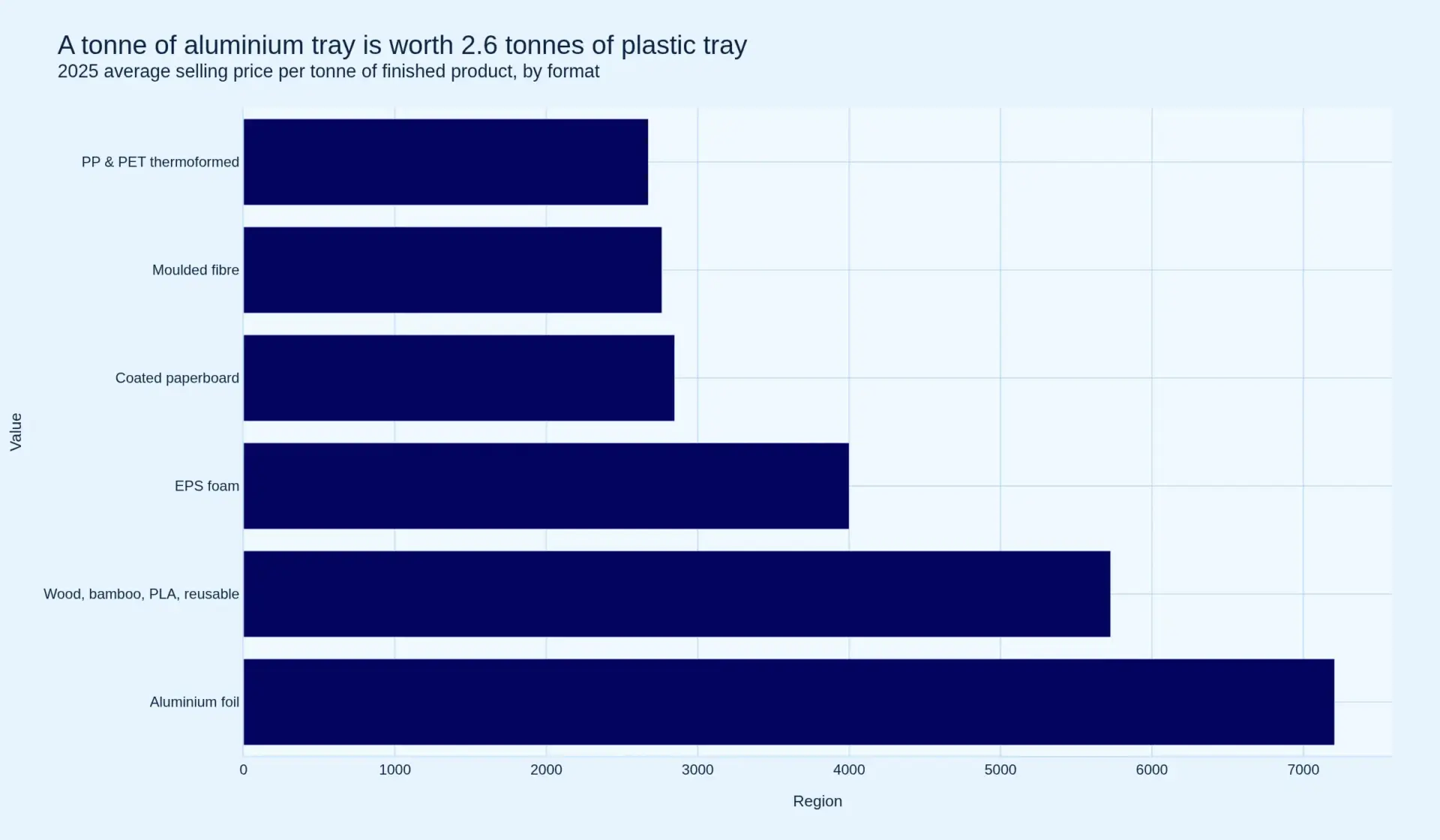
This is where the trade data becomes unexpectedly useful, because customs value is a realised price and it is the only independent check available on a modelled one. Our valuation of the format puts 2025 moulded fibre foodservice trays, plates and bowls at USD 3,150 million across 1.14 million tonnes — USD 2,763 a tonne.
| Route to the realised price | Value | USD per tonne |
|---|---|---|
| Pheonix model, 2025 global average | USD 3,150m / 1.14 Mt | 2,763 |
| Chinese customs, moulded pulp exports 2024 | RMB 5.06bn / 254,000 t | 2,806 |
| UN Comtrade, US imports from China 2024 | USD 391.9m / 146,400 t | 2,677 |
| UN Comtrade, US imports from China 2025 | USD 119.0m / 47,200 t | 2,521 |
Four measurements, three source systems, one price, within 11 per cent from top to bottom. That agreement is the most reassuring number in this analysis. It means the modelled realisation is not an artefact of the model, and it means the direction of travel is legible: the 2025 US import unit value of USD 2,521 is the lowest of the four, which is what you would expect in a year when the cheapest origin was removed and buyers paid up for whatever capacity remained.
The 2027 decision point
Announced non-Chinese moulded fibre capacity is now a meaningful fraction of the hole. Zhongxin’s 100,000-tonne target, alone, is roughly the size of the 99,200 tonnes the duties removed. Add the capacity being added in North America — Huhtamäki’s egg carton line in Hammond, Indiana, the expansion at Paris, Texas, the Zellwin Farms acquisition in Florida — and the arithmetic of scarcity stops working somewhere around 2027.
That is the point at which this market’s price structure is decided, and it is decided by something quite specific: whether the fibre premium is a value proposition or a supply gap. If it is a value proposition — barrier performance, brand permission, compliance certainty — the premium survives capacity arriving. If it is a supply gap, the premium compresses the moment the tonnage lands, and every forecast built on 7.58 per cent value growth in moulded fibre is wrong in the direction of the conservative case.
There is a test for this and it does not require waiting. Watch realised price per tonne, not volume. Volume in this format is legislated: California’s EPS food service ware restriction has been in force since 1 January 2025 and covers plates, bowls and trays, and Regulation (EU) 2025/40 requires all packaging to be recyclable by 2030 with PFAS caps arriving 18 months after entry into force. Demand will show up regardless. Price is the only honest signal about whether the industry has built something scarce or merely something expensive.
The falsifier, stated as a number
If moulded fibre realisation does not hold above USD 2,900 a tonne through 2028, the premium is a tariff artefact and the substitution in this market is happening at the low end of the price ladder rather than at the top. If US imports of moulded pulp articles from origins other than China do not exceed 120,000 tonnes a year by 2028, the format is capacity-bound rather than demand-bound and the growth will be rationed rather than earned. Both are checkable, both are public, and neither requires a subscription to find out.
Sources
US Department of Commerce, final anti-dumping and countervailing duty determinations on thermoformed moulded fibre products from the People’s Republic of China and Vietnam, 25 September 2025. Zhejiang Zhongxin annual report 2025; and its replies to the Shanghai Stock Exchange during its 2023 listing review, citing China Pulp and Paper Research Institute production data. UN Comtrade, HS 4823.70, US imports 2024 and 2025. CalRecycle, Expanded Polystyrene Food Service Ware Requirements, Public Resources Code 42057(i). Regulation (EU) 2025/40 on packaging and packaging waste, OJ L 22.1.2025. Pheonix Research, Global Foodservice Trays, Plates & Bowls Market Report, Size, Share and Forecast 2026–2033. Pheonix Research, Global Moulded Fibre Packaging Market Report (post 114815).
Methodology note: this article draws on approximately 70 per cent secondary evidence and 30 per cent primary work conducted by Pheonix Research — converter and distributor interviews, operator surveys and trade-event floor work. No third-party market-research publication is cited.
Frequently Asked Questions
How large were the US duties on moulded fibre from China and Vietnam?
The final determinations, issued on 25 September 2025, gave Zhejiang Zhongxin, a mandatory respondent, 283.89 per cent anti-dumping and 97.82 per cent countervailing. Other Chinese exporters were assigned 49.08 to 477.97 per cent anti-dumping and 7.56 to 319.92 per cent countervailing. At those rates a moulded fibre plate made in China cannot be sold into the United States at any commercially viable price.
What happened to US imports of moulded fibre after the duties?
US imports of moulded pulp articles under HS 4823.70 from China fell from USD 391.9 million for 146,400 tonnes in 2024 to USD 119.0 million for 47,200 tonnes in 2025 — down 69.6 per cent by value and 67.8 per cent by tonnage. China's share of US imports fell from 58.1 to 22.1 per cent. Imports from Thailand rose from USD 8.4 million to USD 81.5 million and 32,400 tonnes, taking Thailand's share from 1.2 to 15.1 per cent. That is 32.7 per cent of the 99,200-tonne hole, in the first year.
Where did the capacity go?
To Thailand, largely under the same ownership. Zhejiang Zhongxin's Thai plant started in April 2025 and reached 75,000 tonnes of capacity by year end against a target of 100,000 tonnes, earning RMB 431.8 million of revenue and RMB 162.6 million of net profit in its first year. Meanwhile the group's total output fell 19.76 per cent to 88,100 tonnes, which the company attributed to lower Chinese output following the duties and to the Thai ramp-up.
What is a moulded fibre plate actually worth per tonne?
Four independent measurements agree within 11 per cent. Pheonix Research's model puts the 2025 global average at USD 2,763 a tonne. Chinese customs data cited in Zhongxin's 2025 annual report implies USD 2,806 from 254,000 tonnes of exports worth RMB 5.06 billion. UN Comtrade unit values for US imports from China give USD 2,677 a tonne in 2024 and USD 2,521 in 2025. Customs value is a realised price, which makes it the only independent check available on a modelled one.