
Manufacturing & Industrial Automation / Market Segment
Machinery
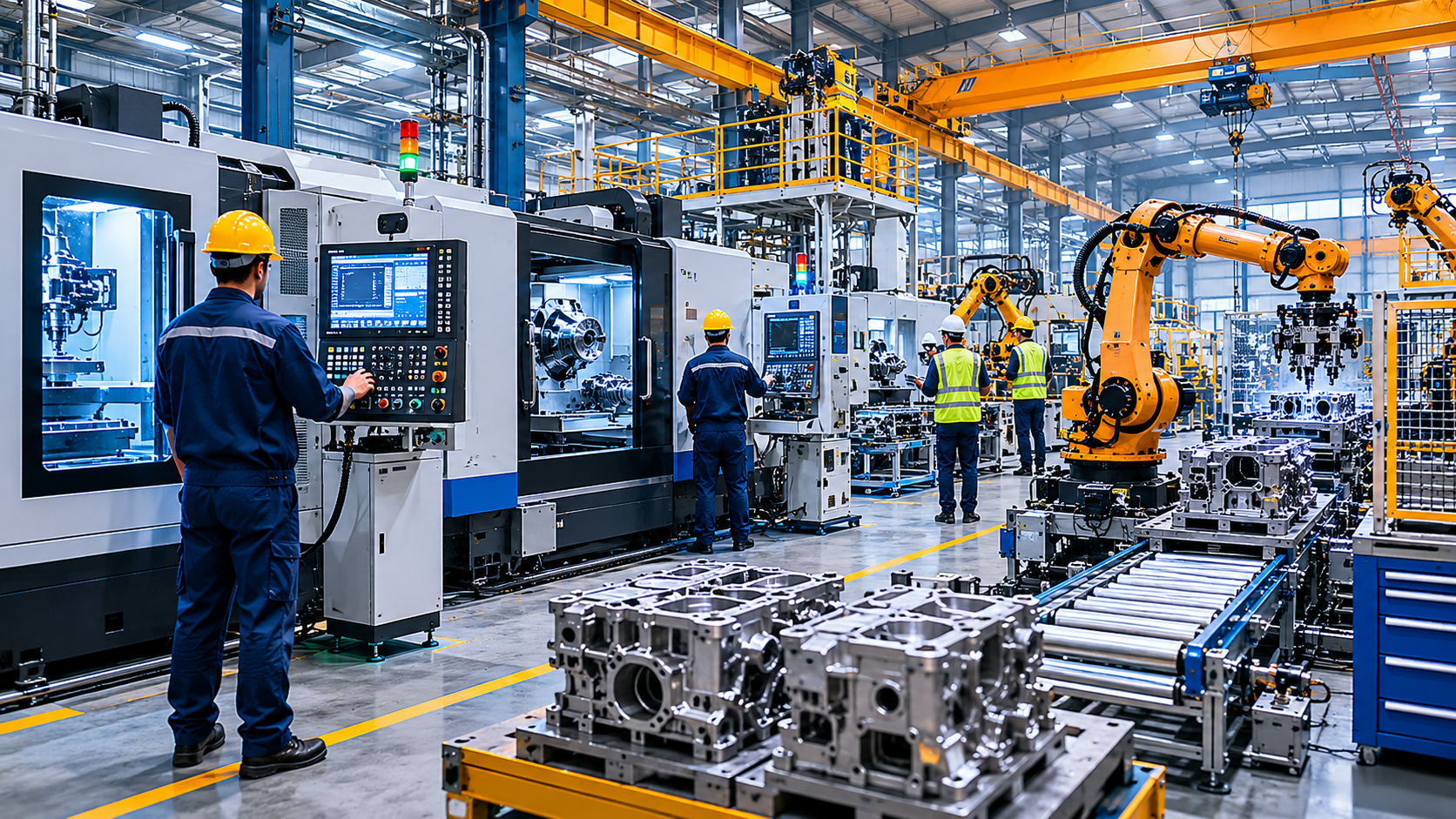
Segment Overview
The Machinery segment covers the design, manufacturing, installation, and maintenance of mechanical systems and equipment used across industrial, commercial, and infrastructure applications. It includes heavy machinery, production equipment, processing systems, and specialized mechanical tools that support manufacturing, construction, agriculture, energy, and logistics operations.
This segment operates at the intersection of mechanical engineering, industrial manufacturing, materials science, and automation systems, making it a core physical infrastructure layer of industrial economies.
Scope of the Machinery Segment
This segment includes, but is not limited to:
Industrial machinery systems
Equipment used in manufacturing plants, assembly lines, and production facilities.
Construction and heavy machinery
Excavators, loaders, cranes, bulldozers, and earth-moving equipment.
Agricultural machinery
Tractors, harvesters, irrigation machinery, and farm mechanization equipment.
Processing and production equipment
Machinery used in food processing, chemical processing, textiles, and material handling.
Power and energy machinery
Turbines, compressors, pumps, and industrial energy systems.
Material handling equipment
Conveyors, forklifts, automated storage systems, and lifting equipment.
Market Characteristics
The Machinery segment is defined by several structural characteristics:
- Capital-intensive production and long equipment lifecycle cycles
- Strong dependence on industrial output and infrastructure development
- High integration with automation, control systems, and digital monitoring
- Demand driven by manufacturing, construction, agriculture, and energy sectors
- Requirement for heavy engineering expertise and precision manufacturing
- Ongoing shift toward smart, connected, and automated machinery systems
- Strong focus on durability, efficiency, and operational reliability
Value Chain Overview
The segment spans the full machinery value chain:
- Design & Engineering: Product development, mechanical design, and prototyping
- Component Manufacturing: Production of parts, engines, and mechanical assemblies
- Assembly & Integration: Final equipment assembly and system integration
- Installation & Commissioning: Deployment at industrial or field locations
- Operation & Maintenance: Usage, monitoring, servicing, and repair cycles
- Upgrades & Lifecycle Management: Equipment modernization and performance optimization
Each stage requires precision engineering, supply chain coordination, and technical servicing capabilities.
Key Market Drivers
- Growth in industrial manufacturing and infrastructure development
- Expansion of construction and urban development activities
- Increasing mechanization in agriculture and production sectors
- Rising demand for automation and productivity improvement
- Replacement of aging industrial equipment and machinery
- Expansion of global supply chains and logistics infrastructure
Strategic Importance within Industrial Equipment & Manufacturing
Machinery plays a foundational role in enabling industrial production, infrastructure development, and large-scale economic activity. It forms the physical backbone of manufacturing systems and supports efficiency across multiple sectors.
Upstream, the segment drives demand for raw materials, engineering components, and industrial design. Downstream, it enables construction, manufacturing, agriculture, energy production, and logistics operations.
As industries continue to modernize and adopt automation, the Machinery segment remains essential for productivity enhancement, industrial expansion, and infrastructure development.