
Global Biotech Intellectual Property Tokenization Market 2025-2033
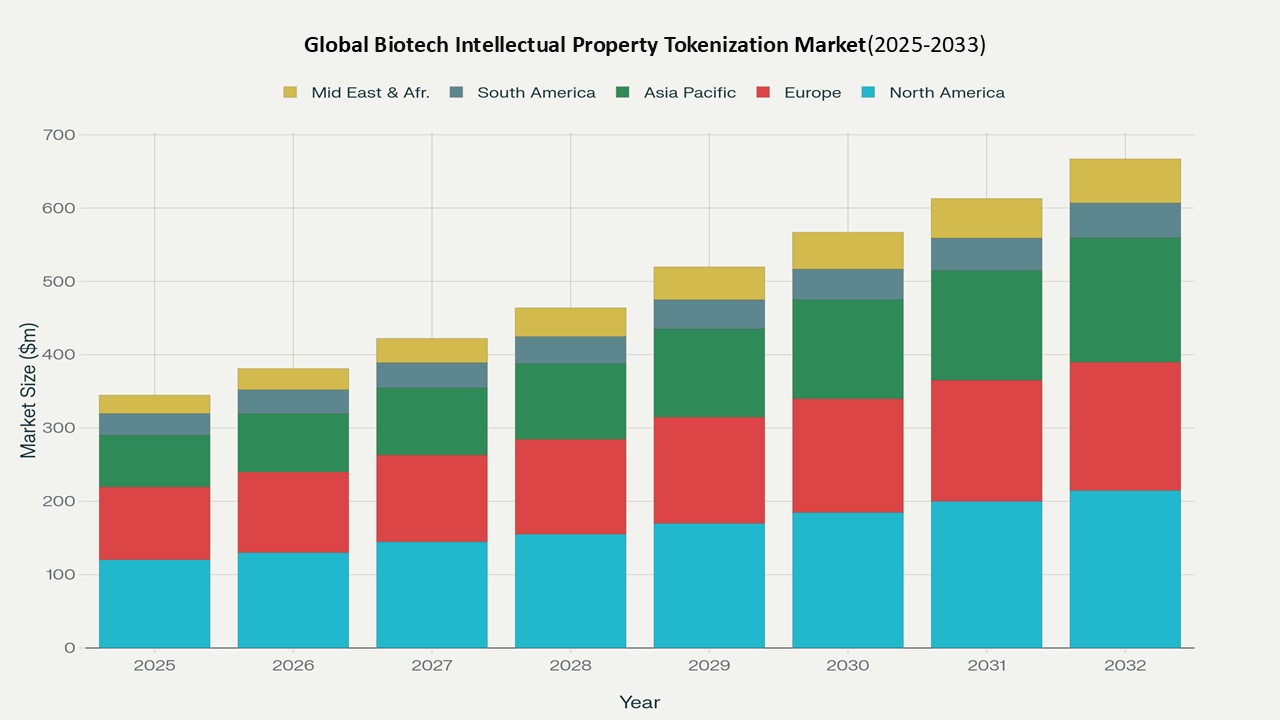
- Demand for Transparent and Efficient IP Management Tokenization enhances traceability and transactional efficiency in biotech IP markets, enabling seamless licensing and investment through secure blockchain frameworks.
- Increased Liquidity via Fractional Ownership By unlocking access to fractionalized IP assets, tokenization attracts diversified capital pools???accelerating funding for biotech R&D and early-stage innovations.
- Automated Royalty Flows via Smart Contracts Smart contracts streamline royalty payments and licensing revenues in real time, enhancing fairness and operational simplicity for IP holders and investors alike.
- Strategic IP Portfolio Monetization Tokenized biotech IP adds tangible value to startup balance sheets, bolstering investor confidence and enabling more robust commercialization strategies.
- Regulatory Momentum and Institutional Onboarding The rise of compliant tokenization platforms and clear legal frameworks???especially in APAC and Europe???is removing entry barriers and boosting institutional confidence.
- Globalization of Biotech R&D and Innovation With biotech innovation occurring across jurisdictions, tokenization facilitates international IP trading, collaboration, and risk diversification.
- IntelliP ??? Facilitated over 5,000 biotech patent token trades in 2025, showing 200% YoY growth ??? InvestaX ??? Regulated STO platform offering biotech IP token offerings ??? IX Swap ??? Specializes in decentralized liquidity solutions for tokenized IP ??? Securitize ??? A pioneer in regulatory-compliant digital securities and IP-backed asset issuance ??? BlockchainX ??? Delivers customizable blockchain tokenization stacks for IP-driven startups
- Pheonix Demand Forecast Engine models IP tokenization growth using proprietary data from biotech filings, IP transactions, and blockchain platform deployments. ??? AI-powered Valuation Models enable real-time IP scoring, risk prediction, and monetization optimization. ??? Sentiment Analyzer Tool reveals rising policy support for tokenization in Singapore, UAE, Switzerland, and key EU member states. ??? Automated Porter???s Five Forces Modeling suggests increasing buyer power and reduced friction in IP licensing as secondary markets expand.
| Metric | Value |
| 2025 Market Size | USD 678.25 Million |
| 2033 Market Size | ~USD 2,913.9 Million |
| CAGR (2025???2033) | 20.1% |
| Largest Region (2024) | North America (43.6%) |
| Fastest Growing Region | Asia Pacific (24.5% CAGR) |
| Top Segment | Patents (by Asset Type) |
| Key Trend | Smart Contracts for Royalties |
| Future Growth Focus | IP Tokenization for Startups |
- Biotech tokenization addresses long-standing liquidity barriers in early-stage innovation financing ??? Global R&D demands interoperable IP monetization models, which blockchain-enabled platforms uniquely fulfill ??? As tokenized IP becomes more standardized, investor trust is rising across both institutional and retail segments ??? International frameworks support cross-border biotech partnerships???critical for tackling global health challenges and rare disease R&D
Table of Contents
Global Biotech Intellectual Property (IP) Tokenization Market ??? Table of Contents
- Executive Summary & Market Overview
- 1.1 Introduction to Biotech IP Tokenization
- 1.2 Tokenization???s Role in Biotech Innovation Financing
- 1.3 Market Snapshot: Size, Growth Rate, and Forecast (2025???2033)
- 1.4 Key Drivers and Disruptive Trends
- 1.5 Pheonix Research Methodology & Toolset Overview (Forecast Engine, Event Detection, AI Valuation)
- Key Drivers of Market Growth
- 2.1 Demand for Transparent and Efficient IP Management
- 2.2 Increased Liquidity via Fractional Ownership
- 2.3 Automated Royalty Flows via Smart Contracts
- 2.4 Strategic IP Portfolio Monetization for Startups
- 2.5 Regulatory Momentum and Institutional Onboarding
- 2.6 Globalization of Biotech R&D and Innovation
- Market Segmentation
- 3.1 By Asset Type
- 3.1.1 Patents
- 3.1.2 Copyrights
- 3.1.3 Trademarks
- 3.1.4 Proprietary Biotechnology Data
- 3.2 By Tokenization Platform
- 3.2.1 Permissioned (Private) Blockchains
- 3.2.2 Permissionless (Public) Blockchains
- 3.2.3 Hybrid Models
- 3.3 By Monetization Strategy
- 3.3.1 Licensing
- 3.3.2 Direct Sales
- 3.3.3 Royalty Monetization
- 3.3.4 Litigation Funding
- 3.4 By End User
- 3.4.1 Institutional Investors
- 3.4.2 Biotech Firms
- 3.4.3 Research Organizations
- 3.4.4 Individual Investors
- 3.5 By Geography
- 3.5.1 North America
- 3.5.2 Europe
- 3.5.3 Asia Pacific
- 3.5.4 Latin America
- 3.5.5 Middle East & Africa
- Region-Level Insights
- 4.1 North America
- 4.1.1 Early Adoption by U.S. Startups
- 4.1.2 IP Law Strength and Blockchain Maturity
- 4.2 Europe
- 4.2.1 Impact of MiCA Regulation and IP Harmonization
- 4.2.2 Growth in Tokenized Patent Exchanges
- 4.3 Asia Pacific
- 4.3.1 Fastest Growing Region ??? CAGR 24.5%
- 4.3.2 IP Digitization in China, India, and Singapore
- 4.4 Latin America & Middle East
- 4.4.1 Incubator-Led Adoption and Academic Partnerships
- 4.4.2 Infrastructure Gaps and Policy Evolution
- Leading Companies in the Market
- 5.1 Competitive Landscape Overview
- 5.2 Innovation Profiles of Key Players
- 5.2.1 IntelliP
- 5.2.2 InvestaX
- 5.2.3 IX Swap
- 5.2.4 Securitize
- 5.2.5 BlockchainX
- 5.3 Smart Contract Capabilities and Compliance Readiness
- 5.4 Product Development, Patent Trades, and Ecosystem Expansion
- Strategic Intelligence and AI-Backed Insights
- 6.1 Pheonix Demand Forecast Engine: Market Growth Model
- 6.2 AI-Based IP Valuation and Risk Assessment Tools
- 6.3 Sentiment Analyzer Tool: Regulatory Support Mapping
- 6.4 Automated Porter???s Five Forces Analysis
- 6.4.1 Competitive Rivalry
- 6.4.2 Supplier Power
- 6.4.3 Buyer Power
- 6.4.4 Threat of New Entrants
- 6.4.5 Threat of Substitutes
- Forecast Snapshot: 2025???2033
| Metric | Value |
| 7.1 2025 Market Size | USD 678.25 Million |
| 7.2 2033 Market Size | USD 2,913.9 Million |
| 7.3 CAGR (2025???2033) | 20.1% |
| 7.4 Largest Region (2024) | North America (43.6%) |
| 7.5 Fastest Growing Region | Asia Pacific (24.5% CAGR) |
| 7.6 Top Segment | Patents (By Asset Type) |
| 7.7 Key Trend | Smart Contracts for Royalty Management |
| 7.8 Future Growth Focus | IP Tokenization for Startups |
- Why the Global Market Remains Critical
- 8.1 Solving Liquidity Challenges in Biotech Innovation
- 8.2 Enabling Interoperable and Scalable IP Commercialization
- 8.3 Rising Investor Confidence through Standardized Tokens
- 8.4 Driving Global R&D Collaboration for Rare Diseases and Public Health
- 8.5 Resilience Through Cross-Border and Multi-Jurisdictional Adoption
- Final Takeaway
- 9.1 Tokenization is Reshaping IP Value Chains
- 9.2 AI and Blockchain Unlock New Monetization Models
- 9.3 Compliance-Driven Growth to Attract Institutional Capital
- 9.4 Biotech Firms Must Adapt to the Digital IP Economy
- 9.5 Pheonix Tools Enable Strategic Foresight and Competitive Edge
- Appendices
- 10.1 Research Methodology
- 10.2 List of Data Sources and Models
- 10.3 Glossary of Key Terms
- 10.4 About Pheonix AI Intelligence Tools
10.5 Contact Information and Customization Support