
Global Enema-Based Products Market Report, Size, Share and Forecast 2026–2033: USD 2.07 Billion of New Revenue, and Neither End of the Market Can Grow by Being Used More
Forecast Snapshot
| Metric | Value |
|---|---|
| Market size, 2025 | USD 2.85 Billion |
| Market size, 2033 | USD 4.92 Billion |
| Net addition, 2026–2033 | USD 2.07 Billion |
| Growth multiple | 1.73× |
| CAGR, 2026–2033 | 7.05% |
| Share of 2033 value that is new revenue | 42.1% |
| Average annual increment | USD 258.7 Million |
| Increment in 2026 / in 2033 | USD 0.20 Billion / USD 0.32 Billion |
| Share of the addition falling in 2030–2033 | 56.8% |
| Market structure | Fragmented |
| Competitive intensity | High |
| Tier-1 players profiled | 10 |
| Largest product segment | Cleansing enemas |
| Fastest-growing product segment | Disposable ready-to-use enemas |
| Leading end-use setting | Hospitals & clinics |
| Coverage | Global — Asia Pacific, Europe, Middle East & Africa, North America, South America |
Market Overview
Enema-based products are rectally administered solutions used to cleanse the bowel, relieve constipation, deliver medication locally, or prepare a patient for diagnostic imaging and colorectal procedures. The category spans saline and phosphate cleansing enemas, oil retention and medicated retention enemas, prescription 5-ASA enemas, and disposable ready-to-use kits, and it sells into hospitals, ambulatory and endoscopy settings, long-term care and, increasingly, the home.
It is a category defined less by what it does than by who is allowed to use it, how often, and under whose supervision. That is not a rhetorical framing. It is the single most important input to any forecast of the market, and it is why this report leads with a constraint rather than with a driver list.
The forecast, held in dollars rather than in per cent
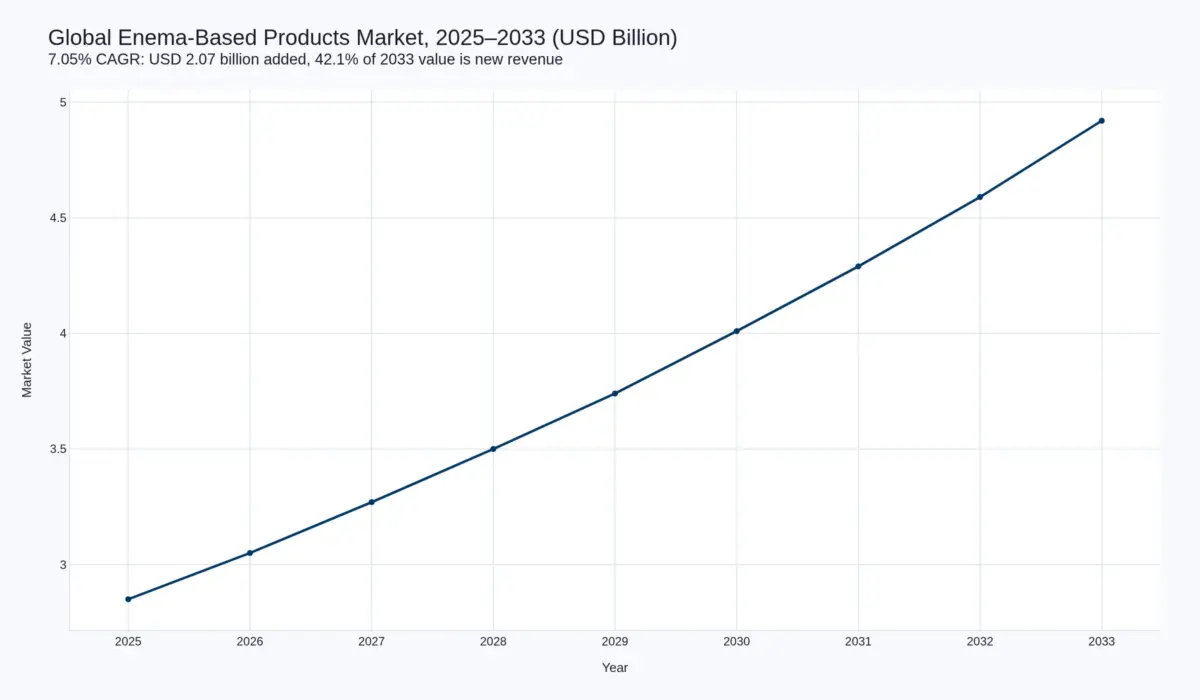
The stated CAGR of 7.05% is the least interesting number in this report. It describes a rate; it does not describe what has to happen. Held in dollars, the market adds USD 2.07 billion between 2025 and 2033, taking the total from USD 2.85 billion to USD 4.92 billion — a multiple of 1.73×. Because the curve compounds rather than adding a fixed amount each year, 42.1% of the 2033 market is revenue that does not exist today. Roughly four dollars in every ten at the end of the window have to be won, not defended.
The shape of the addition matters as much as its size. The first year of the forecast adds USD 0.20 billion; the final year adds USD 0.32 billion. The average across the eight years is USD 258.7 million, but no single year actually delivers that number — every one of the eight increments is larger than the one before it, and 56.8% of the total addition lands in the final four years. A growth rate applied to a growing base quietly asks for a step-up each year, and a category with two structural ceilings on usage has less room than most to deliver one late.
| Year | Market value (USD Billion) | Increment (USD Billion) |
|---|---|---|
| 2025 | 2.85 | — |
| 2026 | 3.05 | 0.20 |
| 2027 | 3.27 | 0.22 |
| 2028 | 3.50 | 0.23 |
| 2029 | 3.74 | 0.25 |
| 2030 | 4.01 | 0.26 |
| 2031 | 4.29 | 0.28 |
| 2032 | 4.59 | 0.30 |
| 2033 | 4.92 | 0.32 |
The path compounds at 7.05% and lands on 4.92 at the terminal year; the two endpoints imply 7.06%, so the one-basis-point gap between the stated and implied rate is rounding, not a modelling discrepancy.
The constraint the category is built around: it cannot grow by being used more
Most healthcare product categories grow through some combination of more patients and more intensity per patient. This one, unusually, has a documented ceiling on both sides of its revenue base — and neither ceiling is scientific.
Ceiling one: the label caps frequency, and it caps it hardest among the people who need the product most
Sodium phosphate enemas are sold over the counter, which is the source of their reach and also of their limit. The published drug facts for the leading saline enema specify a single 118 mL bottle per 24 hours and state plainly that using more than one enema in 24 hours can be harmful. The same label directs users to ask a doctor before use if they are 55 or older, on a sodium-restricted diet, dehydrated, or have kidney or heart problems — and to avoid use beyond three days without medical advice.
Read as a commercial document rather than a safety one, that is a frequency cap aimed squarely at the chronic, older, comorbid user who would otherwise be the category's heaviest customer. The FDA's 2014 safety communication sharpened it: a review of its adverse-event database and the medical literature identified 54 cases of serious harm in 25 adults and 29 children from oral or rectal over-the-counter sodium phosphate, predominantly hyperphosphataemia, hypocalcaemia and hypernatraemia, with kidney and cardiac consequences and some deaths, most occurring at above-label doses or with more than one dose in a day. That is why the label reads the way it does, and why the growth model cannot lean on consumption intensity.
Ceiling two: clinical guidance keeps the enema as a rescue tool, not a routine step
On the institutional side the ceiling is a guideline. Multi-society bowel-preparation guidance from the American Society of Gastrointestinal Endoscopy, the American Society of Colon and Rectal Surgeons and the Society of American Gastrointestinal and Endoscopic Surgeons positions enemas as an adjunct — useful for washing out the distal colon in patients with poor or incomplete cleansing, and in patients with a proximal stoma or a defunctioned distal colon — and grades the supporting evidence as largely anecdotal with no recent prospective trials. ASGE's technology review reaches the same conclusion from the other direction, noting that adjunctive therapies including enemas do not appear to improve the efficacy of full-volume polyethylene glycol preparations. The same guidance advises against sodium phosphate preparations in elderly patients and those with renal impairment.
The consequence is a category whose hospital revenue tracks procedure volume rather than enema use per procedure. More colonoscopies means more of everything; it does not mean more enemas per colonoscopy. An enema is what a unit reaches for when a prep fails, not what a prep is built on.
What that leaves
Growth has to arrive as breadth: more people who need bowel management, more procedures generating the rescue and stoma use cases, and a continued shift of care into the home where the product is bought rather than ordered. Breadth is a real and defensible driver — chronic constipation is common and rises with age — but it is a slower and less elastic driver than depth, which is precisely why 7.05% is a plausible number for this category and 15% would not be.
Ten tier-1 names, and nothing to consolidate
The structured profile of this market is fragmented with high competitive intensity, and both are true at once despite ten profiled tier-1 players. There is no contradiction here, and it is worth being precise about why, because the obvious reading — that ten large players means a moderately consolidated market — is the wrong one.
The over-the-counter tier has no molecule moat. A saline enema is a published composition of monobasic sodium phosphate and dibasic sodium phosphate heptahydrate in a fixed volume, in a moulded bottle with a lubricated tip. None of that is defensible through intellectual property. What is defensible is brand recognition, shelf position, packaging execution and the distributor and group-purchasing relationships that put a box in front of an institutional buyer. So the ten profiled players are not really ten competitors in one game; they are two different kinds of firm sharing a category — consumer-health brand owners who own the demand, and medical-supply and device distributors who own the access.
The transaction history supports the fragmentation reading rather than contradicting it. When Prestige Brands acquired C.B. Fleet Company in January 2017 for USD 825 million in cash, it bought a portfolio that included the category's leading enema brand — but roughly 65% of that portfolio's revenue came from a feminine-hygiene brand, and the trailing-twelve-month revenue across the whole company was approximately USD 205 million. That is 4.02× revenue for the bundle, and it means the number one enema brand in the world has never carried a standalone valuation at scale. Where no standalone multiple exists, no consolidator has a benchmark to bid against, and the category stays fragmented. See the Investment Activity and Competitive Landscape chapters for the detail.
Regional shape
North America is the largest market, on advanced gastrointestinal infrastructure, established colorectal screening programmes and the deepest over-the-counter bowel-management shelf. Europe follows, driven by ageing demographics and high awareness of digestive health. Asia Pacific is the fastest-growing region, on infrastructure expansion, rising healthcare expenditure and improving access to medical products, with Latin America and the Middle East & Africa behind it on healthcare-access development rather than on category maturity.
This ordering is a qualitative read of the category, not a modelled output. The model carries a single global value series and does not allocate dollars by region; no regional value is stated anywhere in this report for that reason.
What this model is not
A forecast is only useful if its boundaries are visible, so: this model carries one value series, from USD 2.85 billion in 2025 to USD 4.92 billion in 2033 at 7.05%. It does not carry a volume series in units, and therefore implies no price per unit and no volume-per-capita figure. It does not split value by product segment, indication, end-use or region, so segment and regional statements throughout this report are rankings and structural judgements rather than modelled dollar shares. The clinical, regulatory and epidemiological evidence cited — over-the-counter labelling and the 2014 FDA communication, multi-society bowel-preparation guidance, Cochrane evidence on rectal 5-ASA, published constipation prevalence — is used to explain the mechanism of the forecast. None of it is an input to the arithmetic. Readers who need volume, price-per-unit or segment-dollar detail should commission that work explicitly rather than infer it from this page.
A report that manufactures a segment table to look complete is worse than one that states what it measures. The three headline figures here are solid; everything downstream of them is reasoning, and it is labelled as such.
What would falsify this forecast
Three conditions would have to hold for USD 4.92 billion to be reached, and each has a mirror-image falsifier worth monitoring.
- Breadth keeps expanding. Constipation prevalence is high and rises with age, and care continues to shift toward the home. Falsifier: a sustained reversal in home-care utilisation, or a reclassification of the category that moves routine bowel management out of over-the-counter retail.
- The label stays where it is. One bottle in 24 hours is compatible with a large population using the product occasionally. Falsifier: a tightening of the monograph or labelling regime that further restricts at-risk groups, which would cut the heaviest-using cohort out of the addressable base.
- Institutional use holds its adjunct role. The enema's niche in failed preparations and stoma patients is durable precisely because nothing else reaches the distal colon. Falsifier: prep protocols that eliminate the rescue step entirely, which would remove the institutional line without removing the procedures.
None of these three requires a scientific failure. That is the honest character of the risk in this category: the downside case is regulatory and operational, not clinical.
Articles on this market
- No Depth, Only Breadth: In the Enema Market, Chronic Use Is the Risk, Not the Prize — why the two ceilings on this category make 7.05 per cent a breadth bet, and why ten tier-1 players have never consolidated it.
Table of Contents
Competitive Landscape
Competitive Landscape: Fragmented and Intensely Competitive, Without Contradiction
The structured read of this market is fragmented structure with high competitive intensity, across ten profiled tier-1 players. Ten large participants sounds like a consolidated market; it is not, and understanding why is the key to reading the category.
The over-the-counter tier has no molecule moat. A saline enema is a published composition — monobasic sodium phosphate and dibasic sodium phosphate heptahydrate in a fixed delivered volume — in a moulded bottle with a lubricated tip. None of that can be defended by intellectual property, because none of it is novel. What can be defended is brand recognition, retail shelf position, packaging execution and the distributor and group-purchasing relationships that place a product in front of an institutional buyer. Competition therefore happens at the shelf and at the contract, not in the laboratory.
Two kinds of player sharing one category
The ten profiled companies are not ten competitors in a single game. They divide into brand owners who own the demand, and medical-supply and device distributors who own the access.
- Bayer AG — consumer-health and gastrointestinal portfolio, with brand and distribution reach into pharmacy and retail.
- Cardinal Health — healthcare services and medical-product distribution; owns no meaningful enema brand and controls the institutional route.
- Prestige Consumer Healthcare — the category’s clearest brand owner, following the 2017 acquisition of C.B. Fleet, whose Fleet brand holds market-leading share in enemas and glycerin suppositories and whose Pedia-Lax holds leading share in paediatric laxatives.
- CooperSurgical — specialised devices for diagnostic, surgical and women’s-health procedures, including bowel-preparation and procedural accessories.
- Medline Industries — disposable enema kits and gastrointestinal consumables into hospitals, clinics and long-term care, competing on supply breadth rather than brand.
- B. Braun SE — medical devices and infusion-adjacent consumables, competing on clinical safety and manufacturing quality.
- Baxter International — hospital and clinical-care products, present in the institutional channel rather than in retail bowel care.
- Viatris — generic and branded pharmaceutical access, relevant chiefly on the prescription side of the category.
- Sanofi — diversified pharmaceutical and consumer portfolio with gastrointestinal presence in several markets.
- Coloplast — bowel care and continence management, positioned on patient-centred chronic care rather than on acute constipation relief.
What competition actually looks like
Price competition is real but constrained at the retail end by brand habit at a price point of a few dollars a unit, and at the institutional end by group-purchasing contracts where volume goes to whoever already holds the supply agreement. Private label sits underneath both and sets the floor. Because the unit value is low and the product is undifferentiated, marketing efficiency and distribution reach matter more than any R&D line, which is why the competitive set looks like a consumer-goods category bolted onto a medical-consumables category.
The consolidation that would normally follow ten large participants has not happened, and the transaction record explains why: the category’s leading brand has never been valued on its own. When Prestige Brands acquired C.B. Fleet in January 2017 for USD 825 million, roughly 65% of that portfolio’s revenue came from a feminine-hygiene brand. The enema business travelled inside a bundle. No standalone benchmark multiple exists, so no consolidator has a price to anchor a bid against, and the market stays fragmented. Structural consolidation in this category would require a buyer to underwrite an enema business on brand share and distribution access alone — a defensible thesis, but not one the market has yet priced.
A correction worth stating
Earlier versions of this analysis described the market as “moderately competitive”. That is inconsistent with the dataset and with the evidence: a market with no intellectual-property protection, a low unit price, active private label and ten tier-1 participants is highly competitive and fragmented. The two are compatible precisely because fragmentation here reflects the absence of defensible assets, not the presence of many small firms.
Value Chain
Value Chain: Two Businesses Sharing One Word
“Enema-based products” describes two different value chains that happen to deliver a liquid rectally, and they do not share economics. Reading the category as one chain is the most common analytical error made about it.
Chain one: the over-the-counter and consumable chain
The steps are short and the interesting part is where margin pools.
- Active salts. Monobasic sodium phosphate and dibasic sodium phosphate heptahydrate, plus saline and oil variants. These are commodity chemicals with multiple suppliers. No margin pool exists here.
- Blending and filling. The category’s real asset base. The 2017 C.B. Fleet transaction included a “mix and fill” manufacturing facility in Lynchburg, Virginia — a fact that tells you precisely where the physical asset of an enema business sits: in filling lines and packaging, not in synthesis.
- Packaging and format. Bottle, lubricated tip, carton, and increasingly the assembly of a ready-to-use kit. At a unit price in single-digit dollars, packaging is a meaningful share of cost of goods, which makes it a margin lever rather than a detail.
- Brand. Where the demand actually lives. The leading saline enema brand’s position rests on household recognition accumulated over more than a century, and the leading paediatric laxative brand exists because the adult rectal form is not for children under two — a regulatory boundary converted into a brand franchise.
- Distribution. Retail pharmacy and grocery on one side; wholesalers, group purchasing organisations and integrated delivery networks on the other. The institutional route is frequently owned by companies that own no brand at all.
Value in this chain accrues to whoever owns demand or access — the brand owner and the distributor — and only incidentally to whoever owns the formulation, because the formulation is published and unprotected. That is the structural explanation for a fragmented market: the assets that matter are relationships and recognition, both of which are contestable and neither of which compounds into a barrier.
Chain two: the prescription chain
Medicated enemas, principally 5-aminosalicylic acid formulations for distal ulcerative colitis, run a different sequence: active pharmaceutical ingredient, formulation and stability work, a regulatory dossier, a gastroenterology call point, and a payer or reimbursement relationship. Price is set against clinical evidence rather than against shelf competitors, and the evidence is strong — systematic review evidence supports rectal 5-ASA as first-line therapy for mildly to moderately active distal disease, superior both to placebo and to rectal corticosteroids. Margin here is pharmaceutical margin, defended by dossier and by evidence, and it is not exposed to the label-driven frequency cap that governs the over-the-counter trade.
Where the chain is fragile
Three points of fragility follow directly from that split.
First, the growth segment and the margin segment are not the same segment. Breadth — the volume that has to deliver USD 2.07 billion — arrives in the over-the-counter tier, where price is lowest, private label sits underneath, and no participant holds a defensible position. The tier with defensible margin is small in patient volume and cannot carry a global series.
Second, the category’s most valuable brand has never been valued alone. When Prestige Brands acquired C.B. Fleet in January 2017 for USD 825 million against roughly USD 205 million of trailing revenue, about 65% of that portfolio’s revenue came from a feminine-hygiene brand. The enema business travelled as a minority component of a bundle, which means the chain has no standalone price discovery at the point where value should be clearest.
Third, freight, packaging and distribution are a larger share of value than the product is. In a category where the chemically active input is a commodity and the device is a moulded bottle, the cost structure looks closer to consumer packaged goods than to pharmaceuticals — and so does the competitive behaviour. Any participant trying to earn a pharmaceutical return on an over-the-counter enema is fighting the structure of the chain rather than exploiting it.
Investment Activity
Investment Activity: One Benchmark Transaction, and a Category That Resists Consolidation
The investment record in enema-based products is thin, and the thinness is itself the finding. Where a category has no defensible intellectual property, no standalone valuation benchmark and a low unit price, capital does not flow to it as a platform — it flows to it as a component of a consumer-health or medical-supply portfolio.
The benchmark: C.B. Fleet to Prestige Brands
Prestige Brands Holdings agreed on 22 December 2016 to acquire C.B. Fleet Company for USD 825 million in cash, and completed the acquisition on 26 January 2017. The purchase was funded from cash on hand, additional borrowings under an asset-based revolving facility and a new USD 740 million senior secured incremental term loan, and the consideration was subject to adjustment for cash, indebtedness, transaction expenses and working capital at closing.
What was actually bought matters more than the price. The portfolio carried feminine hygiene, gastrointestinal and infant-care over-the-counter brands, and it included a “mix and fill” manufacturing facility in Lynchburg, Virginia. Trailing-twelve-month revenue across the acquired business was approximately USD 205 million. That is 4.02× revenue for the whole company.
The composition is the point. Roughly 65% of that portfolio’s revenue came from a single feminine-hygiene brand. Everything else — the enema brand with leading share in its category, the paediatric laxative brand, the anti-gas brand and the baby-care line — accounted for the remaining share, on the order of USD 71.75 million. So the transaction that acquired the world’s leading enema brand was not, in any material sense, a transaction that priced an enema business. It priced a consumer-health portfolio in which bowel care was a minority component.
Why the multiple is what it is
Four times revenue for a portfolio anchored by a category-leading feminine-hygiene brand and carrying a fill-and-finish plant is a brand-and-shelf multiple, not a technology multiple. What was acquired was demand and access: household recognition, retail placement, and the manufacturing footprint to fill bottles at volume. The chemically interesting part of the product — the phosphate composition — was not the asset, and could not have been, because it is published and unprotected.
Where capital goes instead
Since that transaction the category has not produced a comparable standalone platform deal, and the structural reasons are consistent:
- No benchmark. With the leading brand priced inside a bundle, there is no standalone multiple for a seller to point at or a buyer to underwrite against.
- No intellectual property to acquire. Buying an enema business buys share and relationships, both of which can decay; it does not buy a protected position.
- Low unit economics. At a few dollars a unit, revenue scale is built from enormous unit volume, which means the asset is distribution-intensive rather than margin-rich.
Capital in the category consequently concentrates in three places: fill-and-finish and packaging capacity, where format innovation is the only durable differentiator; consumer-health portfolios that can absorb a bowel-care brand alongside adjacent categories; and the adjacent pharmaceutical and device franchises of the larger players, where a 5-ASA enema or a continence system earns a return that a saline bottle cannot. For a prospective acquirer, the correct valuation frame is brand share plus distribution access, discounted for the fact that neither carries exclusivity. For a prospective builder, the correct frame is that capacity and packaging are the only assets that appreciate. Neither frame supports a technology premium, and no transaction in this category has ever paid one.
Technology & Innovation
Technology and Innovation: Everything Moves Except the Molecule
Innovation in this category is real and continuous, and almost none of it is chemical. That is not a criticism; it is a description of where the marginal return sits when the active composition is published, unprotected and decades old.
Where innovation actually lands
- Format and delivery. Pre-filled single-use bottles with lubricated tips, single-use enema bags, and paediatric formats built around a smaller delivered volume have done more for adherence than any formulation change. The paediatric segment is not incidental: the leading paediatric laxative brand exists because the adult rectal form must not be used under two, which creates a distinct, separately regulated product line.
- Ready-to-use kits. Disposable ready-to-use enemas are the fastest-growing product segment precisely because they remove preparation and assembly from the patient or nurse, and because they fit institutional protocol and home use at the same time.
- Formulation substitution away from phosphate. Given the risk profile of sodium phosphate in older and renally impaired patients, formulation work concentrates on saline, polyethylene-glycol-based and magnesium-citrate-adjacent approaches, and on preservative-free variants. This is substitution aimed at the safety constraint rather than at efficacy.
- Packaging and ergonomics. At a few dollars a unit, packaging cost is a material share of cost of goods, so packaging redesign is simultaneously a clinical, a manufacturing and a margin intervention.
What innovation cannot do
The ceiling on innovation is regulatory rather than technical. A home-use enema reaches its market through an over-the-counter monograph and a drug facts label, or through a device route for kits and delivery systems. Any change with a meaningful effect on how often or for how long the product can be used requires a different regulatory pathway. That is why the most commercially valuable innovation available to this category — a home format that improves adherence in the 55-and-over cohort without triggering the label’s instruction to consult a clinician first — is also the one nobody can execute by formulation alone. It would require a new evidence base and a new labelling position, not a better bottle.
The institutional blind spot
On the hospital side, innovation has effectively moved in the opposite direction. Bowel preparation has standardised around oral split-dose polyethylene glycol lavage, and multi-society guidance treats enemas as an adjunct for incomplete cleansing and for patients with a proximal stoma or defunctioned distal colon, on evidence graded largely anecdotal. ASGE’s technology review notes that adjunctive therapies including enemas do not appear to improve full-volume polyethylene glycol preparation. Technological progress in prep has therefore reduced the number of enema touches per procedure rather than increased them, and the category’s institutional line grows only with procedure volume. Innovation that would reverse that — a distal-colonic delivery format that earns a routine rather than rescue role — has no prospective trial base behind it today, which is exactly what the guidance says.
The one place depth is permitted
Prescription 5-ASA enemas for distal ulcerative colitis are the exception where the technology and the evidence both point to more intensive use: systematic review evidence supports rectal 5-ASA as first-line therapy for mildly to moderately active distal disease, superior to placebo and to rectal corticosteroids. That is innovation that expands usage rather than rationing it. It is also a pharmaceutical business with a full dossier, a gastroenterology call point and a payer relationship — structurally separate from the over-the-counter trade, and small in patient volume. It will not carry a global value series on its own, but it is where the category’s most defensible margin and its only intensity-led growth sit.
Market Risk
Market Risk: Five Ranked Risks, None of Them Clinical
The distinctive feature of risk in this category is that the downside cases are regulatory and commercial rather than scientific. Nothing in the forecast depends on a molecule working. Four of the five risks below are, in effect, different ways the same two ceilings could tighten.
1. Labelling and monograph restriction — high
This is the largest single risk to the forecast, because the home segment is where breadth has to be won and the label governs who may use the product and how often. Current over-the-counter labelling permits one 118 mL bottle in 24 hours, warns that more than one in 24 hours can be harmful, and directs users aged 55 and over, those with kidney or heart problems, those who are dehydrated and those on sodium-restricted diets to consult a clinician first. Those are precisely the populations that would otherwise use the product most. The 2014 FDA safety communication, which identified 54 cases of serious harm including electrolyte disturbance with renal and cardiac consequences, is the evidentiary basis for that labelling and remains available to support further restriction. A tightening of the monograph, or an adverse litigation outcome that reframes the risk, would compress the addressable base directly.
2. Substitution by oral laxatives — high
The home constipation pool is the growth engine, and it is contested. Oral over-the-counter polyethylene glycol is widely used for chronic constipation and carries no comparable frequency ceiling in practice; prescription secretagogues and prokinetics address the chronic and refractory cohorts with a clinical positioning an enema cannot claim. The enema’s advantage is speed — relief in minutes — and its disadvantage is that speed is what you want occasionally, not what you want chronically. A category whose growth depends on chronic prevalence is structurally exposed to products designed for chronic use.
3. Guideline drift in bowel preparation — moderate to high
Institutional revenue tracks procedure volume because the enema is an adjunct, not a routine step. Multi-society guidance confines it to incomplete cleansing and to patients with a proximal stoma or defunctioned distal colon, on evidence graded largely anecdotal, and ASGE’s technology review notes that adjunctive therapies including enemas do not appear to improve the efficacy of full-volume polyethylene glycol preparation. The risk is not that enemas are removed from guidance; it is that prep protocols standardise in a way that eliminates the rescue step, which would remove the institutional line while leaving procedure counts unchanged.
4. Price erosion and private label — moderate
With no intellectual-property protection and a unit price in single-digit dollars, the category has no structural defence against private label at retail or against group-purchasing pressure institutionally. A value forecast of 7.05% is a nominal growth rate; if realised price per unit declines faster than volume grows, the dollar outcome is worse than the rate implies. This model carries no volume series and therefore cannot decompose the two, which is a genuine limitation rather than a rounding issue.
5. Home-care channel and reimbursement — moderate
The shift of bowel management into the home is a growth driver only if the product is bought rather than funded. Where home care is reimbursed, coverage policy governs volume; where it is self-pay, price sensitivity governs it. A shift toward self-pay home care would move the channel without moving the revenue.
Falsifiers
Three conditions must hold for the forecast: breadth keeps expanding, the label stays where it is, and institutional use holds its adjunct role. The mirror images are the falsifiers — a sustained reversal in home-care utilisation, a further tightening of labelling that removes the at-risk cohort, or prep protocols that eliminate the rescue step. None requires a scientific failure, and that is the honest character of this category’s risk.
Regulatory Landscape
Regulatory Landscape: Three Regimes, and Reimbursement as the Real Gate
Enema-based products do not sit under a single regulatory regime. That is not a technicality; it is a commercial fact that shapes who can sell what, through which channel, at what cost of conformity.
Over-the-counter drug regime — the route for cleansing and saline enemas
In the United States, sodium phosphate and saline enemas are sold under an over-the-counter drug framework, which makes the drug facts label the operative regulatory document. It is also the operative commercial document. The label fixes a maximum of one 118 mL bottle in 24 hours, states that more than one enema in 24 hours can be harmful, directs users aged 55 and over, those with kidney or heart problems, those who are dehydrated and those on sodium-restricted diets to ask a doctor before use, and warns against use beyond three days without medical advice. The rectal form must not be given to children under two.
The FDA’s 2014 safety communication is the anchor for that labelling. Reviewing its adverse-event reporting database and the medical literature, the agency identified 54 cases of serious adverse events in 25 adults and 29 children associated with oral or rectal over-the-counter sodium phosphate, with electrolyte disturbances — predominantly hyperphosphataemia, hypocalcaemia and hypernatraemia — producing renal and cardiac harm and in some cases death, most occurring where the labelled dose was exceeded or more than one dose was used in a day. The same action removed oral sodium phosphate bowel-cleansing products from over-the-counter availability while leaving the rectal form in place under tightened labelling. That asymmetry tells you where regulators drew the line: the enema was judged defensible at a capped dose with clear risk communication, and the oral lavage was not.
Medical device regime — the route for kits and delivery systems
Disposable enema kits and delivery systems are regulated as medical devices in the European Union under the Medical Device Regulation, with classification depending on invasiveness and duration of contact, and in the United States largely under the same device framework where the product is a delivery system rather than a drug. Conformity requirements differ materially from the drug route — technical documentation, clinical evaluation, notified-body involvement and post-market surveillance rather than a monograph and a drug facts label. This is one reason the competitive field splits the way it does: supply and device companies can operate in the kit segment without carrying pharmaceutical obligations, while consumer-health companies operate in the drug segment where the label is the licence.
Medicinal product regime — the route for medicated enemas
Prescription enemas, principally 5-aminosalicylic acid formulations for distal ulcerative colitis, sit under a full medicinal-product regime with approved indications, dossiers and pharmacovigilance. They are priced on clinical evidence rather than on brand, and the evidence base is unusually strong for so small a segment: systematic review evidence supports rectal 5-ASA as a first-line treatment for mildly to moderately active distal ulcerative colitis, superior to placebo and to rectal corticosteroids. This is the one part of the category where depth of use is permitted and encouraged — because a physician is directing it — and it is also the part where the volume is smallest.
Reimbursement, not approval, is the gate
The regulatory distinction that matters commercially is not which regime a product clears but who pays for it. An approved or compliant product that a patient buys out of pocket is exposed to retail price competition and to the label’s frequency cap. The same product reimbursed in a home-care setting is governed instead by coverage policy, which can expand volume or exclude it entirely. For any reader modelling the home-care shift, coverage decisions are a more consequential variable than conformity routes, and they are set outside the device and drug regimes described above.