
Global Lithium Mining Market Report, Size & Forecast 2026 - 2033
Global Lithium Mining Market Forecast Snapshot 2026 - 2033
The global lithium mining market, covering the extraction, concentration, and refining of lithium from hard-rock spodumene and brine sources, is forecast from a base year of 2025 through 2033. The market is measured in billion USD and includes all production of lithium concentrate and battery-grade lithium compounds destined for battery manufacturing, ceramics and glass, lubricants, metallurgy, and pharmaceutical applications. Excluded are recycling, downstream battery manufacturing beyond its demand impact, and other critical minerals markets.
The market enters the forecast period from a base of $1.4 billion in 2025, shaped by two countervailing forces. A punishing price correction—lithium prices fell more than 85% from their 2022 peak of $80,000 per tonne to approximately $10,000 per tonne—has compressed margins and kept the market in cautious oversupply through early 2026. Yet structural demand drivers are building momentum: an accelerating energy storage boom, continued electric vehicle deployment, and direct government stockpiling by the United States. On the supply side, policy interventions in Zimbabwe, project delays in Chile and California, and water availability constraints across the U.S. Southwest are tightening the future supply pipeline. The result is a market poised for inflection from surplus in 2025–2026 to progressive tightening from 2027 onward, supporting a baseline CAGR of 18.97% that lifts market value to $5.62 billion by 2033.
Lithium Mining Market Forecast Matrix
| Metric | Value |
|---|---|
| Base Year | 2025 |
| Base Market Size | $1.4 billion |
| Forecast Window | 2026–2033 |
| Market Direction | Strong positive |
| Baseline CAGR (2025–2033) | 18.97% |
| Optimistic CAGR | 21.47% |
| Conservative CAGR | 16.47% |
| Baseline 2033 Endpoint | $5.62 billion |
| Growth Shape | Front-loaded; peak annual growth ~2029–2030, moderation through 2033 |
| Largest Producing Regions | Australia (hard-rock), Chile and Argentina (brine), China (refining) |
| Fastest-Growing Demand Node | Energy storage systems in China and globally |
| Dominant Application Segment | Battery manufacturing (EV, energy storage, consumer electronics) |
| Key Trend | Transition from near-term oversupply to structural deficit by 2027 |
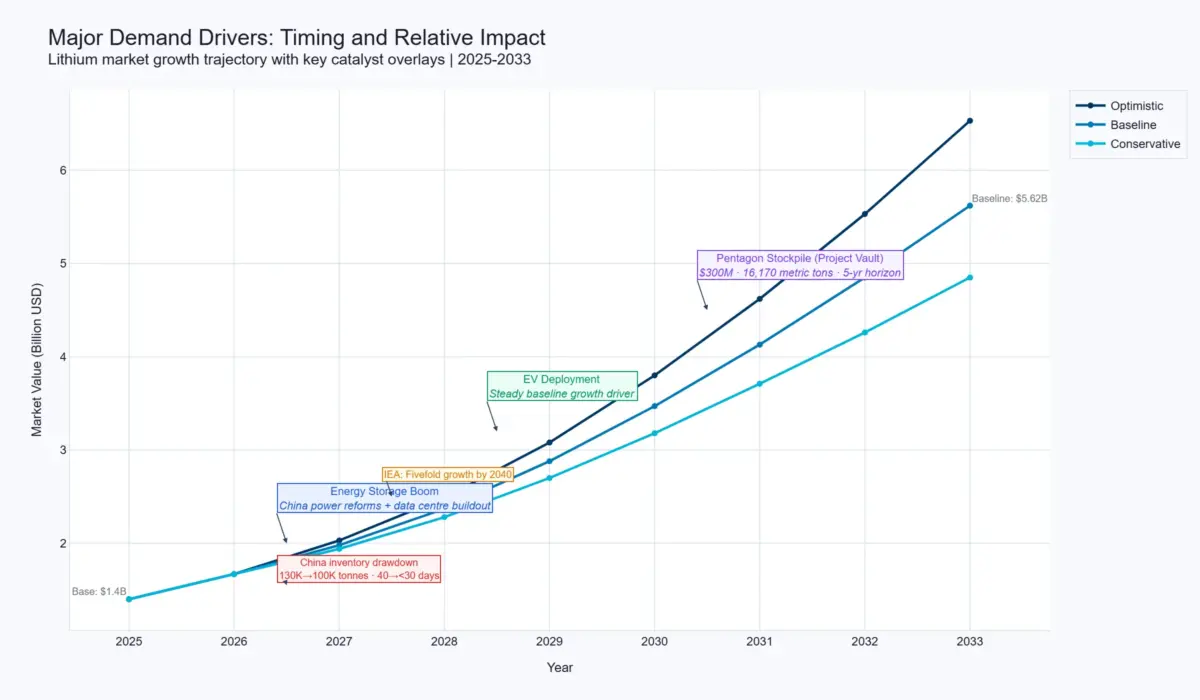
- The energy storage boom, particularly in China driven by power sector reforms and global data centre buildout, is accelerating lithium demand faster than previously expected and could absorb the current oversupply by late 2026. The IEA projects lithium demand will grow fivefold by 2040.
- Supply-side constraints—including Zimbabwe's concentrate export ban effective January 2027, the Maricunga project delay to 2034, and a USGS study finding that water scarcity could make 22 proposed U.S. mines unviable by 2040–2060—will tighten the market by 2027, supporting a price recovery from current suppressed levels.
- Government stockpiling under the Pentagon's $300 million Project Vault creates a new demand floor for battery-grade lithium carbonate, while China's inventory drawdown from 130,000 tonnes (Q3 2024) to 100,000 tonnes signals the surplus is being absorbed.
- The lithium mining market is forecast to grow from $1.4 billion in 2025 to $5.62 billion by 2033 under the baseline scenario (CAGR 18.97%), with the optimistic scenario reaching a CAGR of 21.47% and the conservative scenario a CAGR of 16.47%, depending on the pace of DLE deployment, regulatory outcomes, and demand trajectory.
- Bernstein analysts project that demand will exceed capacity growth by 2026, with a tighter market emerging by 2027, as inventory days in China drop from 40 to below 30 and high-cost supply curtailments stabilize prices.
Demand Drivers: Energy Storage, EV Deployment, and Strategic Stockpiling
Energy Storage Boom Reshapes Demand Trajectory
The most consequential shift in the lithium demand landscape is the accelerating energy storage boom, reported by Reuters in January 2026. China's power sector reforms, combined with the global data centre buildout, drove stronger-than-expected lithium demand from battery storage in the second half of 2025. Analysts at consultancy Fubao noted that rapid growth in lithium demand from energy storage in this period surpassed expectations and is likely to be a game-changer for the lithium market. The International Energy Agency's Global Critical Minerals Outlook 2025 projects that lithium demand will grow fivefold by 2040 under the Stated Policies Scenario, driven primarily by EV and storage deployment. Wood Mackenzie's Energy Transition Outlook for Lithium similarly supports a strong demand outlook. This structural shift means that energy storage is no longer a secondary demand driver but a primary force capable of absorbing the oversupply that has weighed on prices since 2023.
Strategic Government Stockpiling: Pentagon's Project Vault
In July 2026, the U.S. Department of Defense launched Project Vault, seeking to purchase up to $300 million of battery-grade lithium carbonate over five years. The Defense Logistics Agency issued a procurement solicitation for 35.64 million pounds (approximately 16,170 metric tons) of lithium carbonate under a fixed-price contract model. Unlike traditional government reserves, Project Vault operates on a demand-led model where original equipment manufacturers identify the specific grades and volumes they require and pay a commitment fee for emergency access. The broader initiative, established in February 2026, is a $12 billion public-private stockpiling program backed by a $10 billion loan from the U.S. Export-Import Bank and nearly $2 billion in private sector investment. This creates a new, sovereign-backed demand floor for battery-grade lithium that persists through the forecast window and beyond, insulating a portion of demand from cyclical price movements.
Electric Vehicle Deployment Maintains Baseline Demand Growth
Continued EV deployment across all major markets—China, Europe, and North America—provides the underlying demand growth that underpins the baseline forecast. The IEA projects that battery deployment in EVs and storage applications drives the bulk of lithium demand growth through 2040. While near-term EV sales growth has moderated from the hyper-growth phase of 2020–2023, the absolute volume of batteries deployed continues to rise, sustaining lithium consumption growth at rates that outpace most other commodity markets.
Bernstein Forecast: Demand to Exceed Capacity Growth by 2026
Bernstein analysts project that while 2025 capacity expansions will be sufficient to meet demand, capacity growth will slow in 2026 and 2027, leading to a tighter market. Their report, published in early 2025, notes that lithium prices—after peaking at $80,000 per tonne in 2022 and falling more than 85% to $10,000 per tonne—are now below the marginal cash cost of production, prompting high-cost suppliers to curtail output. China's lithium inventory has declined from 130,000 tonnes in Q3 2024 to 100,000 tonnes, with inventory days dropping from 40 to less than 30, suggesting supply and demand are moving toward equilibrium. Bernstein sees further upside for lithium prices as the market tightens through 2027.
Major Demand Drivers: Sources and Timing
| Driver | Source | Timing | Impact |
|---|---|---|---|
| Energy storage boom | Reuters, IEA, Wood Mackenzie | Accelerating from 2025; sustained through 2040 | Fivefold demand growth by 2040; could absorb oversupply by late 2026 |
| Pentagon Project Vault stockpile | Investing News Network | 2026–2031 procurement | $300 million, 16,170 metric tons; sovereign demand floor |
| Electric vehicle deployment | IEA, Bernstein | Steady through 2033 | Baseline demand growth; absolute battery volumes rising |
| Bernstein demand-exceeds-capacity | Bernstein analysis | Demand exceeds capacity growth by 2026, tightening by 2027 | Supports price recovery from $10,000/t level |
Supply Constraints and Price Trajectory
Zimbabwe Export Ban Creates Supply Bottleneck
Zimbabwe, Africa's top lithium producer, is implementing a phased export ban on lithium concentrates, with a full ban effective January 1, 2027. The mines ministry has rejected industry pleas for a grace period, despite the fact that only one lithium sulphate plant (owned by Zhejiang Huayou Cobalt) is operational and cannot process third-party material. Sinomine's Bikita Minerals and Kamativi Mining Company are building plants but will not have capacity before the ban. This creates a supply bottleneck that could remove significant concentrate volumes from global markets for an extended period, disrupting supply chains for downstream converters that depend on Zimbabwean material.
Water Scarcity Threatens U.S. Mine Viability
A comprehensive 2026 study by the U.S. Geological Survey and Northwestern University analyzed the single existing and 22 proposed U.S. lithium mines under four socioeconomic-climate scenarios and five climate models. The study found that available water supply in most sub-basins would likely be insufficient to support new mines' water demands, or even non-mining water demand from other sectors. The lead author noted that even if all proposed mines become operational, the United States does not have enough lithium to meet domestic demand, necessitating higher imports. This directly constrains supply growth that would otherwise support the optimistic scenario, particularly for hard-rock and evaporation-based projects in the arid U.S. Southwest.
Project Development Delays Across Multiple Jurisdictions
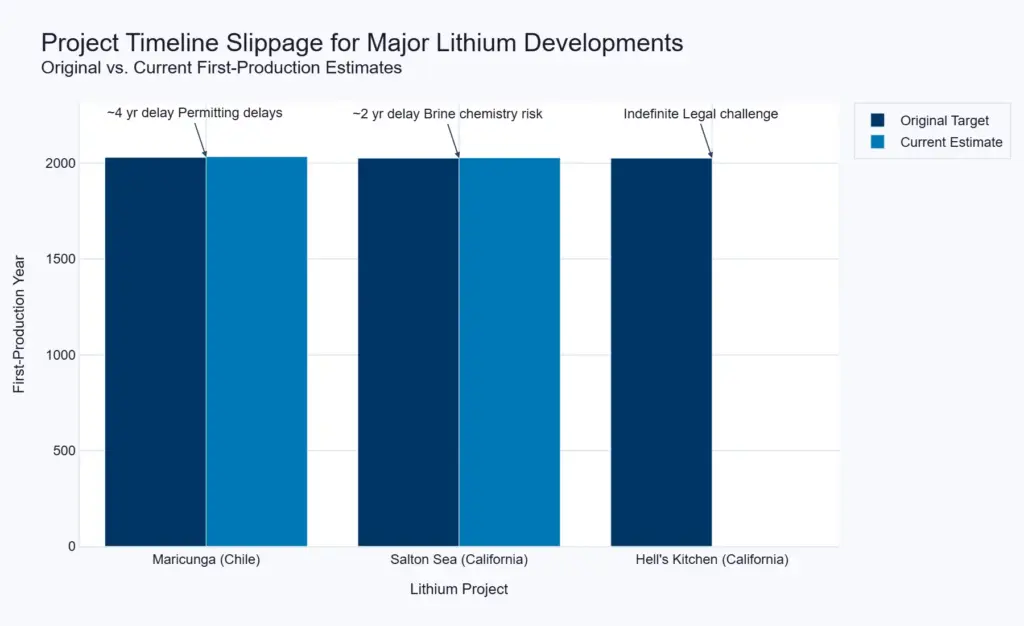
Major lithium projects continue to slip. The Maricunga project in Chile, a partnership between Codelco and Rio Tinto, was originally targeted for 2030 but has been delayed to 2034 because of permitting, consultation, and environmental processes. The Salton Sea DLE project in California, backed by a $1.4 billion DOE loan, has shifted from an initial 2025 target to full production by the end of 2027. The Hell's Kitchen project in the same region faces a legal challenge under CEQA that could cause additional delays if an appeal succeeds. These delays compound the supply gap that Bernstein projects will emerge by 2027.
Near-Term Oversupply and Inventory Overhang
Despite the positive demand signals, the lithium market entered the forecast period carrying significant surplus. Chinese inventories, though declining from 130,000 tonnes in Q3 2024 to 100,000 tonnes, remain above the long-term average, and inventory days, while reduced from 40 to below 30, have not yet reached equilibrium levels. Bernstein notes that ample inventory and potential restarts of curtailed capacity should keep a cap on prices in the near term, limiting the pace of market value growth in 2025–2026.
Key Supply Constraints: Timing and Market Impact
| Constraint | Effective Date | Expected Market Impact |
|---|---|---|
| Zimbabwe concentrate export ban | January 1, 2027 | Removal of significant concentrate supply; bottleneck for downstream converters |
| Water scarcity (USGS study) | Sustained risk through 2040–2060 | 22 proposed U.S. mines potentially unviable; higher import reliance |
| Maricunga project delay | First production now 2034 (4-year slip) | Widens supply gap from 2027 onward |
| Salton Sea DLE project delay | Full production end-2027 (2-year slip) | Delay in North American DLE supply |
| China inventory overhang | Through 2025–2026 | Prices suppressed until inventory normalizes |
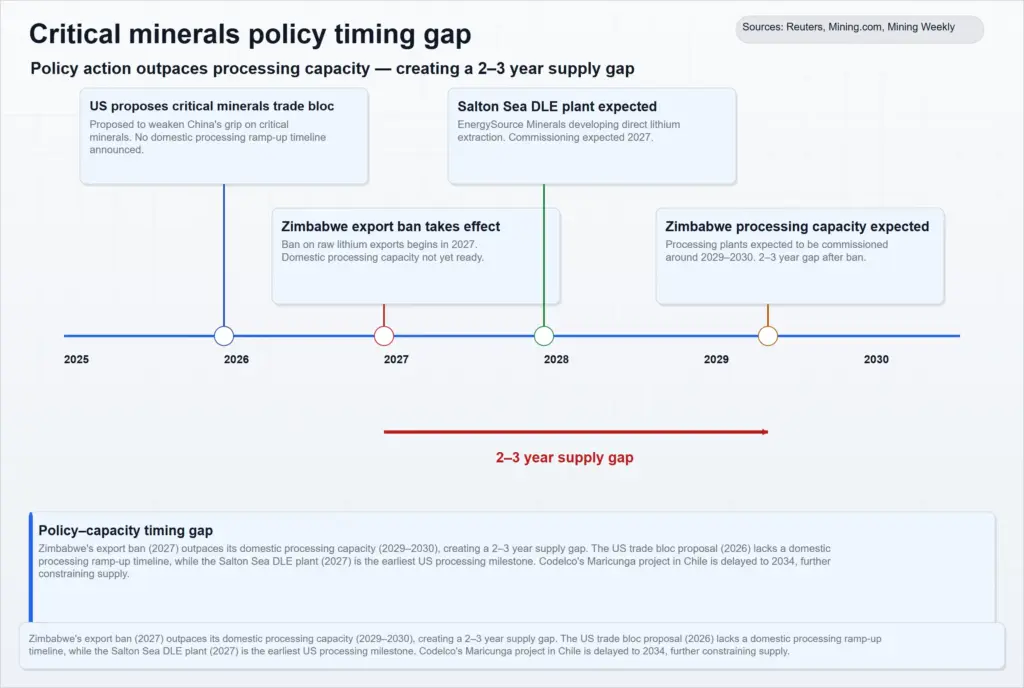
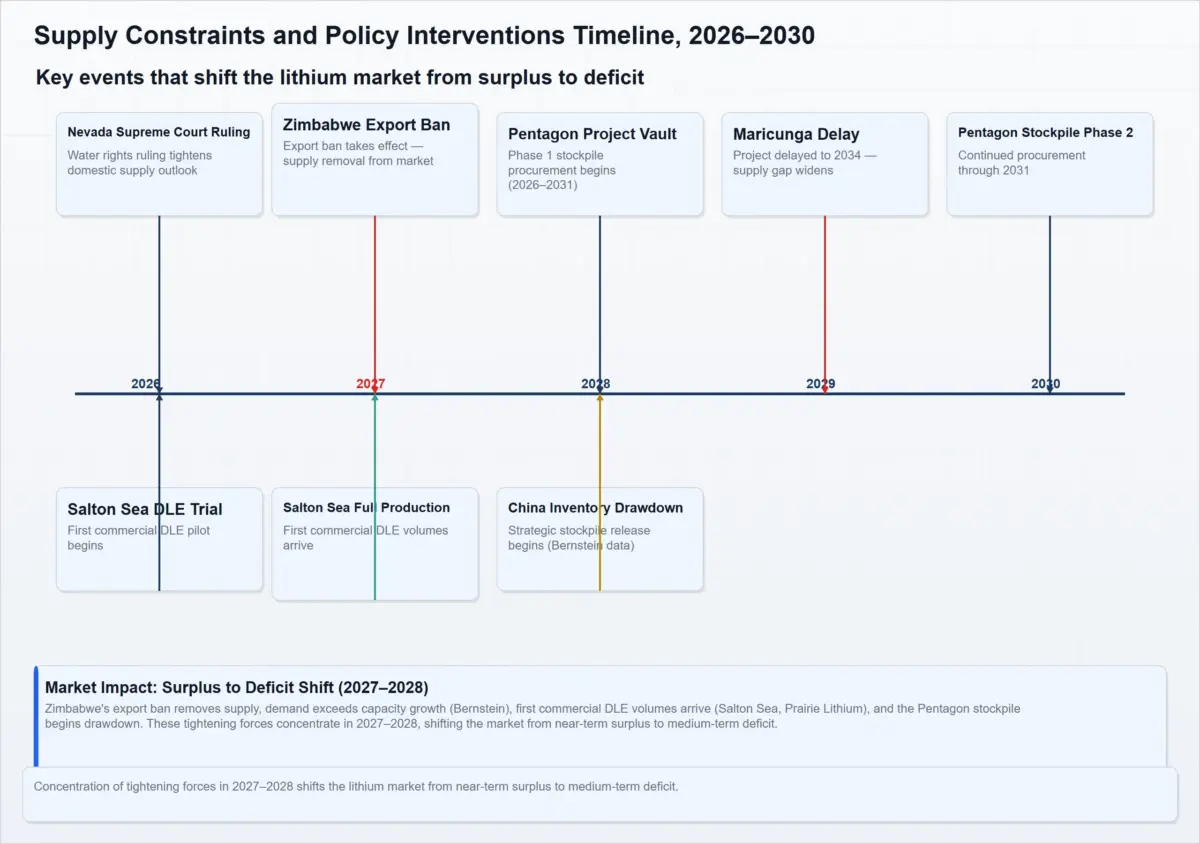 supply constraints policy timeline 2026-2030 of global lithium mining market
Market Forecast Scenarios: 2025–2033
The baseline forecast follows a front-loaded growth shape, meaning the highest annual growth rates occur earlier in the forecast window before moderating. The trigger for this shape is an early capital expenditure and technology ramp that concentrates positive modifiers in the 2027–2030 period. The annual growth rate climbs from 18.79% in 2027 to a peak of 21.19% in 2029, then gradually decelerates to 15.89% by 2033. The value chain axis is the dominant positive contributor across 2027–2030, reflecting multi-year offtake agreements, downstream integration (notably Tesla's Texas refinery), and new processing capacity. The risk axis exerts a persistent negative drag that peaks in 2030, driven by water scarcity projections, permitting delays, and the Zimbabwe export ban timeline. The technology axis contributes increasing positive modifiers from 2028 onward as direct lithium extraction (DLE) projects advance from pilot to commercial scale. In the later years (2031–2033), the competition landscape axis becomes the dominant positive modifier as new entrants and technology shifts intensify investment in new capacity.
Baseline Lithium Mining Market Values and Annual Growth Rates, 2025–2033
| Year | Market Value (Billion USD) | Annual Growth Rate |
|---|---|---|
| 2025 | 1.40 | Base year |
| 2026 | 1.67 | 18.97% |
| 2027 | 1.98 | 18.79% |
| 2028 | 2.37 | 19.97% |
| 2029 | 2.88 | 21.19% |
| 2030 | 3.47 | 20.59% |
| 2031 | 4.13 | 19.04% |
| 2032 | 4.85 | 17.37% |
| 2033 | 5.62 | 15.89% |
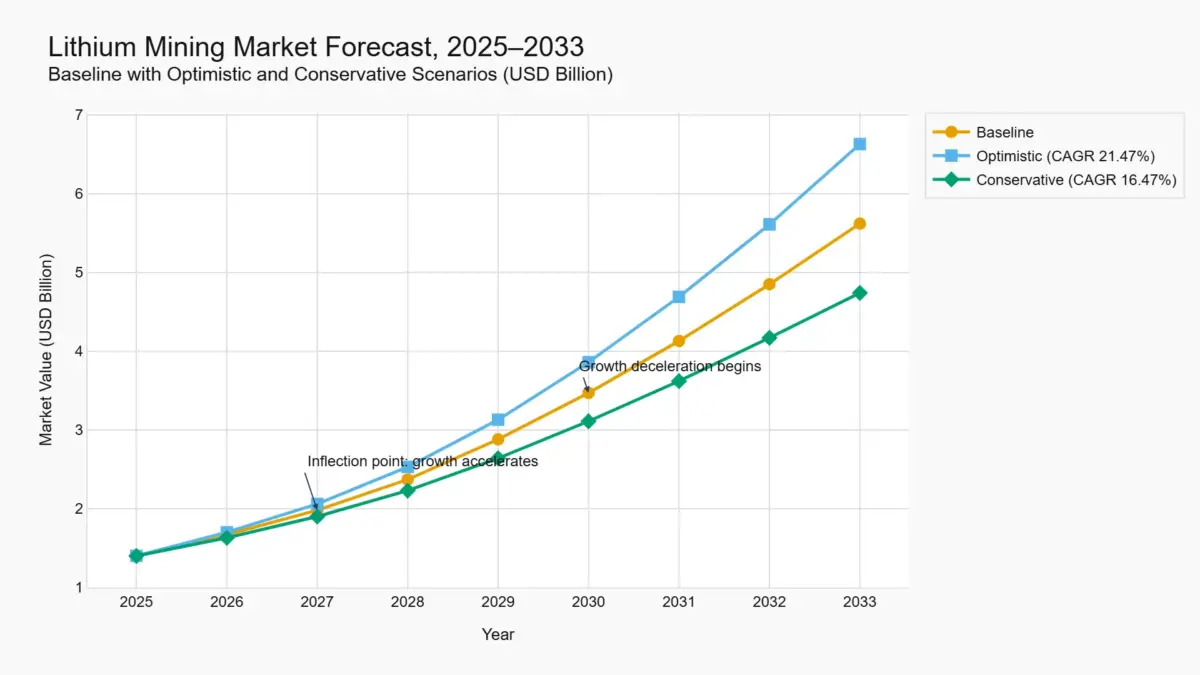
lithium mining market forecast 2025 2033 baseline with optimistic and conservative scenarios for global lithium mining market
Scenario Comparison: Optimistic, Baseline, and Conservative
Three scenarios bracket the forecast range for the lithium mining market from 2025 to 2033.
1. Baseline Scenario (CAGR 18.97%, Endpoint $5.62 Billion)
Reflects the convergence of accelerating energy storage and EV demand with moderate supply growth from existing projects and new DLE capacity, partially offset by known project delays, water constraints, and the Zimbabwe export ban. The growth path is front-loaded with peak annual growth of 21.19% in 2029.
2. Optimistic Scenario (CAGR 21.47%)
Assumes faster-than-expected DLE scaling, including EnergySource, Prairie Lithium, POSCO–Anson, and other projects reaching commercial production on schedule. It also assumes rapid resolution of Zimbabwe's processing gap through accelerated plant construction, expansion of the Pentagon's Project Vault beyond the initial $300 million tranche, and stronger-than-expected energy storage demand in China. Under this scenario, the market follows a steeper annual growth trajectory with peak annual growth of 23.88% in 2029.
3. Conservative Scenario (CAGR 16.47%)
Assumes that water scarcity rulings, permitting delays—including the Maricunga delay to 2034 and Hell's Kitchen legal challenges—and Zimbabwe's export ban create more severe supply disruptions than anticipated. It also assumes additional delays in DLE commercialization and a slower inventory drawdown. Despite these challenges, the market continues to expand, reaching a peak annual growth rate of 18.45% in 2029.
All three scenarios follow the same front-loaded growth profile and are driven by the same value chain, technology, competition, and risk axes. The difference lies in the magnitude and timing of these factors, particularly regarding DLE commercialization, regulatory outcomes, and future energy storage demand. The approximately five percentage-point spread between the optimistic and conservative CAGR reflects the realistic range of possible market outcomes.
Scenario Comparison: CAGR and Endpoint Values
| Scenario | CAGR (2025–2033) | 2033 Endpoint (Billion USD) | Peak Annual Growth Rate (Year) |
|---|---|---|---|
| Optimistic | 21.47% | Derived from CAGR (baseline endpoint $5.62B) | 23.88% (2029) |
| Baseline | 18.97% | $5.62 | 21.19% (2029) |
| Conservative | 16.47% | Derived from CAGR (baseline endpoint $5.62B) | 18.45% (2029) |
Why the Lithium Market Is Moving Toward Structural Tightening
The lithium mining market is not simply growing—it is undergoing a structural transformation from a surplus-ridden, price-suppressed commodity market to one increasingly supported by long-term demand and constrained supply. Three structural forces underpin this transformation.
1. Demand Is Diversifying and Becoming More Resilient
Energy storage has emerged as a demand driver comparable in importance to electric vehicles. China's power sector reforms and global data centre expansion are creating a new policy-supported source of lithium consumption. At the same time, the Pentagon's Project Vault establishes a sovereign demand layer with a five-year procurement horizon. The International Energy Agency's projection of a 40% lithium supply deficit by 2035 under current policies indicates that demand is expected to outpace supply despite aggressive capacity expansion.
2. Supply Growth Faces Structural Constraints
The phased Zimbabwe export ban removes a significant source of lithium concentrate at a critical stage of market development. Simultaneously, the USGS–Northwestern University study highlights severe water constraints across the U.S. Southwest, potentially affecting the viability of 22 proposed lithium mines. Additional delays affecting projects such as Maricunga, Salton Sea, and other developments reinforce the structural limitations facing future supply.
3. Demand Growth Is Arriving Faster Than New Supply
Bernstein projects demand will exceed capacity growth by 2026, with the market tightening by 2027. However, major supply additions—including Thacker Pass (late 2027), Salton Sea (end-2027), Rincon (beyond 2027), and Maricunga (2034)—remain back-end loaded relative to the accelerating demand curve. This timing mismatch creates a multi-year window of tightening that supports higher lithium prices and sustained market value growth while the longer-term project pipeline gradually comes online.
Table of Contents
1. Executive Summary
1.1 Global Lithium Mining Market Snapshot (2025–2033)
1.2 Market Size & CAGR Analysis
1.3 Largest Producing Region & Fastest-Growing Demand Node
1.4 Key Regional Insights
1.5 Major Market Growth Drivers
1.6 Competitive Landscape Overview
1.7 Strategic Outlook Through 2033
2. Introduction & Market Overview
2.1 Definition of Lithium Mining
2.2 Scope of the Study
2.3 Evolution of the Global Lithium Mining Industry
2.4 Lithium Mining Value Chain Analysis
2.5 Global Lithium Supply Chain & Production Landscape
2.6 Regulatory Framework for Lithium Mining & Critical Minerals
2.7 Technology Innovations in Lithium Mining & Processing
3. Research Methodology
3.1 Primary Research
3.2 Secondary Research
3.3 Market Size Estimation Model
3.4 Forecast Assumptions (2025–2033)
3.5 Data Validation & Market Triangulation
4. Market Dynamics
4.1 Drivers
4.1.1 Energy Storage Systems (ESS) Demand Boom
4.1.2 Strategic Government Stockpiling (Project Vault)
4.1.3 Growth in Electric Vehicle Deployment
4.1.4 Demand Outpacing Capacity Growth
4.1.5 Expansion of Battery Manufacturing Investments
4.2 Restraints
4.2.1 Lithium Price Correction & Market Oversupply
4.2.2 Zimbabwe Lithium Concentrate Export Ban
4.2.3 Water Scarcity Affecting Mining Projects
4.2.4 Project Development & Permitting Delays
4.3 Opportunities
4.3.1 Commercialization of Direct Lithium Extraction (DLE)
4.3.2 Expansion of Energy Storage Applications
4.3.3 Strategic Critical Mineral Investments
4.3.4 Refining & Processing Capacity Expansion
4.4 Challenges
4.4.1 Environmental & Water Resource Constraints
4.4.2 Regulatory & Permitting Complexity
4.4.3 Supply Chain Concentration Risks
4.4.4 Long Mine Development Timelines
5. Global Lithium Mining Market Analysis (USD Billion), 2025–2033
5.1 Market Size Overview
5.2 CAGR Analysis
5.3 Regional Revenue Distribution
5.4 Segment Revenue Analysis
5.5 Supply-Demand Balance Analysis
5.6 Technology & Investment Trends
6. Market Segmentation (USD Billion), 2025–2033
6.1 By Extraction Method
6.1.1 Hard-Rock Mining
6.1.1.1 Spodumene Mining
6.1.1.1.1 Open-Pit Mining
6.1.1.1.1.1 Mine-to-Concentrate Processing
6.1.2 Brine Extraction
6.1.2.1 Conventional Evaporation
6.1.2.1.1 Direct Lithium Extraction (DLE)
6.1.2.1.1.1 Commercial DLE Operations
6.1.3 Emerging Lithium Extraction Technologies
6.2 By Product Type
6.2.1 Lithium Concentrate
6.2.2 Lithium Carbonate
6.2.3 Lithium Hydroxide
6.2.4 Other Lithium Compounds
6.3 By Application
6.3.1 Battery Manufacturing
6.3.2 Energy Storage Systems
6.3.3 Consumer Electronics
6.3.4 Ceramics & Glass
6.3.5 Lubricants
6.3.6 Metallurgy
6.3.7 Pharmaceuticals
6.4 By End User
6.4.1 Battery Manufacturers
6.4.2 Automotive Industry
6.4.3 Energy Storage System Providers
6.4.4 Industrial Manufacturers
6.4.5 Government & Strategic Stockpile Organizations
7. Market Segmentation by Geography
7.1 Australia
7.2 Chile
7.3 Argentina
7.4 China
7.5 Zimbabwe
7.6 United States
7.7 Canada
7.8 Brazil
7.9 Rest of the World
8. Competitive Landscape
8.1 Market Share Analysis
8.2 Technology & Processing Benchmarking
8.3 Production Capacity Analysis
8.4 Strategic Partnerships, Investments & Acquisitions
8.5 Sustainability & ESG Strategies
9. Company Profiles
9.1 Albemarle Corporation
9.2 SQM (Sociedad Química y Minera de Chile S.A.)
9.3 Tianqi Lithium Corporation
9.4 Ganfeng Lithium Group Co., Ltd.
9.5 Pilbara Minerals Limited
9.6 Mineral Resources Limited
9.7 Arcadium Lithium plc
9.8 Sigma Lithium Corporation
9.9 Lithium Americas Corp.
9.10 Rio Tinto Group
9.11 Codelco
9.12 Zhejiang Huayou Cobalt Co., Ltd.
9.13 POSCO Holdings Inc.
9.14 EnergySource Minerals LLC
9.15 Prairie Lithium Corporation
10. Strategic Intelligence & Pheonix AI Insights
10.1 Pheonix Lithium Demand Forecast Engine
10.2 Supply Chain Risk Analytics Dashboard
10.3 Critical Mineral Investment Tracker
10.4 Lithium Market Opportunity Monitor
10.5 Automated Porter’s Five Forces Analysis
11. Future Outlook & Strategic Recommendations
11.1 Direct Lithium Extraction (DLE) Commercialization Outlook
11.2 Supply Diversification & Resource Security Strategy
11.3 Investment in Sustainable Lithium Mining
11.4 Battery Supply Chain Localization Strategy
11.5 Long-Term Market Outlook (2033+)
12. Appendix
13. About Pheonix Research
14. Disclaimer
Competitive Landscape
Global Lithium Mining Market Competitive Landscape
The competitive landscape for lithium mining is fragmenting along regulatory, technological, and vertical-integration lines. Incumbents face growing pressure from new entrants deploying direct lithium extraction (DLE), automakers securing captive refining capacity, and regulatory shifts that compel local processing. Established brine producers such as SQM continue to supply lithium carbonate from operations in Chile, but their market positions are under pressure from new entrants and technology shifts. This chapter examines four competitive arenas: Zimbabwe’s export-quota regime, Tesla’s dual sourcing and captive refinery strategy, the DLE race in North American brine, and the momentum of European and Canadian projects. No single firm dominates; differentiation increasingly comes from technology, regulatory strategy, and offtake relationships rather than raw resource ownership alone.
Key Highlights
-
- Zimbabwe’s export-quota policy forces miners to invest in local lithium-sulphate plants, shifting cost structures and favouring Chinese-backed groups with available capital.
- Tesla’s acid-free lithium hydroxide refinery in Texas and its multi-year supply agreements with Ganfeng Lithium and Albemarle intensify competitive pressure on traditional refiners to offer secure, cost-competitive contracts.
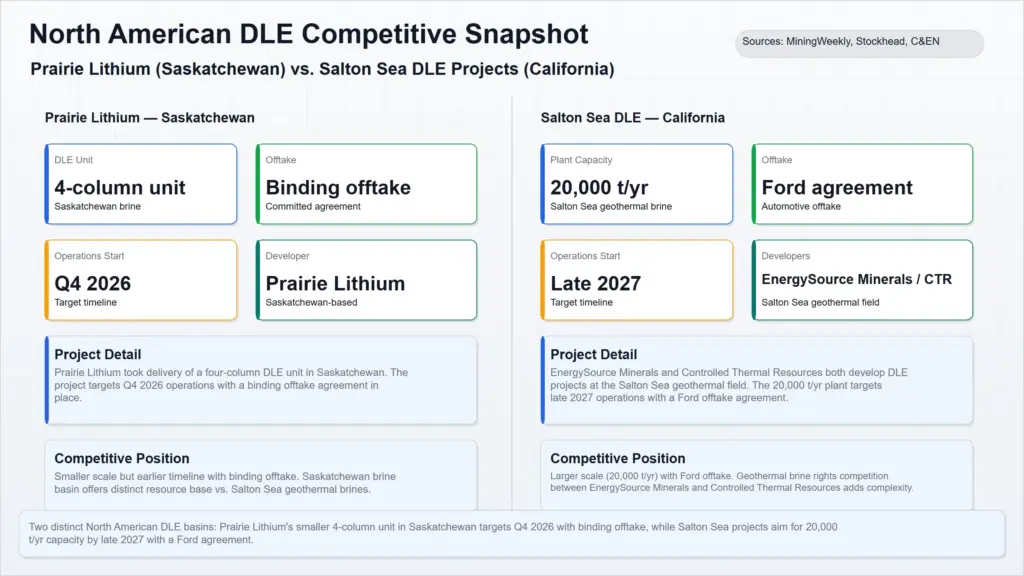
- Direct lithium extraction is scaling commercially in North America. Prairie Lithium installed the largest DLE unit in Saskatchewan while Salton Sea projects attract DOE backing, heightening competition for geothermal brine rights.
- European lithium supply advanced with Vulcan Energy’s €2.2 billion financing for the Lionheart project, while the Harfang-Eramet joint venture in Quebec signals renewed exploration interest in hard-rock lithium.
- Coverage limitations: Official market-share data for top producers (Albemarle, SQM, and Ganfeng) is unavailable. Competitive positioning is inferred from project-level activity and financial close events.
Regulatory Intervention in African Lithium: Zimbabwe’s Export Quotas
In April 2026, Zimbabwe introduced lithium concentrate export quotas and re-imposed a 10% export tax on concentrates, with a full ban scheduled for 2027. The mines ministry required producers to submit written commitments on dedicated timelines to establish lithium sulphate plants before January 1, 2027, and to publish annual financial statements.
Six companies—mostly controlled by Chinese groups—received quotas:
-
- Sinomine (Bikita Minerals)
- Chengxin Lithium (Sabi Star)
- Sichuan Yahua (Kamativi)
- Huayou Cobalt (Arcadia)
- Tsingshan (Gwanda)
- Kuvimba Mining (Sandawana)
The policy compels miners to localize processing, shifting investment burdens from concentrate exports toward plant construction. Bikita and Kamativi are already building lithium sulphate plants, reflecting the capital-intensive transition accelerated by the quota system. This regulatory intervention changes African lithium supply flows and favors producers with sufficient financial capacity to develop downstream processing facilities.
Vertical Integration and Supply Security: Automakers as Lithium Producers
Tesla operates its own lithium hydroxide refinery in Corpus Christi, Texas—the first spodumene-to-hydroxide refinery in North America. The facility broke ground in 2023, became operational in 2025, and represents an investment exceeding US$1 billion.
Its acid-free process uses an alkaline leach route, eliminates the approximately 32,000 km transport chain that traditionally sends ore to Asia for processing, and targets 50 GWh of battery material output annually, sufficient for approximately one million electric vehicles.
Simultaneously, Tesla has secured multi-year supply agreements with two of the world’s largest lithium producers:
-
- Ganfeng Lithium (2022–2024) for battery-grade lithium hydroxide.
- Albemarle Corporation (US$1.2 billion agreement effective 2026), covering an estimated 80,000 metric-ton LCE deficit.
This dual strategy—combining captive refining with diversified offtake agreements—places increasing competitive pressure on traditional refiners to match Tesla’s cost efficiency, supply security, and contract terms. Other automakers are expected to pursue similar vertical integration strategies, further reducing margins and contract flexibility for independent lithium processors.
Competitive Dynamics of Tesla’s Lithium Sourcing Strategy
| Participant | Relationship | Competitive Dimension | Product / Customer | Geography | Measured Basis |
|---|---|---|---|---|---|
| Tesla | Captive refiner | Vertical integration | Battery-grade lithium hydroxide; internal use | Corpus Christi, Texas | US$1 billion investment; 50 GWh capacity; operational 2025 |
| Ganfeng Lithium | Supplier to Tesla | Competing for offtake | Battery-grade lithium hydroxide; Tesla | China → US | Multi-year agreement (2022–2024); value not disclosed |
| Albemarle Corporation | Supplier to Tesla | Competing for offtake | Lithium compounds; Tesla | Global → US | US$1.2 billion agreement effective 2026; addresses forecast 80,000-t LCE deficit |
Direct Lithium Extraction: The Battle for North American Brine
Direct lithium extraction (DLE) is moving from pilot to commercial scale in North America, with multiple projects racing to secure brine rights, technology partnerships, and offtake agreements.
Prairie Lithium – Saskatchewan
Prairie Lithium took delivery of a four-column DLE unit at its Prairie project in Saskatchewan, representing North America’s largest commercial DLE unit. The unit is approximately four times larger than the C-DLE system deployed at Standard Lithium’s Arkansas project, where a single column was installed in March 2024. Prairie has already completed production and disposal wells, electrical infrastructure, and power transformer installation on site. Commissioning remains on track for Q4 2026. All Phase 1 production has been secured under a binding 100% offtake agreement with Hydro Lithium.
Salton Sea – California
Two developers—EnergySource Minerals and Controlled Thermal Resources—are competing for geothermal brine rights at the Salton Sea field in Imperial County, California.
EnergySource received a US$1.4 billion DOE loan and plans to construct a DLE facility capable of producing 20,000 tonnes per year of lithium hydroxide. Trial operations are scheduled for 2026, with full commercial production expected by the end of 2027. EnergySource has secured investment from SLB and Livent (now part of Rio Tinto), together with a 2023 offtake agreement with Ford.
Controlled Thermal Resources is also developing projects within the same geothermal field, although detailed production capacity and financing information has not been publicly disclosed. Competition for geothermal brine resources and DOE financial support creates a winner-take-most dynamic within the U.S. lithium supply chain.
Competitive Dynamics of North American DLE Projects
| Participant | Relationship | Competitive Dimension | Geography | Measured Basis |
|---|---|---|---|---|
| Prairie Lithium | DLE developer | Scale and offtake | Saskatchewan, Canada | Four-column DLE unit (largest in North America); 100% binding offtake with Hydro Lithium; commissioning Q4 2026 |
| EnergySource Minerals | DLE developer | DOE backing and offtake | California, US | US$1.4 billion DOE loan; 20,000 t/yr lithium hydroxide capacity; Ford offtake agreement; trial operations 2026; full production late 2027 |
European and Canadian Project Momentum: Financing and Exploration Partnerships
Vulcan Energy – Lionheart, Germany
Vulcan Energy Resources reached financial close on Phase 1 of its Lionheart lithium and renewable energy project in Germany’s Upper Rhine Valley.
The project targets:
-
- 24,000 tonnes per year of battery-quality lithium hydroxide monohydrate (LHM).
- Production sufficient for approximately 500,000 EV batteries annually.
- 275 GWh/year of renewable electricity.
- 560 GWh/year of renewable heat.
Vulcan secured a €2.2 billion financing package in December 2025, including €250 million from the European Investment Bank, together with financing from commercial banks and export credit agencies.
Project infrastructure includes:
-
- A geothermal-lithium extraction facility in Landau.
- A central lithium processing plant located within the Höchst Industrial Park near Frankfurt.
This represents the largest project-specific financing package within the European lithium industry and positions Vulcan as a strategic domestic supplier for Europe’s battery manufacturing ecosystem.
Harfang & Eramet – Serpent Project, Quebec
In July 2026, Harfang Exploration signed a Letter of Intent with the Eramet Group covering the Serpent Project in Eeyou Istchee James Bay, Quebec.
Under the proposed framework:
-
- Eramet may earn up to 65% ownership.
- Eramet will fund 100% of exploration expenditures across three phased earn-in stages.
- The program culminates in completion of a Preliminary Economic Assessment (PEA).
- Harfang receives staged cash payments.
- Harfang remains operator of day-to-day exploration activities.
Exploration focuses primarily on lithium mineralization along the Améliane–Milou spodumene corridor.
Although still at an early exploration stage, the partnership combines Eramet’s mining and processing expertise with Harfang’s strategic land position, creating an additional competitive front within Canada’s hard-rock lithium sector.
Comparison of Project Scale and Advancement
| Project | Capacity / Scale | Technology | Offtake / Customer | Timeline to Production | Region |
|---|---|---|---|---|---|
| Vulcan – Lionheart | 24,000 t/yr lithium hydroxide monohydrate; 275 GWh renewable power; 560 GWh renewable heat | Geothermal brine with DLE | No specific offtake disclosed; targets European battery and automotive sectors | Financial close December 2025; construction underway | Germany (Upper Rhine Valley) |
| Harfang–Eramet – Serpent | Exploration stage; no production capacity yet | Hard-rock spodumene | None (Pre-PEA stage) | Preliminary Economic Assessment expected within four years | Quebec, Canada |
| EnergySource – Salton Sea | 20,000 t/yr lithium hydroxide | Geothermal brine with DLE | Ford (2023 offtake agreement) | Trial operations 2026; full production late 2027 | California, US |
| Prairie Lithium | Four-column DLE unit (largest in North America) | Direct Lithium Extraction (DLE) | 100% binding offtake agreement with Hydro Lithium | Commissioning Q4 2026 | Saskatchewan, Canada |
Value Chain
Lithium Mining Value Chain
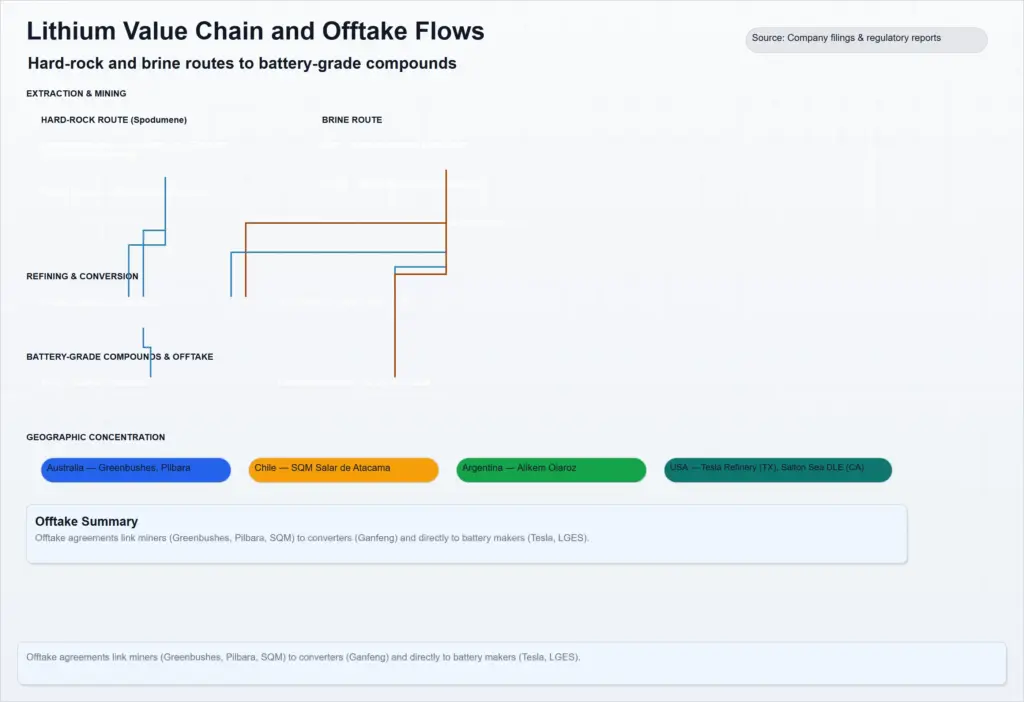
The lithium mining value chain encompasses the extraction of lithium from hard-rock spodumene or brine and its initial processing into spodumene concentrate, lithium carbonate, or lithium hydroxide. Two production routes dominate: Australian hard-rock mining and South American brine evaporation. Downstream battery manufacturers and automakers are integrating upstream through direct refining and multi-year offtake agreements, while direct lithium extraction (DLE) technologies and new North American projects aim to broaden supply sources.
Key Takeaways
-
- Hard-rock spodumene (Greenbushes, 1.95 Mt/year) and brine evaporation (Salar de Atacama and Olaroz) remain the principal lithium supply routes. Direct lithium extraction (DLE) projects in North America are emerging but have not yet reached large-scale commercial deployment.
- Tesla’s lithium hydroxide refinery in Texas is the first spodumene-to-battery-grade lithium hydroxide refinery in North America, bypassing traditional Asian conversion facilities.
- Multi-year offtake agreements—including SQM–LG Energy Solution (up to 100,000 tonnes LCE) and Pilbara Minerals–Ganfeng Lithium (up to 310 ktpa spodumene concentrate)—secure long-term supply volumes and provide demand visibility, although pricing remains linked to prevailing market conditions.
Global Production Base: Hard-Rock and Brine Operations
Lithium mining is currently concentrated in Australia, Chile, and Argentina, reflecting two dominant extraction methods.
The Greenbushes Mine in Western Australia is the world’s largest hard-rock lithium operation, producing approximately 1.95 million tonnes of spodumene concentrate annually.
Ownership is divided through the Talison Lithium joint venture:
-
- Tianqi Lithium Corporation – 51%
- Albemarle Corporation – 49%
Spodumene concentrate produced at Greenbushes is subsequently processed into lithium hydroxide for battery manufacturing.
In Chile, Sociedad Química y Minera (SQM) extracts lithium-rich brine from the Salar de Atacama under a CORFO lease covering approximately 1,400 km².
The lease remains valid until December 31, 2030.
SQM’s production process includes:
-
- Pumping lithium-bearing brine from underground wells.
- Concentrating lithium through solar evaporation.
- Producing lithium carbonate and lithium hydroxide.
In Argentina, Allkem Limited operates the Olaroz Lithium Facility, producing lithium carbonate from brine.
The operation currently includes:
-
- Initial production capacity of 17,500 tonnes per year.
- Planned expansion to 42,500 tonnes per year.
In the United States, Albemarle Corporation’s Silver Peak operation in Nevada remains the country’s only active commercial brine-based lithium operation.
The facility produces lithium carbonate through:
-
- Solar evaporation ponds.
- A downstream conversion plant.
Collectively, these operations demonstrate the strong geographic concentration of global lithium production.
-
- Australia dominates hard-rock spodumene production.
- The Lithium Triangle (Chile and Argentina) supplies most global brine-based lithium.
- North America currently has only one producing commercial brine operation—Silver Peak.
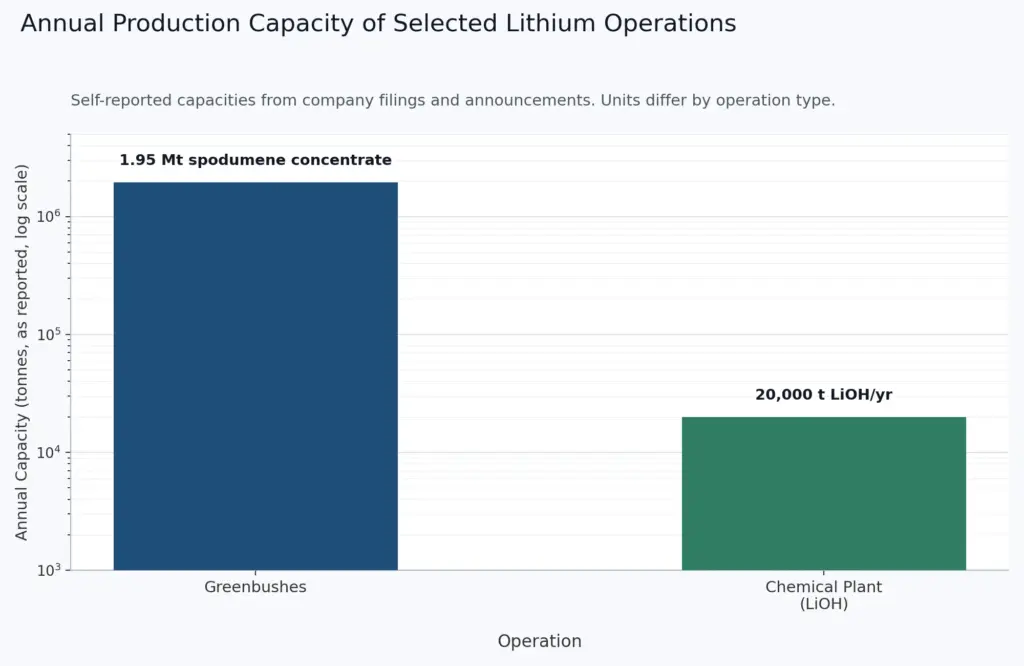
Major Lithium Operations and Their Characteristics
| Operation | Type | Location | Annual Capacity | Primary Product | Ownership |
|---|---|---|---|---|---|
| Greenbushes | Hard-rock (spodumene) | Western Australia | 1.95 million tonnes spodumene concentrate | Spodumene concentrate | Tianqi (51%) / Albemarle (49%) |
| Salar de Atacama (SQM) | Brine evaporation | Antofagasta, Chile | Not disclosed in source material | Lithium carbonate / Lithium hydroxide | SQM (CORFO lease approximately 1,400 km²) |
| Olaroz | Brine evaporation | Jujuy, Argentina | 17,500 t/year (initial); 42,500 t/year (ultimate) | Lithium carbonate | Allkem Limited |
| Silver Peak | Brine evaporation | Nevada, USA | Not disclosed | Lithium carbonate | Albemarle Corporation |
Downstream Integration and Long-Term Offtake Agreements
Automobile manufacturers and battery producers are reshaping the lithium value chain through direct ownership of refining assets and long-term procurement agreements.
These arrangements:
-
- Secure long-term raw material supply.
- Improve demand visibility for producers.
- Reduce reliance on traditional third-party lithium converters.
Tesla operates a lithium hydroxide refinery in Corpus Christi, Texas.
The refinery:
-
- Converts spodumene concentrate directly into battery-grade lithium hydroxide.
- Uses an acid-free refining process.
- Produces anhydrite as a co-product.
The facility represents the first spodumene-to-lithium hydroxide refinery in North America.
Project milestones include:
-
- Construction began in 2023.
- Kiln operations commenced during 2024.
- Integrated plant startup began during 2025.
Tesla states that the refinery has production capacity equivalent to approximately 50 GWh of battery capacity.
The refinery allows Tesla to purchase spodumene concentrate directly and complete refining internally, reducing dependence on external conversion facilities.
Long-term offtake agreements are also strengthening integration across the lithium supply chain.
Key agreements include:
-
- Ganfeng Lithium → Tesla
- Battery-grade lithium hydroxide.
- Contract period: 2022–2024.
- Volume not publicly disclosed.
- SQM → LG Energy Solution
- Battery-grade lithium carbonate and lithium hydroxide.
- Original agreement: approximately 55,000 tonnes LCE (2021–2029).
- Revised agreement: 100,000 tonnes LCE (2023–2029).
- Pilbara Minerals → Ganfeng Lithium
- Up to 310 ktpa of spodumene concentrate.
- Calendar years 2024–2026.
- Prices determined using prevailing market rates.
- Ganfeng Lithium → Tesla
These agreements demonstrate that downstream manufacturers increasingly secure long-term lithium supply without fixing future pricing.
Unlike procurement agreements, Tesla’s vertically integrated refinery enables the company to capture refining margins while reducing exposure to external processing markets.
Key Offtake Agreements in the Lithium Value Chain
| Supplier | Buyer | Product | Volume | Period |
|---|---|---|---|---|
| Ganfeng Lithium | Tesla | Battery-grade lithium hydroxide | Not disclosed | 2022–2024 |
| SQM | LG Energy Solution | Lithium carbonate / Lithium hydroxide | Approximately 55,000 t LCE (2021–2029); superseded by 100,000 t (2023–2029) | Original: 2021–2029; Revised: 2023–2029 |
| Pilbara Minerals | Ganfeng Lithium | Spodumene concentrate | Up to 310 ktpa | 2024–2026 |
Emerging Projects and Technology Shifts: Direct Lithium Extraction and North American Diversification
New extraction technologies and development projects in North America aim to reduce dependence on Chilean brine and Australian hard-rock supply, although most remain in the development stage.
EnergySource Minerals – Salton Sea Direct Lithium Extraction Project
EnergySource Minerals is developing a direct lithium extraction (DLE) project at the Salton Sea geothermal field in Imperial County, California.
The U.S. Department of Energy has issued a conditional commitment for a direct loan of up to US$1.36 billion (comprising US$1.22 billion in principal and US$141 million in capitalized interest) to finance the project.
The project is expected to:
-
- Produce 20,000 metric tonnes of lithium hydroxide annually.
- Supply lithium equivalent to approximately 52 GWh of battery capacity each year.
The DLE process extracts lithium from geothermal brine while using significantly less water and land than conventional evaporation ponds, offering potential environmental advantages.
Other North American Lithium Projects
Several additional projects are intended to diversify North American lithium production.
- Lithium Americas – Thacker Pass (Nevada, USA)
- Claystone-hosted lithium deposit.
- Planned integrated lithium processing plant.
- Standard Lithium – Southwest Arkansas Project (USA)
- Direct lithium extraction from Smackover Formation brine.
- Covers approximately 22,000 gross acres.
- Targets production of battery-grade lithium carbonate.
- Bacanora Lithium – Sonora Project (Mexico)
- Integrated lithium processing facility included within project development.
Outside North America, Ganfeng Lithium operates the Mariana Lithium-Potash Project in Salta, Argentina.
The project:
- Entered production during 2025.
- Followed approximately US$790 million of investment.
- Targets annual production of 20,000 metric tonnes of lithium chloride.
Strategic Implications
These projects demonstrate increasing efforts to diversify global lithium supply away from its traditional dependence on:
-
- Chilean brine operations.
- Australian hard-rock mining.
Federal incentives are playing an important role in supporting project development.
A notable example is the U.S. Department of Energy’s US$1.36 billion conditional loan commitment supporting EnergySource Minerals.
However, most projects remain under development, and commercial production schedules continue to carry uncertainty.
Direct lithium extraction technologies offer important potential advantages, including:
-
- Reduced water consumption.
- Lower land-use requirements.
- Improved environmental performance compared with conventional evaporation ponds.
Despite these benefits, publicly available evidence remains insufficient to independently assess:
-
- Commercial operating costs.
- Long-term scalability.
- Competitiveness relative to conventional lithium extraction technologies.
Investment Activity
Global Lithium Mining Investment Activity
In 2026, lithium mining investment was characterizedGlobal by large-scale project financings led by diversified mining and energy majors, alongside strategic equity deals that signal technology and geographic diversification. Major capital commitments were disclosed for five projects spanning Nevada, Argentina, Germany, Chile, and Ghana. All major commitments target production after 2027, raising questions about the pace of supply growth from earlier-stage assets not captured in this packet.
Key Takeaways
-
- Three advanced-stage projects—Thacker Pass, Rincon, and Lionheart—attracted combined project financing and capital expenditure guidance supported by multilateral lenders, sovereign export credit agencies, and U.S. Department of Energy loans.
- Oil major Eni entered lithium mining through a US$225 million equity investment in the Black Giant DLE project in Chile, reflecting a technology- and decarbonization-driven diversification strategy.
- Chinese battery materials company Zhejiang Huayou Cobalt agreed to acquire Atlantic Lithium’s Ewoyaa project in Ghana for approximately US$210 million, expanding its upstream footprint in Africa.
- All major production targets are scheduled for 2027 or later, implying that near-term supply growth will rely on assets outside the scope of this analysis.
- The Americas and Europe attracted the largest disclosed investments, while African assets experienced increased acquisition activity from Chinese investors at comparatively smaller transaction values.
Major Project Financing and Capex Guidance
Three major lithium developments—Thacker Pass (Nevada), Rincon (Argentina), and Lionheart (Germany)—account for the majority of publicly disclosed capital commitments during 2026, each supported by institutional lenders or sovereign financing.
Thacker Pass (Lithium Americas)
In February 2026, Lithium Americas announced Phase 1 capital expenditure guidance of US$1.3 billion to US$1.6 billion for the Thacker Pass project in Humboldt County, Nevada.
The guidance includes:
-
- US$1.2 billion–US$1.5 billion in construction costs.
- US$30 million–US$40 million in other capitalized development costs.
- US$45 million–US$55 million in capitalized interest associated with a U.S. Department of Energy loan.
The company continues to target late 2027 for completion of Phase 1.
Rincon (Rio Tinto)
In March 2026, Rio Tinto secured a US$1.175 billion project financing package for the Rincon lithium project in Salta, Argentina.
The project has an estimated total development cost of US$2.5 billion and targets annual production of approximately 60,000 tonnes of battery-grade lithium carbonate equivalent (LCE).
Financing sources include:
-
- International Finance Corporation (IFC): US$400 million
- IDB Invest: US$100 million
- Export Finance Australia: US$275 million
- Japan Bank for International Cooperation (JBIC): US$240 million, plus US$160 million in JBIC-backed commercial loans.
Lionheart (Vulcan Energy Resources)
In May 2026, Vulcan Energy Resources achieved financial close on a €2.2 billion (approximately US$3.9 billion) funding package for its Lionheart integrated lithium hydroxide monohydrate (LHM) and renewable energy project in Germany’s Upper Rhine Valley.
The project targets:
-
- 24,000 tonnes per year of lithium hydroxide monohydrate.
- Production sufficient for approximately 500,000 electric vehicle batteries annually.
- 275 GWh of renewable electricity generation annually.
The financing package combines equity and debt financing across the project, subsidiary, and corporate levels.
Comparison of Major Project Financings and Capex Commitments (2026)
| Project / Company | Investor or Operator | Geography | Amount / Financing | Target Capacity (t/y LCE or LHM) | Timing | Status |
|---|---|---|---|---|---|---|
| Thacker Pass Phase 1 | Lithium Americas (DOE loan supported) | Nevada, USA | US$1.3B–US$1.6B capex guidance (includes US$45M–US$55M DOE interest) | Not disclosed (Phase 1) | Late 2027 target | Under construction; capex guidance announced |
| Rincon Lithium Project | Rio Tinto (IFC, IDB Invest, Export Finance Australia, JBIC) | Salta, Argentina | US$1.175B financing package; total project cost US$2.5B | 60,000 | Construction advancing | Financing secured; under development |
| Lionheart Lithium Hydroxide Plant | Vulcan Energy Resources | Upper Rhine Valley, Germany | €2.2B (US$3.9B) funding package | 24,000 LHM | Not disclosed | Financial close achieved |
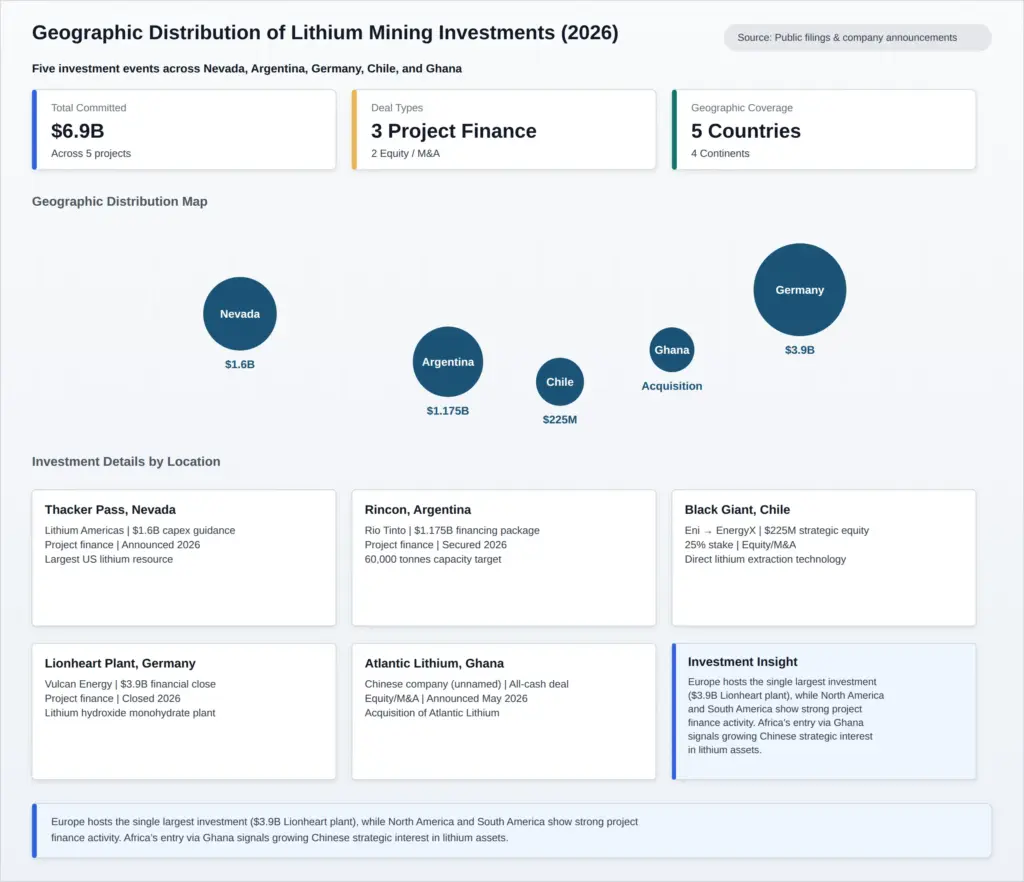
Strategic Equity Investments and M&A
Two transactions completed during 2026 illustrate divergent strategic approaches to lithium investment: an oil major’s technology-driven entry through direct lithium extraction (DLE) and a Chinese battery materials producer’s acquisition of a hard-rock lithium project in West Africa.
Eni / EnergyX (Black Giant Project, Chile)
In July 2026, Eni announced a US$225 million phased investment to acquire a 25% equity stake in Black Giant SpA, the Chilean subsidiary of U.S.-based EnergyX.
The Black Giant project is a direct lithium extraction (DLE) development located near Salar de Punta Negra in northern Chile and is designed as a closed-loop system utilizing brine reinjection.
The project development plan includes:
-
- Train 1 with 7.5 kt/year lithium carbonate equivalent (LCE) production by 2028.
- Expansion to 52.5 kt/year total production capacity by 2030.
- A seat on the Board of Directors for Eni.
The investment was executed through Eni Next, the company’s corporate venture capital division, highlighting Eni’s strategy of diversifying into low-carbon technologies and critical minerals.
Zhejiang Huayou Cobalt / Atlantic Lithium (Ewoyaa Project, Ghana)
In May 2026, Zhejiang Huayou Cobalt entered into a binding Scheme Implementation Deed to acquire Atlantic Lithium for US$0.25 per share, valuing the company at approximately US$210 million.
The acquisition includes:
-
- Atlantic Lithium’s flagship Ewoyaa Lithium Project in Ghana.
- Exploration assets located in Ghana and Côte d’Ivoire.
Atlantic Lithium’s largest shareholder, Assore International Holdings, holding approximately 26.4% of the company, publicly supported the transaction.
Huayou stated that the acquisition complements its existing African battery metals portfolio and strengthens its upstream supply position.
Comparison of Strategic Equity Investments and M&A Transactions (2026)
| Transaction | Investor / Acquirer | Target / Asset | Geography | Amount | Stake / Control | Technology / Stage | Strategic Purpose |
|---|---|---|---|---|---|---|---|
| Eni investment in Black Giant | Eni (through Eni Next) | Black Giant SpA (EnergyX subsidiary) | Chile (Salar de Punta Negra) | US$225 million (phased) | 25% equity stake plus board representation | Direct Lithium Extraction (DLE); 7.5 kt/y LCE by 2028, 52.5 kt/y by 2030 | Technology diversification and decarbonization strategy |
| Huayou Cobalt acquisition of Atlantic Lithium | Zhejiang Huayou Cobalt | Atlantic Lithium (Ewoyaa Project) | Ghana and Côte d’Ivoire | Approximately US$210 million (US$0.25/share) | Full acquisition | Hard-rock spodumene project under development | Expansion of African upstream lithium portfolio and integration with existing battery metals operations |
Visualization Recommendation
Create a world map or bubble chart showing all five major investment events by location:
-
- Nevada, USA – Thacker Pass
- Salta, Argentina – Rincon
- Upper Rhine Valley, Germany – Lionheart
- Salar de Punta Negra, Chile – Black Giant
- Ghana – Ewoyaa
The visualization should display:
-
- Investment amount.
- Deal type (Project Financing vs. Equity Investment vs. M&A).
- Current project status.
- Geographic distribution.
- Strategic partners and financing participants.
- Planned production capacity or capacity implications where disclosed.
Suggested data sources: Public company filings and official company announcements.
Technology & Innovation
Technology Landscape in Lithium Mining
The technology chapter examines the transition of direct lithium extraction (DLE) from pilot to near-commercial scale across multiple projects, alongside emerging hard-rock and solvent-based processes, collectively reshaping supply security, cost structures, and environmental profiles of lithium mining.
Key Takeaways
-
- At least six DLE projects reached pilot or demonstration stage during 2025–2026, with capacities ranging from 250 tpa (EnergyX) to 20,000 tpa (EnergySource), demonstrating rapid technology maturation.
- Government and corporate funding commitments exceed US$1.4 billion (including the DOE loan to EnergySource), together with strategic private investments from Rio Tinto, SLB, and POSCO, validating the strategic importance of DLE technology.
- Novel extraction methods for hard-rock resources (MIT low-temperature processing) and clay resources (superacidic deep eutectic solvent technology) promise to reduce production costs and environmental impacts but remain at laboratory or early pilot stages.
- Compared with conventional brine evaporation, DLE technologies offer significantly lower water and land requirements, creating an important advantage for regulatory approval and community acceptance.
- Partnerships between technology developers and major mining companies—including Rio Tinto/ILiAD and POSCO/Anson—demonstrate an industry shift toward collaborative commercialization rather than entirely in-house technology development.
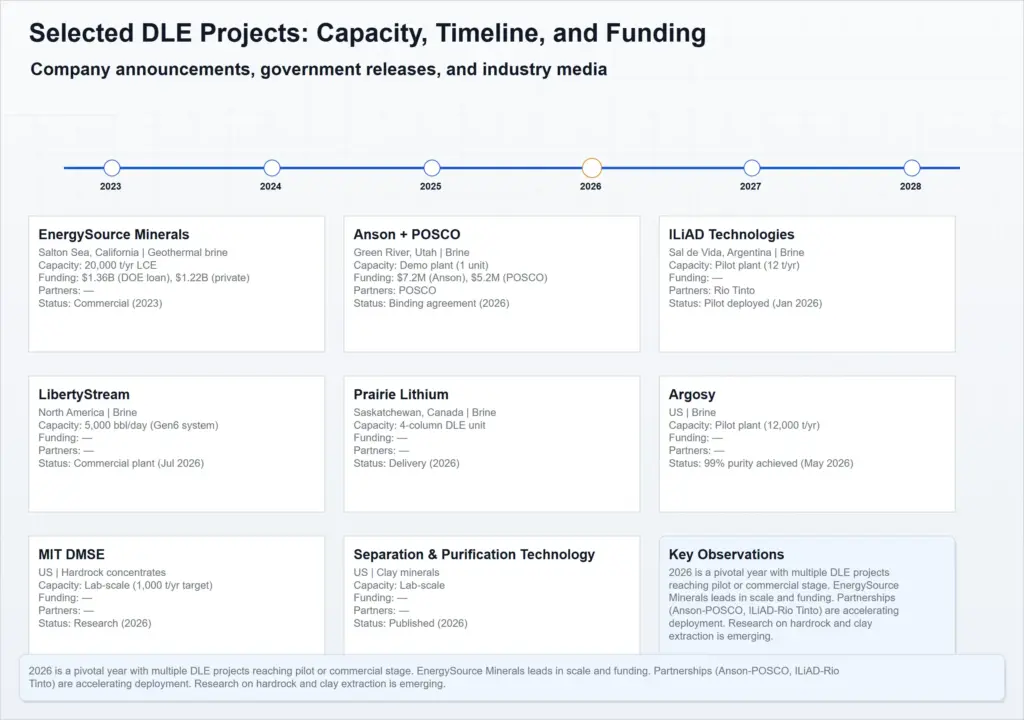
Direct Lithium Extraction: The Accelerating Deployment Race
Multiple direct lithium extraction (DLE) projects achieved pilot or demonstration milestones during 2025–2026, supported by significant corporate investment and government funding.
These projects span:
-
- Geothermal brines in California.
- Oil-field brines in Utah and Texas.
- Sedimentary brines in Saskatchewan and Argentina.
EnergySource Minerals – Project ATLiS (Salton Sea, California)
The U.S. Department of Energy issued a conditional commitment for a US$1.36 billion loan supporting construction of a facility capable of producing up to 20,000 metric tonnes per year of battery-grade lithium hydroxide from geothermal brine.
The project schedule includes:
-
- Trial operations during 2026.
- Full commercial production by the end of 2027.
EnergySource has secured:
-
- Strategic investments from SLB.
- Strategic investments from Livent (now part of Rio Tinto).
- A lithium offtake agreement with Ford, signed in 2023.
Anson Resources / POSCO (Green River, Utah)
In June 2026, Anson Resources executed a binding demonstration plant agreement with POSCO Holdings.
Under the agreement:
-
- POSCO will design the demonstration plant.
- POSCO will construct the demonstration plant.
- POSCO will operate its proprietary DLE technology at Anson’s Green River project.
- Anson will receive approximately US$5.2 million as a facilitation payment.
The demonstration facility is intended to validate the commercial deployment of POSCO’s DLE technology using Green River brines.
Aquatech / Prairie Lithium (Saskatchewan, Canada)
Aquatech will supply North America’s largest DLE unit to Prairie Lithium.
The modular Quadpod™ system consists of:
-
- Four full-scale Li-Pro™ extraction columns.
The system is scheduled for delivery during summer 2026.
Aquatech reports that its Li-Pro LSS technology has successfully completed:
-
- More than 15,000 DLE operating cycles.
- Processing of more than 1 million barrels of lithium-bearing brine.
EnergyX – Project Lonestar (United States)
In March 2026, EnergyX commissioned Project Lonestar, a 250-tonne-per-year direct lithium extraction production facility located in the United States.
The project:
-
- Produces lithium directly from brine resources.
- Represents an important commercial-scale milestone for EnergyX’s proprietary technology.
ILiAD Technologies / Rio Tinto – Sal de Vida (Argentina)
In January 2026, ILiAD Technologies deployed an advanced DLE pilot unit at Rio Tinto’s Sal de Vida Project in Catamarca, Argentina.
The pilot incorporates:
-
- ILiAD+ technology enhancements.
- Real-world testing of scalability.
- Efficiency validation.
- Selectivity testing under operating conditions.
The deployment expands the strategic partnership established in 2023, when Rio Tinto (then Livent) invested in ILiAD Technologies.
LibertyStream (Freedom Launchpad, United States)
In July 2026, LibertyStream commissioned its fully automated Generation 6 (Gen 6) lithium extraction system.
The Gen 6 platform:
-
- Processes approximately 5,000 barrels of brine per day.
- Produces lithium carbonate for customer qualification and training through the Freedom Launchpad facility.
The company is simultaneously preparing construction of Freedom 1, its first 1,000-tonne-per-year commercial production facility.
Prairie Lithium (Commercial DLE Delivery)
During July 2026, Prairie Lithium received delivery of a four-column DLE processing unit, currently the largest commercial DLE system deployed in North America.
The unit:
-
- Is approximately four times larger than the single-column system operating at Standard Lithium’s Arkansas project.
- Will be installed at Prairie Lithium’s Saskatchewan development.
- Will utilize existing production wells and electrical infrastructure already in place.
Argosy Minerals – Rincon Project (Argentina)
In May 2026, Argosy Minerals reported successful pilot plant testing for its 12,000-tonne-per-year Rincon Project.
Testing achieved:
-
- 99% lithium chloride purity.
- Maximum lithium recovery of 94.4%.
These results support the commercial scalability of the company’s concentrated brine processing technology.
Comparison of Advanced Direct Lithium Extraction Projects (2025–2026)
| Developer | Location | Resource Type | Capacity (tpa LCE or LiOH) | Timeline | Key Partners | Funding Source |
|---|---|---|---|---|---|---|
| EnergySource Minerals | Salton Sea, California, USA | Geothermal brine | 20,000 tpa LiOH | Trials 2026; commercial production 2027 | SLB, Livent (Rio Tinto), Ford (offtake) | DOE conditional loan – US$1.36 billion |
| Anson Resources / POSCO | Green River, Utah, USA | Brine (Paradox Basin) | Demonstration plant (capacity not disclosed) | Agreement June 2026; demonstration construction underway | POSCO Holdings | POSCO-funded; US$5.2 million facilitation fee |
| Aquatech / Prairie Lithium | Saskatchewan, Canada | Sedimentary brine | Four-column commercial DLE unit (capacity not disclosed) | Delivery Summer 2026; commissioning Q4 2026 | Prairie Lithium | Private funding |
| EnergyX | United States | Brine | 250 tpa | Commissioned March 2026 | — | Private funding |
| ILiAD Technologies | Sal de Vida, Catamarca, Argentina | Brine | Pilot unit (capacity not disclosed) | Deployed January 2026 | Rio Tinto | Strategic Rio Tinto investment (2023) |
| LibertyStream | Freedom Launchpad, USA | Oil-field brine | Gen 6 system (5,000 barrels/day); Freedom 1 (1,000 tpa planned) | Gen 6 commissioned July 2026; Freedom 1 under development | — | Private funding |
| Prairie Lithium (Commercial Delivery) | Saskatchewan, Canada | Brine | Largest four-column DLE unit in North America | Delivered July 2026 | Aquatech | Private funding |
| Argosy Minerals | Rincon, Salta, Argentina | Concentrated brine | Pilot supporting 12,000 tpa project | 99% purity achieved May 2026 | — | Private funding |
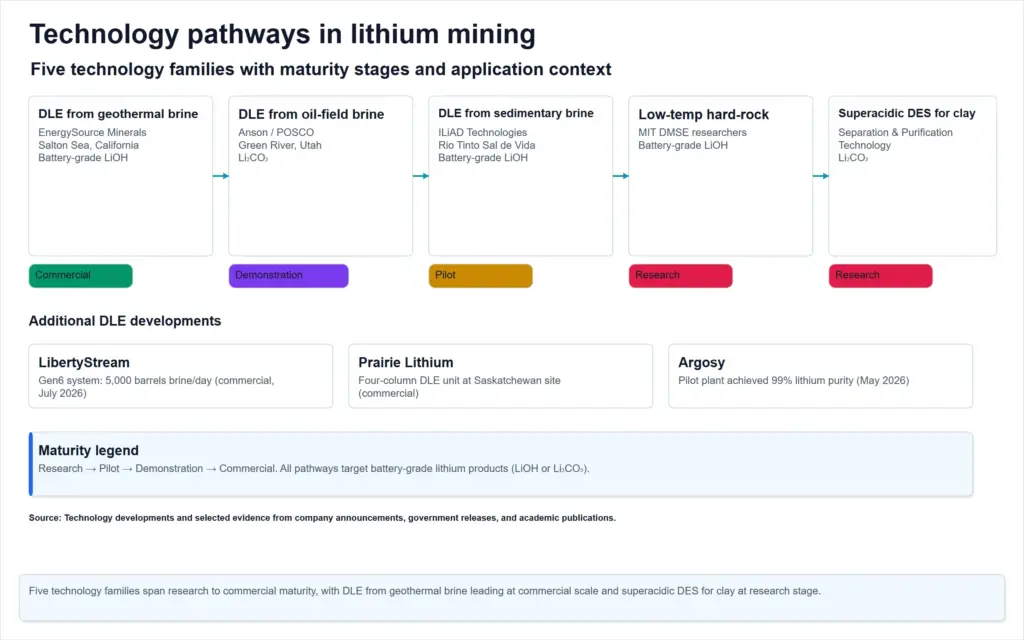
Emerging Extraction Technologies: Expanding the Resource Base
Beyond brine-focused direct lithium extraction (DLE), new extraction technologies are being developed to recover lithium from hard-rock and clay resources. These approaches have the potential to reduce dependence on conventional brine extraction while lowering production costs and environmental impacts.
Low-Temperature Hard-Rock Processing (MIT)
In May 2026, researchers at the Massachusetts Institute of Technology (MIT) reported a low-temperature process capable of producing battery-grade lithium from the common hard-rock mineral spodumene.
The process:
-
- Uses a liquid reagent to dissolve spodumene at temperatures well below the conventional 1,000°C roasting process.
- Significantly reduces energy consumption compared with traditional hard-rock processing.
- Minimizes waste generation during extraction.
- Allows recovery of additional mineral constituents contained within the ore.
The research was conducted by the MIT Department of Materials Science and Engineering and remains at the laboratory research stage. No pilot-scale program or commercial deployment timeline has been announced.
Superacidic Deep Eutectic Solvent for Clay Minerals
A 2026 study published in Separation and Purification Technology demonstrated a superacidic urea–methanesulfonic acid (MSA) deep eutectic solvent (DES) for selective lithium extraction from clay-bearing ores.
The optimized 1:2 urea–MSA system containing 20% water demonstrated:
-
- Superacidity of H₀ = –3.102.
- 100% extraction of lithium, sodium, and strontium.
- Only 23% aluminum dissolution.
- Only 6% potassium dissolution.
Compared with conventional extraction methods, the process achieved substantially greater selectivity:
-
- Conventional sulfuric acid extraction achieved approximately 4% lithium recovery.
- Citric acid extraction achieved approximately 92% lithium recovery.
- The DES process achieved 100% lithium extraction while substantially reducing unwanted element dissolution.
The technology currently exists only as an academic research study, and no industrial pilot or commercial scale-up program has been announced.
Strategic Implications: Supply Security, Cost, and Environmental Impact
The accelerating deployment of DLE technologies together with emerging extraction methods has significant implications for lithium supply security, production costs, and environmental performance.
Supply Security
The U.S. Department of Energy’s US$1.36 billion conditional loan to EnergySource Minerals demonstrates strong federal support for domestic lithium supply chains based on direct lithium extraction.
Together with projects in:
-
- Canada (Prairie Lithium).
- Argentina (Rio Tinto/ILiAD).
- Argentina (Argosy Minerals).
DLE technologies are expanding lithium production capacity outside China, which continues to dominate global lithium refining.
If successfully commercialized, MIT’s low-temperature hard-rock process could further expand lithium production opportunities across:
-
- The United States.
- Australia.
- Europe.
The technology would eliminate the energy-intensive roasting process that currently limits the competitiveness of many hard-rock deposits.
Cost and Environmental Benefits
According to the U.S. Department of Energy, direct lithium extraction:
- Requires less water than conventional evaporation ponds.
- Requires less land than conventional brine evaporation methods.
LibertyStream reports that its Generation 6 system reduces extraction cycle time:
- Approximately 60 minutes using Generation 5 technology.
- Approximately 20 minutes using Generation 6 technology.
This improvement substantially increases operational efficiency.
For hard-rock resources, MIT’s low-temperature extraction process offers the potential to:
- Reduce overall energy consumption.
- Lower operating costs.
- Minimize process waste compared with conventional 1,000°C roasting.
However, the available evidence does not include direct cost-per-kilogram comparisons between DLE technologies and conventional lithium extraction methods.
Participant Dynamics
Technology developers are increasingly commercializing their innovations through strategic partnerships rather than independent mine development.
Examples include:
- Aquatech partnering with Prairie Lithium.
- ILiAD Technologies partnering with Rio Tinto.
- EnergyX collaborating with major industry participants.
Major industrial companies are also investing directly in DLE technology.
These include:
- Rio Tinto (through the Livent acquisition and ILiAD investment).
- SLB.
- POSCO Holdings.
These investments indicate growing confidence that DLE will become a mainstream commercial extraction technology rather than remaining a niche innovation.
In addition, downstream manufacturers are beginning to support DLE-based supply chains.
For example:
- Ford signed an offtake agreement with EnergySource Minerals.
Such agreements may ultimately support premium pricing for lithium produced through extraction technologies with lower environmental footprints.
Limitations of Current Evidence
- Long-term cost comparisons between direct lithium extraction and conventional extraction technologies are not supported by publicly available evidence.
- Comparative performance metrics—including lithium recovery rates, energy consumption per tonne, and operating costs across competing DLE technologies—remain largely unavailable.
-
Emerging technologies such as MIT’s low-temperature hard-rock process and deep eutectic solvent extraction remain at laboratory or early pilot stages, with no confirmed commercialization timelines.
- Geographic coverage within the available evidence is concentrated primarily on the United States, Canada, and Argentina. Limited information is available for developments in Chile and China.
Visualization Recommendation
Illustrate the principal lithium extraction technology families, their current maturity levels, and their intended applications.
The visualization should compare:
- Direct lithium extraction from geothermal brine.
- Direct lithium extraction from oil-field brine.
- Direct lithium extraction from sedimentary brine.
- Low-temperature hard-rock extraction.
- Superacidic deep eutectic solvent extraction for clay resources.
For each technology, indicate:
- Technology maturity (research, pilot, demonstration, or commercial).
- Resource type.
- Primary application (battery-grade lithium hydroxide or lithium carbonate).
- Representative projects or developers.
Suggested data sources: Company announcements, government publications, and peer-reviewed academic research.
Market Risk
Key Takeaways
-
- Water scarcity under projected climate change could make 22 proposed U.S. lithium mines unviable in most subbasins by 2040–2060, forcing continued reliance on imports even if all mines enter production.
- Proposed U.S. critical-minerals trade blocs and Zimbabwe’s concentrate export ban are misaligned in timing. Domestic processing capacity in Zimbabwe will take years to build, creating a significant supply bottleneck.
- Major lithium projects in Chile and California are slipping 4–8 years from their original production targets because of permitting delays, technology hurdles, and legal challenges, widening the supply gap for downstream users.
- Environmental compliance incidents, including Sigma Lithium’s waste-pile fine, introduce operational disruption risks at producing mines that are separate from uncertainties affecting greenfield developments.
Water Scarcity and Environmental Compliance
Climate-Driven Water Constraints on U.S. Lithium Production
For U.S. lithium mining projects, water availability represents the most clearly quantified physical risk. Lithium extraction is highly water-intensive, while climate change is reducing water availability across the arid regions where most U.S. lithium deposits are located.
A comprehensive study conducted by the U.S. Geological Survey (USGS) and Northwestern University analyzed the single operating lithium mine and 22 proposed U.S. lithium projects under four socioeconomic-climate scenarios and five climate models.
Published in 2026, the research concluded that available water supplies across most subbasins are unlikely to support the water requirements of new lithium mines or even satisfy competing demands from agriculture, households, and industry.
The lead author concluded that even if every proposed lithium project reaches production, domestic resources alone will still be insufficient to satisfy U.S. demand, requiring continued reliance on imported lithium.
Water-use risks differ considerably across extraction technologies.
-
- Evaporation ponds consume significant quantities of water through atmospheric evaporation.
- Hard-rock mining requires water for ore processing and cooling while creating contamination risks from substances such as arsenic, making water recovery expensive.
- Direct lithium extraction (DLE) generally consumes less water because much of the brine is returned underground, although it still requires substantial energy and brine handling.
Consequently, projects utilizing water-intensive extraction methods within already water-stressed basins face the greatest long-term operational risk.
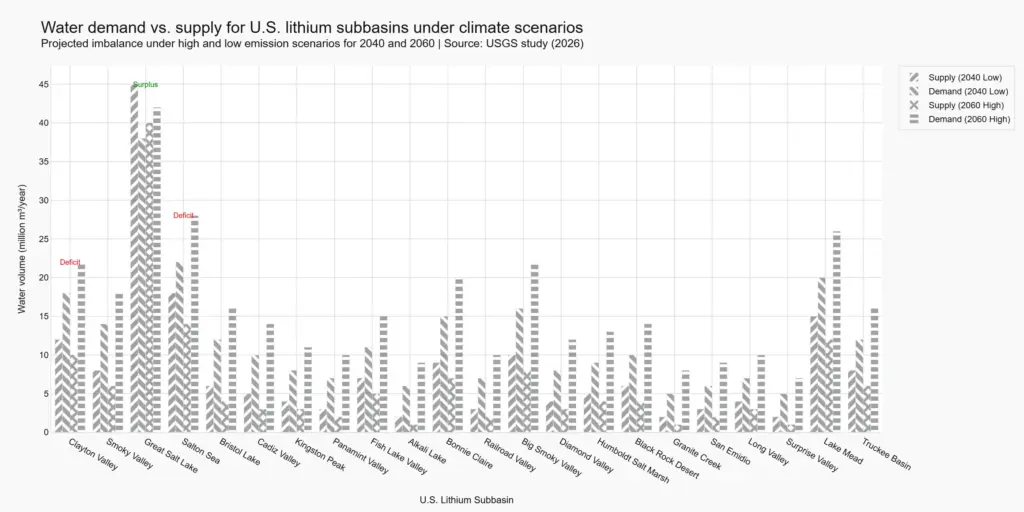
Water-Use Risk by Extraction Method (Based on USGS/Northwestern Study)
| Extraction Method | Water Consumption per Unit | Contamination Risk | Vulnerability to Water Scarcity |
|---|---|---|---|
| Evaporation (Brine) | High (water lost through evaporation) | Low (contained brine) | High – requires large brine volumes with permanent water loss |
| Hard-Rock Mining | Moderate to High (processing, washing, cooling) | High (arsenic and other contaminants) | High – contamination limits water reuse and competes with local users |
| Direct Lithium Extraction (DLE) | Lower (most water returned underground) | Low to Moderate | Moderate – lower consumption but still dependent on brine availability and energy |
Operational Compliance Risk: Sigma Lithium Waste-Pile Incident
Even operating mines remain vulnerable to regulatory compliance actions.
In May 2026, Brazilian labour inspectors fined Sigma Lithium 10,000 reais (approximately US$2,041) after determining that the company had deposited waste onto a storage pile that had previously been shut down because it posed a “grave and imminent” risk to workers and nearby communities.
The waste pile was located near a school, and authorities had previously documented a partial failure.
Inspectors also issued an additional penalty after the company refused inspectors access to its operating site.
Sigma Lithium stated that:
-
- The incident had no material impact on mining operations.
- Media reports surrounding the event were “fake news.”
Nevertheless, the incident demonstrates that tailings management, environmental compliance, and regulatory inspections remain significant operational risks, particularly in jurisdictions with active environmental enforcement.
Geopolitical Supply Chain Risks and Policy Shifts
U.S. Critical-Minerals Trade Bloc Proposal
The proposed U.S. critical-minerals trade bloc, announced in February 2026 by Vice President Vance, seeks to build a preferential alliance among critical-mineral-producing nations.
Approximately 55 countries attended the Washington meeting.
The proposal includes:
-
- Coordinated critical-mineral price floors.
- Reference pricing mechanisms across production stages.
- Tariff coordination among participating countries.
The initiative is intended to reduce China’s dominance across lithium processing and broader critical-mineral supply chains.
However, it also introduces significant uncertainty regarding pricing mechanisms, tariff implementation, and possible retaliatory actions.
Following the announcement, shares of several mining companies declined, reflecting investor concerns regarding potential disruption to existing global trade flows despite the proposal’s long-term strategic objectives.
Zimbabwe’s Export Ban and Processing Capacity Gap
Zimbabwe, Africa’s largest lithium producer, announced a January 2027 ban on lithium concentrate exports, accompanied by:
-
- A 16% export tax on concentrates.
- Export quotas for lithium concentrate.
The policy is intended to encourage domestic processing of battery materials.
However, Zimbabwe currently possesses very limited downstream processing capacity.
The country’s only lithium sulphate processing facility—owned by Zhejiang Huayou Cobalt (Prospect Lithium Zimbabwe)—produces approximately 400,000 tonnes of concentrate annually but cannot process third-party material.
Other producers, including:
-
- Sinomine’s Bikita Minerals
- Kamativi Mining
are constructing lithium sulphate facilities, but neither is expected to become operational before the export ban takes effect.
In June 2026, the Lithium Producers’ Association requested that implementation be delayed until mid-2027, but the Ministry of Mines has maintained its intention to proceed according to the original schedule.
The resulting mismatch between regulatory deadlines and available processing infrastructure creates the possibility of prolonged disruption to global lithium concentrate supply chains.
Policy Timeline Comparison
| Policy | Announcement / Effective Date | Key Details | Processing Capacity Readiness |
|---|---|---|---|
|
.S. Critical-Minerals Trade Bloc |
February 2026 (proposed) | 55 participating countries; coordinated price floors; reference pricing; tariff coordination | No domestic processing requirement; focuses on trade and investment |
| Zimbabwe Concentrate Export Ban | Effective January 2027 | Export ban; 16% export tax; quota system | Only one sulphate processing plant exists and cannot process third-party material; additional facilities remain under construction |
Project Development Delays and Permitting Uncertainty
Chile: Codelco–Rio Tinto Maricunga Project Slips to 2034
The Maricunga lithium project in Chile, a public-private partnership between Codelco and Rio Tinto, was originally scheduled to begin production in 2030. In July 2026, Codelco’s chairman informed the Senate Mining Committee that first production is now expected no earlier than 2034, representing a four-year delay.
The delay has been attributed primarily to:
-
- Lengthy permitting processes.
- Stakeholder consultation requirements.
- Environmental approval procedures.
The project development plan includes:
-
- Phase 1: Production of 15,000–20,000 tonnes per year of lithium carbonate equivalent (LCE) using conventional evaporation technology.
- Phase 2: Expansion to approximately 55,000 tonnes per year using direct lithium extraction (DLE).
The revised schedule demonstrates the growing difficulty of bringing large-scale lithium projects into production, even in jurisdictions with mature mining industries and strong government support.
California: Salton Sea DLE Project and Imperial Valley Legal Challenge
EnergySource Minerals is developing a direct lithium extraction (DLE) project within the Salton Sea geothermal field, supported by a US$1.4 billion loan from the U.S. Department of Energy.
The revised development schedule now includes:
-
- Trial operations during 2026.
- Commercial production of 20,000 metric tonnes per year of lithium hydroxide by the end of 2027.
This represents approximately a two-year delay from earlier expectations that commercial production would begin in 2025.
EnergySource has secured:
-
- Offtake agreements with Ford.
- Technology partnerships with SLB.
- Technology partnerships with Livent.
However, complex brine chemistry within the Salton Sea geothermal system has repeatedly delayed commercialization.
Hell’s Kitchen Project Legal Challenge
Separately, the Hell’s Kitchen geothermal lithium project in California’s Imperial Valley continues to face legal uncertainty.
The nonprofit organization Comite Civico del Valle argues that the project’s Environmental Impact Report prepared under the California Environmental Quality Act (CEQA) failed to adequately evaluate:
-
- Regional water supply impacts.
- Tribal cultural resources.
- Air quality impacts.
Although a lower court rejected the challenge, the organization has appealed the decision.
If the appeal succeeds, the project could experience:
-
- Additional permitting delays.
- Revision of environmental documentation.
- Further postponement of commercial production.
The legal uncertainty surrounding Hell’s Kitchen further increases timeline risk for California’s emerging lithium industry.
Project Timeline Comparison: Lithium Development Delays
| Project | Original First-Production Target | Current Estimate | Primary Cause of Delay |
|---|---|---|---|
| Maricunga (Chile) | 2030 | 2034 | Permitting, stakeholder consultation, and environmental approvals |
| Salton Sea DLE (California) | 2025 | End of 2027 | Technology scale-up and complex brine chemistry |
| Hell’s Kitchen (California) | 2024 (following project approval) | Uncertain (under appeal) | Legal challenge under CEQA; additional environmental review may be required |
Coverage Note
This assessment is limited to the evidence supplied and should be interpreted within those boundaries.
-
- The analysis does not quantify the impact of energy price volatility on lithium mining margins because only limited supporting evidence was available.
- A comprehensive supply-demand balance model has not been developed; therefore, the conclusions presented are directional rather than predictive.
- Water availability projections are based on four socioeconomic-climate scenarios and five climate models. Alternative climate pathways could materially alter projected outcomes.
- Zimbabwe’s export ban is assumed to become effective in January 2027. However, continued industry lobbying could result in implementation delays.
- Additional permitting, legal, or technical delays affecting the Maricunga or Salton Sea projects remain possible and could further postpone future lithium supply growth.
Regulatory Landscape
Macro Regulatory Trends in Lithium Mining
Governments across Zimbabwe, Mexico, Chile, Peru, and the United States are tightening control over lithium extraction and processing through export restrictions, state ownership mandates, and environmental permitting, reshaping the supply chain and forcing mining participants to adapt their investment and operational strategies. This chapter covers binding laws, decrees, permits, and official designations issued by these governments during 2025–2026, excluding non-regulatory market dynamics and jurisdictions not supported by claims.
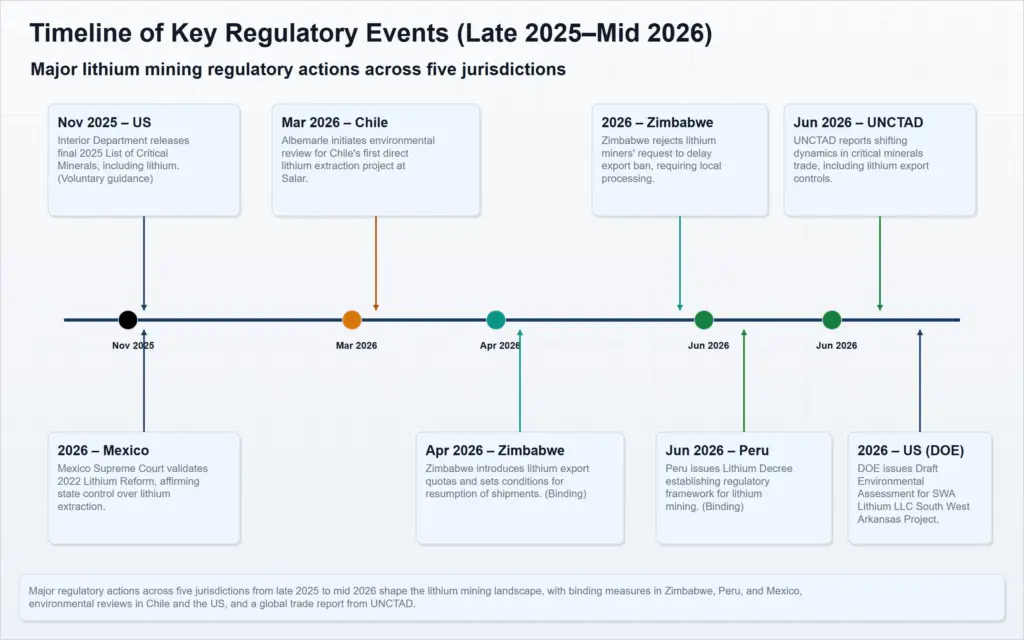
Key Takeaways
-
- Zimbabwe is enforcing a phased export ban on lithium concentrates with mandatory domestic processing by January 2027, rejecting industry pleas for delay and exposing a gap in local processing capacity.
- Mexico’s Supreme Court validated state exclusivity over lithium, while Peru and Chile are tightening state control through strategic mineral designations and public-private contracts, limiting private freehold access.
- Environmental permitting for direct lithium extraction (DLE) projects in Chile and the United States is advancing, creating regulatory templates while also introducing timeline uncertainty for developers.
- The United States’ inclusion of lithium on the 2025 Critical Minerals List signals federal priority but does not, by itself, grant permitting or funding approvals.
- Globally, nearly 100 export-related measures affecting critical minerals have been introduced since 2020, indicating a structural shift toward resource nationalism.
According to UNCTAD’s June 2026 Global Trade Update, nearly 100 export-related measures (including licensing requirements, taxes, and export bans) have been introduced for critical minerals since 2020.
Lithium demand is projected to increase by 353% between 2024 and 2040, while supply remains highly concentrated. Australia, Chile, and China together produced more than 70% of global lithium output in 2025. This concentration has encouraged governments to increasingly use trade policy to secure supply, strengthen domestic processing capacity, and reduce strategic dependence on foreign producers.
In the United States, the Department of the Interior, through the U.S. Geological Survey (USGS), published the final 2025 List of Critical Minerals on November 6, 2025, identifying 60 minerals considered essential to the nation’s economy and national security.
Lithium remains included on the list, which added 10 new minerals following updated assessment methodologies and public consultation.
Although inclusion on the Critical Minerals List does not automatically provide permitting approvals or funding, the designation establishes federal priority and influences future investment decisions, interagency coordination, and policy development.
Export Controls and Domestic Processing Requirements
Zimbabwe, Africa’s largest lithium producer, has implemented a sequence of progressively stricter export controls.
On February 26, 2026, the government suspended exports of lithium concentrates and other unprocessed minerals, citing mineral leakages and regulatory non-compliance.
In April 2026, Zimbabwe introduced export quotas together with conditions governing shipment approvals.
These conditions require mining companies to:
-
- Publish annual financial statements.
- Demonstrate compliance with labor, occupational safety, and environmental regulations.
- Submit written commitments and implementation schedules for constructing lithium sulphate processing plants before January 1, 2027.
A 10% export tax on lithium concentrates continues to apply until the complete export ban becomes effective.
Despite requests from the Lithium Producers Association of Zimbabwe for a grace period, Mines Minister Polite Kambamura confirmed on July 20, 2026, that the January 1, 2027 implementation date will not be postponed.
The minister noted that producers had already received formal notice during June 2025.
Zimbabwe currently has only one operational lithium sulphate processing facility, owned by Zhejiang Huayou Cobalt (Prospect Lithium Zimbabwe).
The facility:
-
- Has processing capacity of approximately 400,000 tonnes per year.
- Cannot process third-party concentrate, according to the mine manager.
Additional facilities under construction include:
-
- Sinomine Resource Group’s Bikita Minerals processing plant.
- Kamativi Mining Company processing plant.
However, neither facility is expected to become operational before the export ban takes effect.
These regulatory measures require lithium producers either to rapidly develop domestic processing capacity or risk losing access to export markets.
Until additional processing facilities become operational, the absence of third-party processing capacity is expected to create a significant bottleneck, potentially reducing Zimbabwe’s lithium concentrate exports and disrupting downstream global supply chains.
Comparison of Regulatory Instruments Across Jurisdictions
| Jurisdiction | Rule / Standard | Requirement | Effective Date | Affected Participant |
|---|---|---|---|---|
| Zimbabwe | Export suspension (February 2026) | Suspension of all lithium concentrate exports | February 26, 2026 | All lithium miners and exporters |
| Zimbabwe | Export quotas and conditions (April 2026) | Export quotas, mandatory financial reporting, labor, safety and environmental compliance, written commitments to construct lithium sulphate plants before January 2027 | April 8, 2026 (effective until January 2027 ban) | Lithium miners requiring export approvals |
| Zimbabwe | Full export ban on concentrates | Prohibition of lithium concentrate exports; mandatory domestic processing | January 1, 2027 | All lithium concentrate producers |
| Mexico | 2022 Mining Law Reform (upheld by Supreme Court in 2026) | State exclusivity over lithium, prohibition on private concessions, creation of LitioMx | Reform enacted 2022; Supreme Court ruling 2026 | Private mining companies and investors |
| Peru | Supreme Decree on Strategic Minerals | Declares lithium and uranium as critical strategic minerals; mandates coordination between the Ministry of Energy and Mines (MINEM) and the Ministry of Housing | Early June 2026 | All lithium mining operators, particularly American Lithium (Falchani and Macusani projects) |
| Chile | CEOL modification under the National Lithium Strategy | Expands state-controlled area, revises exploration and exploitation deadlines, enables public-private partnership with Rio Tinto (up to US$900 million investment) | February 12, 2026 | Codelco, Rio Tinto, and project partners |
| United States | 2025 List of Critical Minerals | Includes lithium among 60 designated critical minerals using updated assessment methodology | November 6, 2025 | Mining companies, investors, and federal agencies |
| Chile | Environmental review of Albemarle TED Project | Environmental Impact Assessment submitted for first DLE project at Salar de Atacama featuring increased recovery, gravity brine reinjection, and no additional evaporation ponds | March 25, 2026 | Albemarle and the Chilean Environmental Assessment Service |
| United States | DOE Draft Environmental Assessment for SWA Lithium Arkansas Project | Environmental assessment covering 200,000 barrels/day brine extraction, 22,500 tonnes/year lithium carbonate production, and a 20-year operating life | March 2026 | SWA Lithium LLC, U.S. Department of Energy, and potential federal funding recipients |
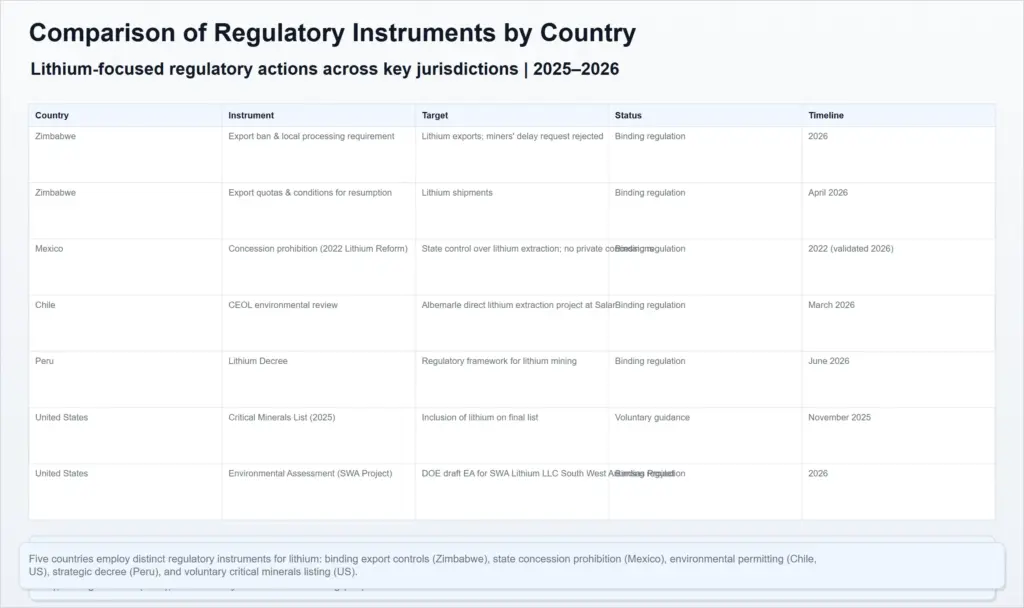
State Ownership and Strategic Exclusivity
Mexico’s Supreme Court of Justice of the Nation upheld the 2022 Mining Law reform, validating Articles 1, 5 Bis, and 10, which establish state exclusivity over the exploration, extraction, processing, and use of lithium. The ruling also prohibits the granting of new private lithium concessions and classifies lithium deposits as mining reserve zones.
The decision, issued under Constitutional Action 78/2022, confirms the legal framework governing the state-owned enterprise LitioMx.
Despite the strengthened legal framework, LitioMx’s 2026 budget totals only MX$13.9 million (approximately US$805,000), covering operating expenses only. This limited funding leaves Mexico significantly behind major lithium-producing countries such as Chile, Bolivia, and Australia.
Global lithium consumption is projected to increase 13.5% to 1.48 million tonnes of lithium carbonate equivalent (LCE) during 2026.
Peru issued a Supreme Decree in early June 2026 declaring lithium and uranium to be critical and strategic minerals of national importance.
The decree requires coordination between:
-
- The Ministry of Energy and Mines (MINEM).
- The Ministry of Housing, Construction, and Sanitation.
The policy extends beyond mining activities to encompass regional infrastructure, housing development, and industrial planning.
The decree directly affects American Lithium’s Falchani and Macusani projects, where land-use approvals and water-right permits will now be administered within a national strategic priority framework.
Chile continues strengthening state participation through its National Lithium Strategy.
On February 12, 2026, the Ministry of Mining approved modifications to the Special Lithium Operation Contract (CEOL) for Codelco’s Salar de Maricunga subsidiary.
The amendments:
-
- Expand the contract area by incorporating pre-1979 mining holdings together with assets acquired from Lithium Power International.
- Revise exploration and exploitation deadlines.
- Establish community contribution requirements.
In May 2025, Rio Tinto was selected as the strategic private partner for the Maricunga project, committing investment of up to US$900 million.
This public-private partnership model enables Chile to maintain state ownership while leveraging private-sector capital and expertise.
Collectively, the regulatory actions implemented by Mexico, Peru, and Chile:
-
- Restrict unrestricted private ownership of lithium resources.
- Expand the role of state-owned enterprises and state-approved partnerships.
- Require international mining companies to adapt to concession restrictions and joint-venture operating models.
Environmental Permitting and Technology Transitions
Albemarle, the world’s largest lithium producer, submitted an Environmental Impact Assessment (EIA) on March 25, 2026, for its Transition to Direct Lithium Extraction (TED) project at Salar de Atacama, Chile.
The project introduces direct lithium extraction (DLE) technology designed to:
-
- Recover nearly twice as much lithium as current operations.
- Reduce overall brine extraction requirements.
- Return lithium-depleted brine to the salar through gravity flow to preserve hydrological and geochemical balance.
- Eliminate the need for additional solar evaporation ponds.
- Avoid expansion into new extraction areas.
The modular design allows construction of up to six production lines and includes development of a dedicated electrical transmission line.
The project is located within the municipality of San Pedro de Atacama, approximately 31 km from Peine.
Subject to successful environmental approval and a positive final investment decision, the TED project would become Chile’s first commercial direct lithium extraction project, potentially establishing a regulatory and technological template for future developments.
In the United States, the Department of Energy (DOE) released the Draft Environmental Assessment (DOE/EA-2304) in March 2026 for the SWA Lithium LLC South West Arkansas Project located in Lafayette County, Arkansas.
The proposed development includes:
-
- Brine extraction of up to 200,000 barrels per day from the Smackover Formation.
- Annual production of 22,500 metric tonnes of battery-grade lithium carbonate.
- A projected operating life of 20 years.
Project infrastructure includes:
-
- A central lithium processing facility.
- A wellfield consisting of five well pads.
- Brine production and injection wells.
- Gathering pipelines.
- A sour gas disposal pipeline.
- Electrical transmission and distribution infrastructure.
The Draft Environmental Assessment evaluates both environmental and social impacts associated with DOE’s proposed cost-shared funding.
These environmental reviews are establishing the regulatory pathway for commercial DLE projects in both Chile and the United States.
While environmental permitting introduces additional timeline uncertainty before final investment decisions can be reached, it also creates precedents that may accelerate approvals for future projects.
For mining companies, a detailed understanding of environmental baseline studies, regulatory documentation requirements, and community engagement expectations is becoming increasingly important for successful project planning and execution.
Visualization Recommendation 1
Illustrate the sequence of major regulatory actions affecting lithium mining across Zimbabwe, Mexico, Chile, Peru, and the United States.
Suggested data sources:
-
- UNCTAD
- USGS
- Reuters
- Mining.com
- BNamericas
- Codelco
- U.S. Department of Energy (energy.gov)
The visualization should compare:
-
- Regulatory instrument.
- Jurisdiction.
- Effective date.
- Current status (binding, voluntary, or under review).
Visualization Recommendation 2
Compare the principal regulatory instruments across Zimbabwe, Mexico, Chile, Peru, and the United States.
The visualization should summarize:
-
- Instrument type.
- Regulatory target (exports, concessions, permitting, environmental review, or strategic designation).
- Binding status.
- Implementation timeline.
Recommended regulatory topics include:
-
- Zimbabwe: Export ban and export quotas.
- Mexico: State exclusivity and prohibition of private concessions.
- Peru: Strategic mineral decree.
- Chile: CEOL modifications and National Lithium Strategy.
- United States: Critical Minerals List and environmental assessments.