
Editorial Article
Monarch Raised $200 Million. Caterpillar Bought the Engineering.
On 15 April 2026, Caterpillar bought what was left of Monarch Tractor. The company had raised more than USD 200 million to build an electric tractor, had a working product, had customers with logos on its website, and had spent two years telling a story about the future of farming. What Caterpillar acquired was the engineering. Not the order book, not the brand, not the dealer relationships. The engineering.
That distinction is the most useful thing anyone has said about this industry in a decade, and it was said with a purchase order rather than a press release.
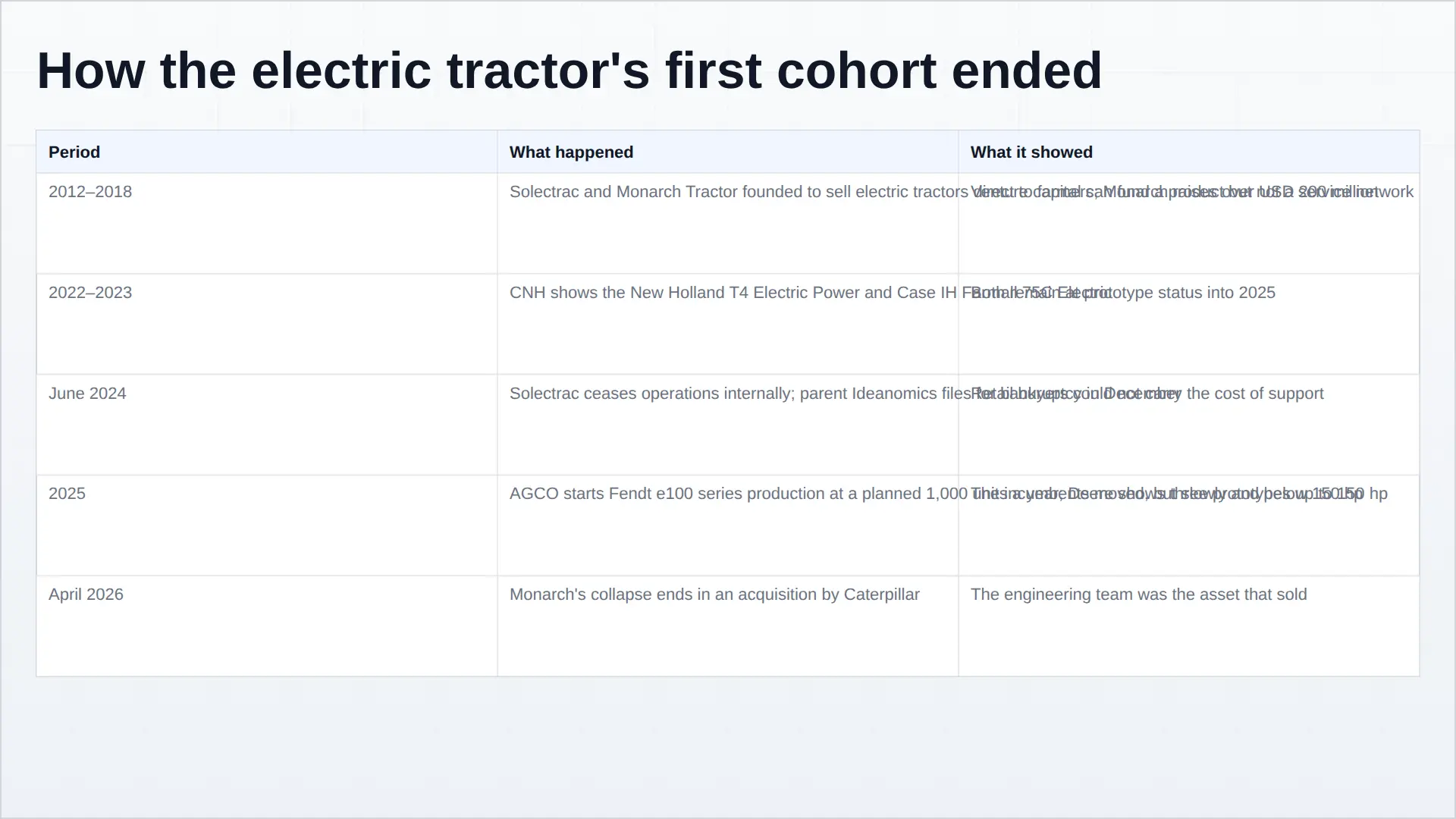
Monarch was not the first. Solectrac, founded in Santa Rosa in 2012, built small electric tractors for small farms and was going to change how the smallholder bought machinery. It ceased operations in 2024; its parent, Ideanomics, filed for bankruptcy that December. Two companies, twelve years apart, more than USD 200 million in capital between them, one product category, and the same ending.
The conventional explanation is that batteries were too expensive or that farmers were too conservative. Neither holds up. Battery pack prices fell to a 2025 average of USD 108 per kilowatt-hour, and farmers buy capital equipment on payback calculations all the time — it is the one thing they are demonstrably good at. Something else killed these companies, and it is the same thing both times.
A tractor is a service contract with an engine attached
Agricultural machinery is not sold the way cars are sold. A dealer carries parts for several hundred part numbers across a range of models, employs technicians who know the product, and keeps a van on the road during the season. That overhead is fixed. It is recovered across units, and it only makes sense above a certain annual volume.
Now consider what the buyer is actually purchasing. A tractor that stops during the sowing window is not an inconvenience that can be scheduled; the window closes, and the season with it. So the farmer is not buying 90 horsepower. They are buying the assurance that the machine will run, or be fixed within hours, during the six to eight weeks a year when the machine’s entire annual value is realised.
That assurance is the product. The tractor is the hardware that delivers it.
A startup selling two hundred units a year cannot fund the network that creates the assurance. Without the network, the farmer will not buy. Without the farmer, the volume never arrives. Solectrac and Monarch both attacked the hardest segment first — the smallholder, who has the least capacity to absorb downtime, the least access to a second machine, and the fewest hours a year over which to amortise a premium. It is a customer segment that punishes exactly the weakness a new entrant has.
Two business models survived, and neither needs a farmer
Look at who is still trading and the answer becomes obvious, because there are exactly two survivors and both route around the problem rather than solving it.
The first is the incumbent. AGCO builds the Fendt e100 at Marktoberdorf on the same line as its diesel machines and sells it through a dealer network that already exists and is already paid for by a business ten thousand times the size of the electric line. AGCO did not have to invent distribution. It had to add a battery. That is why a company with a fraction of Monarch’s evangelism shipped a series-production electric tractor in the third quarter of 2025 while Monarch did not.
The second is the industrial seller. In India, AutoNxt and TI Clean Mobility sell to compressed biogas plants, sugar mills, paper mills and factory yards. Those buyers run a fixed circuit at fixed hours, have an electrician on staff, can put a charger where the machine parks, and buy in batches of twenty. They service the machine themselves or hold a maintenance contract. They do not need a dealer within fifty kilometres, because they are not a farm.
Both survivors describe a market in which the dealer network either already exists or is not required. Neither describes a market in which somebody built a new one.
The uncomfortable conclusion for anyone funding this
The venture thesis for electric tractors was that a better machine creates a market. The record says the machine was never the constraint. If that is right, then the next USD 200 million in this category should not go into another tractor. It should go into the two things the incumbents already own and the startups could not buy: field service at sub-dealer scale, and charging where the machine actually sleeps.
Both are unglamorous, both are capital-intensive, and neither fits the business model of a single manufacturer — which is precisely why neither has been funded. Instead the capital went into machines, the machines went into a distribution gap, and the distribution gap did what it does.
Caterpillar’s purchase is the market’s own valuation of what the machines were worth. Not nothing. The engineering, and only the engineering.
Related research: Global Electric Tractor Market Report, Size, Share and Forecast 2026–2033.
Frequently Asked Questions
Why did Caterpillar acquire Monarch Tractor?
Monarch Tractor collapsed in 2026 and its assets were acquired by Caterpillar in April 2026, as reported by TechCrunch. The acquisition gave Caterpillar the engineering team and electric drivetrain capability rather than a going concern with an order book.
Why is distribution more important than the battery in agricultural machinery?
Because a tractor's value is realised in a short seasonal window, and a machine that cannot be repaired within hours during that window destroys the season rather than delaying a task. The manufacturer therefore has to sell assurance — parts, technicians and field support — not just hardware, and that fixed cost cannot be funded at low volume.
Why did Solectrac and Monarch fail at the same point?
They sold to smallholders, who have the least ability to absorb downtime, the least access to a second machine, and the fewest annual hours over which to amortise a purchase premium. It is the segment least tolerant of a new entrant's weaknesses.
What business models have survived in electric tractors?
Two, and neither requires a new dealer network. Either an incumbent sells through a network that already exists and is paid for by its diesel business, as AGCO does with the Fendt e100, or the customer is industrial and services the machine in-house, as with AutoNxt and TI Clean Mobility in India.