
Global Hybrid Seeds Market Report, Size, Share and Forecast 2026–2033
Global Hybrid Seeds Market, 2026–2033
Hybrid seed is the oldest productivity technology in commercial agriculture and still the one with the most headroom. A hybrid captures heterosis — the yield advantage of a first-generation cross over either parent — and sells it as a repeat purchase, because the progeny of a hybrid cannot be saved and re-sown without losing the advantage that was paid for. That single biological fact built the modern seed industry, and it is why hybrid seed carries a price per kilogram that open-pollinated seed can never command. We size the global hybrid seed market at USD 31.10 billion in 2025, rising to USD 49.80 billion by 2033 — a 6.06% CAGR across 2026–2033. Hybrids account for 39.67% of the USD 78.40 billion global seed market our seed report establishes for the same year, and for 41.87% of the 2033 seed base.
The average rate is not the story. Two of the world's three staple cereals have barely been hybridised at all. Maize is effectively fully hybrid wherever it is grown commercially. Rice is hybrid on 62–63% of China's area and on roughly 6–7% of India's. Wheat — close to a fifth of global calories — has been sold as a hybrid for thirty years only through chemically induced systems that never achieved commercial scale, and becomes a genuine category from 2027. The inflection in this forecast is not a price effect. It is the opening of the last large non-hybrid crop on earth.
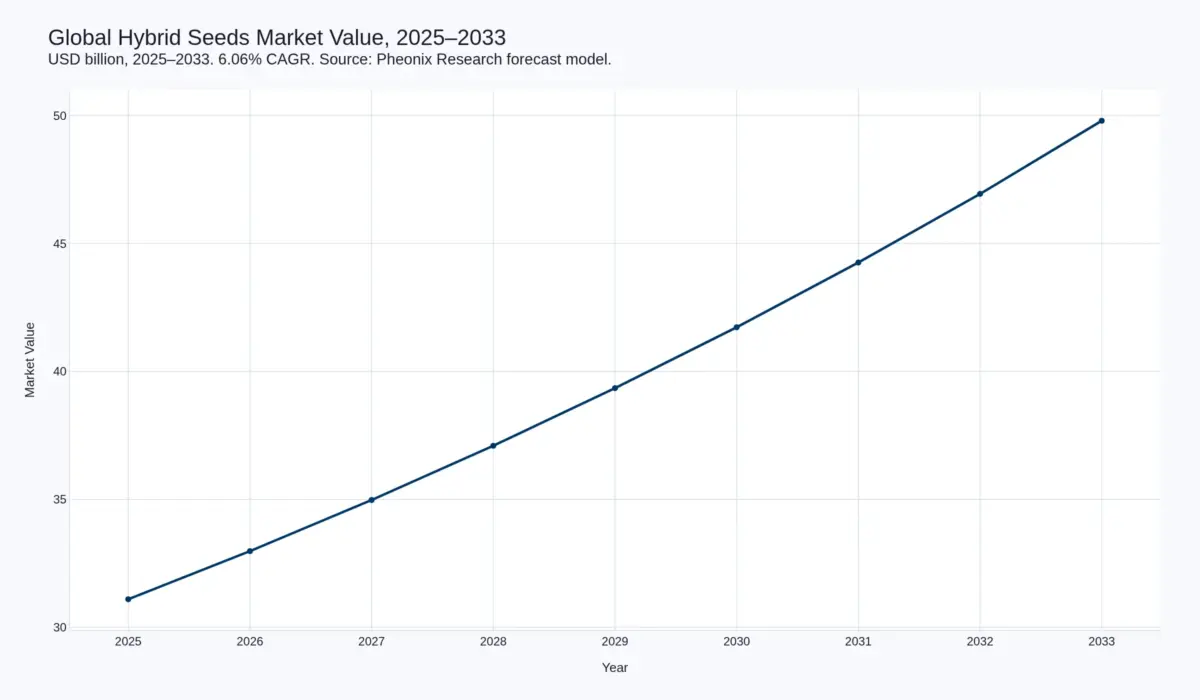
The market at a glance
| Indicator | 2025 / period |
|---|---|
| Global market value, 2025 | USD 31.10 billion |
| Forecast value, 2033 | USD 49.80 billion |
| CAGR, 2026–2033 | 6.06% |
| Hybrid share of global seed value, 2025 | 39.67% |
| Hybrid share of global seed value, 2033 | 41.87% |
| Largest crop segment | Cereals & grains, 63.8% of 2025 value |
| Largest single crop | Hybrid maize, USD 16.50 billion, 53.1% of 2025 value |
| Fastest-growing crop segment | Oilseeds, 6.8% CAGR |
| Fastest-growing category | Hybrid wheat, USD 30 million to USD 1.55 billion by 2033 |
| Largest region | Asia-Pacific, 31.5% of 2025 value |
| Largest technology class | Conventional (non-GM) hybrids, 71.5% of 2025 value |
| Tier-1 suppliers | 4 (Bayer, Syngenta, Vylor, KWS) |
Market size and forecast
The segments grow at different rates and the weighted average is the headline. Cereals and grains compound at 6.3%, oilseeds at 6.8%, vegetables at 5.6%, cotton and other industrial crops at 4.9%, and sugar beet, forage and other crops at 4.5%. Applied to their 2025 shares, those rates reconcile to USD 49.80 billion in 2033 and to the 6.06% CAGR. The ordering is deliberate rather than mechanical. Oilseeds grow fastest because hybrid rapeseed and hybrid sunflower are still converting area in Europe and the Black Sea, and because short-cycle hybrid sunflower now fits into rotations between wheat and barley where it previously had no slot. Vegetables grow slowest in value despite rising volume, because hybrid vegetable seed is already the default format in every commercial market and the pricing power has migrated from hybridity itself to the rootstock and the resistance trait.
We do not adopt a licensed third-party estimate. The 2025 base year is triangulated from three independent directions: crop-level hybrid penetration applied to the global seed base, the hybrid-bearing portfolio of the tier-1 seed businesses after removing trait and technology fees and non-hybrid crops, and national certified-seed statistics for hybrid area in the United States, Brazil, China, India, France and Türkiye. The three approaches converge within a band of roughly USD 29.8–32.4 billion, and we take the midpoint. Published estimates for 2025 range from USD 30.2 billion to USD 34.8 billion; our figure sits at the low end of that range for two explicit reasons. First, we measure germplasm value net of separately invoiced trait fees, because in the United States and Brazil those fees are a distinct line item and counting them here would double-count the USD 26.15 billion biotech seed market we publish separately. Second, we exclude contract multiplication and parent-seed production revenue, which are inputs to this market rather than sales of it.
Growth is a value story with a volume complication that almost nobody models. Hybrid wheat, the fastest-growing category in the forecast, will be sold at a seed rate 15% below conventional wheat — Syngenta's guidance for X-Terra is that growers can go down to 85% of the conventional rate without losing yield, because the hybrid canopy tillers harder. That means the category can add USD 1.5 billion of value while reducing the kilos of seed sown per hectare. Hybrid rice in India is the mirror image: it grows by converting area, so it adds volume and value together. A single tonnage series would blend those two effects into a number that means nothing, which is why we publish no volume series for this market. Seed rates across the crops in scope differ by three orders of magnitude — a few kilograms per hectare for sugar beet, twenty-five for maize, well over a hundred for rice — so any cross-crop aggregate would be arithmetic, not analysis.
Three structural shifts defining 2026–2033
1. Hybrid wheat stops being a research programme. Syngenta's X-Terra system received registration approval in France in February 2026, with SY Sphynx and SY Xanthis available for the 2026 sowing season and UK variety listing targeted for autumn 2027. Vylor — the seed and genetics business Corteva separated with effect from 1 October 2026 — will launch its Xpedite hybrid wheat system in North America in late 2027, starting with Hard Red Winter, adding Soft Red Winter in 2029 and Hard Red Spring in 2030. Vylor's published yield expectation is a 10% gain over elite varieties, rising to as much as 20% in water-stressed environments, from a non-GMO system that requires no regulatory approval and, the company states, works across 100% of the wheat germplasm it has tested. Bayer has expanded hybrid wheat germplasm work through a partnership with RAGT and has put a peak-sales ambition of around EUR 1 billion on the segment. Three of the four largest seed businesses are now commercial or near-commercial in the same crop in the same window. That has not happened in wheat before.
2. India's rice conversion is the largest single volume opportunity in the market. India plants roughly 43–44 million hectares of rice and hybrids occupy about 6–7% of it — around 3.5 million hectares in 2024, concentrated in Uttar Pradesh, Jharkhand, Chhattisgarh, Madhya Pradesh, Odisha and Haryana. In the core eastern markets adoption is closer to 15%, and Bayer's India business reported a 6–8% increase in hybrid rice acreage for kharif 2025 on favourable procurement prices. The agronomic case is settled: hybrids yield 15–30% more than inbred varieties in irrigated trials, with better stress tolerance. The constraint has never been yield; it has been seed supply, price and farmer familiarity. India has notified 162 rice hybrids, 118 of them from the private sector, and the pipeline is no longer the bottleneck.
3. Hybrid and biotech stop being two markets in maize. Trait fees are invoiced separately, but the seed itself is a single object: a triple-stack hybrid. Our technology-class split makes the overlap explicit — USD 7.46 billion of hybrid value, 24.0% of the market, is hybrid germplasm carrying GM traits, which is 28.54% of the value of the biotech seed market we size separately. The rest of that market is trait fees and GM soybean, which is not a hybrid crop at all. The competitive consequence is that in maize the germplasm now has to win on its own merits against a competitor's germplasm carrying comparable traits, and the trait premium is no longer a differentiator in the way it was in 2015. That is why Vylor's separation matters beyond its own balance sheet: it is a bet that genetics, not chemistry, is where the next decade of value sits.
What is driving growth
Five forces carry the forecast. The first is the yield gap itself: hybrid vigour is the cheapest route to more grain per hectare that does not require new land, new water or new fertiliser, and it is why public breeding programmes in South and Southeast Asia have shifted from releasing open-pollinated varieties to licensing hybrids. The second is the wheat conversion described above. The third is protected horticulture, which is expanding fastest in Asia and the Mediterranean and which consumes hybrid vegetable seed at several times the rate of open-field production. The fourth is quality: waxy maize for starch, high-oleic sunflower, provitamin-A maize, quality-protein maize and low-amylose rice are all hybrid-delivered traits sold at a premium that does not depend on yield at all. The fifth is formalisation of the seed system — as governments tighten certification and crack down on counterfeit seed, the addressable share for branded hybrids expands without any change in farmer demand.
The restraints are equally concrete. Hybrid seed production is expensive: it needs two parent lines, isolation, rouging and a multiplication ratio that puts a large land and working-capital burden between the breeder and the sale. Wheat is the hardest case, which is why it has taken sixteen years from Syngenta's 2010 project start to a commercial French launch, and why the first varieties deliver closer to 4% over conventionals rather than the 10% the technology is expected to reach. In the Americas, soybean — the second-largest seed crop in the world by value — is not a hybrid crop and never will be, capping the addressable base. Farm-saved seed erodes the market wherever enforcement is weak. And hybrid maize seed prices in the United States have plateaued, so growth there has to come from mix rather than from rate.
How the market segments
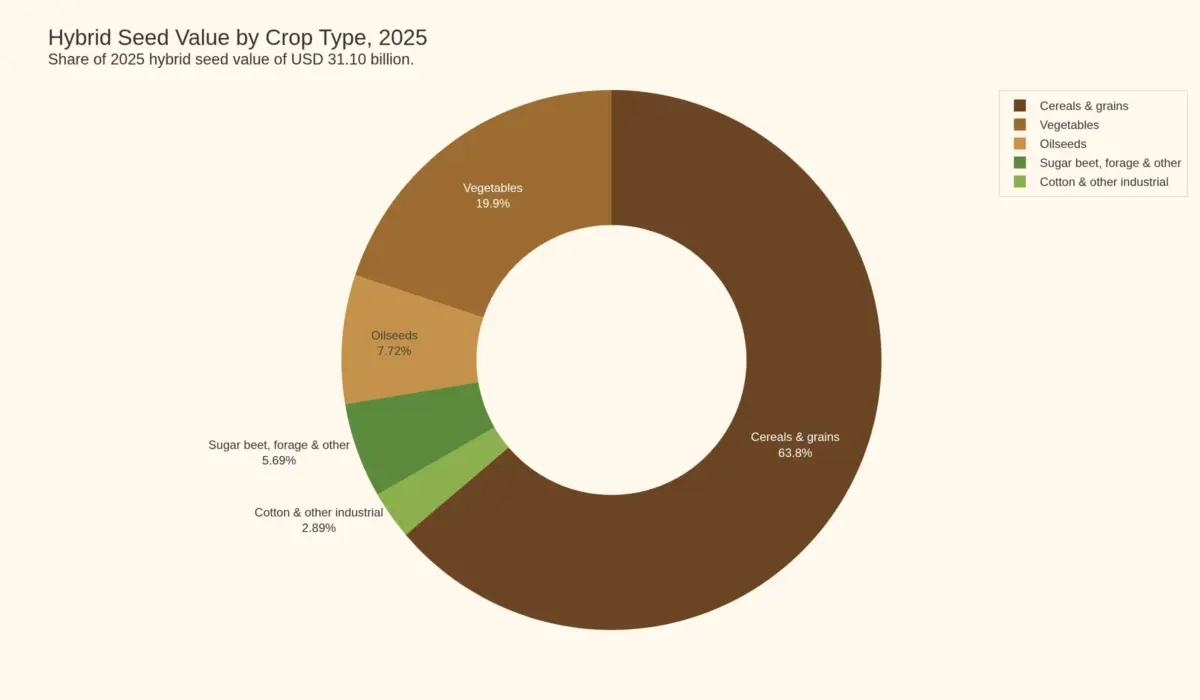
By crop, cereals and grains hold 63.8% of 2025 value at USD 19.84 billion, vegetables 19.9% at USD 6.19 billion, oilseeds 7.7% at USD 2.40 billion, cotton and other industrial crops 2.9% at USD 902 million, and sugar beet, forage and other crops 5.7% at USD 1.77 billion. Inside cereals, hybrid maize alone is USD 16.50 billion, or 53.1% of the entire market — a concentration that explains both the industry's profitability and its strategic anxiety. Hybrid rice is USD 2.30 billion, hybrid sorghum and millet USD 1.01 billion, and hybrid wheat USD 30 million, a rounding error that becomes USD 1.55 billion by 2033 and 3.11% of the market.
By technology class, conventional non-GM hybrids hold 71.5% of value at USD 22.24 billion, GM-stacked hybrids 24.0% at USD 7.46 billion on a germplasm-only basis, and value-added and specialty hybrids 4.5% at USD 1.40 billion. That last category is small but the fastest-growing in price per bag, because a waxy maize or high-oleic sunflower hybrid is sold against a processor specification rather than a commodity price, and the grower is buying a contract outcome rather than a yield.
By channel, distributor and dealer networks carry 68.0% of value at USD 21.15 billion, direct and large-grower relationships including contract multiplication 21.0% at USD 6.53 billion, and institutional, government and development programmes 11.0% at USD 3.42 billion. The institutional channel matters more than its share implies in South Asia and Sub-Saharan Africa, where hybrid adoption is often publicly funded and where a single procurement decision can move a national conversion rate by several points in one season.
Regional picture
Asia-Pacific is the largest region at 31.5% of 2025 value (USD 9.80 billion), and it is largest for a single reason: China. China grows hybrid rice on 62–63% of its rice area, is the world's largest hybrid maize producer by volume, and dominates hybrid rapeseed. India contributes the fastest-growing large rice market and the world's largest hybrid cotton seed business. North America follows at 30.0% (USD 9.33 billion), the highest-value market per hectare, where hybrid maize is effectively universal and where hybrid wheat arrives commercially in 2027. South America is 16.5% (USD 5.13 billion) and the fastest-growing region in the forecast, led by Brazilian safrinha maize and by the rapid conversion of the Southern Cone to hybrid sunflower and hybrid canola. Europe is 13.5% (USD 4.20 billion), a market where hybrid rye, hybrid barley, hybrid oilseed rape and hybrid sugar beet are established but hybrid wheat has only just begun. The Middle East and Africa are 8.5% (USD 2.64 billion), the least penetrated region in the study and the one where hybrid maize conversion in East and West Africa offers the longest runway.
Competitive landscape
Four businesses define the top of this market and, on our estimate, hold roughly 45–50% of hybrid seed value between them. The structure below them is unusually fragmented for an input market of this size — hundreds of regional breeders in China, India, Thailand, Türkiye and Brazil, most of them with a genuine proprietary germplasm position in one or two crops. That is the opposite of crop protection, where a handful of actives and a registration burden concentrate the market, and it is why hybrid seed is the one agricultural input where a national champion can still be built from nothing in a decade.
| Player | FY2025 anchor | Hybrid position |
|---|---|---|
| Bayer CropScience | Crop Science sales EUR 21,622m; EBITDA pre-special EUR 4,188m; Corn Seed & Traits EUR 7,149m, +13.2% adjusted | Hybrid maize and hybrid cotton at global scale; hybrid wheat via RAGT germplasm partnership |
| Syngenta Group | Group sales USD 28.4bn; EBITDA USD 4.4bn, +13%; 15.4% margin | First scalable hybrid wheat in Europe (X-Terra, France 2026); leading hybrid rice position via Syngenta Group China |
| Vylor (Corteva seed & genetics) | Corteva seed sales USD 9,898m; separation effective 1 October 2026 | Hybrid maize and sunflower core; Xpedite hybrid wheat launching North America 2027 |
| KWS SAAT SE | Net sales EUR 1,676.6m, +1.0% comparable; Sugarbeet segment EUR 871.8m at a 42.1% EBIT margin | Global leader in hybrid sugar beet; leading hybrid rye; expanding hybrid cereals and vegetables |
Bayer holds the broadest hybrid maize franchise in the world and the strongest single-crop economics: Corn Seed & Traits grew 13.2% on an adjusted basis in 2025 while the crop protection lines contracted, which is the clearest available evidence that germplasm, not chemistry, currently carries pricing power. Syngenta has won the race that matters most for the forecast — the first commercially scalable hybrid wheat in Europe — and backs it with the deepest hybrid rice position outside a Chinese domestic breeder, through Syngenta Group China's Hubei AllWin joint venture, which produces on roughly 5,000 acres of hybrid rice seed land, distributes more than 4 million kilograms domestically and exports more than 1 million kilograms a year. Vylor begins life as the only pure-play seed and genetics company of scale in the industry, with a stated hybrid wheat target of USD 500 million of North American wheat revenue by 2035 and USD 1 billion by 2040. KWS is the specialist's specialist: a 42.1% EBIT margin in sugar beet, a dominant position in hybrid rye, and the clearest demonstration in the sector that a mid-sized breeder can hold a global franchise in a hybrid crop.
Below the four sit distinct groups with different economics. The hybrid vegetable specialists — Rijk Zwaan, Enza Zaden, Bejo, Sakata, Takii and East-West Seed — hold proprietary germplasm and sell at margins that exceed the row-crop majors. The Chinese domestic breeders, led by Yuan Longping High-Tech and Beijing Dabeinong, hold the deepest hybrid rice and hybrid maize pipelines in the world's largest market. The Indian and Southeast Asian hybrids businesses — Mahyco, Nuziveedu, SeedWorks, Savannah Seeds, SL Agritech and Charoen Pokphand — own hybrid rice and hybrid cotton in the geographies where conversion is still ahead rather than behind. And the national champions in Türkiye, Brazil and Argentina hold positions that no global business has been able to displace because the germplasm is locally adapted and the distribution is relational.
Strategic outlook
Three judgements follow from the data. First, the hybrid wheat window is a genuine first-mover opportunity but a narrow one: Syngenta has two seasons of European field experience before Vylor lands in North America, and Bayer's RAGT partnership is the hedge. Whoever establishes the parental line base and the seed production capacity in the first three seasons will set the price architecture for a decade. Second, India is the single most valuable conversion in the market and it will not be won on yield claims, because the yield claims are already proven. It will be won on seed production capacity, on price points that work at two hectares, and on distribution into states where the dealer network is thin. Third, the mid-tier specialists are the acquisition inventory of this market: a hybrid vegetable breeder with proprietary germplasm is worth more per dollar of revenue than almost any other asset in agriculture right now, which is precisely the reasoning behind KWS building a vegetable business at a EUR 45.8 million operating loss.
What we are watching: the pace of X-Terra registration beyond France and the first independent yield data from commercial fields rather than trials; whether Vylor holds to its 2027 launch date after separation; China's hybrid rice seed export volumes, which are the clearest leading indicator of conversion in South and Southeast Asia; India's hybrid rice area in kharif 2026 against the 3.5 million hectares of 2024; and hybrid rapeseed area in the EU, where the conventional breeding pipeline is the only route to improved oil content without a biotech approval.
Conclusion
Hybrid seed is a mature technology with an immature geography. In maize it is finished business, priced accordingly, and growing at the rate of the crop. In wheat it is beginning, and the three companies that will define it have already shown their hands. In rice it is a national conversion story in which the yield argument is closed and only the seed system remains. The 6.06% CAGR we forecast is not a technology bet; it is the arithmetic of an existing premium spreading across crops and geographies that have not yet paid it.
Further reading: Hybrid Rice Is a Chinese Market in Managed Decline and That Is the Entire Forecast — why this report's 6.06 per cent is carried by hybrid wheat and oilseed conversion rather than by rice, and what the Indian conversion opportunity is actually worth.
Table of Contents
- Executive Summary
- Research Methodology & Scope
- Market Overview & Definitions
- 3.1 Heterosis and the Economics of a Repeat Purchase
- 3.2 Hybrid, Open-Pollinated and Genetically Modified Seed: A Working Boundary
- 3.3 Segmentation Framework
- 3.4 Forecasting Assumptions (2026–2033)
- Market Dynamics
- 4.1 Market Drivers
- 4.1.1 The Yield Gap and the Cost of New Land
- 4.1.2 Hybrid Wheat Commercialisation
- 4.1.3 India and South Asia Rice Conversion
- 4.1.4 Protected Horticulture and Hybrid Vegetable Seed
- 4.1.5 Quality Traits and Processor Specifications
- 4.2 Market Restraints
- 4.2.1 Hybrid Seed Production Economics
- 4.2.2 Farm-Saved Seed and Counterfeit Supply
- 4.2.3 The Soybean Ceiling
- 4.3 Market Opportunities
- 4.1 Market Drivers
- 5. Global Hybrid Seeds Market Size & Forecast (USD Million), 2026–2033
- 5.1 Market Revenue Analysis
- 5.2 CAGR Analysis
- 5.3 Demand-Supply Trends
- 5.4 Pricing Analysis
- 5.5 Investment Trends
- 5.6 Future Market Outlook
- 6. Market Segmentation Analysis (USD Million), 2026–2033
- 6.1 By Crop Type
- 6.1.1 Cereals & Grains (Largest Segment)
- 6.1.2 Vegetables
- 6.1.3 Oilseeds (Fastest-Growing Segment)
- 6.1.4 Cotton & Other Industrial Crops
- 6.1.5 Sugar Beet, Forage & Other Crops
- 6.2 By Technology Class
- 6.2.1 Conventional (Non-GM) Hybrids
- 6.2.2 GM-Stacked Hybrids (Germplasm Basis)
- 6.2.3 Value-Added & Specialty Hybrids
- 6.3 By Distribution Channel
- 6.3.1 Distributor & Dealer Network
- 6.3.2 Direct, Large-Grower & Contract Multiplication
- 6.3.3 Institutional, Government & Development Programmes
- 6.1 By Crop Type
- 7. Regional Market Analysis
- 7.1 Asia-Pacific (Largest Market)
- 7.2 North America
- 7.3 South America (Fastest-Growing Market)
- 7.4 Europe
- 7.5 Middle East & Africa
- 8. Competitive Landscape
- 8.1 Market Share Analysis
- 8.2 Competitive Benchmarking
- 8.3 Strategic Developments
- 8.4 Breeding Pipeline & Germplasm Strategies
- 8.5 Partnerships, Acquisitions & Seed Production Capacity
- 9. Company Profiles
- 9.1 Bayer CropScience AG
- 9.2 Syngenta Group
- 9.3 Vylor (Corteva Seed & Genetics)
- 9.4 KWS SAAT SE & Co. KGaA
- 9.5 Limagrain / Vilmorin & Cie
- 9.6 Yuan Longping High-Tech Agriculture
- 9.7 Beijing Dabeinong Technology Group
- 9.8 RiceTec & Savannah Seeds
- 9.9 Mahyco & Nuziveedu Seeds
- 9.10 Rijk Zwaan & East-West Seed
- 10. Strategic Intelligence & Phoenix AI Insights
- 10.1 Hybrid Seed Demand Forecast Model
- 10.2 Hybrid Wheat Adoption & Seed-Rate Analysis
- 10.3 India and South Asia Conversion Tracker
- 10.4 Breeding Innovation & Germplasm Patent Assessment
- 10.5 Automated Porter’s Five Forces Analysis
- 11. Future Outlook & Strategic Recommendations
- 11.1 Securing Hybrid Wheat Seed Production Capacity
- 11.2 Building Distribution for the India Conversion
- 11.3 Converting Hybrid Vegetables to Trait and Rootstock Value
- 11.4 Managing Counterfeit Seed and Variety Piracy
- 11.5 Long-Term Market Outlook (2033+)
- 12. Appendix
- 13. About Phoenix Market Research
- 14. Disclaimer
Competitive Landscape
Competitive Landscape
Overview
The hybrid seed market is oligopolistic at the top and unusually fragmented below. Four businesses — Bayer, Syngenta, Vylor and KWS — hold an estimated 45–50% of global hybrid seed value on our calculation, and they hold it through ownership of elite germplasm rather than through any regulatory barrier or network effect. Beneath them sit hundreds of regional breeders with genuine proprietary positions in one or two crops, several of which are larger in their home market than any global player.
That structure is the opposite of crop protection, where registration cost and active-substance concentration compress the field. In hybrid seed, a national breeder with twenty years of locally adapted germplasm can win share against a tier-1 business and often does, because the variety has to perform in a specific agro-climate and the breeder’s advantage is measured in seasons of local testing.
2025 results: what the numbers actually signal
Bayer’s Crop Science closed 2025 with sales of EUR 21,622 million, up 1.1% on a currency- and portfolio-adjusted basis, and EBITDA before special items of EUR 4,188 million at a 19.4% margin. The composition is the argument for this report: Corn Seed & Traits delivered EUR 7,149 million, up 9.0% reported and 13.2% adjusted, while Fungicides fell 8.5% and Insecticides 16.5%. Germplasm grew through a crop protection contraction, in the same company, in the same year, sold to the same farmers.
Syngenta Group reported 2025 sales of USD 28.4 billion, 1% lower as reported but up 2% excluding a deliberate USD 1 billion reduction in lower-margin grain trading, with EBITDA of USD 4.4 billion, up 13%, and the margin expanding 1.9 percentage points to 15.4%. The seed business carries the strategic weight: Syngenta reached the first commercially scalable hybrid wheat launch in Europe and holds the deepest hybrid rice position outside a Chinese domestic breeder through Syngenta Group China.
KWS closed fiscal 2024/25 with net sales of EUR 1,676.6 million, flat as reported and up 1.0% on a comparable basis, against a declining European acreage backdrop. The Sugarbeet segment — the purest hybrid franchise in agriculture — generated EUR 871.8 million of sales and EUR 367.2 million of EBIT, a 42.1% margin, with the CONVISO SMART and CR+ product lines rising to around 61% of segment sales from 56%. The Cereals segment fell 4.6% to EUR 263.3 million on lower oilseed rape and rye sales, with earnings hit by higher research spending on hybrid breeding. That single line explains the strategic posture of the whole industry: profit from the hybrid crop that is finished funds the breeding of the crops that are not.
| Player | FY2025 anchor | Hybrid strategy |
|---|---|---|
| Bayer CropScience | EUR 21,622m sales; Corn Seed & Traits EUR 7,149m, +13.2% adjusted; 19.4% EBITDA margin | Defend hybrid maize economics; hybrid wheat through the RAGT germplasm partnership |
| Syngenta Group | USD 28.4bn sales; EBITDA USD 4.4bn, +13%; 15.4% margin | First scalable hybrid wheat in Europe; deep hybrid rice via Syngenta Group China |
| Vylor (Corteva seed & genetics) | Corteva seed sales USD 9,898m; separation effective 1 October 2026 | Pure-play genetics; Xpedite hybrid wheat from 2027; USD 500m NA wheat revenue targeted by 2035 |
| KWS SAAT SE | EUR 1,676.6m sales; sugar beet EUR 871.8m at a 42.1% EBIT margin | Hybrid sugar beet and rye leadership; hybrid breeding expansion funded from segment profit |
Strategy by player
Bayer holds the broadest hybrid maize franchise and the best single-crop economics in the industry. Its 2025 performance shows a company being carried by germplasm while its chemistry contracts, and its hybrid wheat position is a partnership hedge — RAGT brings European wheat germplasm that Bayer does not have in-house, which is a faster route to the crop than building a wheat programme from a maize platform.
Syngenta made the boldest bet of the four and, on the evidence available, is ahead. X-Terra received French registration approval in February 2026, with SY Sphynx and SY Xanthis available for the 2026 sowing season, UK variety listing targeted at autumn 2027 and Germany planned for 2029. Its hybrid rice position through Hubei AllWin — roughly 5,000 acres of seed production land, more than 4 million kilograms sold domestically and more than 1 million kilograms exported a year, 69 approved varieties and 62 plant variety rights — is the most complete hybrid rice franchise outside the Chinese domestic leaders.
Vylor begins as the only pure-play seed and genetics business of scale. Corteva’s seed sales of USD 9,898 million in 2025 provide the base, and the hybrid wheat target — USD 500 million of North American wheat revenue by 2035 and USD 1 billion by 2040, including licensing — is the most concrete forward financial commitment anyone in this market has made. The separation is itself a strategic statement: it prices genetics separately from chemistry and forces the business to be judged on breeding returns alone.
KWS is the model for everyone below the top three. It has never had a maize or soybean franchise and does not need one: a 42.1% EBIT margin in hybrid sugar beet and a leading hybrid rye position produce the cash to fund hybrid cereals and a vegetable business currently running at a EUR 45.8 million operating loss. That loss is the price of a second franchise, and it is being paid deliberately.
The Chinese, Indian and Southeast Asian field
China is the largest hybrid seed market in the world by area and the most self-contained. Yuan Longping High-Tech and Beijing Dabeinong hold the deepest hybrid rice and hybrid maize pipelines, supported by a national seed industry revitalisation policy explicitly aimed at reducing import dependence. China is also an exporter of hybrid rice seed, mainly to South and Southeast Asia and to parts of Africa, which makes Chinese breeders commercial competitors in exactly the markets where conversion is still ahead.
India is the most contested growth market in the study. Mahyco and Nuziveedu hold large hybrid cotton and vegetable positions, SeedWorks and Bayer are expanding in hybrid rice, and Savannah Seeds — owned by the Liechtenstein Group and RiceTec — has commercialised ten hybrid varieties and twenty improved varieties since 2010 on the back of an R&D programme that has absorbed USD 50 million and reinvests 10–15% of revenue each year. India has notified 162 rice hybrids, 118 from the private sector. In Southeast Asia, East-West Seed, Charoen Pokphand and SL Agritech hold positions that global businesses have found difficult to displace because the germplasm is tropically adapted and the distribution is relational.
Hybrid vegetables: the quiet margin pool
Below the row-crop majors sit the hybrid vegetable specialists — Rijk Zwaan, Enza Zaden, Bejo, Sakata, Takii and East-West Seed — which hold proprietary germplasm, sell at prices that would be unrecognisable in maize, and operate in the 19.9% of this market that is vegetables. Their economics are superior because the grower is not comparing seed cost to a commodity price but to the value of a harvest sold into a differentiated market, and because resistance traits command a premium with a measurable shelf-life and yield-loss justification. They are the most likely acquisition targets for any row-crop major that wants a higher-margin germplasm franchise.
Strategic implications
Three observations for competitive strategy. Share is sticky but not fixed: it is held by germplasm performance measured over seasons, so displacement is slow in maize and fast in rice where a single step-change variety can convert a district in two years. The hybrid wheat window is genuinely open and genuinely narrow — two to three seasons separate Syngenta’s European launch from Vylor’s North American one, and the price architecture for the crop will be set in that interval. And the specialist tier is where the strategic value sits relative to revenue: a hybrid vegetable breeder with proprietary germplasm is worth more per dollar of sales than any other asset in agriculture today.
Forward outlook
Through 2033 we expect consolidation in two directions. Upstream, the majors will buy breeding programmes and germplasm libraries rather than build them, because the cost of a hybrid wheat or hybrid rice programme is now measured in fifteen-year horizons. Downstream, regional champions in India, Türkiye and Brazil will acquire or merge to build the scale needed to fund genomic selection, which is the one technology in this market with real returns to size. The four leaders keep their position, but the mix of what they sell shifts: hybrid maize falls from 53.1% of the market in 2025 to under half by 2033 as hybrid wheat and hybrid oilseeds take share, and the competitive question becomes who owns the germination of the next crop rather than who owns the current one.
Value Chain
Hybrid Seed Value Chain Analysis
Overview
Hybrid seed has a value chain unlike any other agricultural input, because the product has to be made twice. Parent lines are first multiplied in a pure, inbred form; only then are two of those lines crossed to produce the seed that is actually sold. Every economic property of this market follows from that two-step structure. It is why hybrid seed carries a price per kilogram ten to thirty times that of grain, why the breeder sits at the top of the chain rather than in the middle, and why the capacity to produce seed — not the capacity to invent a variety — is the binding constraint on growth.
Five layers matter: germplasm and breeding; parent seed multiplication; commercial hybrid seed production; conditioning, testing and certification; and distribution to the farm. A sixth layer — the seed-applied treatment that now travels with most hybrid lots — is analysed in our seed treatment report.
Breeding and germplasm: the only durable asset
Value in this chain is created in the breeding programme, and nowhere else. A commercial hybrid is a specific combination of two inbred parents, and the parent lines themselves are the intellectual property that cannot be copied without access to the breeder’s nursery. This is why the same four companies have held the top of the maize market for two decades despite spending a fraction of the crop protection industry on research, and why a mid-sized breeder such as KWS can hold a 42.1% EBIT margin in sugar beet against competitors many times its size.
The strategic consequence is that breeding programmes are valued on the depth of their elite germplasm and the speed at which they can recycle it, not on their running costs. Syngenta began its hybrid wheat project in 2010 and reached a French commercial launch in 2026; KWS funds hybrid breeding expansion at the cost of near-term segment profit; Vylor carries eighteen distinct breeding pipelines into its separation. Sixteen years of cost before the first bag is sold is normal in this chain, and no other input market tolerates it.
Parent seed multiplication: the invisible bottleneck
Between the breeder and the commercial field sits the least visible and most capacity-constrained step. Inbred parent lines yield less and are more fragile than the hybrid they produce, so parent seed must be multiplied on dedicated ground under strict isolation, with careful rouging and independent testing. In maize the multiplication ratio is roughly one hectare of seed production to sixty or seventy hectares of commercial crop; in wheat, where seed rates are higher and the multiplication ratio is less favourable, the ratio is closer to one to twenty-five.
That ratio, multiplied by the area of commercial crop in scope, sets the land, working capital and logistics burden of an entire business. It is the reason hybrid wheat has taken so long: a scalable wheat hybrid requires not only a workable sterility system but enough parent seed capacity to serve a crop planted on more than 200 million hectares worldwide. Vylor’s stated claim that its Xpedite system accelerates elite germplasm scale-up by increasing parent seed production is a production claim as much as a breeding one, and it is the claim that matters most commercially.
Commercial hybrid seed production: contract multiplication
Commercial production is done overwhelmingly by contract growers, in geographies chosen for cheap land, reliable irrigation, low disease pressure and a dry harvest window. Chinese and Indian multipliers serve South and Southeast Asia; Thailand serves tropical hybrid maize; Chile, Brazil and Argentina serve the Southern Cone and northern-hemisphere counter-season supply; and the US Corn Belt and southern Europe serve their own regions.
The grower is paid on delivered, tested, accepted seed, which pushes production risk upstream. A heat event during flowering does not merely reduce a farmer’s income; it removes a season of hybrid seed supply, because hybrid seed cannot be substituted from a different year’s stock at short notice. This is the structural reason hybrid seed companies hold relatively thin inventories and price in a risk premium that an open-pollinated crop never carries.
Conditioning, testing and certification
After harvest the seed is dried, conditioned, sized, treated and tested for genetic purity, germination and physical quality. Hybrid purity is the critical specification: an off-type in a hybrid lot costs yield directly, and certification regimes in most countries set a maximum permissible level. Independent testing through ISTA-accredited laboratories is standard for traded seed, and OECD seed scheme certification is required for most cross-border hybrid trade.
This layer is capital-intensive at plant level but high-margin in the sense that it protects value already created. It is also where the chain’s digital investment is concentrated — batch-level traceability from nursery to bag is increasingly a condition of access to regulated import markets, and it is the only practical defence against the counterfeit segment that absorbs real volume in South Asia.
Distribution and the last mile
Distribution carries 68.0% of market value at USD 21.15 billion globally, split between distributor and dealer networks, direct large-grower relationships including contract multiplication (21.0%, USD 6.53 billion) and institutional or government programmes (11.0%, USD 3.42 billion). The split is far more consequential than the arithmetic suggests. In North America and Brazil, agronomy advice, financing and the seed decision are increasingly bundled by the retailer or cooperative, which gives the channel real influence over variety choice. In India, Bangladesh and much of Sub-Saharan Africa, adoption is often pulled by public procurement and demonstration plots rather than by a dealer’s recommendation, which is why a single programme decision can move a national conversion rate by several points in one season.
Value capture across the chain
| Layer | Role | Value capture |
|---|---|---|
| Germplasm and breeding | Elite inbred lines, sterility systems | Highest and most defensible; protected by plant variety rights |
| Parent seed | Pure-line multiplication under isolation | Internal cost centre, the real capacity constraint |
| Contract multiplication | Commercial hybrid seed production | Thin margin for the grower; risk transferred upstream |
| Conditioning and testing | Drying, sizing, treatment, purity | Capital-intensive, moderate margin, high switching cost |
| Distribution | Agronomy, finance, last mile | Thin margin, high influence on variety choice |
| Farm | Repeat purchase buyer | Captures the yield gain, pays a premium every season |
Strategic implications
Three implications follow. Germplasm is the place to own capability, and acquisitions in this market are purchases of breeding programmes and germplasm libraries rather than of plants or brands. Seed production capacity is the real barrier to entry in a new crop: a competitor can license a sterility system but cannot conjure the multiplier land, the isolation blocks and the conditioning capacity in a single season. And the channel decides who converts: in a market where the yield advantage is already proven and widely published, the constraint on growth is the distribution and financing structure that puts a bag in front of a farmer at a price that works on two hectares.
Forward outlook
Through 2033 we expect the breeding layer to consolidate further and the multiplication layer to remain fragmented and regional, because seed production is land-bound and cannot be globalised the way formulation can. The structural change to watch is vertical integration downwards by the mid-tier specialists, as hybrid vegetable and hybrid cereal breeders buy or contract dedicated multiplication capacity to protect supply of the varieties their margins depend on. In hybrid wheat, the first business to secure multi-season multiplier contracts across the North American and European wheat belts will hold an advantage that no amount of breeding spend can buy back.
Investment Activity
Investment Activity
Overview
Capital in this market flows to germplasm and to seed production capacity, and the two have very different profiles. Germplasm investment is patient, long-dated and largely expensed through research: a hybrid wheat programme costs sixteen years before it returns anything, as Syngenta’s 2010-to-2026 path demonstrates. Seed production capacity is land-bound, working-capital heavy and built in seasons. The pattern of the past two years is that the majors are restructuring to make germplasm value visible while simultaneously committing capital to the one crop — wheat — that has never been commercialised at scale.
We rate investment direction as rising, capital intensity as high, and recent M&A and corporate activity as present and continuing.
The Vylor separation: genetics priced on its own
The most consequential capital event in the sector is Corteva’s separation of its seed and genetics business as Vylor, effective 1 October 2026, built on seed sales of USD 9,898 million in 2025. The strategic logic is a valuation argument: a pure-play genetics business is valued on breeding returns and germplasm depth, whereas the same assets inside a combined chemistry-and-seed company are valued on a blended multiple that reflects the slower growth of crop protection. Vylor has put concrete numbers on the ambition — USD 500 million of North American wheat revenue by 2035 and USD 1 billion by 2040, including licensing — which is the only forward financial commitment of its kind in the hybrid wheat race.
Investors should read the separation as a signal about where the sector believes value sits. It is also a bet on hybrid wheat specifically: a spin-off that has explicitly identified wheat as its third pillar is not a diversification story but a concentration one.
Where the money is going in hybrid wheat
Syngenta has spent sixteen years and an undisclosed but substantial sum to reach a French commercial launch, and has built a hybrid rice franchise in China alongside it — Hubei AllWin operates roughly 5,000 acres of hybrid rice seed production land and exports more than a million kilograms a year. Bayer has taken the partnership route, expanding hybrid wheat germplasm work with RAGT and putting a peak-sales ambition of around EUR 1 billion on the segment, which buys European wheat adaptation without building a wheat programme from a maize platform. KWS funds hybrid breeding expansion out of sugar beet profit — the Cereals segment’s earnings fell to EUR 32.1 million with higher research spending on hybrid breeding explicitly cited — and is simultaneously building a vegetable business that ran a EUR 45.8 million operating loss in fiscal 2024/25. That is a deliberate trade of current segment profit for a second hybrid franchise.
R&D intensity and the emerging-market breeders
Research intensity in hybrid seed is high and rising, but it is concentrated. The tier-1 businesses spend at rates that would be unremarkable in pharmaceuticals but are extraordinary in agriculture, and the proportion going into breeding technology rather than into variety trials is increasing. At the other end of the scale, the specialists demonstrate that meaningful R&D is not the exclusive property of the majors: Savannah Seeds has invested USD 50 million in hybrid rice research since 2010 and reinvests 10–15% of annual revenue in R&D, which is how a subsidiary of the Liechtenstein Group and RiceTec commercialised ten hybrid varieties and twenty improved varieties across fifteen Indian states.
| Investment type | Recent examples | Purpose |
|---|---|---|
| Corporate separation | Vylor spin-off from Corteva, effective 1 October 2026 | Re-rate genetics separately from chemistry |
| Germplasm partnership | Bayer and RAGT hybrid wheat, EUR 1bn peak-sales ambition | Acquire European wheat adaptation without a greenfield programme |
| Organic breeding platform | Syngenta X-Terra, 2010 to 2026 | First commercially scalable hybrid wheat in Europe |
| Cross-segment funding | KWS sugar beet profit funding hybrid cereals and vegetables | Build a second hybrid franchise |
| Emerging-market R&D | Savannah Seeds: USD 50m invested since 2010, 10–15% of revenue | Hybrid rice conversion in India |
Capital intensity and where it binds
The capital-intensive step in this market is not the laboratory; it is the seed production system. Parent seed multiplication requires dedicated land under isolation, commercial hybrid seed production requires contracted growers with irrigation and a dry harvest, and conditioning requires plant capacity sized to a peak that arrives in a twelve-week window. All three are fixed in geography and slow to expand, which is why a new hybrid wheat business cannot be scaled with money alone in its first three seasons. Working capital is the second binding constraint: seed must be produced a season before it is sold, so a business growing at 6% a year funds a permanent inventory position equal to roughly one season of sales.
The valuation question
Seed and genetics assets have traded at a premium to crop protection for most of the past decade, and the Vylor separation is the market’s attempt to crystallise that premium explicitly. The valuation logic rests on three properties that chemistry does not have: a germplasm position is renewable without a re-registration cycle, the customer repeats the purchase every season by biology rather than by contract, and the price is not exposed to generic erosion because there is no off-patent equivalent of a protected inbred line. The counter-argument is equally clear — breeding returns are slow, seed production is capital-heavy, and a single failed season can remove a year of supply — which is why the discount to software-like multiples persists.
Public-market signals
The listed bellwethers tell a consistent story of germplasm outperforming chemistry inside the same companies. Bayer’s Corn Seed & Traits grew 13.2% on an adjusted basis in 2025 while Fungicides fell 8.5% and Insecticides 16.5%, and its Crop Science EBITDA before special items held at EUR 4,188 million with a 19.4% margin despite a EUR 208 million negative currency effect. Syngenta lifted EBITDA 13% to USD 4.4 billion and expanded its margin 1.9 percentage points to 15.4% while deliberately shedding USD 1 billion of low-margin grain trading revenue. KWS held sales flat in a declining European acreage market and still generated a 42.1% EBIT margin in hybrid sugar beet. In each case the hybrid franchise is the most profitable thing the company owns.
Strategic implications
Three implications for capital allocation. Breeding programmes should be valued on genetic gain per year and elite germplasm depth rather than on the number of varieties launched, because a single step-change hybrid can be worth more than a portfolio of marginal ones. Seed production capacity is an under-appreciated investment category: the returns to owning multiplier land and conditioning capacity are rising as hybrid wheat scales, and they are the least contestable assets in the chain. And the consolidation window for mid-tier specialists is open now, because the majors need germplasm depth in crops where they are weak and are prepared to pay for locally adapted material rather than wait fifteen years to breed it.
Forward outlook
Through 2033 we expect investment to concentrate in three places: hybrid wheat seed production capacity across North America and Europe, breeding technology infrastructure — genomic selection, phenotyping and gene editing — at the tier-1 and upper mid-tier level, and hybrid rice and maize capacity in India and Southeast Asia where conversion is still ahead. The USD 49.80 billion market of 2033 will be served by a more consolidated, more capital-intensive and more technically stratified supplier base than the one serving the market today, with a small number of globally competitive breeding platforms and a long tail of regionally adapted specialists behind them.
Technology & Innovation
Technology and Innovation
Overview
The technology frontier in hybrid seed has not moved in the mechanism for forty years — it has moved in the speed, precision and reach of the breeding that feeds it. Maize was hybridised a century ago, rye and sunflower followed, hybrid barley arrived in 2003 and hybrid rice transformed Chinese production from 1976. Wheat is the last major crop to resist, and it is resisting for reasons that are botanical rather than commercial: wheat is a hexaploid with a complex genome, its seed and plants are small relative to maize, and its seed production economics are less favourable.
Our assessment rates innovation intensity high, patent activity high and technology maturity at the growth stage. That combination is deliberate: the underlying hybridisation methods are mature, but the breeding technologies now being applied to them — genomic selection, doubled haploids, high-throughput phenotyping, gene editing — are not, and their effect is to compress the gap between a discovery in the nursery and a bag on a truck.
Hybridisation systems: three-line, two-line and the wheat problem
Rice offers the clearest illustration of how hybridisation technology evolves. The original three-line system relied on cytoplasmic male sterility, a maintainer line and a restorer line — three parents, high seed production cost and a narrow window of usable combinations. The two-line system, built on thermo-sensitive and photoperiod-sensitive genic male sterility, removes the maintainer and widens the range of usable parents; it is the technology that Indian entrants such as Savannah Seeds commercialised to build a position in a market where the incumbents were strong. Inter-subspecific crossing between indica and japonica, the route Syngenta Group China’s Hubei AllWin has developed, goes further still by exploiting heterosis between two different rice subspecies.
Wheat has historically been hybridised through chemically induced male sterility — hybrids have been commercially available for three decades on that basis, but never at scale, because the yield advantage did not survive the seed production cost. The change of the past two years is that both leading programmes now use breeding-based systems rather than chemical induction, and both claim the system works across essentially all wheat germplasm. That is the technical claim to interrogate: a sterility system that works only in part of the germplasm pool fragments a breeding programme, whereas one that works across the pool lets the breeder optimise for yield rather than for compatibility.
What actually changed in hybrid wheat
Three developments, none of them agronomic in isolation, together made the category viable. Sequencing costs fell far enough for breeders to screen entire genomes and identify the genes governing yield stability and stress tolerance, which is what Syngenta describes as the basis of its X-Terra system. Doubled haploid and speed-breeding techniques cut the time to fix a parent line. And seed production systems were redesigned to raise the multiplication ratio, which is Vylor’s explicit claim for Xpedite.
The performance numbers are modest in year one and significant over a decade. Syngenta’s first X-Terra varieties are expected to deliver nearer 4% over conventionals, moving toward 10% as the pipeline matures; Vylor’s published expectation is a 10% yield gain, rising to as much as 20% in water-stressed conditions, with a target of doubling the annual rate of genetic gain by 2040. A 4% first-generation advantage is not a revolution, but in a crop planted on more than 200 million hectares it is a very large number of tonnes.
One mechanical detail carries disproportionate commercial weight: hybrid wheat will be drilled at roughly 85% of the conventional seed rate, because the hybrid canopy tillers harder. Seed volume per hectare therefore falls while value per hectare rises. Any supplier that models hybrid wheat as a volume business will mis-size it.
Breeding acceleration and the new toolchain
The toolchain now standard in tier-1 programmes — genomic selection on large training populations, high-throughput phenotyping by drone and satellite, doubled haploids to fix lines in two generations rather than six, and managed stress environments to test drought and heat tolerance reproducibly — has one aggregate effect: the cost per unit of genetic gain is falling fast. This is the least visible force in the market and arguably the most important, because it changes the returns to scale in breeding. A programme with a larger training population gets a better prediction, which means the leaders compound their advantage in a way that was not true in the pedigree era.
Gene editing sits at the edge of this. In markets that have separated gene-edited from transgenic regulation, an edited hybrid can carry a trait that would previously have required a biotech approval and a decade. In the European Union, Regulation (EU) 2026/1388 applies from July 2028 and creates a lighter pathway for certain New Genomic Technique plants; in the United States and Brazil, edited traits already move through conventional-style pathways. For hybrid seed specifically the consequence is that quality and stress traits will reach hybrids faster than the regulatory cycle suggests, because the hybrid pipeline is where a validated edit is most easily monetised.
Convergence with seed treatment and precision planting
Two adjacent technologies are now part of the hybrid product rather than accessories. Seed treatment travels with the hybrid bag, and the recipe is increasingly specified by the seed company rather than the farmer; that is analysed in full in our seed treatment report. Precision planting interacts more subtly: singulated planting to a uniform stand makes emergence uniformity the yield-limiting variable, which rewards seed lot quality and hybrid vigour, and variable-rate seeding lets a grower exploit a hybrid’s response-to-density curve field by field. The technology that unlocks value here is not the planter but the seed lot specification that goes into it.
Intellectual property and germplasm protection
Hybrid seed has a structural IP advantage over open-pollinated seed: the farmer cannot save the parent lines, and re-sowing saved grain loses the heterosis. That biological protection has been reinforced over three decades by plant variety rights under the UPOV 1991 convention, by trademarks on varieties, and increasingly by essentially derived variety provisions that restrict a competitor from making a cosmetic change to a protected variety and selling it as new. Enforcement quality varies enormously: strong in the EU, US, Brazil and Japan; weak in parts of South Asia, which is where the counterfeit and mislabelled segment persists and where the measured return to a breeding programme is lowest.
Strategic implications
Three implications for technology strategy. Breeding throughput, not a single variety, is the asset — investors should value programmes on genetic gain per year and on the size of the elite germplasm pool, not on the number of hybrids launched. The hybrid wheat window will be won on seed production engineering as much as on the sterility system, because the agronomic case is already made by two competitors independently. And the gene-editing regulatory divergence between the EU and the Americas will produce two hybrid pipelines with different trait content, which is a product-mix problem for the majors and an opportunity for regional breeders with a single-market focus.
Forward outlook
Through 2033 we expect hybrid wheat to progress from a 4% advantage to something close to 10%, hybrid rice to convert area outside China on two-line and inter-subspecific technology, and hybrid oilseeds to absorb gene-edited quality traits well before they appear in cereals. The next genuine step change in the technology — one that would move the 6.06% CAGR materially — would be a scalable apomictic or clonal seed system that lets a farmer re-sow a hybrid without losing vigour. That remains a research frontier, not a forecast input, and it would fundamentally change the economics of the entire chain if it arrived.
Market Risk
Market Risk Analysis
Overview
The hybrid seed market carries moderate overall risk, but the distribution of that risk is unusual. The established core — hybrid maize, hybrid rice inside China, hybrid vegetables — is about as predictable as any agricultural market gets, protected by a biological repeat-purchase mechanism and by germplasm that cannot be copied. The growth assumption, which is hybrid wheat, carries almost all of the forecast’s uncertainty, and it is concentrated in a two-year window. We rate geopolitical exposure moderate, substitution risk low for established hybrids and high for hybrid wheat, and regulatory complexity moderate because hybridisation itself is conventionally bred.
The hybrid wheat adoption risk
Hybrid wheat is the single largest assumption in this report and the one most likely to disappoint on timing rather than on direction. Three specific things could go wrong. The first-generation yield advantage is modest — Syngenta’s own guidance is nearer 4% over conventionals for the first varieties, moving towards 10% only as the pipeline matures — and a 4% advantage may not justify a seed price premium to a wheat grower operating on thin margins. Seed cost per hectare rises while seed volume per hectare falls to roughly 85% of the conventional rate, so the grower’s economics depend on a yield response that has not yet been demonstrated at farm scale across multiple seasons. And the launch calendar itself is exposed: Vylor’s 2027 date sits after a corporate separation, and separations have a way of delaying commercial milestones.
If hybrid wheat reaches USD 800 million rather than USD 1.55 billion by 2033, the market’s CAGR falls by roughly half a point and the 2033 value lands near USD 47.5 billion rather than USD 49.8 billion. That is a shape change, not a collapse, and it is worth stating plainly because the category’s share of 2033 value is only 3.11%.
Concentration: the hybrid maize exposure
The market’s most under-discussed risk is its concentration in a single crop. Hybrid maize is USD 16.50 billion, or 53.1% of 2025 value. If United States maize seed pricing cracks — whether through grower economics, trait commoditisation, generic germplasm competition or a litigation event resembling the 2025 dicamba vacatur — the effect on the headline number is immediate and large, and no amount of growth in hybrid wheat, hybrid rice or hybrid oilseeds offsets it in the same year. A 5% price correction in hybrid maize removes roughly USD 825 million of value, more than half the entire hybrid wheat market in 2033.
Grower economics and trade-down
Hybrid seed demand is relatively inelastic because the yield advantage is large and proven, but it is not immune to a sustained margin squeeze. The first response of a squeezed grower is to trade down: a cheaper hybrid rather than the premium one, a lower seed rate, or in extreme cases saved seed where the crop allows it. The 2024–2026 commodity correction tested this and the hybrid segment held, in contrast to foliar crop protection spending, which fell. A multi-year squeeze on maize and wheat prices would show up first in the premium tier of the US and Brazilian maize markets and in the European hybrid oilseed rape market.
Counterfeit seed and farm-saved seed
In South Asia and parts of West Africa, counterfeit and mislabelled hybrid seed suppresses the registered market and damages category confidence. In crops where hybrids do not dominate — wheat above all — farm-saved seed is a structural competitor: a large share of global wheat area is planted from saved or informally traded seed, and the willingness to pay for certified hybrid seed has to be built against a zero-cost alternative. This is a genuine brake on how fast hybrid wheat can convert area, independent of agronomic performance.
Regulatory and intellectual property risk
The regulatory risk in this market is commercial rather than scientific. India’s price control on Bt cotton seed and its separate trait-fee determination show how quickly a government can reprice a hybrid market; an extension of price control to hybrid rice would materially reduce the value of the largest conversion opportunity in the forecast. China’s seed policy can move the terms of foreign participation at any time. In Europe, the gene-editing framework under Regulation (EU) 2026/1388 applies from July 2028 and its detailed implementing rules are still being written, which creates uncertainty about which edited traits enter European hybrids and when. At the germplasm level, essentially derived variety disputes and royalty collection remain contentious, particularly in Brazil and India.
Production, climate and currency
Hybrid seed production is a seasonal, geographically concentrated activity exposed to weather in a way that the sale of seed is not. A heat event during flowering in a major multiplication region does not merely reduce a harvest; it removes a season of supply, because hybrid seed cannot be substituted from another year at short notice. Contract multipliers are spread across China, India, Thailand, Chile, Brazil and southern Europe for exactly this reason, but concentration remains. Currency is a live and measurable exposure: Bayer absorbed a EUR 208 million negative currency effect in 2025 against a EUR 37 million positive in 2024, and any USD-denominated forecast embeds a currency view that can move reported growth by several points in a single year.
| Risk | Likelihood | Impact on the forecast |
|---|---|---|
| Hybrid wheat adoption slower than modelled | Moderate to high | High — but bounded at 3.11% of 2033 value |
| Hybrid maize price correction in North America | Moderate | Very high — 53.1% of value sits in one crop |
| Sustained multi-year commodity price squeeze | Moderate | Moderate — trade-down within the hybrid tier |
| Indian price control extended to hybrid rice | Low to moderate | High — reprices the largest conversion opportunity |
| Counterfeit and farm-saved seed erosion | High | Moderate — compresses price and slows conversion |
| Seed production failure in a major multiplication region | Low to moderate | Moderate to high — removes a season of supply |
| Currency translation | High | Low to moderate — reporting effect, not demand effect |
Strategic implications
Three implications for risk management. Participants should treat the concentration in hybrid maize as the primary exposure of the market rather than the volatility of any new category, and should stress the maize pricing assumption before the hybrid wheat one. They should assume that any market where the state sets seed prices can reprice without notice, and should build hybrid rice businesses in India on a cost base that survives a margin reset. And they should treat seed production capacity as a risk asset, not just a cost: multi-region multiplier contracts are the only practical insurance against a season lost to weather.
Forward outlook
None of these risks is sufficient to derail the trajectory. The 6.06% CAGR to USD 49.80 billion survives a materially slower hybrid wheat adoption path, because the established hybrid categories alone plus modest wheat and oilseed contribution get close to it. What would change the shape of the forecast rather than its level is a hybrid maize price correction combined with a delay in hybrid wheat commercialisation in the same two-year window — a combination we consider unlikely, but which would move the market towards the low end of our range for several seasons and would test the assumption that germplasm pricing power is structurally different from chemistry.
Regulatory Landscape
Regulatory Landscape
Overview
Hybrid seed sits in the part of the regulatory system that governs seed rather than the part that governs biotechnology, and that distinction is the single most important structural fact about the market. Hybridisation is conventional breeding: it creates no new organism, triggers no biosafety review and requires no food-safety approval anywhere in the world. The regulatory burden is instead variety registration, seed certification and plant variety protection — commercially burdensome, but measured in seasons rather than the decade a biotech trait can consume.
That clean boundary is breaking down at the edges, as it must, because a hybrid is now usually the vehicle that carries a genetically modified or gene-edited trait. When it does, the two regimes stack: the hybrid still needs variety registration, and the trait inside it needs separate approval in every jurisdiction where the seed is sold.
Variety registration and seed certification
Every major market requires a hybrid to be registered before it can be sold. The European Union uses national listing, administered member state by member state — Syngenta’s X-Terra wheats are being listed in France first, with the UK following through its own variety listing process and Germany later. China requires variety approval through the Ministry of Agriculture and Rural Affairs, and the approval batches for maize and rice are the practical gate on which hybrids reach the market each season. India notifies hybrids under the Seeds Act framework, and has notified 162 rice hybrids to date, 118 of them from the private sector. Brazil registers cultivars through the RNC system. The United States is the outlier: variety registration is largely voluntary, and the operative controls are truth-in-labelling state seed laws plus federal regulation of any trait the variety carries.
Above national systems sits the international layer. Cross-border trade in hybrid seed almost always requires OECD Seed Scheme certification and ISTA-accredited testing, with hybrid purity the specification that matters most. An off-type in a hybrid lot costs yield directly, and the permissible level is set by certification rules in the destination market rather than the source market — a compliance point that shapes where hybrid seed can be produced and shipped from.
Plant variety rights and the saved-seed question
Hybrid seed enjoys a structural form of biological protection that no legal instrument can replicate: a farmer who saves grain from a hybrid and re-sows it loses the heterosis, which is precisely what was paid for. The saved-seed question that consumes regulatory attention in wheat, barley and soybean is therefore largely moot in hybrid crops, and the farmer’s privilege exemption under UPOV 1991 costs breeders very little where hybrids dominate.
Legal protection still matters at the germplasm level. Plant variety rights under UPOV 1991, trademarks on varieties, and essentially derived variety provisions — which prevent a competitor making a cosmetic change to a protected variety and commercialising it as new — are the framework that protects a breeding programme’s return. Enforcement quality varies sharply: strong in the EU, the United States, Brazil and Japan; weak in parts of South Asia, where the counterfeit and mislabelled segment persists and where the measured return to breeding is correspondingly lower.
India: the price control that shapes a market
India is the one major hybrid market where the state sets a commercial term directly. Bt cotton seed prices are capped by government notification, and the trait fee payable to the technology provider is set separately — an intervention that has compressed margins in the world’s largest hybrid cotton seed market and pushed value towards the trait licensor and away from the seed company. Any expansion of price control to hybrid rice would change the economics of the single largest conversion opportunity in this report. Alongside the price regime sits the Seeds Act 1966 and the long-pending Seeds Bill, which together govern registration, certification and quality enforcement; the direction of travel is towards tighter enforcement against spurious seed, which favours the branded hybrid segment.
China: policy as the primary variable
China’s seed sector is regulated as a matter of industrial policy as much as of agricultural law. The revised Seed Law tightened variety approval, introduced essentially derived variety rules and strengthened enforcement against infringement, in support of a national seed industry revitalisation strategy explicitly aimed at reducing dependence on imported germplasm. Foreign participation in Chinese seed production is constrained by ownership rules, which is why the major global presence in Chinese hybrid rice is an in-country joint venture — Syngenta Group China’s Hubei AllWin — rather than a wholly owned operation. The commercial consequence is that China is simultaneously the world’s largest hybrid rice market, its most important hybrid rice seed exporter, and a market where a foreign breeder’s route to the farmer runs through a domestic partner.
Europe, the Americas and the gene-editing divergence
Europe’s regulatory constraint on hybrid seed is not hybridisation but the trait palette. Hybrid oilseed rape, hybrid rye, hybrid barley and hybrid sugar beet are all established and registered through national listing; what Europe restricts is what can be put into them. Regulation (EU) 2026/1388, adopted in June 2026 and applying from 17 July 2028, creates a lighter pathway for certain New Genomic Technique plants and will materially change the trait content of European hybrids in the second half of the forecast window. Until it applies, the European pipeline is essentially conventional breeding, which is one reason hybrid wheat is arriving in Europe first: it requires no trait approval at all.
The Americas run the other direction. In the United States, a hybrid carrying a deregulated trait moves to market once the trait clears USDA APHIS and EPA where relevant, and variety registration is voluntary; the operative risk is litigation, as the 2025 dicamba vacatur demonstrated when a court decision, not a regulator, removed a technology from the market. Brazil registers cultivars and protects varieties through the SNPC, and has become the most efficient major jurisdiction at collecting technology fees — a system built for soybean but now applied across the portfolio. For hybrid seed the practical effect is that the Americas monetise germplasm and traits most completely, and Europe monetises breeding quality with almost no trait revenue at all.
Counterfeit seed and truth in labelling
The most commercially damaging regulatory failure in this market is not over-regulation but under-enforcement. Mislabelled and counterfeit hybrid seed is a persistent problem across South Asia and parts of West Africa, where a farmer buying a bag cannot verify genetic purity and where the penalty for selling a false variety is weak. The consequence is not only lost revenue for the breeder; it is lost confidence in the category, because a farmer whose hybrid underperforms often concludes that hybrids do not work rather than that the bag was not a hybrid. Bag coding, batch traceability and public demonstration trials are the practical countermeasures, and they are increasingly funded by breeders rather than by regulators.
Strategic implications
Three implications for regulatory strategy. The conventional-breeding status of a hybrid is a real commercial asset and should be defended: it is why hybrid wheat can reach a European field in 2026 while a gene-edited wheat cannot. Jurisdictions should be treated as separate product-development tracks rather than as a single global registration exercise, because the trait content of the same hybrid will legitimately differ between the Americas and Europe for the rest of the forecast window. And in India and China, regulatory engagement is commercial strategy, not compliance: a price-control decision in Delhi or an approval batch in Beijing can move more value than a decade of breeding.
Forward outlook
Through 2033 we expect three broad movements. Hybrid seed registration will become faster and more digital in most markets, shortening the launch lag for a new hybrid from five seasons towards three. Europe’s gene-editing framework will converge partially with the Americas after 2028, narrowing the trait gap without closing it. And enforcement against counterfeit and mislabelled seed will tighten, most likely first in India, which modestly favours branded hybrids and raises the measured return to breeding in the market with the most conversion still ahead of it.