
Global Forage and Turf Grass Seed Market Report, Size, Share and Forecast 2026–2033
Executive Summary
The global forage and turf grass seed market was worth USD 3.70 billion in 2025 and reaches USD 5.28 billion by 2033, a 4.55% compound annual growth rate. Volume rises from 1.18 million to 1.38 million tonnes, or 1.98% a year, so roughly 44% of the growth is tonnage and 56% is price and mix. Value per tonne climbs from about USD 3,140 to USD 3,830.
That 4.55% is the second-lowest growth rate in our Seeds coverage, above only soybean at 4.12%. It is not a judgement about demand. Grass is the most widely planted crop on earth and demand for it is not in question. It is a judgement about price, because this is the only major seed market in which the price of the product fell in the base year and is, in the largest producing region, still below the cost of making it.
Two facts, from the same 2026 season, make the point better than any forecast can. In Europe, DLF told customers in October 2026 that perennial ryegrass stocks were falling, that many commodity and recommended varieties were already sold out or approaching exhaustion, and that the problem for 2027 would be availability rather than demand. In Oregon, three months earlier, the same species was clearing at 96 cents a pound against a cost of production of USD 1.05, and tall fescue at 80 cents against 95 cents, in a harvest that came in 10 to 20% below average yield. Same crop. Same year. Opposite outcomes. The difference is not agronomy. It is that Europe has consolidated into a handful of breeders who can cut acreage, and the Willamette Valley has thirty to forty independent seed companies, none of whom can see what the others are planting.
Three structural shifts drive the forecast. Deflation has been the dominant force since 2024 and is now turning, but it turns slowly and unevenly. Turf's addressable area is being legislated down in the American West while its specification is being bid up by record golf participation and a World Cup. And the incremental tonne is tropical, coming from Brazilian pasture renovation, which makes a meaningful slice of this forecast a function of one government's land policy.
Market Snapshot
| Base year market value (2025) | USD 3,700 million |
| Forecast year market value (2033) | USD 5,280 million |
| CAGR, 2025–2033 | 4.55% |
| Base year volume (2025) | 1,180 thousand tonnes |
| Forecast year volume (2033) | 1,380 thousand tonnes |
| Volume CAGR, 2025–2033 | 1.98% |
| Value per tonne, 2025 → 2033 | USD 3,140 → USD 3,830 |
| Largest application (2025) | Turf and amenity, 47.3% |
| Largest species group (2025) | Ryegrass, 31.5% |
| Largest region (2025) | North America, 36.0% |
| Fastest-growing region | South America, 7.1% CAGR |
| Top two suppliers | DLF and Barenbrug, about 39% of value combined |
| Cool-season share of value | 78.5% |
Research Methodology and Scope
No licensed study sits underneath this number. The 2025 base is a triangulation from three directions that do not share a data source, and the fact that they land inside a band is the only reason to trust any of them.
Top-down from the dominant supplier. DLF states a 30% share of the world forage and turf seed market and 50% of Europe. Its FY2025/26 revenue of DKK 6,874 million converts at DKK 6.55 to the dollar to USD 1,049 million, which is 28.4% of our USD 3.70 billion base. That is close enough to the company's own claim to be corroborating rather than contradictory. It also implies something worth sitting with: a 30% share of this market is about a billion dollars of revenue. Strip out DLF's vegetable seed multiplication, which is not grass, and the company's own share claim implies a market nearer USD 3.2 billion. That is why the answer is a band and not a point.
Bottom-up from disclosed peer sales. Royal Barenbrug Group reports annual net sales in excess of EUR 370 million, which at EUR 1.08 is USD 400 million, or 10.8% of the base. Germinal, Pennington, Jacklin and the Brazilian houses do not disclose grass seed revenue separately, so this leg is thinner than we would like and is treated as a floor rather than a check.
Production side. Certified area and clean-seed tonnage across the Willamette Valley, Denmark, the Netherlands, Canada, New Zealand, Argentina and the Brazilian Cerrado, valued at trade prices of 80 to 120 US cents per pound for commodity cool-season species. USDA NASS forecast 289,000 acres of Oregon ryegrass and tall fescue for the 2025 crop, down 5,000 acres from 294,000 in 2024, and the Willamette Valley produces roughly two-thirds of America's cool-season grass seed.
The three converge in a USD 3.30–4.10 billion band. The midpoint, USD 3.70 billion, is taken. Public research-firm estimates surfaced during research and were used only as an internal sanity check; they are neither cited nor referenced anywhere in this report.
Scope boundary. This is a grass market. Forage legumes — alfalfa, lucerne, white and red clover, vetch, brassica — are excluded from both value and volume. They are a different crop family with a different certification regime, a different breeding base and a different price structure, and including them would inflate this market by roughly a quarter. Where they matter to grass demand, they are discussed as context and never counted.
Volume. Grass seed is measured in thousand tonnes of clean seed. Unlike the row-crop reports in this cluster, the cross-species tonnage aggregate here is not arithmetic: a hectare of turf-type tall fescue and a hectare of Brachiaria in Mato Grosso are both grass, and both are counted, but the seeding rates and the product forms are close enough within each application that a market-level tonnage is meaningful. Where species-level tonnage would not be — comparing bentgrass at a few kilograms per hectare with forage ryegrass at thirty — the report does not present it.
Market Overview and Definitions
3.1 Why a Grass Seed Market Is Not a Grassland Market
Grass covers roughly a quarter of the planet's land surface. The market for its seed is USD 3.70 billion. The gap between those two statements is the single most important thing to understand about this report.
Most of the world's grassland is permanent pasture, never sown to purchased seed, renewed by natural reseeding and grazing management. A further large share is sown with farm-saved or uncertified seed that never enters a commercial transaction. The commercial market exists at the margin where a farmer decides that the yield, persistence or quality gain from a bred variety justifies buying seed rather than saving it — and that decision is made on the economics of a pasture that might be renewed once every eight to fifteen years, not annually.
The consequence is that this market is driven by renewal events, not by planting intentions. A dairy farmer in Ireland reseeding 8% of the platform a year generates demand for grass seed that is essentially fixed. A Brazilian rancher deciding to renovate 200 hectares of degraded Brachiaria generates demand that is entirely discretionary, driven by cattle prices, credit and policy. Those are two different businesses sharing a supply chain.
3.2 Grass Versus Forage Legume: The Scope Boundary
The boundary matters commercially, not just definitionally. Alfalfa is a legume, fixes its own nitrogen, is priced on protein and is sold into dairy rations. It is also the largest single forage crop in the United States by value, and its harvested area has fallen by nearly 40% since 2000, from roughly 23 million acres to about 14 million. That decline is real and it shapes the forage economy, but it is not a grass seed story.
It does, however, create a substitution effect worth flagging. As alfalfa area contracts in the American West, a share of that land moves to grass hay and to pasture, and the forage seed demand follows. The two markets are complements in a rotation and substitutes in a forage budget. We count only the grass.
3.3 Segmentation Framework
The market is cut three ways. By application: forage and pasture, turf and amenity, and conservation, reclamation and cover crop. By species group: ryegrass, fescue, Kentucky bluegrass, bentgrass, warm-season turf grasses, tropical forage grasses and other cool-season grasses. By season type: cool-season and warm-season.
The application cut is the one that matters strategically, because the three segments have almost nothing in common beyond the species. Forage buyers are farmers optimising cost per unit of metabolisable energy. Turf buyers are professional managers optimising appearance, playability and drought survival, and will pay five times the price for a cultivar that holds colour through August. Conservation buyers are usually not buying at all — a government agency or a reclamation contractor is.
3.4 Forecasting Assumptions, 2026–2033
Three explicit assumptions sit under the 4.55%.
Price repair, not price inflation. About 1.0 percentage point of the 4.55% is cyclical recovery from a 2024–2026 trough, concentrated in 2026–2028 and already visible in European trade prices. Strip it out and the structural rate is closer to 3.5%. We say so because a reader who annualises the near-term slope will over-forecast the decade.
No transgenic traits. There is no commercially grown genetically modified turf or forage grass anywhere, and we assume there will not be one inside the forecast window. This is not a technology-optimism assumption; it is the reason this market has no trait-fee layer and therefore no mechanism for the kind of value-per-hectare escalation that corn and soybean have delivered.
Tropical volume, policy-dependent. Brazilian pasture renovation is assumed to continue at a rate consistent with the ABC+ Plan's 30 million hectare target, but at roughly two-thirds of the pace the target implies, because Brazilian agricultural policy targets have historically been under-delivered on the acreage side.
Market Dynamics
4.1 Market Drivers
4.1.1 Pasture Renovation and Brazil's Degradation Map
Brazil has approximately 160 million hectares under pasture. MapBiomas data puts about 105 million hectares of that as showing signs of degradation; Embrapa's own framing is that roughly 60% faces some level of degradation and around 80 million hectares is at low productivity. Whichever number is used, the order of magnitude is the same: a land resource the size of Western Europe is underperforming.
The ABC+ Plan targets restoration of degraded pastures on 30 million hectares, plus integrated crop-livestock-forestry systems on a further 10 million. Seed is the cheapest input in that programme and the one that gates it. Brazil is already the world's largest producer, consumer and exporter of tropical forage seed, with internal demand estimated at around 90,000 tonnes a year, and the market is dominated by a single species complex: Urochloa brizantha cultivar Marandu accounts for more than 80% of total seed volume. Hybrid Brachiaria is the growth frontier — 19 cultivars are registered in the National Cultivar Registry, and 6,232 tonnes were produced in the 2023/24 season on 4,700 hectares.
That is the driver, and it is also the concentration risk. One cultivar, in one country, on a policy target.
4.1.2 Drought-Damaged Grassland Restoration in Europe
The European forage market went into 2026 exceptionally strong, and the reason is weather. DLF's October 2026 update describes a late spring across Northern Europe followed by an exceptionally dry growing season: in parts of Denmark less than 40 millimetres of rain fell between April and July, and record temperatures of 37°C in the final week of June stressed crops already short of water. The Netherlands exceeded 40°C. The Dutch perennial ryegrass harvest came in 12% down on yield, while Danish perennial ryegrass finished slightly above average, particularly in the irrigated west.
Farmers whose grassland was damaged by that drought reseed. Demand was strongest for Italian ryegrass, hybrid ryegrass and perennial ryegrass, with pressure also building on timothy, cocksfoot, red fescue and the clovers. This is a one-to-two-year demand pulse, not a permanent step change, but it arrives exactly when inventories are lowest and it is the mechanism by which the price cycle turns.
4.1.3 Golf at Record Rounds on Two Thousand Fewer Courses
The National Golf Foundation reported in February 2026 that rounds played at US courses reached an all-time high again in 2025 — the sixth consecutive year above 500 million rounds, and the fourth record in five years. Rounds were up just over 1% on 2024, with stable public-course activity offset by a modest increase in private play.
What makes that relevant to seed is the supply side of the same statistic. Current play levels are being achieved with as many as 2,000 fewer golf courses than existed at the early-2000s peak. The 2020–2025 period saw rounds 16% above the prior six-year average while the facility count fell about 3%. Fewer courses, more rounds per course, and a superintendent under pressure to keep a heavily trafficked surface in condition: that is a specification and renovation demand, not an area demand. It is the most valuable kind of turf seed demand there is.
4.1.4 Turf Specification Uplift and the 2026 World Cup
The 2026 FIFA World Cup put natural turfgrass into sixteen stadiums across Canada, Mexico and the United States, plus dozens of training facilities, on a five-year research programme run out of the University of Tennessee. Eight of the sixteen stadiums were designed for artificial turf, and FIFA plays only on natural grass, so those venues had to be converted or built up on a shallow-profile system using permavoid and geotextile in place of a conventional gravel base.
The specification detail is the commercial point. Cooler venues were sown to a Kentucky bluegrass and perennial ryegrass mix; warmer ones to bermudagrass. Surfaces were reinforced with hybrid stitching, with 65 millimetres of synthetic fibre at Toronto alongside grow lights and undersoil heating, and a new bermudagrass over 30 centimetres of sand at Kansas City with sod sourced from North Carolina. Boston, natural until 2006 and synthetic since, converted back.
None of that is a large volume of seed. All of it is the highest specification seed in the market, and it is a live demonstration, to every sports-field manager and sod producer in North America, of what a hybrid-stitched elite cultivar surface can do. Specification events of that kind move the whole distribution curve, slowly.
4.1.5 Conservation, Reclamation and Cover Crops
The smallest of the three application segments and the fastest-growing. Conservation and reclamation seeding — roadside, mine reclamation, wildfire rehabilitation, erosion control — is contractor and agency demand, usually on lowest-price-compliant-tender, and it absorbs large volumes of cheap utility species. Cover cropping is the commercial half: annual ryegrass as a nitrogen-scavenging and compaction-breaking cover in corn and soybean rotations, sold on a completely different value proposition from either forage or turf, and growing from a policy and soil-health agenda rather than from a farming profitability one.
4.2 Market Restraints
4.2.1 Prices Below the Cost of Production
In August 2026 the Oregon Grass Seed Bargaining Association put the numbers plainly. Cost of production was about 95 cents a pound for tall fescue and USD 1.05 for perennial ryegrass at average yields. Trade prices were about 80 cents and 96 cents. The benchmark K-31 tall fescue variety had reached USD 1.20 a pound on the open market, but contracts for other tall fescues were being offered at 80 to 82 cents, a spread one grower described as disheartening. Some dealers, anxious to secure supply, went to USD 1.03 for perennial ryegrass and 85 cents for tall fescue, and most growers were still losing money at those rates.
Then the 2026 harvest came in 10 to 20% below average yield, which raises the true cost per pound further because the same fixed cost is spread over fewer pounds. A market in which the marginal producer sells below cost does not clear; it accumulates inventory and destroys capacity until it does. That is the mechanism behind the restraint, and it is the reason the recovery in our forecast is dated to 2026–2028 rather than assumed immediately.
4.2.2 The Nonfunctional Turf Legislation
California Assembly Bill 1572, adopted in 2024 as Water Code section 10608.14, prohibits the use of potable water to irrigate nonfunctional turf — mowed grass that is not in a recreational use area or community space — on commercial, industrial, institutional, HOA and common-interest properties. Public water systems must revise their ordinances and communicate the requirements by 1 January 2027; state and local government properties must stop watering nonfunctional turf by the same date; affected properties must certify compliance to the State Water Resources Control Board.
The exemptions define the market that survives: residential lawns, cemeteries, sports fields, areas regularly used for civic or community events, and areas that ensure the health of trees and other perennial plantings. What is being removed is utility turf — the cheapest seed sold, normally a contractor blend at the bottom of the price range. What is being protected and expanded is the expensive end. This is a restraint on volume and, in value terms, close to neutral.
4.2.3 Thirty to Forty Seed Houses and No Supply Discipline
The Oregon Grass Seed Bargaining Association's own executive director framed the structural problem better than any analyst could: with 30 to 40 seed companies, how does everybody know what everybody else is doing, and is everybody planning on 10% growth and planting 10% more than they should? That is not a market failure in the textbook sense. It is a coordination problem in a commodity with a one-year production lag, a multi-year inventory and no futures contract.
The contrast with Europe is instructive. DLF's stated 50% share of the European market means European acreage decisions are made by a small enough group that they can be made at all, and DLF explicitly reports reducing acreage to bring the market back into balance. In Oregon, the same adjustment happens, but by attrition — individual growers exiting after successive loss-making years.
4.3 Market Opportunities
Three stand out. European scarcity: with perennial ryegrass and red fescue stocks at or near exhaustion and buyers being told to plan early, the 2027 season offers pricing power to anyone holding certified stock of recommended varieties. Turf specification: the gap between commodity turf seed and elite cultivars is the widest margin in the market, and every hectare removed from nonfunctional turf concentrates volume into the higher-specification end. Tropical hybrids: 19 registered hybrid Brachiaria cultivars against 6,232 tonnes of production is a very early-stage market sitting on top of an 80-million-hectare renovation problem.
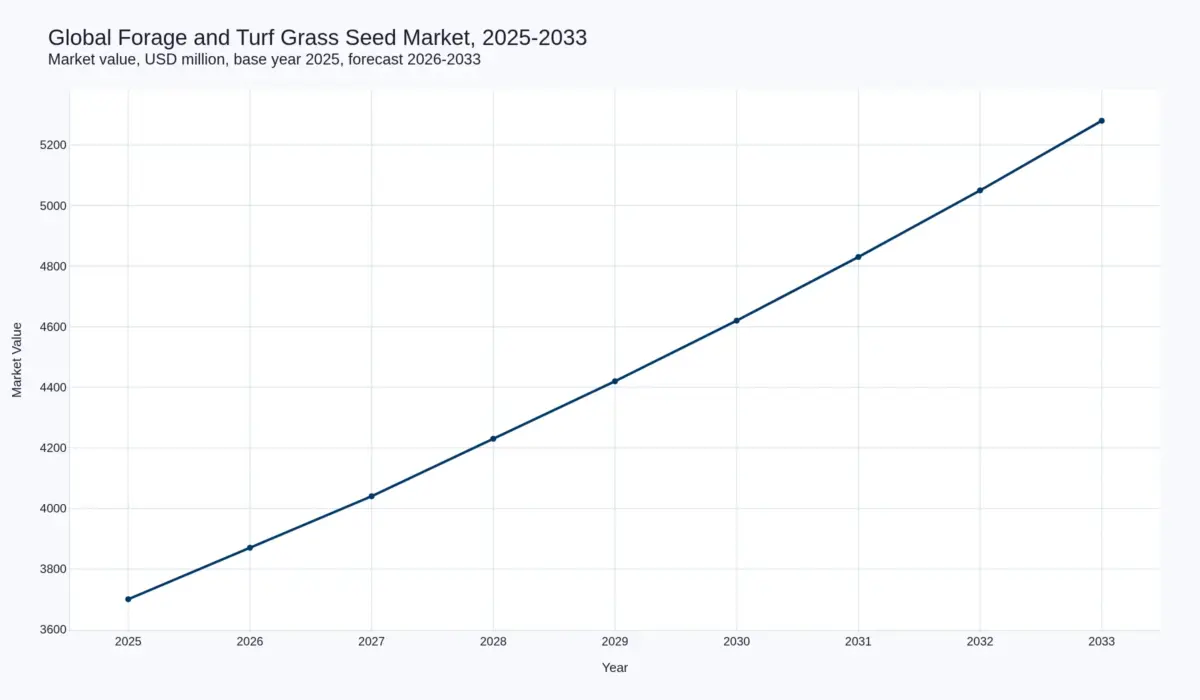
5. Global Forage and Turf Grass Seed Market Size and Forecast (USD Million), 2026–2033
5.1 Market Revenue Analysis
The market grows from USD 3,700 million in 2025 to USD 5,280 million in 2033, an increase of USD 1,580 million over eight years. The path is deliberately front-loaded on the price side and back-loaded on the volume side: 2026 and 2027 carry most of the pricing recovery because that is when European scarcity meets depleted inventory, while volume growth compounds slowly across the whole window as Brazilian renovation accumulates.
| Year | Market value (USD million) | Volume (thousand tonnes) |
|---|---|---|
| 2025 | 3,700 | 1,180 |
| 2026 | 3,870 | 1,203 |
| 2027 | 4,040 | 1,227 |
| 2028 | 4,230 | 1,251 |
| 2029 | 4,420 | 1,276 |
| 2030 | 4,620 | 1,302 |
| 2031 | 4,830 | 1,327 |
| 2032 | 5,050 | 1,354 |
| 2033 | 5,280 | 1,380 |
| CAGR | 4.55% | 1.98% |
5.2 CAGR Analysis
The 4.55% decomposes cleanly because the two drivers are measured independently. Volume compounds at 1.98% and value per tonne at roughly 2.5%, and the two multiply to 4.55%. That is an unusually transparent decomposition for a seed market, and it exists only because the unit of trade here is a commodity pound rather than a branded bag.
Compare it with the rest of the cluster. In corn, volume contributes 24% of growth and price and technology 76%. In soybean, 29 and 71. In grass seed, volume contributes 44% and price 56%. This is the least technology-driven, most commodity-like market in our Seeds coverage, and the difference is not a matter of degree. Corn sells a trait; grass seed sells a plant.
5.3 Demand-Supply Trends
2024 and 2025 were oversupplied in the Northern Hemisphere. DLF reported that sales volumes increased year on year while wholesale prices declined as a result of that oversupply, and that the prices it could pay growers for the 2024 harvest were at a level it was not satisfied with. Its own revenue fell from DKK 7,585 million in FY2024/25 to DKK 6,874 million in FY2025/26, a decline of roughly 9%, and EBIT from DKK 474 million to DKK 376 million — in a year when it sold more seed.
2026 marks the turn. DLF's October 2026 update describes supply tightening, prices already risen in both forage and turf segments, and 2027 framed as a question of availability. The inventory that was the problem in 2024 has become the constraint. What has not yet happened is the acreage adjustment in Oregon, which is why the recovery is real in Europe and still theoretical in the Pacific Northwest.
5.4 Pricing Analysis
This is the section that matters most, because grass seed is one of the few agricultural products in the developed world currently trading below its cost of production in a major producing region. The price deck below is the Oregon trade, August 2026, in US cents per pound — the convention the industry actually uses.
| Product | Trade price (US cents/lb) | Cost of production (US cents/lb) | Spread |
|---|---|---|---|
| Perennial ryegrass, contract | 96 | 105 | −9 |
| Perennial ryegrass, dealer top | 103 | 105 | −2 |
| Tall fescue, contract | 80–82 | 95 | −13 to −15 |
| Tall fescue, dealer top | 85 | 95 | −10 |
| K-31 tall fescue, open market | 120 | 95 | +25 |
Three things follow. First, the negative spreads are measured at average yields; the 2026 harvest came in 10 to 20% below average, so the realised cost per pound is higher and the true spread wider. Second, the only product above cost is the oldest, cheapest, least-bred one — K-31 is a 1940s-era utility fescue, and its premium over improved tall fescue is a market signal that buyers are currently valuing volume and price over performance. Third, that inversion is not sustainable and will not persist: it is the definition of a market that has to reprice.
5.5 Investment Trends
Capital in this market goes into three things: breeding programmes, seed conditioning and storage capacity, and working capital. There is almost no venture or growth capital, and the reason is structural — an eight to twelve year breeding cycle into a commodity with no patentable transgene is not a venture-shaped asset.
DLF's own capital allocation in 2025 was about focus rather than expansion. It carved its sugar beet business out into United Beet Seed, a strategic partnership with Groupe Florimond Desprez, sold its shareholding in Danespo, consolidated around forage and turf seed plus vegetable seed multiplication, and reduced debt while managing what it described as high inventory levels. That is a balance sheet telling you what an oversupplied commodity market does to strategy: concentrate, deleverage, wait.
The genuinely interesting investment is in the public system. Coachella Bermuda, a hybrid bermudagrass selected for drought resistance and shorter winter dormancy, came out of a University of California, Riverside programme re-established in 2012, which has generated nearly 5,000 hybrids and currently evaluates around 2,000 genotypes, advancing only six to ten lines to comparative trials. It was licensed to West Coast Turf in 2025 and is now on Southern California golf courses. Public money is doing the long-horizon work that no private programme in a deflating commodity can justify.
5.6 Future Market Outlook
By 2033 the market is larger, slower-growing and more unevenly distributed than it is today. Europe's share declines as its acreage base stays constrained. North America remains the largest single market but grows at 3.6%, below the global rate, because its turf area is being legislated down and its forage base is mature. South America grows at 7.1% and adds roughly USD 450 million of value, more than any region outside North America in absolute terms.
6. Three Structural Shifts Defining 2026–2033
6.1 Shift One: Deflation, Not Weak Demand
The defining fact of the base year is that the market shrank while it sold more. DLF's revenue fell roughly 9% in a year in which its volumes rose, and it explicitly attributes the fall to wholesale prices rather than to demand. The Oregon price deck puts tall fescue contracts 13 to 15 cents below the cost of production.
A market that is contracting on price while expanding on volume has a supply problem, not a demand problem, and the policy response is different. You do not stimulate demand for grass seed — the farmer either reseeds or he does not, and the golf course either renovates or it does not. You reduce acreage, and you wait for inventory to clear. Europe has done that. Oregon is doing it by attrition, which is slower and more painful and is the reason the recovery in this forecast is not uniform across regions.
6.2 Shift Two: Turf Area Legislated Down, Specification Bid Up
The turf segment is being pulled in two directions at once and the net is not obvious until you look at the price per pound on each side of it.
The area being removed is nonfunctional turf on commercial, industrial, institutional and HOA property in California, with compliance deadlines from 1 January 2027, and comparable pressure in other western states. That turf is normally established with contractor-grade utility mix — the cheapest seed sold, and the segment most exposed to price competition and least attached to any particular cultivar.
The area being protected and expanded is golf, sports and managed landscape: exempt from the ban, at record participation, and buying elite cultivars at multiples of the commodity price. Sixteen World Cup stadiums, eight of which had to convert off artificial turf, is the purest expression of it.
So the correct reading is not that turf is shrinking. It is that turf is stratifying, and the value is migrating to the end that pays for performance. That is a good outcome for anyone with a breeding programme and a bad one for anyone selling commodity blend by the truckload.
6.3 Shift Three: The Incremental Tonne Is Tropical
Almost all of the volume growth in this forecast comes from one place. Brazil's 160 million hectares of pasture, of which something between 80 and 105 million is degraded, is the largest addressable renovation surface in world agriculture, and the ABC+ Plan has put a 30 million hectare target on it.
This is why the volume CAGR is 1.98% and not 1.0%. It is also why a meaningful slice of this forecast rests on a policy that Brazil has historically under-delivered against, and on a single species complex: Urochloa brizantha cultivar Marandu is more than 80% of Brazilian pasture seed volume. A disease event, a seed-production failure or a change of direction in Brasília moves the global tonnage number more than anything that happens in Oregon, Denmark or New Jersey.
There is a second-order consequence worth naming. Tropical seed is produced on a different model — largely in the Cerrado, in rotation with annual crops, harvested by mechanised ground sweeping — and it is sold into a market with different price points. As tropical tonnage grows, the global average value per tonne is pulled in two directions simultaneously: up from the turf specification shift, down from tropical mix. That tension is why the value-per-tonne line in this report rises only 2.5% a year despite a genuine premiumisation story in the developed world.
7. Market Segmentation Analysis (USD Million), 2026–2033
7.1 By Application
| Application | 2025 (USD m) | Share | 2033 (USD m) | CAGR |
|---|---|---|---|---|
| Forage and pasture | 1,650 | 44.6% | 2,293 | 4.2% |
| Turf and amenity | 1,750 | 47.3% | 2,508 | 4.6% |
| Conservation, reclamation and cover crop | 300 | 8.1% | 493 | 6.4% |
| Total | 3,700 | 100% | 5,280 | 4.55% |
7.1.1 Forage and Pasture
USD 1,650 million in 2025, growing at 4.2%. The largest single source of tonnage and the most price-elastic part of the market. Demand is a renewal decision made every eight to fifteen years, so the installed base of grassland, not its annual value, sets the pace. Europe dominates in value per hectare; Brazil and Latin America dominate in tonnage growth.
7.1.2 Turf and Amenity
USD 1,750 million in 2025 and the largest application by value, at 47.3%. Grows fastest among the two large segments at 4.6% because specification is rising even as area is restricted. Golf, sports turf, sod production, landscape and the consumer lawn and garden channel all sit here. This is where the margin is.
7.1.3 Conservation, Reclamation and Cover Crop
USD 300 million in 2025, growing at 6.4% — the fastest of the three. The smallest segment and the least visible, but cover cropping in particular is a genuine structural demand leg rather than a cyclical one, and it is bought on a soil-health and regulatory logic that is independent of both livestock prices and amenity spending.
7.2 By Species Group
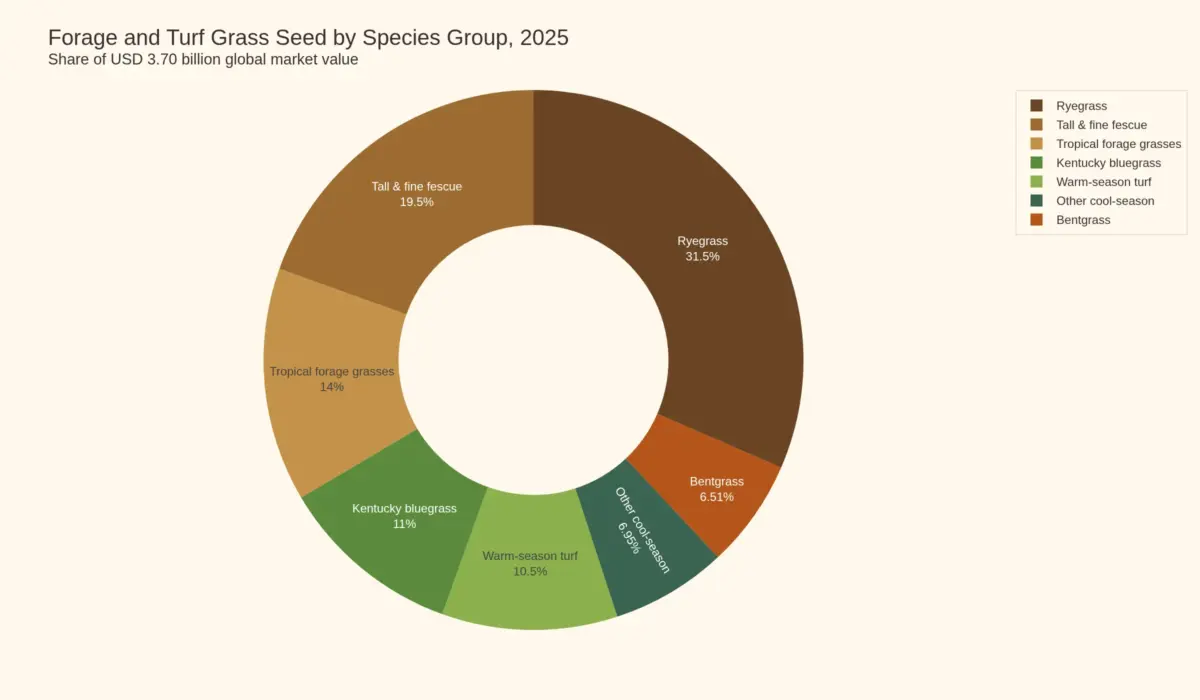
| Species group | 2025 (USD m) | Share | CAGR |
|---|---|---|---|
| Ryegrass (perennial, annual, Italian, hybrid) | 1,166 | 31.5% | 4.4% |
| Fescue (tall, meadow, fine and red) | 722 | 19.5% | 4.3% |
| Tropical forage grasses (Urochloa, Panicum, Andropogon) | 518 | 14.0% | 6.2% |
| Kentucky bluegrass | 407 | 11.0% | 3.9% |
| Warm-season turf (bermudagrass, zoysia, St Augustine, paspalum) | 389 | 10.5% | 5.5% |
| Bentgrass | 241 | 6.5% | 4.1% |
| Other cool-season (orchardgrass, timothy, brome, wheatgrass) | 257 | 7.0% | 3.0% |
| Total | 3,700 | 100% | 4.55% |
7.2.1 Ryegrass
The largest species group at 31.5% of value, and the one that sets the price of everything else. Perennial ryegrass is the workhorse of European and Australasian pasture and a major turf component; annual and Italian ryegrass are the fastest-turnover forage species and, increasingly, a cover crop. It is also the species where the current price inversion is sharpest, which makes it the best single indicator of when the cycle turns.
7.2.2 Fescue
19.5% of value. Tall fescue spans the entire quality range of this market, from K-31 utility grass for erosion and rough ground at the bottom to elite turf-type cultivars for sports surfaces at the top, which is why its price spread is wider than any other species. Fine and red fescue are the fine-turf and shade components and are, per DLF, among the species most exposed to 2027 availability.
7.2.3 Kentucky Bluegrass and Bentgrass
Together 17.5% of value across two very different products. Kentucky bluegrass is the backbone of North American cool-season lawn and sports turf and commands a premium for colour, density and rhizomatous recovery. Bentgrass is the golf-green species, sold in small volumes at very high prices per pound, and is the most specification-sensitive product in the entire market.
7.2.4 Warm-Season Turf Grasses
10.5% of value, growing at 5.5%. Bermudagrass, zoysia, St Augustine and seaspray paspalum. Growing because the climatic envelope is moving and because breeding has closed the winter-colour gap that historically limited them — Coachella Bermuda's shorter dormancy is the clearest current example.
7.2.5 Tropical Forage Grasses
14.0% of value and the fastest-growing species group at 6.2%. Overwhelmingly Brazilian, overwhelmingly Urochloa brizantha, and the single largest source of incremental global tonnage. Hybrid cultivars are the growth frontier and are still a rounding error in tonnage terms.
7.2.6 Other Cool-Season Grasses
7.0% of value, growing at 3.0% — the slowest group. Orchardgrass, timothy, bromegrass and wheatgrass, mostly forage and mostly regional. Timothy in particular is exposed to the same 2027 availability squeeze as ryegrass and fescue.
7.3 By Season Type
| Season type | 2025 (USD m) | Share | CAGR |
|---|---|---|---|
| Cool-season | 2,905 | 78.5% | 4.3% |
| Warm-season | 795 | 21.5% | 5.4% |
The dominance of cool-season species is the market's defining geographic fact. It is why Oregon, Denmark and the Netherlands are the production centres, why a Danish drought is a global supply event, and why the fastest-growing segment is the one least dependent on any of them.
7.4 By Distribution Channel
| Channel | 2025 (USD m) | Share | CAGR |
|---|---|---|---|
| Distributors and agricultural dealers | 2,146 | 58.0% | 4.3% |
| Seed multiplication and contract supply | 906 | 24.5% | 4.7% |
| Retail and online | 648 | 17.5% | 5.3% |
The dealer channel is the market's spine: the same merchant that sells fertiliser and crop protection to a farmer sells him grass seed, and that relationship, not brand, decides most forage purchases. Contract multiplication is the upstream mirror — the seed houses contract acreage with growers, and the contracted share is a direct read on confidence: for the 2025 Oregon crop, 84% of perennial ryegrass acreage and 79% of turf-type tall fescue acreage was under contract, against 48% of annual ryegrass.
8. Regional Market Analysis
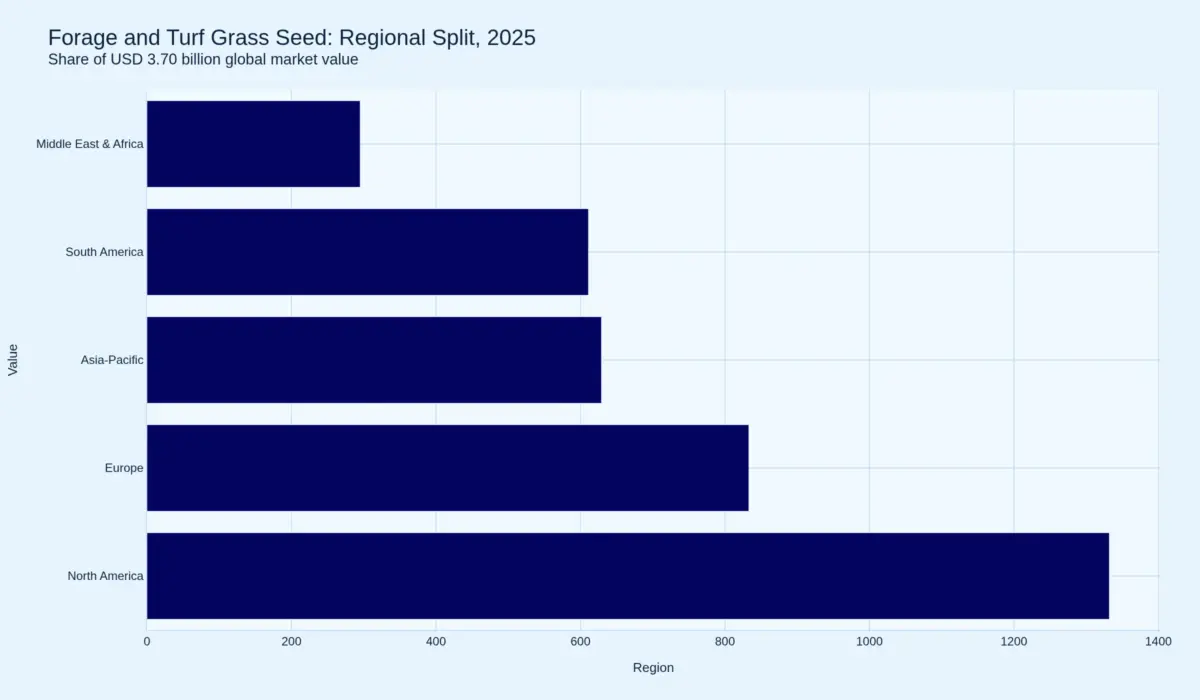
| Region | 2025 (USD m) | Share | 2033 (USD m) | CAGR |
|---|---|---|---|---|
| North America | 1,332 | 36.0% | 1,768 | 3.6% |
| Europe | 833 | 22.5% | 1,072 | 3.2% |
| Asia-Pacific | 629 | 17.0% | 973 | 5.6% |
| South America | 611 | 16.5% | 1,058 | 7.1% |
| Middle East and Africa | 295 | 8.0% | 439 | 5.1% |
| Total | 3,700 | 100% | 5,280 | 4.55% |
Regional 2033 values are compounded at the stated regional CAGR from rounded 2025 values and sum to USD 5,310 million against a global control of USD 5,280 million; the difference is rounding, and the global figure governs.
8.1 North America (Largest Market)
USD 1,332 million, 36.0% of global value, growing at 3.6% — the second-slowest region. North America is simultaneously the most mature and the most exposed. Its forage base is contracting: US alfalfa harvested area has fallen nearly 40% since 2000, and the same economic pressure applies to grass hay. Its turf base is being legislated: California's nonfunctional turf ban carries compliance deadlines from 1 January 2027 with further state action likely.
What holds the value up is specification. Record golf rounds on 2,000 fewer courses, sixteen World Cup stadiums, and a sports-turf sector that keeps raising the bar on what a surface must do. North America will lose volume share over the forecast window and hold value share, which is the right trade for anyone selling to it.
8.2 Europe
USD 833 million, 22.5% of value, growing at 3.2% — the slowest region overall but the one most likely to surprise upward in the near term. Europe is the most consolidated production and breeding base in the world, with DLF at 50% of the market, and it is where supply discipline actually functions.
The 2026 season was defined by weather. Parts of Denmark received under 40 millimetres of rain between April and July; temperatures reached 37°C in late June; the Netherlands exceeded 40°C and its perennial ryegrass yield fell 12%. Total European harvest was close to normal yield per hectare but on significantly fewer hectares than three years ago, and DLF's conclusion is that the harvest will not rebuild inventories in the species already short. The 2027 constraint is availability across perennial ryegrass, red fescue, white and red clover and Kentucky bluegrass.
8.3 South America (Fastest-Growing Market)
USD 611 million, 16.5% of value, growing at 7.1% — the fastest region by a wide margin and the source of most of the market's incremental tonnage. Brazil is the world's largest producer, consumer and exporter of tropical forage seed, with domestic demand of around 90,000 tonnes a year, dominated by Urochloa brizantha cultivar Marandu at more than 80% of seed volume.
The growth thesis is pasture renovation. With roughly 160 million hectares of pasture and 80 to 105 million of it degraded, and an ABC+ target of 30 million hectares restored, the addressable surface is enormous and the current seed market is small relative to it. Production is migrating from São Paulo to the Cerrado, where seed is grown in rotation with annual crops and harvested by mechanised ground sweeping — a lower-cost, higher-volume model that will keep tropical prices structurally below cool-season prices.
8.4 Asia-Pacific
USD 629 million, 17.0% of value, growing at 5.6%. The demand driver is dairy and beef intensification in China, Japan, Korea and Southeast Asia, where forage quality is the binding constraint on livestock productivity. Supply is domestic in China and imported elsewhere, largely from Australasia and North America. This is the region where the gap between current seed use and agronomic potential is widest, and where the forecast is most sensitive to livestock policy rather than to seed economics.
8.5 Middle East and Africa
USD 295 million, 8.0% of value, growing at 5.1%. Two very different markets. In the Gulf and North Africa, irrigated forage production under water constraint drives demand for the most water-efficient cultivars available, and the price premium for those cultivars is the highest in the world. In sub-Saharan Africa, the market is primarily tropical forage and primarily development-funded, which makes it large in potential and unreliable in timing.
9. Competitive Landscape
9.1 Market Share Analysis
| Supplier | FY2025 revenue | Estimated share of global grass seed value | Basis |
|---|---|---|---|
| DLF A/S | DKK 6,874m (approx. USD 1,049m) | 28.4% | Group revenue converted at DKK 6.55/USD; company states 30% of world forage and turf seed |
| Royal Barenbrug Group | EUR 370m+ (approx. USD 400m) | 10.8% | Stated net sales converted at EUR 1.08/USD |
| Germinal, Pennington, Jacklin and other regional houses | Not separately disclosed | Long tail | No disclosed grass seed revenue |
| Public breeding programmes | Not applicable | Licence-based | Royalty and licensing income only |
The top two hold roughly 39% of global value between them, which makes this one of the more concentrated seed markets in the world at the top and one of the most fragmented below it. That shape — a Danish co-operative and a Dutch family firm at the top, 30 to 40 independent houses in Oregon below — explains almost every pricing anomaly in this report.
9.2 Competitive Benchmarking
| Metric | DLF A/S | Royal Barenbrug Group | S&W Seed |
|---|---|---|---|
| Headquarters | Denmark | Netherlands | United States |
| Ownership | Co-operative, approx. 2,378 farmer owners | Family-owned, fourth generation, since 1904 | Listed |
| FY2025 revenue | DKK 6,874m (FY2025/26) | EUR 370m+ | USD 9.6m in fiscal Q3 2025 |
| EBIT | DKK 376m | Not disclosed | Net loss of USD 2.2m in Q3 |
| Employees | 1,809 | 925 | Not disclosed |
| R&D footprint | Breeding across forage, turf and vegetable | 22 R&D facilities, 16 operating companies | Sorghum trait technology |
| Strategic direction | Core focus, deleveraging, beet carve-out | Family continuity, global distribution | Exit from alfalfa toward sorghum traits |
The S&W comparison is the most instructive. It reported fiscal Q3 2025 revenue of USD 9.6 million, gross margin of 37.7% against 24.6% a year earlier, and its first positive adjusted EBITDA quarter in years — but it got there by repositioning away from alfalfa and onto sorghum trait technology, after April 2025 tariffs cut its China export channel. In the grass and forage seed business, the alfalfa pure-play is not a viable standalone position. That is a data point about the legume side of forage, but it is also a warning about scale in a commodity market.
9.3 Strategic Developments
DLF, 2025. Carved out sugar beet into United Beet Seed with Groupe Florimond Desprez; sold its Danespo shareholding; consolidated around forage and turf seed and vegetable seed multiplication; reduced debt; reported growing difficulty managing high inventory. In October 2026 it told customers that supply was tightening and that 2027 would be an availability year.
Barenbrug, 2025–2026. Continuity rather than reconfiguration, with a Group CFO transition in 2025 and continued operation across 16 operating companies, 22 R&D facilities and six continents.
S&W Seed, 2025. Repositioned onto sorghum traits — Double Team and Prussic Acid Free — with non-dormant alfalfa in Mexico offsetting declines in US dormant alfalfa.
Public programmes, 2025–2026. University of California, Riverside licensed Coachella Bermuda hybrid bermudagrass to West Coast Turf; the University of Tennessee carried the five-year turfgrass programme for FIFA World Cup 26 across sixteen stadiums; the University of Georgia and Rutgers maintain active cool- and warm-season breeding.
9.4 Breeding Depth and the Public Research Base
Because there are no transgenic traits in grass, breeding depth is the entire competitive moat, and it is measured in decades. DLF and Barenbrug each run multi-decade programmes across dozens of species; a new cultivar takes eight to twelve years from cross to commercial release. The public system carries a disproportionate share of the early-stage work: the Riverside bermudagrass programme generated nearly 5,000 hybrids to release one cultivar, and only six to ten lines out of 2,000 currently under evaluation will ever reach comparative trials.
That funnel is the economics of this market in miniature. It is also why public funding cuts are a slower-acting but larger threat to the industry than any single competitive move.
9.5 Seed Production Geography and Single-Valley Risk
The Willamette Valley produces roughly two-thirds of US cool-season grass seed. Oregon's 2025 crop was 289,000 acres of ryegrass and tall fescue, of which 117,000 were annual ryegrass, 51,000 perennial ryegrass, 91,000 turf-type tall fescue, 16,000 forage-type tall fescue and 14,000 K-31 and other types. Danish and Dutch production supplies Europe; Canterbury supplies Australasia; the Cerrado supplies tropical South America.
That concentration is efficient and it is fragile. A single poor harvest in one valley moves the global price. And there is a production-side risk that receives almost no attention: glyphosate-resistant Italian ryegrass has been identified in Oregon grass seed fields, and there is currently no standard bioassay that would let a seed testing laboratory tell a buyer whether a given seed lot carries resistant genetics. For a crop whose product is the seed, that is a quality and marketability exposure that sits underneath the entire supply chain.
10. Company Profiles
10.1 DLF A/S
Danish farmer-owned co-operative and the largest grass seed company in the world. FY2025/26 revenue DKK 6,874 million, EBITDA DKK 528 million, EBIT DKK 376 million, equity DKK 3,296 million, solvency ratio 51%, 1,809 employees, approximately 2,378 farmer owners. States a 30% share of world forage and turf seed and 50% of Europe. Consolidated around forage and turf seed plus vegetable seed multiplication in 2025, carving out sugar beet into United Beet Seed with Groupe Florimond Desprez and selling its Danespo shareholding. Wikidata: Q5205536.
10.2 Royal Barenbrug Group
Fourth-generation Dutch family firm, founded 1904, headquartered in Nijmegen. Annual net sales in excess of EUR 370 million, 925 full-time-equivalent employees, 16 operating companies, 22 R&D facilities, active on six continents and in all major climate regions, serving roughly 3,500 customers. The second-largest grass and legume seed business in the world and the principal counterweight to DLF in Europe. Wikidata: Q110069452.
10.3 S&W Seed Company
Listed US seed business that has moved decisively away from alfalfa and onto sorghum trait technology. Fiscal Q3 2025 revenue USD 9.6 million, gross margin 37.7% against 24.6% a year earlier, net loss of USD 2.2 million, and its first positive adjusted EBITDA quarter in several years. Non-dormant alfalfa sales in Mexico grew USD 0.6 million while US dormant alfalfa declined; April 2025 tariffs disrupted its China sorghum channel. Included here because it is the clearest evidence that forage legume seed is not a viable standalone position at sub-scale.
10.4 Germinal and the European Mid-Tier
The layer beneath DLF and Barenbrug in Europe: national champions with strong breeding in specific species and deep dealer relationships in one or two countries. Germinal's position in UK and Irish forage and amenity, alongside comparable houses in France, Germany and the Nordics, means that although European market share is concentrated at the top, variety-level competition is not. No grass seed revenue is separately disclosed by any of these houses.
10.5 Pennington and the Consumer Turf Channel
The consumer-facing end of the US turf market — bagged lawn seed, fertiliser and combination products sold through garden retail. This channel is a different business from the professional trade: brand, packaging and shelf position matter more than cultivar performance, and margins are set by retail price points rather than by seed cost. It is also the channel most exposed to the nonfunctional turf legislation in the medium term, because it serves the residential lawn that the legislation protects but the landscaping that it restricts.
10.6 Jacklin Seed and the US Turf Trade
The professional turf trade in North America — sod producers, golf, sports fields, landscape contractors — is supplied by a set of conditioning and distribution houses with strong cultivar portfolios and regional reach. Jacklin, now part of the Simplot organisation, is the most prominent. These businesses own less breeding than DLF or Barenbrug and more of the cleaning, conditioning, blending and logistics that turns certified seed into a specification-grade product.
10.7 Grasslanz Technology and the Endophyte Layer
The commercialisation arm of New Zealand's grassland research system and the holder of the endophyte licences that underpin pest resistance in Australasian ryegrass and tall fescue. In May 2026 the Ag Emissions Centre committed NZD 5.46 million to a three-year programme with the New Zealand Bioeconomy Science Institute, the Ferrier Institute and the University of Canterbury, testing whether methane-inhibiting compounds can be generated inside Epichloë endophytes. If it works, the delivery mechanism is pasture renewal — no new input, no new machinery — which would make the endophyte system the first genuinely new trait layer in a market that has none.
10.8 PGG Wrightson Seeds
The dominant seed business in New Zealand and a significant supplier into Australia, South America and Asia. Its competitive position rests on endophyte technology licensed from the New Zealand research system and on southern-hemisphere counter-season production, which lets it supply northern customers outside the European and North American harvest windows.
10.9 The Brazilian Tropical Seed Houses
A distinct industry with a distinct economics. Domestic demand of around 90,000 tonnes a year, dominated by Urochloa brizantha cultivar Marandu at more than 80% of volume, with production moving from São Paulo into the Cerrado and integrated into annual crop rotations. Hybrid Brachiaria is the frontier: 19 cultivars registered, 6,232 tonnes produced on 4,700 hectares in 2023/24. The leading houses are largely family-owned and vertically integrated into production.
10.10 The Public Breeding System
Not a competitor in the commercial sense and the most important institution in the market's long-run technology pipeline. University of California, Riverside's warm-season programme, the University of Georgia and Rutgers cool- and warm-season programmes, Oregon State's seed production research and the University of Tennessee's World Cup turfgrass programme collectively do the eight-to-twelve-year work that a deflating commodity cannot fund privately, and license the results out. Coachella Bermuda is the current proof of concept.
11. Strategic Intelligence and Phoenix AI Insights
11.1 Grass Seed Demand Forecast Model
The model decomposes value into volume and value per tonne and forecasts them separately, because in this market they are driven by different things: volume by Brazilian pasture renovation and European reseeding after drought, price by inventory, acreage and the specification mix. The current output is 1.98% volume and roughly 2.5% price, combining to 4.55%.
11.2 Pasture Renovation Tracker (Brazil)
Monitors ABC+ delivery against the 30 million hectare target, hybrid Brachiaria cultivar registrations and certified seed production volumes. The 6,232 tonnes produced in 2023/24 against a 90,000 tonne national market is the number to watch; it is the leading indicator of whether the tropical leg of this forecast is real.
11.3 Turf Area Legislation Tracker
Tracks California AB 1572 implementation through the 1 January 2027 compliance deadline and equivalent measures in other western states, with the exemption categories — residential, cemeteries, sports fields, civic and community areas — mapped against seed consumption by end use. The purpose is to separate volume that is genuinely lost from volume that is merely re-specified.
11.4 Price-Cost Spread Monitor
The single most valuable indicator in this market. Tracking Oregon trade prices against the bargaining association's cost of production, by species, gives advance warning of both capacity destruction and recovery. A sustained move above cost in tall fescue would be the clearest possible signal that the acreage adjustment has finally happened.
11.5 Automated Porter's Five Forces Analysis
Supplier power: moderate to high. Growers are numerous but their bargaining is collective through the bargaining association, and in a sub-cost market they hold stock rather than sell.
Buyer power: moderate. Dealers and distributors are concentrated relative to growers but fragmented relative to breeders, and the pre-selling of seed before harvest transfers risk back to the dealer.
New entrants: low. An eight-to-twelve year breeding cycle, varietal registration and certified production capacity are not things capital can buy quickly. The exception is tropical, where the barriers are lower and the genetics are less protected.
Substitutes: low to moderate. Farm-saved and uncertified seed is the permanent substitute and its share rises when prices are high, which caps pricing power at the top of the cycle.
Rivalry: high. A commodity with a one-year production lag, no futures contract and 30 to 40 independent producers in the largest production region is structurally prone to over-correction in both directions.
12. Future Outlook and Strategic Recommendations
12.1 Pricing Against the Cost of Production
The single most important strategic question in this market is when Oregon prices cross back above the cost of production, because that threshold, not any demand forecast, determines whether the supply base survives intact. Our view is that European scarcity pulls the price up through 2026 and 2027 and that the Pacific Northwest follows with a lag of roughly twelve to eighteen months. Anyone with certified stock of recommended varieties in short species currently holds an appreciating asset.
12.2 Building a Tropical Forage Portfolio
Tropical forage is 14.0% of value, growing at 6.2%, sitting on an 80-million-hectare degradation problem with a 30-million-hectare government target. It is also the least consolidated part of the market and the least protected by plant variety rights. For a European or North American house with no tropical presence, the argument for entry is growth; the argument against is that the genetics are cheap, the competition is local and the price points are set by Brazilian production costs.
12.3 Turf: Fewer Hectares, Higher Specification
The correct posture toward turf is not defensive. Area is being legislated down at the commodity end while specification is bid up at the professional end, and the two effects are roughly value-neutral in the near term and positive thereafter. The strategic move is to exit contractor-grade blend and concentrate breeding and distribution on golf, sports and managed landscape, where the buyer is specifying performance and not shopping on price per pound.
12.4 Endophyte and Trait Licensing
With no transgenic route available, the endophyte system is the only real trait layer in this market, and it is licensed rather than owned by most of the industry. The New Zealand methane work, if it succeeds, would make pasture renewal a delivery mechanism for an emissions outcome — which in a regulated emissions environment is worth considerably more than the seed it is delivered in. The strategic implication is that endophyte licences, not cultivar portfolios, may be the most valuable intellectual property in forage by 2033.
12.5 Long-Term Market Outlook (2033+)
Beyond the forecast window, the structural direction is set by two things that are not really about seed. First, the climatic envelope is moving, which shifts value from cool-season to warm-season species and from northern to southern production. Second, the regulatory envelope is moving, which removes low-value turf area in water-stressed regions and raises the specification bar everywhere else. A market that grows 4.55% a year while its volume grows 1.98% is a market being repriced upward by specification rather than expanded by area, and that is the most durable form of growth available to a commodity.
13. Appendix
Currency conversions. DKK 6,874 million converted at DKK 6.55 per US dollar; EUR 370 million converted at EUR 1.08 per US dollar. Rates are indicative period averages applied consistently and are disclosed so that shares can be recomputed.
Price deck source. Oregon trade prices and costs of production are as reported in August 2026 by the Oregon Grass Seed Bargaining Association and growers, quoted in US cents per pound, the industry convention.
Acreage source. USDA National Agricultural Statistics Service, Oregon Grass Seed Forecast, March 2025 — the most recent Oregon grass seed release available at the time of writing.
Volume basis. Clean grass seed, thousand tonnes, forage legumes excluded. Where species-level seeding rates differ by orders of magnitude, the report declines to present a combined tonnage.
Entity mappings. Poaceae Q43238; Lolium perenne Q161722; Festuca arundinacea Q157922; Urochloa brizantha Q15296365; DLF Seeds Q5205536; Barenbrug Holding Q110069452. All verified against the Wikidata API before assignment; no identifier was assigned to an entity that could not be verified.
Rounding. Regional and segment 2033 values are compounded from rounded 2025 values and may not sum exactly to the global control figure of USD 5,280 million.
14. About Phoenix Market Research and Disclaimer
Phoenix Market Research produces market intelligence built from company filings, regulatory documents, government statistics and primary disclosure rather than from licensed syndicated data. Base-year figures in this report are triangulated from at least three independent directions and the derivation is disclosed so that it can be challenged.
This report is provided for information purposes. It does not constitute investment, legal or agronomic advice. Market values are estimates at the date of publication and are subject to revision. Company financial figures are as reported by the companies concerned for the periods stated and are not restated for subsequent events.
Further reading: the single season that produced opposite outcomes for one crop in two hemispheres — and why the cause was consolidation rather than weather — is set out in Perennial Ryegrass Cleared at 96 Cents Against a USD 1.05 Cost of Production While Europe Ran Out.
Further reading: California Is Legislating Turf Area Down While Specification Goes Up — how AB 1572 draws its exemption line around sports fields, cemeteries and civic areas, why the acreage it removes buys almost no seed and the acreage it protects buys the most, and why the Oregon price signal is currently running against the California area signal.
Table of Contents
- Executive Summary
- Research Methodology and Scope
- Market Overview and Definitions
- 3.1 Why a Grass Seed Market Is Not a Grassland Market
- 3.2 Grass Versus Forage Legume: The Scope Boundary
- 3.3 Segmentation Framework
- 3.4 Forecasting Assumptions (2026–2033)
- Market Dynamics
- 4.1 Market Drivers
- 4.1.1 Pasture Renovation and Brazil’s Degradation Map
- 4.1.2 Drought-Damaged Grassland Restoration in Europe
- 4.1.3 Golf at Record Rounds on Two Thousand Fewer Courses
- 4.1.4 Turf Specification Uplift and the 2026 World Cup
- 4.1.5 Conservation, Reclamation and Cover Crops
- 4.2 Market Restraints
- 4.2.1 Prices Below the Cost of Production
- 4.2.2 The Nonfunctional Turf Legislation
- 4.2.3 Thirty to Forty Seed Houses and No Supply Discipline
- 4.3 Market Opportunities
- 4.1 Market Drivers
- 5. Global Forage and Turf Grass Seed Market Size and Forecast (USD Million), 2026–2033
- 5.1 Market Revenue Analysis
- 5.2 CAGR Analysis
- 5.3 Demand-Supply Trends
- 5.4 Pricing Analysis
- 5.5 Investment Trends
- 5.6 Future Market Outlook
- 6. Three Structural Shifts Defining 2026–2033
- 6.1 Shift One: Deflation, Not Weak Demand
- 6.2 Shift Two: Turf Area Legislated Down, Specification Bid Up
- 6.3 Shift Three: The Incremental Tonne Is Tropical
- 7. Market Segmentation Analysis (USD Million), 2026–2033
- 7.1 By Application
- 7.1.1 Forage and Pasture
- 7.1.2 Turf and Amenity
- 7.1.3 Conservation, Reclamation and Cover Crop (Fastest-Growing)
- 7.2 By Species Group
- 7.2.1 Ryegrass
- 7.2.2 Fescue
- 7.2.3 Kentucky Bluegrass and Bentgrass
- 7.2.4 Warm-Season Turf Grasses
- 7.2.5 Tropical Forage Grasses (Fastest-Growing)
- 7.2.6 Other Cool-Season Grasses
- 7.3 By Season Type
- 7.4 By Distribution Channel
- 7.1 By Application
- 8. Regional Market Analysis
- 8.1 North America (Largest Market)
- 8.2 Europe
- 8.3 South America (Fastest-Growing Market)
- 8.4 Asia-Pacific
- 8.5 Middle East and Africa
- 9. Competitive Landscape
- 9.1 Market Share Analysis
- 9.2 Competitive Benchmarking
- 9.3 Strategic Developments
- 9.4 Breeding Depth and the Public Research Base
- 9.5 Seed Production Geography and Single-Valley Risk
- 10. Company Profiles
- 10.1 DLF A/S
- 10.2 Royal Barenbrug Group
- 10.3 S&W Seed Company
- 10.4 Germinal and the European Mid-Tier
- 10.5 Pennington and the Consumer Turf Channel
- 10.6 Jacklin Seed and the US Turf Trade
- 10.7 Grasslanz Technology and the Endophyte Layer
- 10.8 PGG Wrightson Seeds
- 10.9 The Brazilian Tropical Seed Houses
- 10.10 The Public Breeding System
- 11. Strategic Intelligence and Phoenix AI Insights
- 11.1 Grass Seed Demand Forecast Model
- 11.2 Pasture Renovation Tracker (Brazil)
- 11.3 Turf Area Legislation Tracker
- 11.4 Price-Cost Spread Monitor
- 11.5 Automated Porter’s Five Forces Analysis
- 12. Future Outlook and Strategic Recommendations
- 12.1 Pricing Against the Cost of Production
- 12.2 Building a Tropical Forage Portfolio
- 12.3 Turf: Fewer Hectares, Higher Specification
- 12.4 Endophyte and Trait Licensing
- 12.5 Long-Term Market Outlook (2033+)
- 13. Appendix
- 14. About Phoenix Market Research and Disclaimer
Competitive Landscape
Overview
The competitive structure of the grass seed industry is a barbell. At one end sit two European businesses that between them account for roughly 39% of global value. At the other sits a long tail of several hundred regional houses, seed conditioners and national champions, of which the largest production cluster — 30 to 40 independent companies in the Willamette Valley — supplies roughly two-thirds of American cool-season grass seed and none of which is large enough to influence the global price alone.
Current Scenario
DLF is the largest grass seed company in the world by a wide margin. Its FY2025/26 revenue was DKK 6,874 million with EBIT of DKK 376 million, equity of DKK 3,296 million and a solvency ratio of 51%, employing 1,809 people and owned by approximately 2,378 Danish farmers. It states a 30% share of world forage and turf seed and 50% of Europe. On our base of USD 3.70 billion, its converted revenue of USD 1,049 million is 28.4% — close enough to the company’s own claim to corroborate it.
Royal Barenbrug Group is the counterweight: a fourth-generation Dutch family firm founded in 1904, headquartered in Nijmegen, with net sales in excess of EUR 370 million, 925 full-time-equivalent employees, 16 operating companies on six continents, 22 R&D facilities and roughly 3,500 customers. Converted at EUR 1.08, its USD 400 million of sales are 10.8% of the world market.
Below them, the industry fragments fast. Germinal leads the UK and Irish forage and amenity trade. Pennington owns the American consumer lawn channel. Jacklin, within the Simplot organisation, holds a large share of professional US turf trade distribution. PGG Wrightson Seeds dominates New Zealand and supplies Australia, South America and Asia on counter-season production. In Brazil, family-owned houses control a tropical market of around 90,000 tonnes a year in which a single cultivar, Urochloa brizantha Marandu, is more than 80% of volume.
Signals
The most revealing competitive signal of 2025 came not from the leaders but from a small listed player. S&W Seed reported fiscal Q3 revenue of USD 9.6 million, gross margin improving from 24.6% to 37.7%, and its first positive adjusted EBITDA quarter in years — achieved by repositioning away from alfalfa and onto sorghum trait technology after April 2025 tariffs closed its China export channel. The lesson is not that sorghum is a better business. It is that in forage seed, sub-scale and undifferentiated is not survivable, and the escape routes are trait technology or exit.
At the other end, DLF spent 2025 doing the opposite of expanding: carving sugar beet out into United Beet Seed with Groupe Florimond Desprez, selling its Danespo shareholding, consolidating around forage and turf seed plus vegetable seed multiplication, and reducing debt while managing high inventory. That is a market leader choosing focus and balance-sheet strength over growth in a deflating commodity. When the largest player with the strongest position behaves that way, the cycle is not near its top.
Strategic Implications
Barriers to entry are high at the top and low at the bottom, and the difference is entirely breeding. An eight-to-twelve-year cycle, varietal registration in every market of sale, and certified production capacity are not things capital can buy quickly. But at the commodity end, a conditioning plant and a dealer relationship are enough to compete, which is why the tail never consolidates away and why price competition at the bottom is permanent.
The most likely structural change in the forecast window is consolidation in the mid-tier rather than at the top. With the top two holding 39% and no third player above a few per cent, the rational move for any mid-sized European or American house is to merge with a complementary species portfolio rather than compete head-on. The counter-consideration is that family ownership is the norm in this industry, and family owners sell on their own timetable and not the cycle’s.
Forward Outlook
Expect the top two to hold their positions and possibly extend them in Europe, where consolidation has already happened and supply discipline works. Expect the Oregon tail to shrink by attrition rather than merger, because the assets that matter there are contracted acres rather than brands. Expect tropical to remain the least consolidated and most contested part of the market, since plant variety protection is weakest there and local production costs set the price. The competitive question that will matter most by 2033 is not who owns the most cultivars but who owns the endophyte licences, because that is the only trait layer this market has.
Value Chain
Overview
The grass seed value chain is unlike every other chain in the seeds sector, because the product being sold is a plant rather than a technology. There is no trait fee, no licence attached to a gene, and no service bundle wrapped around the bag. What moves from field to field is germplasm plus a germination test, and the entire commercial structure of the industry follows from that simplicity.
Six stages carry the product. Breeding sits at the top, where DLF, Royal Barenbrug, the New Zealand system behind Grasslanz, and the public programmes at Riverside, Georgia, Rutgers and Oregon State create cultivars on an eight-to-twelve-year cycle. Foundation seed multiplication follows, tightly controlled by the breeder because varietal purity is the only defensible asset. Certified seed multiplication is where the chain becomes an agricultural industry: contracted growers in the Willamette Valley, Jutland, the Netherlands, Manitoba, Canterbury, Argentina and the Brazilian Cerrado grow the crop under contract and bear the production risk. Conditioning turns harvested seed into a saleable product through cleaning, scarifying, sizing, coating, pelleting and testing. Distribution moves it to the trade or the consumer. End use is a farmer reseeding a pasture, a golf superintendent renovating a green, or a homeowner buying a bag.
Current Scenario
The economics of the chain have inverted at the bottom. In August 2026 the Oregon Grass Seed Bargaining Association put the cost of producing a pound of tall fescue at about 95 cents and perennial ryegrass at USD 1.05, against trade prices of roughly 80 and 96 cents. The 2026 harvest came in 10 to 20% below average yield, which raises the cost per pound further because fixed costs are spread across fewer pounds. At those numbers the grower is not merely margin-compressed; he is funding the chain.
Above him the chain remains functional. The breeder earns a variety premium that survives a commodity cycle. The conditioner earns a service margin on cleaning and testing. The dealer earns a logistics margin and, critically, has often pre-sold seed to his own customers before harvest, which is why dealers were reluctant to raise grower prices even as they competed for scarce supply. Only the grower’s margin is residual, and it is currently negative.
Contract structure shows how the risk is distributed. For the 2025 Oregon crop, 84% of perennial ryegrass acreage and 79% of turf-type tall fescue acreage was under contract before harvest, against only 48% of annual ryegrass. The species with the most contracted acreage is the one with the most valuable, most specification-driven end market; the species with the least contracted acreage is the one closest to a commodity and most exposed to spot price.
Signals
Three signals describe the current state of the chain. First, DLF explicitly reports reducing acreage to bring supply back into balance and describes the prices it was able to pay growers for the 2024 harvest as a level it was not satisfied with, which is a co-operative telling its own owners that the chain’s residual has been negative. Second, the Oregon Grass Seed Bargaining Association’s director frames the problem as coordination rather than margin: with 30 to 40 seed companies, nobody knows what anybody else is planting. Third, growers who cannot cover cost are holding stock rather than selling, which delays the clearing price and extends the period of loss.
Strategic Implications
For anyone operating in this chain, the implication is that upstream capacity is the scarce asset and it is being destroyed. Growers exiting grass seed do not return quickly: the crop is a multi-year rotation, the equipment is specialised, and the alternative crops in the Willamette Valley are competing for the same ground. A buyer who secures certified production today is buying an appreciating position, and one who assumes supply will be available at the bottom of the next cycle is making a mistake this chain has punished before.
The second implication concerns where margin can be created. It cannot be created in commodity cool-season seed, where the product is fungible and the price is set by the marginal Oregon grower. It can be created in specification: an elite turf cultivar, a novel endophyte, a hybrid Brachiaria. Every durable margin in this industry is attached to a product that a buyer specifies by name rather than buys on price.
Forward Outlook
By 2028 the chain should look different in two respects. European scarcity will have transferred pricing power upstream for the first time since 2023, and the contraction in Oregon acreage will have reduced the number of growers to the point where the survivors have meaningful bargaining position. Neither change alters the fundamental structure: a commodity base with a branded top, an eight-to-twelve-year breeding cycle above it, and a grower at the bottom absorbing whatever the market leaves. What changes is which party holds the leverage when the next cycle turns, and the answer will depend almost entirely on how much Oregon capacity exits between now and then.
Investment Activity
Overview
Capital formation in grass seed is unlike anything else in the agricultural inputs sector, because there is almost no growth capital in it. Funding comes from three sources: retained earnings inside long-established family firms and co-operatives, public research budgets, and bank debt secured against inventory and land. There is no venture market, no growth equity and very little listed exposure, and the reason is structural rather than cyclical.
Current Scenario
The economics explain the absence. An eight-to-twelve-year breeding cycle produces a cultivar whose genetics cannot be patented in any meaningful jurisdiction, sold into a commodity market at a price set by the marginal producer, with a one-year production lag and a multi-year inventory. That is not a venture-shaped asset. It is not even a particularly good listed-equity asset, which is why so few grass seed businesses are listed and why the one that is, S&W Seed, has been repositioning out of forage and into sorghum trait technology.
DLF’s 2025 decisions are the clearest read on capital allocation in the sector. It carved its sugar beet business out into United Beet Seed, a strategic partnership with Groupe Florimond Desprez; sold its shareholding in Danespo; consolidated around forage and turf seed plus vegetable seed multiplication; reduced debt; and reported that managing high inventory levels had required considerable effort. All of that is a balance sheet responding to a deflating commodity: concentrate on the core, monetise non-core assets, deleverage, and wait for supply to clear.
Royal Barenbrug’s investment is continuity capital — 22 R&D facilities and 16 operating companies, sustained across four generations of family ownership. That is a different model from DLF’s, and it produces a different behaviour: less portfolio surgery, more incremental breeding investment, and a longer horizon than any quarterly-reporting business could sustain.
Signals
The most interesting investment in this market is not commercial at all. Coachella Bermuda came out of a university programme re-established in 2012, funded through public and institutional money, and was licensed to a sod producer in 2025. The University of Tennessee ran a five-year research programme to deliver consistent natural turfgrass across sixteen World Cup stadiums and dozens of training facilities. The University of Georgia, Rutgers and Oregon State maintain active breeding. Public money is financing the long-horizon work that a sub-cost commodity cannot justify privately, and it is doing so at a scale the private sector would not replicate.
On the production side, capital is moving geographically rather than expanding. Brazilian pasture seed production is migrating from São Paulo into the Cerrado, where seed is grown in rotation with annual crops and harvested by mechanised ground sweeping — a lower-cost model that reuses existing crop infrastructure rather than building dedicated capacity. That is the cheapest capacity addition available anywhere in this market.
Strategic Implications
For an investor, the relevant question is not which company grows fastest but which holds the assets that cannot be replicated. Those are: contracted grower acres in a valley with the right climate and infrastructure; endophyte licences; and a breeding programme old enough to have a deep parental pool. Everything else — conditioning plants, dealer networks, brands — can be bought or built.
For the industry, the funding gap has a specific consequence. Because the technology pipeline depends disproportionately on public money, and because public agricultural research budgets are politically exposed, the market is under-investing in its own future relative to the value it extracts. A sector worth USD 3.70 billion that funds its long-horizon breeding through universities is a sector with a structural under-investment problem that will only become visible a decade later.
Forward Outlook
Expect three things in the forecast window. Working capital will remain the binding constraint until inventory clears, which means balance-sheet management rather than strategic expansion is the priority for the next two years. Consolidation will occur in the mid-tier, driven by succession at family firms rather than by strategic ambition. And the first genuinely new investment category will be endophyte and biologicals licensing, where the intellectual property is stronger and the value proposition is not a marginally better plant but a measurable environmental outcome. The methane programme is the first signal of that shift, and it is public-funded, which tells you where the risk capital is coming from.
Technology & Innovation
Overview
Technology in grass seed means one thing: breeding. With no transgenic route available and no trait-fee layer to fund one, every improvement in this market comes from cycles of crossing, selection and field evaluation that take eight to twelve years from first cross to commercial release. The innovation question is therefore not which technology will disrupt the market but how much breeding capacity the market can afford to fund when the product it produces sells below the cost of production.
Current Scenario
The breeding funnel is extraordinarily lossy, and the numbers from the University of California, Riverside illustrate it precisely. Its warm-season programme, re-established in 2012, has generated nearly 5,000 hybrids. Around 2,000 genotypes are currently under evaluation. Only about six to ten promising experimental lines advance into trials against established commercial cultivars. One has been released: Coachella Bermuda, a hybrid bermudagrass combining improved drought resistance with a shorter winter dormancy period, licensed to West Coast Turf in 2025 and now established on Southern California golf courses. In drought trials, candidate lines stayed green for nearly 53 days without irrigation while surrounding grasses showed severe stress.
The endophyte system is the closest thing this market has to a proprietary trait layer. Epichloë endophytes are naturally occurring fungal partners of perennial ryegrass and tall fescue that deliver insect resistance — against Argentine stem weevil larvae, pasture mealy bug, adult black beetle and root aphid — and the choice of strain is a real product decision. DLF’s Australian portfolio alone offers AR37, AR1, Endo5 and the newer AR128, which produces epoxy-janthitrems and behaves in most on-farm respects like AR37. The strains are also constrained products: AR37 materials carry a stated restriction against use for horses and other monogastrics, which is a commercial limitation built into the biology.
The most consequential current research is not agronomic at all. In May 2026 the Ag Emissions Centre committed NZD 5.46 million to a three-year programme with the New Zealand Bioeconomy Science Institute, the Ferrier Institute and the University of Canterbury, alongside commercialisation partner Grasslanz Technology, to determine whether methane-inhibiting compounds can be generated inside Epichloë endophytes. If it works, the delivery mechanism is pasture renewal — no new input, no new machinery, no changed farming system.
Signals
Three signals point to where the technology is actually going. First, breeding objectives have shifted from yield to persistence and quality: the traits that sell today are drought survival, winter colour retention, disease resistance, grazing tolerance and metabolisable energy, not maximum dry matter. Second, the species frontier is moving from cool-season to warm-season, because the climatic envelope is shifting and because breeding has closed enough of the winter-colour gap to make bermudagrass viable further north. Third, seed technology — coating, pelleting, priming — has become a genuine value-add, particularly in Brazil, where coated tropical seed improves establishment and commands a premium that the genetics alone does not.
What is not happening is equally informative. There is no gene editing programme approaching commercial release in turf or forage grass, and no trait stack. The eight-to-twelve-year cycle is not shortening under genomic selection so much as becoming more precise; marker-assisted selection improves the hit rate inside the cycle rather than compressing it.
Strategic Implications
Because breeding is expensive, slow and unpatentable in its outputs, the industry free-rides on public research more than it admits. Riverside’s 5,000 hybrids to one cultivar is not a private-sector risk profile. If public turfgrass breeding contracts, the long-run technology pipeline of the entire market contracts with it, and the effect will be visible in about a decade.
For commercial strategy, the endophyte layer is the one place where a defensible position can be built that is not simply cultivar performance. An endophyte licence is closer to a patent than a plant variety right is: it is a specific biological construct, licensed per strain, and it can be bundled with germplasm. Any house that wants a durable margin in forage should be building position there rather than in another ryegrass cultivar.
Forward Outlook
By 2033 the technology story will be three things: warm-season genetics moving north as the climate shifts, endophyte strains carrying not just pest resistance but a measurable environmental outcome, and tropical hybrids taking share in Brazil from a very low base. The methane programme is early-stage — laboratory development, strain optimisation and pathway validation before any regulatory assessment or field testing — and should not be modelled as a product in this forecast window. But it is the first credible attempt to make pasture do something beyond feed a cow, and if it succeeds it will reprice the forage half of this market.
Market Risk
Overview
The risks in this market are unusual in one respect: the largest of them is not demand. Demand for grass seed is structurally secure — grassland is not going to be replaced, and the renewal cycle does not stop because prices are low. The risks cluster on the supply side and on the policy side, and both are currently active.
Current Scenario
Price below cost of production is the dominant risk and it is not hypothetical. Tall fescue contracts at 80 to 82 cents a pound against a cost of production of about 95 cents, and perennial ryegrass at 96 cents against USD 1.05, in a harvest 10 to 20% below average yield. A market in which the marginal producer sells below cost accumulates inventory and destroys capacity until it clears. The damage is not the loss itself but the acreage that exits and does not come back.
Production concentration amplifies everything. The Willamette Valley produces roughly two-thirds of American cool-season grass seed; Oregon’s 2025 crop was 289,000 acres, of which 117,000 annual ryegrass, 51,000 perennial ryegrass, 91,000 turf-type tall fescue, 16,000 forage tall fescue and 14,000 K-31 and other. Denmark and the Netherlands supply Europe; Canterbury supplies Australasia. A single poor harvest in one of those regions sets the world price, and the 2026 European season shows how quickly that happens.
Climate is the proximate cause of the current turn. Parts of Denmark received under 40 millimetres of rain between April and July 2026; temperatures reached 37°C in late June; the Netherlands exceeded 40°C and saw a 12% drop in perennial ryegrass yield. Total European harvest was near normal per hectare but on significantly fewer hectares than three years ago, and DLF’s assessment is that it will not rebuild inventories.
Signals
Turf legislation is a slow-burn risk to volume. California AB 1572 carries compliance deadlines from 1 January 2027 and the logic behind it applies across the American West. Its effect on value is muted by the exemptions, but a programme built on utility turf will feel it.
Brazilian policy dependence is the largest single risk to the forecast, because the fastest-growing leg of the volume number rests on the ABC+ target of restoring 30 million hectares of degraded pasture. Roughly 160 million hectares of Brazilian pasture, of which 80 to 105 million is degraded, is the opportunity; a change of direction in Brasília, or a credit contraction, is the risk. And the Brazilian market is itself concentrated: Urochloa brizantha cultivar Marandu is more than 80% of seed volume, which is a monoculture exposure in the world’s largest tropical forage seed market.
Seed quality and herbicide resistance is the risk almost nobody prices. Glyphosate-resistant Italian ryegrass has been identified in Oregon grass seed fields, and there is currently no standard bioassay that would let a testing laboratory tell a buyer whether a lot carries resistant genetics. In a crop where the product is the seed, a resistance issue with no accepted test is a market-access problem waiting to happen.
Trade and currency add a layer. US all-hay exports ran at 1.7 million metric tonnes from January to August 2026, below the same period of 2025 and the fourth consecutive annual decline, with tariffs implemented in March 2025 having cut hay exports 16.6% year on year. A strong dollar erodes the competitiveness of US forage in Asian markets, and while hay is not seed, the two move through the same trade channels and the same customers.
Strategic Implications
The concentration of risk in supply rather than demand changes the appropriate response. There is no marketing solution to a market selling below cost; the only solutions are acreage reduction and time. That argues for balance-sheet conservatism, for securing certified supply while it is cheap and available, and for treating grower relationships as the scarce asset rather than the distribution network.
The second implication is diversification of production geography. A business whose supply depends on one valley, one harvest and one set of export channels is taking a risk it is not being paid for. Counter-season production in New Zealand and South America is not a nicety; it is the only structural hedge against a northern-hemisphere failure.
Forward Outlook
The risk profile improves from 2027 and does not return to its 2025 state within the forecast window. European scarcity transfers pricing power upstream, Oregon acreage contracts until the survivors have bargaining position, and inventory clears. What does not improve is the structural exposure to policy: turf area in the American West will keep being legislated down, and Brazilian pasture renovation will keep depending on a government target that has historically been under-delivered. A forecast for this market that does not price those two policy risks is not a forecast, it is an extrapolation.
Regulatory Landscape
Overview
Grass seed is regulated in two completely separate directions, and confusing them is the most common analytical error in this market. On the supply side it is regulated as seed: varietal identity, purity, germination and phytosanitary status, through national seed laws, the OECD Seed Schemes, EU fodder plant seed marketing rules and a certification and testing system built around ISTA and AOSA standards. On the demand side it is increasingly regulated as landscaping: what may be planted, where, and with what water. Neither regime touches genetics, because there are no commercial transgenic grasses to regulate.
Current Scenario
The single most important regulatory fact in this market is a negative one: there is no commercially grown genetically modified turf or forage grass anywhere in the world. That is not because the technology is impossible; it is because the end markets reject it. Grass seed is sold into pastures grazed by livestock whose products are exported, and into amenity turf where no buyer will pay a premium for a transgene. The consequence runs through the entire economics of this report: no trait fees, no royalty stack on herbicide tolerance, no value-per-hectare escalation mechanism, and a technology path that runs through conventional breeding, hybridisation and endophytes instead.
Supply-side regulation is conventional but consequential. Varietal identity is protected through plant variety rights under the UPOV system and enforced through certification, and in practice through trademarks and proprietary brand names. Certification requires field inspection of the multiplication crop and laboratory testing of the cleaned lot for purity, germination and the absence of noxious weeds. Export requires phytosanitary certification, which is why a seed lot’s commercial value depends on a paper trail as much as on its genetics. Brazil maintains its own National Cultivar Registry, in which 19 hybrid Brachiaria cultivars are currently listed.
Demand-side regulation is where the change is happening. California Assembly Bill 1572, adopted in 2024 as Water Code section 10608.14, prohibits the use of potable water on nonfunctional turf — mowed grass not in a recreational or community use area — on commercial, industrial, institutional, HOA and common-interest properties. Public water systems must revise their rules and notify customers by 1 January 2027; state and local government properties must cease by that date; affected properties must certify compliance to the State Water Resources Control Board. Residential lawns, cemeteries, sports fields, areas regularly used for civic events and areas protecting trees are exempt.
Signals
Three signals suggest the regulatory direction of travel. First, AB 1572 is a template rather than an outlier: it formalises a logic — drinking water should not irrigate grass nobody uses — that applies across the American West, and comparable measures have been discussed in other water-stressed jurisdictions. Second, the exemptions are drawn precisely around the high-value end of the market, which means the legislation is effectively a subsidy to specification. Third, the industry’s own voluntary response has been to breed for water use rather than to litigate, which is the clearest sign that producers expect the constraint to tighten.
There is also an unregulated quality risk that behaves like a regulatory one. Glyphosate-resistant Italian ryegrass has been identified in Oregon grass seed fields, and there is currently no standard bioassay available to commercial seed testing laboratories to determine the level of resistance present in a seed lot. A crop whose product is the seed, sold on a promise of purity and performance, with a known resistance issue and no accepted test, carries a marketability exposure that no certification scheme currently addresses.
Strategic Implications
The absence of a transgenic pathway is the most important strategic constraint in this market and the least discussed. It means the industry cannot solve drought tolerance, disease or nitrogen efficiency through a gene insertion and charge for it. It must do the work through decades of selection and sell the result as a better plant at a marginally higher price per pound. That is a materially worse business model than corn or soybean, and it is why this market’s value growth runs at 4.55% while its volume growth runs at 1.98% rather than the other way round.
For turf, the regulatory arithmetic is more favourable than it looks. What is being banned is utility grass established with the cheapest available seed. What is being exempted and protected is golf, sport and managed community space, which buys elite cultivars. A producer who reads AB 1572 as a threat to the turf business is reading the volume line and not the value line.
Forward Outlook
Expect the supply-side regime to remain stable and the demand-side regime to tighten. The 1 January 2027 California deadline is the first hard test, and how water suppliers implement it — how strictly nonfunctional is defined, how compliance is certified — will determine whether the removal of area is orderly or abrupt. Expect also that the endophyte system attracts regulatory attention as a food and feed safety question once methane-inhibiting compounds enter development, since a compound delivered through pasture is a feed additive by another route and will need a regulatory pathway of its own.