
Global Airport Badging & Tenant Access Control Market Report, Size, Share and Forecast 2026–2033: The Renewal Costs Ten Dollars and the Unreturned Badge Costs Five Hundred — the Airport Issues the Credential and Carries the Tenant's Risk
Ten dollars to renew it, five hundred for the one nobody collected
Phoenix Sky Harbor charges a badged worker USD 10.00 to renew. Raleigh-Durham charges USD 65.00 for the same renewal, over the same period, discharging the same federal obligation. And at Raleigh-Durham the employer who fails to collect a departing worker's SIDA badge pays a penalty of USD 500 per badge - five hundred dollars for a piece of plastic the airport has already issued and can no longer account for.
Those three numbers are a better introduction to this market than any technology trend, because they show what is actually being bought. A badged airport worker is not paying for a card. The airport is making a written assertion to a federal regulator that a named human being has been vetted, trained, sponsored and tracked, and that the airport can prove all four to an inspector. The airport sells that assertion for ten dollars and indemnifies it against a certificate it holds under 49 CFR Part 1542.
That gap has just been opened in public. On 4 November 2026 the Department of Homeland Security's Office of Inspector General published OIG-27-03 and found that from fiscal 2022 through fiscal 2024 airport operators issued badges to workers whose security threat assessments were not yet complete, including applicants for whom TSA later conveyed a "Do Not Issue" notice. TSA did not discover it in time, the OIG found, because it had not conducted inspections of airport operations - including the status of employee badges - and had not followed up to ensure badges were revoked. Hartsfield-Jackson Atlanta has more than 63,000 workers; Birmingham-Shuttlesworth around 2,400; and airport operators perform hundreds of thousands of background checks a year across the country.
The control that failed is not exotic. TSA's own guidance on automated badge and credential systems lists, as capability 1.4, that the system "should prevent the issuance of badges/credentials until all applicable procedures have been followed". Capability 8.2.2 goes further: where an authorised signatory's training or badge has expired, the system should stop that person processing applications at all. The audit describes an operational failure sitting exactly where the guidance had already specified a software control. That is the signature of a market about to re-price: the obligation is regulatory, the remedy is a system, and the system has a cost per person and a cost per door.
Market size
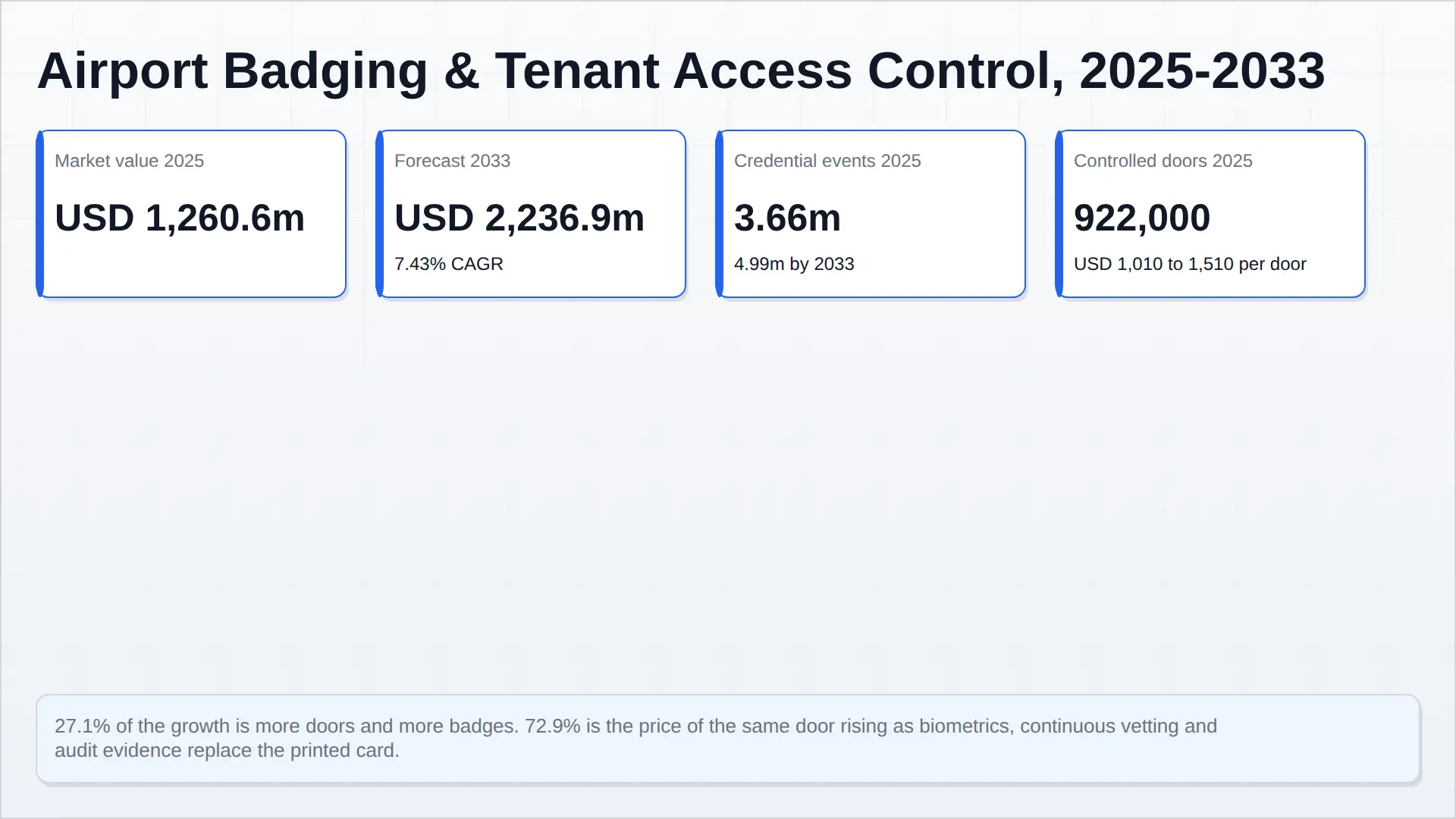
The global market for airport badging and tenant access control is USD 1,260.62 million in 2025, rising to USD 2,236.89 million in 2033 - a compound annual growth rate of 7.43% and an increase of 77.44% across the period. Both are Pheonix Research estimates built bottom-up from credential issuance events and controlled access doors, not top-down from a security-industry aggregate.
| Measure | 2025 | 2033 | CAGR |
|---|---|---|---|
| Market value (USD million) | 1,260.62 | 2,236.89 | 7.43% |
| Credentialing, vetting and badging operations (USD million) | 329.40 | 628.74 | 8.42% |
| Access control infrastructure, software and maintenance (USD million) | 931.22 | 1,608.15 | 7.07% |
| Credential issuance events (millions) | 3.66 | 4.99 | 3.95% |
| Active badges in force (millions) | 3.88 | 4.62 | 2.22% |
| Controlled access doors (thousands) | 922 | 1,065 | 1.82% |
| Revenue per credential event (USD) | 90.00 | 126.00 | 4.30% |
| Revenue per controlled door per year (USD) | 1,010 | 1,510 | 5.16% |
| Spend per active badge per year (USD) | 325.15 | 484.18 | 8.56% |
What this report counts, and what it deliberately does not
Two revenue lines are counted, and they are counted separately because they are bought by different people on different clocks.
Credentialing, vetting and badging operations is spend per person per event: the airport's badging office, fingerprint capture and criminal history records check, the security threat assessment, channeling, training delivery, credential media, and the software that assembles the record. It is 26.13% of the 2025 market and grows at 8.42%, the faster of the two lines, because the number of events per badge rises even where headcount does not.
Access control infrastructure, software and maintenance is spend per controlled door: controllers, readers, biometric capture at high-security doors, the physical access control system and its interfaces, and the recurring maintenance and warranty that keeps it certified. It is 73.87% of the 2025 market and grows at 7.07%. Its volume grows slowly - 922,000 doors to 1,065,000, 1.82% a year, tracking terminal expansion rather than passenger growth - but its price per door rises 5.16% a year as biometric capture, mobile credentials and software maintenance replace card stock and legacy panels.
Deliberately excluded: general airport IT and network infrastructure; standalone video surveillance that is not bundled into an access control contract; airline crew scheduling and rostering; and the internal labour cost tenants absorb in administering their own signatory duties. Where a contract bundles surveillance with access control - Dallas Love Field's maintenance contract explicitly covers closed circuit television, a security intercom subsystem and a video badging/credentialing subsystem under one authorization - the whole contract is counted once, in the access control line, because that is how it is bought.
One double-count is controlled explicitly. The airport's own badging fee is a transfer inside the credentialing line, not incremental revenue on top of it. It is counted once, as spend, and never again as access control revenue.
Why the price moves faster than the volume
Of the 77.44% growth to 2033, 27.06% is volume - more credential events and more doors - and 72.94% is price and mix. That split is the argument of this report, and it is not a forecast of inflation. It is what happens when the unit of sale changes from a card to an assertion.
At the door, the 2025 baseline is calibrated against real awards. Los Angeles World Airports replaced its Access Control and Alarm Monitoring System on a three-year contract to Convergint Technologies not to exceed USD 14,258,512, covering 2,200 doors, 3,600 badge readers, 6,000 alarm points and 365 control panels; first-year maintenance and warranty on the new system alone was budgeted at USD 1,423,870, which is USD 647.21 per controlled door per year before anything is added. Denver approved USD 72,625,546 to PCL Construction Services to replace the physical access control system for the whole airport, including card readers and associated infrastructure. Those are system-replacement numbers, and a system replacement is a fifteen-to-twenty-year event. What is repricing is the recurring layer attached to it.
At the person, the 2025 baseline is the published fee schedules. Burlington bills USD 85.00 all-in for a first badge (STA USD 11.00, CHRC USD 29.00, fingerprinting USD 25.00, badge printing USD 20.00). Des Moines bills USD 145.00 including a refundable USD 100.00 deposit. Raleigh-Durham, effective 1 April 2026, bills USD 25.00 for the threat assessment, USD 100.00 for a new SIDA or sterile-area fingerprint submission and USD 65.00 for the badge - USD 190.00 before training, a 2.24x spread against Burlington for the same federal checks. Renewal tells the same story from the other end: USD 10.00 at Sky Harbor, USD 65.00 at Raleigh-Durham, a 6.5x spread.
Where the market sits
North America carries the largest share because the United States credentials every airport worker on a two-year clock and publishes the fee. Europe's share is structurally smaller per worker for the same reason in reverse: EU airport identification cards may be issued for a period not exceeding five years, so the same person generates fewer events. Asia-Pacific is the fastest-growing region on terminal expansion, not on re-pricing.
| Region | 2025 (USD million) | Share |
|---|---|---|
| North America | 485.34 | 38.5% |
| Europe | 302.55 | 24.0% |
| Asia-Pacific | 289.94 | 23.0% |
| Middle East | 88.24 | 7.0% |
| Latin America | 63.03 | 5.0% |
| Africa | 31.52 | 2.5% |
Regional values are Pheonix Research estimates derived from airport tiers, badge populations and controlled-door counts; they are directional, not measured.
Four things that moved in 2026
The audit. OIG-27-03 established that the failure mode is real, documented and public, which converts a theoretical software upgrade into a defensible capital request inside an airport.
The crew lane. TSA began replacing Known Crewmember with Crewmember Access Point on 22 June 2026, completing airport conversions by 30 September, with the first locations at Washington Reagan, Washington Dulles and Las Vegas and a second wave from the week of 5 July at San Diego, Honolulu, Salt Lake City, Austin and Phoenix. Crew now present a live photograph compared against a federal image through Customs and Border Protection's Traveler Verification Service instead of a barcode read by an airline agent.
The age of the installed base. Los Angeles' previous access control system was over twenty years old and the manufacturer had told the airport it could not support it after the end of 2020. That is not an outlier; it is the condition of the category.
The two clocks. The United States renews at least every two years and audits every twelve months. The European Union caps the card at five years. The same worker therefore generates roughly two and a half times as many credentialing events in the United States as in Europe - a structural revenue difference created entirely by regulation, not by demand.
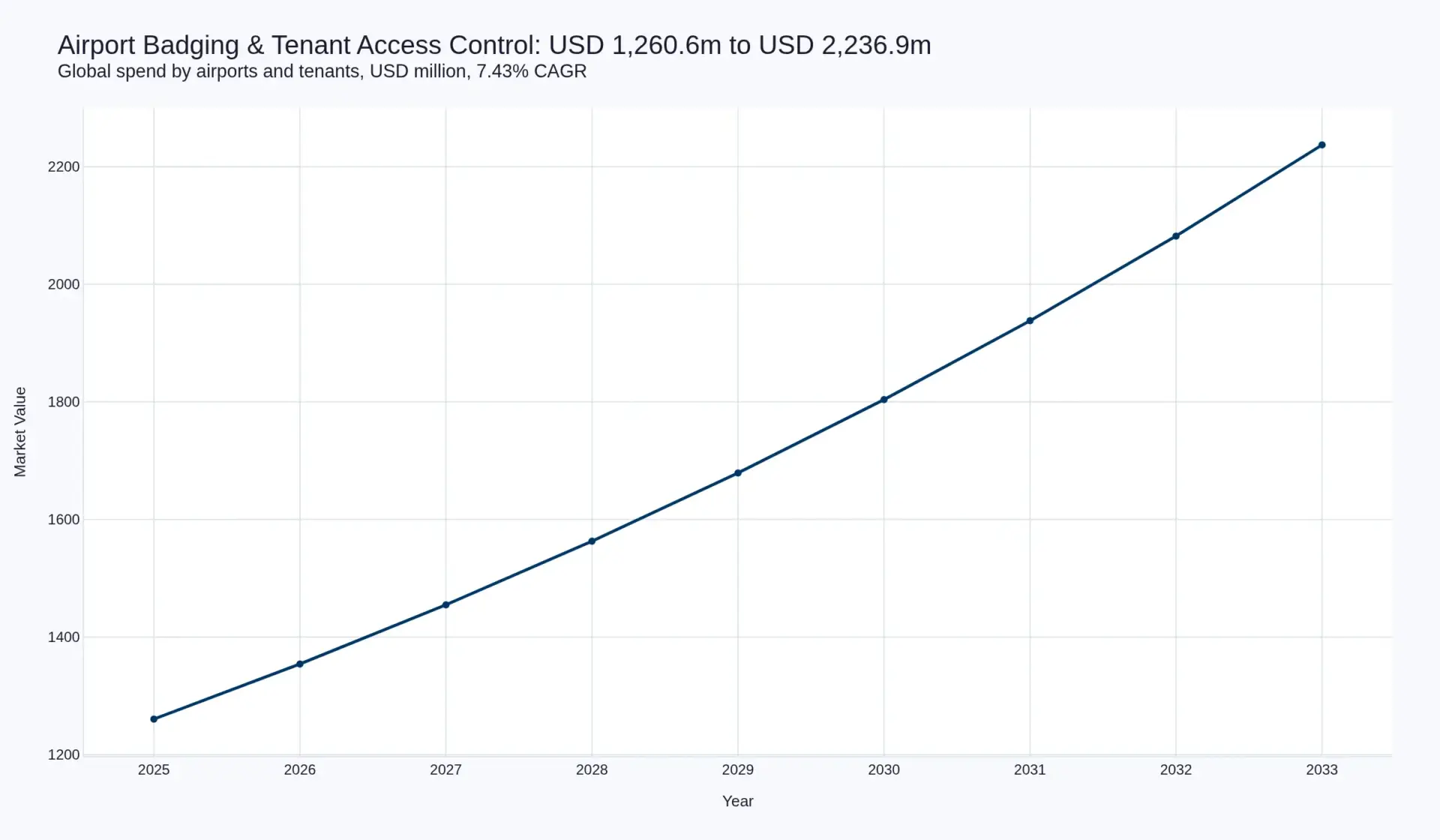
Table of Contents
| # | Section | What it answers |
|---|---|---|
| 1 | Executive summary and market size | The value, the volume, the split, and why a ten-dollar fee carries a five-hundred-dollar liability |
| 2 | Value chain: six invoices between an application and a door | The signatory, the badging office, the channeler, the federal check, the credential and the door – and who is paid at each |
| 3 | Technology: TSA published the control the audit found missing | Capability 1.4, ICE Web Portal, Rap Back, Crewmember Access Point and the biometric door |
| 4 | Competitive landscape: the integrator owns the door, the clearinghouse owns the record | Who wins LAX, Denver and Austin, and why nobody sells the badge as a product |
| 5 | Regulatory landscape: two clocks, two years and five | 49 CFR 1542 against EU 2015/1998, and why the US generates 2.5 credentialing events for every European one |
| 6 | Investment activity: what a PACS replacement actually buys | LAX line by line, Denver’s construction contract, and the yield per door |
| 7 | Market risk: the badge that is never handed back | Unreturned media, single-signatory failure, privacy litigation and the substitution question |
Competitive Landscape
The integrator owns the door, the clearinghouse owns the record
This market has three layers and only one of them behaves like a competitive market. The door is contested, the record is a utility, and the badge itself is not a product anyone sells. Understanding which layer a supplier occupies is the whole of competitive analysis here, because the strategies are not comparable.
The door: contested, but contested by incumbents
Six awards in the United States show the shape of the layer clearly. Los Angeles World Airports awarded Convergint Technologies a three-year contract not to exceed USD 14,258,512 for its access control and alarm monitoring replacement, and separately awarded Convergint a five-year maintenance and support contract for the existing system at Dallas Love Field not to exceed USD 4,645,245, with two one-year renewal options. Denver awarded PCL Construction Services USD 72,625,546 over 815 days for construction and construction management to replace the physical access control system for the entire airport. Clark County authorized up to USD 1,700,000 to Johnson Controls for door controllers and reprogramming at Harry Reid. Austin-Bergstrom selected Preferred Technologies LLC from seven offers for access control and identity management over up to five years at not more than USD 6,400,000. Denver also paid Aviation Security Consulting Inc USD 1,819,934 across twenty-four payments over twenty-two months on a physical access control system purchase order.
Two of those six are structurally incumbent awards. Clark County did not compete the work at all: it used competitive bidding exceptions under Nevada statute to add the project to an existing Johnson Controls contract, on the grounds that equipment trained personnel and maintained replacement-part inventory make a different supplier uneconomic, and because Johnson Controls is already the county’s card access system maintenance provider. That is the honest description of most airport access control procurement – the maintenance incumbent is the natural replacement bidder, and the compatibility argument is real, not pretextual.
Denver’s award is a construction contract, not a systems contract, which is why it prices at five times Los Angeles’ total project value: it includes physical elements such as card readers and associated infrastructure plus software, and it is delivered under construction management. The distinction matters to anyone forecasting this line, because construction-led replacements carry markups that systems-led replacements do not.
Austin is the outlier and therefore the interesting one. It ran a full solicitation, took seven offers, awarded a new contract to a firm that was not the incumbent, and – critically – bought access control and identity management together. The stated purpose of the identity management component was to provide secure integration between disparate applicant vetting systems, reduce duplicate manual data entry and move to a paperless, structured workflow. That is the bundling of layer one and layer three into a single award, and it is the first credible answer to the structural problem this market has.
The record: a single clearinghouse
Between the airport and the federal government sits the American Association of Airport Executives’ Transportation Security Clearinghouse, the data clearinghouse for approximately 359 airports with formal access control programmes, covering approximately 890,000 individuals and 1.2 million active badges, against TSA vetting of roughly 550,000 individuals a year. The privacy assessment is explicit that TSA does not issue the badges: the local airport authority does, and some airports recognise badges issued by tenants, aircraft operators or foreign carriers, while others issue no badge at all and simply require a threat assessment.
This layer is not a market in any commercial sense. It is shared infrastructure with a single operator, priced per transaction, and no airport has a meaningful alternative. It is also the layer where the OIG’s findings must ultimately be fixed, because the notice that an assessment has returned adverse originates here.
The badge: nobody sells it
Not one of the major vendors sells airport badging as a category. Telos operates the ICE Web Portal that Tampa’s signatories use to submit applications, but it is sold as software, not as a badging market position. ASSA ABLOY, Honeywell, Genetec and Thales sell access control, credentials and identity platforms that land inside airports among many other verticals. SITA and Collins Aerospace sell airport IT and airport processing. The consequence is that no supplier has an incentive to price the credential correctly, because no supplier’s revenue depends on the airport’s regulatory exposure. The price of a badge is set by an airport finance department recovering a cost, not by a vendor defending a margin.
That is the competitive gap. The firm that bundles signatory workflow, identity proofing, continuous vetting status and the door into one contract, with an auditable chain that answers OIG-27-03 by default, would be selling the only thing this market actually needs. Austin bought a first version of it in 2021 for USD 6.4 million.
The buyers are also the suppliers
The most unusual feature of this market is that the largest operators are on both sides. Aena, Fraport, Groupe ADP and the major US authorities issue the credential, set the fee, run the audit and procure the system. Because they are self-suppliers, the badging office faces no competition for its core service – there is no alternative to the airport’s own credential – and the fee is therefore a policy instrument rather than a price.
Consolidation among buyers is the one force that could change this. A group operating dozens of airports can standardise one credentialing platform and one access control specification across its estate, which converts a hundred local cost-recovery decisions into a single procurement with real negotiating leverage. That is the fault line to watch: not a vendor consolidating, but an operator standardising.
Structure
The market is fragmented. No supplier holds a double-digit share of the access control layer globally, the credentialing layer is split between airport-run offices, a small number of badging software vendors and one clearinghouse, and the largest single contract in this report – Denver at USD 72.6 million – is a construction award that says nothing about software share. Competitive intensity is moderate because procurement is specification-led and compatibility-driven rather than price-driven. The realistic concentration risk is not at the top; it is at the door, where the maintenance incumbent has an information and switching-cost advantage that no new entrant has yet overcome.
Value Chain
Six invoices between an application and a door
Nobody sells a badge. That is the single most important structural fact about this market, and it explains both why it is fragmented and why it is under-priced. What a tenant actually buys is a sequence of six services from six different parties, each of which invoices separately, and only one of which has any meaningful scale.
1. The authorised signatory – unpaid, and carrying the liability
Every company operating at an airport must nominate an authorised signatory: the person who becomes, in the airport’s own words, the point of contact for that company’s credentialing. Tampa International’s signatory manual is unusually explicit about the weight of the role. The signatory is responsible for credentials issued to the company’s employees, including knowing who physically holds each one; must call the airport operations centre, twenty-four hours a day, so a badge can be deactivated when a worker is lost, stolen or separated; must return all inactivated badges within ten business days; and must complete signatory training every twelve months. Submitting the legal sign-off for an applicant in the badging portal, the manual states plainly, is the same as signing a legal document.
The OIG described the same duty set in its 2016 review of access media badge oversight: signatories must ensure badge holder information is accurate and current, sponsor and request badges, identify who has an operational need, report lost and stolen badges, and notify the airport immediately when an employee separates or is terminated.
This stage is almost entirely unpaid, and it is also the stage where the OIG’s 2026 findings originate. Companies are permitted up to four signatories for redundancy, and Tampa warns what happens without one: the company is suspended, existing badges may be inactivated, and it cannot renew or onboard new employees. A single named individual in a contractor’s office is therefore the load-bearing element of a federal security programme, and no revenue attaches to that role anywhere in the market.
2. The badging office and its trusted agents
TSA relies on airport operator employees as trusted agents to perform the essential functions of badging: collecting, verifying and inputting applicant data used for the threat assessment, and fingerprinting applicants for the criminal history check. The data is granular – full legal name, date of birth, place of birth, passport number, alien registration number – because it is the identity input to a federal check.
This is where the fee schedule bites, and where airports differ most. Phoenix charge a USD 50.00 badge control fee on issue but repay it as a reward when the badge comes back, explicitly to create a financial reason to return the asset. Dulles and Reagan charge a flat USD 40.00 administrative fee per individual and quote twenty to thirty minutes of processing time. Burlington publishes the whole build-up in four lines: STA USD 11.00, criminal history check USD 29.00, fingerprinting USD 25.00, badge printing USD 20.00, total USD 85.00.
TSA’s own best-practice list asks systems here to maintain an audit trail of who collected and transmitted the data, who authorised issue and who issued the media. That capability is the difference between an airport that can answer the OIG and one that cannot.
3. The channeler
Applicant data and fingerprints are transmitted electronically to the American Association of Airport Executives’ Transportation Security Clearinghouse, which runs a centralised aviation credentialing data exchange for TSA. The scale is narrow and deep: the clearinghouse is the data conduit for approximately 359 airports with formal access control programmes, covering approximately 890,000 individuals holding 1.2 million active badges. The gap between individuals and badges is itself a market signal – a worker employed by two companies at the same airport holds two badges, which means two issuance events, two renewals and two audit lines for one human being.
4. The federal check
Two checks run in parallel. TSA’s vetting operation assesses approximately 550,000 individuals a year against intelligence, immigration and criminal datasets. The criminal history records check runs against the FBI, with TSA posting rap sheets for the airport to adjudicate. The look-back is long and the standard is set federally: disqualifying offences within the past ten years, a criminal history examination reaching back fifteen years, and, since the 2018 reauthorisation, a social security number from every applicant for secured-area access.
Prices at this stage are small, published and wildly inconsistent. The threat assessment is USD 7.00 at Sky Harbor, USD 11.00 at Burlington and Dulles, and USD 25.00 at Raleigh-Durham. Fingerprint capture runs from USD 25.00 at Burlington to USD 100.00 at Raleigh-Durham for a new SIDA or sterile-area submission. This is not a competitive market; it is a hundred cost-recovery decisions taken independently by a hundred airport finance departments.
5. The credential and the software behind it
Badge printing is the cheapest line in the chain and the one most often mistaken for the product: USD 20.00 at Burlington. The software layer above it is where the value is moving. Tampa tells its signatories to get to know the badging portal, because their submissions inside it carry legal effect. Austin-Bergstrom bought an identity management system alongside its access control specifically to integrate disparate applicant vetting systems, reduce duplicate manual data entry and move to a paperless, structured workflow – language that could have been drafted from the OIG’s findings five years later. Dallas Love Field’s access control maintenance contract explicitly includes a video badging and credentialing subsystem inside a USD 4,645,245 authorization.
6. The door
The final invoice is the physical access control system, and it is the one that dominates the market. Los Angeles World Airports put a three-year contract to Convergint Technologies at not more than USD 14,258,512 against 2,200 doors, 3,600 badge readers, 6,000 alarm points and 365 control panels, in order to keep access portals compliant with 49 CFR 1542.207. Denver is replacing the system for the whole airport under a USD 72,625,546 construction and construction management contract with PCL Construction Services. Clark County is spending up to USD 1,700,000 with Johnson Controls on door controllers and reprogramming to accommodate new security technologies at Harry Reid. At the smallest end, a request for proposals at Brown Field Municipal in San Diego covers six vehicle gates, eight pedestrian gates and 2,000 proximity cards.
Where the money is, and where the risk is
Access control is 73.87% of the market. Credentialing is 26.13%. But the liability sits almost entirely in credentialing – in the two stages that are unpaid and under-funded. The signatory who sponsors the applicant receives nothing. The badging office that transmits the data is funded by a fee that recovers its cost and no more. Meanwhile the integrator who installs the door reader is paid several thousand dollars per door and hundreds of dollars per door every year thereafter.
| Airport | Background check | Initial badge | Renewal | Return / non-return exposure |
|---|---|---|---|---|
| Phoenix Sky Harbor | USD 32.00 CHRC + USD 7.00 STA | USD 50.00 badge control fee | USD 10.00 | USD 50/75/100 lost + USD 10 replacement; control fee repaid on return |
| Burlington | USD 29.00 CHRC + USD 11.00 STA + USD 25.00 fingerprint | USD 20.00 printing (USD 85.00 total) | Not separately published | Not separately published |
| Dulles / Reagan | USD 34.00 fingerprint + USD 11.00 STA | USD 40.00 administrative fee | Annual renewal application | Not separately published |
| Des Moines | USD 42.00 CHRC + USD 11.00 STA | USD 45.00 + USD 100.00 refundable deposit | USD 35.00 | USD 100.00 lost penalty |
| St. Louis Lambert | USD 40.00 fingerprints | USD 45.00 | USD 35.00 | USD 75 / 100 / 175; a fourth loss is not allowed |
| Pensacola | USD 35.00 fingerprints | USD 67.25 | USD 30.00 + USD 2.25 tax | USD 150.00 + USD 30.00 + tax |
| Raleigh-Durham | USD 25.00 STA + USD 100.00 new SIDA fingerprint | USD 65.00 | USD 65.00 + USD 10.00 Rap Back | USD 500.00 employer penalty per unreturned SIDA badge |
| Salt Lake City | USD 30.00 fingerprint + STA incl. Rap Back | USD 65.00 ground transportation badge | Monthly company invoicing | USD 250.00 to the company per non-returned badge |
The table is the clearest evidence that this market has no price. Eight airports, one federal obligation, and an initial credential that ranges from USD 85.00 to USD 190.00. The spread is not explained by service quality, local labour cost or technology. It is explained by the absence of any commercial discipline applied to a cost-recovery charge – which is precisely the condition that precedes a re-pricing.
Investment Activity
What a PACS replacement actually buys
Access control is 73.87% of this market, and almost all of it is decided inside procurement documents that nobody reads until a system fails. The Los Angeles World Airports board action is the most useful document in the category, because it prices the whole replacement line by line and states what each line is for.
| Line | Amount (USD) |
|---|---|
| Implementation | 7,838,244 |
| Biometrics implementation | 1,160,258 |
| Allowances – new door readers, PIV card readers, intelligent controllers | 893,192 |
| Third-party interface integration | 700,000 |
| Subtotal | 10,591,694 |
| Contingency at 7.7% | 816,085 |
| One year maintenance and warranty – existing system | 1,386,863 |
| One year maintenance and warranty – new system | 1,423,870 |
| Moves, adds and changes allowance | 40,000 |
| Contract total, not to exceed | 14,258,512 |
| Capital appropriation, separately authorised | |
| Server hardware | 533,214 |
| Implementation support and infrastructure | 855,308 |
| Project soft costs | 1,245,495 |
| Total capital | 14,041,796 |
Against the 2,200 doors, 3,600 badge readers, 6,000 alarm points and 365 control panels in scope, that works out to USD 6,382.63 of capital per controlled door, of which USD 3,562.84 is implementation and USD 527.39 is biometric capture. Spread across more than 50,000 badge holders at the airport, the capital cost is USD 280.84 per person – once, for a system that must then survive twenty years to amortise at a rate anyone would accept. The system it replaced had in fact run past that point: it was over twenty years old and the manufacturer had told the airport it could not be supported after the end of 2020, and the airport had continued operating system components that could not receive software security updates.
The recurring bill does not fall
The single most instructive number in the document is the pair of maintenance lines. The final year of maintenance and warranty on the outgoing system was budgeted at USD 1,386,863. The first year on the new system was budgeted at USD 1,423,870. Replacing the platform did not reduce the annual service cost by a dollar; it reset it slightly higher. Per door, that is USD 647.21 a year, and it represents 10.0% of the capital cost annually – which is why the access control line compounds rather than stepping.
It also explains the ratio a buyer should watch: 3,600 readers against 2,200 doors, or 1.64 readers per door. Readers, not doors, are what generate service events and what must be replaced when a credential standard changes. An installed base is priced per reader long before it is priced per door.
Two kinds of replacement
Denver’s USD 72,625,546 award to PCL Construction Services over 815 days is a construction and construction management contract, and it is not comparable to Los Angeles’ systems award even though it buys the same functional outcome. It explicitly covers the physical elements of the system – card readers and associated infrastructure – as well as software. Denver has not published the door count in the award, so a per-door comparison would be an invention; what can be said is that a construction-led replacement prices at a multiple of a systems-led one because it carries general conditions, trades and construction management that a systems integrator never bills.
The retrofit end of the market shows the third pattern. Clark County authorized up to USD 1,700,000 to Johnson Controls for door controllers and reprogramming at Harry Reid, explicitly to accommodate new security technologies, on a system it describes as a critical part of the airport security plan, and it used statutory bidding exceptions to do so because compatibility with existing installed hardware made competition uneconomic. That is the incremental path most airports actually take: buy the capability into the existing platform rather than replace it.
Maintenance annuities as a benchmark
Dallas Love Field’s USD 4,645,245 authorization to Convergint covers five years of maintenance and support for the existing system, with two optional one-year renewals, across closed circuit television, a security intercom subsystem, the access control system’s controlled doors and a video badging and credentialing subsystem. That is roughly USD 929,049 a year for a mature, functioning installation – a realistic annuity for a large-hub airport that is not renewing its platform, and a useful sanity check against the assumption that the access control line only grows when something is replaced.
Austin-Bergstrom’s award is the one that funds the workflow. Up to USD 6,400,000 over up to five years, with an initial two-year term of USD 3,073,446 – roughly USD 1.54 million a year – buys access control and identity management together, on the stated grounds that identity management provides secure integration between disparate applicant vetting systems, reduces duplicate manual data entry and moves the airport to a paperless, structured workflow. It is the only award in this sample that treats the badging office as a system rather than a counter.
At the smallest tier, a request for proposals at Brown Field Municipal in San Diego sets the entry price of the category: six vehicle gates, eight pedestrian gates and 2,000 proximity cards, with a wireless radio network and power-over-ethernet switching. Small airports do not buy smaller versions of what Los Angeles buys; they buy gates and cards.
Who actually pays, and why that suppresses the workflow
The Los Angeles board report states that costs for the access control replacement are recovered through landing fees, terminal rates and charges, and non-aeronautical revenues. Read that against the fee schedules and a structural distortion appears. The tenant pays the capital through airline rates and charges, and pays the credential fee through the badging office, and both charges recover the same security outcome through two separate mechanisms.
The consequence is that capital is recoverable and overhead is not. A USD 14 million access control system can be amortised into the rate base and defended to the airlines as infrastructure. A USD 500,000 rewrite of the badging workflow that would have caught the OIG’s finding is an operating cost with no asset and no rate-base treatment. That asymmetry, more than any technology gap, is why the door is well funded and the credential is not – and why the investment trend in this market is rising at the door while the remediation the OIG actually asked for remains, at most airports, unbought.
Technology & Innovation
TSA published the control the audit found missing
In 2026 the Office of the Inspector General found airport operators issuing badges before security threat assessments were complete. In guidance published years earlier, TSA had already listed the precise capability that prevents it. Capability 1.4 of TSA’s automated airport badge and credential system guidance reads: the system should prevent the issuance of badges or credentials until all applicable procedures have been followed. That single sentence is the entire technical thesis of this market.
What the guidance actually asks for
The document sets out fifteen potential capabilities, and reads more like a specification than a recommendation. Alongside 1.4 it asks for an audit trail that records who collected and transmitted the criminal history and threat assessment data, who authorised issue and who issued the media (1.2 to 1.2.3); validation that the trusted agent has completed TSA vetting (1.1); reporting on trusted agent status changes to the local federal security director (1.3); and, at capability 8.2.2, that where an authorised signatory’s training or badge has expired, the system should prevent that signatory from processing applications at all.
Capability 8.3 goes further still, requiring validation that an authorised signatory has personally passed the threat assessment and criminal history check before qualifying as a signatory. Read as a whole, the list describes a system in which a badge cannot exist without a complete, attributed and auditable chain from a vetted signatory through a vetted trusted agent to a cleared applicant. It is a system with no manual override of the kind the OIG found being used.
Why the override exists anyway
The failure the OIG documented is not a procurement failure; it is an operational one, and the pressure that produces it is easy to understand. The signatory’s verification of ten years of employment history is manual. The threat assessment takes time, and the airport cannot say how long. Airlines and ground handlers staff to a flight schedule, and a new hire who cannot enter the ramp on Monday is a cancelled turn. Against that, issuing a badge and relying on revocation if the assessment returns adverse is the locally rational choice – and it is precisely what OIG-27-03 found, including for applicants TSA later marked Do Not Issue.
The commercial consequence is that the industry has now been given an externally imposed reason to buy the gate rather than the reminder. In an airport, that means workflow software that cannot be bypassed, not a policy that says it should not be.
Rap Back is the revenue event nobody priced
The most consequential technology change in credentialing is not biometric and it is not visible at a door. It is the shift from a point-in-time criminal history check to continuous monitoring through the FBI’s Rap Back service, which the Congressional Research Service describes as the mechanism by which TSA conducts recurrent vetting of workers holding secured-area credentials.
Economically, that transforms the credential from a transaction into a subscription. A badge that must be re-vetted continuously carries a recurring per-person cost for as long as it is in force, whether or not the holder ever applies again. The pricing has already started to reflect it: Raleigh-Durham lists a separate USD 10.00 Rap Back fingerprint fee on renewal, Salt Lake City’s USD 30.00 fingerprint and assessment charge explicitly covers Rap Back enrolment, and Dulles no longer requires the full thirty-seven-question application from renewing applicants who hold an active Rap Back subscription. That last detail is the tell – the airport has already begun to treat the subscription, not the card, as the enduring unit.
In the forecast, this is why credential issuance events per active badge rise from 0.95 to 1.08 over the period, and why revenue per event climbs 4.30% a year even though the federal fee components themselves barely move.
The biometric door
At the door, the technology shift has a clean number attached. Of the USD 14,041,796 Los Angeles World Airports appropriated for its access control replacement, USD 1,160,258 was allocated specifically to biometric implementation – USD 527.39 per controlled door across the 2,200 doors in scope. The stated outcomes are not marketing: reduced exposure through biometric enhanced identification, automation of visual identification at high-security doors to raise staff productivity, fewer false rejects, and a platform able to absorb mobile credentials, piggybacking prevention and advanced encryption.
Piggybacking prevention is worth pausing on, because it is a rare case where the regulation and the technology agree. EU implementing regulation 2015/1998 requires access points to security restricted areas to be controlled either by an electronic system that limits access to one person at a time or by authorised persons. A single credential reader at a door cannot enforce one-person-at-a-time; a biometric reader with tailgating detection can, and can produce the evidence afterwards.
Crew lanes as a leading indicator
The clearest signal of where worker credentialing is heading came from the crew lane, not the staff door. TSA began replacing Known Crewmember – an industry-run system since 2011 in which vetted crew presented an airline ID and a barcode – with Crewmember Access Point on 22 June 2026, converting airports through 30 September. Crew now present a live photograph compared against a federal image record through Customs and Border Protection’s Traveler Verification Service, with the initial sites at Washington Reagan, Washington Dulles and Las Vegas and a second wave from the week of 5 July at San Diego, Honolulu, Salt Lake City, Austin and Phoenix.
CMAP remains formally voluntary, crew must affirmatively consent before their airline enrols them, and a failed match routes the crew member to a passenger checkpoint. But its architecture is the point: identity assertion at the door, against a federal gallery, using airport infrastructure. The same pattern is already deployed at passenger checkpoints, where Credential Authentication Technology devices with facial recognition capability operate at more than 250 US airports, with one-to-many matching tested at ten.
What this does to the market
Every capability in this chapter is billed per unit. Rap Back is per person per year. Biometric capture at a door is per door. Software maintenance and warranty is per system, and Los Angeles budgeted USD 1,423,870 for the first year on the new platform against USD 1,386,863 for the last year on the old one – the replacement did not reduce the recurring bill, it reset it.
That is the mechanism behind the 72.94% price-and-mix share of growth in this forecast. The number of doors is growing 1.82% a year and the number of active badges 2.22%. The technology attached to each is what grows at 5.16% and 4.30%. A market that re-prices its unit faster than it adds units is a market where the incumbent vendor’s advantage compounds – and where an airport that defers the upgrade is not saving money, only deferring it.
Market Risk
The badge that is never handed back
The principal risk in this market is not demand. No regulator is going to stop requiring airports to credential workers, and no airport can choose to stop issuing badges. The risk is custody: whether the airport can account for every credential it has issued, at the moment an inspector asks.
Unaccounted media is the exposure nobody controls
The 2016 Inspector General review is precise about the distinction that matters. A badge is either returned, or it is unaccounted for. Only unaccounted media count against the airport’s accountability thresholds, and where more than a stated proportion of unexpired badges for a nonpublic area are lost, stolen or otherwise unaccounted for, the airport must reissue badges for that area. The trigger is therefore not driven by airport process quality. It is driven by whether a subcontractor’s departing employee put an envelope in the post.
Airports have responded with penalties, and the penalties are the clearest available read on how seriously each one takes it. Raleigh-Durham charges the employer USD 500 per unreturned SIDA badge, USD 200 for sterile and air operations area badges, USD 50 for non-TSA badges, USD 25 per unreturned key and USD 100 per portal to re-core. Salt Lake City charges the company USD 250 per non-returned badge and invoices companies monthly. Des Moines imposes a USD 100 lost-badge penalty. Phoenix charges USD 50, 75 or 100 depending on how many badges have been lost, and repays the USD 50 badge control fee as a reward when a badge is returned. Tampa requires inactivated badges back within ten business days.
None of that penalty income is a market. It is a price the airport sets on its own failure mode, and it is the only lever it has over a party whose diligence it does not employ.
Single-signatory concentration
The second risk is organisational and almost entirely undiscussed. A company operating at an airport may nominate up to four authorised signatories, and their training must be current every twelve months. If none is active, Tampa’s manual states, the company is suspended, existing badges may be inactivated, and it cannot renew credentials or onboard new employees. An entire contractor’s ability to operate at a federally regulated airport therefore sits on one named individual’s training currency. It is a single point of failure that no procurement document prices, because it costs nothing until it fails.
Certification and inspection risk
OIG-27-03 does not impose a fine. It imposes something more expensive in an airport: a finding that must be remediated and then inspected. The remediation lands as an unbudgeted project with a deadline – workflow gating, reconciliation of issued badges against assessments, evidence of the audit trail – and it arrives in a capital plan that was set eighteen months earlier. The airport security programme is amended, the federal security director re-engages, and the next audit cycle tests whether the fix held. For a vendor, this is demand with a deadline. For an airport, it is the least negotiable line item it will carry this decade.
Privacy and legal design risk
Biometric access control carries a second regulator, and the constraint is architectural rather than administrative. The European Data Protection Board’s opinion of 24 May 2024 concluded that only storage where biometric data is held by the individual, or held centrally with the encryption key solely in the individual’s hands, could be compatible with the integrity and confidentiality principle, data protection by design and security of processing – and that centralised storage inside the airport or in the cloud, without the individual holding the key, could not be. It also urged operators to prefer less intrusive means and to limit processing to those who actively enrol and consent.
This is a procurement risk with a capital consequence. A specification written around centralised template storage is not a design choice with a privacy trade-off in Europe; it is a system that cannot lawfully be operated as designed, and the remediation is a re-architecture rather than a setting. In the United States the equivalent constraints are procedural – signage, deletion after matching, a right to decline, and a documented fallback for a failed match – and they show up as integration cost rather than legal exposure.
The substitution question
The Congressional Research Service is explicit that there is no common access credential for airport workers: each airport separately issues and administers its own. The absence of a common credential is the commercial foundation of this market, because it forces every airport to buy its own issuance capability. If a national or common credential were adopted – a single card or a digital identity accepted across airports – per-airport issuance revenue would compress sharply, and the credentialing line would shift from airports to whichever authority ran the register.
A softer version of the same pressure is already visible inside airports. Mobile and digital credentials move value from media, which airports charge for, to software, which integrators charge for. Some airports already recognise badges issued by tenant companies, aircraft operators or foreign carriers, and some issue no badge at all, requiring only a threat assessment. Each of those arrangements removes a credentialing event from the airport’s own ledger.
Price politics
Finally, the fee is charged to the airport’s commercial counterparties and the capital is recovered from them through rates and charges. Raising a USD 10.00 renewal fee is politically free; authorising USD 72.6 million for a physical access control system is not, particularly when airlines are scrutinising every line of the rate base. That is a materially different risk profile from a normal B2B market, where the buyer captures the benefit of the spend.
Sensitivity
The forecast’s sensitivity is concentrated almost entirely in the door line, because it is 73.87% of the 2025 base. If revenue per controlled door grows at 4.00% a year rather than 5.16%, holding every other assumption constant, the 2033 market is USD 2,100.88 million rather than USD 2,236.89 million and the CAGR falls to 6.59%. A 1.16 percentage-point change in a single assumption moves the 2033 value by USD 136 million – which is why the per-door economics in chapter six are worth more attention than the credential fee that opens this report.
Overall market risk is rated moderate. Geopolitical exposure is low: the supply chain is domestic to each market and the buyer cannot relocate an airport. Substitution risk is moderate, and concentrated in the possibility of a common credential rather than in any competing technology. Regulatory complexity is rated high, and it is the one variable that has consistently moved in the direction of more spend.
Editorial sources
All figures in this report are drawn from published primary documents. Fee schedules are as published by each airport and in force in Q4 2026. Contract values are as authorised by the awarding body. No third-party market-research publication is used or cited anywhere in this report.
- DHS Office of Inspector General, Failures in TSA’s Vetting of Airport Workers Allowed Uncleared Individuals Access to Secure Areas, OIG-27-03, 4 November 2026 – oig.dhs.gov
- DHS Office of Inspector General, TSA Could Improve Its Oversight of Airport Controls over Access Media Badges, OIG-17-04, October 2016 – oig.dhs.gov
- Transportation Security Administration, Best Practices for the Automated Airport Badge and Credential System – tsa.gov
- DHS Privacy Office, Privacy Impact Assessment for Airport Access for Aviation Workers, DHS/TSA/PIA-020(c), 27 April 2020 – dhs.gov
- 49 CFR Part 1542, Airport Security, US Government Publishing Office – govinfo.gov
- Congressional Research Service, Transportation Security: Background and Issues for the 119th Congress, R48543 – congress.gov
- Los Angeles World Airports, board action approving the Access Control and Alarm Monitoring System replacement with Convergint Technologies, USD 14,258,512 – lawa.granicus.com
- City and County of Denver, Resolution 24-1799, physical access control system replacement with PCL Construction Services, USD 72,625,546 – denver.legistar.com
- Clark County, item 25-2358, door controllers and reprogramming with Johnson Controls, up to USD 1,700,000 – clark.legistar.com
- City of Austin, item 21-3236, access control and identity management system with Preferred Technologies LLC, up to USD 6,400,000 – services.austintexas.gov
- City of Dallas, item 26-1596A, access control system maintenance and support with Convergint Technologies, USD 4,645,245 – cityofdallas.legistar.com
- Denver Department of Aviation, purchase order PO-00142281 to Aviation Security Consulting Inc, USD 1,819,934 – denverbudget.com
- Phoenix Sky Harbor International Airport, Badging Fees – skyharbor.com
- Metropolitan Washington Airports Authority, Dulles Pass and ID Office – mwaa.com
- Patrick Leahy Burlington International Airport, SIDA badging process and fee schedule – btv.aero
- Raleigh-Durham Airport Authority, Schedule of Fees, effective 1 April 2026 – rdu.com
- Salt Lake City Department of Airports, Badging Fees and Charges – slcairport.com
- Des Moines International Airport, Airport Badging Fees, effective 3 February 2025 – flydsm.com
- St. Louis Lambert International Airport, Badging Office Information, effective January 2026 – flystl.com
- Pensacola International Airport, Badging – flypensacola.com
- Tampa International Airport, Authorized Signatory Manual, November 2026 – tampaairport.com
- Implementing Regulation (EU) 2015/1998, consolidated text, EUR-Lex – eur-lex.europa.eu
- European Data Protection Board, Facial recognition at airports: individuals should have maximum control over biometric data, 24 May 2024 – edpb.europa.eu
- Privacy and Civil Liberties Oversight Board, Use of Facial Recognition Technology by the Transportation Security Administration, May 2025 – pclob.gov
- Biometric Update, TSA expands biometric identity checks to airline crews, 6 July 2026 – biometricupdate.com
Methodology note: the volume, price and forecast figures in this report are Pheonix Research estimates built bottom-up from credential issuance events and controlled access doors, calibrated against the published fee schedules and contract awards listed above. They are not extracted from any third-party market study. Regional splits and airport-tier door counts are directional estimates. Where a public document does not disclose a figure – for example Denver’s controlled door count – no figure has been imputed.
Regulatory Landscape
Two clocks, two years and five
The most important number in this market is not a price. It is the renewal interval, because it determines how many times a regulator makes the airport buy the same credential for the same person. The United States requires access media badges to be renewed at least once every two years. The European Union caps airport identification cards at a period not exceeding five years. That difference alone gives the American market roughly two and a half credentialing events for every European one, per worker, for identical underlying security outcomes.
The American structure
49 CFR Part 1542 is short and unusually direct. Section 1542.207 requires access control measures to ensure that only individuals authorised for unescorted access can gain entry, that an individual is immediately denied entry when that person’s access authority is withdrawn, and that the system can differentiate between individuals authorised for an entire secured area and those authorised for only a part of it. Section 1542.201(b) requires employment history verification before unescorted access is authorised, with the detail in 1542.209.
The Inspector General’s 2016 review of access media badge oversight sets out what sits on top of that. Airport operators must immediately deactivate lost, stolen and unaccounted-for badges; renew all badges at least once every two years; and complete a comprehensive audit of all airport-issued badges at least once every twelve months to verify both employment and operational need. Where more than a set proportion of unexpired badges for a nonpublic area are lost, stolen or otherwise unaccounted for, the airport must reissue badges for that area. The same review defines the authorised signatory duty set that every airport reproduces in its manual.
The 2026 review found the practice diverging from the paper. Between fiscal 2022 and fiscal 2024 airport operators issued badges before threat assessments completed, including to applicants TSA subsequently marked Do Not Issue, and TSA did not conduct the inspections of airport operations that would have caught it. Whatever the remediation costs, it is now a budget line with an audit reference attached – which is the single most useful thing that can happen to a compliance-driven market.
The surrounding scaffolding is thick. The Congressional Research Service records that there is no common access credential for airport workers and each airport separately issues its own; that disqualifying offences within the past ten years and a fifteen-year criminal history examination apply; that the 2018 reauthorisation required applicants for secured-area access to provide a social security number; that recurrent vetting runs through the FBI’s Rap Back service; and that TSA maintains a central database of individuals whose access has been revoked. Random physical inspections of workers at secured-area access points continue, now required by statute to be targeted and strategic rather than random in the literal sense.
One nuance matters for sizing. The privacy assessment confirms that some airports recognise badges issued by tenant companies, aircraft operators or foreign carriers, and some issue no badge at all, requiring only a threat assessment for people who work at the airport. The market is therefore not perfectly uniform even inside one jurisdiction, and the aggregate should be read as an estimate of spend rather than a census of credentials.
The European structure
Implementing Regulation (EU) 2015/1998 approaches the same problem with different instruments. Access to airside requires a legitimate reason and a carried authorisation; vehicles require a vehicle pass. Access to security restricted areas requires one of a listed set of authorisations – a boarding card, a crew card, an airport identification card, a national authority card or a compliance authority card – or, alternatively, access may be granted after positive identification through biometric data verification.
Where biometric identification is used, the regulation requires the verification to establish that the person holds one of the listed authorisations and that the authorisation is valid and was not disabled. Access points must be controlled either by an electronic system that limits access to one person at a time or by authorised persons implementing access control, with a narrow member-state derogation for access points used exclusively by law enforcement. Cards are issued only where there is an operational need and an enhanced background check has been passed, are valid for no more than five years, must be immediately disabled or withdrawn and returned where the holder fails an enhanced background check, and must be worn visibly in restricted areas, with anyone not displaying one to be challenged and reported.
The five-year ceiling is the commercial difference. It is not that Europe is less secure; it is that the European instrument regulates the card’s lifetime while the American instrument regulates its renewal. An airport under the five-year rule can defer re-vetting for four years without breaching anything. An American airport cannot defer past twenty-four months.
The privacy overlay is now a procurement constraint
Biometric access control invites a second regulator. In an opinion adopted on 24 May 2024, the European Data Protection Board examined facial recognition used by airport operators and airlines to streamline passenger flow and concluded that only storage solutions where biometric data is held by the individual, or held centrally with the encryption key solely in the individual’s hands, could be compatible with the integrity and confidentiality principle, data protection by design and security of processing. Centralised storage inside the airport or in the cloud, without the individual holding the key, could not be. The Board also urged operators to prefer less intrusive means where possible, and limited processing to those who actively enrol and consent.
In the United States the constraint is different but present. The Privacy and Civil Liberties Oversight Board’s May 2025 staff report records that Credential Authentication Technology devices with facial recognition capability operate at more than 250 airports, that one-to-many matching is being tested at ten, and that policy requires signage, deletion of photographs after matching and a right to decline. Crewmember Access Point is likewise voluntary, requires affirmative crew consent, and routes a failed match to a passenger checkpoint.
For a systems buyer, this converts privacy law into technical specification: on-device or user-held-key template storage, deletion-on-match, an auditable consent record and a fallback path. None of that is free, and all of it is billed per door or per person – which is why the regulatory layer, not the technology layer, is where the price growth in this market originates.
Why the clock decides the forecast
In a compliance-driven market the regulator sets the refresh cycle and the customer does not. A badge cannot be left to expire, so credentialing revenue is close to non-discretionary. A physical access control system can be sweated for twenty years – Los Angeles ran one past its manufacturer’s end of support and into a state where software security updates had stopped – so access control revenue is discretionary and lumpy.
That asymmetry is visible in the numbers. Credentialing grows at 8.42% and access control at 7.07%, and the faster line is the one a regulator compels. Any forecast of this market that treats the two as a single security budget will misprice both.