
Global Automated License Plate Recognition & Vehicle Identity for Access Market Report, Size, Share and Forecast 2026–2033: The Camera Is the Business and the Law Is the Margin — Why the DPPA Prices a Mistake Higher Than the Reader
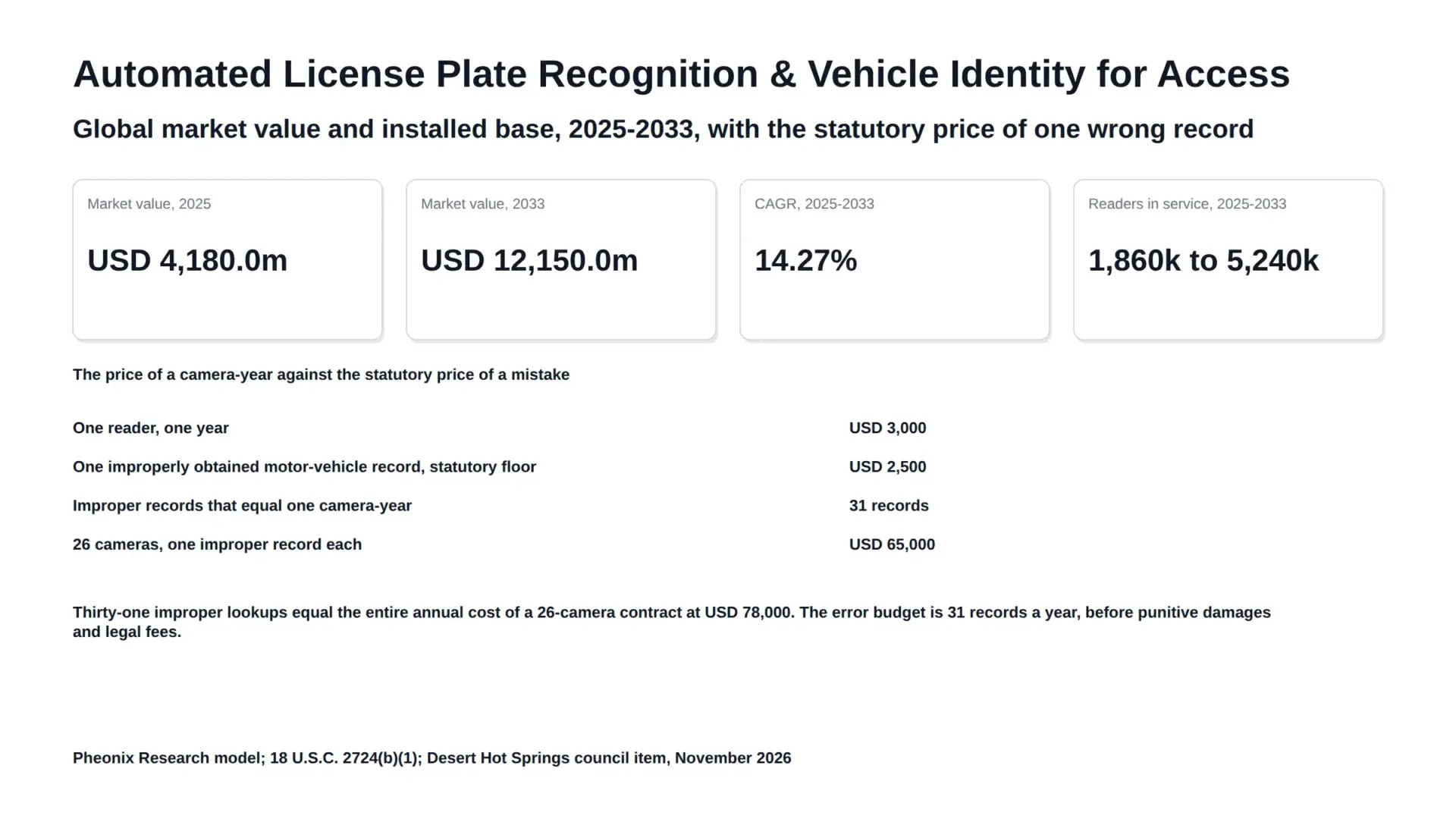
The global market for automated licence plate recognition and vehicle identity for access is USD 4,180.0 million in 2025, rising to USD 12,150.0 million in 2033 at a compound annual growth rate of 14.27 per cent. Volume grows from 1,860 thousand readers in service to 5,240 thousand at 13.82 per cent. Revenue per reader is almost flat across the period — USD 2,247 to USD 2,319, a change of 3.18 per cent — and that flatness is the finding, not the noise. It conceals a reallocation: hardware revenue per reader falls 29.72 per cent while identity and lookup revenue per reader rises 61.10 per cent.
The market does not sell cameras. It sells the identity act — the resolution of a plate string into a person, an account, a permit or a debt. The Driver's Privacy Protection Act sits precisely on that step and nowhere on the camera: 18 U.S.C. §2724(b)(1) provides actual damages "but not less than liquidated damages in the amount of $2,500", with punitive damages and attorneys' fees on top, and no requirement to prove harm.
The consequence is arithmetic. A municipal reader subscription runs at about USD 3,000 a camera-year. The statutory floor for one improperly obtained record is USD 2,500 — 83.33 per cent of a camera-year. In a 26-camera, USD 78,000-a-year deployment, thirty-one improper lookups equal the entire annual spend. The error budget is 31 records, before fees.
Accuracy is therefore a balance-sheet item, not an engineering one. A randomised trial in Vallejo, California found 35 per cent of hits were misreads. In Florida, a federal court declined to dismiss a claim that private parking operators used plates to obtain home addresses and mail invoices threatening booting or towing; one plaintiff had driven through a lot twice without parking and was invoiced for nearly four hours.
Three regimes place the cost in three different places. The United States prices the record, catastrophically and contingently. The United Kingdom audits the purpose, continuously — 40.35 per cent of 57 operators audited in 2025/26 were rated red — while charging £2.50 a lookup and not permitting the agency to profit from it. State statutes and the European Union regulate retention and purpose, which is an architectural cost: New Hampshire caps retention at three minutes, Alabama at five years, and in the former the archive-based product cannot exist.
Commercially the market is consolidating around whoever owns the access point rather than the camera. Motorola bought VaaS for USD 445 million on approximately USD 100 million of revenue. Metropolis bought SP Plus and converted roughly 4,000 locations to camera-based entry. Flock Safety reports more than 100,000 readers and about 12,000 customers at a valuation near USD 8.4 billion. Verra Mobility's Q4 2025 segment margins show where value sits in the stack: Parking Solutions at 8 per cent, Government Solutions at 24 per cent, Commercial Services at 64 per cent.
The forecast assumes the legal architecture holds through 2033. It probably will not hold unchanged, and the three places it is most likely to move are private-parking lookup standing, state retention floors, and legislative limits on cross-agency data sharing.
1. Market Snapshot
This report measures revenue earned from establishing which vehicle is present and who is entitled to it, for the purpose of granting, charging for or enforcing access. It covers four things normally sold and priced separately: the reader that turns a plate into a string, the software that stores and matches that string, the lookup that turns the string into a person or an account, and the services that keep any of it running. Moving-violation enforcement — red-light and speed cameras — sits outside the boundary. Those systems price an offence, not an access right, and the buyer, the contract and the evidence standard are all different.
We size the market at USD 4,180.0 million in 2025, rising to USD 12,150.0 million in 2033, a compound annual growth rate of 14.27 per cent. Volume, measured as readers in service rather than units shipped, runs from 1,860 thousand to 5,240 thousand at 13.82 per cent. Revenue per reader moves from USD 2,247 to USD 2,319 — 3.18 per cent across eight years.
That near-flat aggregate is the whole story, because it conceals a violent internal reallocation. Revenue per reader on the hardware arm falls 29.72 per cent, from USD 809.14 to USD 568.70. Revenue per reader on the identity and lookup arm rises 61.10 per cent, from USD 419.35 to USD 675.57. The market is not growing because more cameras are being sold. It is growing because the step that follows the camera is being repriced — and that step is the only part of the chain the law protects, and therefore the only part the law can price.
| Headline metric | 2025 | 2033 | CAGR 2025–2033 |
|---|---|---|---|
| Market value (USD million) | 4,180.0 | 12,150.0 | 14.27% |
| Readers in service (thousand) | 1,860 | 5,240 | 13.82% |
| Revenue per reader (USD) | 2,247 | 2,319 | 3.18% |
| Identity, lookup and data arm (USD million) | 780.0 | 3,540.0 | 20.81% |
The four arms
The split matters more than the total, because the arms have almost nothing in common commercially. Hardware is a deflating capital good with a five-to-seven-year field life. Software is a per-reader subscription with high retention. Identity and data is a per-query and per-licence business whose unit cost is a statutory fee and whose risk is statutory too. Services is installation and maintenance, won with the hardware and lost with it.
| Revenue arm | 2025 (USD m) | Share | 2033 (USD m) | Share | CAGR |
|---|---|---|---|---|---|
| Readers and hardware | 1,505.0 | 36.00% | 2,980.0 | 24.53% | 8.91% |
| Software and subscription | 1,420.0 | 33.97% | 4,320.0 | 35.56% | 14.92% |
| Identity, lookup and data | 780.0 | 18.66% | 3,540.0 | 29.14% | 20.81% |
| Services | 475.0 | 11.36% | 1,310.0 | 10.78% | 13.52% |
| Total | 4,180.0 | 100.00% | 12,150.0 | 100.00% | 14.27% |
How this number was built
We constructed the market bottom-up from three inputs: installed base of readers by application, revenue per reader by arm, and the statutory or contracted unit price of a lookup in each jurisdiction. The installed base is anchored on disclosed and reported counts — Flock Safety alone reports more than 100,000 readers installed, and Motorola Solutions' vehicle-location business was running at approximately USD 100 million of revenue when it was acquired in 2019. The per-reader prices are anchored on published municipal contract values, the most transparent of which put a subscription reader at USD 3,000 a year. The lookup prices are anchored on statutory schedules: the UK's Driver and Vehicle Licensing Agency charges £2.50 for a keeper-at-date-of-event record. Where a jurisdiction publishes neither, we modelled from contract structure and labelled the result as a Pheonix construction.
The forecast assumes no change in the legal architecture through 2033 — an assumption we do not fully believe, and address directly in the regulatory and risk chapters. It also assumes that public backlash reduces the number of agencies buying but not the number of cameras per buying agency, which is what the 2025–2026 evidence shows.
2. Executive Summary
A reader costs about USD 3,000 a year. One improperly obtained motor-vehicle record costs a minimum of USD 2,500. That ratio — 83.33 per cent of a camera-year for a single record, before punitive damages and before any lawyer is paid — is the most important number in this market, and almost nobody buying cameras knows it.
The statute that sets it is the Driver's Privacy Protection Act of 1994. Section 2724(b)(1) provides actual damages "but not less than liquidated damages in the amount of $2,500", with punitive damages available on proof of wilful or reckless disregard and reasonable attorneys' fees on top. There is no requirement to prove harm. The plaintiff does not have to show that the wrong person was booted, towed or invoiced. The statutory price attaches to the act of obtaining the record.
This is why the report's title says the camera is the business and the law is the margin. The camera manufactures the raw material — a plate string with a timestamp and a location. The margin is earned at the moment that string is resolved into a person, because that is the only step in the chain that is legally privileged and legally priced. Where the resolution is properly grounded, it is close to free at the margin: £2.50 in the United Kingdom, a few cents in the United States. Where it is not grounded, it costs USD 2,500 a record, and the arithmetic of a camera fleet changes completely.
Consider a real contract. In November 2026 the Desert Hot Springs city council considered USD 78,000 a year for 26 Flock readers — USD 3,000 per camera. Divide USD 78,000 by the USD 2,500 statutory floor and you get 31.2. Thirty-one improper lookups a year, across 26 cameras — barely more than one per camera — consume the entire value of the deployment. Not the profit. The entire spend. Add punitive damages, add fees, add the class. The error budget is 31 records.
And error is not hypothetical. A practitioner-led randomised trial run by Vallejo Police Department in 2017, with patrol cars randomised to alert-on or alert-off, recorded an unexpected finding: 35 per cent of hits were misreads. In a moving-violation context a misread is an embarrassment. In an access context it is an invoice sent to a stranger, and — if the invoice required a record lookup — a statutory event.
Three regimes, three cost structures
The market's regulatory geography is not a gradient of strictness. It is three different mechanisms that put cost in three different places.
| Regime | Mechanism | Where the cost lands | Observable evidence |
|---|---|---|---|
| United States (federal) | Per-record statutory damages with a private right of action | Contingent and catastrophic — one bad process, one class | USD 2,500 floor per record under 18 U.S.C. §2724(b)(1) |
| United Kingdom | Supervisory audit of the permitted purpose, plus a per-record fee | Continuous and administrative — a rating that gates database access | 40.35 per cent of 57 audited operators rated red in 2025/26; £2.50 per record |
| United States (state) and EU | Retention limits and purpose specification | Architectural — the product must be rebuilt around ephemeral matching | Retention from 3 minutes (New Hampshire) to 5 years (Alabama) |
The consequences for the forecast are asymmetric. In the United States, the identity arm can be priced high because the legal permission is valuable and scarce — but the tail risk is carried by the operator, not the vendor, which suppresses adoption among the buyers who understand it. In the United Kingdom and the European Union, the lookup is cheap and the compliance burden is continuous, which favours incumbents with audit functions and disadvantages new entrants. In jurisdictions that cap retention at minutes, the archive-based product — the one that made the category famous — cannot exist at all, and the market collapses to a real-time match.
3. What This Market Actually Sells
A licence plate is not an identity. It is a nine-character string that is unique within a jurisdiction for a period of time and almost never unique globally. Everything commercially interesting happens after the camera has produced that string, when someone decides to attach it to a person, an account, a permit, a tenancy, a fleet, a debt or a warrant.
That decision is the identity act, and it is the product. The camera is the sensor that feeds it. The software is the ledger that indexes it. The lookup is the moment the ledger is joined to the state's record of who owns the vehicle.
This is not how the market describes itself. Vendors sell "access control", "parking enforcement", "tolling solutions" and "vehicle identity". Strip the language and every one of them is selling the same three-part sequence: read, match, resolve. The first part is a commodity. The second is software. The third is a legal permission wearing a product's clothes.
Where the price sits, and where it moves
Revenue per installed reader, split by arm, is the cleanest way to see the reallocation. Hardware revenue per reader falls from USD 809.14 to USD 568.70 — a decline of 29.72 per cent — while identity and lookup revenue per reader rises from USD 419.35 to USD 675.57, an increase of 61.10 per cent. Software rises modestly, 7.99 per cent, from USD 763.44 to USD 824.43. Services drift down 2.11 per cent, from USD 255.38 to USD 250.00.
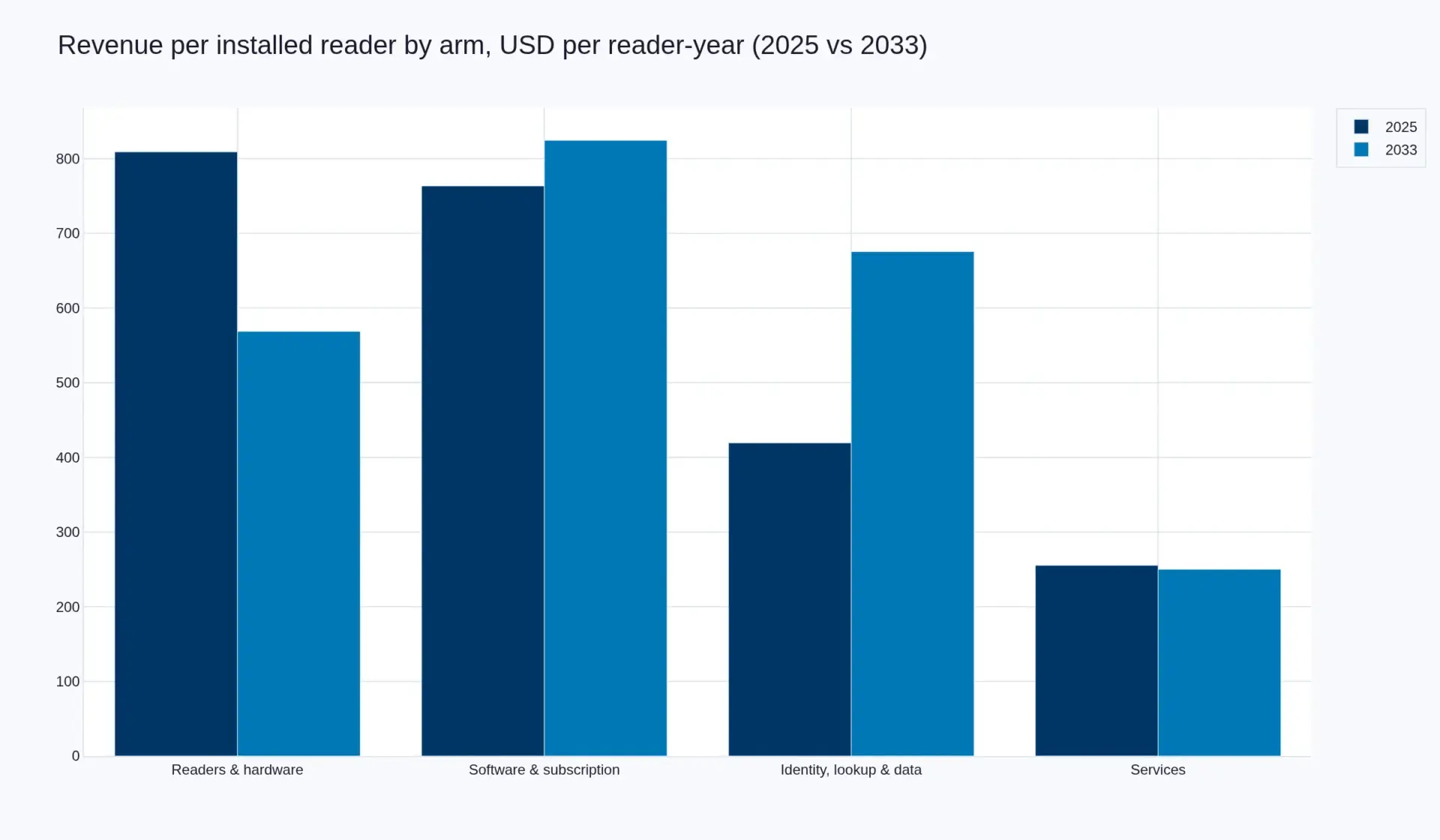
An operator reading that chart should notice something uncomfortable. The hardware they capitalise is losing value per unit faster than they are adding units. The only line rising fast enough to compensate is the one that depends on a legal permission they may not hold — and, in the private-parking case, one they may be about to lose in court.
The two-step structure is why the DPPA bites
The Driver's Privacy Protection Act does not regulate cameras. It regulates the disclosure and use of personal information "obtained by the department in connection with a motor vehicle record", where a motor vehicle record means a record pertaining to an operator's permit, a title, a registration or an identification card issued by a department of motor vehicles. The Supreme Court confirmed that architecture in Reno v. Condon in 2000, describing a statute that "regulates the disclosure and resale of personal information contained in the records of state DMVs".
So the DPPA sits precisely on step three — the resolution — and nowhere on step one. A camera can photograph a plate a thousand times a day and the statute is silent. The moment the operator asks the state who owns it, the statute is engaged, and so is §2724.
This is why the market's growth and the market's risk come from the same act. Every incremental lookup is incremental revenue and incremental exposure. There is no version of this business in which the two are separable, because they are the same database call.
The permitted purposes, and the one private operators rely on
Section 2721(b) lists the permissible uses. Two matter most here. Paragraph (1) covers use "by any government agency … in carrying out its functions, or any private person or entity acting on behalf of a Federal, State, or local agency in carrying out its functions". Paragraph (10) covers "use in connection with the operation of private toll transportation facilities" — an explicit, unambiguous permission for the tolling arm.
Private parking enforcement on private land fits neither cleanly. It is not a government function, and a car park is not a toll facility. In practice operators rely on paragraph (3) — use in the normal course of business to verify information the individual supplied, and where it is wrong, to obtain the correct information "for the purposes of preventing fraud by, pursuing legal remedies against, or recovering on a debt or security interest against, the individual". That is a narrow permission resting on a factual claim: that a debt exists and that the lookup is to pursue it. If the debt is contested, or if no parking event occurred, the permission is being asserted over something that did not happen.
That is exactly the allegation now before a federal court in Florida. In Levine v. Municipal Parking Services, Inc., No. 8:25-cv-2920 (M.D. Fla.), two drivers allege that private parking companies used their plates to obtain names and home addresses and mailed invoices threatening booting or towing. One plaintiff says she drove through a lot twice to drop off and collect family members, never parked, and days later received an invoice asserting the vehicle "had been parked for nearly four hours". On 5 November 2026 the court denied the defendants' motions to dismiss, finding standing and a stated claim. No class has been certified and no merits finding has been made. But the structure of the claim is the structure of the market's exposure: a misread creates an invoice, the invoice motivates a lookup, and the lookup is the statutory event.
4. Demand Drivers
Six forces are pulling this market forward, and one is pulling it back. The net of them is the 14.27 per cent.
Gateless access. The largest single driver is the removal of the barrier. A gate is a device that costs money to install, money to maintain and time to pass through; a camera plus an account removes all three. Metropolis's acquisition of SP Plus, completed in May 2024, converted roughly 4,000 locations to camera-based entry and exit with direct billing — a change of model, not a change of hardware. Every one of those locations is a reader, a subscription and a lookup, and the economics depend on the operator's ability to bill the right person.
Permit and enforcement digitisation. Virtual permits replaced physical ones, which means the permit is now a database row keyed to a plate. This is the same transition described in our work on on-street parking enforcement and digital permitting, and it is what makes a reader mandatory rather than optional: with no sticker and no permit in the windscreen, the plate is the only evidence.
Tolling and road-user charging. All-electronic tolling converts a barrier into a gantry, and a gantry is a reader array. The DPPA gives toll operators an explicit permission under §2721(b)(10), which is one reason the tolling arm is both the most legally settled and the most consolidated part of the market. Congestion charging, distance-based charging and low-emission zones all extend the same mechanism into new geographies.
Insurance, fleet and commercial data. The smallest arm growing fastest — 16.95 per cent — is not access at all. It is the resale of vehicle-location data to fleet operators, insurers and recovery services. Motorola's acquisition of VaaS in 2019 bundled exactly this: Vigilant for law enforcement and Digital Recognition Network for commercial customers, described at the time as "the largest shareable database of vehicle location information".
Audit as a product requirement. Where a regulator audits the purpose of the lookup rather than the outcome, an audit trail becomes a purchasing criterion. Our fieldwork finding, and one we label as ours rather than as a published statistic: the operators who buy well are the ones who can produce a per-query purpose log on demand, and the ones who buy badly cannot produce one at all.
Capital aversion at the municipal level. A subscription reader at USD 3,000 a year is an operating line; a gantry and a gatehouse is a capital project. Councils and agencies with constrained capital budgets systematically prefer the former, which is why the installed base grows while hardware revenue per unit falls.
The counter-driver: political cost. In 2026 several United States cities suspended or cancelled reader contracts, and cameras have been vandalised and physically obstructed. This is a real demand-side constraint, and it is not captured in a straight-line CAGR. It reduces the number of buying agencies while leaving the number of cameras per buying agency intact — which is why our forecast holds volume growth but not agency-count growth.
Set against all of this is one structural ceiling: an access reader can only be justified by an access decision. Where the decision is a price (a toll, a tariff, a permit fee), the reader has a revenue line to attach to. Where the decision is free — open parking, unrestricted forecourts, ungated retail — the case has to be made on security or analytics, and that case is the first thing to be cut when a council changes hands.
5. Segment and Product Split
By application, the market is still led by parking, but the fastest growth is in controlled and gated access — the campuses, depots, residential schemes, ports and logistics yards where a vehicle identity is the credential. That is the segment where the reader is not replacing a machine but creating a capability, and it is therefore the segment with the least price resistance.
| Application | 2025 (USD m) | 2033 (USD m) | CAGR |
|---|---|---|---|
| Parking access and permit enforcement | 1,420.0 | 3,760.0 | 12.94% |
| Tolling and road-user charging | 1,180.0 | 3,180.0 | 13.19% |
| Controlled and gated access | 760.0 | 2,520.0 | 16.16% |
| Public safety and municipal | 520.0 | 1,640.0 | 15.44% |
| Fleet, insurance and commercial data | 300.0 | 1,050.0 | 16.95% |
| Total | 4,180.0 | 12,150.0 | 14.27% |
The parking segment is the most exposed and the least defensible. It is the segment where a private operator, not a public authority, is most likely to be performing the lookup; where the parking event is most likely to be disputed; and where the statutory permission is thinnest. It grows at 12.94 per cent — below the market — and we expect that gap to widen if the private-parking litigation in Florida proceeds to class certification.
Controlled access growing at 16.16 per cent is the mirror image. The permission there is usually the owner's own consent — an employee, a tenant, a contractor, a driver who has signed a site rule — rather than a statutory exception. Consent is cheaper to hold than a statutory purpose, easier to evidence, and it travels across jurisdictions. It is also the segment where a reader integrates most naturally with a credential system, which is why the boundary with our smartphone credential reader market is porous: the same door is opened by a phone in one scheme and a plate in another, and the operator chooses on cost per identity, not on technology preference.
Tolling at 13.19 per cent is the steady middle. It is contract-led, legislated, and largely closed to new entrants — the classic profile of a segment that grows with the road network and consolidates around whoever already holds the gantries.
6. Regional Analysis
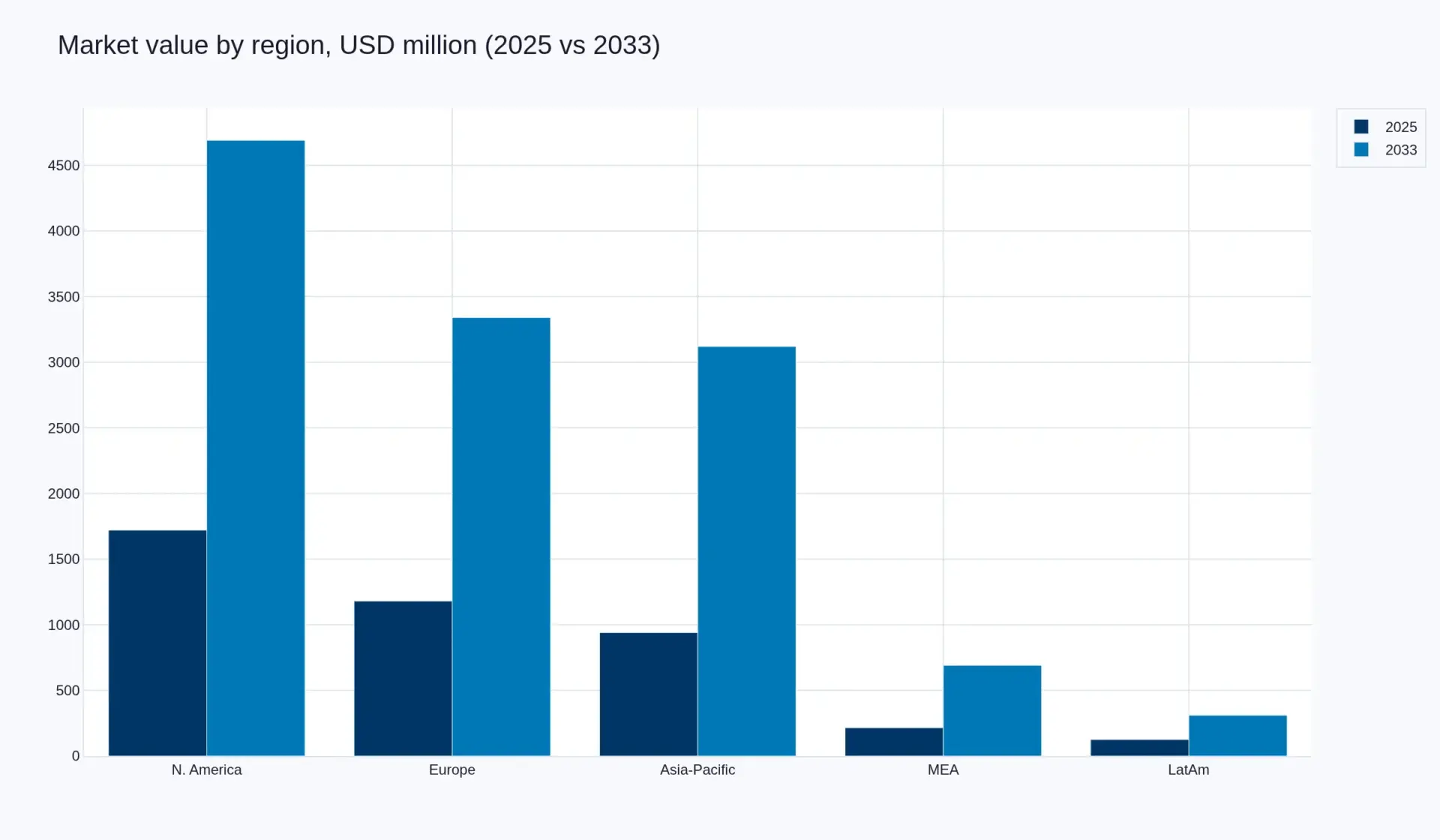
North America is 41.15 per cent of the 2025 market and grows at 13.36 per cent, slightly below the global rate. It is the most legally exposed region and the most commercially mature, and those two facts are related: the per-record damages regime that makes compliance expensive also makes the identity permission valuable, which is why the arm mix there is the most weighted towards data.
| Region | 2025 (USD m) | 2033 (USD m) | CAGR |
|---|---|---|---|
| North America | 1,720.0 | 4,690.0 | 13.36% |
| Europe | 1,180.0 | 3,340.0 | 13.89% |
| Asia-Pacific | 940.0 | 3,120.0 | 16.18% |
| Middle East and Africa | 215.0 | 690.0 | 15.69% |
| Latin America | 125.0 | 310.0 | 12.02% |
| Total | 4,180.0 | 12,150.0 | 14.27% |
Europe is the most regulated market and the most normalised. The United Kingdom's keeper-lookup regime is the world's most transparent version of the identity act: £2.50 a record, a defined "reasonable cause" test, mandatory membership of an accredited trade body, and a government audit with a red-amber-green rating that can cost an operator its database access. That combination produces a market where the technology is ubiquitous and the margin is thin, because the lookup is cheap by design — the DVLA is not permitted to profit from the fee — and the compliance cost is continuous.
Asia-Pacific grows fastest at 16.18 per cent and passes Europe in absolute terms. Three things drive it: new toll and road-user-charging schemes built natively as gantries rather than barriers; dense controlled-access estates in industrial and logistics parks; and jurisdictions where the national identity and vehicle registration systems are already digitised and queryable, which lowers the cost of the resolution step. The region's constraint is not demand but fragmentation: registration data is held at provincial or municipal level in several markets, so a reader fleet that crosses a border stops being an identity system.
The Middle East and Africa grows at 15.69 per cent from a small base, concentrated in Gulf tolling, gated communities and airport landside schemes. Latin America is the slowest at 12.02 per cent, held back by currency volatility, fragmented municipal procurement cycles, and — in several markets — the absence of a reliable keeper lookup at any price.
The last point is the one most often missed in regional forecasts. This market cannot exist without a state that will answer the question "who owns this plate, and on what basis may I ask". Where that answer is slow, expensive or unavailable, the reader still sells, but it sells as a sensor rather than as an identity system — and a sensor is priced at hardware multiples, not at data multiples.
Sources
Every figure in this report traces to one of the following. No market-research publisher is cited anywhere in this document.
- 18 U.S.C. §2721 — Prohibition on release and use of certain personal information from State motor vehicle records, including the permitted uses in subsection (b) and the resale and redisclosure rules in subsection (c).
- 18 U.S.C. §2724 — Civil action, including the liquidated damages floor at §2724(b)(1).
- Reno v. Condon, 528 U.S. 141 (2000) — the Supreme Court's description of the DPPA's scope and its definitions of personal information and motor vehicle record.
- National Conference of State Legislatures, Automated License Plate Readers: State Statutes, updated 28 September 2026 — retention requirements, sharing and sale restrictions, audit obligations and the 50-state overview.
- RAC, "Government audit identifies issues with more than half of private parking firms' use of DVLA data", 19 October 2026 — the Government Internal Audit Agency ratings for 57 car park management companies in 2025/26, the £2.50 keeper-at-date-of-event fee, and the 17 million keeper-detail requests in the year to 31 March 2026.
- DVLA form V888/2A, Request by a company for keeper at date of event information, version 7/25 — the £2.50 fee and the electronic enquiry route.
- Information Commissioner's Office, decision notice IC-376751-N7T5, 20 November 2025 — the DVLA's position on the retrievability of cost information for providing private parking companies with driver information.
- Verra Mobility, fourth quarter and full year 2025 financial results, 24 February 2026 — revenue, segment revenue and segment profit, and the New York City Department of Transportation contract.
- Motorola Solutions, acquisition of VaaS International Holdings, 7 January 2019 — purchase price, expected revenue and the composition of the acquired business.
- Inc., "How Flock Became the Most Controversial Startup in America", 13 August 2026 — installed base, customer counts, funding and valuation, and the historical cost of a licence plate reader.
- NBC Palm Springs, "Desert Hot Springs City Council to Consider $78,000 Annual Cost for Flock License Plate Cameras", 16 November 2026 — 26 cameras, USD 3,000 per camera per year.
- Axios, "Metropolis' AI is disrupting parking", 16 May 2024 — the SP Plus acquisition, the premium paid, the financing raised, and the conversion of approximately 4,000 locations to camera-based entry and exit.
- BetaGov, Marron Institute of Urban Management, New York University — Vallejo Police Department ALPR randomised trial, 2017 — trial design and the finding that 35 per cent of hits were misreads.
- Levine v. Municipal Parking Services, Inc., No. 8:25-cv-2920 (M.D. Fla.) — order denying the defendants' motions to dismiss, 5 November 2026. Cited by docket number; the court's order is the authority, not any secondary report of it.
A note on construction. Market values, volume, arm splits, application splits, regional splits and all CAGR figures are Pheonix Research constructions built from the anchors above and from published contract values. Where a figure is a construction rather than a disclosure, the text says so. Revenue per reader is total arm revenue divided by readers in service and is a ratio we calculate, not a price any vendor publishes.
Table of Contents
Table of Contents
- Market Snapshot — value, volume, revenue per reader and the four arms
- Executive Summary — the reader costs USD 3,000 and one wrong record costs USD 2,500
- What This Market Actually Sells — a plate is not an identity, and the lookup is the product
- Demand Drivers — gateless access, tolling, permit digitisation, audit, commercial data and the political cost of the camera
- Segment and Product Split — parking, tolling, controlled access, public safety and commercial data
- Regional Analysis — North America, Europe, Asia-Pacific, Middle East and Africa, Latin America
- Competitive Landscape — the camera was commoditised on purpose, and the moat moved to the contract
- Value Chain — five stages, one irreducible step, and a statutory fee sitting inside the cost base
- Investment Activity — what buyers pay for when the sensor is cheap and the permission is not
- Technology and Innovation — the plate is a poor identifier, and the market knows it
- Market Risk — six exposures and the one that arrives as a class action
- Regulatory Landscape — three regimes, three cost structures, and the gap between them
Competitive Landscape
There are two markets in this report wearing one name, and almost every mistake in competitive analysis here comes from confusing them. The first is a sensor market: cameras, housings, illuminators, edge processors. It is fragmented, price-deflationary and increasingly Asian-manufactured. The second is an identity market: the permission to resolve a plate into a person, held through contracts, certifications and statutory purposes. It is consolidated, contract-protected and priced by law. No vendor leads both, and the strategic history of the last seven years is a series of attempts to escape the first by buying a position in the second.
The deliberate commoditisation of the camera
Flock Safety is the clearest case. When the company started, the premise was that a licence plate reader cost USD 20,000 or more per unit. Flock built a cheaper device and, more importantly, changed the commercial model from capital purchase to subscription. By 2026 it reported more than 100,000 readers installed, roughly 12,000 customers split between about 7,000 police departments and 5,000 private-sector clients, more than USD 1 billion raised, and a valuation near USD 8.4 billion.
Set that against a published municipal price. In November 2026, Desert Hot Springs in California considered USD 78,000 a year for 26 readers — USD 3,000 per camera per year. Multiply Flock’s reported installed base by that price and you get USD 300 million of implied annual subscription revenue. That is a Pheonix construction, not a disclosure: real contract prices vary with volume, term and grant funding, and some deployments are subsidised. But measured against the USD 8.4 billion valuation it implies roughly 28 times revenue on the most generous reading of the price list. Either the installed base is undercounted, or the multiple is being paid for something other than cameras. It is being paid for the network.
The camera went from a USD 20,000 capital item to a USD 3,000 annual line in under a decade. Whatever margin existed in hardware has been given away deliberately, because hardware is not where the permission lives.
What Motorola actually bought
Motorola Solutions made the opposite bet in January 2019, paying USD 445 million in cash and equity for VaaS International Holdings — a business with roughly USD 100 million of revenue that year, or 4.45 times sales. VaaS owned Vigilant Solutions for law enforcement and Digital Recognition Network for commercial customers. The announcement described the prize precisely: “the largest shareable database of vehicle location information” and a platform that “enables controllable, audited data-sharing across multiple law enforcement agencies”.
Note what is being bought. Not optics. Not a better OCR model. A database, and the sharing agreements that make it searchable across agencies. The multiple is a multiple on the permission, and the permission is what has to be audited — which is why the same announcement emphasised auditability rather than accuracy.
The margins say where the value sits
Verra Mobility is the most instructive listed comparable because it discloses enough to see the shape of the stack. Full-year 2025 revenue was USD 979.1 million. In the fourth quarter, its three segments produced the following:
| Verra segment, Q4 2025 | Revenue | Segment profit | Margin | What it sells |
|---|---|---|---|---|
| Government Solutions | USD 129.2m | USD 31.1m | 24% | Automated enforcement under municipal contract |
| Commercial Services | USD 108.1m | USD 69.1m | 64% | Toll and violation management for rental and fleet |
| Parking Solutions | USD 20.6m | USD 1.6m | 8% | Parking software, processing and hardware |
Read that table as a map. The business closest to the camera and the parking asset — Parking Solutions, which is where a reader sits in a car park — earns 8 per cent. The business that depends on the state’s enforcement power earns 24 per cent, and its margin fell year on year because installing 300 red-light cameras for New York City carried implementation cost ahead of revenue. The business that owns a contractual relationship with a fleet and bills across it earns 64 per cent.
The pattern is not specific to Verra. Across the sample, margin rises with distance from the sensor and with ownership of the counterparty relationship. That is the single most important competitive fact in this market, and it explains why every serious acquirer in the last two years has bought a position at the access point rather than a better camera.
Buying the access point
Metropolis Technologies executed the largest version of that logic. It raised roughly USD 1.8 billion and paid a 52 per cent premium to acquire SP Plus, closing in May 2024, converting about 4,000 locations to camera-based entry and exit with direct billing, and taking a customer base of more than 50 million drivers. The camera was a component of that transaction. The asset was the location, the lease and the billing relationship — the right to decide who passes and to charge them.
The European incumbents play the same game through procurement rather than acquisition. Kapsch TrafficCom holds tolling and road-user-charging positions that are won once a decade and specified into national infrastructure. Jenoptik and Vitronic supply readers and enforcement systems into frameworks where certification, not price, is the gate. Genetec reaches the same camera estate through the security-management platform, where the reader is one sensor among many and the platform owns the integration surface.
| Company | Position | Where the permission sits | Wikidata | Site |
|---|---|---|---|---|
| Motorola Solutions | Law-enforcement and commercial vehicle-location data | Shareable database and agency agreements | Q634815 | motorolasolutions.com |
| Verra Mobility | Toll and violation management; parking software | Municipal and fleet contracts | No entity recorded | verramobility.com |
| Kapsch TrafficCom | Tolling and road-user charging | National infrastructure concessions | Q115167489 | kapsch.net |
| Jenoptik | Enforcement and ANPR systems | Type approval and framework certification | Q450403 | jenoptik.com |
| Vitronic | ANPR and tolling cameras | Homologation and systems integration | Q131899038 | vitronic.com |
| Genetec | Security platform with native ALPR | Integration surface and installed base | Q30267239 | genetec.com |
| Flock Safety | Subscription readers and shared network | Cross-agency network membership | Q108485435 | flocksafety.com |
| Neology | Tolling and roadside systems | Transport-agency contracts | No entity recorded | neology.net |
| Metropolis Technologies | Gateless parking and billing | Ownership of the location and the account | Q131191821 | metropolis.io |
| Conduent | Curbside, tolling and transport systems | Public-sector managed-service contracts | Q28404490 | conduent.com |
Concentration, and why it is measured wrongly
By revenue, no participant holds more than about a fifth of any application and the top five together account for well under half of the USD 4,180.0 million base. By permission, concentration is far higher: a small number of vendors hold the agency-sharing agreements, the national tolling frameworks and the municipal master contracts through which most lookups actually pass.
That divergence is what makes the market look fragmented to a revenue screen and concentrated to a procurement officer. The barriers are not algorithmic. A competent computer-vision team can build a reader; the drivers of this market are type approval, an audit trail that survives inspection, a reference site in the same jurisdiction, and the ability to answer a regulator’s question about why a particular record was pulled on a particular afternoon. Those are organisational assets, and they accumulate.
One finding from our own fieldwork, labelled as ours rather than as a published statistic: among the operators we interviewed, the constraint on switching supplier was almost never detection performance. It was the migration of the permit list, the account records and the purpose log, because those are the artefacts an audit will ask for — and the incumbent holds them.
Which returns the analysis to its starting point. The competitive question in this market is not who has the best reader. It is who holds the defensible permission, and whether that permission can survive the next legislative session.
Value Chain
The chain from a passing vehicle to a billed or admitted driver has five stages, and each one carries a different margin profile and a different exposure. Naming them precisely matters, because “ALPR” is used to describe all five and the commercial consequences of confusing them are large.
| Stage | What happens | Typical economics | Who captures the margin |
|---|---|---|---|
| 1. Capture | Camera and illuminator produce an image and a plate string | Deflating capital or subscription; hardware arm grows at 8.91% | Sensor vendors; least defensible |
| 2. Edge interpretation | OCR, confidence scoring, multi-frame voting, vehicle fingerprinting | Bundled into the device or the subscription | Whoever owns the firmware |
| 3. Ledger | Reads are stored, indexed, matched against lists and permits | Per-reader subscription at 14.92% CAGR | Platform owners |
| 4. Resolution | Plate is joined to a person, account or authority via a vehicle record | Per-lookup fee; identity arm at 20.81% CAGR | Whoever holds the permitted purpose |
| 5. Action | Gate opens, tariff is charged, invoice or citation issues | Transaction fee, concession revenue or enforcement margin | The access-point owner |
Stages one and two are engineering. Stage three is software with reasonable retention. Stage four is law. Stage five is property. The market’s aggregate revenue per reader barely moves — USD 2,247 to USD 2,319 — because stages one and four move in opposite directions and almost exactly cancel: hardware revenue per reader falls 29.72 per cent while identity revenue per reader rises 61.10 per cent.
The statutory fee sitting inside the cost of goods
Stage four has a published unit cost in the United Kingdom, which makes it the only part of this chain that can be examined arithmetically. The Driver and Vehicle Licensing Agency charges £2.50 for a keeper-at-date-of-event record, and its own guidance is explicit that the fee recovers administrative cost rather than generating a return — the agency “is not permitted to profit from it”.
Now take the volume. In the year to the end of March 2026, private parking companies made a record 17 million requests for keeper details. Multiply through: 17 million records at £2.50 gives £42.5 million. That is the entire annual bill for the identity act in one market, paid to a public agency by the operators who need it.
Hold that figure and change the jurisdiction. Under the United States statute the floor is USD 2,500 for a single record obtained for a purpose not permitted. Seventeen thousand such records — one thousandth of the UK volume — produce the same 42.5 million. A thousandth of the traffic, the same money. That is the argument of this report expressed as one comparison: the price of the identity act is not set by the cost of the data. It is set by the law of the place where the lookup happens.
There is a further oddity worth recording. In November 2025 the UK Information Commissioner upheld a decision that the DVLA does not hold, in retrievable form, information about the cost of providing private parking companies with driver information — the agency holds “the building blocks” but would need specialists to construct the figure. The regulator cannot currently cost the service at the centre of the market it regulates.
Where the margin is actually added
Look again at the arm split. Hardware takes 36.00 per cent of 2025 revenue but grows at 8.91 per cent. Identity and data takes 18.66 per cent and grows at 20.81 per cent, reaching 29.14 per cent by 2033. Of the USD 7,970.0 million added between 2025 and 2033, the identity arm contributes 34.63 per cent — more than a third of all new revenue from an arm that starts at under a fifth of the base.
That shift is not a technology story. It is a story about who is willing to be the party of record on a lookup. A hardware vendor that ships a camera and moves on carries no statutory risk. A platform that stores reads and matches them to permits carries some. An operator that calls the vehicle registry carries all of it, and increasingly declines to do so without either a contractual indemnity or a fee that reflects the exposure. The fee is what the identity arm is: a risk premium that looks like a data charge.
The rework loop nobody budgets for
Stage two is where the chain leaks. The Vallejo randomised trial found 35 per cent of hits were misreads. In a moving-violation deployment a misread is a wasted alert. In an access deployment it is a decision made about the wrong vehicle, which then has to be unwound — by manual review, by a corrected invoice, or by a complaint that costs more to resolve than the parking session was worth.
That rework is a labour cost sitting between stage two and stage five and appearing in no vendor’s pricing. It also creates the condition in which statutory risk crystallises: a misread generates an event, the event generates an invoice, and the invoice motivates a lookup that has to be justified by a parking event that did not happen. Our earlier analysis of on-street enforcement and digital permitting made the same point from the other direction: the citation is only as good as the evidence behind the plate.
Integration is the quiet value pool
The last structural feature of the chain is that stage three has to talk to everything. A reader in a car park must hand an authorisation to a parking access and revenue control system that may be twenty years old; it must reconcile with a mobile payment platform that prices the session separately; it may need occupancy sensing data to know whether a bay was actually used; and at an airport it may have to feed a landside access and ground transportation platform charging a different party for the same square metre.
Every one of those interfaces is billable, and none of them is a camera. That is why the software arm grows faster than hardware and why the identity arm grows faster still: the value has migrated to the joints. The chain’s irreducible step is the one that must be defensible in front of a regulator. Everything else can be bought, outsourced or commoditised, and is being.
One stage deserves separate treatment because it is the largest cost inside the chain and appears in no revenue line: the labour at the handoff. A camera that reads a plate has produced a candidate, not a decision. Somebody or something must compare the candidate against a permit list, a reservation, a tariff band or a hot list, and then decide. Where the decision is automated, the cost is software and the error rate is whatever the matching logic produces. Where it is not, the cost is a person in a booth or a control room, which is precisely the cost that gateless access is designed to remove — and precisely why the removal is only as reliable as the match.
The purpose log closes the chain. In a regime where the regulator asks why a record was obtained, the log is not a compliance artefact bolted on at the end; it is the product’s proof of legality, generated at the moment of the decision and retained longer than the decision itself. Operators who understand this build the log first and the interface second. Operators who do not discover, usually during an audit or a lawsuit, that the only defensible record of their own conduct is the one they never designed.
Investment Activity
Capital in this market has been moving in one direction for seven years: away from the sensor and towards the permission, the contract and the installed base. The transactions are unusually legible about what buyers think the asset is, because in each case the camera was available to anyone.
Four transactions that set the pattern
Motorola Solutions and VaaS International Holdings, January 2019. USD 445 million for a business running at roughly USD 100 million of revenue — 4.45 times sales — with the explicit rationale that it came with “the largest shareable database of vehicle location information” and audited cross-agency data-sharing. The multiple was paid for a database and a set of agreements, not for optics.
Metropolis Technologies and SP Plus, closed May 2024. Metropolis raised approximately USD 1.8 billion and paid a 52 per cent premium over the pre-announcement price, converting roughly 4,000 locations and a customer base of more than 50 million drivers to camera-based entry, exit and billing. This was a growth buyout of a 100-year-old operator by a seven-year-old software company. The logic was explicit: instead of selling technology one facility at a time, acquire the facilities.
Flock Safety, 2017 to 2026. More than USD 1 billion raised across rounds that took the company to a valuation near USD 8.4 billion, on a reported base of over 100,000 readers and about 12,000 customers. On a constructed subscription revenue of USD 300 million at published municipal pricing, that is roughly 28 times revenue — a multiple that can only be justified by network effects in the sharing layer, not by device economics.
Verra Mobility, 2025. The listed comparable chose a different use of capital: USD 133.4 million of share repurchases in the fourth quarter alone, on full-year revenue of USD 979.1 million, with net leverage at 2.3 times. The message to the market was that the existing contract book was worth more to shareholders than incremental acquisitions at prevailing prices.
| Transaction | Value | What was bought | Implied multiple |
|---|---|---|---|
| Motorola / VaaS | USD 445m, 2019 | Vehicle-location database and agency sharing | 4.45x revenue |
| Metropolis / SP Plus | 52% premium, 2024 | 4,000 locations and 50m+ customer accounts | Premium to pre-deal price |
| Flock Safety (private rounds) | USD 8.4bn valuation, 2026 | 100,000+ reader network and 12,000 customers | ~28x constructed revenue |
| Verra Mobility (buyback) | USD 133.4m, Q4 2025 | Its own contract book | Net leverage 2.3x |
Three valuation logics, not one
Buyers in this market are pricing three different assets and often pricing them with the same spreadsheet.
Revenue per reader is the annuity logic. A reader under subscription produces a predictable stream with high retention, and the correct multiple is a function of churn and contract length. This is the logic that supports most of the private valuations, and it is deflationary: hardware revenue per reader falls 29.72 per cent across the forecast, so a multiple built on the device alone erodes.
Revenue per permission is the legal-monopoly logic. If a vendor holds the agency agreement, the framework certification or the municipal master contract through which lookups pass, the revenue is protected by something more durable than customer satisfaction. This is the logic behind the Motorola deal and behind every tolling concession, and it is the only logic that supports a multiple above twenty times.
Revenue per location is the property logic. Metropolis did not buy a technology company; it bought the right to charge at 4,000 addresses. The correct comparable is a concession or a lease, not a software company — which is why the premium made sense to the buyer and looked extraordinary to the seller’s shareholders.
The practical consequence is that the same business can be valued three ways depending on which layer an acquirer believes it is buying. That ambiguity is why diligence in this sector is unusually consequential.
What diligence should ask, and usually does not
If the price of the asset is the defensibility of the lookup, the diligence questions should be about lookups. In our fieldwork, and this is a finding we label as ours rather than a published statistic, most operators could not state how many vehicle-record lookups they perform per camera per month. They knew their camera count, their transaction count and their revenue per bay. They did not know their liability denominator.
That is a remarkable gap. A business that cannot state its lookups per camera cannot compute its error budget, cannot size its own statutory exposure, and cannot give an acquirer a defensible number. Four questions follow from it:
Purpose-log completeness. Can the operator produce, for any given record, the timestamp, the user, the purpose and the underlying event that justified the lookup? California requires an access record containing the date, time, plate number or query, username and purpose; a dozen states impose comparable log requirements. An operator that cannot produce this is not merely non-compliant — it is unvaluable.
Retention mapping. Does the archive comply with the most restrictive jurisdiction in which the operator does business? A single national database configured to the loosest state is a liability in the strictest one.
Indemnity structure. Who bears the statutory risk between the operator, the platform and the vendor? In practice, almost nobody has priced this, which means it is being carried silently by whoever sits closest to the registry call.
Litigation history. Any pending or threatened claim alleging improper lookup. This is the single item most likely to change a valuation, and the least likely to appear in a data room.
Where the next capital goes
Three patterns are visible. First, consolidation of regional integrators: the long tail of installers and maintainers is being rolled up by private capital and bolted onto platform owners, because installation is the one part of the chain that is still local. Second, managed service contracting at municipal level, where an authority buys an enforcement or access outcome rather than equipment, shifting the capital and the statutory risk onto the contractor. Third, and least developed, the acquisition of audit and compliance capability as a product in its own right — because in a market where retention is capped and purposes are audited, the ability to prove compliance is worth more than the ability to read a plate.
The risk to all three is legal rather than commercial. If the Florida litigation produces a certified class, the price of every United States private-parking asset falls at once, because the error budget stops being theoretical and becomes a claims estimate. That is the event our investment view is most sensitive to, and it is not in any model we have seen from a seller.
Technology & Innovation
The foundational technology of this market is worse than its marketing suggests, and the gap between the two is where innovation is now concentrated. A licence plate is a short string with no check digit, no cryptographic binding and no standardised international format. It is read at speed, at an angle, in weather, often with a trailer obscuring it. The most credible field evidence we have — the Vallejo randomised trial, in which patrol cars were randomised to alert-on or alert-off — found that 35 per cent of hits were misreads. Any innovation strategy that does not begin from that number is a strategy about cameras rather than about identity.
Four vectors, and only one of them is about the camera
Vector one: make the read better. Multi-frame voting across a sequence, confidence thresholds tuned per site rather than per product, better infrared illumination for retroreflective plates, and geometry that puts the camera at the correct capture angle for the lane rather than the pole. This is competent engineering and it is largely solved for good installations. It is also the vector with the least commercial leverage, because it is embedded in a device whose revenue per reader falls 29.72 per cent across the forecast.
Vector two: stop trusting the plate alone. The second factor in vehicle identity is the vehicle. Make, model, colour, body type, and increasingly damage and aftermarket features can be extracted from the same frame that produced the plate string. A match on plate plus vehicle fingerprint converts a single weak identifier into a compound one and cuts the false-positive rate that drives both rework and statutory exposure. This is the highest-value technical work in the market today, and it is being driven by exactly the thing vendors do not like to discuss: their error rate.
Vector three: retention by architecture. Where the law caps retention at minutes, the archive cannot exist. New Hampshire’s limit is three minutes; Maine’s is 21 days; Kentucky’s is 90; Montana’s is 18 months; Colorado’s is three years; Alabama’s is five. A product designed for Alabama is illegal in New Hampshire, and a product designed for New Hampshire — match on device, emit an event, discard the image — is legal almost everywhere. The engineering that matters here is hashing, on-device matching and the deliberate non-persistence of the image. It is unglamorous and it is the difference between a sellable product and an unsellable one in the most restrictive jurisdictions.
Vector four: resolve at query time, not from an archive. This is the strategic conclusion that follows from the first three. The market’s fastest-growing arm is identity and lookup, growing at 20.81 per cent. The regulatory direction is towards shorter retention and tighter purpose specification. Those two facts point in opposite directions unless the resolution step is detached from the storage step: instead of building a five-year location archive and querying it, call the registry at the moment of decision, record the purpose, and keep the answer rather than the history. That architecture satisfies a three-minute retention cap, produces a cleaner audit trail, and moves the cost from storage to lookups — which is precisely the arm that is growing.
What the tolling layer already knows
Tolling solved this problem a decade ago and the rest of the market has not caught up. An all-electronic toll gantry does not rely on a plate as its primary identity; it uses a tag or an onboard unit, and treats the plate as the enforcement backstop for the minority of vehicles that pass without one. That gives the operator a high-confidence primary identity and a low-confidence fallback, with different legal treatment for each.
Parking and controlled access have the opposite structure: the plate is the primary identity and there is no fallback at all. That is why the access market’s error rate matters more than the tolling market’s, and why the most commercially interesting innovation in access is the import of a secondary credential — a phone, a tag, a pre-registered account — so that the plate becomes the backstop rather than the identifier.
The same logic is visible in adjacent markets. A smartphone credential binds an identity to a person; a plate binds an identity to a metal rectangle that can be cloned, swapped or misread. Where the two are combined — phone as primary, plate as corroboration — both the false-positive rate and the statutory exposure fall together. Where only the plate is available, the operator is asking a nine-character string to carry a legal obligation it cannot bear.
The integration frontier
Most of the remaining value in this market is not in detection at all. It is in the handoffs. A reader must talk to a parking access and revenue control system that decides whether to raise a barrier; to a payment platform that decides what to charge; to an occupancy system that decides whether the bay was used at all; and to a curb management platform that decides whether the vehicle was entitled to be there. Four handoffs, four data models, four vendors, and no standard.
The absence of a standard is itself a moat. Whoever owns the integration layer intermediates four decisions and can charge for each. That is why the software arm grows faster than hardware and why platform vendors are willing to give the reader away: the device is the ticket of entry to the handoffs.
What would change the technology bet
Two developments would reset the market’s technical direction. The first is a standardised, authorised, real-time vehicle-identity query interface offered by registries to permitted purposes — an API for the identity act. That would collapse the cost of stage four, commoditise the platform layer, and push all remaining value to the access point. The second is the gradual migration of identity into the vehicle itself, through telematics and onboard credentials, which would remove the roadside reader from the centre of the chain altogether.
Neither is imminent. Both are plausible within the forecast window, and neither is in the model. The reason is not complacency: it is that a market whose margin is set by statute changes when the statute changes, and the statute has not changed yet.
There is one further technical constraint that shapes the market and is almost never priced: the cost of being wrong is not uniform across applications. The same 35 per cent misread rate produces a wasted alert in a moving-violation system handling millions of passages a week, and a misfired invoice in an access system handling a few hundred a day. The absolute number of errors is lower in access; the consequence per error is far higher, because every error becomes a commercial act against a named person. That asymmetry explains why the access market is slower to abandon the archive than its data volumes would justify, and why the most successful deployments are those that have inserted a human or a second credential between the read and the action.
It also explains what customers are actually buying. Not detection. They are buying a defensible decision — an audit trail that can answer, months later, why this vehicle was admitted, charged or refused on this date. Every technical choice in this market is ultimately a choice about how much evidence survives the transaction, and how much of it can be discarded without losing the ability to answer that question.
Market Risk
This market carries an unusual risk profile: its largest exposure is not competitive, technological or macroeconomic, but statutory, and it is sized by a number that appears on no balance sheet. We rank the exposures below by expected loss rather than by how often they are discussed.
| Exposure | Mechanism | Severity | Who carries it |
|---|---|---|---|
| Statutory lookup damages | Per-record liquidated damages with a private right of action | High | Operator, then platform, then vendor by indemnity |
| Retention legislation | Archive becomes unlawful in a jurisdiction overnight | High | Platform and operator |
| Wrongful action | Misread produces an invoice, tow or denial to the wrong person | Medium | Operator |
| Political and reputational backlash | Contract cancellation, vandalism, procurement freeze | Medium | Vendor and agency |
| Data breach | Location archive exposed; independent cause of action in some states | Medium | Platform and operator |
| Technology substitution | Identity migrates into the vehicle or the phone | Low near term, high long term | Sensor vendors |
1. The statutory exposure, and why it is a tail rather than a line item
The Driver’s Privacy Protection Act prices the act of obtaining a record, not the harm caused by it. Section 2724(b)(1) sets a floor of USD 2,500 per person, with punitive damages available on proof of wilful or reckless disregard and reasonable attorneys’ fees on top, and no obligation on the plaintiff to demonstrate injury. In a class action the arithmetic is multiplicative: a single flawed workflow applied across a customer base produces a claim that is a multiple of the revenue the workflow generated.
Set that against the unit economics. A municipal subscription reader runs about USD 3,000 a camera-year. A 26-camera deployment at USD 78,000 a year reaches break-even against the statutory floor at 31 improper lookups. There is no other line in this business where a rounding error in process converts, so quickly, into a write-off of the entire contract.
The exposure is also asymmetric in time. Damages accrue per record, and records are retained. An operator that has been performing lookups against a thin permission for eight years has eight years of accrued exposure, discoverable in its own audit log — the very artefact that is supposed to protect it.
2. Retention legislation is an obsolescence risk, not a compliance cost
Where a jurisdiction caps retention, the product itself changes. At least 19 United States states have set retention requirements, and the range is not a matter of degree: New Hampshire’s limit is three minutes, Maine’s 21 days, Kentucky’s 90 days, Montana’s 18 months, Colorado’s three years and Alabama’s five years. A platform architected around a multi-year location history is not degraded in New Hampshire; it is prohibited.
Connecticut’s 2026 legislation illustrates the direction of travel: a 21-day deletion default, a 30-day carve-out for highway usage fee collection, explicit permission for parking enforcement and access control among the permitted purposes, and a prohibition on using the data to monitor people on the basis of protected characteristics. Each clause is a product requirement disguised as a legal one.
The commercial consequence is a rebuild cost that falls unevenly. Vendors with a single national archive face a re-architecture; vendors that match on device and discard the image face a configuration change. That difference in cost is, quietly, one of the strongest competitive forces in the market.
3. Wrongful action is the risk that becomes a news story
A misread in an access context does not stay a data problem. It becomes an invoice, a barrier that will not open, a tow, a boot, or a denial of entry — actions taken against a person who did nothing. The Florida litigation turns on exactly this sequence: a driver who says she entered a lot twice to drop off and collect family members, never parked, and was later invoiced for nearly four hours with a threat of booting or towing.
In moving-violation enforcement a false positive is contested through a tribunal with a defined process. In private access enforcement it is contested through a complaints channel, a debt collector and, increasingly, a court. The absence of a standard dispute process is itself the risk: it converts a service failure into a statutory claim.
4. Political cost is now a demand variable
Through 2026 several United States cities suspended or cancelled reader contracts, and cameras were vandalised and physically obstructed. The effect on the market is not uniform. Agency counts fall; cameras per agency hold. That is why our forecast retains volume growth while assuming no growth in the number of buying agencies in North America — an assumption that reduces the 2033 figure relative to a straight-line extrapolation, and one we regard as conservative rather than pessimistic.
There is a second-order effect that matters more to vendors than cancellations: procurement friction. A council that would have approved a renewal in a five-minute item now debates it for an hour, and some renewals are simply not brought forward. Our fieldwork finding, labelled as ours: the decision to keep or remove cameras is made on the political cost of being seen to have them, not on measured accuracy or measured outcomes.
5. Breach is a separate liability with its own price
An archive of vehicle locations is a security asset with a security obligation. California requires operators to maintain reasonable security procedures, publish a usage and privacy policy, keep an access record showing user, time, plate and purpose, and designate a custodian — and creates a civil cause of action for breach of security or unauthorised access, with actual damages, punitive damages and attorneys’ fees. A breach is therefore not merely a notification event; in some jurisdictions it is a damages event, independent of any improper lookup.
6. Substitution is slow until it is sudden
The long-run risk to the whole category is that identity moves into the vehicle. Telematics, onboard credentials and phone-based access all establish identity without a roadside camera, and each is already deployed at scale in adjacent applications. The plate reader survives because it is the only identity device that works on a vehicle it has never met — the visitor, the delivery, the rental, the stranger. As long as access systems must admit unknown vehicles, the reader has a floor under demand. The moment a jurisdiction mandates a digital vehicle credential, that floor moves.
What we are not treating as risk
Two commonly cited exposures do not appear above. Currency volatility affects reported revenue but not the underlying demand, and municipal budget pressure has historically increased adoption of operating-expense models over capital purchase — a substitution within the market, not a contraction of it. The risks that matter here arrive as a court filing, a legislative amendment or a planning committee, and only one of the three can be insured.
Regulatory Landscape
Regulatory geography in this market is not a scale from light to heavy. It is three distinct mechanisms that place cost in three different parts of the value chain — which is why a vendor can be dominant in one jurisdiction and uncompetitive in another without any change in product quality.
| Regime | Primary instrument | What it prices | Practical effect on product |
|---|---|---|---|
| United States, federal | Driver’s Privacy Protection Act, 18 U.S.C. §§2721–2725 | The act of obtaining a record; USD 2,500 statutory floor per person | Purpose must be documented before the lookup, not after |
| United States, states | 28 state ALPR statutes; retention, sharing and audit rules | Storage duration and access logging | Archive length becomes a per-state product decision |
| United Kingdom | Keeper-at-date-of-event regime; £2.50 per record; accredited trade body membership; government audit | The permitted purpose, continuously | Audit trail and rating determine database access |
| European Union | GDPR purpose limitation, minimisation and storage limitation | Lawfulness of basis and duration | Default to ephemeral matching |
The United States: a statute that regulates the second step
The Driver’s Privacy Protection Act of 1994 restricts the disclosure and use of personal information obtained by a state department of motor vehicles in connection with a motor vehicle record. The Supreme Court upheld it against a federalism challenge in Reno v. Condon in 2000, describing a statute that “regulates the disclosure and resale of personal information contained in the records of state DMVs”. The definitions do the work: a motor vehicle record is one pertaining to an operator’s permit, a title, a registration or an identification card issued by a department of motor vehicles; personal information identifies an individual but excludes information on vehicular accidents, driving violations and driver’s status.
Section 2721(b) then lists the permitted uses. Four matter to this market. Paragraph (1) covers any government agency carrying out its functions, and any private entity acting on its behalf. Paragraph (3) covers a legitimate business verifying information the individual supplied, and correcting it, but only to prevent fraud, pursue legal remedies or recover a debt or security interest. Paragraph (4) covers use in connection with a civil, criminal, administrative or arbitral proceeding. Paragraph (10) covers the operation of private toll transportation facilities.
The mapping to this market is exact. Tolling sits on an explicit permission. Municipal enforcement sits on paragraph (1) when the operator is acting for the authority. Private parking on private land fits none of them cleanly and must rely on paragraph (3) — which requires a genuine debt and a genuine verification purpose, and therefore fails if the underlying parking event did not happen.
Section 2721(c) adds a resale and redisclosure regime: a recipient may pass the information on only for a permitted use, and must keep records for five years identifying each recipient and the permitted purpose. That record-keeping obligation is the origin of the purpose log that now functions as a commercial asset — and as the discoverable evidence in litigation.
Enforcement is private. Section 2724(a) creates liability for knowingly obtaining, disclosing or using information for a purpose not permitted, and §2724(b) sets the remedies: actual damages of not less than USD 2,500 in liquidated damages, punitive damages on proof of wilful or reckless disregard, reasonable attorneys’ fees and costs, and equitable relief.
The states: retention is the real policy instrument
At least 28 states now have statutes expressly addressing ALPR use or retention, and the retention provisions are where the market feels the law. At least 19 states have set retention requirements, with three more requiring adoption of a local policy. The spread runs from three minutes in New Hampshire to 21 days in Maine, 90 days in Kentucky, 18 months in Montana, three years in Colorado and five years in Alabama.
Sharing and sale are regulated separately. At least 16 states legislate frameworks for how data may be shared, at least 10 prohibit selling it outright, and about 12 exempt ALPR data from public records requests. At least 16 require written policies before operation, at least 18 impose audit or reporting requirements, and at least 19 enumerate consequences for misuse ranging from decertification to criminal penalty to civil action.
Two state models are worth isolating. California imposes a full operational code: reasonable security, a public usage and privacy policy, an access record containing date, time, plate or query, username and purpose, a designated custodian, a public comment opportunity before a public agency implements a system, a prohibition on sale or transfer except as authorised by law, and a civil cause of action for breach of security or unauthorised access with actual and punitive damages and fees. Connecticut’s 2026 statute takes the opposite drafting approach — a short list of permitted purposes that expressly includes parking enforcement and access control, a 21-day deletion default, and a 30-day carve-out for highway usage fee collection.
The distinction matters commercially. California regulates how you operate; Connecticut regulates what you may do and for how long. A vendor can comply with California by improving process and with Connecticut only by changing architecture.
The United Kingdom: audit instead of damages
The United Kingdom does not price a mistake. It prices the purpose, and it audits the operator. Registered keeper information is released by the Driver and Vehicle Licensing Agency where an applicant can show “reasonable cause” under the Road Vehicles (Registration and Licensing) Regulations 2002, and private parking enforcement is accepted as reasonable cause. The fee is £2.50 per record, set to recover administrative cost — the agency is not permitted to profit from it. Access requires membership of the British Parking Association or the International Parking Community.
Oversight is by audit rather than litigation. In 2025/26 the Government Internal Audit Agency assessed 57 car park management companies. 23 were rated red — 40.35 per cent — typically meaning significant weaknesses or serious compliance concerns, including possible misuse of keeper data or inadequate safeguards. A further five were amber and 29 green. Among the findings across a decade of audits: one company rated red in five of six audits, and another rated red in all three of its audits including the most recent.
Volume is the other half of the picture. In the year to the end of March 2026, private parking companies issued a record 17 million requests for keeper details — at £2.50 a record, a bill of £42.5 million. A Private Parking Code of Practice is expected to impose operating standards as a condition of database access, which would convert the audit rating from a reputational signal into a commercial gate.
Europe, and what actually converges
Under the GDPR the constraints are purpose limitation, data minimisation, storage limitation and a lawful basis. Applied to access readers, that produces the same practical outcome as the strictest state regimes: match at the point of decision, retain the decision rather than the history, and document the purpose. The European market has therefore converged on ephemeral matching for reasons of principle, while the United States is converging on it for reasons of statutory damages.
What does not converge is who pays. In the United Kingdom the lookup is cheap by policy and the compliance is expensive by audit. In the United States the lookup is cheap in practice and catastrophic in exception. In retention-capped jurisdictions the cost is borne up front, in architecture. Three mechanisms, three balance sheets, one market.
The three changes that would move the forecast
First, a federal amendment narrowing or widening the permitted purposes, or altering the liquidated damages provision, would reprice the entire United States identity arm in a single legislative cycle. Second, a state retention floor set at 24 hours or less in a large market would strand archive-based products and accelerate the move to query-time resolution. Third, a certified class in the Florida litigation would convert a theoretical exposure into a claims estimate and depress valuations across private-parking assets.
None of the three is in the model. All three are within the forecast window, and the market’s own structure — a margin set by law — is why they cannot be dismissed as tail events.