
Global E-Commerce Market Report, Size & Forecast 2026–2033
Global E-Commerce Market Forecast Snapshot (2026???2033)
| Metric | Value |
|---|---|
| Market Size (2025) | USD 7.95 Trillion |
| Market Size (2033) | USD 18.42 Trillion |
| CAGR (2026???2033) | 11.08% |
| Largest Segment | B2C E-Commerce |
| Fastest Growing Segment | Mobile Commerce (M-Commerce) |
| Leading End-Use Segment | Retail & Consumer Goods |
| Key Trend | AI-Powered Personalization, Social Commerce & Omnichannel Retailing |
| Regulatory Influence | Consumer Data Protection Laws, Digital Payment Regulations & Cross-Border Trade Policies |
| Future Outlook | Growth Driven by Mobile Shopping, Digital Payments, AI Integration & Cross-Border Commerce |
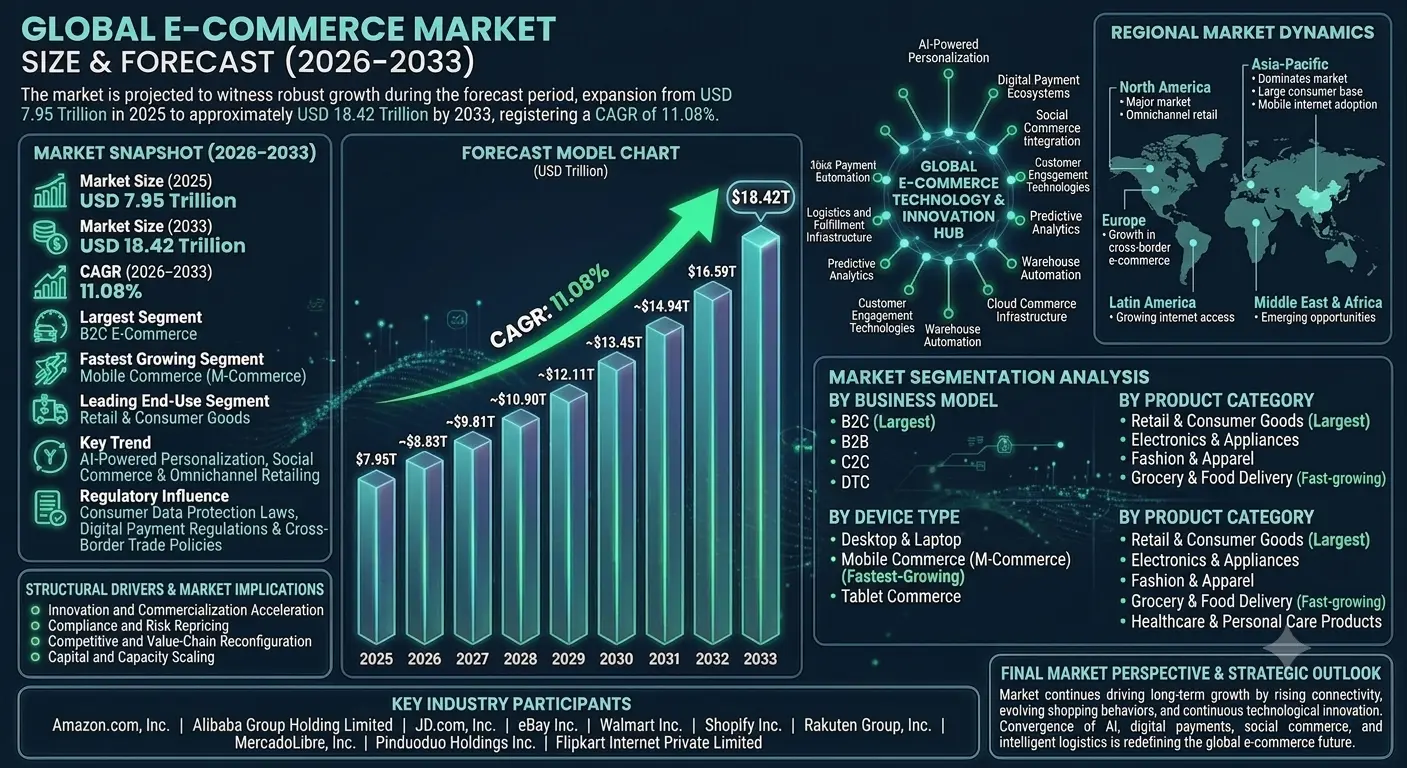
Global E-Commerce Market Size & Forecast
The Global E-Commerce Market is expected to witness robust growth during the forecast period from 2026 to 2033. The market was valued at USD 7.95 trillion in 2025 and is projected to reach approximately USD 18.42 trillion by 2033, registering a CAGR of 11.08%. The market growth is primarily driven by increasing internet penetration, rapid smartphone adoption, growing consumer preference for online shopping, and the expansion of secure digital payment ecosystems. E-commerce platforms have become essential channels for retail, consumer goods, electronics, fashion, healthcare products, food delivery, and digital services. The growing adoption of AI-driven recommendations, personalized shopping experiences, and omnichannel retail strategies is accelerating market expansion. In addition, rising cross-border trade activities, social commerce adoption, and advancements in logistics and fulfillment infrastructure are supporting long-term market growth.Global E-Commerce Market Overview
E-commerce refers to the buying and selling of goods and services through online platforms, digital marketplaces, mobile applications, and internet-enabled channels. The market includes business-to-consumer (B2C), business-to-business (B2B), consumer-to-consumer (C2C), direct-to-consumer (DTC), and subscription-based commerce models. E-commerce platforms are widely utilized across retail, consumer electronics, apparel, grocery, healthcare, automotive, travel, and digital services sectors. The market is evolving toward AI-powered personalization, social commerce integration, voice-enabled shopping, automated fulfillment systems, and immersive digital shopping experiences.Structural Drivers of Market Growth
1. Innovation and Commercialization Acceleration
Rapid advancements in artificial intelligence, recommendation engines, augmented reality shopping, digital payment systems, and?? ?? ??logistics automation are transforming online commerce. Retailers are increasingly investing in personalized shopping experiences, predictive analytics, and customer engagement technologies.Market Implications
Companies investing in AI-driven commerce platforms, advanced customer analytics, and seamless omnichannel experiences are expected to strengthen market leadership.2. Compliance and Risk Repricing
Consumer data privacy regulations, cybersecurity requirements, taxation policies, digital payment regulations, and cross-border trade compliance standards are influencing market operations. Governments worldwide are strengthening digital commerce regulations to improve consumer protection and transaction transparency.Market Implications
Firms offering secure, compliant, and transparent e-commerce ecosystems are likely to gain stronger consumer trust and market acceptance.3. Competitive and Value-Chain Reconfiguration
The market is highly competitive as online marketplaces, direct-to-consumer brands, retailers, logistics providers, and payment technology companies expand their digital ecosystems. Integrated fulfillment networks, last-mile delivery optimization, and marketplace consolidation are reshaping value-chain dynamics.Market Implications
Companies focusing on logistics efficiency, platform scalability, and customer-centric digital experiences may achieve stronger competitive positioning.4. Capital and Capacity Scaling
Rising investments in fulfillment centers, warehouse automation, cloud commerce infrastructure, and digital payment technologies are supporting market expansion. Growing demand for faster delivery and seamless shopping experiences continues to drive infrastructure development.Market Implications
Organizations scaling logistics capabilities, technology infrastructure, and global marketplace reach are expected to capture future opportunities.Market Segmentation Analysis
By Business Model
1. B2C (Business-to-Consumer)
This remains the largest segment due to widespread online retail adoption and increasing digital consumer spending.2. B2B (Business-to-Business)
Strong growth driven by digital procurement platforms and enterprise purchasing solutions.3. C2C (Consumer-to-Consumer)
Growing adoption through online marketplaces and peer-to-peer commerce platforms.4. DTC (Direct-to-Consumer)
Rapid expansion due to brand-owned digital channels and customer engagement strategies.By Device Type
1. Desktop & Laptop Commerce
Widely utilized for high-value purchases and business transactions.2. Mobile Commerce (M-Commerce)
Fastest-growing segment driven by smartphone penetration, mobile wallets, and app-based shopping.3. Tablet Commerce
Moderate growth supported by enhanced digital shopping experiences.By Product Category
1. Retail & Consumer Goods
Largest segment due to strong demand for everyday consumer products and household essentials.2. Electronics & Appliances
Strong adoption due to increasing online product comparison and purchasing convenience.3. Fashion & Apparel
Growing demand driven by social commerce and personalized recommendations.4. Grocery & Food Delivery
Fast-growing segment supported by convenience-driven purchasing behavior.5. Healthcare & Personal Care Products
Increasing online adoption due to accessibility and subscription-based purchasing models.Regional Market Dynamics
Asia-Pacific
Asia-Pacific dominates the global e-commerce market due to large online consumer bases, widespread mobile internet adoption, strong digital payment ecosystems, and rapid growth of online marketplaces across China, India, Southeast Asia, Japan, and South Korea.North America
North America remains a major market supported by advanced digital infrastructure, high online spending, strong logistics capabilities, and widespread adoption of omnichannel retail strategies.Europe
Europe is witnessing significant growth driven by increasing cross-border e-commerce activities, digital payment adoption, and expanding online retail penetration.Latin America
Latin America is experiencing rapid expansion due to growing internet access, increasing smartphone usage, and rising consumer confidence in digital transactions.Middle East & Africa
The region is witnessing emerging opportunities supported by digital transformation initiatives, expanding online retail ecosystems, and increasing fintech adoption.Competitive Landscape
The Global E-Commerce Market is highly competitive with online marketplaces, technology companies, digital retailers, and direct-to-consumer brands competing across global markets.Key Companies Operating in the Market Include:
- Amazon.com, Inc.
- Alibaba Group Holding Limited
- JD.com, Inc.
- eBay Inc.
- Walmart Inc.
- Shopify Inc.
- Rakuten Group, Inc.
- MercadoLibre, Inc.
- Pinduoduo Holdings Inc.
- Flipkart Internet Private Limited
Strategic Outlook
The future of the e-commerce market will be shaped by AI-powered personalization, social commerce, voice commerce, immersive shopping technologies, and automated fulfillment systems. Predictive analytics, conversational commerce, autonomous delivery solutions, and blockchain-enabled transaction security will significantly improve customer experiences and operational efficiency. The rise of mobile commerce, digital payments, cross-border trade, and data-driven retail strategies is expected to create strong long-term growth opportunities.Final Market Perspective
The Global E-Commerce Market remains one of the most dynamic segments within the digital economy. Rising internet connectivity, evolving consumer shopping behaviors, and continuous technological innovation continue driving long-term market growth. Companies capable of delivering scalable, secure, personalized, and omnichannel commerce experiences will be best positioned to capture future opportunities. The convergence of AI, digital payments, social commerce, and intelligent logistics is expected to redefine the future of the global e-commerce industry.Table of Contents
Table of Contents
- Executive Summary
- Global E-Commerce Market Snapshot (2026???2033)
- Market Size & Growth Overview
- Key Market Highlights
- Largest & Fastest-Growing Segments
- Leading End-Use Segment Overview
- Key Market Trends & Digital Commerce Transformation
- Strategic Outlook Through 2033
- Market Introduction & Overview
- Definition of E-Commerce
- Scope of the Global E-Commerce Market
- Evolution of Digital Retail & Online Marketplaces
- Role of E-Commerce in the Global Digital Economy
- Value Chain Analysis of E-Commerce Ecosystems
- Regulatory Influence (Consumer Data Protection Laws, Digital Payment Regulations & Cross-Border Trade Policies)
- Transition Toward AI-Powered, Omnichannel & Mobile Commerce Platforms
- Research Methodology
- Primary Research Approach
- Secondary Research Sources
- Market Size Estimation Methodology
- Forecasting Assumptions (2026???2033)
- Data Validation & Triangulation Process
- Market Dynamics
- Structural Drivers of Market Growth
- Innovation and Commercialization Acceleration in Digital Commerce Technologies
- Compliance and Risk Repricing in E-Commerce Ecosystems
- Competitive and Value-Chain Reconfiguration
- Capital and Capacity Scaling in Logistics & Fulfillment Infrastructure
- Market Restraints
- Cybersecurity Risks and Data Privacy Concerns
- High Logistics and Last-Mile Delivery Costs
- Cross-Border Regulatory and Taxation Complexities
- Market Opportunities
- Expansion of Mobile Commerce (M-Commerce)
- Growth in AI-Powered Personalization & Recommendation Engines
- Rising Adoption of Social Commerce Platforms
- Increasing Cross-Border E-Commerce Activities
- Market Challenges
- Intense Competition Among Online Marketplaces
- Customer Retention and Rising Acquisition Costs
- Supply Chain Disruptions and Fulfillment Complexities
- Structural Drivers of Market Growth
- Global E-Commerce Market Size & Forecast (2026???2033)
- Market Revenue Analysis
- CAGR Analysis
- Demand-Supply Trends
- Digital Payment & Transaction Analysis
- Investment Trends
- Future Market Outlook
- Market Segmentation Analysis (2026???2033)
- By Business Model
- B2C (Business-to-Consumer) (Largest Segment)
- B2B (Business-to-Business)
- C2C (Consumer-to-Consumer)
- DTC (Direct-to-Consumer)
- By Device Type
- Desktop & Laptop Commerce
- Mobile Commerce (M-Commerce) (Fastest-Growing Segment)
- Tablet Commerce
- By Product Category
- Retail & Consumer Goods (Largest Segment)
- Electronics & Appliances
- Fashion & Apparel
- Grocery & Food Delivery
- Healthcare & Personal Care Products
- By Business Model
- Regional Market Analysis
- Asia-Pacific (Largest Regional Market)
- North America
- Europe
- Latin America (Fastest-Growing Emerging Region)
- Middle East & Africa
- Competitive Landscape
- Market Structure & Fragmentation Analysis
- Key Player Benchmarking
- Strategic Developments
- AI-Powered Commerce & Omnichannel Retail Strategies
- Partnerships, Marketplace Expansion & Logistics Trends
- Company Profiles
- Amazon.com, Inc.
- Alibaba Group Holding Limited
- JD.com, Inc.
- eBay Inc.
- Walmart Inc.
- Shopify Inc.
- Rakuten Group, Inc.
- MercadoLibre, Inc.
- Pinduoduo Holdings Inc.
- Flipkart Internet Private Limited
- Strategic Outlook
- Future of AI-Powered Personalization & Intelligent Commerce
- Growth of Social Commerce & Conversational Shopping
- Expansion of Mobile-First Retail Ecosystems
- Development of Automated Fulfillment & Smart Logistics Networks
- Long-Term Market Outlook (2033+)
- Final Market Perspective
- Appendix
- About Phoenix Market Research
- Disclaimer
Competitive Landscape
Global E-Commerce Market Competitive Intensity & Market Structure Overview
The Global E-Commerce Market is extremely competitive and highly concentrated at the platform level, while remaining fragmented across merchants, direct-to-consumer brands, and regional digital retailers. Competitive intensity is primarily driven by platform scalability, logistics efficiency, customer acquisition cost, AI-driven personalization, pricing strategies, and ecosystem integration across payments, fulfillment, and digital services.
Market participants compete across B2C marketplaces, B2B procurement platforms, C2C trading ecosystems, and direct-to-consumer (DTC) channels. The rapid expansion of mobile commerce, social commerce, and omnichannel retailing is intensifying competition as companies race to capture digital consumer attention and maximize conversion rates across multiple touchpoints.
The market structure is evolving from standalone online retail platforms toward fully integrated digital commerce ecosystems that combine marketplaces, fintech services, logistics networks, cloud infrastructure, and AI-powered recommendation engines. Strategic alliances between retailers, technology providers, and logistics companies are reshaping global competitive dynamics.
Global E-Commerce Market Competitive Intensity & Market Structure Current Scenario
Leading Global E-Commerce Companies
- Amazon.com, Inc.: The global leader in e-commerce and cloud-integrated retail ecosystems, offering extensive product categories, advanced logistics infrastructure, and AI-driven personalization systems.
- Alibaba Group Holding Limited: A dominant player in global and Asian digital commerce, operating large-scale marketplaces and integrated fintech and logistics ecosystems.
- JD.com, Inc.: A major Chinese e-commerce company known for its strong logistics network, direct retail model, and technology-driven supply chain operations.
- eBay Inc.: A leading C2C and marketplace platform focused on auctions, resale commerce, and global peer-to-peer trade.
- Walmart Inc.: A global retail giant rapidly expanding its e-commerce capabilities through omnichannel integration and hybrid retail models.
- Shopify Inc.: A leading e-commerce infrastructure provider enabling direct-to-consumer brands with digital storefronts, payment systems, and merchant tools.
- Rakuten Group, Inc.: A diversified Japanese e-commerce and digital services company integrating retail, fintech, and loyalty ecosystems.
- MercadoLibre, Inc.: The dominant e-commerce platform in Latin America, supported by integrated payments and logistics solutions.
- Pinduoduo Holdings Inc.: A fast-growing platform specializing in social commerce, group buying, and price-sensitive consumer segments.
- Flipkart Internet Private Limited: A leading Indian e-commerce company focused on retail expansion, mobile-first commerce, and logistics optimization.
Key Competitive Intensity & Market Structure Drivers
The increasing dominance of mobile commerce and AI-driven personalization is intensifying competition as platforms compete for user engagement, conversion optimization, and customer retention.
Logistics speed, last-mile delivery efficiency, and fulfillment automation have become critical differentiators, especially in high-growth urban markets with rising consumer expectations for rapid delivery.
The expansion of social commerce and influencer-driven shopping is reshaping customer acquisition strategies and increasing competition among digital platforms and retail brands.
Data privacy regulations, digital payment compliance standards, and cross-border trade policies are influencing operational strategies and shaping market entry barriers across regions.
The integration of fintech services, embedded payments, credit systems, and subscription-based commerce models is strengthening ecosystem-based competition rather than standalone platform rivalry.
Strategic Implications of Competitive Intensity & Market Structure
Companies with strong logistics infrastructure, AI capabilities, diversified merchant ecosystems, and integrated payment systems are expected to maintain dominant competitive positions.
Investment in automation, warehouse robotics, predictive analytics, and cross-border commerce capabilities is becoming essential for sustaining long-term competitiveness.
Platforms focusing on omnichannel integration, mobile-first experiences, and hyper-personalized shopping journeys are likely to strengthen user retention and revenue growth.
Strategic expansion through global marketplace scaling, regional acquisitions, and vertical integration of supply chains is enabling companies to reinforce ecosystem control.
Organizations capable of combining technological innovation, operational efficiency, merchant ecosystem depth, and customer-centric experiences will be best positioned to lead the evolving global e-commerce market.
Global E-Commerce Market Competitive Intensity & Market Structure Forward Outlook
The competitive landscape of the global e-commerce market is expected to become increasingly ecosystem-driven as AI, automation, and digital payments reshape how consumers interact with online platforms.
Future competition will be shaped by advancements in conversational commerce, autonomous logistics systems, AR/VR shopping environments, blockchain-based transaction security, and AI-powered demand forecasting.
Platforms are expected to further integrate financial services, supply chain intelligence, and personalized retail experiences into unified digital ecosystems to enhance competitiveness.
Over the forecast period, companies that successfully balance technological innovation, global scalability, logistics excellence, and customer engagement will be best positioned to dominate the evolving digital commerce landscape.
Value Chain
Global E-Commerce Market Value Chain & Supply Chain Evolution Overview
The Global E-Commerce Market is undergoing rapid transformation driven by increasing internet penetration, widespread smartphone adoption, expanding digital payment ecosystems, and evolving consumer preferences toward online shopping. The market???s value chain spans product sourcing, digital storefront management, marketplace operations, payment processing, warehousing, fulfillment services, logistics networks, customer engagement, and post-purchase support activities.
A defining characteristic of this value chain is the growing convergence of artificial intelligence, cloud computing, digital payments, logistics automation, data analytics, and omnichannel retail technologies. E-commerce platforms are continuously enhancing customer experiences through personalized recommendations, social commerce integration, predictive demand forecasting, and intelligent fulfillment systems.
Supply chain complexity continues to increase due to rising cross-border trade, multi-channel retail operations, last-mile delivery challenges, inventory management requirements, cybersecurity concerns, and evolving regulatory frameworks. Market participants must coordinate across manufacturers, suppliers, marketplaces, payment providers, fulfillment operators, logistics partners, and technology vendors while ensuring operational efficiency, customer satisfaction, and regulatory compliance.
Companies are increasingly investing in automated warehouses, AI-powered customer engagement tools, digital payment innovations, smart logistics infrastructure, and resilient supply chain networks to support growing transaction volumes. The value chain is evolving into a highly connected, data-driven, and technology-intensive ecosystem supporting global digital commerce expansion.
Global E-Commerce Market Value Chain & Supply Chain Evolution Current Scenario
Market-Specific Value Chain
- Product Sourcing & Supplier Management: Procurement of goods, supplier onboarding, inventory planning, product catalog management, and vendor relationship development.
- Digital Commerce Platform Operations: Marketplace management, website and mobile app development, product listing optimization, customer experience management, and digital merchandising.
- Payment Processing & Transaction Management: Digital payments, payment gateways, fraud prevention systems, financial settlement processes, and transaction security management.
- Warehousing & Fulfillment Operations: Inventory storage, order processing, packaging, fulfillment center management, and automated warehouse operations.
- Logistics & Last-Mile Delivery: Transportation management, parcel distribution, route optimization, cross-border shipping, and final customer delivery services.
- Customer Support & Post-Purchase Services: Returns management, customer service, loyalty programs, product reviews, and after-sales engagement.
Company-to-Stage Mapping
- Product Sourcing & Supplier Management: Manufacturers, wholesalers, brand owners, third-party sellers, and supplier networks operating on digital marketplaces.
- Digital Commerce Platform Operations: Amazon.com, Inc., Alibaba Group Holding Limited, JD.com, Inc., eBay Inc., Shopify Inc., Rakuten Group, Inc., and Flipkart Internet Private Limited.
- Payment Processing & Transaction Management: Digital payment providers, fintech companies, payment gateways, and financial technology platforms.
- Warehousing & Fulfillment Operations: Marketplace fulfillment divisions, third-party logistics providers, warehouse operators, and automated fulfillment service providers.
- Logistics & Last-Mile Delivery: Courier companies, parcel delivery providers, transportation operators, and cross-border logistics organizations.
- Customer Support & Post-Purchase Services: Marketplace service teams, customer experience providers, returns management specialists, and loyalty platform operators.
Key Value Chain & Supply Chain Evolution Signals in Global E-Commerce Market
Expansion of AI-Powered Personalization Technologies
Artificial intelligence and machine learning are increasingly being utilized to deliver personalized recommendations, targeted promotions, dynamic pricing strategies, and enhanced customer experiences.
Growth of Mobile Commerce Ecosystems
Rapid smartphone adoption and mobile payment integration are accelerating the expansion of app-based shopping and mobile-first retail experiences.
Increasing Adoption of Automated Fulfillment Systems
Warehouse automation, robotics, predictive inventory management, and intelligent order processing technologies are improving operational efficiency and delivery speed.
Rise of Social Commerce & Influencer-Led Retailing
Social media platforms are becoming important commerce channels, enabling direct product discovery, engagement, and purchasing within digital ecosystems.
Strengthening Cross-Border Commerce Infrastructure
Global marketplaces are investing in international logistics networks, localized payment systems, and regulatory compliance capabilities to support international trade growth.
Supply Chain Diversification & Resilience Initiatives
Retailers and marketplaces are expanding supplier networks, regional fulfillment centers, and inventory management strategies to mitigate operational risks and disruptions.
Strategic Implications of Value Chain & Supply Chain Evolution
Investment in AI & Data Analytics Platforms
Companies leveraging advanced analytics, predictive intelligence, and customer behavior insights can improve conversion rates and customer retention.
Expansion of Fulfillment & Logistics Capabilities
Enhanced warehouse automation, last-mile delivery optimization, and fulfillment network expansion can strengthen operational competitiveness.
Strengthening Payment Security & Consumer Trust
Robust cybersecurity systems, fraud prevention technologies, and secure payment infrastructures are becoming critical differentiators.
Development of Omnichannel Retail Ecosystems
Integrating online and offline retail experiences can improve customer convenience, engagement, and lifetime value.
Enhancement of Cross-Border Commerce Strategies
Localized operations, regulatory compliance capabilities, and international logistics partnerships can unlock new growth opportunities.
Acceleration of Sustainable Logistics Initiatives
Environmentally responsible packaging, carbon-efficient transportation, and green fulfillment practices can support sustainability objectives and brand reputation.
Global E-Commerce Market Value Chain & Supply Chain Evolution Forward Outlook
Looking ahead, the value chain is expected to evolve into a highly intelligent, automated, and globally interconnected ecosystem supporting seamless digital commerce experiences across industries and regions.
Key Future Developments Include:
- Expansion of AI-driven personalization, recommendation engines, and predictive shopping experiences.
- Increased adoption of automated fulfillment centers, robotics, and smart warehouse technologies.
- Growth of social commerce, live-stream shopping, and influencer-driven retail ecosystems.
- Strengthening of cross-border trade infrastructure and localized digital commerce operations.
- Expansion of digital payment innovations, embedded finance, and secure transaction technologies.
- Greater focus on supply chain resilience, sustainability initiatives, and intelligent logistics networks.
As the market evolves, competitive advantage will increasingly depend on the ability to combine customer-centric digital experiences, advanced analytics, logistics excellence, payment security, and scalable technology infrastructure within an integrated commerce ecosystem.
Companies that successfully integrate AI-powered personalization, automated fulfillment operations, omnichannel retail capabilities, and resilient global supply chains will achieve stronger market positioning, operational efficiency, and long-term growth in the Global E-Commerce Market.
Investment Activity
Global E-Commerce Market Investment & Funding Dynamics Overview
The Global E-Commerce Market is experiencing intense investment activity driven by accelerating digital adoption, rising mobile commerce penetration, expansion of cross-border trade, and growing demand for AI-powered personalized shopping experiences. E-commerce platforms, digital retailers, logistics providers, fintech companies, private equity firms, and institutional investors are actively investing in AI-driven commerce platforms, omnichannel retail infrastructure, digital payment ecosystems, fulfillment automation, and last-mile delivery networks.
Investment momentum is strengthening as global retail continues shifting toward digital-first models. Capital allocation is increasingly focused on cloud commerce infrastructure, data analytics platforms, social commerce systems, automated warehouses, and intelligent recommendation engines.
Additionally, rising investments in mobile commerce ecosystems, cross-border e-commerce infrastructure, fintech-enabled payments, and AI-driven customer engagement tools are creating substantial long-term opportunities across the global digital commerce landscape.
Global E-Commerce Market Investment & Funding Dynamics Current Scenario
Currently, the market is witnessing strong capital inflows as established players and emerging startups expand digital capabilities and global marketplace reach. Industry participants are investing heavily in platform scalability, logistics optimization, warehouse automation, and digital payment integration.
The market is benefiting from large-scale investments in fulfillment centers, AI-based personalization engines, and advanced supply chain technologies aimed at improving delivery speed and customer experience. Significant funding is being directed toward social commerce platforms, direct-to-consumer brands, and omnichannel retail solutions.
Furthermore, strategic partnerships among marketplaces, logistics companies, payment processors, fintech firms, and technology providers are reshaping investment flows and accelerating innovation across the e-commerce value chain.
Key Investment & Funding Dynamics Signals in Global E-Commerce Market
- Rapid expansion of mobile commerce (m-commerce) is driving platform-level investments and app ecosystem development.
- Growing demand for AI-powered personalization and recommendation engines is attracting strong technology-focused funding.
- Expansion of cross-border e-commerce trade is increasing investment in global logistics and compliance infrastructure.
- Rising adoption of social commerce and influencer-driven retail models is reshaping marketing and platform investments.
- Strategic investments in warehouse automation, robotics, and smart fulfillment centers are improving supply chain efficiency.
- Increasing focus on digital payment ecosystems and fintech integration is strengthening transaction security and scalability.
- Growth of DTC (direct-to-consumer) brands and digital marketplaces is accelerating venture capital and private equity activity.
Strategic Implications of Investment & Funding Dynamics in Global E-Commerce Market
- Continuous investment in AI-driven commerce platforms, analytics infrastructure, and personalization engines is essential for competitive leadership.
- Capital allocation toward logistics automation, fulfillment expansion, and last-mile delivery optimization will strengthen market positioning.
- Companies developing integrated omnichannel and mobile-first commerce ecosystems are expected to secure stronger long-term growth opportunities.
- Strategic partnerships between retailers, logistics providers, fintech companies, and technology platforms will accelerate ecosystem expansion.
- Investments in data privacy, cybersecurity, and regulatory compliance systems will remain critical for trust and scalability.
- Compliance with digital trade regulations, consumer protection laws, and payment security standards will continue shaping investment decisions.
- Organizations building end-to-end capabilities across commerce, logistics, payments, and customer engagement are expected to capture substantial future value.
Global E-Commerce Market Investment & Funding Dynamics Forward Outlook
Looking ahead, the Global E-Commerce Market is expected to maintain strong investment momentum driven by rising internet penetration, rapid mobile adoption, AI integration, and increasing consumer preference for online shopping.
Future capital deployment will increasingly focus on AI-powered retail ecosystems, immersive shopping experiences, autonomous logistics systems, blockchain-based transaction security, and cross-border commerce platforms.
As digital retail continues to evolve, investment activity is expected to expand across social commerce platforms, fulfillment automation, cloud commerce infrastructure, and intelligent supply chain systems.
In conclusion, the Global E-Commerce Market represents a high-growth digital investment landscape where AI-driven personalization, omnichannel retailing, mobile commerce expansion, logistics innovation, and digital payment ecosystems will define future funding priorities, competitive differentiation, and long-term industry transformation.
Technology & Innovation
Global E-Commerce Market Technology & Innovation Landscape Overview
The Global E-Commerce Market is experiencing rapid technological transformation driven by advancements in artificial intelligence (AI), machine learning, cloud computing, big data analytics, digital payment technologies, augmented reality (AR), blockchain, and automation solutions. As consumer expectations continue to evolve, e-commerce companies are investing heavily in intelligent digital ecosystems that enhance personalization, improve operational efficiency, and deliver seamless omnichannel shopping experiences.
The market demonstrates a high level of innovation intensity as retailers, online marketplaces, payment providers, and technology vendors compete to optimize customer acquisition, engagement, fulfillment, and retention through data-driven technologies.
At the center of this transformation is the adoption of AI-powered recommendation engines, predictive analytics platforms, dynamic pricing systems, and customer behavior analysis tools that enable highly personalized shopping experiences.
The industry is also witnessing significant innovation in digital payment infrastructure, including mobile wallets, buy-now-pay-later (BNPL) solutions, real-time payment systems, biometric authentication, and blockchain-enabled transaction security technologies.
Furthermore, advancements in logistics technologies such as warehouse automation, robotics, autonomous delivery systems, route optimization software, and smart inventory management platforms are improving supply chain efficiency and fulfillment capabilities.
The growing integration of social commerce, conversational commerce, voice-enabled shopping, and immersive technologies such as augmented reality and virtual reality is reshaping customer engagement across digital retail platforms.
The convergence of AI, cloud infrastructure, advanced analytics, digital payments, automation technologies, and immersive commerce solutions is redefining the future technology landscape of the global e-commerce market.
Global E-Commerce Market Technology & Innovation Landscape Current Scenario
Currently, the e-commerce industry is rapidly adopting intelligent technologies and digital platforms to improve customer experience, operational efficiency, security, and scalability.
1. AI-Powered Personalization Engines
Artificial intelligence is enabling personalized product recommendations, targeted marketing campaigns, customer segmentation, demand forecasting, and shopping behavior analysis.
2. Mobile Commerce Technologies
Advanced mobile applications, mobile wallets, one-click checkout solutions, and app-based shopping experiences are accelerating mobile commerce adoption globally.
3. Digital Payment Innovations
Secure payment gateways, BNPL platforms, contactless payments, biometric authentication, and real-time transaction processing are enhancing payment convenience and security.
4. Cloud-Based Commerce Platforms
Cloud infrastructure enables scalable online storefronts, inventory synchronization, customer relationship management, and seamless omnichannel operations.
5. Warehouse Automation & Smart Fulfillment
Robotics, automated storage systems, intelligent picking technologies, and AI-driven inventory management are improving fulfillment speed and accuracy.
6. Social & Conversational Commerce Solutions
Integration with social media platforms, live-stream shopping, chatbots, and AI-powered virtual assistants is transforming digital customer engagement.
7. AR/VR Shopping Experiences
Augmented reality and virtual reality technologies are enabling virtual product visualization, digital fitting rooms, and immersive shopping experiences.
Key Technology & Innovation Landscape Signals in Global E-Commerce Market
Several innovation trends are expected to influence future market growth and competitive differentiation.
1. Growing Adoption of Artificial Intelligence
AI is becoming increasingly critical for personalization, pricing optimization, fraud detection, customer service automation, and predictive analytics.
2. Expansion of Mobile-First Commerce
Increasing smartphone penetration and mobile payment adoption are driving significant investments in mobile commerce technologies.
3. Rising Demand for Automated Fulfillment
Retailers are investing in robotics, warehouse automation, and intelligent logistics solutions to meet growing delivery expectations.
4. Growth of Social Commerce Platforms
Consumers are increasingly purchasing products directly through social media ecosystems, accelerating platform integration and influencer-driven commerce.
5. Integration of Voice Commerce
Voice assistants and smart devices are enabling hands-free shopping experiences and expanding digital commerce accessibility.
6. Increasing Focus on Cybersecurity & Fraud Prevention
Advanced encryption, behavioral analytics, biometric authentication, and AI-powered fraud detection systems are strengthening transaction security.
7. Cross-Border Commerce Technology Expansion
Localization platforms, global payment systems, and international logistics technologies are facilitating seamless cross-border transactions.
Strategic Implications of Technology & Innovation Landscape in Global E-Commerce Market
The evolving technology landscape is reshaping competition throughout the global e-commerce ecosystem. Companies are increasingly differentiating themselves through superior digital experiences, intelligent automation, personalized engagement strategies, and advanced fulfillment capabilities.
Organizations investing in AI-powered analytics, cloud commerce platforms, automation technologies, digital payment innovations, and omnichannel retail solutions are expected to strengthen their long-term market positioning.
Strategic partnerships among e-commerce platforms, logistics providers, fintech companies, cloud service providers, and technology vendors are accelerating innovation and improving operational efficiency.
The growing convergence of artificial intelligence, social commerce, intelligent logistics, digital payments, and immersive retail experiences is creating significant opportunities for competitive differentiation and customer acquisition.
Additionally, compliance with data privacy regulations, cybersecurity standards, consumer protection laws, and digital payment regulations is driving continuous investment in secure and compliant technology infrastructure.
Global E-Commerce Market Technology & Innovation Landscape Forward Outlook
Looking ahead to 2026???2033, the Global E-Commerce Market is expected to evolve toward highly intelligent, automated, and personalized digital commerce ecosystems supported by advanced technologies and data-driven business models.
1. AI-Driven Hyper-Personalization Platforms
Advanced artificial intelligence systems will deliver real-time personalized product recommendations, dynamic pricing, and individualized shopping experiences.
2. Autonomous Fulfillment & Delivery Networks
Robotics, autonomous vehicles, drone delivery systems, and AI-powered logistics platforms will enhance fulfillment speed and operational efficiency.
3. Next-Generation Digital Payment Ecosystems
Real-time payments, embedded finance, biometric authentication, and blockchain-enabled transactions will improve payment security and convenience.
4. Immersive Commerce Experiences
Augmented reality, virtual reality, and metaverse-based shopping environments will create highly interactive and engaging consumer experiences.
5. Intelligent Conversational Commerce
AI-powered virtual shopping assistants and conversational interfaces will support personalized customer interactions and purchasing decisions.
6. Predictive Commerce & Demand Intelligence
Advanced analytics platforms will improve inventory optimization, demand forecasting, customer retention, and supply chain planning.
7. Unified Omnichannel Commerce Platforms
Integrated digital ecosystems will seamlessly connect online stores, mobile applications, social commerce channels, physical retail locations, and customer service platforms.
In conclusion, companies capable of combining AI-driven personalization, advanced digital payments, intelligent logistics, immersive shopping technologies, and scalable omnichannel platforms will be best positioned to lead the future evolution of the Global E-Commerce Market.
Market Risk
Global E-Commerce Market Risk Factors & Disruption Threats Overview
The Global E-Commerce Market operates within a highly dynamic digital ecosystem shaped by rapid technological innovation, shifting consumer behavior, and expanding cross-border trade. While the sector continues to benefit from strong growth in online retail adoption, mobile commerce penetration, and digital payment expansion, it is simultaneously exposed to structural risks related to regulatory tightening, cybersecurity threats, logistics dependencies, and intensifying platform competition.
A key structural risk is increasing regulatory pressure around data privacy, consumer protection, and digital taxation. Governments across major economies are enforcing stricter compliance frameworks governing how consumer data is collected, stored, and used, directly impacting platform operations and advertising-driven revenue models.
Another major disruption factor is cybersecurity vulnerability, including data breaches, payment fraud, identity theft, and ransomware attacks. As transaction volumes and digital payment ecosystems expand, e-commerce platforms become high-value targets for cybercriminal activity.
The market is also exposed to supply chain and logistics disruptions, particularly in last-mile delivery networks, cross-border shipping, and warehouse automation systems. Delays, rising fuel costs, and infrastructure bottlenecks can significantly impact customer experience and operational efficiency.
Additionally, intense competition from global marketplaces, direct-to-consumer brands, and regional platforms is driving pricing pressure, rising customer acquisition costs, and increased dependence on digital advertising ecosystems.
Global E-Commerce Market Risk Factors & Disruption Threats Current Scenario
The current e-commerce landscape is characterized by strong expansion in mobile commerce, AI-powered personalization, and omnichannel retail integration across global markets.
Consumers are increasingly shifting toward app-based shopping, digital wallets, and one-click checkout systems, accelerating platform dependency on secure and seamless digital payment infrastructure.
At the same time, regulatory authorities are strengthening oversight of cross-border trade, digital taxation, and antitrust practices, particularly targeting large global platforms and marketplace dominance.
Logistics networks are undergoing rapid transformation through automation, AI-driven routing, and warehouse digitization, although capacity constraints and delivery inefficiencies remain persistent challenges in high-demand regions.
Competition continues to intensify as established players, regional marketplaces, and niche DTC brands invest heavily in customer acquisition, personalization technologies, and ecosystem expansion.
Key Risk Factors & Disruption Threats Signals in Global E-Commerce Market
A major disruption signal is the tightening of global data protection laws, including stricter enforcement of user consent, data localization, and digital advertising transparency requirements.
Another key signal is the rising incidence of cyber fraud and payment security breaches, driving increased investment in encryption technologies, fraud detection systems, and blockchain-based transaction validation.
The rapid expansion of social commerce and influencer-driven retail is reshaping traditional marketing channels, increasing platform dependency on third-party ecosystems and content-driven sales models.
The growing adoption of AI-driven shopping assistants, voice commerce, and predictive recommendation engines is redefining consumer engagement and purchasing behavior.
Additionally, increasing geopolitical tensions and trade restrictions are impacting cross-border e-commerce flows, tariffs, and global fulfillment strategies.
Strategic Implications of Risk Factors & Disruption Threats in Global E-Commerce Market
E-commerce companies must prioritize cybersecurity infrastructure, fraud prevention systems, and secure payment ecosystems to maintain consumer trust and regulatory compliance.
Investment in AI-driven personalization, predictive analytics, and customer data governance will be critical for sustaining competitive differentiation in an increasingly saturated digital marketplace.
Organizations should diversify logistics networks and strengthen last-mile delivery capabilities to mitigate risks associated with supply chain disruptions and regional infrastructure limitations.
Compliance with evolving data privacy laws, digital taxation policies, and cross-border trade regulations will be essential for long-term operational stability and market access.
Strategic partnerships with fintech providers, logistics companies, cloud platforms, and social commerce ecosystems will play a key role in expanding market reach and improving service efficiency.
Global E-Commerce Market Risk Factors & Disruption Threats Forward Outlook
Looking ahead to 2026???2033, the Global E-Commerce Market is expected to evolve into a more intelligent, regulated, and experience-driven digital commerce ecosystem.
Regulatory frameworks around data privacy, digital taxation, and platform accountability are expected to become more stringent, reshaping how global marketplaces operate and monetize user engagement.
AI-powered commerce, autonomous logistics systems, immersive shopping experiences, and voice-enabled retail will significantly transform customer interaction and purchasing journeys.
Mobile commerce and social commerce will continue to dominate growth, supported by increasing smartphone penetration, digital wallet adoption, and influencer-driven marketing ecosystems.
Overall, the market will remain highly growth-oriented but increasingly shaped by regulatory compliance, cybersecurity resilience, logistics efficiency, and technological innovation. Long-term leaders will be defined by their ability to deliver secure, seamless, and highly personalized omnichannel commerce experiences at global scale.
Regulatory Landscape
Global E-Commerce Market Regulatory & Policy Environment Overview
The regulatory and policy environment governing the Global E-Commerce Market is evolving rapidly as governments, digital regulators, financial authorities, and consumer protection agencies respond to the expanding scale of online trade and cross-border digital transactions. Regulatory frameworks are increasingly focused on ensuring data privacy, transaction security, fair competition, taxation compliance, and consumer protection in an increasingly digital and borderless retail ecosystem.
E-commerce platforms, online marketplaces, direct-to-consumer brands, payment service providers, logistics companies, and digital advertisers must comply with a wide range of regulations covering consumer data protection, cybersecurity, digital payments, taxation, anti-trust laws, cross-border trade policies, and product compliance standards. As AI-driven personalization and omnichannel retailing expand, regulators are also increasing scrutiny on algorithmic transparency, digital advertising practices, and platform accountability.
The rapid growth of mobile commerce, social commerce, and cross-border online shopping is encouraging governments to modernize regulatory frameworks that support innovation while ensuring fairness, transparency, and consumer trust in digital markets.
Global E-Commerce Market Regulatory & Policy Environment Current Scenario
The current regulatory environment is characterized by increasing efforts to standardize digital trade practices and strengthen consumer protection in online transactions. Governments across major economies are implementing regulations aimed at improving transparency in pricing, data usage, payment processing, and return policies.
Consumer data protection laws play a central role in shaping e-commerce operations. Regulations governing data collection, user consent, profiling, targeted advertising, and data storage are becoming stricter, requiring platforms to adopt stronger privacy frameworks and security controls.
Digital payment regulations are also a key focus area, with authorities enforcing standards for payment security, fraud prevention, transaction monitoring, and interoperability across financial systems. These regulations are essential for maintaining trust in online commerce ecosystems.
Taxation and cross-border trade policies are increasingly influencing global e-commerce operations. Governments are introducing digital service taxes, import duty regulations, and customs compliance frameworks to ensure fair taxation and transparent international trade practices.
Additionally, product safety regulations and marketplace accountability rules are being strengthened to ensure that goods sold online meet safety, quality, and labeling standards, particularly in high-volume retail categories.
Key Regulatory & Policy Environment Signals in Global E-Commerce Market
- Consumer Data Protection Laws: Regulations governing data privacy, consent management, digital profiling, targeted advertising, and user information security.
- Digital Payment Regulations: Frameworks ensuring secure transactions, fraud prevention, payment interoperability, and financial compliance across online platforms.
- Cross-Border Trade & Taxation Policies: Rules governing import duties, digital taxation, customs compliance, and international e-commerce transactions.
- Cybersecurity & Platform Security Standards: Requirements addressing data breaches, platform integrity, fraud prevention, and digital infrastructure protection.
- Consumer Protection & E-Commerce Fair Trade Rules: Regulations ensuring transparent pricing, return policies, grievance mechanisms, and fair marketplace practices.
- Digital Platform & Antitrust Regulations: Policies aimed at preventing monopolistic behavior, ensuring fair competition, and regulating large digital marketplaces.
Strategic Implications of Regulatory & Policy Environment
The evolving regulatory landscape is encouraging e-commerce companies to strengthen compliance systems, enhance data governance, and invest in secure digital infrastructure. Regulatory compliance is becoming a critical factor influencing platform trust, user retention, and global market expansion.
Consumer data protection laws are driving investment in privacy-by-design systems, secure data storage, and transparent user consent mechanisms. Platforms that prioritize data security and ethical data usage are expected to gain stronger consumer confidence.
Digital payment regulations are accelerating the adoption of secure payment gateways, fraud detection systems, and interoperable financial technologies that enhance transaction reliability and user experience.
Cross-border trade regulations are encouraging the development of localized fulfillment networks, compliance automation tools, and integrated logistics systems to streamline international e-commerce operations.
Antitrust and platform governance regulations are also reshaping competitive dynamics by promoting fair competition, limiting monopolistic practices, and encouraging market diversification across digital commerce ecosystems.
Global E-Commerce Market Regulatory & Policy Environment Forward Outlook
Between 2026 and 2033, the regulatory environment for the global e-commerce market is expected to become more comprehensive as governments adapt to the rapid expansion of digital trade, AI-driven commerce, and global platform ecosystems. Regulatory frameworks are likely to evolve toward greater harmonization across regions to facilitate smoother cross-border transactions.
Data privacy regulations are expected to become more stringent, with increased emphasis on user consent, data minimization, algorithmic transparency, and responsible AI usage in personalized commerce and targeted advertising.
Digital taxation policies and cross-border trade regulations are likely to expand further as governments seek to ensure fair revenue collection from global online transactions while maintaining competitive digital markets.
Cybersecurity and platform accountability requirements will likely intensify, with stricter obligations for preventing fraud, securing transactions, and protecting consumer data across large-scale digital ecosystems.
Overall, the future regulatory landscape will be shaped by the convergence of consumer protection laws, digital payment regulations, cross-border trade policies, cybersecurity standards, and platform governance frameworks. Companies capable of delivering secure, compliant, transparent, and user-centric digital commerce experiences will be best positioned to capture long-term opportunities within the evolving global e-commerce market.