
Global Denim Market Report, Size, Share and Forecast 2026–2033
Global Denim Market Forecast Snapshot (2026???2033)
| Metric | Value |
|---|---|
| Market Size (2025) | USD 88.35 Billion |
| Market Size (2033) | USD 132.60 Billion |
| CAGR (2026???2033) | 5.23% |
| Largest Segment | Denim Apparel (Jeans) |
| Fastest Growing Segment | Sustainable & Recycled Denim |
| Leading End-Use Segment | Men???s Fashion Apparel |
| Key Trend | Sustainable Fabric Innovation & Premiumization of Denim Products |
| Regulatory Influence | Textile Sustainability Standards, Water Usage Regulations & Labor Compliance Policies |
| Future Outlook | Growth Driven by Eco-Friendly Production, Fast Fashion Demand & Premium Denim Branding |
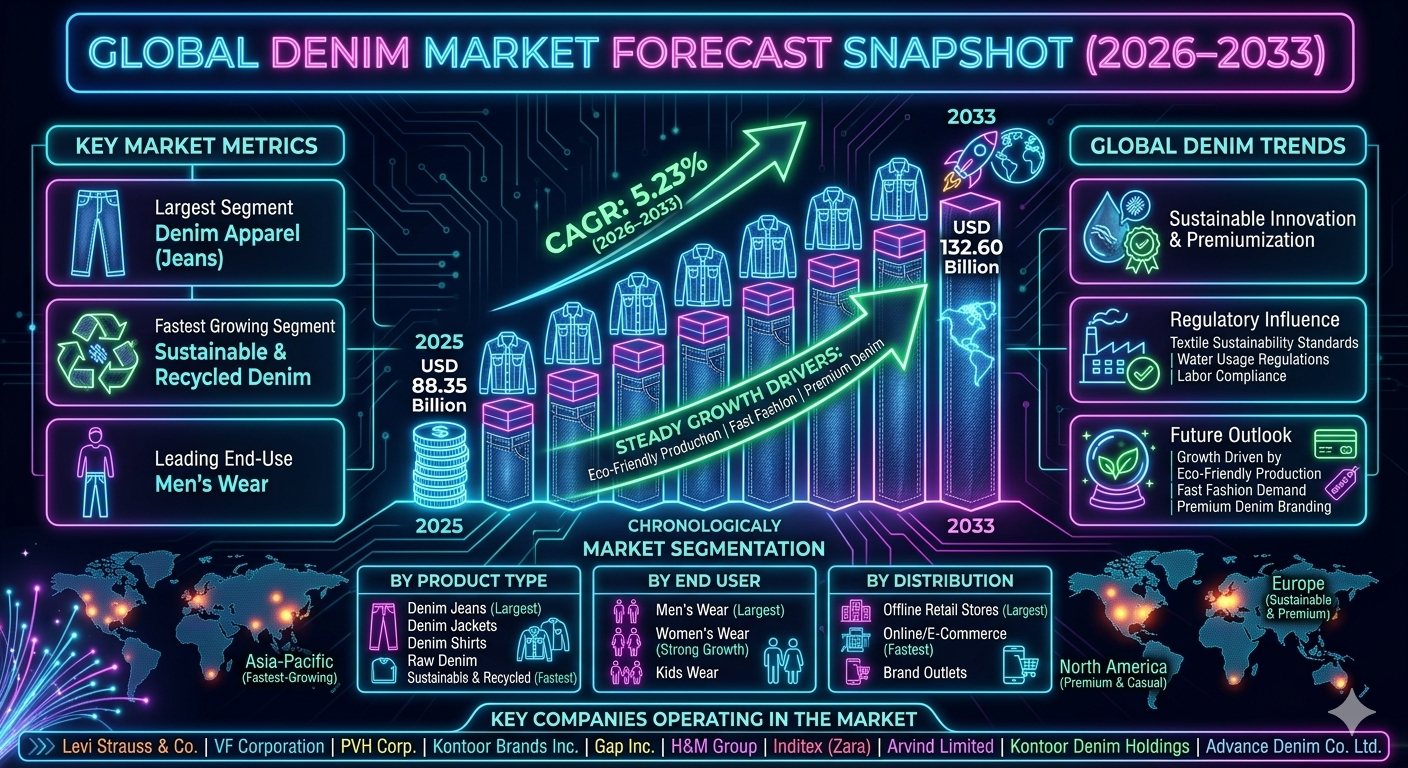
Global Denim Market Size & Forecast
The Global Denim Market is expected to witness steady growth during the forecast period from 2026 to 2033. The market was valued at USD 88.35 billion in 2025 and is projected to reach approximately USD 132.60 billion by 2033, registering a CAGR of 5.23%. The market growth is primarily driven by sustained demand for denim apparel across global fashion industries, rising youth population, expanding casual wear adoption, and continuous product innovation in fabric design and comfort. Denim remains one of the most widely used textile materials globally, especially in jeans, jackets, shirts, and fashion accessories. Increasing focus on sustainable manufacturing, recycled fibers, and water-efficient production processes is further supporting market expansion. In addition, the influence of fast fashion brands, premium denim labels, and e-commerce fashion platforms is accelerating global denim consumption.Global Denim Market Overview
Denim is a durable cotton twill fabric primarily used in apparel manufacturing, particularly jeans and casual wear clothing. The market includes raw denim fabric, washed denim, stretch denim, recycled denim, and designer/premium denim products. Denim products are widely used across men???s wear, women???s wear, and children???s apparel segments, with applications in both mass-market and luxury fashion categories. The market is evolving from traditional cotton-based production toward sustainable, eco-friendly, and technologically enhanced textile manufacturing processes.Structural Drivers of Market Growth
1. Innovation and Commercialization Acceleration
Advancements in fabric technology, including stretchable denim, lightweight blends, waterless dyeing, and recycled fiber integration, are transforming product offerings. Innovations in textile finishing and digital fabric design are enhancing comfort, durability, and aesthetic appeal.Market Implications
Companies investing in sustainable denim innovation and premium fabric technologies are expected to strengthen market competitiveness.2. Compliance and Risk Repricing
Environmental regulations on textile wastewater, chemical dye usage, and labor standards are influencing production processes globally. Brands are increasingly adopting sustainable sourcing certifications and eco-friendly manufacturing practices.Market Implications
Firms offering compliant, sustainable, and ethically produced denim products are likely to gain stronger brand trust and market share.3. Competitive and Value-Chain Reconfiguration
The market is highly competitive as global fashion brands, textile manufacturers, and fast-fashion retailers expand denim portfolios. Supply chain integration, nearshoring, and digital retail channels are reshaping industry dynamics.Market Implications
Companies focusing on vertical integration, sustainable sourcing, and direct-to-consumer fashion models may gain stronger margins.4. Capital and Capacity Scaling
Rising investment in textile manufacturing infrastructure, sustainable dyeing technologies, and automated production systems is supporting market growth. Expanding global apparel consumption and e-commerce penetration are increasing production demand.Market Implications
Manufacturers scaling efficient, sustainable, and digitally enabled production facilities are expected to capture future opportunities.Market Segmentation Analysis
By Product Type
1. Denim Jeans
This remains the largest segment due to universal consumer adoption and fashion relevance.2. Denim Jackets
Strong demand driven by seasonal fashion trends and casual wear adoption.3. Denim Shirts
Popular across casual and semi-formal fashion categories.4. Raw Denim
Preferred in premium and fashion-conscious consumer segments.5. Sustainable & Recycled Denim
Fastest-growing segment driven by eco-conscious consumer demand.By End User
1. Men???s Wear
Largest segment due to high global consumption of denim jeans and casual apparel.2. Women???s Wear
Strong growth driven by fashion diversity and expanding product lines.3. Kids Wear
Steady demand supported by mass-market apparel consumption.By Distribution Channel
1. Offline Retail Stores
Largest segment due to strong brand presence in physical outlets.2. Online/E-Commerce Platforms
Fastest-growing segment driven by digital shopping and fashion marketplaces.3. Brand Outlets
Important channel for premium denim brands and exclusive collections.Regional Market Dynamics
North America
North America remains a major denim market driven by strong fashion brands, high casual wear adoption, and premium denim consumption.Europe
Europe shows steady growth supported by sustainable fashion trends and premium textile demand.Asia-Pacific
Asia-Pacific is the fastest-growing region due to large population base, expanding middle class, and strong textile manufacturing capabilities.Latin America
Latin America is gradually expanding due to rising fashion retail and youth-driven apparel demand.Middle East & Africa
The region is witnessing moderate growth supported by increasing urbanization and fashion retail expansion.Competitive Landscape
The Global Denim Market is highly competitive with global fashion brands, textile manufacturers, and fast-fashion retailers operating across regions.Key Companies Operating in the Market Include:
- Levi Strauss & Co.
- VF Corporation
- PVH Corp.
- Kontoor Brands Inc.
- Gap Inc.
- H&M Group
- Inditex (Zara)
- Arvind Limited
- Kontoor Denim Holdings
- Advance Denim Co. Ltd.
Strategic Outlook
The future of the denim market will be shaped by sustainable textile innovation, circular fashion models, recycled fiber adoption, and digital apparel retailing. Technologies such as waterless dyeing, bio-based dyes, and smart textile manufacturing will significantly improve environmental performance and efficiency. The rise of eco-conscious fashion, premium denim branding, and e-commerce-driven apparel sales is expected to create strong long-term growth opportunities.Final Market Perspective
The Global Denim Market remains a core segment within the global textile and apparel industry. Rising fashion demand, sustainability trends, and product innovation continue driving long-term market growth. Companies capable of delivering sustainable, high-quality, and fashion-forward denim products will be best positioned to capture future opportunities. The convergence of eco-friendly manufacturing, digital retail expansion, and premium fashion branding is expected to redefine the future of the global denim industry.Table of Contents
Table of Contents
- 1. Executive Summary
- 1.1 Global Denim Market Snapshot (2026???2033)
- 1.2 Market Size & Growth Overview
- 1.3 Key Market Highlights
- 1.4 Largest & Fastest-Growing Segments
- 1.5 Regional Performance Summary
- 1.6 Competitive Landscape Overview
- 1.7 Strategic Outlook Through 2033
- 2. Market Introduction & Overview
- 2.1 Definition of Denim & Textile Fabric Types
- 2.2 Scope of the Global Denim Market
- 2.3 Evolution of Denim Fashion & Manufacturing
- 2.4 Denim Value Chain Analysis
- 2.5 Regulatory & Sustainability Framework (Textile Industry)
- 2.6 Emerging Trends in Sustainable Fashion & Circular Textiles
- 2.7 Fast Fashion vs Premium Denim Market Dynamics
- 3. Research Methodology
- 3.1 Primary Research Approach
- 3.2 Secondary Research Sources
- 3.3 Market Size Estimation Methodology
- 3.4 Forecasting Assumptions (2026???2033)
- 3.5 Data Validation & Triangulation
- 4. Market Dynamics
- 4.1 Market Drivers
- 4.1.1 Sustained Global Demand for Denim Apparel
- 4.1.2 Rising Youth Population & Casual Wear Adoption
- 4.1.3 Growth of Fast Fashion & E-Commerce Retail
- 4.1.4 Product Innovation in Fabric Design & Comfort
- 4.1.5 Expansion of Sustainable & Recycled Denim Production
- 4.2 Market Restraints
- 4.2.1 Environmental Impact of Textile Dyeing Processes
- 4.2.2 Volatility in Cotton Prices & Raw Material Supply
- 4.2.3 High Water & Energy Consumption in Production
- 4.3 Market Opportunities
- 4.3.1 Expansion of Sustainable Fashion & Eco-Friendly Denim
- 4.3.2 Growth in Premium & Designer Denim Segments
- 4.3.3 Adoption of Waterless Dyeing & Smart Textile Technologies
- 4.3.4 Expansion of E-Commerce Fashion Platforms
- 4.4 Market Challenges
- 4.4.1 Intense Competition from Fast Fashion Brands
- 4.4.2 Sustainability Compliance & Certification Requirements
- 4.4.3 Supply Chain Complexity in Global Textile Manufacturing
- 4.1 Market Drivers
- 5. Global Denim Market Size & Forecast (USD Billion), 2026???2033
- 5.1 Market Revenue Analysis
- 5.2 CAGR Analysis
- 5.3 Demand-Supply Trends
- 5.4 Pricing Analysis
- 5.5 Investment Trends
- 5.6 Future Market Outlook
- 6. Market Segmentation Analysis (USD Billion), 2026???2033
- 6.1 By Product Type
- 6.1.1 Denim Jeans (Largest Segment)
- 6.1.2 Denim Jackets
- 6.1.3 Denim Shirts
- 6.1.4 Raw Denim
- 6.1.5 Sustainable & Recycled Denim (Fastest-Growing Segment)
- 6.2 By End User
- 6.2.1 Men???s Wear (Largest Segment)
- 6.2.2 Women???s Wear
- 6.2.3 Kids Wear
- 6.3 By Distribution Channel
- 6.3.1 Offline Retail Stores (Largest Segment)
- 6.3.2 Online/E-Commerce Platforms (Fastest-Growing Segment)
- 6.3.3 Brand Outlets
- 6.1 By Product Type
- 7. Regional Market Analysis
- 7.1 North America
- 7.2 Europe
- 7.3 Asia-Pacific
- 7.4 Latin America
- 7.5 Middle East & Africa
- 8. Competitive Landscape
- 8.1 Market Share Analysis
- 8.2 Competitive Benchmarking
- 8.3 Strategic Developments
- 8.4 Sustainable Textile Innovation Strategies
- 8.5 Brand Expansion & E-Commerce Growth Strategies
- 9. Company Profiles
- 9.1 Levi Strauss & Co.
- 9.2 VF Corporation
- 9.3 PVH Corp.
- 9.4 Kontoor Brands Inc.
- 9.5 Gap Inc.
- 9.6 H&M Group
- 9.7 Inditex (Zara)
- 9.8 Arvind Limited
- 9.9 Kontoor Denim Holdings
- 9.10 Advance Denim Co. Ltd.
- 10. Strategic Intelligence & Pheonix AI Insights
- 10.1 Denim Demand Forecast Model
- 10.2 Sustainable Denim Adoption Tracker
- 10.3 Fast Fashion vs Premium Denim Analysis
- 10.4 Textile Sustainability & Compliance Impact Study
- 10.5 Automated Porter???s Five Forces Analysis
- 11. Future Outlook & Strategic Recommendations
- 11.1 Expansion of Sustainable Denim Manufacturing
- 11.2 Investment in Waterless Dyeing & Eco Fabrics
- 11.3 Growth Opportunities in Premium Denim Branding
- 11.4 Strengthening E-Commerce Fashion Channels
- 11.5 Long-Term Market Outlook (2033+)
- 12. Appendix
- 13. About Pheonix Market Research
- 14. Disclaimer
Competitive Landscape
Global Denim Market Competitive Intensity & Market Structure Overview
The global denim market is highly competitive and moderately fragmented, characterized by the presence of multinational fashion conglomerates, premium denim brands, fast-fashion retailers, and vertically integrated textile manufacturers. Competitive intensity is driven by brand positioning, pricing strategy, fabric innovation, sustainability credentials, supply chain efficiency, and responsiveness to fast-changing fashion trends.
Market participants are increasingly focusing on sustainable denim production, recycled fibers, water-efficient dyeing technologies, and premium product differentiation to strengthen brand identity and market share. As consumer preferences shift toward eco-conscious fashion and high-quality apparel, competition is intensifying between mass-market fast fashion players and premium denim brands.
The market structure is evolving from traditional mass-production apparel manufacturing toward a more diversified ecosystem that includes sustainable fashion brands, digitally enabled retail platforms, and vertically integrated supply chains. This transition is reshaping competitive dynamics across both developed and emerging markets.
Global Denim Market Competitive Intensity & Market Structure Current Scenario
Leading Global Denim Companies
Levi Strauss & Co.: A global leader in denim apparel, widely recognized for its iconic jeans products, strong brand equity, and expanding focus on sustainable denim innovation.
VF Corporation: Major apparel conglomerate with a diversified portfolio of denim and casual wear brands, supported by global distribution and strong retail presence.
PVH Corp.: Global fashion company managing premium apparel brands with significant denim product offerings across international markets.
Kontoor Brands Inc.: Dedicated denim-focused company specializing in Wrangler and Lee brands, with strong expertise in mass-market denim apparel.
Gap Inc.: Leading global retailer offering denim-focused casual wear through multiple brand channels and omnichannel retail strategies.
H&M Group: Fast-fashion leader with strong denim collections, emphasizing affordability, rapid product cycles, and increasing sustainability initiatives.
Inditex (Zara): Global fashion retailer known for agile supply chains, fast fashion denim collections, and trend-responsive apparel production.
Arvind Limited: One of the largest textile manufacturers in India, specializing in denim fabric production and integrated apparel manufacturing solutions.
Advance Denim Co. Ltd.: Leading denim fabric manufacturer focused on innovation in fabric finishing, sustainability, and export-oriented production.
Kontoor Denim Holdings: Key denim-focused manufacturing and branding entity with strong emphasis on product quality and global distribution.
Key Competitive Intensity & Market Structure Drivers
Increasing consumer demand for sustainable and ethically produced fashion is pushing denim manufacturers to adopt eco-friendly production methods, recycled materials, and certified supply chains.
Rapid product cycles driven by fast fashion retailers are intensifying competition by reducing time-to-market and increasing pressure on pricing and inventory management.
Technological advancements in textile manufacturing, including waterless dyeing, stretch fabric engineering, and recycled fiber integration, are becoming key competitive differentiators.
Strong brand identity and premium positioning are playing a critical role in differentiating products in an increasingly crowded apparel market.
Expansion of e-commerce and direct-to-consumer retail channels is reshaping distribution strategies and increasing competition among both established brands and digital-native fashion players.
Strategic Implications of Competitive Intensity & Market Structure
Companies investing in sustainable denim production technologies, circular fashion models, and recycled textile innovation are expected to gain long-term competitive advantages as environmental regulations and consumer preferences evolve.
Vertical integration across textile manufacturing, design, and retail distribution is becoming increasingly important for improving margins, supply chain control, and responsiveness to market demand.
Strong investment in brand building, premium product lines, and fashion innovation is essential for differentiating offerings in both mass-market and luxury segments.
Digital transformation in retail, including e-commerce expansion, AI-driven fashion recommendations, and omnichannel strategies, is enhancing customer engagement and driving sales growth.
Partnerships between textile manufacturers and global fashion brands are accelerating innovation in sustainable materials and efficient production processes.
Global Denim Market Competitive Intensity & Market Structure Forward Outlook
The competitive landscape of the global denim market is expected to become increasingly sustainability-driven and technology-enabled, with greater emphasis on eco-friendly production processes and circular fashion systems. Brands that successfully integrate sustainability with fashion innovation will gain stronger market positioning.
Future competition will be defined by advancements in recycled textile technologies, digital fashion design, automated manufacturing, and data-driven demand forecasting for apparel production.
Asia-Pacific is expected to remain a key manufacturing hub, while North America and Europe will continue to lead in premium denim branding, sustainable fashion innovation, and consumer demand for high-quality apparel.
Over the forecast period, companies that effectively combine sustainability, brand strength, supply chain efficiency, and digital retail capabilities will be best positioned to lead the evolving global denim market.
Value Chain
Global Denim Market Value Chain & Supply Chain Evolution Overview
The Global Denim Market is experiencing steady structural transformation driven by rising fashion consumption, sustainability pressures, premiumization trends, and rapid expansion of e-commerce apparel channels. The market???s value chain is built on a globally distributed textile ecosystem that integrates cotton farming, fiber processing, yarn manufacturing, denim fabric production, garment manufacturing, fashion design, branding, retail distribution, and end-consumer engagement.
A defining feature of the denim value chain is the increasing convergence of traditional textile manufacturing with advanced sustainable production technologies. Manufacturers are adopting water-efficient dyeing processes, recycled fiber integration, bio-based materials, and automated textile production systems to reduce environmental impact while improving efficiency and product differentiation.
Supply chain complexity remains high due to multi-country sourcing of raw cotton, fluctuating commodity prices, labor-intensive manufacturing processes, environmental compliance requirements, and rapidly changing fashion demand cycles. Companies must manage sourcing, spinning, weaving, finishing, garment manufacturing, branding, logistics, and retail distribution while maintaining cost efficiency, quality consistency, and sustainability compliance.
Industry participants are increasingly investing in circular fashion systems, sustainable fabric innovation, digital supply chain management, and vertically integrated production models to strengthen competitiveness. The value chain is evolving into a more transparent, sustainability-driven, and digitally connected ecosystem focused on efficiency, ethical sourcing, and consumer-centric fashion delivery.
Global Denim Market Value Chain & Supply Chain Evolution Current Scenario
Market-Specific Value Chain
- Raw Material Sourcing: Cotton farming, recycled textile fibers, synthetic blends, and sustainable fiber inputs.
- Fiber Processing & Yarn Production: Spinning, yarn manufacturing, fiber blending, and textile-grade material preparation.
- Fabric Production & Denim Manufacturing: Weaving, denim fabric creation, washing treatments, dyeing processes, finishing technologies, and quality control.
- Garment Manufacturing & Product Design: Apparel production, stitching, garment finishing, design innovation, and product development for jeans, jackets, shirts, and fashion items.
- Branding & Retail Distribution: Fashion branding, marketing, wholesale distribution, offline retail stores, brand outlets, and e-commerce platforms.
- End-User Consumption: Men???s wear, women???s wear, kids wear, fashion-conscious consumers, and premium apparel buyers.
Company-to-Stage Mapping
- Raw Material Sourcing: Cotton producers, textile fiber suppliers, recycled fabric suppliers, and agricultural cooperatives.
- Fiber Processing & Yarn Production: Arvind Limited, textile mills, yarn manufacturers, and integrated spinning companies.
- Fabric Production & Denim Manufacturing: Advance Denim Co. Ltd., Arvind Limited, global textile mills, and sustainable denim producers.
- Garment Manufacturing & Product Design: Levi Strauss & Co., VF Corporation, Kontoor Brands Inc., PVH Corp., H&M Group, Inditex (Zara).
- Branding & Retail Distribution: Gap Inc., H&M Group, Inditex (Zara), Levi???s retail network, e-commerce platforms, and fashion retailers.
- End-User Consumption: Global consumers across North America, Europe, Asia-Pacific, and emerging fashion markets.
Key Value Chain & Supply Chain Evolution Signals in Global Denim Market
- Expansion of Sustainable Denim Production:
Increasing adoption of recycled fibers, organic cotton, and eco-friendly dyeing processes is reshaping manufacturing practices. - Growth of Water-Efficient and Low-Impact Dyeing Technologies:
Waterless dyeing and advanced finishing technologies are reducing environmental impact and production costs. - Rise of Circular Fashion Models:
Recycling, upcycling, and textile reuse initiatives are gaining traction across global apparel brands. - Increasing Demand for Premium Denim Products:
Consumers are shifting toward high-quality, durable, and fashion-forward denim apparel. - Expansion of E-Commerce Fashion Ecosystems:
Digital retail platforms are accelerating global denim distribution and brand accessibility. - Strengthening Supply Chain Transparency & Ethical Sourcing:
Brands are focusing on labor compliance, sustainability certifications, and transparent sourcing practices.
Strategic Implications of Value Chain & Supply Chain Evolution
- Investment in Sustainable Textile Innovation:
Eco-friendly fabrics, recycled denim, and low-impact production technologies are becoming key differentiators. - Expansion of Vertical Integration Strategies:
Controlling design, manufacturing, and retail enhances cost efficiency and brand control. - Optimization of Global Sourcing Networks:
Nearshoring and diversified sourcing reduce supply chain risks and improve responsiveness. - Strengthening Digital Retail & Omnichannel Strategies:
E-commerce and direct-to-consumer models improve market reach and customer engagement. - Development of Circular Fashion Ecosystems:
Recycling and resale programs support sustainability goals and brand value creation. - Enhancement of Production Automation:
Smart manufacturing systems improve efficiency, consistency, and scalability.
Global Denim Market Value Chain & Supply Chain Evolution Forward Outlook
Looking ahead, the denim value chain is expected to evolve into a highly sustainable, digitally enabled, and innovation-driven ecosystem shaped by circular fashion principles, advanced textile technologies, and evolving consumer preferences.
Key Future Developments Include:
- Expansion of recycled and bio-based denim materials across global fashion markets.
- Increased adoption of waterless dyeing and sustainable finishing technologies.
- Growth of digital fashion retail and AI-driven consumer personalization.
- Advancement of smart textile manufacturing and automated production systems.
- Expansion of circular fashion models including resale, rental, and recycling programs.
- Strengthening of ESG compliance and ethical sourcing across global supply chains.
As the market evolves, competitive advantage will increasingly depend on the ability to balance sustainability, cost efficiency, product innovation, and brand differentiation. Companies capable of delivering eco-friendly, high-quality, and fashion-forward denim products will be best positioned to capture long-term growth opportunities.
Organizations that successfully integrate sustainable sourcing, advanced textile technologies, digital retail capabilities, and circular economy models will achieve stronger brand positioning, operational resilience, and long-term leadership in the Global Denim Market.
Investment Activity
Global Denim Market Investment & Funding Dynamics Overview
The Global Denim Market is witnessing steady investment momentum driven by rising global apparel consumption, increasing demand for sustainable fashion, expanding e-commerce penetration, and continuous innovation in textile manufacturing technologies. Fashion conglomerates, textile manufacturers, retail brands, and private equity investors are actively investing in sustainable denim production, recycled fiber technologies, water-efficient dyeing systems, automated textile manufacturing, and premium denim branding initiatives.
Investment activity is strengthening as global fashion brands transition toward eco-friendly production models and circular fashion systems. Capital deployment is increasingly focused on recycled denim materials, bio-based dyes, waterless finishing technologies, digital textile design platforms, and supply chain sustainability initiatives.
Additionally, growing investments in fast fashion expansion, premium denim product lines, nearshoring manufacturing capabilities, and vertically integrated apparel supply chains are shaping the long-term evolution of the global denim industry.
Global Denim Market Investment & Funding Dynamics Current Scenario
Currently, the denim market is experiencing consistent investment flows as apparel companies modernize production systems and align with sustainability regulations. Leading market participants are investing heavily in eco-friendly fabric innovation, recycled cotton integration, advanced denim finishing technologies, and automated garment manufacturing systems.
The market is attracting funding into sustainable fashion startups, textile innovation companies, circular economy platforms, and digital apparel retail businesses. Investors are increasingly prioritizing companies that can balance cost efficiency with environmental compliance and premium brand positioning.
Furthermore, the industry is witnessing active mergers, acquisitions, brand collaborations, and supply chain partnerships as global fashion companies consolidate operations and expand sustainable product portfolios.
Key Investment & Funding Dynamics Signals in Global Denim Market
- Rising demand for sustainable and recycled denim products is accelerating eco-focused investments.
- Expansion of fast fashion and premium denim brands is increasing capital deployment in product innovation.
- Growing adoption of waterless dyeing and eco-friendly textile technologies is reshaping manufacturing investments.
- Strategic investments in digital fashion design and automated textile production are improving efficiency and scalability.
- Increasing consumer preference for ethical and sustainable apparel is strengthening brand-driven investment strategies.
- Partnerships between fashion retailers, textile manufacturers, and sustainability technology providers are supporting innovation ecosystems.
- Expansion of e-commerce and direct-to-consumer fashion platforms is driving digital retail investments.
Strategic Implications of Investment & Funding Dynamics in Global Denim Market
- Continuous investment in sustainable textile innovation and circular fashion systems is essential for long-term competitiveness.
- Capital allocation toward recycled fiber production and water-efficient manufacturing technologies will strengthen environmental compliance.
- Companies offering premium, sustainable, and fashion-forward denim products are expected to gain stronger market positioning.
- Strategic acquisitions and brand partnerships will accelerate portfolio diversification and global expansion.
- Investments in digital retail platforms, AI-driven fashion forecasting, and supply chain optimization will remain key growth drivers.
- Compliance with textile sustainability regulations, water usage restrictions, and labor standards will continue shaping investment priorities.
- Organizations integrating sustainable production with premium branding strategies are expected to capture significant long-term value.
Global Denim Market Investment & Funding Dynamics Forward Outlook
Looking ahead, the Global Denim Market is expected to maintain stable investment growth driven by rising demand for casual wear, increasing sustainability regulations, and continued expansion of global fashion retail networks.
Future capital deployment will increasingly focus on recycled denim innovation, bio-based textile materials, circular fashion models, smart textile manufacturing systems, and fully digitalized apparel supply chains.
As the fashion industry continues transitioning toward sustainable and technology-enabled production, investment activity is expected to expand across eco-friendly manufacturing, premium denim branding, and digital retail ecosystems.
In conclusion, the Global Denim Market represents a stable yet innovation-driven apparel investment landscape where sustainability, digital transformation, premiumization, and circular fashion models will define future funding priorities and long-term industry evolution.
Technology & Innovation
Global Digital Banking Market Technology & Innovation Landscape Overview
The global digital banking market is undergoing a rapid technological transformation driven by advancements in artificial intelligence, cloud-native banking infrastructure, open banking APIs, blockchain-enabled financial systems, biometric authentication, and real-time payment processing technologies. These innovations are fundamentally reshaping how financial institutions deliver banking services across retail, corporate, and institutional segments.
Modern digital banking platforms increasingly integrate AI-powered financial assistants, predictive analytics engines, cloud-based core banking systems, API-driven ecosystems, and embedded finance frameworks to enhance customer experience, operational efficiency, and service personalization. These technologies are enabling banks to transition from traditional branch-based models to fully digital, always-on financial ecosystems.
The market is also witnessing strong adoption of mobile-first banking applications, instant payment infrastructures, digital wallets, neobanking platforms, and real-time fraud detection systems, which are improving transaction speed, financial accessibility, and security across global banking networks.
Global Digital Banking Market Technology & Innovation Current Scenario
Current innovation in the digital banking market is primarily centered around AI-driven personalization, cloud migration of core banking systems, and real-time financial transaction processing. Financial institutions are increasingly modernizing legacy infrastructure to support scalable, secure, and data-driven banking operations.
Artificial intelligence and machine learning systems are being widely adopted to improve credit scoring, customer segmentation, fraud detection, and personalized financial product recommendations.
Open banking frameworks are enabling secure data sharing between banks, fintech companies, and third-party service providers, fostering ecosystem-based financial innovation and embedded finance solutions.
Blockchain and distributed ledger technologies are being explored to enhance transaction transparency, cross-border payment efficiency, and secure identity verification mechanisms.
Cloud-based banking infrastructure is reducing operational costs while improving scalability, resilience, and real-time service delivery across digital channels.
Additionally, advanced cybersecurity systems and biometric authentication technologies are strengthening data protection, fraud prevention, and regulatory compliance across digital banking platforms.
Key Technology & Innovation Trends in Global Digital Banking Market
- AI-Powered Banking Systems: Intelligent financial assistants, predictive analytics, and automated decision-making tools.
- Cloud-Native Core Banking Platforms: Scalable and flexible infrastructure enabling real-time banking operations.
- Open Banking APIs: Secure data sharing between financial institutions and fintech ecosystems.
- Blockchain-Based Financial Systems: Enhancing transparency, security, and cross-border payment efficiency.
- Mobile-First Banking Applications: Seamless financial services through smartphones and digital wallets.
- Real-Time Payment Systems: Instant money transfer and settlement infrastructure.
- Biometric Authentication Technologies: Facial recognition, fingerprint scanning, and voice-based security systems.
- Fraud Detection & Risk Analytics: AI-driven monitoring of suspicious transactions and financial behavior.
- Embedded Finance Solutions: Integration of banking services into non-financial platforms.
- RegTech & Compliance Automation: Automated regulatory reporting and AML/KYC compliance systems.
Strategic Implications of Technology & Innovation
Technological advancements are transforming the digital banking industry into a fully connected, API-driven, and AI-enabled financial ecosystem that prioritizes speed, personalization, and security.
Banks and fintech companies investing in AI-driven financial intelligence, cloud-native infrastructure, and embedded finance capabilities are gaining stronger competitive positioning through enhanced customer engagement and operational scalability.
The convergence of fintech innovation, data analytics, and real-time payment systems is enabling hyper-personalized banking experiences and improving financial inclusion across emerging markets.
Automation and AI-based risk management systems are significantly reducing fraud risks, improving compliance efficiency, and optimizing financial decision-making processes.
However, cybersecurity threats, regulatory fragmentation, legacy infrastructure limitations, and data privacy concerns remain key challenges for large-scale digital banking transformation.
Global Digital Banking Market Technology & Innovation Forward Outlook
The future of the digital banking market is expected to evolve toward fully autonomous, AI-driven, and hyper-personalized banking ecosystems supported by cloud computing, open finance architectures, and advanced data intelligence systems.
Emerging innovations include AI-powered financial advisory systems, decentralized finance (DeFi) integration, real-time global payment networks, and fully automated digital onboarding processes.
Financial inclusion is expected to expand significantly as mobile-first banking solutions and low-cost digital financial platforms penetrate underserved markets.
The integration of banking systems with e-commerce, healthcare, travel, and retail ecosystems will further accelerate embedded finance adoption globally.
Overall, the global digital banking market is evolving into a highly intelligent, secure, and interconnected financial ecosystem where AI, cloud infrastructure, open banking, and real-time payments collectively redefine global financial services.
Market Risk
Global Denim Market Risk Factors & Disruption Threats Overview
The global denim market operates within a moderately high-risk environment shaped by evolving fashion cycles, intense price competition, environmental compliance pressures, and supply chain dependencies on cotton, dyes, and textile manufacturing hubs. While denim remains a core category in global apparel consumption, the industry is increasingly influenced by sustainability expectations, shifting consumer preferences, and regulatory scrutiny on textile production practices.
The market is also undergoing structural transformation driven by fast fashion acceleration, premiumization trends, and the rapid expansion of sustainable and recycled denim segments. However, these growth drivers also introduce complexity in production processes, cost structures, and compliance requirements, particularly for water-intensive dyeing and chemical processing operations.
Additionally, global denim supply chains are heavily concentrated in Asia-Pacific manufacturing hubs, making the industry sensitive to labor regulations, trade policies, logistics disruptions, and raw material price volatility. This dependency creates exposure to geopolitical and macroeconomic fluctuations.
Global Denim Market Risk Factors & Disruption Threats Current Scenario
The current denim market landscape is characterized by strong consumer demand for casual wear and jeans, but this is counterbalanced by rising production costs and tightening environmental regulations. Brands are under increasing pressure to reduce water usage, chemical waste, and carbon emissions throughout the textile production lifecycle.
One of the most significant challenges is the environmental impact of denim manufacturing, particularly in dyeing and finishing processes, which are highly water- and chemical-intensive. Regulatory bodies in key markets are imposing stricter wastewater treatment requirements and sustainability certifications, increasing compliance costs for manufacturers.
At the same time, fast fashion dynamics are intensifying pricing pressure across the value chain. Retailers are demanding shorter production cycles, lower costs, and rapid design turnover, which can strain manufacturing capacity and reduce profit margins for suppliers.
Supply chain volatility in cotton pricing also remains a key concern. Cotton is subject to climatic risks, agricultural output variability, and global commodity price fluctuations, which directly affect denim production costs and pricing stability.
Additionally, labor compliance risks in textile manufacturing regions remain under scrutiny. Regulatory enforcement on working conditions, wages, and ethical sourcing is increasing, requiring brands to invest more in traceability and supplier audits.
Key Risk Factors & Disruption Threats Signals in the Denim Market
- Environmental Compliance Pressure: Strict regulations on water usage, chemical dyes, and textile wastewater treatment are increasing production costs.
- Raw Material Price Volatility: Cotton price fluctuations and fiber supply constraints directly impact manufacturing margins.
- Fast Fashion Margin Pressure: Demand for rapid production cycles and low-cost apparel reduces profitability for manufacturers.
- Supply Chain Concentration Risk: Heavy reliance on Asia-Pacific manufacturing hubs exposes the market to geopolitical and logistics disruptions.
- Labor and Ethical Compliance Risks: Increasing scrutiny on working conditions and labor standards affects brand reputation and sourcing strategies.
- Sustainability Transition Costs: Shifting to recycled fibers, eco-friendly dyes, and waterless technologies requires high capital investment.
- Demand Volatility: Fashion cycles and changing consumer preferences can rapidly shift demand across denim categories.
- Counterfeit and Low-Cost Competition: Unbranded and low-cost alternatives in emerging markets pressure premium denim segments.
- E-Commerce Pricing Disruption: Online retail intensifies price transparency and competition among global brands.
- Trade Policy & Tariff Risks: Import/export duties and textile trade restrictions can impact global sourcing and pricing structures.
Strategic Implications of Risk Factors & Disruption Threats in the Denim Market
The evolving risk landscape is forcing denim manufacturers and apparel brands to prioritize sustainability transformation, supply chain diversification, and production efficiency improvements. Companies are increasingly investing in waterless dyeing technologies, recycled cotton fibers, and low-impact finishing processes to align with regulatory expectations and consumer demand.
Vertical integration and nearshoring strategies are gaining importance as brands seek to reduce dependency on distant manufacturing hubs and improve responsiveness to fast-changing fashion cycles. This shift is also helping mitigate geopolitical and logistics-related risks.
Digitalization of the fashion supply chain is becoming a key competitive advantage. AI-driven demand forecasting, automated inventory management, and digital fabric design tools are improving production planning and reducing waste across denim manufacturing ecosystems.
Additionally, brands are strengthening ESG (Environmental, Social, and Governance) frameworks to enhance transparency and build consumer trust. Certifications for sustainable sourcing and ethical production are becoming critical differentiators in both premium and mass-market denim segments.
Global Denim Market Risk Factors & Disruption Threats Forward Outlook
Looking ahead, the denim market will continue to grow steadily, supported by strong global demand for casual wear and ongoing product innovation. However, growth will increasingly depend on the industry???s ability to transition toward sustainable and resource-efficient production models.
Sustainable and recycled denim is expected to become a mainstream segment, driven by regulatory mandates and consumer preference shifts. This will accelerate investment in circular fashion systems, textile recycling technologies, and low-impact dyeing solutions.
Premiumization trends will also shape market evolution, with brands focusing on high-quality fabrics, differentiated design, and value-added product positioning to offset margin pressures from fast fashion competition.
At the same time, supply chain resilience will remain a key priority. Companies that diversify sourcing, integrate digital supply chain technologies, and improve material traceability will be better positioned to manage future disruptions.
Overall, the global denim market will continue balancing strong consumer demand with increasing operational and regulatory complexity. Long-term success will depend on sustainability leadership, agile manufacturing capabilities, and strong brand differentiation in an increasingly competitive global apparel landscape.
Regulatory Landscape
Global Denim Market Regulatory & Policy Environment Overview
The regulatory and policy environment governing the Global Denim Market is primarily shaped by environmental sustainability mandates, labor compliance standards, and textile manufacturing regulations. Governments and international organizations are increasingly focusing on reducing the environmental impact of textile production, particularly in areas such as water consumption, chemical dye usage, carbon emissions, and industrial waste management.
Denim manufacturing is a resource-intensive process, especially due to water-intensive cotton cultivation, dyeing, washing, and finishing processes. As a result, regulatory frameworks are evolving to enforce stricter environmental controls, sustainable sourcing requirements, and responsible production practices across the global textile value chain.
In addition, global fashion brands and manufacturers are under increasing pressure to comply with sustainability certifications, ethical labor standards, and circular economy initiatives, which are becoming essential for market access and brand credibility.
Global Denim Market Regulatory & Policy Environment Current Scenario
The current regulatory landscape is characterized by growing enforcement of environmental compliance standards in textile production, particularly in regions such as Europe and North America. Regulations such as wastewater discharge limits, chemical dye restrictions, and carbon footprint reporting are influencing production processes and supply chain decisions.
Many countries are also implementing stricter labor laws and ethical sourcing requirements to ensure fair wages, safe working conditions, and transparency in textile manufacturing hubs, especially in Asia-Pacific production centers.
Sustainability certifications such as OEKO-TEX, GOTS (Global Organic Textile Standard), and Bluesign are increasingly being adopted by denim manufacturers to demonstrate compliance with global environmental and safety standards.
Additionally, regulations targeting hazardous chemicals used in dyeing and finishing processes are pushing manufacturers toward eco-friendly alternatives such as waterless dyeing technologies, bio-based dyes, and recycled fiber integration.
Carbon emissions reporting requirements are also becoming more common, with major fashion brands required to disclose supply chain emissions and implement decarbonization strategies aligned with global climate goals.
Key Regulatory & Policy Environment Signals in Global Denim Market
- Textile Sustainability Regulations: Increasing enforcement of eco-friendly production practices and sustainable raw material sourcing.
- Water Usage & Wastewater Standards: Strict controls on industrial water consumption and effluent discharge from dyeing and finishing units.
- Chemical & Dye Restrictions: Regulations limiting hazardous chemicals used in textile processing and encouraging safer alternatives.
- Labor & Ethical Compliance Policies: Enforcement of fair labor practices, workplace safety, and supply chain transparency.
- Carbon Emission Reporting Requirements: Mandatory disclosure of environmental impact and emissions across textile supply chains.
- Sustainability Certification Adoption: Growing reliance on global certification frameworks such as GOTS, OEKO-TEX, and Bluesign.
Strategic Implications of Regulatory & Policy Environment
The tightening regulatory environment is driving denim manufacturers to invest heavily in sustainable production technologies, including water-efficient dyeing systems, recycled cotton integration, and chemical-free finishing processes. Compliance is increasingly becoming a core competitive differentiator in the global denim industry.
Brands that align with sustainability standards and ethical sourcing requirements are gaining stronger consumer trust, particularly among younger demographics that prioritize eco-friendly fashion consumption. This is also influencing premiumization trends in denim products.
Manufacturers operating in traditional production hubs are under pressure to modernize facilities and adopt cleaner technologies to meet international export requirements and brand compliance audits.
At the same time, regulatory-driven innovation is accelerating the shift toward circular fashion models, including denim recycling, resale markets, and closed-loop production systems.
Overall, compliance with environmental and labor regulations is becoming a key factor shaping supply chain partnerships, brand reputation, and long-term market positioning in the global denim industry.
Global Denim Market Regulatory & Policy Environment Forward Outlook
Between 2026 and 2033, the regulatory framework for the global denim market is expected to become more stringent, with stronger global alignment on sustainability standards, carbon neutrality goals, and chemical usage restrictions in textile production.
Governments are likely to expand regulations on textile waste management, encouraging recycling, reuse, and circular production systems to reduce landfill impact and environmental degradation from fast fashion.
Digital traceability systems and supply chain transparency requirements are expected to become more widespread, enabling end-to-end tracking of raw materials, production processes, and environmental impact metrics.
Sustainable innovation will become a regulatory expectation rather than a competitive advantage, pushing denim manufacturers to adopt advanced eco-friendly technologies as standard industry practice.
Overall, the regulatory future of the denim market will be defined by stricter environmental enforcement, stronger labor governance, and accelerated transition toward sustainable and circular textile ecosystems.