
Editorial Article
Your Best Customer Is Building Your Laboratory
Somewhere in Neogen’s disclosure about its genomics business, in the middle of an explanation of why revenue fell, there is a phrase that describes the future of an entire industry: a higher level of customer in-sourcing.
Neogen was not describing a cyclical problem or a competitive loss. It was describing its customers deciding to do the work themselves. The company has now agreed to sell the business — best known through the GeneSeek brand — to Zoetis for USD 160 million against roughly USD 90 million of annual sales. That is 1.78 times revenue, and it is the most honest valuation this market has produced.
The animal genomics and agrigenomics testing market is USD 475.3 million in 2025 across 12.70 million tests. It grows at 6.34 per cent to USD 777.2 million by 2033. And roughly a third of it — 31 per cent by value — is generated by organisations that are not trying to make a laboratory margin at all, because their owners are their customers.
The arithmetic of building your own
Consider a breeding operation genotyping 200,000 animals a year. At USD 30 a head, that is USD 6 million of annual spend. The instrument, the reagent, the technician and the quality system cost materially less than that at that volume — and the breeder already owns the animals, already controls the turnaround and already holds whatever data rights matter.
The payback period on that decision is short enough that it barely requires a business case. What it requires is scale, and scale is exactly what the largest breeders have. Genus genotypes its own nucleus populations through PIC and ABS. Hendrix Genetics runs its own programmes. The broiler primary breeders do the same. None of that activity crosses an invoice, which is why a market sized only on merchant laboratory revenue would be wrong about both the volume of animal DNA being read and the pricing power of the laboratories reading it.
In-sourcing is not a new phenomenon. What is new is that a public company has named it as a reason for revenue decline, and then sold the laboratory. That is a signal other participants will read correctly.
The customer that cannot be out-priced
In-sourcing is the visible half of the constraint. The invisible half is the co-operative.
Livestock Improvement Corporation, CRV, VikingGenetics and Semex are farmer-owned. Their genotyping exists to improve the genetics they sell back to their owners, and any surplus returns through price rather than being retained as margin. A co-operative laboratory pricing at cost plus a thin reserve sets the reference price for every commercial farmer in its market.
A merchant laboratory cannot match that, and should not try. It has to recover capital, tax and a return from the same customer. So it competes where the co-operatives are weakest: across borders, in species the co-operatives do not cover, in companion animals, and in the technical services — custom arrays, sequencing, bioinformatics — that a single-breed organisation cannot amortise across enough volume.
That is what the channel split actually means:
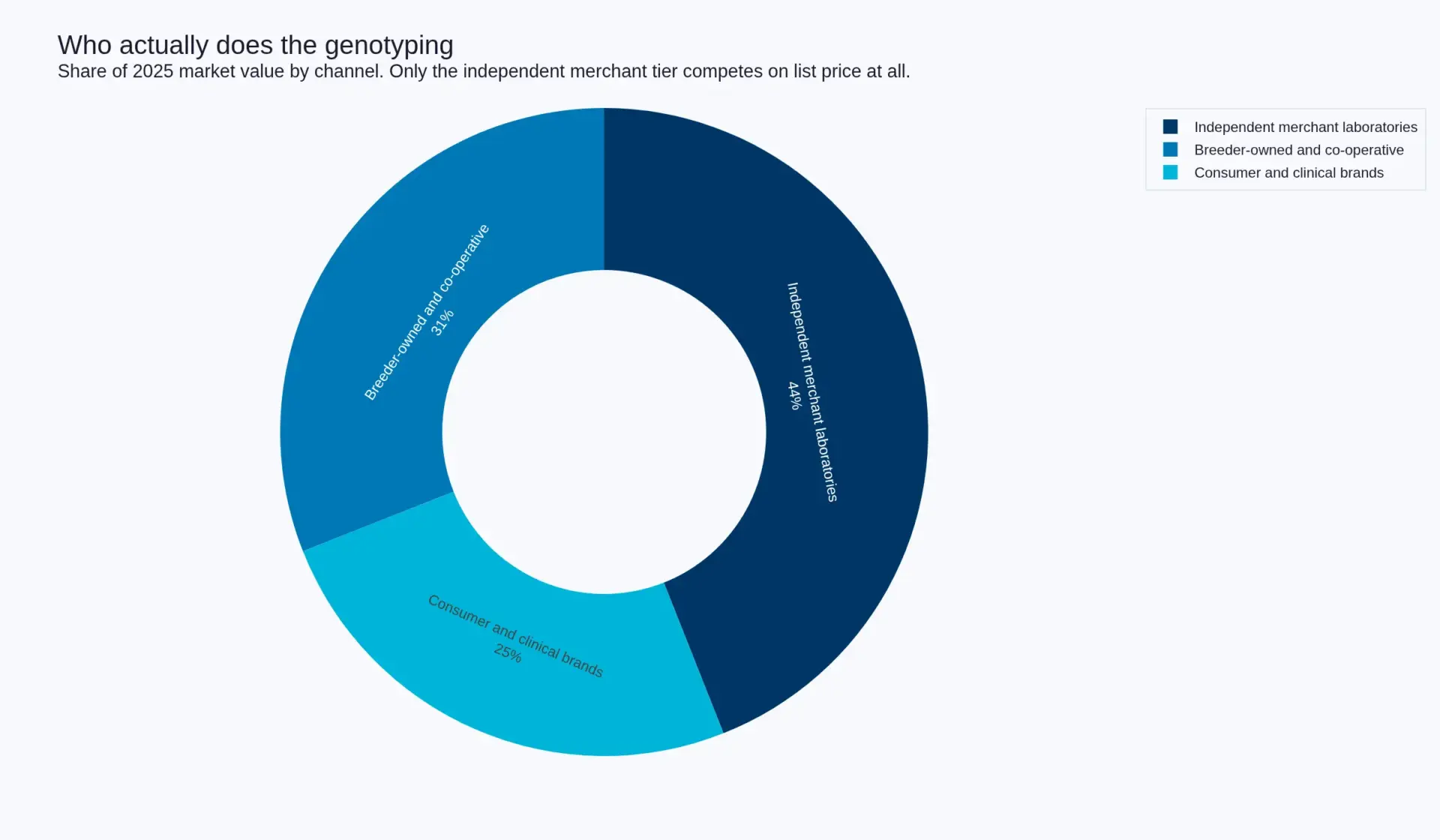
Only 44 per cent of this market — the independent merchant tier — competes on list price at all. The other 56 per cent is either priced at cost by its owners or priced at retail to a household. Neither responds to a laboratory’s price list in the way a competitive market model assumes.
What the residual business actually is
If in-sourcing were total and co-operatives were universal, GeneSeek would have been worth nothing. It sold for USD 160 million, which tells you precisely where the residual sits.
It sits in the customers too small to justify a laboratory: a breed association with 50,000 registrations a year, a regional producer group, a research programme, a studbook. It sits in the species that fall outside co-operative structures — companion animals, equine, aquaculture, wildlife. It sits in geography, where a laboratory in Scotland, Brazil, Australia, China or Canada serves markets whose domestic infrastructure cannot reach the scale of a national programme. And it sits in the technical frontier, where sequencing is displacing arrays and only a facility with throughput can absorb the capital.
That is a real business. It is simply not a business that earns a premium multiple, because every one of those positions is contestable and none of them confers authority over the answer the customer needs.
The consolidation this produces
Three things follow from a market with a cost-priced third, a captive third and a competitive third.
The first is that merchant capacity in Western markets will shrink. Existing facilities are not full, price falls faster than volume rises, and costs are largely fixed. The facilities that survive will be those with the highest utilisation or an attached channel — which is exactly the logic of Zoetis buying the network and attaching it to a veterinary and producer franchise it already owns.
The second is that the companion animal tier will keep consolidating at higher multiples than the agricultural tier. Mars built Wisdom Panel to five million tested pets by March 2025 and paired it with a diagnostics business; Zoetis bought Basepaws. Consumer brands own their reference data and improve with every test, which is the one position in this industry that compounds.
The third is that nobody will build greenfield merchant genotyping capacity in a mature market. The marginal customer does not justify the instrument, and the incumbents have already shown they will match any price. Capital goes instead to sequencing platforms, to emerging markets where co-operative infrastructure is thinner, and to decision software — the only layer where a new entrant can earn a return without owning a laboratory or an animal.
What to watch
The test of this thesis is not whether Neogen’s genomics revenue fell. It is whether a major breeder closes a laboratory it previously operated, or opens one it previously did not. The first would mean capacity is genuinely overbuilt. The second would mean the in-sourcing cycle still has room to run, and that the merchant market shrinks further than the headline growth rate suggests.
Either way, the strategic conclusion is the same one the breeder-owned laboratories reached decades ago: the money is not in reading the genome. It is in owning the population that makes the reading mean something.
Related Pheonix research
The input that genetic improvement quietly substitutes for is sized in feed additives, and in animal feed including the Latin American edition. The costs genetics cannot remove are in mycotoxin testing and feed binders, and the same integration logic applied to plants is in genetically modified and biotech seeds.
Frequently Asked Questions
What does customer in-sourcing mean in animal genomics?
It means large breeding organisations building their own genotyping capacity instead of buying the service. At 200,000 animals a year and USD 30 a head, a breeder spends USD 6 million annually, which is materially more than the instrument, reagent and technician cost at that volume. Neogen cited in-sourcing as one reason its genomics revenue declined.
Why can't merchant laboratories compete with co-operative laboratories on price?
About 31 per cent of 2025 market value is generated by breeder-owned and co-operative laboratories such as LIC, CRV, VikingGenetics and Semex. They are owned by their farmer customers and price at or near cost, returning surplus through price. That sets a reference price merchant laboratories cannot undercut without losing money.
If customers are in-sourcing, where is the remaining merchant business?
It sits in customers too small to justify their own laboratory, in species outside co-operative structures such as companion animals, equine and aquaculture, in geographies without national programmes, and in sequencing and bioinformatics. Those positions are real but contestable, which is why the business sold for a laboratory multiple rather than a data multiple.