
Global In-Vehicle Payments & Connected-Car Commerce for Parking, Fuel and Tolls Market Report, Size, Share and Forecast 2026–2033: The Session Leaves the Phone and Moves Into the Dashboard — and the Money Follows the Credential
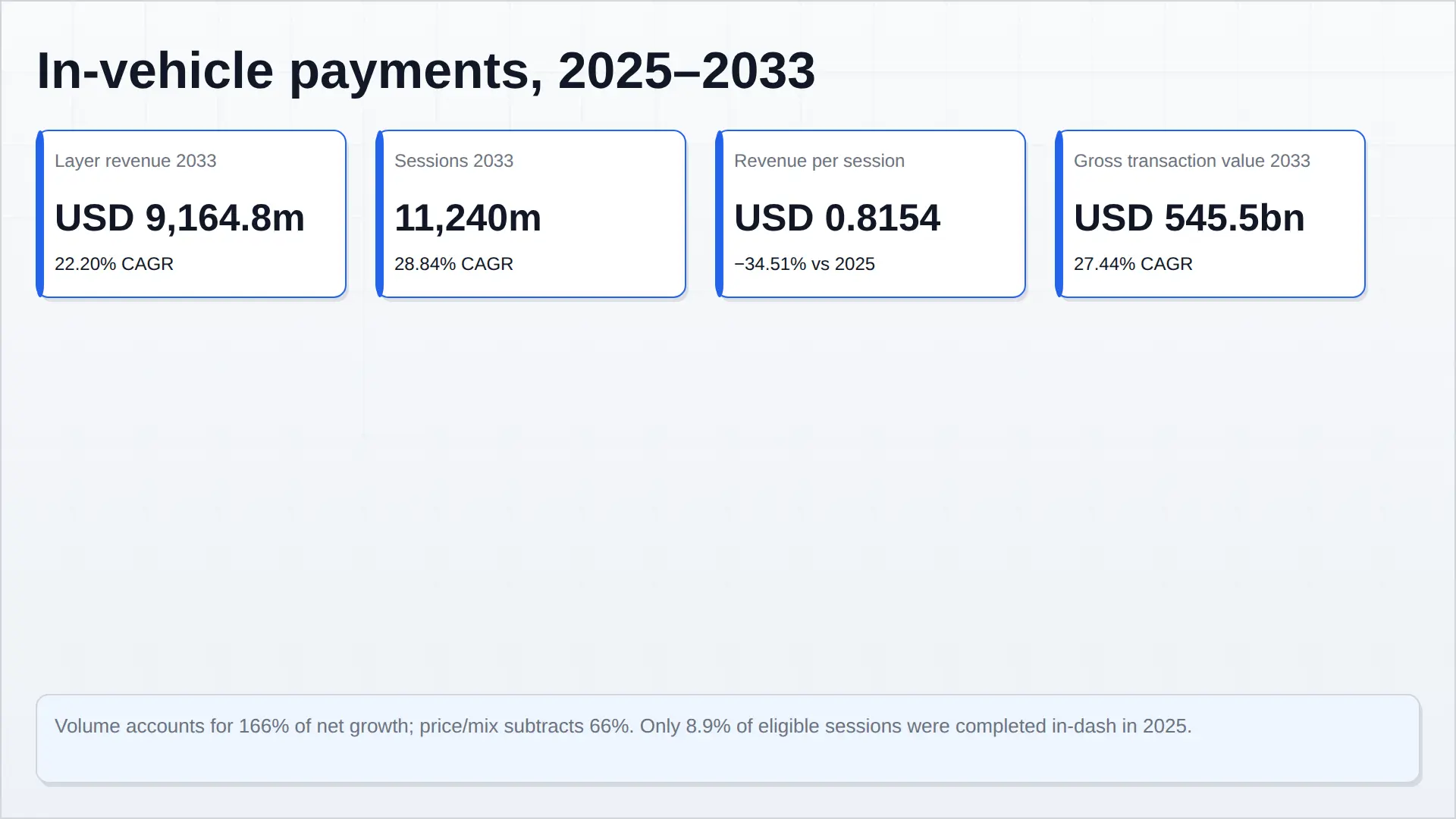
Pheonix Research — Global In-Vehicle Payments & Connected-Car Commerce for Parking, Fuel and Tolls, 2026–2033. The in-vehicle payment layer earned USD 1,842.6 million in 2025 and will earn USD 9,164.8 million by 2033 — a 22.20% CAGR. Underneath it, gross transaction value rises from USD 78,408.5 million to USD 545,523.8 million at 27.44%, and sessions from 1,480 million to 11,240 million at 28.84%. The layer's revenue therefore grows 4.97× while the flow it sits on grows 6.96×. That gap is the report. Revenue per session falls from USD 1.245 to USD 0.8154 — down 34.51%, or 5.15% a year — and every strategic question in this market follows from it.
The thesis in the title is easier to state than to prove. A payment session arrived in a car in 2025 far more often through a phone than through a head unit. The migration to the dashboard is real, but it is not the migration the industry described in 2017, when the first in-dash commerce marketplaces launched and were quietly killed five years later. What is migrating is narrower and more durable: the authenticated, vehicle-bound payment for three specific categories where the car already knows something the phone does not — that it is standing at pump four, that it crossed a gantry at 08:14, that it is in bay 221 of a barrier car park. Those three categories are the market.
What is being sized, and what is not
This report sizes the revenue earned by the in-vehicle payment layer: OEM platform fees and feature subscriptions, supplier and aggregator platform fees, per-session enablement fees, and the platform's retained share of merchant discount. It does not size the parking, fuel, charging or toll purchase itself. That flow — USD 78,408.5 million in 2025 rising to USD 545,523.8 million in 2033 — is reported separately as gross transaction value, because conflating the two is the single most common error in this category and inflates the market by a factor of forty.
In scope: sessions authenticated and settled through the vehicle for (i) tolls and road usage, (ii) fuel and EV charging, and (iii) parking. Out of scope: in-vehicle insurance, service booking, e-commerce delivery, infotainment subscriptions, and fleet fuel cards where the transaction is card-present at a forecourt terminal and the vehicle plays no role. Fleet fuelling is a real and large adjacent market, covered in Pheonix's fuel card research, and it is the most likely source of substitution into this one — not the other way round.
Headline numbers
| Metric | 2025 | 2033 | CAGR / change |
|---|---|---|---|
| Layer revenue (USD million) | 1,842.6 | 9,164.8 | 22.20% |
| Active transacting vehicles (million) | 34.8 | 196.5 | 24.16% |
| In-vehicle payment sessions (million) | 1,480 | 11,240 | 28.84% |
| Sessions per active vehicle | 42.5 | 57.2 | +34.6% |
| Gross transaction value (USD million) | 78,408.5 | 545,523.8 | 27.44% |
| Average ticket (USD) | 52.98 | 48.53 | −8.40% |
| Take rate on GTV | 2.35% | 1.68% | −67 bp |
| Revenue per session (USD) | 1.245 | 0.8154 | −34.51% (−5.15% p.a.) |
| In-dash share of eligible sessions | 8.9% | 34.6% | +25.7 pp |
| Recurring share of layer revenue | 44.6% | 58.3% | +13.7 pp |
Two numbers in that table carry the argument. In-dash share of eligible sessions is 8.9% in 2025: roughly one in eleven transactions that could be completed by the vehicle is completed some other way. And the take rate falls 67 basis points, because the volume that arrives is weighted toward categories where the ticket is thin and the merchant margin thinner. The market does not grow by charging more per session. It grows by charging less, on far more sessions, and finding a second revenue line — subscription — to compensate.
Segment structure
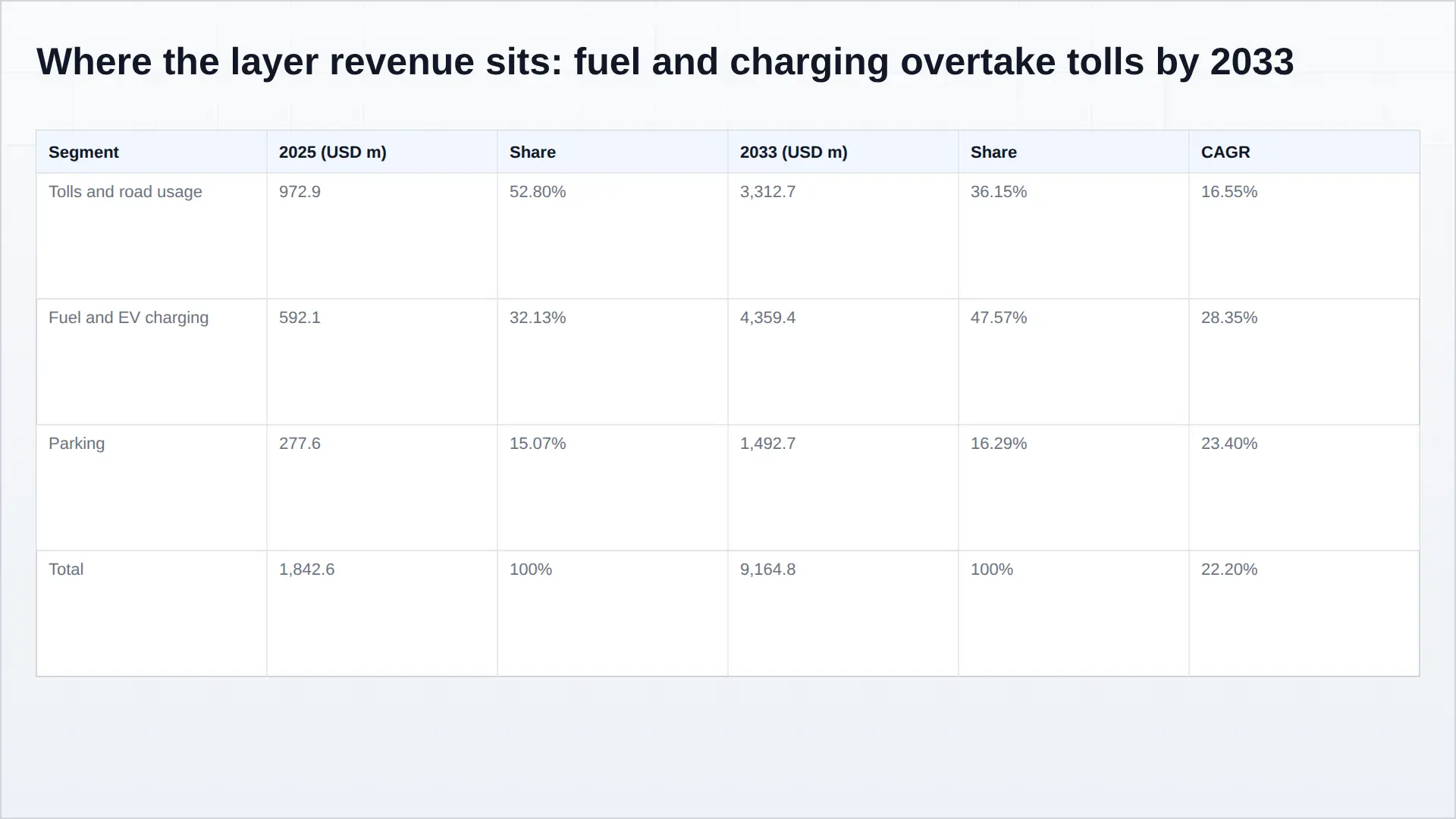
Tolls are the largest segment in 2025 and the slowest-growing; fuel and charging is the smallest of the two large segments and the fastest. By 2033 charging and fuelling together take the majority of layer revenue, which is a structural change and not a cyclical one.
| Segment | 2025 (USD m) | Share | 2033 (USD m) | Share | CAGR |
|---|---|---|---|---|---|
| Tolls and road usage | 972.9 | 52.80% | 3,312.7 | 36.15% | 16.55% |
| Fuel and EV charging | 592.1 | 32.13% | 4,359.4 | 47.57% | 28.35% |
| Parking | 277.6 | 15.07% | 1,492.7 | 16.29% | 23.40% |
| Total | 1,842.6 | 100% | 9,164.8 | 100% | 22.20% |
Tolling is the segment where the vehicle already is the payment device and has been since the transponder. It is also the segment with the highest revenue per session, the most concentrated supply base, and the least room to grow: 16.55% is a respectable rate and it is an order of magnitude below what fuelling and charging do. Fuel and charging overtake tolls in 2032 in the base case. Parking stays structurally small in value and structurally large in session count — thousands of low-ticket events that make the unit economics of the whole layer look worse than the tolling business inside it.
Unit economics: the deflating session
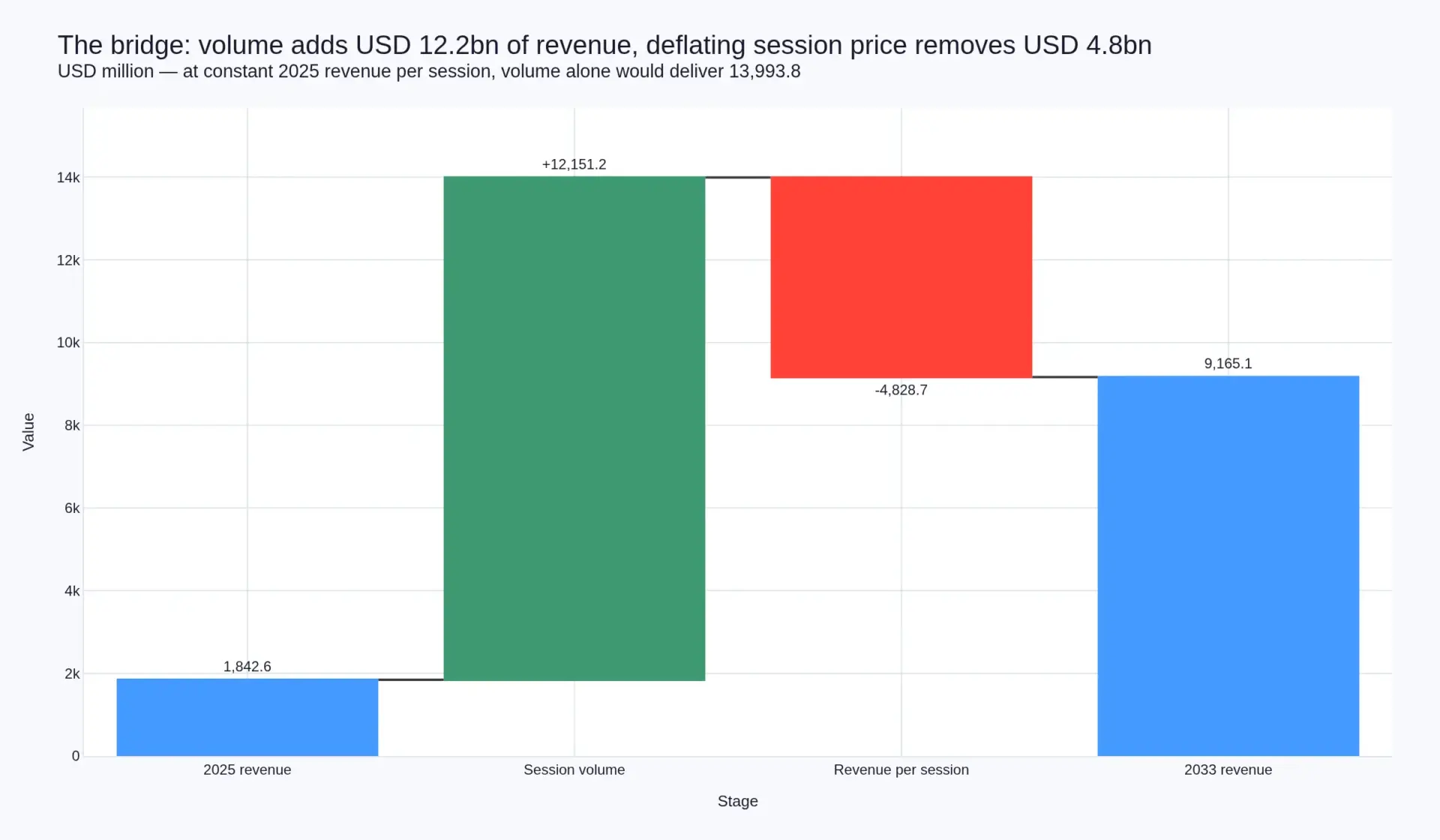
At constant 2025 revenue per session, the 2033 session count would have produced USD 13,993.8 million. The 34.51% fall in revenue per session removed USD 4,828.7 million, leaving USD 9,164.8 million. In those terms, volume accounts for 166% of the net increase and price/mix accounts for −66%. There is no pricing story here to tell investors. There is a coverage story, and a subscription story, and a cost-to-serve story.
The mechanism is mix, in both directions. Average ticket falls from USD 52.98 to USD 48.53 because charging sessions replace larger fuel fill-ups and because a growing share of sessions are short parking events. Take rate falls from 2.35% to 1.68% because the categories that grow fastest — regulated tolling, thin-margin fuel retail, contract-based charging — negotiate harder than the fragmented parking operators who paid the 2025 rates. A platform that models this business as a take-rate business will over-forecast it every year for eight years.
Why the session leaves the phone
The evidence for the migration is not that consumers prefer the dashboard. It is that the dashboard performs better on exactly one variable, and that variable turns out to be decisive: context. A 2025 study by Parkopedia and Drive Research tested production in-car payment systems against an optimised one with real drivers in the United States and Germany. Roughly 20% of drivers said they were extremely likely to use the system as currently deployed on production vehicles; more than 90% said the same of the optimised system. Ninety-seven percent in both markets said they would consider in-car payment for all vehicle transactions if it were easy to use. The technology is not the constraint. The deployed experience is.
Where the experience is good, the volume follows. BMW's in-car fuel payment, delivered with Parkopedia, went live in Germany in September 2024 across seven fuel brands and reached a base of more than 500,000 BMW customers in that market on the strength of a single feature bundled into a subscription. That is the commercial shape of the successful version of this market: not a marketplace of merchants inside the car, which General Motors launched in 2017 and discontinued in March 2022 after the usage never arrived, but one or two high-frequency transactional jobs the car can complete faster than a phone can.
Method: the 70/30 split
Seventy percent of the evidence base is secondary: EU regulation and EUR-Lex text, US payments-industry certification roadmaps, European and US tolling interoperability documentation, standards-body material from ISO and CharIN, published merchant and authority tariffs, and company disclosures. Thirty percent is Pheonix's own primary layer — our reconstruction of merchant and authority cost-to-serve from published tariffs and procurement material, our own bottom-up session and take-rate model, and our own teardown of the failure modes in deployed in-car checkout flows. No interview is quoted in this report and no unnamed source is presented as a data point; where a number is our estimate it is labelled as one, and where it is an assumption it is named as an assumption in the chapter where it bites.
Table of Contents
- Market Definition and Key Findings
- Market Size and Forecast, 2025–2033
- Volume, Session Economics and the Deflating Payment
- Segment Structure: Tolls, Fuel and Charging, Parking
- Why the Session Leaves the Phone
- Headline Numbers and the 2026 Starting Point
- Research Methodology and the Primary Layer
- Value Chain: Who Owns the Credential
- Value Chain: What the In-Car Session Actually Displaces
- Technology and Innovation: ISO 15118-20 and the Tokenised Credential
- Technology: The Four Failure Modes That Cap Conversion
- Competitive Landscape: Four Camps and One Contested Fee
- Competitive Landscape: The Tolling Incumbents and the Interoperability Clock
- Regulatory Landscape: AFIR, EETS, Congestion Charging and the AFD Liability Shift
- Investment Activity: Where the Capital Is Committed
- Market Risk, Substitution and What Would Break the Base Case
Competitive Landscape
Competitive Landscape: Four Camps and One Contested Fee
The competitive structure of this market is best understood as four camps competing for one fee. The camps do not compete for customers in the ordinary sense; they compete for the position from which the fee is taken. Overall structure is fragmented, competitive intensity is high, and no participant is present in all three transaction categories at scale.
Camp one: the schemes and processors
Visa and Mastercard do not sell in-car payment. They sell the token, the acceptance rules and the clearing rails that make it possible, and they earn on the flow rather than on the session. Their position is structurally advantaged: tokenisation standardised the vehicle’s credential inside the scheme vault, and contactless acceptance at the forecourt and the parking barrier already exists. The processors behind them compete on basis points and are consolidating, which transfers margin from the processing layer to the scheme layer rather than to the platform layer this report sizes.
For an OEM or an aggregator, the strategic consequence is uncomfortable. The schemes are not a competitor that can be displaced; they are a senior claim on the same transaction. Every basis point they take is unavailable to the platform, and the platform’s own 2.35% is the residual that remains.
Camp two: the OEMs
The OEMs own the binding moment and the interface, and they have learned the category the hard way. General Motors launched an in-dash commerce marketplace in 2017 and discontinued it in March 2022, an early and expensive demonstration that a merchant catalogue inside a car does not create transactions. The OEMs that have succeeded since have done the opposite: one job, done better than a phone.
BMW’s in-car fuel payment, delivered with Parkopedia and live in Germany from September 2024, covers seven fuel brands and reaches a base of more than 500,000 BMW customers in that market, and it is sold as part of a digital subscription bundle rather than as a stand-alone fee. Mercedes-Benz, Ford, Toyota and Stellantis have each shipped some version of in-vehicle payment or in-vehicle commerce enablement. The pattern is consistent: the OEM monetises the feature as recurring revenue, and treats the transaction fee as a secondary stream to be negotiated with suppliers. That is why 58.3% of 2033 layer revenue is recurring in the base case and why an OEM that tries to fund the category from per-session fees alone will under-earn its own investment.
The OEM camp is also where the fragmentation is most visible. Each OEM runs its own stack, its own supplier relationships and its own market coverage, so a fuel brand that wants to be payable from the dash negotiates the same integration many times.
Camp three: the aggregators and cockpit suppliers
This is the camp that built the actual capability. Parkopedia supplies in-car parking payment into OEM head units across sixteen European markets and fuel payment across eight, with Škoda among its long-standing deployments, and in April 2025 extended its reach through a partnership with Neusoft covering parking, charging and tolls inside a production cockpit platform. The Tier-1 cockpit suppliers — Bosch, Continental, Aptiv, Harman and the software layer around them — sit one step further from the merchant and one step closer to the OEM bill of materials.
The aggregator’s asset is merchant acceptance: the contracts, the site data and the integration work that let a car name a specific pump or bay. The aggregator’s vulnerability is that this asset is a portfolio of bilateral agreements, each of which the OEM could in principle sign itself, and each of which the merchant can re-price once the car has become a meaningful channel. This is the most contested position in the value chain and the one whose margin is least protected by regulation.
Camp four: the tolling and road-pricing incumbents
Tolling is the one category where the incumbents are genuinely entrenched, and the entrenchment is administrative rather than technological. Cubic, Siemens Mobility, Conduent, TransCore and Kapsch hold the authority accounts, the back-office systems and the interoperability certifications, and those are renewed on procurement cycles measured in decades. The vehicle side of a toll session has been a payment device since the transponder; what changes is the credential, as free-flow and account-based charging reduce the physical tag to one option among several.
Interoperability is the barrier that protects this camp and the constraint that limits its growth. The industry’s national interoperability programme in the United States, run through the tolling associations and the federal highway administration, has been converging on common device and business-rule standards with staged effective dates through the middle of the decade. Every authority that adopts those standards widens the addressable session base; every authority that delays keeps its own closed ecosystem intact. That is why tolling grows at 16.55% — faster than the underlying traffic, slower than everything else in this report.
The forecourt and the charge point operator
Shell and BP operate both sides of the fuel relationship — they are merchants and, increasingly, charge point operators — and therefore have the option of refusing to share the credential at all. Independent charge point operators have the same option and less incentive to use it, because account-based charging already requires them to accept credentials they do not issue. This is the camp most likely to move first on vehicle-native settlement, and the camp whose procurement decisions determine whether the fuel and charging segment’s 47.57% share of 2033 value is earned by platforms or absorbed by merchants.
Concentration
We treat twelve players as tier-one in this market: the two global schemes, three vehicle platforms with production-scale in-car payment, four aggregation and cockpit suppliers, and three tolling incumbents with multi-jurisdiction back-office positions. None of them holds more than a low-double-digit share of global layer revenue in 2025. The market is fragmented at the top and consolidating in the middle, which is the classic setup for the aggregation layer to be acquired by the party that already owns either the OEM relationship or the merchant relationship — and for none of the acquisition prices to reflect the transaction-fee economics that this report shows deflating.
Value Chain
Value Chain: The Credential Is the Scarce Asset and the Rail Is Nobody’s Business
Every in-vehicle payment session, whatever the category, decomposes into the same five functions. Something establishes presence and context — that the vehicle is at pump four, in bay 221, or under gantry 14 at 08:14. Something holds the credential — a tokenised card, a contract certificate, a fleet account, a toll account. Something performs authentication. Something performs authorisation and clearing. And something closes the loop with a receipt, an expense record or a statement that satisfies a human or an auditor.
Only one of those five functions carries durable margin, and it is not the one the industry has spent a decade competing over. Authorisation is commoditised: ISO 8583 messaging, EMVCo tokenisation rules, scheme assessments, and a long tail of processors willing to run the rail for basis points. Presence is nearly free once the vehicle has GNSS and a data connection. Authentication is converging on the phone as a second factor. The credential — the thing stored in a secure element or an OEM cloud that lets a session settle without a human entering card details — is the asset, because it is the only link in the chain that is bound once and monetised many times.
Who holds the credential, and why it keeps moving
Four parties can plausibly claim it, and each holds a different piece of the binding moment.
- The card scheme holds the token. Network tokenisation put the durable identifier in the scheme’s own vault rather than in the merchant’s, which means the OEM, the aggregator and the forecourt all rent access to a credential the scheme can re-provision, re-scope or revoke. This is the quiet reason the schemes are the most defensible participants in the category and the least visible in its marketing.
- The OEM holds the delivery moment. A vehicle is bound to a payment instrument once, at handover, and that binding survives for the life of the car if the experience does not break it. The OEM also owns the only interface the driver sees. Where an OEM has monetised this successfully it has done so as a feature inside a subscription package rather than as a per-transaction fee — which is why the recurring share of layer revenue rises from 44.6% to 58.3% in the base case.
- The aggregator holds merchant acceptance. Parkopedia’s position — merchant relationships across forecourt brands and parking operators, delivered into OEM head units — is the hardest asset to replicate quickly and the easiest to disintermediate slowly. Every OEM that decides to contract directly with a fuel brand or a parking operator is a small tax on the aggregator’s position.
- The tolling incumbent holds the authority. Cubic, Siemens Mobility and their peers own the account relationship, the back office and the interoperability certification. That is the most defensible seat in the entire market and the one with the least growth: 16.55% a year against 28.35% for fuel and charging.
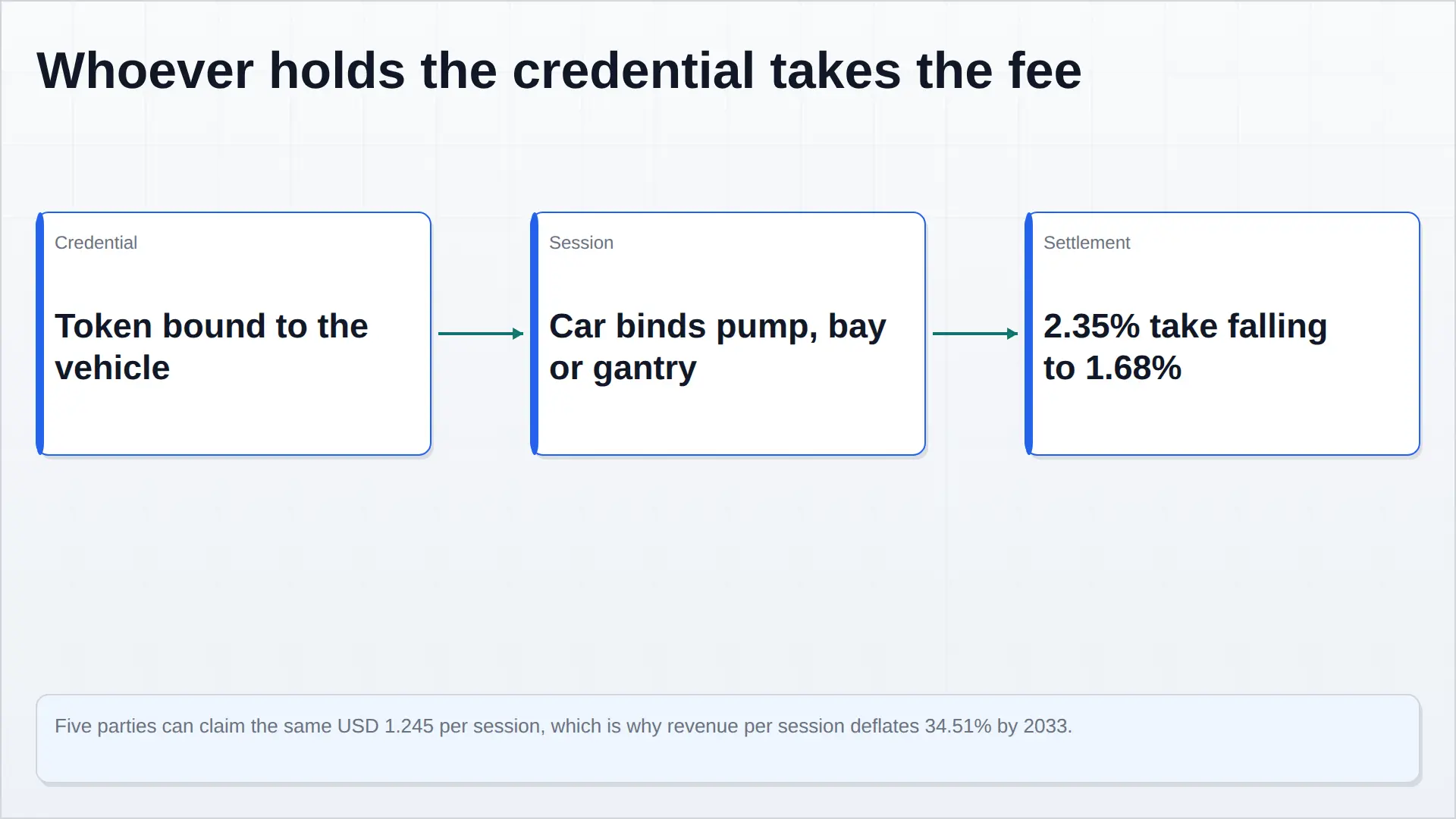
The consequence is visible in the unit economics. A layer where five parties can claim the same USD 1.245 per session does not hold USD 1.245. It holds less each year, which is exactly what the base case shows: revenue per session falls 34.51% from 2025 to 2033 at a time when session volume grows 7.6×.
What the in-car session actually displaces
Willingness to pay in this market is not driven by the convenience of the driver. It is driven by a cost the operator stops incurring. That cost differs sharply by category, and it explains the whole segment structure of the forecast.
| Category | What the session displaces | Who bears the displaced cost | Willingness to pay |
|---|---|---|---|
| Tolls and road usage | Transponder or on-board unit issuance and fulfilment, mailed invoices for non-tag users, exceptions handling and call-centre load | Toll authority / concessionaire | High per session; concentrated and slow to open |
| Parking | Pay-and-display machines, cash collection and coin processing, machine vandalism and downtime, enforcement verification | Municipal operator or private car park operator | Moderate; fragmented buyer, thousands of small contracts |
| Fuel | Outdoor payment terminal in the critical path, its downtime, and the forecourt’s own EMV refresh cycle | Fuel retailer | Low per session; thin fuel margin caps the fee |
| EV charging | App download, RFID card issuance and roaming settlement; the card reader the regulation now requires anyway | Charge point operator | Moderate and rising, because contract-based charging already runs on account credentials |
Two observations follow. First, tolling pays best per session because the displaced object is a physical device with a unit cost and a mailing cost behind it. That is why tolls are 52.80% of 2025 layer revenue on a minority of the eligible session base. Second, fuel pays worst per session precisely because the fuel margin is thin — a forecourt cannot fund a platform fee out of four cents a litre, so the fee has to come from the shop basket, from the OEM’s subscription, or from the terminal refresh budget that is being spent anyway. A market model that assumes fuel-session fees behave like toll-session fees will over-forecast 2033 by several multiples.
The four-corner arithmetic on a USD 52.98 ticket
Layer revenue of USD 1.245 on an average 2025 ticket of USD 52.98 is a 2.35% take. That is not one fee; it is a stack. On an open-loop parking or fuel transaction the issuing bank’s interchange, the scheme’s assessments and the acquirer’s margin are all senior to the platform, and the platform keeps a residual. On a closed-loop toll transaction the same arithmetic exists but the participants are different — the authority is effectively both merchant and issuer, so the platform’s fee is a line item in an operating budget rather than a deduction from a merchant’s revenue. The structural difference matters: closed-loop fees are negotiated annually against a public procurement document and are visible; open-loop fees are invisible, embedded, and far easier to compress quietly at renewal.
That asymmetry is why the take rate falls to 1.68% by 2033 rather than holding. The volume arriving in the forecast is weighted toward the two categories with the least room to pay: regulated road pricing and thin-margin fuel. A platform that cannot sell a subscription alongside the transaction will watch its per-session revenue deflate by roughly 5% a year and confuse that with execution failure.
The primary layer: reconstructing cost-to-serve
Thirty percent of the evidence in this chapter is Pheonix’s own. We rebuilt the operator-side cost stack from published tariffs, procurement and concession documents, and public certification material, then tested whether the resulting willingness to pay is consistent with the take rates implied by supplier and OEM disclosures. It is consistent at the category level and inconsistent at the ticket level: operators will pay roughly 2–4% of a parking session and roughly 1–2% of a fuel transaction, and the difference is explained almost entirely by the merchant margin available, not by the value of the convenience. Where we could not establish a cost line from a public document we have treated the fee as an assumption rather than an estimate, and named it.
Investment Activity
Investment Activity: Where the Capital Is Actually Committed
The capital in this market is not being spent on in-vehicle payment. It is being spent on three adjacent things that decide whether in-vehicle payment works: replacing forecourt acceptance hardware, building charging infrastructure with a payment device in it, and modernising tolling back offices to a common interoperability standard. The payment layer is a beneficiary of that spending far more than it is a source of it, and that is the most important thing to understand about the investment case.
The forecourt refresh is the largest single programme
In the United States, bringing roughly 1.9 million outdoor dispenser payment devices to current EMV and PCI standards has been estimated at close to USD 8.9 billion across the industry. The liability shift for counterfeit outdoor transactions moved in April 2021, and the certification roadmaps published by the payments industry carry further milestones, including an end-of-sale date for the older point-of-interaction standard in April 2027. That is a capital programme the fuel retail sector cannot avoid, funded by merchants site by site, and it is the window in which vehicle-native settlement either gets designed in or gets designed out.
The investment signal for the platform layer is therefore indirect but unambiguous: the marginal cost of enabling an in-vehicle session on a dispenser that is already being replaced is small, while the cost of retrofitting it later is not. Platforms that can get written into a retailer’s specification during the refresh earn a position; platforms that arrive afterwards compete against a bill of materials that has already closed.
Charging infrastructure carries a mandated payment device
European rules require ad-hoc payment by card at publicly accessible recharging points, which puts a payment acceptance device into the bill of materials of every compliant charging site. That is capital the charge point operator has to spend, and it is the reason the charging category can support a slightly higher take than fuel: the operator is already carrying the cost of acceptance, so a vehicle-native session is a route to better utilisation of an asset it has already funded rather than a new cost line.
Capital intensity across the segment as a whole is medium. The platform layer itself is asset-light; the hardware layer that makes it possible — dispensers, chargers, gantries, back offices — is heavy and is being funded by merchants, operators and authorities rather than by the platforms.
Road pricing is proving it can pay for itself
The clearest investment signal in the tolling camp came from New York, where congestion pricing went live on 5 January 2025 with a USD 9 peak toll for E-ZPass users — reduced from the USD 15 originally proposed — and a USD 2.25 overnight rate. In its first year the programme raised roughly USD 562 million net of operating costs, ahead of its USD 500 million target.
That result matters beyond New York. A road-pricing scheme that covers its own operating cost in year one is a scheme other jurisdictions can copy, and each new scheme creates a population of account-based charging events that did not exist before. Those events are the most valuable session type in this report, and they are created by a political decision rather than by a consumer behaviour change — which makes them the most forecastable part of the model and the part least sensitive to the user-experience risk that governs everything else.
Where strategic capital is moving
Three patterns are visible in corporate activity, all of them consistent with the credential argument in this report rather than with the transaction-fee story.
- OEMs are buying capability into the cockpit, not into the merchant catalogue. The productive partnerships are integrations that put a transaction job inside an existing interface — the pattern established by Parkopedia’s work with BMW on fuel payment in Germany from September 2024 and with Škoda on parking payment since 2022 and fuel since 2023 — rather than marketplaces that ask a driver to browse.
- Aggregators are buying geographic reach rather than merchant depth. The April 2025 partnership between Parkopedia and Neusoft, which places parking, charging and toll payment inside a production cockpit platform across a wider set of markets, is the shape of the deals that matter: distribution into a head unit is worth more than another hundred merchant contracts.
- The credential infrastructure itself is being professionalised. The migration of the V2G public key infrastructure that underpins Plug & Charge to a specialist operator in 2024 is an unglamorous transaction with large strategic content: whoever operates the trust anchor for vehicle certificates sits underneath every session that uses one.
Why there is no pure play, and what that does to valuations
There is no listed company whose revenue is primarily in-vehicle payment layer fees, and the structure of the market explains why: the capability sits inside a scheme, an OEM, a cockpit supplier, a tolling incumbent or a forecourt operator, each of which earns most of its money elsewhere. That has two consequences.
First, the market consolidates through strategic acquisition rather than through growth capital, and the buyer is almost always the party that already owns either the OEM relationship or the merchant relationship. Second, and more importantly for anyone valuing a target in this space, the transaction-fee line deflates at roughly 5% a year in real terms while the subscription line grows. An acquirer that pays for the transaction line is paying for an asset whose price is falling; an acquirer that pays for the installed position — merchant contracts, head-unit integration, credentialed vehicles — is paying for the thing that actually compounds. The gap between those two valuations is the single most common source of disagreement in this market, and it is a disagreement about the model, not about the company.
Technology & Innovation
Technology and Innovation: ISO 15118-20 Made the Car a Payment Device, and the Cockpit Has Not Caught Up
Three technical changes between 2019 and 2025 turned the vehicle from a payment terminal into a payment device. None of them was an in-car commerce feature, and all three of them matter more than the marketplaces that were supposed to launch the category.
1. Plug & Charge standardised the credential inside the car
ISO 15118 defined a charging communication interface in which the vehicle presents a contract certificate to the charge point and is authenticated and billed without a card, an app, an RFID tag or a human action. That is the cleanest instance of the thesis in this report: the session leaves the phone entirely and settles from the car. The second edition, ISO 15118-20, extended the standard to bidirectional charging and to a multi-PKI architecture in which certificate authorities compete for the trust anchor rather than one body owning it. CharIN, which governs the Plug & Charge ecosystem, moved its V2G PKI operation to an external operator in 2024 — an unglamorous event that matters because a payment credential is only as valuable as the governance behind it.
The commercial consequence is that a charging session can be a pure machine-to-machine transaction. Roaming and settlement then run through account-based clearing rather than card rails, which raises the platform’s share of the economics in the charging category and explains why fuel and EV charging grows at 28.35% while fuel alone would not.
2. Tokenisation made it safe to keep a credential in a vehicle
The reason a car can hold a payment credential at all is that it no longer needs to hold a card number. Network tokenisation substitutes a token bound to a device or a channel, with the cryptogram generated per transaction, so a compromise of the vehicle’s storage does not yield a usable instrument — and the scope of the merchant’s card-data obligations shrinks accordingly. The industry standards work that followed, on software-based acceptance on commercial off-the-shelf devices, is what allows a head unit to be treated as a payment acceptance point without turning the OEM into a card-data environment.
This is a real technical achievement and it is also a strategic transfer. Tokenisation standardised the vehicle’s credential at the scheme, not at the OEM and not at the aggregator. The party that can re-provision a token is the party that ultimately owns the relationship, however much of the interface the OEM controls.
3. The forecourt terminal is being replaced anyway
In the United States, the outdoor automated fuel dispenser is going through a decade-long certification transition. Counterfeit liability for outdoor transactions shifted to the forecourt side in April 2021 across approximately 1.9 million dispensing payment devices, and the certification roadmaps published by the payments industry set further milestones: contactless EMV Level 1 requirements on those devices, and an end-of-sale date for the older PCI PTS point-of-interaction standard in April 2027. Industry estimates put the total upgrade cost near USD 8.9 billion.
Whatever else that programme does, it guarantees that the forecourt’s acceptance hardware is being touched this decade. That is the window in which an in-vehicle session can be made first-class rather than a parallel path, because the marginal cost of enabling it is small next to a dispenser retrofit the retailer is already funding. It is also why the fuel segment’s 28.35% growth is not a forecast of consumer preference; it is a forecast of a hardware refresh coinciding with a regulatory payment requirement.
The part that is not solved: the cockpit
All three advances above concern the session. None of them concern the driver’s decision to start one, which is where the market actually fails. A 2025 study by Parkopedia and Drive Research put real drivers in front of two working systems in the United States and Germany: the in-car payment product as deployed on current production vehicles, and an optimised equivalent. Roughly 20% of drivers said they were extremely likely to use the production system. More than 90% said the same of the optimised one. In both markets 97% said they would consider in-car payment for all vehicle transactions if it were easy to use, and in the United States 80% said they would be frustrated if in-car payment were available nearby and the car did not tell them.
A five-fold gap between the deployed product and the achievable one is not an adoption curve. It is a product-quality curve, and it is the single largest variable in this report’s floor case.
Four failure modes that cap conversion
Our own teardown of deployed in-car checkout flows identifies four recurring failure classes, in descending order of cost:
- Stale or wrong merchant mapping. The vehicle offers a fuel brand or a car park that has closed, changed operator or changed tariff. Each instance destroys a session and teaches the driver to reach for the phone next time. The damage is not the lost transaction; it is the lost habit.
- Session binding errors. The pump or bay is identified incorrectly, so the transaction settles against the wrong site. Rare, and disproportionately expensive because it is the failure drivers repeat to other drivers.
- Authentication fallback loops. A PIN pad in a vehicle is a bad interface and a biometric is not always available; when fallback drops the driver into a phone app, the thesis in this report evaporates in front of the customer.
- No receipt or expense handoff. Undervalued in consumer deployments and decisive in commercial ones: a session that does not produce a reconcilable record is a session a fleet manager will not authorise twice.
Innovation in the next phase is therefore concentrated where these failures live: deterministic merchant binding using GNSS geofencing plus the forecourt’s own pump protocol, notification timing that fires before the driver opens a door rather than after, in-vehicle biometric authorisation, and — at the far end — bidirectional charging that turns the vehicle into a seller as well as a buyer of energy, with the same contract certificate doing both jobs.
Market Risk
Market Risk, Substitution and What Would Break the Base Case
The base case is a coverage story with a deflating unit price. The risks that matter are the ones that break the coverage, not the ones that compress the price — because the price is already assumed to fall by a third.
Substitution risk is high, and it is not the phone
The obvious substitution threat is that the phone is good enough. It is a real threat: tap-to-pay at a barrier, an app for the car park, a forecourt terminal that works, a charging app that already holds the driver’s account. But the more interesting substitution is architectural, and it removes the vehicle from the critical path entirely.
Free-flow tolling based on automatic number-plate recognition does not need a device in the car at all; it needs a camera and an account. Account-based charging can be initiated from a phone, a card reader or a roaming contract without the vehicle presenting a certificate. If those architectures win, the session never leaves the phone — it leaves the person, and the vehicle becomes an object that is observed rather than a party that pays. That outcome is entirely compatible with a growing road-pricing market and a shrinking in-vehicle payment layer, and it is why substitution risk is assessed as high in this report even though the base case grows at 22.20%.
The user-experience floor case
The second risk is the one the evidence points at hardest. If the deployed experience stays where production systems are today, the migration stalls. In the floor case — roughly 6,200 million sessions in 2033 at USD 0.78 of revenue per session — layer revenue reaches about USD 4,836.0 million, a 12.82% CAGR rather than 22.20%. That is still a doubling and a half, and it is not a failure of the market; it is a failure of the product.
The high case is not a different technology either. At 14,900 million sessions and USD 0.86 per session, layer revenue reaches about USD 12,814.0 million — a 27.43% CAGR — on the assumption that the optimised interface described in the technology chapter ships broadly and the conversion gap between the two study conditions closes. The spread between the three cases, from USD 4.8 billion to USD 12.8 billion, is almost entirely a function of interface quality rather than of vehicle capability, merchant acceptance or regulation. Very few markets of this size have their entire variance concentrated in a design decision.
Monetisation risk: the OEM that cannot charge for it
The third risk is that the party bearing the integration cost cannot recover it. The category has one clear precedent: an in-dash commerce marketplace launched with considerable ambition in 2017 and discontinued in 2022 because usage did not justify it. The lesson taken from that episode — sell one job, bundle it, do not build a shop — is the reason the successful deployments are subscription features. But a subscription feature monetises only where the OEM has a subscription business with a large installed base, and not every OEM does. An OEM that has to fund in-car payment from transaction fees alone is competing for a residual that is already falling 5% a year, and will rationally under-invest, which slows merchant coverage, which degrades the experience, which feeds the floor case.
Margin risk: the senior claims on the same transaction
The layer’s take rate falls from 2.35% to 1.68% in the base case. That assumption could easily be too generous. Interchange and scheme assessments are senior claims, and any shift in the balance between open-loop card settlement and account-based clearing moves the platform’s residual without the platform doing anything. Tolling fees are set in public procurement and are visible and contestable; parking fees are negotiated operator by operator against an operator who increasingly understands what the session is worth. The realistic downside is not a collapse in volume but a take rate that falls faster than modelled because the parties holding the credential price the platform as a feature rather than as a channel.
Regulatory and geopolitical risk
Regulation in this market has so far been helpful — card payment mandates create acceptance, interoperability rules create session volume, and travel-information rules create the static data that lets a vehicle know what a parking bay costs and how to pay. It can also move against the category. Interface safety rules are the live concern: since July 2024 the EU’s General Safety Regulation has required new vehicles to be equipped with advanced driver distraction warning, which means any in-dash transaction flow is now designed in the shadow of a system that is legally obliged to notice when a driver is not looking at the road. A flow that requires more than a confirmation will struggle to coexist with that.
Data protection is the second live concern. A vehicle-bound credential is also a vehicle-bound identity, and a session record is a location record with a timestamp. The regulatory regime that governs it varies by market, and the compliance cost falls hardest on the aggregators who hold data across many OEMs and many merchants.
Geopolitical exposure is moderate and mostly indirect: the supply chain for the secure elements, modems and cockpit semiconductors that make the credential possible is concentrated, and a disruption slows the vehicle population that can transact rather than the payment layer itself. Currency exposure is real for a global model, since tolling tariffs and fuel prices are local and the platform fee is typically negotiated in a single currency.
What would make us wrong in the other direction
The base case is not the high case, and the strongest argument that it is too conservative is that the migration is being pulled by two forces that do not care about user experience. Contract-based charging grows because Plug & Charge removes the human from the loop entirely — a session that requires no interface has no interface risk. And road pricing grows because governments need the revenue and account-based collection is the cheapest way to take it. If those two categories compound faster than modelled, they can carry the layer past the base case even while parking and fuel disappoint. That is the asymmetry worth watching: the categories where the vehicle is unambiguously the payment device are the categories where the forecast is least dependent on the thing this report worries about most.
Regulatory Landscape
Regulatory Landscape: AFIR, EETS, Congestion Charging and the AFD Liability Shift
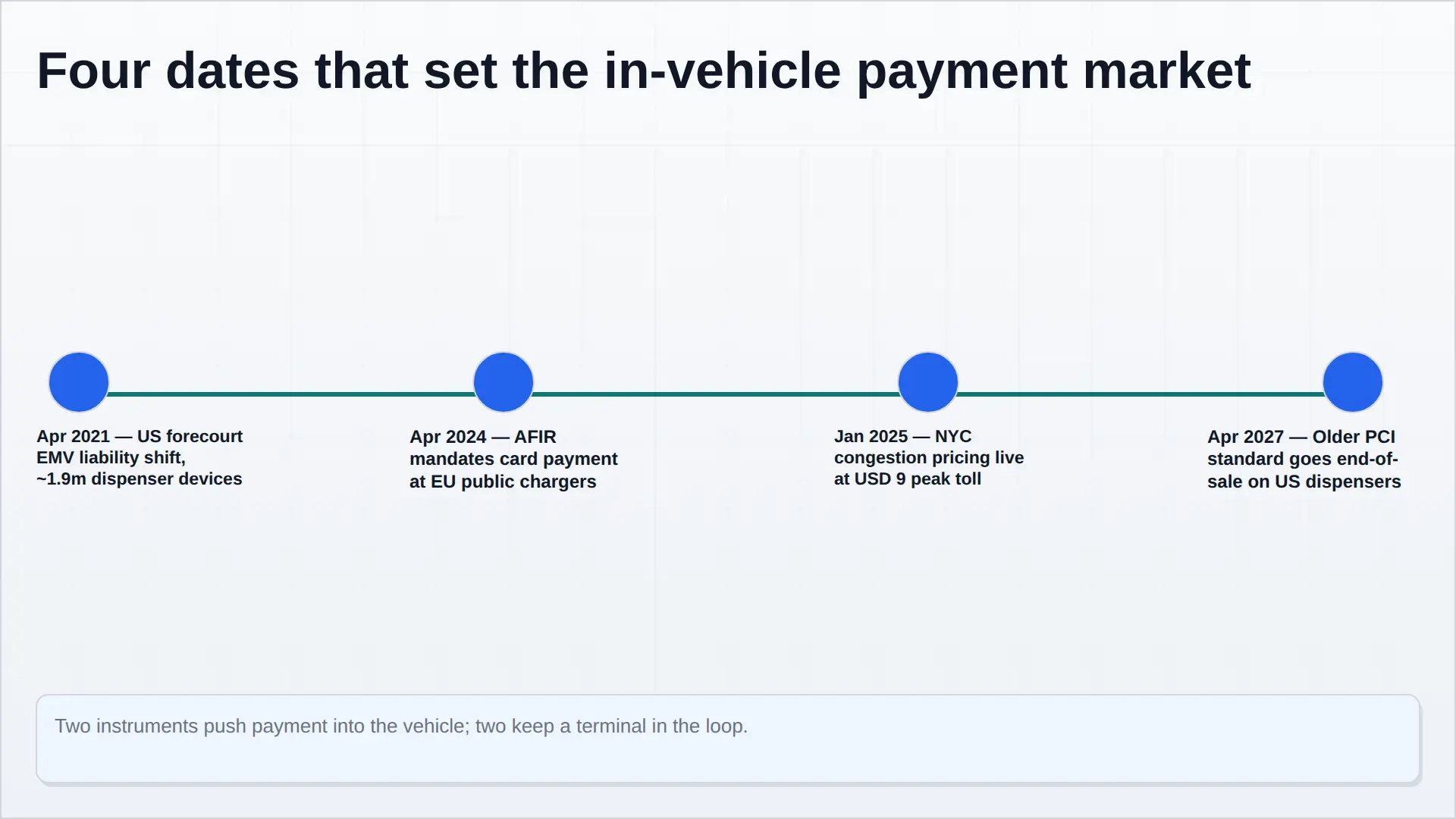
This is one of the few markets where the regulator has done more to create the addressable transaction base than the industry has. Four instruments do most of the work, and they pull in slightly different directions: two push the payment into the vehicle, two keep a terminal in the loop as a fallback.
AFIR: ad-hoc payment at every public charger
The EU’s Alternative Fuels Infrastructure Regulation requires operators of publicly accessible recharging points to offer ad-hoc recharging without a prior contract, with payment by card, applicable from 13 April 2024. In practice this put a card acceptance device into the bill of materials of every compliant public charging site in the Union.
The obvious reading is that this protects the card and the phone against vehicle-native settlement. The more useful reading is that it establishes acceptance as a legal floor and leaves the vehicle free to be the preferred path. A driver who must be able to tap a card has already been persuaded that the site is payable; the question is only whether the car settles it faster. Plug & Charge, built on ISO 15118 with a contract certificate in the vehicle, is the mechanism that makes the vehicle path faster — and the same regulation expects it to be supported.
EETS: one contract, one device, many countries
Directive (EU) 2019/520 on the interoperability of electronic road toll systems and facilitating cross-border exchange of information established the European Electronic Toll Service on the principle that a road user should be able to pay for a journey across the Union under a single contract and a single on-board device. The consolidated text has been in force since March 2022.
For this market, EETS does something specific and underrated: it makes the on-board credential portable across jurisdictions, which converts a national transponder business into a European service business. It also creates a class of EETS providers who are neither the toll authority nor the vehicle manufacturer and whose entire commercial existence depends on holding a credential that works everywhere. Those providers are the natural counterparty for a vehicle-native credential, and the natural casualty if the OEM route wins.
National tolling interoperability in the United States
The United States is solving the same problem through an industry programme rather than a directive. The tolling associations have been converging on shared business rules and a common device standard, with staged effective dates running through the middle of the decade — an integrated client device standard taking effect at the end of 2025 and business rules revised in parallel, supported by regional interoperability programmes.
The commercial effect is the same as EETS: every authority that adopts the common standard widens the addressable population of vehicles that can transact with it, and every authority that does not keeps a closed ecosystem alive. It is the single largest determinant of how fast the tolling segment converts from a hardware business into a payment business — and it is why tolling grows at 16.55% rather than at the rate of traffic.
Congestion charging: the new toll that never needs a tag
New York’s congestion pricing scheme went live on 5 January 2025, charging USD 9 at peak for E-ZPass users — cut from the USD 15 originally proposed — and USD 2.25 overnight, and it raised roughly USD 562 million net in its first year against a USD 500 million target.
Two things about that scheme matter here. It is collected from an account the vehicle is associated with rather than from a device the driver presents, which is the model the whole market is moving toward. And it demonstrated that a new road-pricing scheme can be politically survivable when the revenue is visible and hypothecated. Every jurisdiction that follows creates a fresh population of account-based charging events, and those events are the most reliable growth in this report’s forecast because they are created by statute rather than by consumer habit.
The forecourt: a liability shift and a certification clock
The US forecourt is being regulated through the payment system rather than through transport law. Counterfeit liability for outdoor dispenser transactions shifted to the forecourt side in April 2021 across approximately 1.9 million dispensing payment devices, and the industry’s certification roadmaps set the following milestones: contactless EMV Level 1 requirements for those devices, and an end-of-sale date for the older PCI point-of-interaction standard in April 2027. The total upgrade cost has been estimated at around USD 8.9 billion.
None of that mentions vehicles. All of it determines whether vehicles can pay at a pump, because the acceptance hardware being installed now is the acceptance hardware that will be in place through 2033.
The data layer that makes the session possible
A vehicle can only offer to pay for a parking bay if it knows the bay exists, what it costs, and how payment is taken. The EU’s multimodal travel information rules — Delegated Regulation 2017/1926 as amended — require the publication of static data including where and how to pay for parking, and the pattern is being replicated in the curb data specifications now being adopted by municipalities, a subject Pheonix treats separately in its mobility data research.
This is the quiet enabler of the parking segment’s 23.40% growth. The regulatory obligation is on the authority to publish, not on the platform to integrate, and published structured data is the difference between a merchant directory that goes stale and one that does not.
Authentication, privacy and the interface
Three further regimes shape the product rather than the market size. Strong customer authentication rules make the inherence factor — a biometric, an established device binding — the practical route to one-tap in-vehicle checkout, which is why biometrics appear in every serious roadmap. Data protection rules make a session record a location record, and the compliance burden falls hardest on the parties aggregating across many OEMs and merchants. And interface safety rules now cut against complexity: since July 2024 the EU’s General Safety Regulation has required new vehicles to carry advanced driver distraction warning, so an in-dash transaction flow is designed in the shadow of a system legally obliged to notice when the driver’s eyes leave the road.
Taken together, the regulatory picture is favourable on acceptance, neutral on technology and mildly hostile on interaction design. That is consistent with the base case in this report: the constraint on this market is not permission, and it never was.