
Editorial Article
New York Raised USD 562 Million From Congestion Pricing Without Putting Anything in the Car
New York’s congestion charge went live on 5 January 2025, at USD 9 for a peak crossing by E-ZPass users — cut from the USD 15 originally proposed — and USD 2.25 overnight. In its first year it raised roughly USD 562 million net of operating costs, ahead of its USD 500 million target.
Nothing was installed in anybody’s car to make that happen. The scheme identifies a vehicle by its plate, matches it to an account, and bills it. The largest new road-pricing programme of the decade is, architecturally, a camera and a database — and that single fact is the most important thing to understand about the future of in-vehicle payments.
The industry’s assumption has been that road pricing pulls payment into the vehicle. It does the opposite. Road pricing pulls payment out of the vehicle and into an account that the vehicle never touches. If that pattern holds, the fastest-growing category of tolling revenue in the world will generate almost no in-vehicle payment sessions at all, and the segment that is 52.80% of the layer’s revenue today will not be rescued by it.
The tolling segment’s strange position
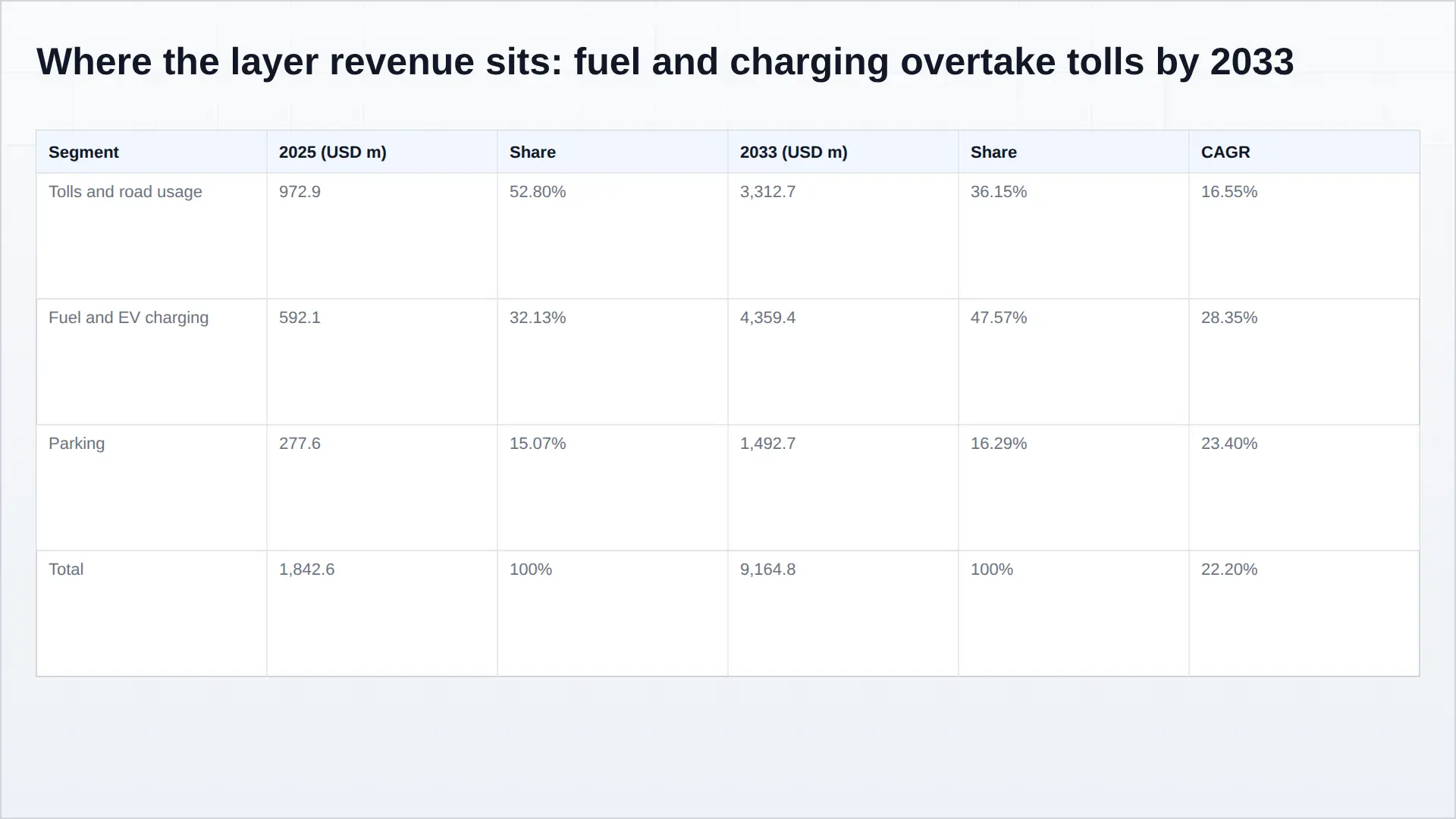
In Pheonix Research’s sizing of the in-vehicle payment layer, tolls and road usage are the largest segment in 2025 at USD 972.9 million, or 52.80% of a total market of USD 1,842.6 million. They are also the slowest-growing: 16.55% a year to USD 3,312.7 million in 2033, at which point they are 36.15% of a market that has reached USD 9,164.8 million.
That position is not a forecast of decline. It is a forecast of a category that has already banked its easiest growth. Tolling is the one category where the vehicle genuinely is a payment device and has been for thirty years: the transponder in the windscreen is a credential, the gantry is a reader, and the settlement is account-based. Everything the in-vehicle payment industry says it wants to build already exists in tolling — which is precisely why tolling has so little left to convert.
The growth that remains comes from three sources, and only one of them involves the vehicle. New schemes, like New York’s, create new charging events. Interoperability widens the number of authorities a single credential can pay, which converts national transponder businesses into regional service businesses. And the physical tag itself slowly gives way to plate-based and app-based identification, which reduces cost per transaction but also reduces the vehicle’s role.
One contract, one device — and then no device
The European rulebook made the interoperability case explicit. Directive (EU) 2019/520, consolidated in force since March 2022, established the European Electronic Toll Service on the principle that a road user should be able to pay for a journey across the Union under a single contract and a single on-board device. It created a class of EETS providers who are neither the toll authority nor the vehicle manufacturer, and whose entire commercial existence rests on holding a credential that works everywhere.
The United States has been solving the same problem through an industry programme rather than legislation. The tolling associations and the federal highway administration have been converging on shared business rules and a common integrated client device standard, with staged effective dates running through the middle of the decade — the device standard taking effect at the end of 2025 and the business rules revised alongside it, supported by regional interoperability efforts.
Read the direction of travel. Europe legislated a single device. The United States standardised a common one. Both then watched the underlying technology make the device optional, because a plate and an account do the same job without a windscreen-mounted object. The credential is becoming software, and software credentials belong to whoever holds the account — not to whoever holds the hardware.
Where the vehicle actually is the credential
There is one large category where the vehicle genuinely holds the payment credential, and it is not tolling. It is charging.
ISO 15118 defined an interface in which a vehicle presents a contract certificate to a charge point and is authenticated and billed with no card, no app, no tag and no human action. That is Plug & Charge, and its second edition, ISO 15118-20, extended it to bidirectional charging and to a multi-PKI architecture in which certificate authorities compete for the trust anchor rather than a single body owning it. CharIN, which governs the Plug & Charge ecosystem, moved its V2G public key infrastructure to an external operator in 2024 — an unglamorous transaction with large strategic content, because whoever operates the trust anchor for vehicle certificates sits underneath every session that uses one.
Now put the two categories side by side. Tolling: a plate, a camera, an account — the vehicle is observed. Charging: a certificate in the vehicle, verified by the charger, settled on an account — the vehicle is a party. One of those is a payment market and the other is a billing market, and the difference explains why fuel and EV charging grow at 28.35% a year while tolling grows at 16.55%.
The floor case is not the technology
It is worth being precise about what would have to go wrong for this market to disappoint. Pheonix Research puts the floor case — in which the deployed in-car interface does not improve — at roughly 6,200 million sessions in 2033 at USD 0.78 of revenue per session, or about USD 4,836.0 million, a 12.82% CAGR. The high case, with an optimised interface shipped broadly, is roughly 14,900 million sessions at USD 0.86, or USD 12,814.0 million, a 27.43% CAGR.
Neither case turns on tolling. Tolling is the stable part; its growth is set by statute, by interoperability adoption and by the political willingness of jurisdictions to charge for road use. The variance sits in parking and fuelling, where the vehicle’s claim to the session depends entirely on whether the confirmation is faster than a phone. That is why the architectural question raised by New York matters so much: if road pricing can be collected without a vehicle credential, then the vehicle credential has to earn its place on the forecourt and in the car park, where the competition is a phone that already works.
The counter-argument, which is strong
The best argument against all of this is that account-based collection is not free. A camera network, an image-review operation, an exceptions process and a customer service function are real costs, and they scale with dispute volume rather than with revenue. A plate-read error in a toll lane produces a mailed invoice, a call, and occasionally a complaint to a regulator. A vehicle credential that settles automatically produces none of those things.
That is the same cost-to-serve logic that makes in-vehicle payment attractive in parking — where the displaced object is a pay-and-display machine — and in fuelling, where the displaced object is the outdoor payment terminal now being replaced across roughly 1.9 million US dispenser devices in a programme estimated at close to USD 8.9 billion. Tolling authorities face the same arithmetic: the cheapest session is the one that never becomes a customer-service event.
So the realistic outcome is not that the vehicle is excluded from tolling. It is that tolling splits. Plate-based collection becomes the default for occasional users, visitors and rental vehicles, where enrolment cannot be assumed. Account-based vehicle credentials become the default for the high-frequency commuter, because that is where the exception cost is concentrated. The volume goes to the plate; the margin stays with the credential.
What that means for the participants
The incumbents that hold authority accounts — Cubic, Siemens and their peers — are structurally protected in either outcome, because the back office is the back office whether the identity arrives by plate or by certificate. Their risk is not disintermediation; it is that the transaction fee they earn per session deflates as the identity becomes cheaper to establish.
The card schemes, Visa Inc. and Mastercard, are the quiet beneficiaries of the split, because a vehicle credential in a charging session or a parking session is usually a tokenised card underneath. The OEMs that can bind that credential at delivery — General Motors, BMW, Ford Motor Company, Toyota — hold the option on the high-frequency, high-margin half of the tolling market without having to build anything new.
And the suppliers in the middle, Robert Bosch among them, are exposed to the same pressure they face everywhere in this market: the integration work is necessary, the position is valuable, and the fee is contested by everyone senior to it. Fuel brands such as Shell retain the simplest lever of all — the choice of whether to accept the credential the car presents.
New York proved that road pricing works as a revenue instrument. It also proved that it does not need the car to be a payment device. The in-vehicle payment market has to be won somewhere else, and 2026 is when it becomes clear whether it will be.
Frequently Asked Questions
How much did New York's congestion pricing raise in its first year?
Congestion pricing went live in New York on 5 January 2025 at USD 9 for a peak crossing by E-ZPass users, reduced from the USD 15 originally proposed, and USD 2.25 overnight. The programme raised roughly USD 562 million net of operating costs in its first year, ahead of its USD 500 million target.
Does congestion pricing create in-vehicle payment sessions?
No. The scheme identifies a vehicle by its number plate, matches it to an account and bills it, so the vehicle never presents a payment credential. That is why the fastest-growing category of road pricing does not necessarily create in-vehicle payment sessions, and why tolling is the slowest-growing segment in the in-vehicle payment layer at 16.55% a year.
Where does the vehicle genuinely hold the payment credential?
In charging. ISO 15118 Plug & Charge lets a vehicle present a contract certificate to the charge point and be billed with no card, app or tag. ISO 15118-20 extended the standard to bidirectional charging and a multi-PKI trust architecture. That is why fuel and EV charging grows at 28.35% a year while tolling grows at 16.55%.
How big is the tolling share of the in-vehicle payment market?
Tolls and road usage are 52.80% of the USD 1,842.6 million in-vehicle payment layer in 2025, falling to 36.15% of the USD 9,164.8 million market in 2033 as fuel and EV charging reach 47.57%. Tolling remains the most defensible seat in the value chain and the least able to grow.