
Editorial Article
The Car Knows Which Pump You Are At — and That Is the Only Reason In-Car Payment Will Work
Put a driver in a car that can pay for fuel from the central screen and roughly one in five will tell you they are extremely likely to use it. Change nothing except the interface, and that number goes above nine in ten. The gap between those two figures is the most expensive design problem in the automotive industry right now, and it is worth somewhere between four and thirteen billion dollars by 2033.
The numbers come from a 2025 study run by Parkopedia with Drive Research, which put real drivers in the United States and Germany in front of two working in-car payment systems: the product as deployed on current production vehicles, and an optimised equivalent. Around 20% said they were extremely likely to use the first. More than 90% said the same of the second. In both markets, 97% said they would consider in-car payment for all vehicle transactions — parking, charging, fuel, tolls — if it were easy to use.
Read that carefully. The consumer is not rejecting in-car payment. The consumer is rejecting a specific product. That is a very different problem, and it is the one the industry keeps failing to solve.
What the car knows that the phone does not
The case for paying from the dashboard rests on one asset the phone has never had: presence. The vehicle knows it is standing at pump four of a specific forecourt, in bay 221 of a specific car park, under gantry 14 at 08:14. A phone knows roughly where it is. A car knows exactly what it is at, and that precision is the only durable reason to move a payment session off a device that already holds a card.
Everything else is worse in the car. The screen is worse than a phone for typing. The authentication options are worse. The merchant catalogue is worse, assuming it exists at all. If the session requires discovery, browsing or data entry, the phone wins on every dimension and will keep winning. If the session requires only confirmation — this pump, this amount, yes — the car wins, and it wins decisively enough to justify the integration cost.
That distinction explains almost every commercial outcome in this category. The deployments that work are one job wide. The deployments that were killed were catalogue-shaped.
The failure the industry already paid for
In late 2017, General Motors launched an in-dash commerce marketplace that let drivers order coffee, find a hotel and reserve a table from the vehicle’s screen. It was the most ambitious version of this idea anyone shipped. It was discontinued in March 2022 because the usage never arrived.
The lesson taken from that episode was that drivers do not want to shop in cars. The lesson that should have been taken is narrower and more useful: drivers do not want to browse in cars, and a merchant marketplace is a browsing product. Nobody has ever needed a marketplace to buy petrol. They need to pay for the petrol they are already standing next to.
The counter-example is unglamorous. BMW’s in-car fuel payment, delivered with Parkopedia and live in Germany from September 2024, covers seven fuel brands, lets the driver confirm the station and the pump from the central screen, and reaches a base of more than 500,000 BMW customers in that market alone. Škoda has run parking payment in the car since 2022 across sixteen markets and added fuel payment in 2023 across eight. Neither is a platform play. Both are single-job products, and both are monetised as features inside a subscription rather than as transaction fees.
Four ways a session dies
The difference between the 20% product and the 90% product is not intelligence. It is a short list of failure modes, and they are consistent across deployments.
- Stale merchant mapping. The car offers a fuel brand or a car park that has closed, changed operator or changed tariff. Every instance costs one session and teaches the driver to reach for the phone next time. The transaction is small; the lost habit is not.
- Session binding errors. The pump or the bay is identified incorrectly and the transaction settles against the wrong site. It is rare, and disproportionately damaging, because it is the failure drivers tell other drivers about.
- Authentication fallback loops. A PIN pad in a moving vehicle is a bad interface and an in-vehicle biometric is not always available. When fallback drops the driver into a phone app, the whole proposition dissolves at the moment of payment — the worst possible place to lose a customer.
- No receipt, no expense record. Underweighted in consumer deployments and decisive in commercial ones. A session that does not produce a reconcilable record is a session a fleet manager will not authorise twice.
None of these is a research problem. Each is an integration and product-management problem, and each is fixable at a fraction of the cost of getting the vehicle’s connectivity stack right. That is precisely why the gap between 20% and 90% should be read as an opportunity rather than a warning: the industry has already paid for the hard part and is losing the revenue on the easy part.
Why the stake is smaller than the headline — and why that matters more
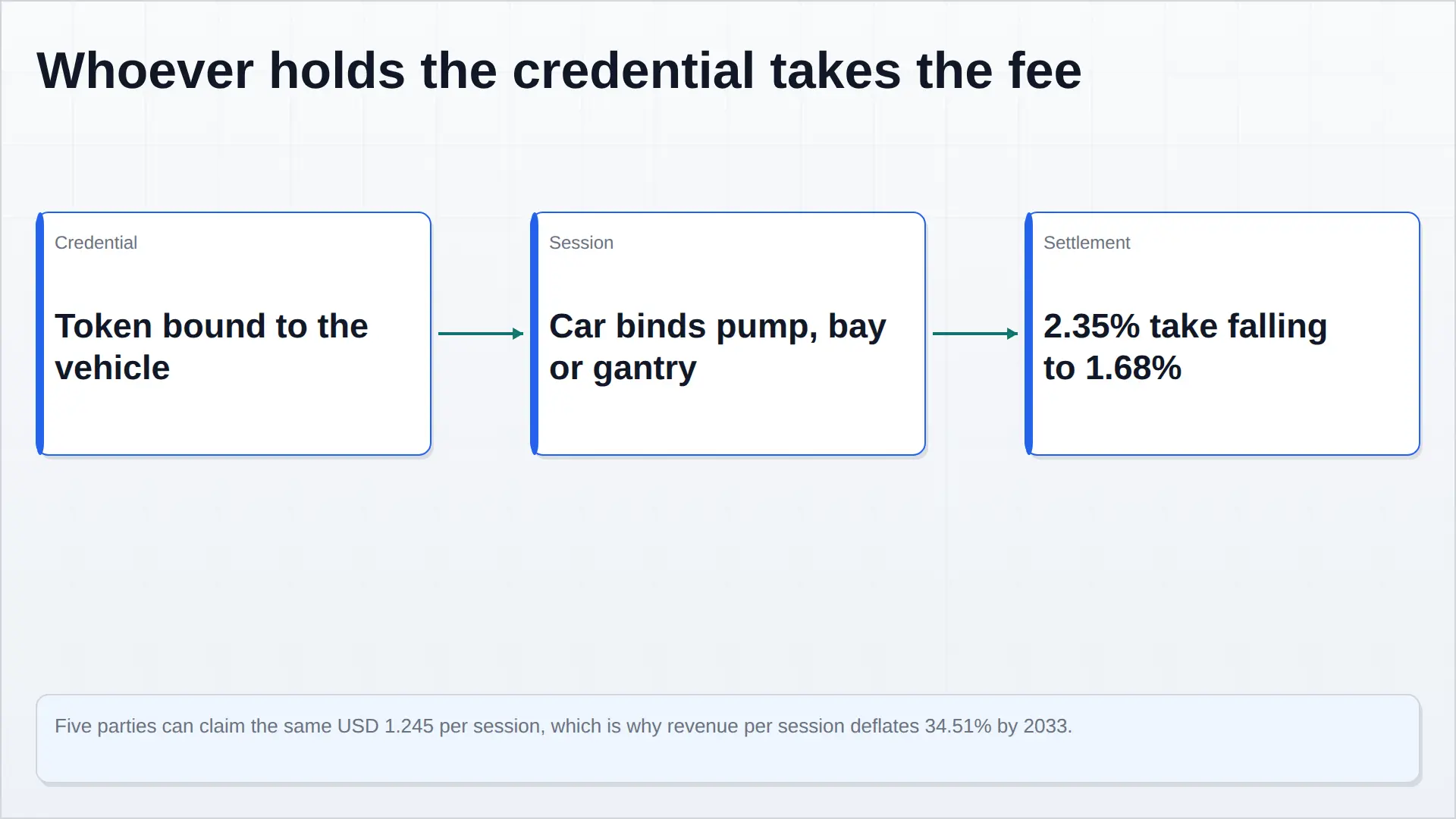
In Pheonix Research’s sizing of this market, the in-vehicle payment layer — the fees, not the fuel — earned USD 1,842.6 million in 2025 and reaches USD 9,164.8 million in 2033, a 22.20% CAGR. Revenue per session, though, falls from USD 1.245 to USD 0.8154 over the same period, a decline of 34.51%. Session volume grows 7.6 times while the fee per session falls by a third, and the two effects almost cancel.
| Scenario to 2033 | Sessions (million) | Revenue per session (USD) | Layer revenue (USD m) | CAGR |
|---|---|---|---|---|
| Floor — deployed interface does not improve | 6,200 | 0.78 | 4,836.0 | 12.82% |
| Base | 11,240 | 0.8154 | 9,164.8 | 22.20% |
| High — optimised interface ships broadly | 14,900 | 0.86 | 12,814.0 | 27.43% |
Almost the entire spread between the floor and the high case is a product decision. It is not a battery chemistry problem, a regulatory problem or a merchant-acceptance problem. It is whether the confirmation screen works, whether the pump is correctly identified, and whether the receipt arrives. Very few markets of this size concentrate their variance so completely in something so mundane.
Which is also why the take-rate story is a trap. A platform that models this business as a percentage of transaction value will over-forecast every year for eight years, because the volume that actually arrives is weighted toward two categories with almost no room to pay: regulated road pricing, and fuel retail operating on a margin that cannot fund a platform fee out of a litre. The money in this market is not in the fee. It is in the installed position — the credentialed vehicles, the merchant contracts and the head-unit integration — which is why the successful players sell it as a subscription feature and treat the transaction fee as a rounding error with strategic value.
What to watch in 2026
Three signals will tell you within a year whether the optimised interface is shipping or whether the industry is going to spend another cycle at one in five.
The first is whether in-car fuel payment arrives on more than one OEM’s volume models in more than a handful of markets. The second is whether the payment rails become invisible to the driver: vehicle-bound tokens at Visa Inc. and Mastercard are the plumbing that makes one-tap confirmation possible, and platform announcements that lead with the credential rather than the merchant list are the ones worth taking seriously. The third is whether the tolling incumbents — Cubic, Siemens — start treating a vehicle credential as an alternative to a transponder rather than as a threat to one.
The manufacturers with the most to gain are the ones with the largest credentialed fleets: General Motors, BMW, Ford Motor Company and Toyota, each of which has already bound a payment instrument to a vehicle for a subset of its customers. The suppliers with the most to lose are the ones in the middle of the chain — Robert Bosch and the cockpit platform providers — whose position is valuable precisely until an OEM decides to sign the merchant contracts itself.
And the fuel brands, Shell among them, hold the option that nobody discusses: they can decline to be payable from the car at all. Whether they exercise it depends entirely on whether the dashboard converts at one in five or nine in ten.
Frequently Asked Questions
How big is the gap between deployed in-car payment and an optimised version?
A 2025 study by Parkopedia and Drive Research tested production in-car payment systems against an optimised equivalent with real drivers in the United States and Germany. Around 20% of drivers said they were extremely likely to use the production system; more than 90% said the same of the optimised one. In both markets 97% said they would consider in-car payment for all vehicle transactions if it were easy to use.
Why did the first generation of in-car marketplaces fail?
General Motors launched an in-dash commerce marketplace in 2017 and discontinued it in March 2022 because usage never arrived. The problem was the product shape, not the channel: a merchant catalogue asks a driver to browse. Successful deployments since have been single-job integrations, such as BMW's in-car fuel payment in Germany from September 2024, which covers seven fuel brands on the strength of a confirmation screen rather than a shop.
If the technology works, why does revenue per session fall?
Because so much of the growth is consumed by a falling fee per session. Pheonix Research puts layer revenue at USD 1,842.6 million in 2025 rising to USD 9,164.8 million by 2033, a 22.20% CAGR, while revenue per session falls 34.51% from USD 1.245 to USD 0.8154 as volume shifts toward low-ticket parking and thin-margin fuel. Volume accounts for 166% of net growth and price/mix subtracts 66%.
What are the four failure modes that cap in-car payment conversion?
Stale merchant mapping, incorrect pump or bay binding, authentication fallback loops that push the driver back into a phone app, and the absence of a receipt or expense record. None of these is a research problem; each destroys sessions and, more expensively, teaches drivers not to try again.