
Editorial Article
Three Hours of Endurance, Thirty Minutes of Permission
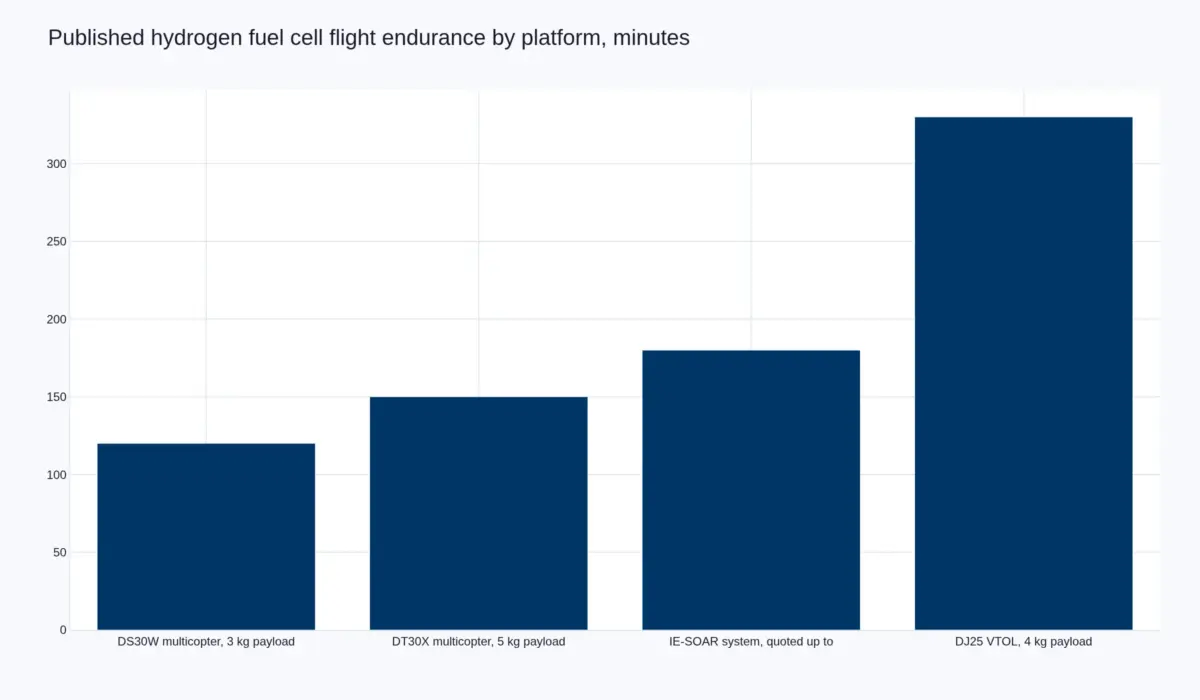
Doosan Mobility Innovation publishes an endurance figure for its DJ25 VTOL that no battery multicopter has matched at that payload: 330 minutes at 4 kg. Its DT30X claims 150 minutes at 5 kg, and its smaller DS30W 120 minutes at 3 kg. Intelligent Energy quotes flight times of up to three hours for aircraft carrying its IE-SOAR system, which spans 800 W to 2.4 kW.
Those numbers are not marketing. They are the output of a hydrogen fuel cell running on a drone that has already flown, repeatedly, in front of people who check.
And they are, at the moment, largely unusable.
The engineering problem is closed. The legal one is not.
An uncrewed aircraft has two constraints on how far it can go: how long it can stay up, and how far the regulator will let it travel while somebody on the ground can still see it. In most jurisdictions the second constraint binds first, and by an enormous margin.
Under visual-line-of-sight rules, a drone operator must keep the aircraft in sight — unaided, in practice a few hundred metres to a couple of kilometres depending on the airframe and the conditions, with a trained observer looking at the sky rather than at a screen. That single requirement does most of the work of defining which missions are possible. Inspection of a wind turbine, a power line, a pipeline, a rail corridor or a coastal search area is not a hover; it is a transit. If you cannot transit, endurance is a specification looking for a use.
Which is why the November 2025 flight in Wales mattered more than its press coverage suggested. Intelligent Energy put an IE-SOAR system into a 25 kg six-blade hexacopter and flew it from Llanbedr, in north Wales, into Eryri National Park and up to 10 km offshore, with a command-and-control chain combining protected-spectrum radio, cellular and satellite links, coordinated by BT with uAvionix and Skyfarer. The achievement was not that a fuel cell powered a drone. It was that the flight happened beyond visual line of sight, which required satisfying the UK Civil Aviation Authority that the aircraft could be supervised without being seen.
That is what a three-hour fuel cell is actually waiting for: not a better membrane, but a permission.
The docket that carries a market
Pheonix Research models uncrewed aircraft at USD 71.0 million of a USD 218.0 million portable hydrogen fuel cell market in 2025 — 32.6% — rising to USD 437.0 million of USD 1,046.0 million by 2033, or 41.8%. No other application gains share over that period.
That forecast is not primarily a technology forecast. It is, in a fairly literal sense, a forecast about a rulemaking. In the United States the instrument is the Federal Aviation Administration’s Part 108 — formally “Normalizing Unmanned Aircraft Systems Beyond Visual Line of Sight Operations”, tracked in the regulatory agenda as RIN 2120-AL82 — whose projected final-rule date is 2026.
Treat the timeline as the load-bearing assumption, because it is. If final rules land on schedule and are operationally usable, the endurance advantage converts into missions: corridor inspection, long-line survey, offshore monitoring, delivery over distance, and the search-and-rescue work that is currently done by helicopter at a cost per hour that no drone operator can approach. If the rule slips two years, or lands with restrictions that keep most flights inside visual range in practice, then a large part of the modelled 2033 uncrewed value simply moves to the right — and the suppliers carrying the certification cost carry it for longer, against the same cash runway.
This is an unusual thing to write in a market analysis: the biggest single variable in a hardware forecast is a publication date. It is nonetheless true here, and pretending otherwise would flatter the technology and mislead the buyer.
The lag is not neutral. It has favourites.
Regulatory delay is usually described as bad for everybody. It is not. It is bad for entrants and good for whoever is already certified.
A drone operator who wants to fly a fuel cell beyond visual line of sight needs to demonstrate a command-and-control architecture, a hydrogen storage arrangement that satisfies dangerous-goods rules, an airframe with a documented power system, and a maintenance regime. Every one of those is a file. Companies that have already built the file — Doosan with its integrated powerpack, vessel and refilling package; Intelligent Energy with a flight-proven system and a regulator that has seen it — start the next conversation from a different place than an integrator assembling a stack and a tank for the first time.
The delay also freezes the shape of the supply chain. Cartridges have to reach the operating site. A hydrogen vessel is a dangerous good, which means it moves under 49 CFR 173.311 and ISO 16111 if it is metal hydride, capped at 150 litres and 25 MPa, and it carries a requalification obligation on a five-year cycle. Operators who solve that once, in one jurisdiction, have a template. Operators who have never done it are estimating. Two years of regulatory limbo is two years in which the template becomes the standard.
The third-order effect is on the airframe makers. A drone designed around a battery has a certain mass budget, a certain thermal profile and a certain centre of gravity. A drone designed around a fuel cell and a hydrogen vessel is a different aircraft. The manufacturers who co-designed airframe and powerplant — rather than bolting a fuel cell onto an existing battery airframe — will be the ones whose platforms are already flying when the rule lands. Doosan’s product line reads like exactly that: airframes, powerpacks, vessels and refilling equipment, sold as one thing.
What operators are actually buying, and what that means for price
No operator buys flight minutes. They buy missions per operating day, and a mission’s value is set by the customer, not the aircraft.
That reframing changes the economics in the fuel cell’s favour. A pipeline inspection contractor charging by the kilometre of corridor surveyed does not care that a fuel cell system costs more than a battery pack; they care that one aircraft and one crew can cover a corridor that previously required three battery changes and a vehicle repositioned at each end. The relevant comparison is not fuel cell versus battery on capital cost. It is fuel cell versus a second crew, a second vehicle and a generator to recharge in the field.
It also explains why this market’s prices behave the way they do. Pheonix Research models revenue per portable hydrogen fuel cell system falling from USD 10,140 in 2025 to USD 6,983 in 2033 — 4.56% a year — while unit volumes compound at 27.46%. The stack inside the aircraft is deflating with every other stack on the market; the certification, the integration and the fuel logistics around it are not. An operator buying in 2033 will pay roughly a third less per system than one buying in 2025, and will be buying a materially more capable mission.
The uncomfortable question
There is a version of the next five years in which hydrogen drone endurance becomes a technical achievement that the market never pays for — a specification that appears in tenders, wins demonstrations, and is then not procured because the operational authority stayed narrow and a battery flight of well under an hour turned out to be enough for the missions that were actually permitted.
That is not a remote scenario. It is what happened to the consumer fuel cell: the engineering arrived, the surrounding system did not, and the product died of a missing interface rather than a missing capability. The difference this time is that the missing interface is being negotiated in public, by a regulator, on a published timetable.
The full market analysis — value chain, technology, competitive landscape, regulatory landscape, investment activity and market risk — is published as the Global Portable Hydrogen Fuel Cell Market Report, Size, Share and Forecast 2026–2033 in the Hydrogen & Electrolysers segment. The hydrogen supply this market depends on is analysed in the Global Hydrogen Electrolyser Market report.
Frequently Asked Questions
How long can a hydrogen fuel cell drone actually fly?
Doosan publishes 330 minutes for its DJ25 VTOL with a 4 kg payload, 150 minutes for the DT30X at 5 kg, and 120 minutes for the DS30W at 3 kg. Intelligent Energy quotes flight times of up to three hours for aircraft carrying its IE-SOAR system, which spans 800 W to 2.4 kW. These are manufacturer figures, not independently audited flight data.
Why doesn't every drone operator use hydrogen fuel cells?
Because endurance is not the binding constraint. Under visual-line-of-sight rules an operator must keep the aircraft in sight, which rules out the long transits that make endurance valuable. Beyond that, a hydrogen vessel is a dangerous good that must move under 49 CFR 173.311 and ISO 16111, and the system carries certification and requalification obligations a battery pack does not.
What is FAA Part 108 and why does it matter?
Part 108 is the Federal Aviation Administration's rulemaking formally titled Normalizing Unmanned Aircraft Systems Beyond Visual Line of Sight Operations, tracked in the regulatory agenda as RIN 2120-AL82. Its projected final-rule date is 2026. It is the instrument that converts drone endurance from a demonstration into a commercially operable service in the United States.
What happens to the fuel cell drone market if the rule is delayed?
The market defers rather than disappears. Pheonix Research models uncrewed aircraft at 41.8% of a USD 1,046.0 million market in 2033, and treats a slip beyond 2026 as the single largest identifiable risk: roughly a third of that 2033 uncrewed value depends on the rule landing on schedule and being operationally usable.