
Global Elderly Care Market Report, Size, Share and Forecast 2026–2033
Global Elderly Care Market Forecast Snapshot (2026???2033)
| Metric | Value |
|---|---|
| Market Size (2025) | USD 1,185.40 Billion |
| Market Size (2033) | USD 2,067.85 Billion |
| CAGR (2026???2033) | 7.21% |
| Largest Segment | Home-Based Elderly Care Services |
| Fastest Growing Segment | Digital Health & Remote Monitoring Solutions |
| Leading End-Use Segment | Individuals Aged 65 Years and Above |
| Key Trend | Aging-in-Place Care Models, Telehealth & Smart Care Technologies |
| Regulatory Influence | Healthcare Quality Standards, Long-Term Care Regulations & Senior Welfare Policies |
| Future Outlook | Growth Driven by Aging Population, Chronic Disease Management & Technology-Enabled Care |
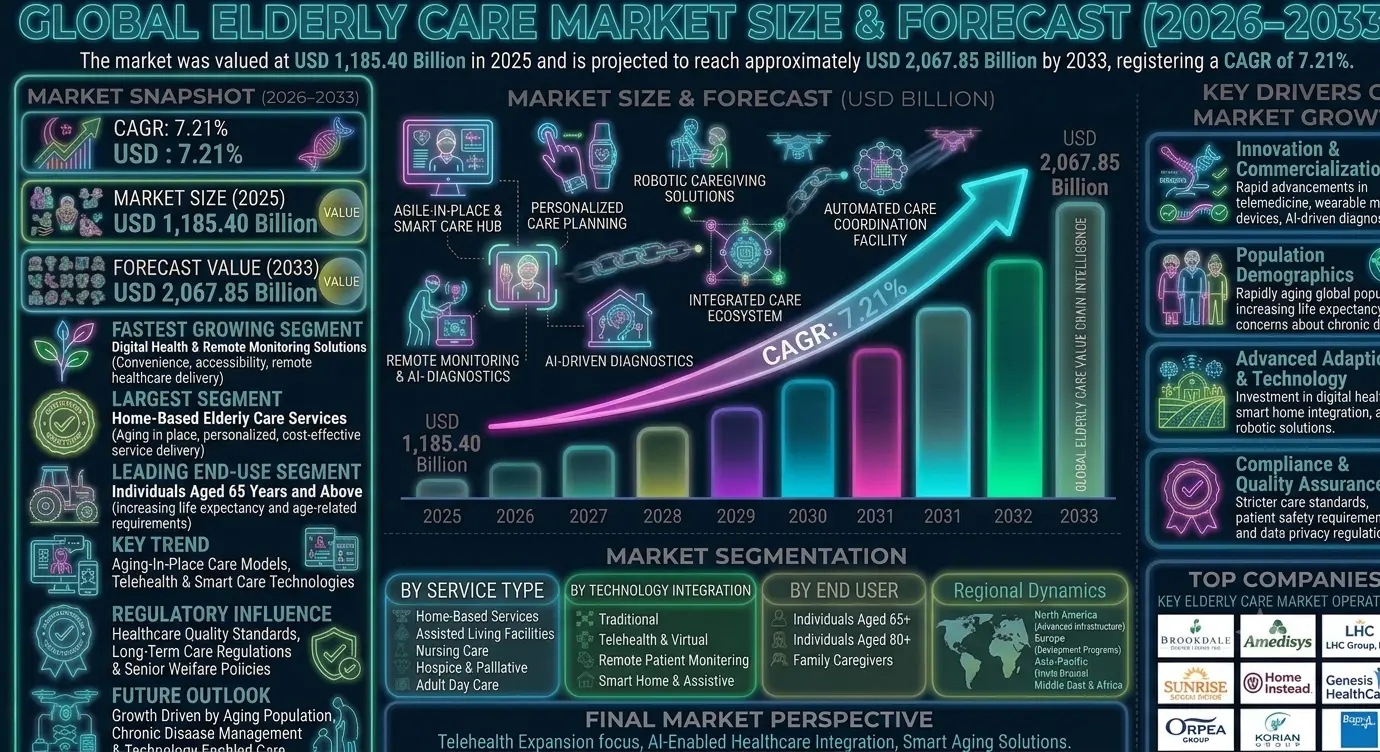
Global Elderly Care Market Size & Forecast
The Global Elderly Care Market is expected to witness strong growth during the forecast period from 2026 to 2033. The market was valued at USD 1,185.40 billion in 2025 and is projected to reach approximately USD 2,067.85 billion by 2033, registering a CAGR of 7.21%. The market growth is primarily driven by the rapidly aging global population, increasing life expectancy, rising prevalence of chronic diseases, and growing demand for long-term healthcare and support services. Elderly care services are increasingly critical for healthcare management, assisted living, rehabilitation, personal care, and independent aging support. The adoption of telehealth platforms, wearable monitoring devices, and AI-enabled healthcare solutions is accelerating market expansion. In addition, growing healthcare expenditure, family structure changes, and government initiatives focused on senior welfare are supporting long-term market growth.Global Elderly Care Market Overview
Elderly care refers to a broad range of healthcare, personal assistance, social support, and residential services designed to improve the quality of life for aging populations. The market includes home healthcare, assisted living facilities, nursing care services, adult day care centers, hospice care, telehealth services, and remote patient monitoring solutions. Elderly care services are widely utilized for chronic disease management, post-acute care, mobility support, cognitive care, rehabilitation, and daily living assistance. The market is evolving toward personalized care delivery, digital health integration, smart home healthcare systems, and aging-in-place care models.Structural Drivers of Market Growth
1. Innovation and Commercialization Acceleration
Rapid advancements in telemedicine, wearable health monitoring devices, AI-driven diagnostics, robotic caregiving solutions, and smart home healthcare technologies are transforming elderly care delivery. Technology-enabled care is improving patient outcomes, reducing hospital visits, and enhancing independence among seniors.Market Implications
Companies investing in digital health platforms, remote monitoring systems, and AI-enabled care solutions are expected to strengthen market leadership.2. Compliance and Risk Repricing
Healthcare quality regulations, long-term care standards, patient safety requirements, data privacy regulations, and elder protection policies are influencing market modernization. Governments worldwide are implementing frameworks to ensure safe, accessible, and high-quality care services for aging populations.Market Implications
Firms offering compliant, secure, and quality-focused elderly care solutions are likely to gain stronger market trust and adoption.3. Competitive and Value-Chain Reconfiguration
The market is highly competitive as healthcare providers, assisted living operators, home healthcare agencies, technology companies, and insurance providers expand senior care services. Integrated care ecosystems and partnerships between healthcare providers and technology firms are reshaping value chains.Market Implications
Companies focusing on integrated care delivery, digital transformation, and patient-centered services may achieve stronger market positioning.4. Capital and Capacity Scaling
Rising investments in senior housing communities, home healthcare infrastructure, telehealth platforms, and healthcare workforce development are supporting market expansion. Increasing demand for long-term care services is encouraging capacity expansion across developed and emerging markets.Market Implications
Organizations scaling care facilities, technology capabilities, and service networks are expected to capture future opportunities.Market Segmentation Analysis
By Service Type
1. Home-Based Elderly Care Services
This remains the largest segment due to strong preference for aging in place, personalized care, and cost-effective service delivery.2. Assisted Living Facilities
Growing demand driven by increasing need for supervised living environments and support services.3. Nursing Care Services
Widely utilized for medical care, chronic disease management, and rehabilitation support.4. Hospice & Palliative Care
Strong adoption for end-of-life care and quality-of-life management.5. Adult Day Care Services
Growing demand due to increasing need for social engagement and daytime supervision.By Technology Integration
1. Traditional Care Services
Largest segment due to established healthcare delivery models.2. Telehealth & Virtual Care
Fast-growing segment driven by convenience, accessibility, and remote healthcare delivery.3. Remote Patient Monitoring
Increasing adoption due to chronic disease management and continuous health tracking.4. Smart Home & Assistive Technologies
Growing utilization for fall detection, medication management, and independent living support.By End User
1. Individuals Aged 65 Years and Above
Largest segment due to increasing life expectancy and age-related healthcare requirements.2. Individuals Aged 80 Years and Above
Fast-growing segment due to higher dependency rates and specialized care needs.3. Family Caregivers
Growing utilization of support services and home care solutions.Regional Market Dynamics
North America
North America dominates the global elderly care market due to advanced healthcare infrastructure, high healthcare expenditure, aging demographics, and strong adoption of digital healthcare solutions.Europe
Europe remains a major market supported by aging populations, government-funded senior care programs, and well-established healthcare systems.Asia-Pacific
Asia-Pacific is the fastest-growing region due to rapidly aging populations, increasing healthcare investments, rising disposable incomes, and expanding senior care awareness.Latin America
Latin America is witnessing gradual expansion due to improving healthcare access and growing demand for elderly support services.Middle East & Africa
The region is experiencing emerging growth supported by healthcare modernization initiatives and increasing awareness of elderly care requirements.Competitive Landscape
The Global Elderly Care Market is highly competitive with healthcare providers, senior living operators, home care agencies, and digital health companies expanding service offerings globally.Key Companies Operating in the Market Include:
- Brookdale Senior Living Inc.
- Amedisys Inc.
- LHC Group, Inc.
- Sunrise Senior Living
- Home Instead, Inc.
- Kindred Healthcare
- Genesis HealthCare
- Orpea Group
- Korian Group
- Bupa plc
Strategic Outlook
The future of the elderly care market will be shaped by telehealth expansion, AI-enabled healthcare, remote monitoring systems, and smart aging solutions. Personalized healthcare plans, predictive analytics, robotic assistance, and digital care coordination platforms will significantly improve service quality and operational efficiency. The rise of aging-in-place care models, preventive healthcare, and connected health ecosystems is expected to create strong long-term growth opportunities.Final Market Perspective
The Global Elderly Care Market remains a critical component of the healthcare and social support ecosystem. Rising life expectancy, increasing chronic disease prevalence, and technological advancements continue driving long-term market growth. Companies capable of delivering scalable, technology-enabled, patient-centric, and high-quality care solutions will be best positioned to capture future opportunities. The convergence of digital health, remote care, smart monitoring, and personalized healthcare is expected to redefine the future of the global elderly care industry.Table of Contents
Table of Contents
- Executive Summary
- Global Elderly Care Market Snapshot (2026???2033)
- Market Size & Growth Overview
- Key Market Highlights
- Largest & Fastest-Growing Segments
- Leading End-Use Segment Overview
- Key Market Trends & Digital Care Transformation
- Strategic Outlook Through 2033
- Market Introduction & Overview
- Definition of Elderly Care Services
- Scope of the Global Elderly Care Market
- Evolution of Senior Care & Long-Term Healthcare Services
- Role of Elderly Care in Modern Healthcare Systems
- Value Chain Analysis of Elderly Care Services
- Regulatory Influence (Healthcare Quality Standards, Long-Term Care Regulations & Senior Welfare Policies)
- Transition Toward Aging-in-Place, Telehealth & Smart Care Models
- Research Methodology
- Primary Research Approach
- Secondary Research Sources
- Market Size Estimation Methodology
- Forecasting Assumptions (2026???2033)
- Data Validation & Triangulation Process
- Market Dynamics
- Structural Drivers of Market Growth
- Innovation and Commercialization Acceleration in Digital Elderly Care Technologies
- Compliance and Risk Repricing in Long-Term Care & Healthcare Regulations
- Competitive and Value-Chain Reconfiguration Across Senior Care Ecosystems
- Capital and Capacity Scaling in Healthcare Infrastructure & Senior Living Facilities
- Market Restraints
- High Cost of Long-Term Care Services
- Shortage of Skilled Caregivers & Healthcare Professionals
- Limited Access to Elderly Care Services in Rural Regions
- Market Opportunities
- Expansion of Telehealth & Virtual Care Platforms
- Growth in Remote Patient Monitoring Solutions
- Increasing Demand for Aging-in-Place Care Models
- Integration of AI, Robotics & Smart Home Healthcare Technologies
- Market Challenges
- Managing Rising Healthcare Costs for Aging Populations
- Ensuring Data Privacy & Security in Digital Healthcare Systems
- Balancing Care Quality with Operational Efficiency
- Structural Drivers of Market Growth
- Global Elderly Care Market Size & Forecast (2026???2033)
- Market Revenue Analysis
- CAGR Analysis
- Demand-Supply Trends
- Pricing & Reimbursement Analysis
- Investment Trends
- Future Market Outlook
- Market Segmentation Analysis (2026???2033)
- By Service Type
- Home-Based Elderly Care Services (Largest Segment)
- Assisted Living Facilities
- Nursing Care Services
- Hospice & Palliative Care
- Adult Day Care Services
- By Technology Integration
- Traditional Care Services (Largest Segment)
- Telehealth & Virtual Care (Fastest-Growing Segment)
- Remote Patient Monitoring
- Smart Home & Assistive Technologies
- By End User
- Individuals Aged 65 Years and Above (Largest Segment)
- Individuals Aged 80 Years and Above (Fastest-Growing Segment)
- Family Caregivers
- By Service Type
- Regional Market Analysis
- North America (Largest Market)
- Europe
- Asia-Pacific (Fastest-Growing Region)
- Latin America
- Middle East & Africa
- Competitive Landscape
- Market Structure & Competitive Intensity Analysis
- Key Player Benchmarking
- Strategic Developments
- Digital Health & Senior Care Innovation Strategies
- Partnerships, Expansion & Care Network Development Trends
- Company Profiles
- Brookdale Senior Living Inc.
- Amedisys Inc.
- LHC Group, Inc.
- Sunrise Senior Living
- Home Instead, Inc.
- Kindred Healthcare
- Genesis HealthCare
- Orpea Group
- Korian Group
- Bupa plc
- Strategic Outlook
- Future of Telehealth & Remote Elderly Care
- AI-Driven Healthcare & Predictive Care Management
- Expansion of Smart Aging & Assisted Living Technologies
- Growth of Personalized & Preventive Healthcare Models
- Long-Term Market Outlook (2033+)
- Final Market Perspective
- Appendix
- About Phoenix Market Research
- Disclaimer
Competitive Landscape
Global Elderly Care Market Competitive Intensity & Market Structure Overview
The Global Elderly Care Market is highly competitive and moderately fragmented, comprising senior living operators, home healthcare providers, nursing care organizations, rehabilitation service providers, and digital health technology companies. Competitive intensity is primarily driven by service quality, healthcare outcomes, technological integration, regulatory compliance, caregiver availability, and geographic coverage.
Companies compete across home-based care, assisted living, nursing care, hospice services, adult day care, and technology-enabled healthcare solutions. Increasing demand for aging-in-place services, chronic disease management, and personalized elderly care is intensifying competition across developed and emerging markets.
The market structure is evolving from traditional institutional care models toward integrated care ecosystems that combine in-home services, telehealth platforms, remote patient monitoring, and smart assistive technologies. Strategic partnerships between healthcare providers, insurance companies, and technology firms are reshaping competitive dynamics throughout the industry.
Global Elderly Care Market Competitive Intensity & Market Structure Current Scenario
Leading Global Elderly Care Market Participants
Brookdale Senior Living Inc.: One of the largest senior living operators globally, offering independent living, assisted living, memory care, and healthcare support services.
Amedisys Inc.: A leading provider of home healthcare, hospice care, and personal care services focused on improving patient outcomes and quality of life.
LHC Group, Inc.: A major home healthcare organization providing skilled nursing, rehabilitation, hospice, and community-based care services.
Sunrise Senior Living: A prominent senior living provider specializing in assisted living, memory care, and personalized elderly support services.
Home Instead, Inc.: A globally recognized home care company offering non-medical assistance, companionship, and aging-in-place support solutions.
Kindred Healthcare: A healthcare services provider focused on rehabilitation, long-term acute care, and post-acute healthcare management.
Genesis HealthCare: A major provider of skilled nursing, rehabilitation therapy, and long-term care services across multiple healthcare settings.
Orpea Group: An international operator of nursing homes, rehabilitation centers, and long-term elderly care facilities.
Korian Group: A leading European elderly care provider offering nursing care, assisted living, and healthcare support services.
Bupa plc: A global healthcare company providing senior care, residential care, health insurance, and wellness-focused healthcare services.
Key Competitive Intensity & Market Structure Drivers
The rapidly growing aging population and increasing prevalence of chronic diseases are intensifying competition among providers seeking to expand care capacity and service offerings.
The adoption of telehealth, remote patient monitoring, AI-enabled healthcare tools, and smart home technologies is creating new opportunities for service differentiation and operational efficiency.
Healthcare quality standards, long-term care regulations, patient safety requirements, and senior welfare policies are encouraging providers to strengthen compliance and care quality.
Growing preference for aging-in-place care models is driving investment in home healthcare services, digital care coordination, and personalized support solutions.
Strategic collaborations between healthcare organizations, insurers, technology companies, and senior housing providers are reshaping industry value chains and competitive positioning.
Strategic Implications of Competitive Intensity & Market Structure
Companies with strong care networks, advanced healthcare capabilities, and established brand trust are expected to maintain significant competitive advantages.
Investment in digital health platforms, remote monitoring systems, predictive analytics, and AI-assisted care management is becoming a critical factor for long-term market differentiation.
Providers focusing on personalized care delivery, integrated healthcare ecosystems, and patient-centered service models are likely to strengthen market positioning.
Strategic expansion into home healthcare, telehealth services, and specialized elderly care programs is enabling organizations to diversify revenue streams and improve patient engagement.
Organizations capable of combining clinical excellence, technology integration, affordability, regulatory compliance, and compassionate care will be better positioned to compete across diverse elderly care segments.
Global Elderly Care Market Competitive Intensity & Market Structure Forward Outlook
The competitive landscape of the global elderly care market is expected to become increasingly technology-driven as digital health platforms, connected care ecosystems, and smart aging solutions gain broader adoption worldwide.
Future competition will be shaped by advancements in telehealth, wearable health monitoring devices, AI-powered care management systems, robotic caregiving technologies, and predictive healthcare analytics.
Providers are expected to increase investments in digital transformation, workforce development, personalized care programs, and integrated healthcare delivery models to strengthen competitive positioning.
Over the forecast period, companies that successfully balance care quality, technological innovation, regulatory compliance, operational efficiency, and patient-centered service delivery will be best positioned to lead the evolving global elderly care market.
Value Chain
Global Elderly Care Market Value Chain & Supply Chain Evolution Overview
The Global Elderly Care Market is experiencing significant transformation driven by rapidly aging populations, increasing life expectancy, rising chronic disease prevalence, and growing demand for long-term healthcare and support services. The market value chain spans healthcare service providers, caregiving professionals, medical equipment suppliers, digital health technology providers, insurance organizations, assisted living operators, and end-user care recipients.
A defining characteristic of the elderly care value chain is the growing integration of healthcare delivery, personal care services, digital health technologies, and social support systems. Service providers are increasingly leveraging telehealth platforms, remote patient monitoring devices, AI-enabled diagnostics, and smart home technologies to improve care accessibility, efficiency, and patient outcomes.
Supply chain complexity continues to increase as care providers coordinate across healthcare professionals, rehabilitation specialists, pharmaceutical suppliers, medical device manufacturers, home healthcare agencies, insurance companies, and government healthcare programs. The industry is shifting toward integrated care ecosystems that combine clinical services, preventive care, and technology-enabled support.
The value chain is evolving into a highly connected, patient-centric, and technology-driven ecosystem focused on delivering personalized, continuous, and cost-effective care for aging populations while supporting independent living and improved quality of life.
Global Elderly Care Market Value Chain & Supply Chain Evolution Current Scenario
Market-Specific Value Chain
- Healthcare Research & Care Model Development: Development of elderly care protocols, chronic disease management programs, telehealth solutions, rehabilitation methodologies, and senior wellness initiatives.
- Medical Equipment & Technology Supply: Production of medical devices, remote monitoring systems, wearable health trackers, mobility aids, assistive technologies, and smart home healthcare solutions.
- Care Service Delivery: Provision of home healthcare, nursing care, assisted living services, rehabilitation programs, hospice care, adult day care, and long-term support services.
- Digital Health & Care Coordination: Telehealth consultations, virtual care platforms, patient monitoring systems, electronic health records, and care management software integration.
- Insurance & Funding Support: Healthcare reimbursement, long-term care insurance, government-funded care programs, and private healthcare financing.
- End User Care Consumption: Elderly individuals, family caregivers, assisted living residents, and patients utilizing healthcare and support services.
Company-to-Stage Mapping
- Healthcare Research & Care Model Development: Healthcare institutions, research organizations, geriatric care specialists, and digital health innovators.
- Medical Equipment & Technology Supply: Remote monitoring technology providers, medical device manufacturers, wearable health technology companies, and assistive equipment suppliers.
- Care Service Delivery: Brookdale Senior Living Inc., Sunrise Senior Living, Home Instead, Inc., Genesis HealthCare, Kindred Healthcare, and Korian Group.
- Digital Health & Care Coordination: Telehealth providers, healthcare software companies, AI-enabled care management platforms, and remote monitoring solution providers.
- Insurance & Funding Support: Bupa plc, healthcare insurers, long-term care financing organizations, and government healthcare agencies.
- End User Care Consumption: Individuals aged 65 years and above, individuals aged 80 years and above, family caregivers, and senior care communities.
Key Value Chain & Supply Chain Evolution Signals in Global Elderly Care Market
Expansion of Aging-in-Place Care Models
Increasing preference among seniors to remain in their homes is driving demand for home healthcare services, remote monitoring technologies, and personalized support solutions.
Growth of Telehealth and Virtual Care Platforms
Digital healthcare solutions are enabling greater access to medical consultations, chronic disease management, and continuous care services without requiring frequent hospital visits.
Rising Adoption of Remote Patient Monitoring Technologies
Wearable devices, health sensors, and connected monitoring systems are improving proactive healthcare management and reducing emergency care requirements.
Integration of AI and Predictive Healthcare Analytics
Artificial intelligence is enhancing diagnostics, risk assessment, medication management, and personalized treatment planning for elderly populations.
Expansion of Assisted Living and Long-Term Care Infrastructure
Growing demand for professional senior care services is encouraging investment in assisted living communities, nursing facilities, and rehabilitation centers.
Development of Smart Home Healthcare Ecosystems
Smart home technologies including fall detection systems, voice assistants, and automated medication management solutions are supporting independent living.
Strategic Implications of Value Chain & Supply Chain Evolution
Investment in Digital Care Technologies
Organizations deploying telehealth platforms, AI-enabled care systems, and remote monitoring solutions can improve care quality and operational efficiency.
Expansion of Home-Based Care Services
Home healthcare providers can benefit from growing demand for personalized and cost-effective care delivered outside traditional healthcare facilities.
Strengthening Integrated Care Networks
Collaboration among healthcare providers, insurers, technology firms, and caregivers can improve patient outcomes and service continuity.
Development of Workforce Training Programs
Investment in caregiver education, nursing workforce expansion, and specialized geriatric training can help address growing service demand.
Growth of Remote Monitoring and Preventive Care Solutions
Continuous health monitoring and early intervention programs can reduce healthcare costs and improve patient well-being.
Enhancement of Senior Living Infrastructure
Expansion of assisted living communities and long-term care facilities can support increasing demand from aging populations worldwide.
Global Elderly Care Market Value Chain & Supply Chain Evolution Forward Outlook
Looking ahead, the elderly care value chain is expected to become increasingly technology-enabled, integrated, and personalized as healthcare providers adopt advanced digital tools and patient-centered care models.
Key Future Developments Include:
- Expansion of telehealth and virtual care services for elderly populations.
- Increased adoption of wearable health monitoring devices and connected care platforms.
- Growth of AI-powered predictive healthcare and personalized treatment planning.
- Expansion of aging-in-place solutions supported by smart home technologies.
- Strengthening of integrated healthcare, insurance, and caregiving ecosystems.
- Investment in long-term care infrastructure and workforce development programs.
As the market evolves, competitive advantage will increasingly depend on the ability to combine healthcare expertise, digital innovation, personalized service delivery, and integrated care coordination within a scalable elderly care ecosystem.
Companies that successfully integrate home healthcare services, telehealth technologies, remote monitoring systems, and patient-centered care models will achieve stronger market positioning, improved care outcomes, and long-term growth in the Global Elderly Care Market.
Investment Activity
Global Elderly Care Market Investment & Funding Dynamics Overview
The Global Elderly Care Market is attracting substantial investment activity driven by rapidly aging populations, increasing life expectancy, rising prevalence of chronic diseases, and growing demand for long-term healthcare and support services. Healthcare providers, senior living operators, private equity firms, insurance companies, institutional investors, and technology companies are actively investing in home-based care services, assisted living facilities, telehealth platforms, remote monitoring systems, and AI-enabled elderly care solutions.
Investment momentum is accelerating as governments and private organizations prioritize healthcare accessibility, aging-in-place initiatives, and technology-enabled care delivery. Capital allocation is increasingly focused on digital health infrastructure, senior housing developments, smart care technologies, caregiver support platforms, and integrated elderly care ecosystems.
Additionally, growing investments in remote patient monitoring, wearable healthcare devices, robotic caregiving systems, predictive healthcare analytics, and personalized senior wellness programs are creating significant long-term opportunities across the global elderly care industry.
Global Elderly Care Market Investment & Funding Dynamics Current Scenario
Currently, the market is witnessing strong capital deployment as healthcare providers and senior care organizations expand capacity to address rising demand for long-term care services. Industry participants are investing heavily in home healthcare networks, assisted living communities, nursing care facilities, telehealth platforms, and digital patient management systems.
The market is benefiting from government-supported senior welfare initiatives, healthcare modernization programs, and reimbursement reforms aimed at improving elderly care accessibility and quality. Significant investments are being directed toward care facility expansion, workforce development, digital care coordination platforms, and healthcare technology integration.
Furthermore, strategic partnerships among healthcare providers, insurance companies, technology firms, senior housing operators, and remote care specialists are reshaping investment flows and accelerating innovation across the elderly care value chain.
Key Investment & Funding Dynamics Signals in Global Elderly Care Market
- Growing demand for home-based elderly care services is driving large-scale investments in community and in-home healthcare delivery models.
- Expansion of telehealth and virtual care platforms is increasing capital deployment across digital healthcare infrastructure.
- Government-backed senior welfare programs and healthcare funding initiatives are accelerating investment activity throughout the sector.
- Rising adoption of remote patient monitoring and wearable healthcare technologies is supporting technology-focused funding.
- Strategic investments in assisted living facilities, nursing homes, and senior housing communities are creating long-term growth opportunities.
- Growing focus on chronic disease management, preventive healthcare, and aging-in-place care models is strengthening investment confidence.
- Increasing adoption of AI-driven healthcare analytics, smart home care technologies, and robotic assistance solutions is attracting innovation-led capital.
Strategic Implications of Investment & Funding Dynamics in Global Elderly Care Market
- Continuous investment in digital health technologies and personalized care solutions is essential for maintaining competitive advantage.
- Capital allocation toward home healthcare infrastructure, remote monitoring systems, and senior living facilities will strengthen market positioning.
- Companies developing technology-enabled elderly care platforms and integrated service ecosystems are expected to secure stronger long-term growth opportunities.
- Strategic collaborations between healthcare providers, technology companies, and insurers will accelerate innovation and service expansion.
- Investments in caregiver support tools, automation technologies, and digital patient engagement platforms will remain key growth priorities.
- Compliance with healthcare quality standards, long-term care regulations, patient safety requirements, and senior welfare policies will continue influencing investment decisions.
- Organizations building comprehensive elderly care ecosystems across healthcare, housing, wellness, rehabilitation, and technology services are expected to capture substantial future value.
Global Elderly Care Market Investment & Funding Dynamics Forward Outlook
Looking ahead, the Global Elderly Care Market is expected to maintain strong investment momentum driven by demographic shifts, increasing healthcare demand, technological innovation, and expanding long-term care requirements worldwide.
Future capital deployment will increasingly focus on telehealth platforms, AI-powered care management systems, remote patient monitoring technologies, smart home healthcare solutions, and next-generation senior living infrastructure.
As governments, healthcare organizations, and private investors continue prioritizing healthy aging and care accessibility, investment activity is expected to expand across digital healthcare ecosystems, senior care facilities, preventive care programs, and connected health networks.
In conclusion, the Global Elderly Care Market represents a strategically important healthcare investment landscape where aging-in-place solutions, digital health innovation, remote care delivery, smart monitoring technologies, and integrated elderly care ecosystems will define future funding priorities, competitive dynamics, and long-term industry growth.
Technology & Innovation
Global Elderly Care Market Technology & Innovation Landscape Overview
The Global Elderly Care Market is experiencing rapid technological transformation driven by advancements in telehealth platforms, remote patient monitoring systems, artificial intelligence (AI), wearable healthcare devices, smart home technologies, and assistive robotics. The market demonstrates a high innovation intensity level as healthcare providers, technology companies, and senior care organizations increasingly focus on improving care quality, operational efficiency, patient independence, and long-term health outcomes.
At the center of this transformation is the shift from traditional institutional care models toward digitally connected, patient-centric, and aging-in-place care ecosystems that enable seniors to maintain independence while receiving continuous healthcare support.
A major innovation area is remote healthcare delivery, where telemedicine platforms, virtual consultations, and digital care coordination systems are improving healthcare accessibility and reducing unnecessary hospital visits for elderly patients.
The market is also witnessing significant advancements in wearable health monitoring technologies, including smart watches, biosensors, fall detection devices, heart monitoring systems, glucose tracking devices, and medication adherence solutions.
Healthcare providers are increasingly investing in AI-powered predictive analytics, clinical decision support systems, and personalized care management platforms that help identify health risks, optimize treatment plans, and improve preventive care outcomes.
Product innovation further includes smart home healthcare systems, automated medication dispensers, mobility assistance devices, voice-enabled healthcare assistants, and robotic caregiving technologies that enhance daily living support.
Additionally, IoT-enabled healthcare ecosystems and cloud-based care management platforms are improving communication between seniors, caregivers, healthcare providers, and family members through real-time health monitoring and data sharing.
The convergence of digital health technologies, artificial intelligence, remote monitoring, and personalized care delivery is redefining the future technology landscape of the global elderly care market.
Global Elderly Care Market Technology & Innovation Landscape Current Scenario
Currently, the Global Elderly Care Market is witnessing growing adoption of connected healthcare solutions, smart monitoring systems, and technology-enabled care services that support independent living and chronic disease management.
1. Telehealth & Virtual Care Platforms
Telemedicine solutions are enabling remote consultations, follow-up care, mental health support, and continuous healthcare access for elderly populations.
2. Remote Patient Monitoring Technologies
Connected devices and wearable sensors are providing real-time tracking of vital signs, chronic disease indicators, and overall health conditions.
3. Smart Home Healthcare Systems
IoT-enabled technologies support fall detection, emergency response, environmental monitoring, and independent living assistance.
4. AI-Powered Predictive Healthcare
Artificial intelligence is being used to identify health risks, predict disease progression, and support personalized treatment planning.
5. Assistive Robotics & Mobility Solutions
Robotic technologies are helping seniors with mobility support, rehabilitation, companionship, and routine caregiving activities.
6. Digital Medication Management Platforms
Automated reminders, smart dispensers, and medication tracking systems are improving treatment adherence and patient safety.
Key Technology & Innovation Landscape Signals in Global Elderly Care Market
Several innovation trends are influencing the future development of the market:
1. Rising Adoption of Aging-in-Place Models
Technology-enabled home care solutions are becoming increasingly preferred over institutional care settings.
2. Expansion of Wearable Healthcare Devices
Demand for continuous health monitoring is accelerating adoption of smart medical wearables.
3. Growth of Artificial Intelligence in Healthcare
AI-powered analytics are improving preventive care, risk prediction, and personalized treatment management.
4. Increasing Utilization of Telehealth Services
Virtual healthcare platforms are expanding accessibility and reducing healthcare delivery barriers.
5. Development of Smart Home Ecosystems
Connected living environments are improving safety, comfort, and independence for elderly individuals.
6. Advancements in Caregiving Robotics
Robotic assistance technologies are supporting physical care, rehabilitation, and social engagement.
7. Digital Transformation of Long-Term Care Facilities
Healthcare organizations are implementing integrated digital systems to improve operational efficiency and patient outcomes.
Strategic Implications of Technology & Innovation Landscape in Global Elderly Care Market
The evolving innovation landscape is reshaping competition across the elderly care industry. Organizations are increasingly competing through digital healthcare capabilities, personalized care models, remote monitoring services, and technology-enabled care delivery systems.
Healthcare providers investing in telehealth infrastructure, AI-driven healthcare platforms, wearable monitoring technologies, and smart home care solutions are expected to strengthen long-term market positioning.
Strategic collaborations among healthcare providers, digital health companies, technology developers, insurers, and senior care operators are accelerating innovation and expanding service accessibility.
The growing convergence of connected healthcare ecosystems, predictive analytics, remote care services, and personalized treatment models is creating strong differentiation opportunities throughout the market.
Additionally, compliance with healthcare quality standards, patient safety regulations, elder care policies, and healthcare data privacy requirements is driving continuous technological advancement and service modernization.
Global Elderly Care Market Technology & Innovation Landscape Forward Outlook
Looking ahead to 2026???2033, the Global Elderly Care Market is expected to evolve toward highly integrated digital healthcare ecosystems supported by AI, automation, advanced monitoring technologies, and intelligent caregiving solutions.
Future technological developments are likely to include:
1. AI-Driven Personalized Care Platforms
Artificial intelligence will deliver individualized care plans, predictive health insights, and proactive intervention strategies.
2. Advanced Wearable Monitoring Devices
Next-generation wearable technologies will provide continuous and non-invasive health monitoring with enhanced accuracy.
3. Intelligent Smart Home Healthcare Ecosystems
Connected living environments will automatically monitor health conditions, safety risks, and daily activity patterns.
4. Autonomous Caregiving Robots
Robotic assistants will increasingly support mobility, rehabilitation, companionship, and routine healthcare tasks.
5. Integrated Digital Care Coordination Platforms
Unified healthcare systems will connect patients, caregivers, healthcare providers, and insurers through real-time data sharing.
6. Predictive Preventive Healthcare Solutions
Advanced analytics will enable earlier disease detection, proactive care management, and reduced hospitalization rates.
7. Voice-Enabled & AI-Powered Senior Assistance Technologies
Smart virtual assistants will support medication reminders, emergency communication, health monitoring, and daily living activities.
In conclusion, companies capable of combining telehealth innovation, AI-powered healthcare management, remote monitoring technologies, smart home integration, and personalized elderly care solutions will be best positioned to lead the future evolution of the Global Elderly Care Market.
Market Risk
Global Elderly Care Market Risk Factors & Disruption Threats Overview
The Global Elderly Care Market operates within a rapidly evolving healthcare and social support ecosystem where healthcare providers, home care agencies, senior living operators, rehabilitation centers, insurers, and digital health companies compete to address the growing needs of aging populations. While the market benefits from demographic expansion, rising life expectancy, and increasing healthcare demand, it faces significant structural risks related to workforce shortages, regulatory complexity, reimbursement pressures, and healthcare affordability challenges.
A major structural risk is the growing shortage of qualified caregivers, nurses, therapists, and geriatric healthcare professionals. As elderly populations expand faster than healthcare workforce capacity, service providers face increasing recruitment costs, staff burnout, and operational constraints that may limit care availability.
Another significant disruption factor is dependency on government healthcare programs, insurance reimbursement systems, and long-term care funding mechanisms. Changes in reimbursement policies, healthcare budgets, or public welfare programs can directly impact provider profitability and service accessibility.
The market also faces increasing regulatory scrutiny regarding patient safety, care quality standards, elder protection requirements, workforce certifications, and healthcare data privacy. Compliance obligations continue to expand across both physical care facilities and digital healthcare platforms.
Additionally, rising healthcare costs, inflationary pressures, and affordability concerns may limit access to professional elderly care services, particularly in developing economies where long-term care infrastructure remains underdeveloped.
Global Elderly Care Market Risk Factors & Disruption Threats Current Scenario
The current market is characterized by growing demand for home-based care services, assisted living facilities, chronic disease management programs, and technology-enabled healthcare solutions.
Aging-in-place models are becoming increasingly popular as seniors seek to maintain independence while receiving personalized healthcare support within their homes.
Digital health technologies such as telemedicine, wearable monitoring devices, remote patient monitoring systems, and AI-driven health management platforms are improving care accessibility and operational efficiency.
At the same time, healthcare providers face mounting workforce shortages, rising labor costs, increasing regulatory requirements, and growing pressure to deliver high-quality care while controlling expenses.
Governments and healthcare systems are actively exploring innovative care models to address rising demand while maintaining sustainability within long-term care infrastructures.
Key Risk Factors & Disruption Threats Signals in Global Elderly Care Market
A major disruption signal is the rapid expansion of telehealth and remote monitoring technologies, enabling continuous care delivery while reducing dependency on physical healthcare facilities.
Another important signal is the growing adoption of AI-driven predictive analytics, which can support early intervention, chronic disease management, and personalized treatment planning for elderly populations.
The increasing integration of smart home technologies, connected medical devices, and assistive robotics is transforming traditional care delivery models and enabling greater independence for seniors.
Workforce shortages continue to intensify globally, encouraging automation, digital care coordination, and technology-assisted caregiving solutions to address service gaps.
Healthcare reimbursement reforms and long-term care funding challenges remain critical risk indicators that could significantly influence market growth and provider economics.
Strategic Implications of Risk Factors & Disruption Threats in Global Elderly Care Market
Organizations must invest in workforce development, caregiver retention programs, and operational efficiency initiatives to address growing labor shortages and rising staffing costs.
Investment in telehealth platforms, remote monitoring solutions, AI-enabled diagnostics, and digital care coordination systems will be essential for scaling service delivery and improving patient outcomes.
Providers should diversify revenue streams across home care, assisted living, rehabilitation, digital health services, and chronic disease management programs to reduce dependence on individual reimbursement channels.
Strong compliance frameworks focused on patient safety, healthcare quality standards, elder protection, and data security will become increasingly important for maintaining trust and regulatory approval.
Strategic partnerships among healthcare providers, technology companies, insurers, pharmaceutical firms, and senior living operators will play a critical role in building integrated elderly care ecosystems.
Global Elderly Care Market Risk Factors & Disruption Threats Forward Outlook
Looking ahead to 2026???2033, the Global Elderly Care Market is expected to evolve into a highly integrated, technology-enabled healthcare ecosystem focused on preventive care, chronic disease management, and personalized aging support.
Home-based care services are expected to remain dominant, while telehealth, remote patient monitoring, and smart healthcare technologies will drive the fastest rates of innovation and adoption.
Regulatory frameworks governing care quality, digital health services, patient protection, and healthcare accessibility are expected to become increasingly comprehensive across major markets.
Artificial intelligence, predictive analytics, robotics, and connected healthcare systems will significantly improve care delivery efficiency, patient monitoring, and healthcare outcomes.
Overall, the market will remain highly attractive but operationally complex, with long-term success determined by workforce resilience, technology integration, regulatory compliance, care quality, and the ability to deliver scalable, patient-centric elderly care solutions in an increasingly aging global population.
Regulatory Landscape
Global Elderly Care Market Regulatory & Policy Environment Overview
The regulatory and policy environment governing the Global Elderly Care Market is becoming increasingly important as governments, healthcare authorities, social welfare organizations, and regulatory agencies respond to the challenges associated with rapidly aging populations. Regulations are focused on ensuring high-quality care delivery, protecting the rights and safety of elderly individuals, improving healthcare accessibility, and supporting long-term sustainability of elderly care systems.
Elderly care providers, healthcare institutions, assisted living operators, home healthcare agencies, digital health companies, and insurance organizations must comply with a wide range of regulations covering healthcare quality standards, patient safety requirements, caregiver qualifications, long-term care operations, data privacy, and senior welfare policies. As technology becomes more integrated into elderly care services, regulatory oversight is also expanding to include telehealth services, remote patient monitoring, cybersecurity, and digital health compliance.
The growing emphasis on aging-in-place care models, chronic disease management, and healthcare accessibility is encouraging policymakers to introduce frameworks that improve care quality while supporting innovation in senior care delivery.
Global Elderly Care Market Regulatory & Policy Environment Current Scenario
The current regulatory environment is characterized by increasing government efforts to strengthen healthcare quality standards and improve care outcomes for elderly populations. Regulatory authorities across major markets are implementing policies that establish minimum care standards, staffing requirements, operational guidelines, and patient protection measures for elderly care providers.
Long-term care regulations are playing a critical role in shaping market operations by establishing standards for nursing facilities, assisted living centers, rehabilitation services, and home healthcare providers. Compliance with these standards is essential for licensing, accreditation, and reimbursement eligibility.
Patient safety and elder protection regulations remain central to market oversight. Governments continue to strengthen monitoring mechanisms aimed at preventing neglect, abuse, and inadequate care practices while promoting transparency and accountability across care settings.
Data privacy and healthcare information security regulations are becoming increasingly significant as telehealth platforms, wearable devices, electronic health records, and remote monitoring systems gain widespread adoption. Elderly care organizations must ensure secure management of sensitive patient information while maintaining regulatory compliance.
In addition, public healthcare funding programs, senior welfare initiatives, and reimbursement policies are influencing service accessibility and market expansion, particularly in countries facing significant demographic aging trends.
Key Regulatory & Policy Environment Signals in Global Elderly Care Market
- Healthcare Quality Standards: Regulations establishing service quality benchmarks, caregiver competency requirements, patient care protocols, and performance monitoring systems.
- Long-Term Care Regulations: Standards governing assisted living facilities, nursing homes, home healthcare agencies, rehabilitation centers, and hospice care services.
- Elder Protection & Patient Safety Policies: Frameworks designed to safeguard elderly individuals from abuse, neglect, discrimination, and inadequate care practices.
- Data Privacy & Digital Health Compliance: Regulations addressing patient data security, electronic health records, telehealth services, remote monitoring systems, and cybersecurity requirements.
- Healthcare Reimbursement & Funding Policies: Government programs supporting elderly healthcare access through insurance coverage, long-term care financing, and social welfare benefits.
- Workforce Certification & Training Requirements: Standards governing caregiver qualifications, workforce development, professional licensing, and ongoing training programs.
Strategic Implications of Regulatory & Policy Environment
The evolving regulatory landscape is encouraging elderly care providers to prioritize quality improvement, compliance management, patient safety, and service transparency. Regulatory compliance is increasingly becoming a critical factor influencing provider reputation, market access, and operational sustainability.
Healthcare quality regulations are driving investments in staff training, care coordination systems, patient monitoring technologies, and evidence-based care practices. Organizations capable of consistently meeting regulatory requirements are expected to strengthen their competitive position.
Long-term care standards are creating opportunities for providers that offer high-quality residential care, home healthcare services, and integrated care models that align with government expectations and patient needs.
The expansion of telehealth and remote care services is increasing the importance of digital compliance capabilities, including cybersecurity protection, secure patient communication, and regulatory adherence for connected healthcare systems.
Government reimbursement policies and senior welfare programs are also influencing investment decisions, service expansion strategies, and care delivery models across both developed and emerging markets.
Global Elderly Care Market Regulatory & Policy Environment Forward Outlook
Between 2026 and 2033, the regulatory environment for the global elderly care market is expected to become more comprehensive as governments address the growing healthcare and social support needs of aging populations. Policymakers are likely to strengthen quality standards, long-term care regulations, and patient protection frameworks to ensure sustainable elderly care delivery.
Healthcare authorities are expected to introduce stricter oversight mechanisms focused on care quality measurement, workforce competency, service accountability, and patient outcome monitoring across elderly care settings.
Digital healthcare regulations will likely continue evolving as telehealth, remote monitoring, artificial intelligence, and connected care technologies become increasingly integrated into elderly care ecosystems. Greater emphasis on cybersecurity, interoperability, and data governance is anticipated.
Governments may also expand funding programs, reimbursement support, and policy incentives aimed at promoting aging-in-place care models, home healthcare services, preventive care programs, and technology-enabled senior care solutions.
Overall, the future regulatory landscape will be shaped by the convergence of healthcare quality standards, long-term care regulations, elder protection policies, workforce development requirements, and digital health governance frameworks. Organizations capable of delivering compliant, technology-enabled, patient-centered, and high-quality care solutions will be best positioned to capitalize on long-term opportunities within the evolving global elderly care market.