
Global Posture Corrector Market Report, Size and Forecast 2026-2033
Global Posture Corrector Market Report, Size and Forecast 2026???2033
Market Forecast Snapshot (2025???2033)
| Metric | Value |
|---|---|
| Market Size (2025) | USD 1.45 Billion |
| Market Size (2033) | USD 2.89 Billion |
| CAGR (2026???2033) | 9.01% |
| Largest Region | North America |
| Fastest Growing Region | Asia-Pacific |
| Leading Segment | Smart & Adjustable Posture Correctors |
| Key Trend | AI-Integrated Wearable Posture Devices |
| Regulatory Influence | Consumer Health & Medical Wearable Compliance Standards |
| Future Outlook | Growth Driven by Preventive Healthcare & Ergonomic Awareness |
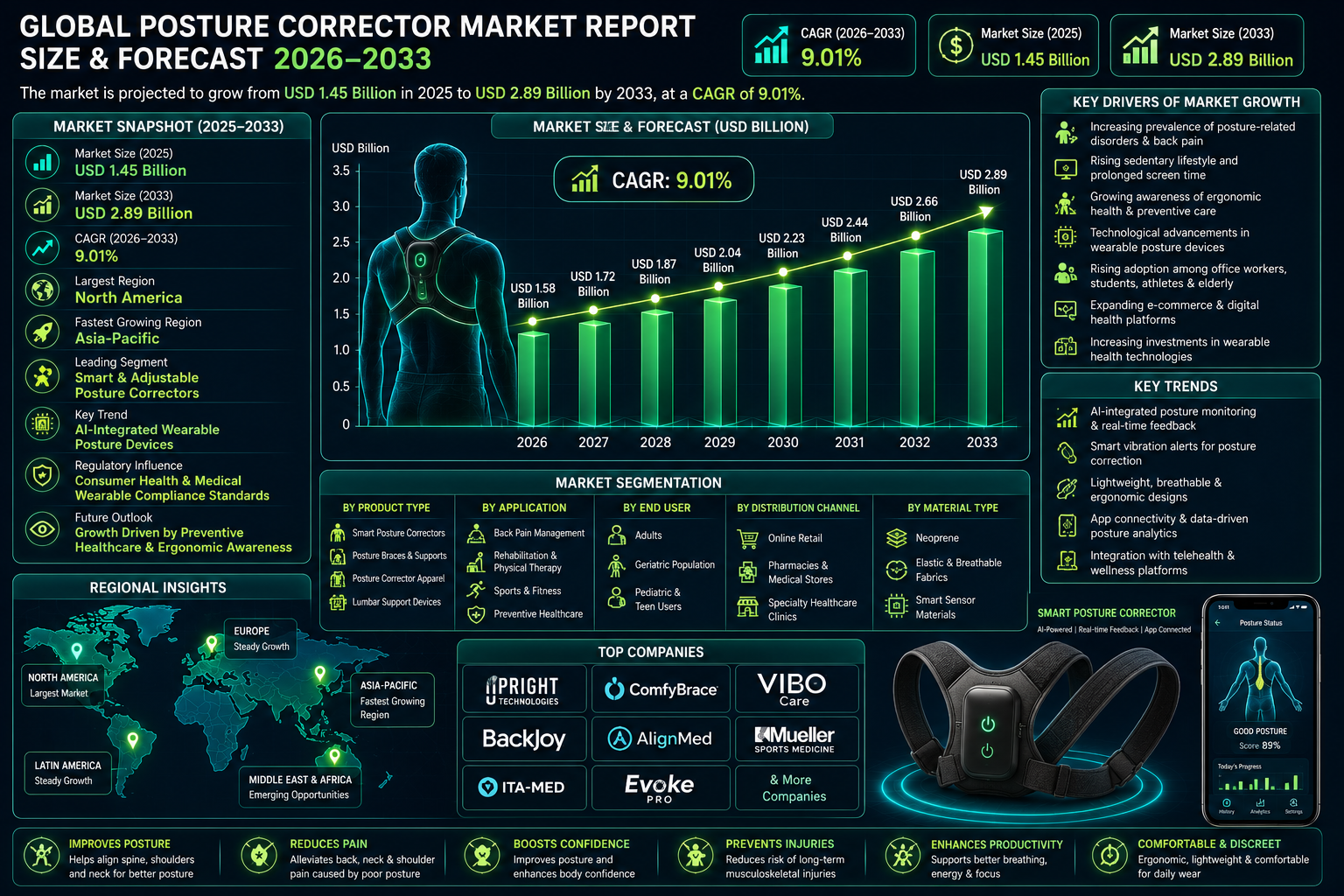
Market Size & Forecast
The Global Posture Corrector Market is expected to witness substantial growth during the forecast period from 2026 to 2033. The market was valued at USD 1.45 billion in 2025 and is projected to reach approximately USD 2.89 billion by 2033, expanding at a CAGR of 9.01% throughout the forecast timeline. The increasing prevalence of posture-related disorders, sedentary lifestyles, and rising awareness regarding musculoskeletal health are major factors driving market growth globally. The growing adoption of posture correction products among office workers, students, athletes, and elderly populations is accelerating demand for wearable posture support solutions. Increasing screen time, prolonged desk-based work culture, and smartphone dependency have significantly contributed to poor spinal posture and associated chronic pain conditions, thereby increasing the need for corrective and preventive healthcare devices. Technological advancements such as smart posture correctors with vibration alerts, AI-based posture tracking systems, mobile application integration, and lightweight ergonomic materials are reshaping the market landscape. Consumers are increasingly seeking comfortable, discreet, and technologically advanced posture correction devices that can support long-term posture improvement without disrupting daily activities. Additionally, increasing healthcare expenditure, expanding preventive healthcare awareness, and rising investments in wearable health technologies are expected to further strengthen market growth during the forecast period.Global Posture Corrector Market Overview
The Posture Corrector Market is evolving rapidly due to increasing awareness regarding spinal health, workplace ergonomics, and preventive musculoskeletal care. Posture correctors are wearable devices designed to align the spine, shoulders, and neck to improve body posture and reduce discomfort associated with poor posture habits. The market includes a wide range of products such as posture braces, posture shirts, smart wearable posture trainers, clavicle support braces, lumbar support devices, and ergonomic corrective accessories. These products are increasingly being adopted across healthcare, sports, rehabilitation, and consumer wellness applications. The market is moderately fragmented with the presence of numerous international and regional manufacturers focusing on product innovation, ergonomic designs, and digital health integration. Companies are actively investing in lightweight materials, breathable fabrics, adjustable support mechanisms, and AI-powered posture monitoring systems to differentiate their product offerings. The rise of e-commerce platforms, direct-to-consumer healthcare brands, and online physiotherapy consultation services has significantly improved product accessibility and consumer adoption globally. In parallel, healthcare professionals including physiotherapists, chiropractors, and orthopedic specialists are increasingly recommending posture correction devices as part of conservative treatment approaches for musculoskeletal disorders.Structural Drivers of Market Growth
1. Innovation and Commercialization Acceleration
Rapid innovation in wearable healthcare technology is accelerating the commercialization of advanced posture correction solutions. Smart posture correctors integrated with sensors, AI algorithms, and smartphone applications are enabling real-time posture monitoring and corrective feedback mechanisms. Advancements in ergonomic product design, lightweight materials, and flexible support systems are improving user comfort and long-term compliance. The increasing integration of digital health ecosystems is also enabling posture monitoring to become part of broader wellness and preventive healthcare platforms.Market Implications
Companies focusing on AI-enabled posture correction technologies and personalized posture analytics are expected to gain strong competitive advantages. Technological innovation will continue expanding product adoption across both medical and consumer wellness markets.2. Compliance and Risk Repricing
The increasing focus on wearable health device safety and consumer healthcare compliance standards is reshaping product development and manufacturing requirements. Regulatory authorities are emphasizing product safety, skin compatibility, material quality, and wearable technology standards. Manufacturers are investing heavily in product testing, ergonomic certifications, and quality assurance processes to ensure compliance with evolving healthcare and consumer protection regulations.Market Implications
Companies capable of maintaining strong compliance frameworks and clinically validated product performance will strengthen consumer trust and improve long-term market positioning.3. Competitive and Value-Chain Reconfiguration
The posture corrector market is witnessing competitive restructuring driven by rising digital health adoption, e-commerce expansion, and direct-to-consumer business models. Traditional orthopedic support manufacturers are increasingly competing with wearable technology startups and wellness-focused consumer brands. Strategic partnerships between healthcare technology companies, physiotherapy providers, and fitness platforms are reshaping distribution channels and customer engagement strategies.Market Implications
The growing convergence of wearable health technology and consumer wellness ecosystems will continue redefining competitive advantages within the market. Companies with strong digital branding and online distribution capabilities are likely to achieve faster market penetration.4. Capital and Capacity Scaling
Increasing investment in wearable healthcare technologies, manufacturing automation, and global e-commerce infrastructure is supporting rapid market scalability. Manufacturers are expanding production capabilities and strengthening logistics networks to meet rising consumer demand for posture correction solutions. Growing healthcare investments in preventive care and rehabilitation technologies are also contributing to market expansion globally.Market Implications
Companies investing in manufacturing efficiency, product customization, and scalable digital health ecosystems are expected to benefit from long-term market growth opportunities.Market Segmentation Analysis
By Product Type
1. Smart Posture Correctors
AI-enabled wearable posture trainers with mobile application integration and vibration alerts represent the fastest-growing product category.2. Posture Braces & Supports
Traditional shoulder braces, clavicle supports, and spinal alignment belts remain widely used for posture correction and rehabilitation.3. Posture Corrector Apparel
Compression shirts and ergonomic posture garments are gaining popularity among fitness enthusiasts and office workers.4. Lumbar Support Devices
Lumbar support cushions and lower-back corrective devices are increasingly utilized in office and home settings.By Application
1. Back Pain Management
Posture correctors are widely used to reduce chronic back pain associated with prolonged sitting and poor spinal alignment.2. Rehabilitation & Physical Therapy
Healthcare professionals increasingly incorporate posture correction devices into rehabilitation and physiotherapy programs.3. Sports & Fitness
Athletes and fitness users adopt posture correction solutions to improve body mechanics and reduce injury risk.4. Preventive Healthcare
Preventive posture management is becoming increasingly popular among younger consumers and office workers.By End User
1. Adults
Working professionals and sedentary populations represent the largest consumer base.2. Geriatric Population
Elderly individuals increasingly use posture correctors for spinal support and musculoskeletal comfort.3. Pediatric & Teen Users
Rising smartphone and computer usage among younger populations is driving adoption in this segment.By Distribution Channel
1. Online Retail
E-commerce platforms dominate distribution due to convenience, product variety, and direct-to-consumer marketing strategies.2. Pharmacies & Medical Stores
Retail healthcare channels remain important for orthopedic and medically prescribed posture devices.3. Specialty Healthcare Clinics
Physiotherapy centers and chiropractic clinics increasingly distribute posture correction products.By Material Type
1. Neoprene
Widely used due to flexibility, comfort, and durability.2. Elastic & Breathable Fabrics
Lightweight breathable materials are increasingly preferred for daily wearable applications.3. Smart Sensor Materials
Advanced wearable sensors and conductive textiles are emerging in premium smart posture devices.Regional Market Dynamics
North America
North America dominates the Global Posture Corrector Market due to strong consumer awareness regarding preventive healthcare, high adoption of wearable technologies, and increasing prevalence of musculoskeletal disorders associated with sedentary lifestyles. The United States remains the largest regional contributor owing to growing workplace ergonomics initiatives and strong e-commerce penetration.Europe
Europe is witnessing steady growth driven by increasing awareness regarding spinal health, aging population demographics, and expanding physiotherapy adoption. Countries including Germany, the UK, and France remain major contributors to regional market growth.Asia-Pacific
Asia-Pacific is projected to witness the fastest growth during the forecast period due to rising urbanization, increasing smartphone dependency, expanding healthcare awareness, and rapidly growing middle-class populations in countries such as China, India, Japan, and South Korea.Latin America
The Latin American market is gradually expanding due to improving healthcare accessibility and growing awareness regarding preventive musculoskeletal care.Middle East & Africa
The market in the Middle East & Africa is experiencing moderate growth supported by improving healthcare infrastructure and increasing awareness regarding orthopedic wellness and rehabilitation products.Competitive Landscape
The Global Posture Corrector Market is highly competitive with companies focusing on ergonomic innovation, wearable health technologies, and direct-to-consumer digital marketing strategies. Key companies operating in the market include:- Upright Technologies
- ComfyBrace
- VIBO Care
- BackJoy
- AlignMed
- Mueller Sports Medicine
- ITA-MED
- Evoke Pro
Strategic Outlook
The future of the Posture Corrector Market will be shaped by increasing integration of wearable technology, AI-driven health monitoring, and personalized wellness solutions. Smart posture correction devices capable of real-time analytics and remote monitoring are expected to witness substantial demand growth. Companies are increasingly focusing on hybrid solutions that combine orthopedic support with digital wellness tracking. Integration with telehealth, physiotherapy applications, and corporate wellness programs will further strengthen market opportunities. In addition, increasing awareness regarding workplace ergonomics and preventive musculoskeletal healthcare is expected to expand the addressable consumer base significantly during the forecast period.Final Market Perspective
The Global Posture Corrector Market is undergoing rapid transformation driven by changing lifestyles, rising musculoskeletal health concerns, and technological advancements in wearable healthcare devices. The growing emphasis on preventive healthcare, ergonomic wellness, and digital health integration is creating strong long-term growth opportunities for market participants. As consumers increasingly prioritize posture improvement, spinal wellness, and non-invasive rehabilitation solutions, posture correctors are expected to become a mainstream component of everyday health management. Companies capable of balancing ergonomic innovation, affordability, digital integration, and clinical effectiveness will be best positioned to capitalize on the market???s future growth potential.Table of Contents
Executive Summary
1.1 Market Forecast Snapshot (2026???2033)
1.2 Global Posture Corrector Market Size & CAGR Analysis
1.3 Largest & Fastest-Growing Segments
1.4 Region-Level Leadership & Growth Trends
1.5 Key Market Drivers
1.6 Competitive Landscape Overview
1.7 Regulatory Influence & Consumer Wearable Compliance Trends
1.8 Strategic Outlook Through 2033
Introduction & Market Overview
2.1 Definition of the Posture Corrector Market
2.2 Market Size & Forecast (2026???2033)
2.3 Industry Evolution & Market Development
2.4 Supply Chain & Distribution Infrastructure
2.5 Impact of Consumer Trends & Ergonomic Awareness
2.6 Regulatory & Compliance Landscape for Wearable Health Devices
2.7 Technology & Innovation Landscape (AI Wearables, Smart Sensors & Digital Health Integration)
Research Methodology
3.1 Primary Research
3.2 Secondary Research
3.3 Market Size Estimation Model
3.4 Forecast Assumptions (2026???2033)
3.5 Data Validation & Triangulation
Market Dynamics
4.1 Drivers
4.1.1 Rising Prevalence of Posture-Related Disorders
4.1.2 Increasing Adoption of Wearable Health Technologies
4.1.3 Expansion of Preventive Healthcare Awareness
4.1.4 Growing Workplace Ergonomics Initiatives
4.1.5 Technological Advancements in Smart Posture Devices
4.2 Restraints
4.2.1 High Cost of Smart Posture Correctors
4.2.2 Limited Clinical Standardization
4.2.3 Consumer Discomfort & Compliance Challenges
4.2.4 Low Awareness in Developing Regions
4.3 Opportunities
4.3.1 AI-Integrated Wearable Posture Monitoring
4.3.2 Expansion of Corporate Wellness Programs
4.3.3 Growing Telehealth & Physiotherapy Integration
4.3.4 Emerging Market Penetration Across Asia-Pacific & Latin America
4.4 Challenges
4.4.1 Intense Market Competition & Product Fragmentation
4.4.2 Regulatory Compliance for Wearable Devices
4.4.3 Counterfeit & Low-Quality Product Availability
4.4.4 Maintaining Long-Term Consumer Engagement
Posture Corrector Market Analysis (USD Billion), 2026???2033
5.1 Market Size Overview
5.2 CAGR Analysis
5.3 Regional Revenue Distribution
5.4 Segment Revenue Analysis
5.5 Distribution Channel Analysis
5.6 Consumer Adoption & Healthcare Impact Analysis
Market Segmentation (USD Billion), 2026???2033
6.1 By Product Type
6.1.1 Smart Posture Correctors
6.1.1.1 AI-Based Wearable Posture Trainers
6.1.1.1.1 Sensor-Integrated Posture Devices
6.1.1.1.1.1 Smartphone-Connected Posture Monitoring Systems
6.1.2 Posture Braces & Supports
6.1.2.1 Shoulder & Clavicle Support Braces
6.1.2.1.1 Adjustable Spinal Alignment Supports
6.1.2.1.1.1 Orthopedic Posture Rehabilitation Devices
6.1.3 Posture Corrector Apparel
6.1.3.1 Compression Posture Shirts
6.1.3.1.1 Ergonomic Corrective Garments
6.1.3.1.1.1 Fitness-Oriented Posture Apparel
6.1.4 Lumbar Support Devices
6.1.4.1 Lower Back Support Cushions
6.1.4.1.1 Ergonomic Lumbar Corrective Systems
6.1.4.1.1.1 Office & Home Lumbar Support Solutions
6.2 By Application
6.2.1 Back Pain Management
6.2.1.1 Chronic Spinal Pain Relief Solutions
6.2.1.1.1 Ergonomic Spinal Support Devices
6.2.1.1.1.1 Daily Posture Improvement Systems
6.2.2 Rehabilitation & Physical Therapy
6.2.2.1 Physiotherapy Support Devices
6.2.2.1.1 Musculoskeletal Rehabilitation Systems
6.2.2.1.1.1 Post-Injury Posture Recovery Solutions
6.2.3 Sports & Fitness
6.2.3.1 Athletic Posture Training Systems
6.2.3.1.1 Performance Optimization Supports
6.2.3.1.1.1 Injury Prevention Posture Devices
6.2.4 Preventive Healthcare
6.2.4.1 Wellness & Lifestyle Posture Solutions
6.2.4.1.1 Office Ergonomics Devices
6.2.4.1.1.1 Preventive Musculoskeletal Care Products
6.3 By End User
6.3.1 Adults
6.3.1.1 Office Workers & Sedentary Users
6.3.1.1.1 Workplace Ergonomic Consumers
6.3.1.1.1.1 Remote Working Posture Users
6.3.2 Geriatric Population
6.3.2.1 Elderly Musculoskeletal Support Users
6.3.2.1.1 Age-Related Posture Care Solutions
6.3.2.1.1.1 Senior Rehabilitation Support Devices
6.3.3 Pediatric & Teen Users
6.3.3.1 Student Posture Management Products
6.3.3.1.1 Smartphone & Screen-Time Correction Devices
6.3.3.1.1.1 Youth Ergonomic Wellness Solutions
6.4 By Distribution Channel
6.4.1 Online Retail
6.4.1.1 E-Commerce Healthcare Platforms
6.4.1.1.1 Direct-to-Consumer Wearable Brands
6.4.1.1.1.1 Subscription-Based Wellness Platforms
6.4.2 Pharmacies & Medical Stores
6.4.2.1 Retail Orthopedic Distribution Channels
6.4.2.1.1 Consumer Healthcare Device Stores
6.4.2.1.1.1 OTC Orthopedic Support Products
6.4.3 Specialty Healthcare Clinics
6.4.3.1 Physiotherapy Distribution Networks
6.4.3.1.1 Chiropractic Support Product Channels
6.4.3.1.1.1 Rehabilitation Equipment Providers
6.5 By Material Type
6.5.1 Neoprene
6.5.1.1 Flexible Orthopedic Materials
6.5.1.1.1 Durable Posture Support Fabrics
6.5.1.1.1.1 Reinforced Ergonomic Support Materials
6.5.2 Elastic & Breathable Fabrics
6.5.2.1 Lightweight Wearable Materials
6.5.2.1.1 Moisture-Resistant Corrective Fabrics
6.5.2.1.1.1 Daily Wear Ergonomic Textiles
6.5.3 Smart Sensor Materials
6.5.3.1 Conductive Textile Technologies
6.5.3.1.1 Embedded Sensor Fabrics
6.5.3.1.1.1 AI-Enabled Wearable Sensor Systems
Market Segmentation by Geography
7.1 North America
7.2 Europe
7.3 Asia-Pacific
7.4 Latin America
7.5 Middle East & Africa
Competitive Landscape
8.1 Market Share Analysis
8.2 Product Portfolio Benchmarking
8.3 Product Positioning Mapping
8.4 Digital Distribution & Strategic Partnerships
8.5 Competitive Intensity & Innovation Benchmarking
Company Profiles
9.1 Upright Technologies
9.2 ComfyBrace
9.3 VIBO Care
9.4 BackJoy
9.5 AlignMed
9.6 Mueller Sports Medicine
9.7 ITA-MED
9.8 Evoke Pro
Strategic Intelligence & Pheonix AI Insights
10.1 Pheonix Demand Forecast Engine
10.2 Supply Chain & Infrastructure Analyzer
10.3 Technology & Innovation Tracker
10.4 Product Development Insights
10.5 Automated Porter???s Five Forces Analysis
Future Outlook & Strategic Recommendations
11.1 Expansion of AI-Based Posture Monitoring Systems
11.2 Growth of Corporate Ergonomics & Wellness Programs
11.3 Regional Expansion Strategies
11.4 Smart Wearable Product Innovation & Cost Optimization
11.5 Long-Term Market Outlook (2033+)
Appendix
About Pheonix Research
Disclaimer
Value Chain
Global Posture Corrector Market Value Chain & Supply Chain Evolution Overview
The Global Posture Corrector Market is undergoing rapid transformation driven by increasing awareness regarding musculoskeletal health, preventive healthcare adoption, and the growing integration of wearable health technologies. The market???s value chain is characterized by a hybrid operational model supported by a hybrid distribution structure integrating direct-to-consumer channels, e-commerce platforms, healthcare clinics, pharmacies, and wellness ecosystems. This multi-channel framework is reshaping product accessibility, commercialization strategies, and competitive positioning across the posture correction industry.
A defining feature of this value chain is the convergence of orthopedic support products with AI-enabled wearable technology and digital wellness platforms. Smart posture correctors increasingly integrate motion sensors, AI-powered posture analytics, smartphone connectivity, and real-time vibration feedback systems to provide personalized posture monitoring and corrective support. This evolution is accelerating the transition from traditional orthopedic products toward connected preventive healthcare solutions.
Supply chain complexity remains moderate due to the integration of wearable electronics, ergonomic textile manufacturing, smart sensors, app-based software ecosystems, and regulatory compliance requirements. Companies must coordinate across material sourcing, wearable device assembly, sensor integration, e-commerce logistics, and healthcare compliance frameworks while maintaining product comfort, durability, and affordability.
Manufacturers are increasingly investing in lightweight materials, breathable ergonomic fabrics, AI-enabled wearable technologies, and scalable e-commerce infrastructure to improve product accessibility and enhance consumer engagement. The value chain is evolving into a digitally connected, consumer-centric, and wellness-driven ecosystem focused on comfort, preventive care, and long-term posture management.
Global Posture Corrector Market Value Chain & Supply Chain Evolution Current Scenario
Market-Specific Value Chain
- Raw Material & Component Sourcing: Neoprene, elastic fabrics, breathable textiles, wearable sensors, conductive materials, and electronic components
- Manufacturing & Assembly: Orthopedic brace production, smart wearable assembly, ergonomic apparel manufacturing, and product quality testing
- Technology Integration: AI posture analytics, smartphone applications, wearable sensors, and cloud-connected wellness platforms
- Regulatory & Compliance Management: Consumer healthcare compliance, wearable device standards, ergonomic certifications, and safety validation
- Distribution: E-commerce platforms, direct-to-consumer channels, pharmacies, physiotherapy clinics, and specialty healthcare retailers
- End User Utilization: Office workers, athletes, rehabilitation patients, elderly consumers, and wellness-focused users
Company-to-Stage Mapping
- Raw Material & Component Sourcing: Textile suppliers, wearable sensor manufacturers, electronic component providers
- Manufacturing & Assembly: ComfyBrace, BackJoy, AlignMed
- Technology Integration: Upright Technologies, VIBO Care
- Regulatory & Compliance Management: Consumer healthcare regulators, wearable compliance certification authorities
- Distribution: Online marketplaces, pharmacies, physiotherapy centers, orthopedic clinics
- End User Utilization: Consumers, rehabilitation programs, fitness and wellness users
Key Value Chain & Supply Chain Evolution Signals in Global Posture Corrector Market
- Expansion of AI-Integrated Wearable Devices
Smart posture correctors with real-time posture tracking and vibration feedback are rapidly transforming the product landscape. - Growth of Preventive Healthcare & Ergonomic Awareness
Increasing focus on spinal wellness and workplace ergonomics is expanding consumer adoption globally. - Rise of Direct-to-Consumer & E-Commerce Distribution
Digital platforms and online healthcare brands are improving product accessibility and customer engagement. - Integration with Digital Wellness Ecosystems
Smartphone-connected posture devices and wellness applications are enabling personalized posture analytics and long-term monitoring. - Increasing Compliance & Wearable Safety Standards
Regulatory focus on material safety, wearable electronics, and ergonomic validation is influencing product development strategies. - Expansion of Lightweight & Smart Material Technologies
Advanced breathable fabrics, flexible support systems, and conductive textiles are improving comfort and long-term usability.
Strategic Implications of Value Chain & Supply Chain Evolution
- Investment in AI & Connected Wellness Platforms
Companies integrating posture correction with digital health ecosystems will strengthen long-term competitive positioning. - Expansion of Direct-to-Consumer Distribution Models
E-commerce and digital wellness platforms are becoming essential for scalability and brand visibility. - Optimization of Wearable Manufacturing & Material Innovation
Lightweight, ergonomic, and sensor-integrated materials are critical for improving user comfort and product differentiation. - Strengthening Regulatory & Quality Compliance Infrastructure
Compliance with wearable device standards and ergonomic certifications is essential for consumer trust and market expansion. - Development of Subscription & Wellness Engagement Models
Connected posture correction platforms are enabling recurring digital wellness and coaching services. - Localization & Scalable Production Strategies
Regional manufacturing and flexible logistics systems improve supply chain responsiveness and cost efficiency.
Global Posture Corrector Market Value Chain & Supply Chain Evolution Forward Outlook
Looking ahead, the value chain is expected to evolve into a highly connected, AI-enabled, and preventive healthcare-focused ecosystem.
Key Future Developments Include:
- Expansion of AI-powered posture monitoring and analytics systems
- Increased adoption of smart wearable posture correction devices
- Growth of smartphone-connected and cloud-enabled wellness platforms
- Integration of posture correction with telehealth and physiotherapy ecosystems
- Expansion of advanced ergonomic materials and wearable sensor technologies
As the market evolves, competitive advantage will increasingly depend on the ability to combine ergonomic innovation, digital connectivity, affordability, and clinical effectiveness.
Companies that effectively integrate wearable technology, AI-driven wellness analytics, and scalable e-commerce ecosystems will achieve superior customer engagement, operational scalability, and long-term competitive positioning in the Global Posture Corrector Market.
Investment Activity
Posture Corrector market Investment & Funding Dynamics Overview
The investment landscape for posture correctors, a niche yet growing segment within the broader healthcare technology market, is evolving through dynamic funding and strategic capital allocation. As consumers become more health-conscious and technology becomes increasingly integrated into everyday wellness solutions, the posture corrector market is witnessing a surge in investment interest. This interest is reflected in the capital logic and strategic allocation of funds aimed at enhancing product innovation, expanding market reach, and developing integrated health solutions.
Investment trends in the posture corrector market are notably rising, with a medium capital intensity level. This trend is primarily driven by the convergence of healthcare technology advancements and consumer demand for non-invasive, digital health monitoring solutions. Investors are particularly drawn to the potential for posture correctors to integrate with broader health management systems, providing real-time feedback and data-driven insights to users. This integration aligns with the growing investment themes of healthcare technology and non-invasive monitoring, which are attractive to investors looking to harness the benefits of technology in health improvement.
Recent mergers and acquisitions (M&A) activities further underscore the market’s potential. For instance, LaserShip’s acquisition of West Coast carrier OnTrac in 2021 for $1.3 billion and the launch of a transcontinental delivery service in 2022 highlight the strategic moves companies are making to enhance logistics infrastructure, a critical component for scaling operations and improving delivery efficiency. Such M&A activities are pivotal in positioning companies to better serve a geographically dispersed consumer base, ultimately enhancing market competitiveness and growth potential.
Active investors in this space, such as Target, LaserShip, Abbott, and Unilever, are strategically placing their bets on the future of posture correctors by aligning their investments with key themes such as healthcare technology and logistics infrastructure. These investors are not only providing capital but also bringing in strategic expertise and operational know-how to accelerate market growth. Their involvement signals a strong belief in the market’s potential to deliver substantial returns, driven by the increasing consumer focus on health and wellness.
The increase in U.S. research and development (R&D) expenditure, which rose by $72 billion in 2021 to a total of $789 billion, with estimates for 2022 indicating a further increase to $886 billion, is another critical factor influencing investment dynamics. This surge in R&D spending reflects a broader commitment to innovation and technological advancement, with significant implications for the posture corrector market. As companies invest in R&D, they are likely to develop more sophisticated posture correction solutions that integrate seamlessly with existing health monitoring systems, thereby enhancing their value proposition to consumers.
Posture Corrector Investment & Funding Dynamics Current Scenario
The current investment and funding scenario in the posture corrector market is characterized by strategic capital allocation and a focus on innovation-driven growth. Investors are actively engaging in funding rounds, mergers, and partnerships to capitalize on the market’s growth potential. The average Series A funding amount, as of 2024, is $18.7 million, while Series B funding typically involves amounts of $30 million or more, and Series C funding rounds generally range between $30 million and $100 million, with an average of $50 million. These funding trends illustrate the market’s readiness for scaling and the appetite of investors to support companies as they expand their product offerings and market presence.
Abbott’s contribution to the DTS Surveillance Program, part of its commitment to supporting individuals with diabetes, exemplifies how companies are aligning their investments with broader healthcare goals. By funding this program, Abbott is not only supporting diabetes management but also reinforcing the broader trend of integrating posture correctors into comprehensive health management solutions. This strategic alignment enhances the market’s credibility and attractiveness to investors, who see the potential for posture correctors to play a significant role in preventive health care.
Moreover, the study supported by Baylor College of Medicine, iCAMP, and the National Institute on Aging, which received additional funding from award no. R44-AG061951-02, highlights the academic and research interest in posture correction solutions. This support underscores the scientific community’s recognition of the importance of posture correction in maintaining overall health and well-being, which in turn boosts investor confidence in the market’s long-term viability.
In FY 2022, the Department of Health and Human Services (HHS) accounted for 81% of all basic research funding for life sciences, highlighting the substantial government commitment to advancing healthcare research. This level of funding is indicative of the significant resources being directed towards understanding and improving health outcomes, within which posture correction plays a crucial role. The alignment of government funding priorities with market trends provides a favorable environment for posture corrector companies to innovate and expand.
The current scenario is also influenced by regulatory developments, such as the FDA’s Quality Management System Regulation (QMSR) amendments, which incorporate ISO 13485 requirements. This regulatory alignment is expected to result in annualized net cost savings of approximately $532 million at a 7 percent discount rate, providing financial incentives for companies to enhance compliance and operational efficiency. Such regulatory shifts not only reduce operational costs but also create a standardized framework that can boost investor confidence by ensuring product quality and safety.
Key Investment & Funding Dynamics Signals in Posture Corrector
The posture corrector market is experiencing a series of key investment and funding dynamics signals that are shaping its trajectory. These signals, rooted in strategic investments, regulatory frameworks, and technological advancements, offer insights into the market’s potential and the directions in which it is likely to evolve.
One of the most prominent signals is the strategic acquisition by LaserShip of West Coast carrier OnTrac in 2021 for $1.3 billion. This acquisition and the subsequent launch of a transcontinental delivery service in 2022 highlight the importance of logistics infrastructure in the posture corrector market. Efficient logistics are critical for scaling operations and ensuring timely delivery to consumers, particularly in a market where quick access to products can significantly enhance customer satisfaction and brand loyalty.
Additionally, the average Series C funding amount, which generally ranges between $30 million and $100 million with an average round of $50 million, signifies the market’s readiness for scaling and expansion. Such funding rounds are crucial for companies looking to invest in advanced technologies and expand their market reach. These investments enable companies to enhance their product offerings, integrate more sophisticated features, and cater to a broader consumer base, thereby driving market growth.
The contribution of Abbott to the DTS Surveillance Program further underscores the integration of posture correctors into broader healthcare initiatives. By supporting programs aimed at chronic health conditions such as diabetes, companies are not only expanding their product applicability but also enhancing their market position as integral components of comprehensive health management solutions.
Moreover, the substantial increase in U.S. R&D expenditure, which reached an estimated $886 billion in 2022, reflects a broader commitment to innovation and technological advancement. This increase in funding provides the necessary resources for companies to explore new technologies, improve product efficacy, and develop solutions that meet the evolving needs of health-conscious consumers.
In summary, the posture corrector market’s investment and funding dynamics are being shaped by strategic acquisitions, significant funding rounds, and increased R&D spending. These signals indicate a market that is poised for growth, driven by innovations in healthcare technology, efficient logistics solutions, and strategic capital allocation by key industry players. Investors and companies alike are recognizing the potential of posture correctors to contribute to improved health outcomes, positioning this market segment for a promising future in the healthcare technology landscape.
Key Investment & Funding Dynamics Signals in Posture Corrector
The posture corrector market is experiencing a significant shift in its investment and funding landscape, underscored by a series of strategic moves and capital flows. This transformation is propelled by a combination of factors, including increased R&D expenditure, strategic acquisitions, and targeted funding initiatives. These dynamics are essential in understanding how the market is evolving and what it means for stakeholders involved.
One of the most prominent signals is the acquisition activity in logistics, as seen with LaserShip’s purchase of West Coast carrier OnTrac for $1.3 billion in 2021. This acquisition was instrumental in launching a transcontinental delivery service in 2022, which highlights the importance of logistics infrastructure in enhancing market capabilities for posture correctors and other health-related products. Efficient and expansive logistics networks ensure that products reach consumers swiftly and cost-effectively, thereby enhancing market reach and consumer satisfaction.
Another key signal is the increased funding directed toward digital health technologies, as evidenced by Abbott’s investment in the DTS Surveillance Program. This initiative reflects a broader trend where companies are channeling resources into healthcare technology that supports non-invasive monitoring and digital pathology. Such investments are crucial in developing posture correctors that are not just corrective devices but integral components of holistic health monitoring systems.
Series C funding activities are also indicative of the market’s maturity and potential for expansion. With typical funding rounds ranging between $30 million and $100 million, and an average round of $50 million, these investments signify investor confidence in the scalability and profitability of posture corrector businesses. This capital influx supports further R&D, product refinement, and market expansion efforts, enabling companies to enhance their competitive edge.
Strategic Implications of Investment & Funding Dynamics in Posture Corrector
The strategic implications of these investment and funding dynamics are profound, affecting both market players and consumers. For companies, the increased flow of capital into posture correctors means an opportunity to innovate and differentiate their product offerings. With consumers becoming more discerning and demanding advanced features, the integration of technology into posture correctors is not just an option but a necessity. This trend aligns with broader healthcare technology themes, such as non-invasive monitoring and digital pathology, which are attracting investor interest.
Logistics infrastructure improvements, as driven by strategic acquisitions, are pivotal in establishing competitive advantages. Companies that invest in robust logistics capabilities can significantly reduce lead times, improve delivery reliability, and ultimately enhance customer satisfaction. This capability is crucial in a market where consumer expectations for swift and seamless service are high.
Moreover, the focus on R&D spending, as demonstrated by the increase to $789 billion in 2021 and an estimated $886 billion in 2022, signifies a commitment to innovation across the healthcare landscape. For posture correctors, this means leveraging cutting-edge technologies such as sensors, AI, and data analytics to create products that offer real-time feedback and personalized health insights.
These dynamics also have implications for market structure. As investment themes shift towards integrated health solutions, companies that can offer comprehensive wellness packages stand to gain a competitive advantage. This approach not only caters to consumer demand for holistic health solutions but also opens up new revenue streams through cross-selling opportunities.
Posture Corrector Investment & Funding Dynamics Forward Outlook
Looking forward, the posture corrector market is poised for further growth and transformation, driven by ongoing investment and funding activities. The market’s trajectory will be shaped by several key factors, including technological advancements, regulatory changes, and evolving consumer preferences.
Technological innovation will continue to be a major driver, with companies investing in advanced materials, smart sensors, and AI-driven analytics to enhance product functionality. As posture correctors become more sophisticated, they are likely to evolve from simple corrective devices to integral components of broader health monitoring systems. This evolution will open up new opportunities for collaboration with digital health platforms and healthcare providers.
Regulatory changes will also play a role in shaping the market’s future. As the FDA incorporates ISO 13485 requirements into its Quality Management System Regulation, companies will need to ensure compliance to maintain market access. While this may pose challenges, it also presents opportunities for companies to differentiate themselves by adhering to high standards of quality and safety.
Consumer preferences are expected to continue evolving, with a growing emphasis on personalized and integrated health solutions. Companies that can anticipate and respond to these preferences by offering customizable and data-driven posture correctors will be well-positioned to capture market share.
In conclusion, the posture corrector market’s investment and funding dynamics are indicative of a segment on the cusp of significant growth and innovation. Key players such as LaserShip and Abbott are setting the stage for a competitive and dynamic market environment, where strategic capital allocation and innovation are critical to success. As the market continues to evolve, stakeholders must remain agile and forward-thinking to capitalize on emerging opportunities and navigate potential challenges.
Technology & Innovation
Global Posture Corrector Market Technology & Innovation Landscape Overview
The Global Posture Corrector Market is undergoing rapid technological transformation driven by advancements in wearable healthcare devices, AI-powered posture monitoring systems, ergonomic product engineering, and digital wellness integration. The market is characterized by a high innovation intensity level, supported by increasing commercialization of smart posture correction technologies and rising consumer demand for preventive musculoskeletal healthcare solutions.
At the center of this technological evolution are AI-enabled posture correctors, smart wearable posture trainers, vibration feedback systems, mobile application integration, and sensor-based posture analytics platforms. These innovations are enabling real-time posture monitoring, personalized corrective feedback, and long-term spinal health management.
Smart posture correctors equipped with embedded sensors and AI algorithms can continuously track spinal alignment, shoulder positioning, and body posture patterns. These devices provide real-time vibration alerts and digital coaching to help users maintain proper posture throughout daily activities. The integration of smartphone applications further enhances user engagement through posture analytics, progress tracking, and personalized wellness recommendations.
Another significant innovation trend is the increasing adoption of lightweight ergonomic materials, breathable fabrics, conductive textiles, and flexible support systems. These advancements are improving product comfort, wearability, durability, and long-term user compliance, making posture correction devices more suitable for continuous daily use.
The market is also witnessing growing convergence between posture correction technologies and broader digital health ecosystems. Integration with telehealth platforms, physiotherapy applications, fitness tracking systems, and corporate wellness programs is transforming posture correction devices into connected preventive healthcare tools.
Technological advancements in wearable sensors, AI-driven health analytics, cloud-based monitoring systems, and smart textiles are further reshaping the market landscape and supporting expansion across healthcare, sports, rehabilitation, and consumer wellness applications.
Global Posture Corrector Market Technology & Innovation Landscape Current Scenario
Currently, the Global Posture Corrector Market demonstrates moderate-to-high patent activity and increasing investments in wearable health technologies, ergonomic product innovation, and digital wellness integration.
1. AI-Integrated Smart Posture Correctors
AI-enabled posture trainers with real-time posture tracking, vibration alerts, and smartphone connectivity are emerging as the fastest-growing product category.
2. Wearable Sensor Integration
Embedded wearable sensors and motion tracking technologies are improving posture monitoring accuracy and enabling personalized corrective feedback.
3. Mobile Application Connectivity
Smart posture correction devices increasingly integrate with mobile applications to provide posture analytics, remote monitoring, and user engagement features.
4. Smart Textile & Conductive Fabric Innovation
Manufacturers are developing conductive textiles, breathable materials, and flexible wearable designs to improve comfort and long-term usability.
5. Digital Wellness Ecosystem Expansion
Posture correction technologies are increasingly integrated with fitness platforms, telehealth systems, physiotherapy applications, and workplace wellness programs.
6. Ergonomic Product Engineering
Advanced ergonomic product design and lightweight support structures are improving compliance, mobility, and product effectiveness across consumer groups.
Key Technology & Innovation Landscape Signals in Global Posture Corrector Market
The market is evolving through several major innovation signals:
1. Rapid Growth of Smart Wearable Healthcare Devices
Consumers are increasingly adopting AI-enabled wearable health technologies for preventive musculoskeletal care and posture management.
2. Expansion of Personalized Posture Analytics
AI-driven posture monitoring systems are enabling customized corrective programs and personalized spinal health insights.
3. Integration with Digital Health Platforms
Growing interoperability between posture correctors, mobile health applications, and telehealth ecosystems is reshaping wellness management.
4. Increasing Adoption of Smart Textiles
Advanced fabrics and conductive materials are enabling more comfortable, lightweight, and discreet posture correction devices.
5. Workplace Ergonomics & Corporate Wellness Adoption
Employers and corporate wellness programs are increasingly adopting posture correction technologies to reduce musculoskeletal health risks.
6. Preventive Healthcare & Rehabilitation Focus
The growing emphasis on preventive musculoskeletal care and non-invasive rehabilitation is accelerating demand for posture correction technologies.
Strategic Implications of Technology & Innovation Landscape in Global Posture Corrector Market
The evolving technology landscape is significantly transforming competitive dynamics within the market. Companies are increasingly competing on AI integration, ergonomic design, wearable comfort, digital connectivity, and personalized wellness capabilities rather than solely on orthopedic support functionality.
The convergence of posture correction technologies with wearable health ecosystems, telehealth platforms, and digital physiotherapy solutions is creating opportunities for continuous posture monitoring and long-term wellness management.
Manufacturers are increasingly investing in AI algorithms, cloud-connected health platforms, wearable sensors, and smart textile innovation to strengthen product differentiation and improve customer retention.
In addition, regulatory focus on wearable healthcare compliance, product safety, skin compatibility, and ergonomic certifications is increasing the importance of quality assurance and clinically validated product performance.
Strategic collaborations between wearable technology companies, physiotherapy providers, fitness platforms, and digital wellness brands are further accelerating innovation and expanding market accessibility globally.
Global Posture Corrector Market Technology & Innovation Landscape Forward Outlook
Looking ahead to 2026???2033, the Global Posture Corrector Market is expected to evolve toward highly connected, AI-driven, and personalized musculoskeletal wellness ecosystems.
Future technological developments are likely to include:
1. AI-Powered Predictive Posture Analytics
Advanced AI systems capable of detecting long-term posture risks, spinal stress patterns, and preventive health recommendations.
2. Fully Connected Wearable Wellness Platforms
Increasing integration between posture correction devices, fitness trackers, telehealth systems, and cloud healthcare platforms.
3. Smart Textile & Sensor Expansion
Wider commercialization of conductive fabrics, biometric sensors, and intelligent wearable materials.
4. Remote Physiotherapy & Tele-Rehabilitation Integration
Growth of posture correction solutions integrated with remote physiotherapy consultations and rehabilitation monitoring platforms.
5. Personalized Digital Wellness Coaching
AI-driven posture coaching systems delivering customized wellness programs, exercise guidance, and ergonomic recommendations.
6. Corporate Ergonomics & Preventive Healthcare Adoption
Expanding use of posture monitoring technologies within workplace ergonomics programs and preventive healthcare initiatives.
Overall, companies that successfully combine AI innovation, ergonomic engineering, wearable comfort, digital connectivity, affordability, and preventive healthcare integration will be best positioned to lead the next phase of growth within the Global Posture Corrector Market.
Market Risk
Global Posture Corrector Market Risk Factors & Disruption Threats Overview
The Global Posture Corrector Market is shaped by evolving consumer wellness trends, wearable healthcare innovation, ergonomic awareness, and increasing demand for preventive musculoskeletal care. Despite strong growth potential, the market faces several operational, technological, regulatory, and competitive risks that influence adoption dynamics and long-term scalability.
The overall market risk level is moderate, driven by product commoditization, varying consumer compliance, limited clinical standardization, and intense competition from low-cost manufacturers. While demand for posture correction solutions continues to rise globally due to sedentary lifestyles and spinal health concerns, the market remains vulnerable to consumer skepticism regarding product effectiveness and long-term usage adherence.
Geopolitical exposure is low-to-moderate, as posture correctors primarily rely on global textile manufacturing, wearable sensor components, electronic modules, and e-commerce-driven supply chains. Trade restrictions, raw material inflation, logistics disruptions, and manufacturing concentration in Asia-Pacific can impact production costs and inventory availability.
Substitution risk is high, because posture correction can be addressed through alternative solutions including physiotherapy, chiropractic care, exercise programs, ergonomic furniture, orthopedic supports, yoga, and fitness-based rehabilitation approaches. Additionally, many consumers may shift toward general wellness and physical therapy solutions rather than relying on wearable posture correction devices alone.
Global Posture Corrector Market Risk Factors & Disruption Threats Current Scenario
Currently, the market is experiencing rapid product commercialization alongside increasing competition and consumer-driven purchasing behavior. One of the primary risks is market fragmentation and product commoditization, with numerous low-cost brands entering the market through online retail channels. This intensifies pricing pressure and reduces differentiation among manufacturers.
Another major concern is limited clinical validation and inconsistent product efficacy. Many posture correction products are marketed as wellness devices rather than medically certified orthopedic solutions, creating variability in performance, user trust, and healthcare professional acceptance.
The market also faces challenges related to consumer compliance and long-term usage behavior. Many users discontinue posture corrector usage due to discomfort, inconvenience, skin irritation, or unrealistic expectations regarding posture improvement timelines.
Technological risks are increasing as smart posture correctors integrate AI, mobile applications, and wearable sensors. Cybersecurity vulnerabilities, software reliability issues, and app compatibility concerns may affect user experience and product adoption.
In addition, supply chain disruptions affecting textiles, wearable sensors, microelectronics, and ergonomic materials continue to create manufacturing and inventory management challenges for global brands.
Key Risk Factors & Disruption Threats Signals in Global Posture Corrector Market
Several market signals highlight the evolving risk landscape:
- High Market Fragmentation & Pricing Pressure ??? Growing presence of low-cost online brands is intensifying competition and compressing profit margins.
- Clinical Validation & Credibility Concerns ??? Limited standardized medical evidence for some posture correction claims may affect long-term consumer trust.
- Consumer Compliance Challenges ??? User discomfort, inconsistent usage patterns, and low long-term adherence can reduce product effectiveness.
- Technology Integration Risks ??? Smart wearable posture devices introduce cybersecurity, software reliability, and app integration challenges.
- Substitution from Alternative Therapies ??? Physiotherapy, exercise, ergonomic furniture, and rehabilitation programs compete directly with posture correction wearables.
- Supply Chain Dependency ??? Reliance on textile manufacturing, wearable sensors, and electronic components exposes the market to logistics and sourcing disruptions.
- Regulatory Compliance Complexity ??? Increasing scrutiny on wearable health claims, material safety, and consumer healthcare standards is raising compliance requirements.
Strategic Implications of Risk Factors & Disruption Threats
These risks create important strategic implications for manufacturers, healthcare brands, and wearable technology companies. Companies must prioritize clinical validation, ergonomic design quality, and user comfort optimization to strengthen product credibility and improve long-term adoption rates.
Manufacturers are increasingly required to differentiate products through AI-driven posture analytics, personalized feedback systems, and integration with broader digital wellness ecosystems rather than competing solely on price.
Supply chain diversification and investment in scalable manufacturing infrastructure will become increasingly important to reduce exposure to raw material volatility and logistics disruptions.
Additionally, partnerships with physiotherapists, chiropractors, fitness platforms, and corporate wellness programs can help strengthen professional endorsement and improve customer retention.
The market also presents long-term opportunities in subscription-based wellness ecosystems, remote posture monitoring, preventive musculoskeletal healthcare, and wearable health analytics, particularly as digital wellness adoption accelerates globally.
Global Posture Corrector Market Risk Factors & Disruption Threats Forward Outlook
Looking ahead to 2026???2033, the market is expected to remain innovation-driven but increasingly competitive and wellness-oriented. Growth will continue to be supported by rising ergonomic awareness, sedentary lifestyles, and preventive healthcare adoption.
Future disruption risks are expected to include:
- Intensifying price competition from low-cost manufacturers
- Increasing regulatory scrutiny on wearable health claims and product safety
- Technology obsolescence due to rapid wearable innovation cycles
- Consumer shift toward holistic wellness and physiotherapy alternatives
- Cybersecurity and data privacy concerns for AI-connected devices
- Supply chain volatility affecting wearable electronics and textile materials
- Changing consumer expectations regarding personalization and comfort
At the same time, advancements in AI-enabled posture analytics, connected wearable ecosystems, ergonomic product engineering, and telehealth integration are expected to create substantial growth opportunities.
Overall, the Global Posture Corrector Market represents a fast-growing yet highly competitive consumer healthcare and wearable wellness segment. Companies that successfully balance ergonomic innovation, affordability, clinical credibility, digital integration, and user comfort will be best positioned to achieve sustainable long-term growth.
Regulatory Landscape
Global Posture Corrector Market Regulatory & Policy Environment Overview
The regulatory and policy environment plays an increasingly important role in shaping the Global Posture Corrector Market as wearable health devices, ergonomic wellness products, and AI-enabled posture monitoring systems become more integrated into preventive healthcare ecosystems. Regulatory frameworks establish standards governing product safety, material quality, wearable device functionality, digital health integration, labeling compliance, and consumer protection requirements.
As posture correctors evolve from basic orthopedic supports into smart wearable health technologies, regulatory oversight is expanding beyond traditional consumer wellness regulations toward broader medical wearable and digital health compliance standards. Regulatory agencies are increasingly focused on ensuring device safety, skin compatibility, ergonomic effectiveness, cybersecurity protection, and reliability of AI-driven posture monitoring systems.
Authorities such as the U.S. Food and Drug Administration, the European Commission, and regional consumer healthcare agencies are strengthening oversight for wearable wellness technologies that make therapeutic, rehabilitative, or health-monitoring claims. Products marketed for musculoskeletal correction, rehabilitation, or posture-related pain management may require additional compliance with medical device classification frameworks depending on their intended use and technological sophistication.
Additionally, international standards governing wearable electronics, textile safety, electromagnetic compatibility, and connected healthcare technologies are becoming increasingly relevant for manufacturers commercializing AI-integrated posture correction systems globally.
Global Posture Corrector Market Regulatory & Policy Environment Current Scenario
Currently, the Global Posture Corrector Market operates within a moderately regulated environment that combines consumer product safety standards, wearable technology regulations, and medical device compliance requirements for certain therapeutic products. The level of regulatory oversight largely depends on product positioning, intended medical claims, and degree of digital integration.
Traditional posture braces, spinal supports, and orthopedic corrective garments are primarily regulated under general consumer healthcare and orthopedic support product frameworks. Regulatory authorities emphasize safety testing, material quality validation, skin-contact safety, durability standards, and accurate product labeling.
However, the increasing commercialization of AI-enabled smart posture correctors has expanded regulatory complexity. Devices incorporating biosensors, mobile applications, posture analytics, and cloud connectivity are increasingly subject to wearable technology regulations, digital health governance, cybersecurity requirements, and consumer data privacy laws.
Another important regulatory trend involves increasing scrutiny of marketing claims and clinical effectiveness. Authorities are monitoring exaggerated therapeutic claims related to posture correction, pain reduction, spinal alignment, and musculoskeletal rehabilitation. Companies are increasingly required to substantiate product efficacy through ergonomic testing, clinical validation, or healthcare professional endorsements.
In addition, manufacturers distributing posture correctors through healthcare providers, physiotherapy clinics, or rehabilitation channels may face stricter compliance requirements related to medical-grade product certifications and healthcare procurement standards.
The expansion of e-commerce and direct-to-consumer healthcare channels is also driving stronger oversight regarding online product advertising, consumer disclosures, and digital marketplace compliance.
Key Regulatory & Policy Environment Signals in Global Posture Corrector Market
1. Expansion of Wearable Health Device Regulations
Regulatory agencies are increasing oversight of smart wearable posture devices incorporating sensors, AI algorithms, and mobile health applications. Compliance now increasingly includes cybersecurity, software reliability, and connected healthcare standards.
2. Rising Focus on Consumer Safety & Material Compliance
Authorities are strengthening regulations related to ergonomic safety, breathable fabrics, skin-contact materials, and long-duration wearable comfort to improve consumer protection and product reliability.
3. Growing Scrutiny of Therapeutic & Medical Claims
Manufacturers making posture correction, rehabilitation, or pain management claims are facing stricter validation requirements regarding product effectiveness and marketing transparency.
4. Increasing Digital Health & Data Privacy Oversight
Smart posture correctors integrated with cloud platforms and mobile applications must increasingly comply with healthcare data privacy frameworks and digital health security standards.
5. Expansion of International Wearable Technology Standards
Global commercialization of posture correction devices is driving increased adoption of harmonized standards related to wearable electronics, wireless communication, and smart textile technologies.
Strategic Implications of Regulatory & Policy Environment in Global Posture Corrector Market
The evolving regulatory landscape creates both growth opportunities and operational challenges for posture corrector manufacturers. One of the most significant strategic implications is the increasing convergence between consumer wellness products and regulated wearable healthcare technologies.
Companies developing AI-enabled posture correctors must increasingly invest in regulatory compliance capabilities, software validation, cybersecurity infrastructure, ergonomic testing, and quality management systems. Products positioned as therapeutic or rehabilitative devices may also require additional clinical substantiation and medical device compliance approvals.
At the same time, stronger regulatory oversight is improving market credibility and consumer trust, particularly for premium smart posture correction systems. Companies capable of demonstrating clinical effectiveness, ergonomic safety, and secure digital integration are likely to achieve stronger competitive positioning.
The growing emphasis on wearable technology compliance is also encouraging manufacturers to strengthen partnerships with physiotherapists, chiropractors, rehabilitation specialists, and digital health providers. These collaborations help support product validation and expand integration within preventive healthcare ecosystems.
Additionally, rising global focus on workplace ergonomics, occupational wellness, and preventive musculoskeletal healthcare is likely to encourage further policy support for ergonomic healthcare products and wellness-focused wearable technologies.
Global Posture Corrector Market Regulatory & Policy Environment Forward Outlook
Looking ahead to 2026???2033, the regulatory environment surrounding posture correction technologies is expected to become increasingly sophisticated as wearable healthcare devices continue integrating AI, biosensors, connected applications, and personalized wellness analytics.
Regulators are likely to introduce more formalized standards governing AI-driven posture monitoring, wearable biometric data collection, software transparency, and healthcare interoperability. Products integrating real-time analytics and remote monitoring capabilities may increasingly fall within broader digital health regulatory frameworks.
Consumer protection authorities are also expected to strengthen oversight related to online health product advertising, wellness claims, and direct-to-consumer healthcare marketing practices. This will likely increase the importance of clinical validation, evidence-based product positioning, and transparent communication strategies.
Additionally, the convergence between ergonomic wellness products and healthcare technologies may encourage partial harmonization between consumer wearable standards and medical device frameworks, particularly for posture correction products marketed for rehabilitation or chronic pain management applications.
The growing role of telehealth, corporate wellness initiatives, and preventive musculoskeletal care programs may further support policy development favoring connected posture monitoring systems and ergonomic health solutions.
Overall, the regulatory and policy environment will continue playing a critical role in shaping innovation, consumer trust, and competitive dynamics within the Global Posture Corrector Market. Companies that successfully balance ergonomic innovation, digital health integration, regulatory compliance, and affordability will be best positioned to capitalize on future market expansion opportunities.