
Global Predictive Maintenance (PdM) Market Report, Size, Share and Forecast 2026–2033
Global Predictive Maintenance (PdM) Market Forecast Snapshot (2026???2033)
| Metric | Value |
|---|---|
| Market Size (2025) | USD 11.85 Billion |
| Market Size (2033) | USD 39.72 Billion |
| CAGR (2026???2033) | 16.32% |
| Largest Segment | Predictive Maintenance Software Platforms |
| Fastest Growing Segment | AI & Machine Learning-Based Predictive Analytics Solutions |
| Leading End-Use Segment | Manufacturing Industry |
| Key Trend | Industrial AI, IoT Integration & Real-Time Asset Monitoring |
| Regulatory Influence | Industrial Safety Standards, Asset Reliability Requirements & Operational Compliance Regulations |
| Future Outlook | Growth Driven by Industry 4.0, Smart Factories & Digital Asset Management Strategies |
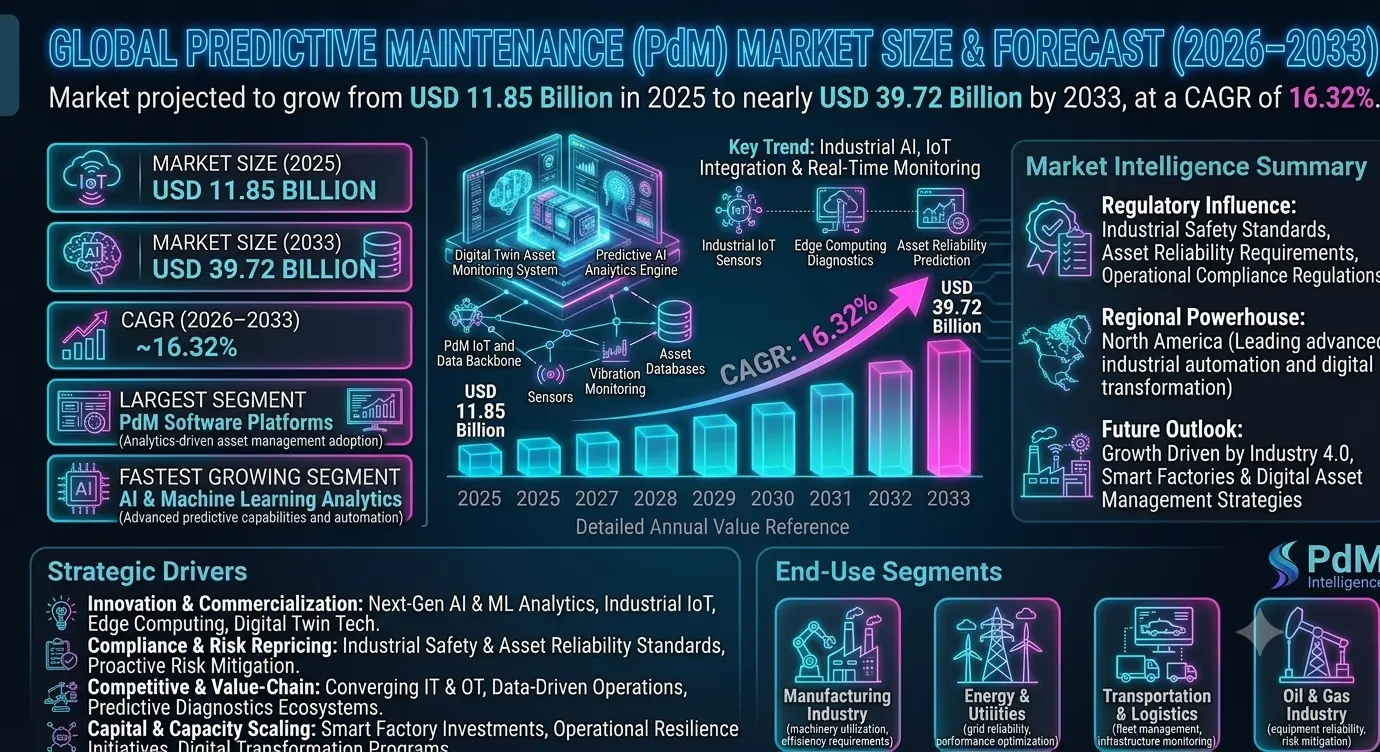
Global Predictive Maintenance (PdM) Market Size & Forecast
The Global Predictive Maintenance (PdM) Market is expected to witness robust growth during the forecast period from 2026 to 2033. The market was valued at USD 11.85 billion in 2025 and is projected to reach approximately USD 39.72 billion by 2033, registering a CAGR of 16.32%. The market growth is primarily driven by increasing adoption of Industry 4.0 technologies, rising demand for operational efficiency, growing industrial automation, and the need to minimize unplanned equipment downtime. Predictive maintenance solutions enable organizations to monitor equipment health, predict failures before they occur, and optimize maintenance schedules through advanced analytics and real-time data collection. In addition, advancements in artificial intelligence, machine learning, IoT sensors, cloud computing, and digital twins are accelerating market expansion.Global Predictive Maintenance (PdM) Market Overview
Predictive maintenance refers to a data-driven maintenance approach that uses real-time equipment monitoring, condition-based analytics, and predictive algorithms to anticipate failures and improve asset performance. The market includes predictive maintenance software, sensors, monitoring systems, analytics platforms, cloud-based asset management solutions, and maintenance consulting services. Predictive maintenance technologies are widely utilized across manufacturing, energy, transportation, healthcare, aerospace, utilities, mining, and oil & gas industries. The market is transitioning from reactive and preventive maintenance models toward intelligent, predictive, and autonomous maintenance ecosystems.Structural Drivers of Market Growth
1. Innovation and Commercialization Acceleration
Rapid advancements in AI, machine learning, industrial IoT, edge computing, and digital twin technologies are transforming predictive maintenance capabilities. Real-time condition monitoring and advanced analytics are significantly improving asset reliability and operational efficiency.Market Implications
Companies investing in AI-powered predictive maintenance platforms and industrial analytics solutions are expected to strengthen market leadership.2. Compliance and Risk Repricing
Industrial safety regulations, equipment reliability standards, operational continuity requirements, and asset management frameworks are increasing demand for predictive maintenance solutions. Organizations are prioritizing proactive maintenance strategies to reduce operational risks and compliance-related incidents.Market Implications
Firms offering compliant, secure, and highly reliable predictive maintenance solutions are likely to gain stronger customer adoption.3. Competitive and Value-Chain Reconfiguration
The market is highly competitive as industrial software providers, automation companies, cloud platform vendors, and equipment manufacturers expand predictive maintenance offerings. The convergence of operational technology (OT) and information technology (IT) is reshaping maintenance management value chains.Market Implications
Companies focusing on integrated industrial intelligence platforms and end-to-end asset management ecosystems may gain stronger competitive advantages.4. Capital and Capacity Scaling
Rising investments in smart factories, digital transformation programs, connected infrastructure, and industrial automation projects are supporting market growth. Organizations are increasing spending on asset optimization and operational resilience initiatives.Market Implications
Technology providers scaling cloud infrastructure, analytics capabilities, and industrial partnerships are expected to capture future opportunities.Market Segmentation Analysis
By Component
1. Predictive Maintenance Software Platforms
This remains the largest segment due to increasing adoption of analytics-driven asset management solutions.2. Sensors & Monitoring Devices
Strong demand driven by industrial IoT deployment and real-time equipment monitoring.3. Services
Growing adoption of consulting, implementation, and maintenance support services.4. Cloud-Based Analytics Solutions
Rapidly expanding due to scalability and remote asset monitoring capabilities.By Technology
1. Vibration Monitoring
Largest segment due to widespread application across rotating machinery and manufacturing equipment.2. Thermal Imaging
Used for identifying overheating components and electrical faults.3. Oil Analysis
Critical for monitoring machinery health and lubrication performance.4. AI & Machine Learning Analytics
Fastest-growing segment due to advanced predictive capabilities and automation benefits.5. Digital Twin Technology
Emerging technology enabling virtual asset simulation and predictive performance analysis.By End User
1. Manufacturing Industry
Largest segment due to extensive machinery utilization and operational efficiency requirements.2. Energy & Utilities
Strong demand for grid reliability and asset performance optimization.3. Transportation & Logistics
Growing adoption for fleet management and infrastructure monitoring.4. Oil & Gas Industry
Significant utilization for equipment reliability and risk mitigation.5. Aerospace & Defense
Increasing deployment for mission-critical asset maintenance.Regional Market Dynamics
North America
North America dominates the global predictive maintenance market due to advanced industrial automation, strong Industry 4.0 adoption, and extensive digital transformation initiatives.Europe
Europe remains a major market supported by smart manufacturing programs, industrial modernization efforts, and stringent operational efficiency requirements.Asia-Pacific
Asia-Pacific is the fastest-growing region due to rapid industrialization, smart factory deployment, and increasing investments in industrial automation technologies.Latin America
Latin America is gradually expanding due to growing adoption of digital asset management and industrial efficiency solutions.Middle East & Africa
The region is witnessing steady growth driven by infrastructure modernization, energy sector investments, and industrial digitalization initiatives.Competitive Landscape
The Global Predictive Maintenance Market is highly competitive with industrial software vendors, automation providers, cloud platform companies, and analytics specialists operating globally.Key Companies Operating in the Market Include:
- IBM Corporation
- Microsoft Corporation
- SAP SE
- Siemens AG
- General Electric Company
- Schneider Electric SE
- ABB Ltd.
- Honeywell International Inc.
- Rockwell Automation Inc.
- PTC Inc.
Strategic Outlook
The future of the predictive maintenance market will be shaped by industrial AI, autonomous maintenance systems, digital twins, and advanced IoT connectivity. Cloud-based analytics, edge intelligence, predictive diagnostics, and real-time operational visibility will significantly enhance asset reliability and maintenance efficiency. The rise of smart factories, connected infrastructure, and industrial digital transformation is expected to create strong long-term growth opportunities.Final Market Perspective
The Global Predictive Maintenance Market remains a critical segment within industrial automation, asset management, and digital transformation ecosystems. Rising demand for operational efficiency, equipment reliability, and intelligent maintenance strategies continues driving long-term market growth. Companies capable of delivering scalable, AI-powered, secure, and integrated predictive maintenance solutions will be best positioned to capture future opportunities. The convergence of artificial intelligence, industrial IoT, digital twins, and smart manufacturing technologies is expected to redefine the future of global predictive maintenance operations.Table of Contents
Table of Contents
- 1. Executive Summary
- 1.1 Global Predictive Maintenance (PdM) Market Snapshot (2026???2033)
- 1.2 Market Size & Growth Overview
- 1.3 Key Market Highlights
- 1.4 Largest & Fastest-Growing Segments
- 1.5 Regional Performance Summary
- 1.6 Competitive Landscape Overview
- 1.7 Strategic Outlook Through 2033
- 2. Market Introduction & Overview
- 2.1 Definition of Predictive Maintenance (PdM)
- 2.2 Scope of the Global Predictive Maintenance Market
- 2.3 Evolution of Maintenance Strategies & Industrial Analytics
- 2.4 Predictive Maintenance Value Chain Analysis
- 2.5 Regulatory & Compliance Framework
- 2.6 Emerging Trends in Industrial AI & Smart Asset Management
- 2.7 Role of Predictive Maintenance in Industry 4.0 Ecosystems
- 3. Research Methodology
- 3.1 Primary Research Approach
- 3.2 Secondary Research Sources
- 3.3 Market Size Estimation Methodology
- 3.4 Forecasting Assumptions (2026???2033)
- 3.5 Data Validation & Triangulation
- 4. Market Dynamics
- 4.1 Market Drivers
- 4.1.1 Rising Adoption of Industry 4.0 Technologies
- 4.1.2 Increasing Demand for Operational Efficiency & Asset Reliability
- 4.1.3 Growth in Industrial IoT Deployments
- 4.1.4 Expansion of Smart Factory Initiatives
- 4.1.5 Advancements in AI, Machine Learning & Digital Twin Technologies
- 4.2 Market Restraints
- 4.2.1 High Initial Implementation & Integration Costs
- 4.2.2 Data Quality & Interoperability Challenges
- 4.2.3 Shortage of Skilled Analytics & Maintenance Professionals
- 4.3 Market Opportunities
- 4.3.1 Expansion of Cloud-Based Asset Management Platforms
- 4.3.2 Growth in AI-Driven Maintenance Automation
- 4.3.3 Increasing Adoption Across Energy & Utilities Infrastructure
- 4.3.4 Integration with Digital Twins & Edge Computing Solutions
- 4.4 Market Challenges
- 4.4.1 Managing Large Volumes of Industrial Data
- 4.4.2 Cybersecurity Risks in Connected Industrial Systems
- 4.4.3 Complexity of Legacy Equipment Integration
- 4.1 Market Drivers
- 5. Global Predictive Maintenance (PdM) Market Size & Forecast (USD Billion), 2026???2033
- 5.1 Market Revenue Analysis
- 5.2 CAGR Analysis
- 5.3 Demand-Supply Trends
- 5.4 Pricing Analysis
- 5.5 Investment Trends
- 5.6 Future Market Outlook
- 6. Market Segmentation Analysis (USD Billion), 2026???2033
- 6.1 By Component
- 6.1.1 Predictive Maintenance Software Platforms (Largest Segment)
- 6.1.2 Sensors & Monitoring Devices
- 6.1.3 Services
- 6.1.4 Cloud-Based Analytics Solutions
- 6.2 By Technology
- 6.2.1 Vibration Monitoring (Largest Segment)
- 6.2.2 Thermal Imaging
- 6.2.3 Oil Analysis
- 6.2.4 AI & Machine Learning Analytics (Fastest-Growing Segment)
- 6.2.5 Digital Twin Technology
- 6.3 By End User
- 6.3.1 Manufacturing Industry (Largest Segment)
- 6.3.2 Energy & Utilities
- 6.3.3 Transportation & Logistics
- 6.3.4 Oil & Gas Industry
- 6.3.5 Aerospace & Defense
- 6.1 By Component
- 7. Regional Market Analysis
- 7.1 North America (Largest Market)
- 7.2 Europe
- 7.3 Asia-Pacific (Fastest-Growing Market)
- 7.4 Latin America
- 7.5 Middle East & Africa
- 8. Competitive Landscape
- 8.1 Market Share Analysis
- 8.2 Competitive Benchmarking
- 8.3 Strategic Developments
- 8.4 Product Innovation & Industrial AI Strategies
- 8.5 Partnerships, Acquisitions & Expansion Analysis
- 9. Company Profiles
- 9.1 IBM Corporation
- 9.2 Microsoft Corporation
- 9.3 SAP SE
- 9.4 Siemens AG
- 9.5 General Electric Company
- 9.6 Schneider Electric SE
- 9.7 ABB Ltd.
- 9.8 Honeywell International Inc.
- 9.9 Rockwell Automation Inc.
- 9.10 PTC Inc.
- 10. Strategic Intelligence & Pheonix AI Insights
- 10.1 Predictive Maintenance Demand Forecast Model
- 10.2 Industrial AI Adoption Opportunity Analysis
- 10.3 Smart Factory Growth Tracker
- 10.4 Asset Reliability & Operational Efficiency Assessment
- 10.5 Automated Porter???s Five Forces Analysis
- 11. Future Outlook & Strategic Recommendations
- 11.1 Expansion of Autonomous Maintenance Systems
- 11.2 Investment in AI-Powered Predictive Analytics Platforms
- 11.3 Growth Opportunities in Connected Industrial Infrastructure
- 11.4 Strengthening Digital Twin & Real-Time Monitoring Capabilities
- 11.5 Long-Term Market Outlook (2033+)
- 12. Appendix
- 13. About Pheonix Market Research
- 14. Disclaimer
Competitive Landscape
Global Predictive Maintenance (PdM) Market Competitive Intensity & Market Structure Overview
The global Predictive Maintenance (PdM) market is highly competitive and rapidly evolving, characterized by the presence of industrial software providers, automation technology companies, cloud platform vendors, industrial IoT specialists, and advanced analytics solution providers. Competitive intensity is primarily driven by artificial intelligence capabilities, predictive analytics accuracy, industrial connectivity, cloud integration, and the ability to deliver measurable operational efficiency improvements.
Market participants compete across predictive maintenance software platforms, industrial IoT monitoring solutions, AI-driven analytics systems, digital twin technologies, and asset performance management platforms. As organizations increasingly prioritize operational resilience and asset optimization, vendors are expanding their capabilities through technology innovation and strategic partnerships.
The market structure is transitioning from traditional maintenance management solutions toward intelligent, connected, and autonomous maintenance ecosystems. The convergence of operational technology (OT), information technology (IT), cloud computing, and industrial AI is reshaping competitive dynamics across the industry.
Global Predictive Maintenance (PdM) Market Competitive Intensity & Market Structure Current Scenario
Leading Global Predictive Maintenance Companies
IBM Corporation: A major provider of AI-powered asset management and predictive maintenance solutions through its enterprise software and analytics platforms.
Microsoft Corporation: Offers cloud-based predictive maintenance capabilities through Azure IoT, AI services, digital twin platforms, and industrial analytics solutions.
SAP SE: Provides integrated asset management, predictive analytics, and enterprise maintenance solutions for industrial operations worldwide.
Siemens AG: A leading industrial technology company offering digital twin solutions, industrial automation systems, and predictive maintenance platforms for smart manufacturing environments.
General Electric Company: Delivers advanced asset performance management and predictive analytics solutions through its industrial software and digital infrastructure portfolio.
Schneider Electric SE: Specializes in industrial automation, energy management, and predictive maintenance solutions focused on operational efficiency and sustainability.
ABB Ltd.: Provides condition monitoring, predictive analytics, and industrial automation solutions across manufacturing, utilities, and process industries.
Honeywell International Inc.: Offers industrial asset management, predictive maintenance software, and connected plant solutions for critical infrastructure and industrial operations.
Rockwell Automation Inc.: A leading provider of industrial automation, smart manufacturing technologies, and predictive maintenance platforms.
PTC Inc.: Focuses on industrial IoT, augmented reality, digital twin technologies, and predictive maintenance solutions for connected industrial ecosystems.
Key Competitive Intensity & Market Structure Drivers
The rapid adoption of Industry 4.0 initiatives and smart factory deployments is increasing demand for intelligent predictive maintenance solutions capable of reducing downtime and improving productivity.
Advancements in artificial intelligence, machine learning, and industrial IoT technologies are enabling more accurate predictive models and real-time equipment health monitoring capabilities.
Growing integration of predictive maintenance platforms with enterprise asset management (EAM), ERP systems, and cloud infrastructure is intensifying competition among technology providers.
Industrial organizations are increasingly seeking end-to-end asset performance management solutions that combine monitoring, diagnostics, analytics, and maintenance automation within a unified platform.
The emergence of digital twins, edge computing, and autonomous maintenance systems is creating new competitive opportunities and accelerating product innovation across the market.
Strategic Implications of Competitive Intensity & Market Structure
Companies capable of delivering highly accurate AI-powered predictive analytics and scalable industrial IoT ecosystems are expected to gain significant competitive advantages.
Investment in cloud-native platforms, edge intelligence, and digital twin technologies is becoming increasingly important for long-term market differentiation and customer retention.
Organizations offering integrated solutions that connect asset monitoring, predictive diagnostics, maintenance scheduling, and operational analytics are likely to achieve stronger market positioning.
Strategic collaborations between software providers, industrial equipment manufacturers, cloud service providers, and automation companies are becoming critical for expanding capabilities and market reach.
Strong cybersecurity frameworks, regulatory compliance capabilities, and industrial-grade reliability are emerging as key decision factors for enterprise customers adopting predictive maintenance solutions.
Global Predictive Maintenance (PdM) Market Competitive Intensity & Market Structure Forward Outlook
The competitive landscape of the global predictive maintenance market is expected to become increasingly AI-driven as organizations continue accelerating industrial digital transformation and asset optimization initiatives. Competition will intensify around predictive accuracy, autonomous maintenance capabilities, and real-time operational intelligence.
Market participants are expected to increase investments in machine learning algorithms, industrial IoT infrastructure, cloud analytics platforms, and digital twin technologies to strengthen their competitive positions.
The integration of edge computing, generative AI, autonomous operations, and advanced asset performance management systems is expected to transform maintenance practices across multiple industries.
Over the forecast period, companies that successfully combine industrial expertise, advanced analytics, cloud scalability, cybersecurity, and end-to-end asset intelligence capabilities will be best positioned to lead the evolving global predictive maintenance market.
Value Chain
Global Predictive Maintenance (PdM) Market Value Chain & Supply Chain Evolution Overview
The Global Predictive Maintenance (PdM) Market is undergoing a significant transformation driven by Industry 4.0 adoption, industrial IoT deployment, artificial intelligence integration, cloud-based analytics, and the increasing need for operational efficiency across asset-intensive industries. The market???s value chain spans sensor manufacturing, data acquisition, connectivity infrastructure, analytics platforms, software development, system integration, maintenance services, and end-user asset management operations. This interconnected ecosystem is reshaping how organizations monitor, maintain, and optimize critical equipment.
A defining characteristic of the evolving value chain is the convergence of operational technology (OT), information technology (IT), industrial automation systems, and advanced analytics platforms. Predictive maintenance solutions are increasingly leveraging machine learning algorithms, digital twins, edge computing, and real-time monitoring technologies to identify equipment anomalies and prevent costly failures before they occur.
Supply chain complexity continues to increase as organizations integrate sensors, industrial communication networks, cloud infrastructure, AI platforms, enterprise asset management systems, and cybersecurity frameworks into unified maintenance environments. Market participants must coordinate hardware suppliers, software vendors, cloud providers, system integrators, and maintenance service providers while ensuring data reliability, system interoperability, and operational security.
Technology providers are increasingly investing in AI-driven analytics engines, industrial connectivity platforms, cloud-native architectures, and digital twin technologies to enhance predictive capabilities and improve maintenance outcomes. The value chain is evolving into a highly connected, data-driven, and intelligent ecosystem focused on maximizing asset reliability, reducing downtime, and improving operational performance.
Global Predictive Maintenance (PdM) Market Value Chain & Supply Chain Evolution Current Scenario
Market-Specific Value Chain
- Technology Research & Development: AI algorithm development, predictive analytics modeling, industrial software engineering, digital twin development, and industrial automation innovation.
- Hardware & Sensor Manufacturing: Production of vibration sensors, thermal imaging devices, acoustic monitoring systems, IoT gateways, and condition monitoring equipment.
- Data Acquisition & Connectivity Infrastructure: Industrial IoT deployment, edge computing systems, wireless connectivity solutions, industrial networks, and cloud integration platforms.
- Analytics & Software Platforms: Predictive maintenance software, machine learning platforms, cloud analytics, asset performance management systems, and real-time monitoring dashboards.
- System Integration & Deployment: Enterprise integration, industrial automation deployment, consulting services, implementation support, and customized maintenance solutions.
- End User Operations: Manufacturing facilities, utilities, transportation networks, oil & gas operations, aerospace systems, mining sites, and healthcare infrastructure utilizing predictive maintenance solutions.
Company-to-Stage Mapping
- Technology Research & Development: IBM Corporation, Microsoft Corporation, SAP SE, PTC Inc.
- Hardware & Sensor Manufacturing: Siemens AG, ABB Ltd., Honeywell International Inc., Schneider Electric SE.
- Data Acquisition & Connectivity Infrastructure: Microsoft Corporation, Siemens AG, Schneider Electric SE, industrial IoT platform providers.
- Analytics & Software Platforms: IBM Corporation, SAP SE, General Electric Company, PTC Inc.
- System Integration & Deployment: Rockwell Automation Inc., Siemens AG, Honeywell International Inc., industrial system integrators and consulting firms.
- End User Operations: Manufacturing companies, energy utilities, transportation operators, aerospace organizations, mining companies, and oil & gas enterprises.
Key Value Chain & Supply Chain Evolution Signals in Global Predictive Maintenance (PdM) Market
Acceleration of Industrial AI Adoption
Artificial intelligence and machine learning are increasingly enabling automated anomaly detection, failure prediction, and intelligent maintenance recommendations across industrial assets.
Expansion of Industrial IoT Connectivity
Growing deployment of connected sensors and edge devices is enabling continuous equipment monitoring and generating large volumes of operational data for predictive analysis.
Rise of Digital Twin Technologies
Digital twins are creating virtual representations of physical assets, enabling advanced simulation, predictive modeling, and performance optimization.
Growth of Cloud-Based Asset Performance Management Platforms
Cloud-native maintenance platforms are improving scalability, remote monitoring capabilities, centralized analytics, and multi-site asset visibility.
Increasing Integration of OT and IT Systems
Organizations are integrating operational technology with enterprise IT platforms to achieve end-to-end asset intelligence and maintenance workflow automation.
Strengthening Industrial Cybersecurity Requirements
As industrial assets become increasingly connected, cybersecurity investments are becoming critical to protect operational systems, data integrity, and business continuity.
Strategic Implications of Value Chain & Supply Chain Evolution
Investment in AI-Powered Predictive Analytics
Technology providers enhancing machine learning capabilities and predictive intelligence platforms will strengthen long-term market competitiveness and customer value creation.
Expansion of Connected Asset Ecosystems
Organizations investing in industrial IoT infrastructure and real-time monitoring technologies will improve operational visibility and maintenance effectiveness.
Optimization of Cloud and Edge Computing Architectures
Combining cloud analytics with edge processing capabilities will improve response times, reduce latency, and support mission-critical industrial operations.
Strengthening Industrial Cybersecurity Frameworks
Robust cybersecurity measures and secure connectivity architectures will become essential for maintaining trust and protecting industrial assets.
Development of End-to-End Asset Intelligence Platforms
Integrated maintenance ecosystems combining sensors, analytics, asset management software, and automation systems will create significant competitive advantages.
Strategic Partnerships Across the Industrial Technology Ecosystem
Collaborations among software vendors, automation providers, cloud companies, and industrial operators will accelerate innovation and solution deployment.
Global Predictive Maintenance (PdM) Market Value Chain & Supply Chain Evolution Forward Outlook
Looking ahead, the value chain is expected to evolve into a highly intelligent, autonomous, and connected industrial ecosystem powered by AI, industrial IoT, and digital engineering technologies.
Key Future Developments Include:
- Expansion of AI-driven autonomous maintenance and self-optimizing industrial systems.
- Increased deployment of digital twins for predictive simulation and asset lifecycle optimization.
- Growth of edge computing and real-time industrial analytics platforms.
- Integration of predictive maintenance with enterprise asset management and smart factory ecosystems.
- Strengthening of industrial cybersecurity frameworks across connected asset networks.
- Expansion of cloud-native predictive maintenance solutions supporting global multi-site operations.
As the market evolves, competitive advantage will increasingly depend on the ability to combine advanced analytics, industrial connectivity, cloud infrastructure, and asset intelligence within a unified predictive maintenance ecosystem.
Companies that successfully integrate AI-powered analytics, digital twins, industrial IoT platforms, and scalable cloud architectures will achieve stronger operational outcomes, customer adoption, and long-term growth in the Global Predictive Maintenance (PdM) Market.
Investment Activity
Global Predictive Maintenance (PdM) Market Investment & Funding Dynamics Overview
The Global Predictive Maintenance (PdM) Market is experiencing significant investment activity driven by the rapid adoption of Industry 4.0 technologies, growing industrial automation initiatives, increasing demand for operational efficiency, and the rising need to minimize unplanned equipment downtime. Industrial software providers, automation companies, cloud platform vendors, manufacturing enterprises, venture capital firms, and institutional investors are actively investing in AI-powered predictive maintenance platforms, industrial IoT infrastructure, real-time asset monitoring systems, digital twin technologies, and advanced analytics solutions.
Investment momentum is accelerating as organizations prioritize asset reliability, operational resilience, maintenance optimization, and digital transformation across industrial environments. Capital allocation is increasingly focused on machine learning-based predictive analytics, cloud-native maintenance platforms, edge computing solutions, intelligent monitoring systems, and connected industrial ecosystems.
Additionally, growing investments in smart factories, industrial AI applications, autonomous maintenance technologies, digital asset management platforms, and next-generation industrial intelligence solutions are creating substantial long-term opportunities across the global predictive maintenance industry.
Global Predictive Maintenance (PdM) Market Investment & Funding Dynamics Current Scenario
Currently, the market is witnessing robust capital inflows as industrial enterprises accelerate investments in digital transformation and asset optimization initiatives. Leading technology providers are investing heavily in AI-driven maintenance software, industrial IoT sensor networks, predictive analytics engines, cloud-based monitoring systems, and digital twin platforms.
The market is attracting strong venture capital funding, private equity participation, and strategic corporate investments targeting industrial analytics providers, predictive maintenance software developers, automation technology firms, and industrial AI startups. Investors are prioritizing organizations with scalable SaaS-based platforms, strong recurring revenue models, and advanced predictive intelligence capabilities.
Furthermore, the industry is witnessing increasing levels of strategic partnerships, acquisitions, technology alliances, and joint development agreements among automation vendors, industrial equipment manufacturers, cloud providers, and software companies to strengthen innovation and expand market reach.
Key Investment & Funding Dynamics Signals in Global Predictive Maintenance (PdM) Market
- Growing adoption of Industry 4.0 and smart manufacturing initiatives is accelerating investment across predictive maintenance technologies.
- Expansion of industrial IoT networks and connected asset ecosystems is driving funding toward real-time monitoring infrastructure.
- Rising demand for AI and machine learning-based predictive analytics solutions is supporting long-term capital deployment.
- Strategic investments in digital twins, edge computing, and autonomous maintenance technologies are improving operational efficiency and asset reliability.
- Increasing focus on reducing equipment downtime, maintenance costs, and operational risks is strengthening investment activity.
- Partnerships between industrial automation companies, software vendors, cloud providers, and equipment manufacturers are accelerating technology commercialization.
- Growing emphasis on industrial safety, asset performance optimization, and regulatory compliance is reinforcing investor confidence.
Strategic Implications of Investment & Funding Dynamics in Global Predictive Maintenance (PdM) Market
- Continuous investment in AI-powered predictive maintenance platforms, industrial analytics, and IoT-enabled monitoring systems is essential for maintaining market competitiveness.
- Capital allocation toward cloud-based asset management, digital twin deployment, and intelligent maintenance ecosystems will strengthen long-term market positioning.
- Companies offering scalable, secure, real-time, and data-driven maintenance solutions are expected to achieve stronger customer adoption.
- Strategic acquisitions and partnerships will accelerate technology innovation, platform integration, and geographic expansion opportunities.
- Investments in industrial AI, edge intelligence, autonomous operations, and smart factory infrastructure will remain key growth priorities.
- Compliance with industrial safety standards, operational reliability requirements, and asset management regulations will continue influencing funding decisions.
- Organizations developing end-to-end predictive maintenance ecosystems combining software, sensors, analytics, and cloud services are expected to capture substantial future value.
Global Predictive Maintenance (PdM) Market Investment & Funding Dynamics Forward Outlook
Looking ahead, the Global Predictive Maintenance (PdM) Market is expected to maintain strong investment momentum driven by increasing industrial digitalization, smart factory deployments, connected infrastructure expansion, and growing demand for intelligent asset management solutions.
Future capital deployment will increasingly focus on AI-driven predictive diagnostics, autonomous maintenance systems, digital twin integration, advanced industrial analytics, and cloud-native maintenance platforms.
As organizations continue prioritizing operational efficiency, equipment reliability, and data-driven decision-making, investment activity is expected to expand across industrial intelligence platforms, predictive technologies, and global deployment capabilities.
In conclusion, the Global Predictive Maintenance (PdM) Market represents a high-growth industrial technology investment landscape where artificial intelligence, industrial IoT, digital twins, cloud analytics, smart manufacturing, and autonomous maintenance systems will define future funding priorities, competitive dynamics, and long-term industry growth.
Technology & Innovation
Global Predictive Maintenance (PdM) Market Technology & Innovation Landscape Overview
The Global Predictive Maintenance (PdM) Market is undergoing rapid technological transformation driven by advancements in artificial intelligence (AI), machine learning (ML), Industrial Internet of Things (IIoT), digital twins, edge computing, cloud analytics, and real-time asset monitoring systems. The market exhibits high innovation intensity as industries increasingly prioritize operational efficiency, equipment reliability, asset optimization, and downtime reduction.
At the center of this transformation is the shift from traditional preventive and reactive maintenance approaches toward intelligent, data-driven, and predictive asset management ecosystems. Organizations are leveraging connected sensors, advanced analytics, and AI-powered algorithms to predict equipment failures before they occur and optimize maintenance interventions.
A major innovation area is AI and machine learning-based predictive analytics, where advanced algorithms continuously analyze equipment performance data, detect anomalies, identify failure patterns, and generate predictive maintenance recommendations with increasing accuracy.
The market is also witnessing rapid adoption of Industrial IoT technologies, including smart sensors, wireless monitoring devices, connected equipment platforms, and industrial communication networks that enable continuous real-time condition monitoring across industrial assets.
Manufacturers and technology providers are increasingly investing in digital twin technology, which creates virtual replicas of physical assets to simulate operating conditions, forecast performance degradation, and support predictive maintenance decision-making.
Product innovation further includes cloud-native maintenance platforms, edge intelligence solutions, autonomous maintenance systems, predictive diagnostics software, asset performance management (APM) platforms, and industrial data integration tools.
Additionally, advancements in vibration monitoring, thermal imaging, acoustic sensing, oil analysis technologies, and AI-enabled visual inspection systems are improving equipment health assessment and predictive maintenance accuracy.
The convergence of AI analytics, IIoT connectivity, digital twins, cloud computing, and autonomous maintenance technologies is redefining the future technology landscape of the global predictive maintenance market.
Global Predictive Maintenance (PdM) Market Technology & Innovation Landscape Current Scenario
Currently, the Global Predictive Maintenance Market demonstrates strong innovation activity and increasing commercialization of AI-powered monitoring platforms, industrial analytics solutions, connected asset ecosystems, and predictive diagnostics technologies.
1. AI & Machine Learning-Based Predictive Analytics
Advanced AI algorithms are enabling more accurate failure prediction, anomaly detection, root-cause analysis, and maintenance scheduling optimization.
2. Industrial IoT Sensor Networks
Connected sensors are providing continuous monitoring of temperature, vibration, pressure, acoustics, and equipment performance across industrial operations.
3. Digital Twin Technology Deployment
Digital twins are increasingly being used to simulate equipment behavior, optimize maintenance planning, and improve asset lifecycle management.
4. Cloud-Based Predictive Maintenance Platforms
Cloud-native platforms enable centralized monitoring, scalable analytics, remote diagnostics, and enterprise-wide asset visibility.
5. Edge Computing & Real-Time Processing
Edge analytics are reducing latency and enabling immediate predictive insights directly at industrial sites and operational facilities.
6. Advanced Condition Monitoring Technologies
Vibration analysis, thermal imaging, oil condition monitoring, and acoustic sensing technologies are becoming increasingly sophisticated and automated.
Key Technology & Innovation Landscape Signals in Global Predictive Maintenance (PdM) Market
Several innovation signals are shaping the future evolution of the market:
1. Expansion of Industrial AI Adoption
AI-powered maintenance intelligence is becoming a core component of smart manufacturing and industrial automation strategies.
2. Growth of Connected Asset Ecosystems
Organizations are increasingly integrating equipment, sensors, software platforms, and operational systems into unified maintenance environments.
3. Increasing Use of Digital Twins
Digital twin adoption is accelerating across manufacturing, energy, transportation, and critical infrastructure sectors.
4. Rise of Autonomous Maintenance Systems
Self-learning maintenance platforms are enabling automated diagnostics, recommendations, and maintenance workflow optimization.
5. Expansion of Edge Intelligence
Real-time analytics at the asset level is improving responsiveness, reducing downtime, and enhancing operational continuity.
6. Integration of Asset Performance Management Platforms
Organizations are combining predictive maintenance with broader asset optimization and operational efficiency initiatives.
7. Cybersecurity & Industrial Data Protection Focus
As predictive maintenance systems become increasingly connected, secure data management and industrial cybersecurity are becoming strategic priorities.
Strategic Implications of Technology & Innovation Landscape in Global Predictive Maintenance (PdM) Market
The evolving technology landscape is significantly reshaping competition across the predictive maintenance industry. Companies are increasingly competing on analytics accuracy, AI capabilities, real-time monitoring performance, platform scalability, interoperability, and automation levels.
Organizations investing in AI-powered predictive analytics, industrial IoT infrastructure, digital twin ecosystems, and cloud-based maintenance platforms are expected to strengthen their long-term market positioning.
Strategic collaborations between industrial automation providers, cloud technology companies, sensor manufacturers, analytics vendors, and equipment OEMs are accelerating innovation and market adoption.
The growing convergence of operational technology (OT), information technology (IT), artificial intelligence, industrial analytics, and cloud computing is creating strong opportunities for predictive maintenance solution providers.
Additionally, increasing pressure to improve operational efficiency, reduce maintenance costs, enhance safety, and maximize asset utilization is encouraging continued investment in intelligent maintenance technologies.
Global Predictive Maintenance (PdM) Market Technology & Innovation Landscape Forward Outlook
Looking ahead to 2026???2033, the Global Predictive Maintenance Market is expected to evolve toward increasingly autonomous, intelligent, and self-optimizing maintenance ecosystems.
Future technological developments are likely to include:
1. Autonomous AI Maintenance Platforms
Next-generation AI systems will autonomously detect failures, generate maintenance actions, and optimize asset performance with minimal human intervention.
2. Advanced Digital Twin Ecosystems
Highly detailed digital twins will support predictive simulations, lifecycle optimization, and real-time operational decision-making.
3. Hyperconnected Industrial IoT Networks
Expanded sensor deployment and industrial connectivity will enable comprehensive asset visibility across entire enterprises.
4. Edge AI & Real-Time Predictive Intelligence
Edge computing combined with AI will provide faster predictive insights and localized decision-making capabilities.
5. Integrated Asset Performance Optimization Platforms
Predictive maintenance solutions will increasingly integrate with enterprise asset management (EAM), ERP, and operational intelligence platforms.
6. AI-Powered Visual Inspection Systems
Computer vision technologies will automate equipment inspections, anomaly detection, and maintenance assessments.
7. Industrial Metaverse & Remote Operations Integration
Immersive digital environments will support remote asset monitoring, maintenance planning, workforce training, and operational collaboration.
In conclusion, companies capable of combining AI-powered predictive analytics, Industrial IoT connectivity, digital twin technologies, edge intelligence, cloud-native platforms, and autonomous maintenance capabilities will be best positioned to lead the future evolution of the Global Predictive Maintenance (PdM) Market.
Market Risk
Global Predictive Maintenance (PdM) Market: Risk Factors & Disruption Threats Overview
The Global Predictive Maintenance (PdM) Market is experiencing rapid expansion as organizations increasingly adopt Industry 4.0 technologies, industrial IoT platforms, artificial intelligence, and digital asset management systems. While predictive maintenance delivers significant operational benefits through reduced downtime and improved asset reliability, the market remains exposed to multiple technological, cybersecurity, implementation, and economic risks that influence adoption and long-term growth.
One of the primary risk factors is the complexity of integrating predictive maintenance solutions into existing industrial environments. Many organizations operate legacy machinery and fragmented operational technology (OT) systems that may not easily support advanced sensors, cloud analytics platforms, or AI-driven monitoring tools. Integration challenges can increase deployment costs and extend implementation timelines.
Cybersecurity threats represent another major disruption risk. As industrial assets become increasingly connected through IoT devices, cloud platforms, and remote monitoring systems, organizations face heightened exposure to ransomware attacks, data breaches, operational disruptions, and unauthorized system access. Security vulnerabilities can compromise both operational continuity and critical infrastructure resilience.
Data quality and reliability risks also remain significant. Predictive maintenance models depend heavily on accurate sensor data, historical equipment records, and real-time operational information. Inaccurate, incomplete, or inconsistent datasets may generate false predictions, reducing confidence in maintenance decisions and limiting return on investment.
Economic uncertainty and budget constraints can further affect market growth. Although predictive maintenance offers long-term cost savings, the initial investment required for sensors, software platforms, analytics infrastructure, and workforce training may discourage adoption among small and medium-sized enterprises.
In addition, supply chain disruptions affecting industrial sensors, semiconductor components, networking equipment, and automation hardware can delay deployment schedules and increase implementation costs across industries.
Global Predictive Maintenance (PdM) Market: Current Risk Scenario
The current market environment is characterized by strong demand for asset optimization, operational resilience, and intelligent maintenance strategies. However, organizations continue to face challenges associated with technology integration, workforce readiness, cybersecurity protection, and infrastructure modernization.
As predictive maintenance solutions become increasingly dependent on cloud computing, edge analytics, and connected devices, companies must manage growing cybersecurity and data governance responsibilities. Industrial operators are investing heavily in secure network architectures and cyber-resilience strategies to protect critical assets.
The shortage of skilled personnel capable of managing AI-driven maintenance systems, industrial analytics platforms, and digital twin technologies remains a significant operational challenge. Workforce skill gaps can limit implementation effectiveness and delay digital transformation initiatives.
Inflationary pressures and fluctuating industrial investment cycles are influencing technology spending decisions. Organizations often prioritize essential operational expenditures, which may postpone predictive maintenance deployment in certain sectors.
Furthermore, concerns regarding interoperability between multiple software platforms, equipment vendors, and industrial communication protocols continue to impact large-scale implementation projects.
Key Risk Factors & Disruption Threats Signals
- Cybersecurity Exposure: Connected industrial assets and cloud-based monitoring systems increase vulnerability to cyberattacks, ransomware, and unauthorized access.
- Integration Complexity: Legacy infrastructure and fragmented OT environments may create deployment challenges and increase implementation costs.
- Data Quality Risks: Inaccurate, incomplete, or inconsistent operational data can reduce predictive model effectiveness and maintenance accuracy.
- Technology Obsolescence: Rapid advancements in AI, IoT, analytics platforms, and digital twins may shorten technology lifecycles and require continuous upgrades.
- Workforce Skill Shortages: Limited availability of data scientists, industrial AI specialists, and predictive maintenance professionals may constrain adoption.
- Supply Chain Disruptions: Shortages of sensors, semiconductors, networking equipment, and automation components may affect deployment schedules.
- Capital Investment Constraints: High upfront implementation costs may discourage adoption among budget-sensitive organizations.
- Interoperability Challenges: Diverse industrial systems and communication standards may complicate platform integration and scalability.
Strategic Implications of Risk Factors & Disruption Threats
The evolving risk landscape is encouraging technology providers to develop scalable, interoperable, and cybersecurity-focused predictive maintenance solutions. Vendors are increasingly integrating advanced encryption, secure cloud architectures, and real-time threat detection capabilities into industrial analytics platforms.
Manufacturers and industrial operators are investing in data governance frameworks, digital infrastructure modernization, and workforce development programs to maximize predictive maintenance effectiveness and improve operational reliability.
Strategic collaborations between industrial automation companies, software providers, cloud platform operators, and equipment manufacturers are becoming increasingly important to deliver integrated asset intelligence ecosystems.
Organizations that successfully combine predictive analytics, digital twins, IoT connectivity, and operational expertise are expected to achieve stronger maintenance performance and competitive differentiation.
Global Predictive Maintenance (PdM) Market: Forward Risk Outlook
Looking ahead, the predictive maintenance market is expected to remain exposed to moderate-to-high technology and cybersecurity risks as industrial operations become increasingly digitalized and interconnected.
Emerging technologies such as autonomous maintenance systems, generative AI, advanced digital twins, edge intelligence, and industrial metaverse applications will create new opportunities while simultaneously increasing infrastructure complexity and governance requirements.
Regulatory expectations regarding operational safety, cybersecurity compliance, critical infrastructure protection, and data management are expected to become more stringent across industrial sectors.
Companies that prioritize cybersecurity resilience, interoperability, workforce training, and scalable analytics capabilities will be better positioned to mitigate disruption risks and capitalize on future growth opportunities.
Overall, the Global Predictive Maintenance Market will continue to operate within a dynamic technology environment shaped by industrial AI, smart manufacturing, connected assets, and real-time operational intelligence. Organizations capable of balancing innovation, security, and operational resilience will be best positioned for sustainable long-term success.
Regulatory Landscape
Global Predictive Maintenance (PdM) Market Regulatory & Policy Environment Overview
The regulatory and policy environment governing the Global Predictive Maintenance (PdM) Market is evolving rapidly as industries increasingly adopt Industrial Internet of Things (IIoT), artificial intelligence (AI), machine learning, cloud computing, and advanced analytics technologies to improve asset reliability, operational efficiency, and maintenance planning. Governments, regulatory agencies, and industry organizations are strengthening frameworks related to industrial safety, equipment reliability, cybersecurity, operational resilience, and data governance to support the secure deployment of predictive maintenance solutions across manufacturing, energy, transportation, utilities, aerospace, healthcare, mining, and oil & gas sectors.
Predictive maintenance solution providers, industrial software vendors, equipment manufacturers, and system integrators must comply with a broad range of regulations governing machinery safety, operational risk management, industrial cybersecurity, critical infrastructure protection, environmental performance, and data management. As maintenance systems become increasingly connected and software-driven, regulatory oversight is expanding beyond traditional maintenance practices to include digital asset monitoring, cloud-based analytics, and AI-powered decision-making systems.
The growing adoption of smart factories, connected industrial assets, Industry 4.0 initiatives, and digital transformation programs is encouraging policymakers to promote standards that enhance equipment uptime, workforce safety, cyber resilience, and sustainable industrial operations.
Global Predictive Maintenance (PdM) Market Regulatory & Policy Environment Current Scenario
The current regulatory environment is characterized by increasing emphasis on industrial safety compliance, operational continuity, and cybersecurity preparedness. Organizations deploying predictive maintenance platforms are expected to ensure that monitoring systems, IoT-enabled sensors, analytics software, and cloud-based maintenance applications comply with applicable industry regulations and security standards.
Industrial safety regulations continue to influence predictive maintenance adoption across manufacturing facilities, power plants, transportation networks, and critical infrastructure assets. Compliance with equipment inspection standards, machinery safety requirements, reliability-centered maintenance practices, and workplace safety regulations remains a key operational priority.
Cybersecurity requirements are becoming increasingly important as connected assets, industrial control systems, and predictive analytics platforms generate and exchange large volumes of operational data. Regulatory agencies are encouraging organizations to implement secure communication protocols, access controls, threat monitoring capabilities, and cyber-risk management frameworks.
Data governance regulations are also gaining importance as predictive maintenance solutions rely on extensive asset-performance data collection, storage, and analysis. Organizations must ensure compliance with applicable regulations governing industrial data management, privacy controls, data integrity, and information security.
Environmental and sustainability regulations are further supporting market adoption by encouraging industries to improve equipment efficiency, reduce resource waste, lower emissions, and extend asset lifecycles through proactive maintenance strategies.
Key Regulatory & Policy Environment Signals in Global Predictive Maintenance (PdM) Market
- Industrial Safety & Asset Reliability Standards: Regulations promoting equipment safety, operational continuity, machinery inspection, and proactive maintenance practices across industrial facilities.
- Industrial Cybersecurity Frameworks: Growing focus on protecting connected assets, industrial control systems, operational technology (OT) environments, and cloud-based maintenance platforms.
- Data Governance & Information Security Requirements: Compliance obligations governing the collection, storage, transmission, and utilization of equipment performance and operational data.
- Industry 4.0 & Smart Manufacturing Policies: Government initiatives supporting industrial automation, digital transformation, connected factories, and intelligent asset management systems.
- Environmental & Sustainability Regulations: Policies encouraging energy efficiency, asset optimization, emissions reduction, and sustainable maintenance practices.
- Critical Infrastructure Compliance Requirements: Regulatory oversight aimed at ensuring reliability and resilience across energy, transportation, utilities, and public infrastructure sectors.
Strategic Implications of Regulatory & Policy Environment
The evolving regulatory landscape is encouraging organizations to invest in secure, compliant, and intelligent predictive maintenance platforms capable of supporting long-term operational resilience and regulatory adherence. Compliance capabilities are becoming an increasingly important factor in vendor selection and technology procurement decisions.
Cybersecurity regulations are driving investments in secure industrial networks, encrypted communications, endpoint protection, asset monitoring systems, and cloud-security frameworks. Vendors capable of demonstrating strong cybersecurity and compliance credentials are expected to gain competitive advantages across regulated industries.
Industrial safety and reliability standards are encouraging broader deployment of predictive analytics solutions that help organizations reduce equipment failures, improve maintenance planning, and minimize operational disruptions.
Data governance requirements are influencing platform development strategies, encouraging software providers to strengthen data transparency, auditability, access management, and compliance-focused analytics capabilities.
Environmental regulations are creating additional opportunities for predictive maintenance providers by increasing demand for solutions that improve asset efficiency, reduce maintenance waste, extend equipment lifespan, and support corporate sustainability objectives.
Global Predictive Maintenance (PdM) Market Regulatory & Policy Environment Forward Outlook
Between 2026 and 2033, the regulatory environment for the global predictive maintenance market is expected to become increasingly comprehensive as organizations accelerate investments in industrial AI, digital twins, autonomous maintenance systems, and cloud-connected asset management platforms. Policymakers are likely to strengthen requirements related to industrial cybersecurity, operational resilience, and critical infrastructure protection.
Data governance regulations are expected to expand further, requiring greater transparency regarding industrial data collection, predictive analytics models, AI-driven decision support systems, and cross-border data management practices.
Cybersecurity compliance standards will likely become more stringent for IIoT ecosystems, industrial cloud platforms, smart factories, and connected operational technology environments. Security certification, continuous monitoring, and cyber-resilience capabilities are expected to become standard procurement requirements.
Industrial safety and reliability frameworks are anticipated to encourage wider adoption of predictive maintenance technologies as organizations seek to reduce downtime, improve equipment performance, and comply with evolving operational standards.
Overall, the future regulatory landscape will be shaped by the convergence of industrial safety requirements, cybersecurity governance, data protection frameworks, sustainability objectives, and Industry 4.0 policies. Companies capable of delivering secure, scalable, compliant, and AI-enabled predictive maintenance solutions will be best positioned to capitalize on long-term growth opportunities within the global industrial ecosystem.