
Global Sulfuric Acid Market Report, Size, Share and Forecast 2026–2033
Global Sulfuric Acid Market Forecast Snapshot (2026???2033)
| Metric | Value |
|---|---|
| Market Size (2025) | USD 15.84 Billion |
| Market Size (2033) | USD 24.67 Billion |
| CAGR (2026???2033) | 5.69% |
| Largest Segment | Fertilizer Production Applications |
| Fastest Growing Segment | Battery Manufacturing & Industrial Processing Applications |
| Leading End-Use Segment | Agriculture & Chemical Manufacturing Industries |
| Key Trend | Sustainable Sulfur Recovery & Industrial Process Optimization |
| Regulatory Influence | Environmental Emission Standards, Chemical Handling Regulations & Industrial Safety Compliance |
| Future Outlook | Growth Driven by Fertilizer Demand, Battery Sector Expansion & Industrial Chemical Processing |
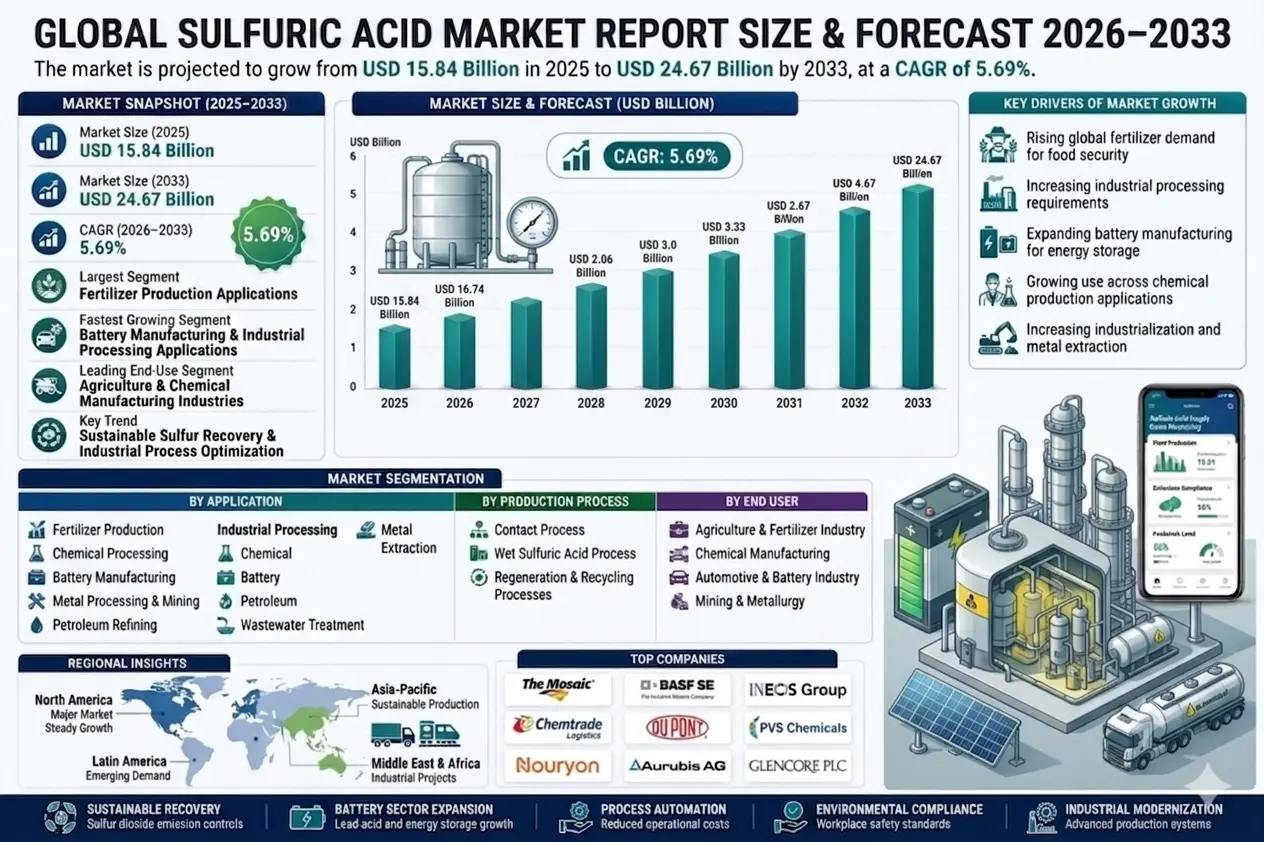
Global Sulfuric Acid Market Size & Forecast
The Global Sulfuric Acid Market is expected to witness steady growth during the forecast period from 2026 to 2033. The market was valued at USD 15.84 billion in 2025 and is projected to reach approximately USD 24.67 billion by 2033, registering a CAGR of 5.69%. The market growth is primarily driven by rising fertilizer demand, increasing industrial processing requirements, expanding battery manufacturing, and growing use across chemical production applications. Sulfuric acid remains one of the most essential industrial chemicals used in fertilizer manufacturing, petroleum refining, wastewater treatment, metal processing, and battery production. Rising industrialization and expanding chemical processing activities are accelerating market growth. In addition, increasing sulfur recovery technologies, sustainable chemical manufacturing practices, and energy storage sector expansion are supporting long-term market development.Global Sulfuric Acid Market Overview
Sulfuric acid is a highly corrosive mineral acid widely used as a critical industrial feedstock across multiple manufacturing and processing sectors. The market includes sulfur-based acid production, recycled sulfuric acid, concentrated sulfuric acid, and application-specific sulfuric acid formulations. Sulfuric acid is extensively utilized across agriculture, chemicals, automotive batteries, petroleum refining, wastewater treatment, and metal extraction industries. The market is shifting toward cleaner production methods, sulfur recovery systems, advanced process automation, and environmentally optimized manufacturing facilities.Structural Drivers of Market Growth
1. Innovation and Commercialization Acceleration
Rapid innovation in sulfur recovery technologies, process optimization systems, and sustainable acid production methods is improving manufacturing efficiency. Advanced automation and process control systems are reducing operational costs and improving environmental performance.Market Implications
Manufacturers investing in process innovation, recycling technologies, and high-efficiency production systems are expected to strengthen market leadership.2. Compliance and Risk Repricing
Environmental emission regulations, hazardous chemical handling standards, and workplace safety requirements are influencing production modernization. Governments are increasingly enforcing strict sulfur dioxide emission controls and chemical transport compliance.Market Implications
Firms offering compliant, environmentally optimized, and safely managed sulfuric acid production systems are likely to gain stronger market trust.3. Competitive and Value-Chain Reconfiguration
The market is highly competitive as integrated chemical producers, fertilizer manufacturers, mining companies, and industrial processing firms expand sulfuric acid production capabilities. Vertical integration and sulfur feedstock optimization are altering value-chain economics.Market Implications
Companies focusing on integrated supply chains and process efficiency may gain stronger margins.4. Capital and Capacity Scaling
Rising investment in fertilizer production plants, battery material processing facilities, sulfur recovery systems, and industrial chemical infrastructure is supporting market growth. Expanding demand from agriculture and energy storage sectors is also increasing production requirements.Market Implications
Manufacturers scaling efficient and sustainable production capacity are expected to capture future opportunities.Market Segmentation Analysis
By Application
1. Fertilizer Production
This remains the largest segment due to extensive use in phosphate fertilizer manufacturing.2. Chemical Processing
Widely used as a key industrial reagent across multiple sectors.3. Battery Manufacturing
Fastest-growing due to rising lead-acid battery demand and energy storage applications.4. Metal Processing & Mining
Strong demand for ore leaching and refining applications.5. Petroleum Refining
Used for alkylation and refining process optimization.By Production Process
1. Contact Process
Largest segment due to widespread industrial adoption.2. Wet Sulfuric Acid Process
Growing demand due to sulfur recovery efficiency.3. Regeneration & Recycling Processes
Fast-growing due to sustainability requirements.By End User
1. Agriculture & Fertilizer Industry
Largest segment due to global food production requirements.2. Chemical Manufacturing
Strong demand for industrial synthesis applications.3. Automotive & Battery Industry
Growing adoption for battery electrolyte production.4. Mining & Metallurgy
Used extensively in extraction and refining operations.Regional Market Dynamics
Asia-Pacific
Asia-Pacific dominates the global sulfuric acid market due to strong fertilizer production, industrialization, and large-scale chemical manufacturing activities.North America
North America remains a major market supported by advanced refining infrastructure and battery manufacturing growth.Europe
Europe is witnessing steady growth driven by sustainable chemical production and industrial modernization.Latin America
Latin America is gradually expanding due to agricultural sector growth and mining activities.Middle East & Africa
The region is witnessing emerging demand driven by fertilizer projects and industrial development investments.Competitive Landscape
The Global Sulfuric Acid Market is highly competitive with integrated chemical manufacturers and industrial processing companies expanding globally.Key Companies Operating in the Market Include:
- The Mosaic Company
- BASF SE
- INEOS Group
- Chemtrade Logistics
- DuPont de Nemours
- PVS Chemicals
- Nouryon
- Aurubis AG
- Boliden Group
- Glencore Plc
Strategic Outlook
The future of the sulfuric acid market will be shaped by sustainable sulfur recovery technologies, battery sector expansion, process automation, and cleaner chemical production systems. Advanced environmental compliance systems and integrated recycling capabilities will significantly improve operational efficiency and competitiveness. The rise of energy storage demand, fertilizer consumption, and industrial modernization is expected to create strong long-term growth opportunities.Final Market Perspective
The Global Sulfuric Acid Market remains a critical segment within industrial chemicals, agriculture, and energy storage ecosystems. Rising demand for fertilizers, batteries, and industrial processing continues driving long-term market growth. Companies capable of delivering efficient, compliant, sustainable, and technologically advanced sulfuric acid production solutions will be best positioned to capture future opportunities. The convergence of industrial automation, sustainable chemical manufacturing, and battery sector growth is expected to redefine the future of the global sulfuric acid industry.Table of Contents
Table of Contents
- 1. Executive Summary
- 1.1 Global Sulfuric Acid Market Snapshot (2026???2033)
- 1.2 Market Size & CAGR Analysis
- 1.3 Largest & Fastest-Growing Segments
- 1.4 Key Regional Insights
- 1.5 Major Market Growth Drivers
- 1.6 Competitive Landscape Overview
- 1.7 Strategic Outlook Through 2033
- 2. Introduction & Market Overview
- 2.1 Definition of Sulfuric Acid Market
- 2.2 Scope of the Study
- 2.3 Evolution of Sulfuric Acid Production Technologies
- 2.4 Industrial Chemical Ecosystem Analysis
- 2.5 Regulatory & Environmental Compliance Framework
- 2.6 Key Market Trends in Industrial Chemicals
- 2.7 Sustainable Sulfur Recovery Innovation Landscape
- 3. Research Methodology
- 3.1 Primary Research
- 3.2 Secondary Research
- 3.3 Market Size Estimation Model
- 3.4 Forecast Assumptions (2026???2033)
- 3.5 Data Validation & Market Triangulation
- 4. Market Dynamics
- 4.1 Drivers
- 4.1.1 Rising Fertilizer Production Demand
- 4.1.2 Expansion of Battery Manufacturing
- 4.1.3 Industrial Chemical Processing Growth
- 4.1.4 Increasing Mining & Metal Processing Activities
- 4.1.5 Sulfur Recovery Technology Advancements
- 4.2 Restraints
- 4.2.1 Stringent Environmental Regulations
- 4.2.2 Hazardous Handling & Transportation Risks
- 4.2.3 Volatility in Sulfur Feedstock Supply
- 4.2.4 High Operational Compliance Costs
- 4.3 Opportunities
- 4.3.1 Growth in Energy Storage Applications
- 4.3.2 Expansion of Recycling & Regeneration Processes
- 4.3.3 Sustainable Chemical Manufacturing Adoption
- 4.3.4 Emerging Industrial Infrastructure Investments
- 4.4 Challenges
- 4.4.1 Emission Reduction Compliance
- 4.4.2 Production Process Modernization Costs
- 4.4.3 Safe Chemical Storage Requirements
- 4.4.4 Global Supply Chain Disruptions
- 4.1 Drivers
- 5. Global Sulfuric Acid Market Analysis (USD Billion), 2026???2033
- 5.1 Market Size Overview
- 5.2 CAGR Analysis
- 5.3 Regional Revenue Distribution
- 5.4 Industrial Demand Trends
- 5.5 End-User Consumption Analysis
- 5.6 Future Growth Projections
- 6. Market Segmentation (USD Billion), 2026???2033
- 6.1 By Application
- 6.1.1 Fertilizer Production
- 6.1.2 Chemical Processing
- 6.1.3 Battery Manufacturing
- 6.1.4 Metal Processing & Mining
- 6.1.5 Petroleum Refining
- 6.2 By Production Process
- 6.2.1 Contact Process
- 6.2.2 Wet Sulfuric Acid Process
- 6.2.3 Regeneration & Recycling Processes
- 6.3 By End User
- 6.3.1 Agriculture & Fertilizer Industry
- 6.3.2 Chemical Manufacturing
- 6.3.3 Automotive & Battery Industry
- 6.3.4 Mining & Metallurgy
- 6.1 By Application
- 7. Market Segmentation by Geography
- 7.1 Asia-Pacific
- 7.2 North America
- 7.3 Europe
- 7.4 Latin America
- 7.5 Middle East & Africa
- 8. Competitive Landscape
- 8.1 Market Share Analysis
- 8.2 Production Capacity Benchmarking
- 8.3 Strategic Partnerships & Expansions
- 8.4 Sustainability Innovation Analysis
- 8.5 Competitive Positioning Strategies
- 9. Company Profiles
- 9.1 The Mosaic Company
- 9.2 BASF SE
- 9.3 INEOS Group
- 9.4 Chemtrade Logistics
- 9.5 DuPont de Nemours
- 9.6 PVS Chemicals
- 9.7 Nouryon
- 9.8 Aurubis AG
- 9.9 Boliden Group
- 9.10 Glencore Plc
- 10. Strategic Intelligence & Pheonix AI Insights
- 10.1 Sulfuric Acid Demand Forecast Engine
- 10.2 Industrial Process Optimization Dashboard
- 10.3 Environmental Compliance Risk Tracker
- 10.4 Chemical Market Opportunity Analyzer
- 10.5 Automated Porter???s Five Forces Analysis
- 11. Future Outlook & Strategic Recommendations
- 11.1 Expansion of Sustainable Sulfur Recovery Systems
- 11.2 Investment in Cleaner Production Technologies
- 11.3 Strengthening Battery Sector Supply Chains
- 11.4 Process Automation Adoption Strategies
- 11.5 Long-Term Market Outlook (2033+)
- 12. Appendix
- 13. About Pheonix Research
- 14. Disclaimer
Competitive Landscape
Global Sulfuric Acid Market Competitive Intensity & Market Structure Overview
The global sulfuric acid market is highly competitive and moderately consolidated, characterized by strong competition among integrated chemical producers, fertilizer manufacturers, mining companies, and industrial acid processing firms. Competitive intensity is driven by production scale, sulfur feedstock access, operational efficiency, environmental compliance capabilities, process optimization technologies, and vertical integration across industrial value chains.
The market structure includes large multinational chemical companies with integrated sulfur recovery and acid production capabilities alongside regional industrial producers serving localized fertilizer, mining, and chemical processing demand. Competition is increasingly shaped by sustainable sulfur recovery systems, advanced process automation, recycling technologies, and energy-efficient manufacturing infrastructure.
Rising fertilizer demand, battery manufacturing expansion, increasing industrial processing requirements, and stricter environmental compliance standards are significantly intensifying competition across the global sulfuric acid market.
Global Sulfuric Acid Market Competitive Intensity & Market Structure Current Scenario
Leading Global Sulfuric Acid Companies
The Mosaic Company: Leading fertilizer producer with large-scale integrated sulfuric acid production for phosphate manufacturing.
BASF SE: Major global chemical company with advanced sulfuric acid processing capabilities and diversified industrial applications.
INEOS Group: Established industrial chemicals producer with strong sulfur-based chemical manufacturing operations.
Chemtrade Logistics: Major supplier specializing in sulfuric acid production, regeneration, and industrial distribution services.
DuPont de Nemours: Global industrial materials company with advanced chemical processing capabilities.
PVS Chemicals: Strong market participant focused on sulfuric acid production and industrial chemical supply solutions.
Nouryon: Leading specialty chemicals company leveraging integrated sulfuric acid processing infrastructure.
Aurubis AG: Major copper producer utilizing sulfuric acid as a critical byproduct of smelting operations.
Boliden Group: Integrated mining and metals company with significant sulfuric acid production capabilities.
Glencore Plc: Diversified mining and commodities company benefiting from large-scale sulfuric acid output through smelting operations.
Key Competitive Intensity & Market Structure Drivers
Growing fertilizer production demand is intensifying competition around high-volume and cost-efficient sulfuric acid supply.
Expansion of battery manufacturing is accelerating investment in high-purity sulfuric acid production technologies.
Environmental emission regulations are strengthening competition around sustainable sulfur recovery and low-emission production systems.
Vertical integration across mining, smelting, and chemical production is reshaping market competitiveness.
Industrial automation and process optimization technologies are becoming critical for cost leadership and operational efficiency.
Strategic Implications of Competitive Intensity & Market Structure
Manufacturers are increasingly investing in sulfur recovery technologies and advanced process control systems to improve production efficiency.
Strategic integration with fertilizer, mining, and battery supply chains is strengthening long-term competitive positioning.
Recycling and regeneration technologies are emerging as major differentiators for sustainable production strategies.
Energy-efficient plant modernization and digital process monitoring are becoming central to operational competitiveness.
Compliance with stringent environmental and chemical handling regulations is enhancing market trust and contract opportunities.
Global Sulfuric Acid Market Competitive Intensity & Market Structure Forward Outlook
The global sulfuric acid market is expected to remain highly competitive as fertilizer demand, battery sector growth, and industrial chemical processing continue expanding.
Future competition will increasingly focus on sustainable sulfur recovery, advanced regeneration systems, AI-driven process optimization, and cleaner production technologies.
Asia-Pacific will remain the dominant competitive region, while North America and Europe will continue driving innovation in sustainable and high-purity sulfuric acid production.
Advancements in process automation, sulfur recycling systems, and environmentally optimized plant infrastructure are expected to significantly reshape market dynamics.
Overall, companies that successfully combine scalable production capacity, environmental compliance excellence, process efficiency, and integrated industrial supply capabilities will remain strongly positioned in the evolving global sulfuric acid market.
Value Chain
Global Sulfuric Acid Market Value Chain & Supply Chain Evolution Overview
The Global Sulfuric Acid Market value chain is evolving from conventional large-scale chemical manufacturing systems into a more integrated, efficiency-driven, and sustainability-focused industrial ecosystem. This transformation is being driven by rising global fertilizer demand, growing industrial chemical processing requirements, expansion of battery manufacturing activities, and increasing regulatory pressure to reduce environmental emissions. Sulfuric acid remains one of the most strategically important industrial chemicals, serving as a foundational input across agriculture, metallurgy, petroleum refining, and energy storage sectors.
The value chain is becoming increasingly interconnected through sulfur recovery technologies, feedstock optimization systems, automated production controls, logistics modernization, and environmentally compliant manufacturing processes. Manufacturers are increasingly adopting advanced monitoring systems and integrated process optimization technologies to improve operational efficiency, reduce waste generation, and ensure compliance with stringent environmental standards.
The upstream segment includes sulfur feedstock sourcing, sulfur recovery from oil and gas refining operations, pyrite mining, smelter gas recovery, and raw material processing. Sulfur availability and feedstock pricing are critical factors influencing production economics and supply chain stability. Integrated oil refiners and mining companies play a central role in supplying sulfur feedstock to acid producers.
The core manufacturing layer involves sulfur combustion, catalytic oxidation, acid concentration processes, quality control systems, and emissions management infrastructure. Modern sulfuric acid plants increasingly rely on automated process controls, waste heat recovery systems, and digital monitoring platforms to optimize production efficiency while minimizing environmental impact.
The downstream distribution network includes bulk transportation systems, storage terminals, chemical logistics operators, and direct supply agreements with fertilizer producers, battery manufacturers, mining companies, and industrial processing facilities. Efficient logistics and safe chemical handling infrastructure are essential due to sulfuric acid???s highly corrosive properties.
Overall, the sulfuric acid value chain is transitioning into a more vertically integrated, technology-enabled, and environmentally optimized ecosystem where production efficiency, feedstock reliability, compliance performance, and industrial integration define competitive advantage.
Global Sulfuric Acid Market Value Chain & Supply Chain Evolution Current Scenario
The current market structure reflects a highly integrated industrial ecosystem where sulfuric acid production is closely linked to oil refining, metal smelting, fertilizer manufacturing, and chemical processing activities. Fertilizer production remains the dominant demand center, particularly for phosphate fertilizer manufacturing, while industrial diversification is creating new growth opportunities across battery production and advanced chemical applications.
Many producers are increasingly integrating sulfur recovery units with refining and industrial operations to ensure stable feedstock availability and improve cost efficiency. This integration is reducing dependency on standalone sulfur supply chains while supporting environmental compliance through sulfur dioxide emission reduction.
Technological modernization is reshaping production systems through process automation, digital control systems, emissions monitoring technologies, and waste heat recovery installations. These upgrades are improving plant efficiency while supporting compliance with increasingly strict environmental and workplace safety regulations.
Despite strong industrial demand, the market continues to face challenges related to feedstock price volatility, transportation safety risks, environmental compliance costs, and capacity balancing across regional supply-demand cycles.
Key Value Chain & Supply Chain Evolution Signals in Global Sulfuric Acid Market
Sulfur recovery system expansion is strengthening upstream integration by enabling efficient feedstock sourcing from petroleum refining and industrial gas treatment operations.
Battery sector demand growth is creating new downstream opportunities, particularly with the expansion of energy storage systems and lead-acid battery manufacturing.
Process automation adoption is enhancing production efficiency, reducing operational costs, and improving consistency in acid concentration and purity levels.
Environmental compliance modernization is accelerating investment in emission control technologies, waste heat recovery systems, and cleaner manufacturing processes.
Integrated industrial partnerships are becoming increasingly important for ensuring stable demand flows and improving long-term supply chain resilience.
Strategic Implications of Value Chain & Supply Chain Evolution in Global Sulfuric Acid Market
The evolving sulfuric acid value chain presents significant strategic opportunities for integrated chemical manufacturers, fertilizer producers, mining operators, and industrial processing firms. Competitive advantage is increasingly determined by feedstock integration, process efficiency, environmental compliance capabilities, and logistics infrastructure reliability.
Companies investing in sulfur recovery systems, high-efficiency catalytic technologies, and advanced process automation are expected to strengthen their market positioning. Sustainability-driven production upgrades are also becoming essential for maintaining long-term regulatory approval and customer trust.
Strategic partnerships between sulfur feedstock suppliers, industrial chemical producers, and downstream end-use industries are becoming increasingly critical for stabilizing supply chains and optimizing production economics.
Organizations capable of balancing operational scale, environmental responsibility, cost efficiency, and supply reliability will be best positioned to capture future growth opportunities in this evolving industrial market.
Global Sulfuric Acid Market Value Chain & Supply Chain Evolution Forward Outlook
Between 2026 and 2033, the sulfuric acid value chain is expected to evolve into a more circular, digitally optimized, and sustainability-oriented industrial ecosystem. Advanced sulfur recycling technologies and process regeneration systems are expected to reduce waste generation while improving resource utilization across production networks.
Battery manufacturing growth, particularly in energy storage and automotive applications, will continue expanding downstream demand for sulfuric acid. This diversification will strengthen market resilience beyond traditional fertilizer-driven demand cycles.
Digital process intelligence systems powered by AI and predictive analytics will further improve production efficiency, maintenance scheduling, and emissions control performance across manufacturing facilities.
Environmental compliance will remain a defining factor, driving continued investment in carbon reduction technologies, emission monitoring systems, and cleaner industrial chemistry processes.
Ultimately, the future sulfuric acid value chain will be defined by feedstock integration, sustainable manufacturing innovation, advanced industrial automation, and diversified end-use application growth.
Market-Specific Value Chain
- Feedstock Sourcing: Sulfur recovery units, petroleum refiners, mining companies, smelter gas recovery systems
- Chemical Processing & Manufacturing: Sulfur combustion plants, catalytic oxidation systems, acid concentration facilities
- Process Optimization: Automation platforms, digital monitoring systems, waste heat recovery technologies
- Storage & Logistics: Bulk chemical transport providers, storage terminals, industrial distribution networks
- Industrial Applications: Fertilizer manufacturers, battery producers, chemical processors, mining and metallurgy operators
- Compliance & Safety Systems: Environmental monitoring technologies, industrial safety regulators, emissions control infrastructure
- End-Use Industries: Agriculture, automotive batteries, petroleum refining, wastewater treatment, industrial manufacturing
Investment Activity
Global Sulfuric Acid Market Investment & Funding Dynamics Overview
The Global Sulfuric Acid Market is witnessing steady investment momentum driven by rising fertilizer production demand, industrial chemical processing expansion, battery manufacturing growth, and increasing focus on sustainable sulfur recovery technologies. Integrated chemical producers, fertilizer manufacturers, mining operators, and industrial processing companies are actively investing in advanced sulfur recovery systems, process automation technologies, sustainable production infrastructure, and high-efficiency manufacturing facilities.
Investment activity is accelerating due to growing demand for phosphate fertilizer production, lead-acid battery manufacturing, industrial refining applications, and environmentally optimized sulfuric acid processing systems. The transition toward cleaner and more efficient production methods is reshaping capital allocation across the market.
Additionally, increasing investments in recycling-based acid regeneration systems, emission control technologies, digital process monitoring platforms, and sustainable industrial chemical infrastructure are strengthening long-term growth opportunities globally.
Global Sulfuric Acid Market Investment & Funding Dynamics Current Scenario
Currently, the global sulfuric acid market is experiencing rising capital deployment due to increasing investment requirements for capacity expansion, process modernization, sulfur recovery optimization, and environmental compliance upgrades. Leading companies are heavily investing in high-efficiency production systems, automated processing controls, sulfur recycling infrastructure, and advanced industrial safety technologies.
The market is attracting strong funding into chemical processing infrastructure, battery material production facilities, fertilizer manufacturing plants, and sustainable sulfur recovery technology providers.
The industry is witnessing active strategic partnerships, plant expansion projects, long-term supply agreements, and industrial technology collaborations as participants seek to strengthen production resilience and operational efficiency.
Key Investment & Funding Dynamics Signals in Global Sulfuric Acid Market
- Rising demand for fertilizer production applications is accelerating large-scale manufacturing investments.
- Expansion of battery manufacturing and energy storage applications is increasing technology-focused capital deployment.
- Growing adoption of sulfur recovery and acid regeneration systems is strengthening sustainability-driven funding.
- Strategic investments in process automation and emission control systems are reshaping operational priorities.
- Partnerships between chemical producers, fertilizer manufacturers, and industrial technology providers are improving ecosystem scalability.
- Increasing regulatory emphasis on environmental emission standards, hazardous chemical handling, and workplace safety compliance is supporting investor confidence.
- Rising demand for industrial process optimization solutions is accelerating R&D spending.
Strategic Implications of Investment & Funding Dynamics in Global Sulfuric Acid Market
- Continuous investment in sustainable sulfur recovery infrastructure and process modernization is essential for long-term competitiveness.
- Capital allocation toward environmentally optimized production systems will strengthen market positioning.
- Companies delivering efficient, compliant, and scalable sulfuric acid production solutions are expected to gain stronger market share.
- Strategic plant expansion and technology partnerships will accelerate production efficiency and supply chain resilience.
- Investments in digital process automation and acid regeneration technologies will remain major priorities.
- Compliance with environmental regulations, chemical handling standards, and industrial safety protocols will remain critical for sustained growth.
- Organizations scaling integrated production ecosystems are expected to capture substantial future opportunities.
Global Sulfuric Acid Market Investment & Funding Dynamics Forward Outlook
Looking ahead, the Global Sulfuric Acid Market is expected to maintain stable investment growth driven by fertilizer demand expansion, battery sector development, sustainable chemical production, and industrial process modernization.
Future capital deployment will increasingly focus on advanced sulfur recovery systems, AI-driven process optimization, low-emission production technologies, and integrated acid recycling infrastructure.
The convergence of industrial automation, environmental compliance technologies, and energy storage material demand is expected to become a major long-term innovation priority.
In conclusion, the Global Sulfuric Acid Market represents a strategically important industrial chemical investment landscape where sustainable manufacturing, production efficiency, process automation, and battery sector expansion will define future capital strategies.
Technology & Innovation
Global Sulfuric Acid Market Technology & Innovation Landscape Overview
The global sulfuric acid market is undergoing significant technological transformation driven by advancements in sulfur recovery systems, process automation technologies, energy-efficient production infrastructure, emission control systems, and digital chemical manufacturing platforms. These innovations are improving production efficiency, reducing environmental impact, and enabling safer handling across industrial applications.
Modern sulfuric acid manufacturing facilities are increasingly integrating advanced catalytic conversion systems, waste heat recovery technologies, real-time process monitoring solutions, and automated control systems to optimize acid production and improve operational reliability. These technological developments are helping manufacturers increase yield efficiency while lowering energy consumption and reducing sulfur dioxide emissions.
The market is also witnessing rising adoption of closed-loop sulfur recycling systems, predictive maintenance platforms, industrial IoT-enabled monitoring systems, and AI-driven process optimization tools. These innovations are transforming sulfuric acid production into a more sustainable, intelligent, and digitally managed industrial process.
Global Sulfuric Acid Market Technology & Innovation Current Scenario
Currently, innovation in the sulfuric acid market is primarily focused on enhancing production efficiency, environmental compliance, and process sustainability. Traditional production systems are increasingly being modernized with automated digital infrastructure capable of improving process consistency and reducing operational risks.
Advanced contact process technologies remain the dominant production innovation, enabling higher conversion efficiency and better sulfur dioxide management through improved catalyst formulations and optimized reactor designs.
Sulfur recovery technologies are becoming increasingly critical, particularly in petroleum refining and chemical processing facilities, where recovered sulfur is being efficiently converted into sulfuric acid to improve circular industrial resource utilization.
AI-enabled process analytics are also emerging as a major innovation area, allowing manufacturers to monitor operational variables in real time, predict equipment failures, and optimize reaction conditions for maximum output efficiency.
In parallel, industrial IoT systems are improving safety monitoring by enabling continuous tracking of pressure, temperature, emission levels, and corrosion risks across production infrastructure.
Key Technology & Innovation Trends in the Global Sulfuric Acid Market
- Advanced Catalytic Conversion Systems: Improving sulfur dioxide conversion efficiency and production consistency.
- Waste Heat Recovery Technologies: Capturing thermal energy to improve operational efficiency and reduce energy costs.
- Industrial IoT Monitoring Systems: Enabling real-time tracking of production parameters and equipment performance.
- AI-Based Process Optimization: Enhancing operational efficiency through predictive analytics and automated adjustments.
- Closed-Loop Sulfur Recovery Systems: Supporting sustainable feedstock recycling and reduced waste generation.
- Emission Control Technologies: Reducing sulfur dioxide release and improving environmental compliance.
- Digital Twin Production Modeling: Simulating plant performance to optimize process design and output.
- Predictive Maintenance Platforms: Minimizing downtime through proactive equipment monitoring.
- Automated Process Control Systems: Increasing production precision and operational safety.
- Corrosion Monitoring Solutions: Improving infrastructure integrity and reducing maintenance risks.
Strategic Implications of Technology & Innovation
Technological advancements are reshaping competitive dynamics in the sulfuric acid market by shifting the industry from traditional high-emission production systems toward digitally optimized, environmentally compliant, and energy-efficient manufacturing ecosystems.
Companies investing in advanced sulfur recovery technologies, AI-driven process control, and automated environmental compliance systems are gaining stronger operational advantages through lower production costs, improved sustainability performance, and enhanced regulatory alignment.
The convergence of automation, digital analytics, and sustainability engineering is enabling sulfuric acid manufacturers to improve production scalability while addressing increasingly strict environmental and industrial safety requirements.
However, high capital investment requirements, process modernization complexity, and compliance-driven infrastructure upgrades remain key challenges influencing adoption speed across developing industrial regions.
Global Sulfuric Acid Market Technology & Innovation Forward Outlook
The future of the sulfuric acid market is expected to evolve toward fully automated, low-emission, and digitally integrated chemical production ecosystems capable of delivering higher efficiency, lower environmental impact, and stronger operational resilience.
Emerging innovations are expected to include AI-powered autonomous process control systems, next-generation catalyst technologies, advanced carbon capture integration, and smart circular sulfur recovery platforms.
Digital twins and predictive industrial intelligence platforms will further improve plant performance optimization, while sustainable process engineering will continue reducing carbon and sulfur emission intensity across production operations.
Overall, the sulfuric acid market is transitioning toward a highly intelligent and environmentally optimized industrial ecosystem powered by automation, AI-driven analytics, sustainable process innovation, and advanced recovery technologies, redefining the future of global industrial chemical manufacturing.
Market Risk
Global Sulfuric Acid Market Risk & Disruption Analysis
The Global Sulfuric Acid Market operates within a highly regulated and industrially sensitive environment influenced by raw material volatility, environmental compliance requirements, production safety risks, and evolving industrial demand patterns. While the market continues to benefit from strong fertilizer demand, battery manufacturing expansion, and industrial chemical processing, it remains exposed to supply chain disruptions, regulatory intervention, and operational hazards.
As one of the world???s most widely utilized industrial chemicals, sulfuric acid production is closely linked to agricultural productivity, mining activity, petroleum refining operations, and chemical manufacturing output. Market profitability is significantly affected by sulfur feedstock availability, energy prices, environmental compliance costs, and process efficiency.
The industry is increasingly transitioning toward sustainable sulfur recovery technologies, process automation, recycling systems, and environmentally optimized production infrastructure, creating both opportunities and capital-intensive disruption risks.
Current Risk Environment
The sulfuric acid market currently faces a complex disruption landscape characterized by environmental regulation tightening, volatile sulfur supply dynamics, and operational modernization pressure.
Environmental and emission compliance remains one of the most significant risk factors. Strict sulfur dioxide (SO???) emission controls, hazardous chemical handling regulations, and industrial waste disposal requirements are increasing operational compliance costs across production facilities.
Raw material supply volatility is another critical challenge, as sulfur availability is closely tied to petroleum refining and natural gas processing activities. Changes in upstream energy production patterns can directly impact sulfur feedstock pricing and supply consistency.
The market is also exposed to operational and safety risks due to the highly corrosive and hazardous nature of sulfuric acid production, storage, and transportation. Accidents, leaks, or equipment failures can create significant financial and reputational consequences.
Additionally, fluctuations in fertilizer demand, battery production cycles, and industrial processing output can create downstream demand instability.
Key Risk & Disruption Factors
- Environmental Compliance Risk: Tightening emission regulations increase production and modernization costs.
- Raw Material Supply Volatility: Sulfur feedstock availability depends heavily on refinery and gas processing output.
- Operational Safety Risk: Hazardous handling and transportation increase accident exposure.
- Energy Cost Sensitivity: High energy consumption makes profitability vulnerable to power price fluctuations.
- Demand Dependency on Agriculture: Fertilizer sector demand fluctuations directly affect market stability.
- Capital Modernization Pressure: Significant investment required for sustainable production upgrades.
- Industrial Demand Cyclicality: Mining, refining, and manufacturing slowdowns impact consumption levels.
- Logistics and Storage Challenges: Transportation and storage infrastructure constraints increase operational complexity.
Strategic Implications of Market Risk & Disruption
The evolving risk environment is accelerating investment in cleaner sulfur recovery systems, closed-loop recycling technologies, and automated production control systems.
Manufacturers are increasingly prioritizing process optimization, digital monitoring systems, and predictive maintenance technologies to improve safety, efficiency, and regulatory compliance.
Vertical integration across sulfur sourcing, production infrastructure, and downstream chemical processing is becoming strategically valuable to mitigate supply chain volatility.
Companies capable of balancing operational efficiency with environmental compliance are expected to strengthen long-term competitiveness.
Global Sulfuric Acid Market Risk & Disruption Forward Outlook
Looking ahead to 2026???2033, the sulfuric acid market is expected to become increasingly sustainability-driven, technologically optimized, and compliance-intensive.
- Expansion of Sustainable Sulfur Recovery: Cleaner recovery technologies will gain wider adoption.
- Growing Battery Sector Influence: Energy storage demand will drive sulfuric acid consumption growth.
- Higher Environmental Oversight: Compliance requirements will intensify globally.
- Increased Process Automation: Smart manufacturing systems will improve operational control.
- Capacity Expansion in Emerging Markets: Fertilizer and industrial chemical demand will support regional growth.
- Greater Recycling Integration: Acid regeneration systems will become more commercially significant.
- Supply Chain Diversification: Producers will seek resilient sulfur sourcing strategies.
Overall, the Global Sulfuric Acid Market remains a strategically essential industrial chemicals segment where long-term success will depend on sustainable production capability, regulatory adaptability, process safety excellence, and supply chain resilience.
Regulatory Landscape
Global Sulfuric Acid Market Regulatory & Policy Environment Overview
The regulatory and policy environment governing the global sulfuric acid market is shaped by environmental emission standards, hazardous chemical handling regulations, industrial safety compliance frameworks, transportation restrictions, and sustainable manufacturing mandates. As sulfuric acid is one of the most widely used yet highly corrosive industrial chemicals, governments and regulatory bodies impose stringent oversight to ensure safe production, storage, transportation, and disposal while minimizing environmental and occupational risks.
Sulfuric acid manufacturers and industrial users must comply with a broad range of regulations covering sulfur dioxide emission controls, hazardous material containment protocols, chemical storage requirements, worker exposure protection standards, waste management systems, and transport certification requirements for hazardous substances.
The increasing focus on sustainable sulfur recovery technologies, emission reduction initiatives, and circular chemical manufacturing is accelerating policy development around cleaner production processes, resource optimization, and environmental accountability across sulfuric acid value chains.
Global Sulfuric Acid Market Regulatory & Policy Environment Current Scenario
The current regulatory framework for the sulfuric acid market combines environmental protection laws, industrial process safety regulations, hazardous chemical transportation standards, and workplace exposure compliance requirements.
In North America and Europe, strict environmental authorities regulate sulfur dioxide emissions, acid mist control, waste acid disposal, and industrial air quality compliance. Manufacturers are increasingly required to deploy advanced scrubbing systems, emission monitoring technologies, and sulfur recovery units to meet environmental performance standards.
Occupational safety regulations governing chemical handling, corrosion-resistant infrastructure, emergency spill response systems, and worker protective equipment significantly influence facility design and operational practices.
Asia-Pacific markets including China, India, Japan, and South Korea are strengthening environmental enforcement and industrial safety frameworks as sulfuric acid production expands alongside fertilizer manufacturing, mining, and battery processing industries.
International transportation of sulfuric acid is also subject to strict hazardous material classification, packaging requirements, cross-border transport documentation, and logistics safety certification protocols.
Key Regulatory & Policy Environment Signals in Global Sulfuric Acid Market
- Environmental Emission Standards: Strict sulfur dioxide and acid mist control requirements are driving cleaner production technologies.
- Hazardous Chemical Handling Regulations: Safety protocols govern storage, transfer, and operational handling of sulfuric acid.
- Industrial Safety Compliance: Worker protection and facility safety standards shape plant design and operational processes.
- Transportation Compliance Requirements: Hazardous material logistics regulations ensure safe domestic and international movement.
- Waste Management & Disposal Policies: Regulations require controlled treatment and disposal of sulfuric acid waste streams.
- Sustainable Manufacturing Mandates: Governments are encouraging sulfur recovery systems and low-emission production infrastructure.
Strategic Implications of Regulatory & Policy Environment
The evolving regulatory landscape is encouraging sulfuric acid manufacturers to invest heavily in sulfur recovery systems, emission control technologies, automated process monitoring, and environmentally optimized production infrastructure.
Environmental compliance requirements are accelerating adoption of advanced gas scrubbing systems, catalytic conversion technologies, waste acid regeneration processes, and real-time emissions monitoring platforms.
Industrial safety regulations are driving deployment of automated chemical handling systems, corrosion-resistant containment solutions, emergency leak detection systems, and enhanced worker protection protocols.
Regulatory pressure is also supporting greater innovation in recycling-based sulfuric acid production, closed-loop manufacturing systems, and energy-efficient process optimization technologies.
International harmonization of hazardous chemical compliance standards is creating competitive advantages for manufacturers operating globally certified, environmentally responsible production facilities.
Global Sulfuric Acid Market Regulatory & Policy Environment Forward Outlook
Between 2026 and 2033, the regulatory environment for the global sulfuric acid market is expected to become increasingly sustainability-focused, emission-sensitive, and technologically standardized.
Governments are likely to introduce stricter sulfur dioxide emission limits, broader carbon reporting obligations, and stronger environmental audit requirements for sulfuric acid production facilities.
Emerging process innovations such as digital plant automation, AI-enabled emissions optimization, and advanced sulfur recycling systems may face increasingly specialized certification and operational compliance requirements.
Cross-border harmonization of hazardous chemical transport and environmental manufacturing regulations is expected to strengthen as global industrial supply chains become more interconnected.
Overall, regulatory and policy developments will remain a critical market influence, with companies investing in cleaner production systems, advanced compliance infrastructure, and sustainable sulfur processing technologies expected to maintain long-term competitive advantage.