
Global Maintenance, Repair, and Operations (MRO) Market Report, Size, Share and Forecast 2026–2033
Market Forecast Snapshot (2026???2033)
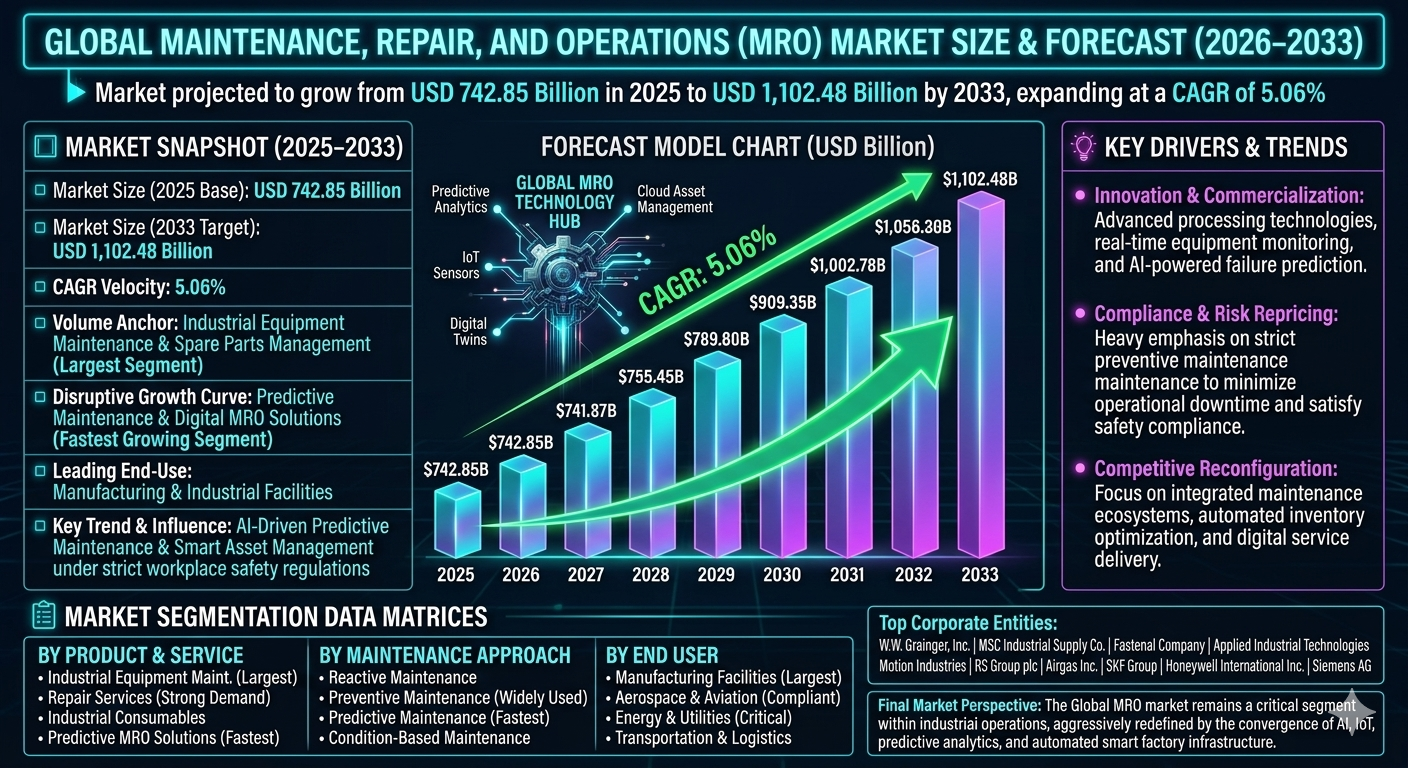
| Metric | Value |
|---|---|
| Market Size (2025) | USD 742.85 Billion |
| Market Size (2033) | USD 1,102.48 Billion |
| CAGR (2026???2033) | 5.06% |
| Largest Segment | Industrial Equipment Maintenance & Spare Parts Management |
| Fastest Growing Segment | Predictive Maintenance & Digital MRO Solutions |
| Leading End-Use Segment | Manufacturing & Industrial Facilities |
| Key Trend | AI-Driven Predictive Maintenance & Smart Asset Management |
| Regulatory Influence | Workplace Safety Regulations, Equipment Compliance Standards & Operational Reliability Requirements |
| Future Outlook | Growth Driven by Industrial Automation, Digital Asset Management & Operational Efficiency Initiatives |
Global Maintenance, Repair, and Operations (MRO) Market Size & Forecast
The Global Maintenance, Repair, and Operations (MRO) Market is expected to witness steady expansion during the forecast period from 2026 to 2033. The market was valued at USD 742.85 billion in 2025 and is projected to reach approximately USD 1,102.48 billion by 2033, registering a CAGR of 5.06%. The market growth is primarily driven by increasing industrial automation, rising demand for asset reliability, growing adoption of predictive maintenance technologies, and expanding investments in operational efficiency programs. MRO activities are critical for ensuring equipment uptime, workplace safety, production continuity, and asset lifecycle optimization. The integration of digital technologies, IoT-enabled monitoring systems, and AI-powered maintenance platforms is accelerating market growth. In addition, growing industrial infrastructure, aging equipment fleets, and the need to reduce operational downtime are supporting long-term market expansion.Global Maintenance, Repair, and Operations (MRO) Market Overview
Maintenance, Repair, and Operations (MRO) refers to the products, services, technologies, and processes used to maintain, repair, and support operational assets and industrial infrastructure. The market includes maintenance services, repair operations, spare parts management, industrial consumables, lubrication products, tools, safety equipment, and digital maintenance solutions. MRO solutions are widely utilized across manufacturing, aerospace, transportation, energy, utilities, oil & gas, mining, logistics, and commercial infrastructure sectors. The market is shifting from reactive maintenance approaches toward predictive, condition-based, and digitally connected maintenance ecosystems.Structural Drivers of Market Growth
1. Innovation and Commercialization Acceleration
Rapid innovation in predictive analytics, IoT sensors, digital twins, AI-powered maintenance systems, and cloud-based asset management platforms is transforming maintenance operations. Advanced technologies are enabling real-time equipment monitoring, failure prediction, and maintenance optimization.Market Implications
Companies investing in digital MRO solutions, predictive maintenance capabilities, and intelligent asset management systems are expected to strengthen market leadership.2. Compliance and Risk Repricing
Workplace safety standards, equipment inspection requirements, environmental regulations, and operational reliability mandates are influencing maintenance strategies. Industries are increasingly prioritizing preventive maintenance to minimize compliance risks and operational disruptions.Market Implications
Firms offering compliant, safety-focused, and reliability-enhancing MRO solutions are likely to gain stronger market trust.3. Competitive and Value-Chain Reconfiguration
The market is highly competitive as industrial distributors, maintenance service providers, technology companies, and OEMs expand integrated MRO offerings. Digital procurement systems and supply chain optimization are reshaping value-chain economics.Market Implications
Companies focusing on integrated maintenance ecosystems, inventory optimization, and digital service delivery may gain stronger margins.4. Capital and Capacity Scaling
Rising investment in industrial automation, smart factories, maintenance software platforms, and asset management infrastructure is supporting market expansion. Industrial operators are increasing maintenance budgets to improve productivity and reduce downtime costs.Market Implications
Providers scaling predictive maintenance technologies and service capabilities are expected to capture future opportunities.Market Segmentation Analysis
By Product & Service Type
1. Industrial Equipment Maintenance & Spare Parts Management
This remains the largest segment due to continuous equipment servicing and replacement part requirements.2. Repair Services
Strong demand driven by equipment restoration and operational continuity needs.3. Industrial Consumables
Widely used across manufacturing and processing facilities.4. Safety Equipment & Operational Supplies
Growing demand due to workplace safety regulations.5. Predictive Maintenance & Digital MRO Solutions
Fastest-growing segment due to AI, IoT, and asset analytics adoption.By End User
1. Manufacturing & Industrial Facilities
Largest segment due to extensive machinery and production asset maintenance requirements.2. Aerospace & Aviation
Strong demand for regulatory-compliant maintenance programs.3. Energy & Utilities
Widely utilized for critical infrastructure reliability.4. Oil & Gas
Significant demand for asset integrity and operational safety.5. Transportation & Logistics
Growing adoption for fleet and infrastructure maintenance.By Maintenance Approach
1. Reactive Maintenance
Traditional maintenance approach used after equipment failure.2. Preventive Maintenance
Widely adopted to reduce downtime and extend equipment life.3. Predictive Maintenance
Fastest-growing segment driven by digital monitoring technologies.4. Condition-Based Maintenance
Increasingly utilized for asset performance optimization.Regional Market Dynamics
North America
North America dominates the global MRO market due to advanced industrial infrastructure, strong automation adoption, and extensive maintenance outsourcing activities.Europe
Europe remains a major market supported by Industry 4.0 initiatives, industrial modernization, and stringent equipment safety regulations.Asia-Pacific
Asia-Pacific is the fastest-growing region due to rapid industrialization, manufacturing expansion, and increasing investments in smart factory technologies.Latin America
Latin America is gradually expanding due to industrial development and infrastructure modernization initiatives.Middle East & Africa
The region is witnessing growing adoption driven by oil & gas investments, industrial diversification, and infrastructure projects.Competitive Landscape
The Global Maintenance, Repair, and Operations (MRO) Market is highly competitive with industrial distributors, OEMs, maintenance service providers, and technology companies expanding globally.Key Companies Operating in the Market Include:
- W.W. Grainger, Inc.
- MSC Industrial Supply Co.
- Fastenal Company
- Applied Industrial Technologies
- Motion Industries
- RS Group plc
- Airgas Inc.
- SKF Group
- Honeywell International Inc.
- Siemens AG
Strategic Outlook
The future of the MRO market will be shaped by predictive maintenance, AI-driven asset analytics, digital twin technologies, and cloud-based maintenance management platforms. Integration of IoT sensors, automated inventory systems, and intelligent maintenance scheduling will significantly improve operational efficiency. The rise of smart factories, connected industrial assets, and data-driven maintenance strategies is expected to create strong long-term growth opportunities.Final Market Perspective
The Global Maintenance, Repair, and Operations (MRO) Market remains a critical segment within industrial operations, asset management, and infrastructure ecosystems. Rising demand for equipment reliability, operational efficiency, and digital maintenance solutions continues driving long-term market growth. Companies capable of delivering scalable, technology-enabled, and reliability-focused MRO ecosystems will be best positioned to capture future opportunities. The convergence of AI, IoT, predictive analytics, and industrial automation is expected to redefine the future of the global MRO industry.Table of Contents
Table of Contents
- 1. Executive Summary
- 1.1 Global Maintenance, Repair, and Operations (MRO) Market Snapshot (2026???2033)
- 1.2 Market Size & Growth Overview
- 1.3 Key Market Highlights
- 1.4 Largest & Fastest-Growing Segments
- 1.5 Regional Performance Summary
- 1.6 Competitive Landscape Overview
- 1.7 Strategic Outlook Through 2033
- 2. Market Introduction & Overview
- 2.1 Definition of Maintenance, Repair, and Operations (MRO)
- 2.2 Scope of the Global MRO Market
- 2.3 Evolution of Industrial Maintenance Practices
- 2.4 MRO Value Chain Analysis
- 2.5 Regulatory & Compliance Framework
- 2.6 Emerging Trends in Digital Maintenance
- 2.7 Smart Asset Management & Industrial Automation Integration
- 3. Research Methodology
- 3.1 Primary Research Approach
- 3.2 Secondary Research Sources
- 3.3 Market Size Estimation Methodology
- 3.4 Forecasting Assumptions (2026???2033)
- 3.5 Data Validation & Triangulation
- 4. Market Dynamics
- 4.1 Market Drivers
- 4.1.1 Rising Industrial Automation Adoption
- 4.1.2 Growing Demand for Asset Reliability & Uptime
- 4.1.3 Increasing Deployment of Predictive Maintenance Technologies
- 4.1.4 Expansion of Industrial Infrastructure & Manufacturing Facilities
- 4.1.5 Advancements in AI, IoT & Digital Twin Technologies
- 4.2 Market Restraints
- 4.2.1 High Implementation Costs of Advanced Maintenance Systems
- 4.2.2 Integration Challenges with Legacy Equipment
- 4.2.3 Skilled Workforce Shortages in Maintenance Operations
- 4.3 Market Opportunities
- 4.3.1 Expansion of Smart Factory Initiatives
- 4.3.2 Growth in Cloud-Based Asset Management Platforms
- 4.3.3 Increasing Demand for Maintenance Outsourcing Services
- 4.3.4 AI-Driven Predictive Maintenance Commercialization
- 4.4 Market Challenges
- 4.4.1 Managing Complex Multi-Site Maintenance Operations
- 4.4.2 Cybersecurity Risks in Connected Maintenance Systems
- 4.4.3 Balancing Cost Efficiency with Operational Reliability
- 4.1 Market Drivers
- 5. Global Maintenance, Repair, and Operations (MRO) Market Size & Forecast (USD Billion), 2026???2033
- 5.1 Market Revenue Analysis
- 5.2 CAGR Analysis
- 5.3 Demand-Supply Trends
- 5.4 Pricing Analysis
- 5.5 Investment Trends
- 5.6 Future Market Outlook
- 6. Market Segmentation Analysis (USD Billion), 2026???2033
- 6.1 By Product & Service Type
- 6.1.1 Industrial Equipment Maintenance & Spare Parts Management (Largest Segment)
- 6.1.2 Repair Services
- 6.1.3 Industrial Consumables
- 6.1.4 Safety Equipment & Operational Supplies
- 6.1.5 Predictive Maintenance & Digital MRO Solutions (Fastest-Growing Segment)
- 6.2 By End User
- 6.2.1 Manufacturing & Industrial Facilities (Largest Segment)
- 6.2.2 Aerospace & Aviation
- 6.2.3 Energy & Utilities
- 6.2.4 Oil & Gas
- 6.2.5 Transportation & Logistics
- 6.3 By Maintenance Approach
- 6.3.1 Reactive Maintenance
- 6.3.2 Preventive Maintenance
- 6.3.3 Predictive Maintenance (Fastest-Growing Segment)
- 6.3.4 Condition-Based Maintenance
- 6.1 By Product & Service Type
- 7. Regional Market Analysis
- 7.1 North America
- 7.2 Europe
- 7.3 Asia-Pacific
- 7.4 Latin America
- 7.5 Middle East & Africa
- 8. Competitive Landscape
- 8.1 Market Share Analysis
- 8.2 Competitive Benchmarking
- 8.3 Strategic Developments
- 8.4 Digital Transformation & Innovation Strategies
- 8.5 Capacity Expansion & Investment Analysis
- 9. Company Profiles
- 9.1 W.W. Grainger, Inc.
- 9.2 MSC Industrial Supply Co.
- 9.3 Fastenal Company
- 9.4 Applied Industrial Technologies
- 9.5 Motion Industries
- 9.6 RS Group plc
- 9.7 Airgas Inc.
- 9.8 SKF Group
- 9.9 Honeywell International Inc.
- 9.10 Siemens AG
- 10. Strategic Intelligence & Pheonix AI Insights
- 10.1 MRO Demand Forecast Model
- 10.2 Predictive Maintenance Adoption Analysis
- 10.3 Industrial Asset Reliability Tracker
- 10.4 Smart Maintenance Technology Assessment
- 10.5 Automated Porter???s Five Forces Analysis
- 11. Future Outlook & Strategic Recommendations
- 11.1 Expansion of AI-Driven Maintenance Programs
- 11.2 Investment in Smart Asset Management Platforms
- 11.3 Growth Opportunities in Predictive Maintenance Solutions
- 11.4 Digital Transformation of Industrial Maintenance Operations
- 11.5 Long-Term Market Outlook (2033+)
- 12. Appendix
- 13. About Pheonix Market Research
- 14. Disclaimer
Competitive Landscape
Global Maintenance, Repair, and Operations (MRO) Market Competitive Intensity & Market Structure Overview
The global Maintenance, Repair, and Operations (MRO) market is moderately fragmented to consolidated, characterized by the presence of large industrial distributors, original equipment manufacturers (OEMs), maintenance service providers, industrial technology firms, and specialized supply chain solution providers. Competitive intensity is driven by product availability, service quality, inventory management capabilities, digital integration, supply chain efficiency, and the ability to deliver comprehensive maintenance solutions across diverse industrial sectors.
Market participants are increasingly focusing on predictive maintenance technologies, digital asset management platforms, integrated procurement systems, and value-added service offerings to strengthen their competitive positioning. As industries prioritize operational efficiency and equipment reliability, competition is intensifying among traditional distributors and technology-driven maintenance solution providers.
The market structure is evolving from conventional maintenance supply models toward digitally connected MRO ecosystems that integrate asset monitoring, inventory optimization, maintenance scheduling, and analytics-driven decision-making. This transformation is creating opportunities for both established market leaders and innovative technology entrants.
Global Maintenance, Repair, and Operations (MRO) Market Competitive Intensity & Market Structure Current Scenario
Leading Global Maintenance, Repair, and Operations (MRO) Companies
W.W. Grainger, Inc.: One of the world’s largest industrial distributors, offering extensive MRO products, inventory management solutions, and digital procurement services across multiple industries.
MSC Industrial Supply Co.: Major provider of industrial supplies and maintenance solutions with strong expertise in metalworking, safety products, and operational support services.
Fastenal Company: Leading distributor specializing in industrial and construction supplies, supported by advanced vending solutions and inventory management technologies.
Applied Industrial Technologies: Prominent provider of industrial motion, fluid power, automation, and maintenance solutions serving manufacturing and industrial customers globally.
Motion Industries: Key supplier of maintenance products, industrial automation technologies, and asset reliability solutions across multiple end-use industries.
RS Group plc: Global distributor of industrial products and digital procurement solutions, serving manufacturing, energy, utilities, and infrastructure sectors.
SKF Group: Leading provider of bearings, lubrication systems, condition monitoring technologies, and predictive maintenance solutions.
Honeywell International Inc.: Industrial technology leader offering connected maintenance platforms, industrial automation systems, and asset performance management solutions.
Siemens AG: Major player providing digital industrial technologies, predictive maintenance software, smart asset management solutions, and industrial automation platforms.
Airgas Inc.: Significant supplier of industrial gases, safety products, and operational support services utilized in maintenance and repair activities across industrial facilities.
Key Competitive Intensity & Market Structure Drivers
The growing adoption of predictive maintenance, AI-powered analytics, and IoT-enabled monitoring systems is intensifying competition among MRO providers seeking to deliver higher operational value and asset reliability.
Increasing demand for integrated maintenance ecosystems that combine products, services, software, and analytics is encouraging companies to expand their solution portfolios and strengthen customer relationships.
Supply chain resilience, inventory optimization, and rapid product availability have become critical competitive differentiators as industrial operators seek to minimize equipment downtime.
Rising workplace safety regulations, equipment compliance requirements, and operational reliability standards are driving demand for specialized maintenance services and safety-focused MRO solutions.
The expansion of smart factories, industrial automation, and connected asset infrastructure is creating new opportunities for technology-enabled maintenance providers and digital platform developers.
Strategic Implications of Competitive Intensity & Market Structure
Companies investing in predictive maintenance technologies, digital twins, and cloud-based asset management platforms are expected to gain a significant competitive advantage as industrial maintenance becomes increasingly data-driven.
Large distributors with extensive logistics networks and diversified product portfolios are likely to maintain strong market positions through superior service levels and supply chain efficiency.
Strategic partnerships between industrial distributors, OEMs, and technology providers are accelerating the development of integrated MRO ecosystems that improve asset performance and maintenance efficiency.
Investment in automation, digital procurement systems, and intelligent inventory management solutions is helping providers reduce operating costs while enhancing customer value.
Organizations capable of combining maintenance expertise with advanced analytics and operational intelligence are expected to capture growing demand from industrial modernization initiatives worldwide.
Global Maintenance, Repair, and Operations (MRO) Market Competitive Intensity & Market Structure Forward Outlook
The competitive landscape of the global MRO market is expected to become increasingly technology-driven as industries accelerate digital transformation and asset optimization initiatives. Predictive maintenance, AI-driven diagnostics, and real-time asset monitoring will play a central role in shaping future competition.
Market participants will continue investing in intelligent maintenance platforms, connected industrial ecosystems, and advanced analytics capabilities to improve equipment reliability and reduce operational downtime.
North America is expected to remain a leading market for advanced MRO technologies, while Asia-Pacific is projected to witness the fastest competitive expansion due to rapid industrialization, manufacturing growth, and increasing automation investments.
Over the forecast period, companies that successfully integrate digital innovation, operational expertise, supply chain excellence, and customer-centric service models will be best positioned to strengthen their market share in the evolving global Maintenance, Repair, and Operations (MRO) market.
Value Chain
Global Maintenance, Repair, and Operations (MRO) Market Value Chain & Supply Chain Evolution Overview
The Global Maintenance, Repair, and Operations (MRO) Market is undergoing significant transformation driven by industrial automation, digital asset management, predictive maintenance technologies, and increasing demand for operational reliability. The market???s value chain is characterized by a highly interconnected ecosystem linking raw material suppliers, equipment manufacturers, spare parts providers, maintenance service companies, technology vendors, distributors, and industrial end users. This integrated framework is reshaping maintenance strategies, procurement models, and operational efficiency across industries worldwide.
A defining feature of the value chain is the convergence of traditional maintenance services with advanced digital technologies such as Artificial Intelligence (AI), Internet of Things (IoT), cloud-based asset management platforms, digital twins, and predictive analytics. Organizations are increasingly transitioning from reactive maintenance models toward predictive and condition-based maintenance ecosystems that improve equipment uptime, reduce operational risks, and optimize lifecycle costs.
Supply chain complexity continues to increase due to the growing integration of smart technologies, global spare parts sourcing networks, inventory optimization systems, regulatory compliance requirements, and real-time monitoring capabilities. Companies must coordinate across procurement, warehousing, maintenance scheduling, service delivery, equipment monitoring, and logistics management while ensuring reliability, responsiveness, and cost efficiency.
Industry participants are investing heavily in predictive maintenance platforms, intelligent inventory management systems, automated procurement solutions, and digital service infrastructure to enhance operational performance and customer value. The value chain is evolving into a data-driven, digitally connected, and performance-focused ecosystem centered on asset reliability and operational excellence.
Global Maintenance, Repair, and Operations (MRO) Market Value Chain & Supply Chain Evolution Current Scenario
Market-Specific Value Chain
- Raw Material & Component Supply: Industrial metals, mechanical components, bearings, lubricants, electrical parts, safety equipment, tools, consumables, and industrial supplies.
- Equipment Manufacturing & Spare Parts Production: OEM equipment production, spare parts manufacturing, industrial machinery components, automation systems, and replacement part development.
- Technology Integration: IoT sensors, predictive maintenance software, computerized maintenance management systems (CMMS), digital twins, AI-powered analytics, and cloud-based asset management platforms.
- Maintenance Service Delivery: Preventive maintenance, corrective maintenance, predictive maintenance, condition-based maintenance, equipment inspections, and technical support services.
- Distribution & Inventory Management: Industrial distributors, MRO procurement platforms, warehouse management systems, spare parts logistics, and automated inventory replenishment solutions.
- End-Use Operations: Manufacturing plants, aerospace facilities, energy infrastructure, oil & gas operations, transportation networks, mining operations, utilities, and commercial infrastructure assets.
Company-to-Stage Mapping
- Raw Material & Component Supply: Industrial component suppliers, bearing manufacturers, lubricant producers, safety equipment providers, and tooling suppliers.
- Equipment Manufacturing & Spare Parts Production: Siemens AG, SKF Group, Honeywell International Inc., OEM machinery manufacturers, and industrial equipment producers.
- Technology Integration: Siemens AG, Honeywell International Inc., predictive maintenance software providers, IoT platform developers, and digital asset management companies.
- Maintenance Service Delivery: Motion Industries, Applied Industrial Technologies, industrial maintenance contractors, technical service providers, and reliability engineering firms.
- Distribution & Inventory Management: W.W. Grainger, Inc., MSC Industrial Supply Co., Fastenal Company, RS Group plc, Airgas Inc., and industrial procurement platforms.
- End-Use Operations: Manufacturing companies, aerospace operators, energy utilities, oil & gas producers, transportation providers, and industrial infrastructure operators.
Key Value Chain & Supply Chain Evolution Signals in Global Maintenance, Repair, and Operations (MRO) Market
- Expansion of AI-Driven Predictive Maintenance:
AI-powered analytics and machine learning models are improving equipment failure prediction, maintenance planning, and asset performance optimization. - Growth of IoT-Enabled Asset Monitoring:
Connected sensors and real-time monitoring systems are enabling continuous equipment performance tracking and proactive maintenance interventions. - Rise of Digital MRO Procurement Platforms:
Automated procurement systems and digital marketplaces are streamlining spare parts sourcing, supplier management, and inventory control. - Increasing Adoption of Smart Factory Technologies:
Industry 4.0 initiatives are accelerating integration between maintenance operations, production systems, and enterprise asset management platforms. - Growing Focus on Inventory Optimization:
Advanced inventory management tools are helping organizations reduce carrying costs while ensuring spare part availability. - Strengthening Regulatory and Safety Compliance Requirements:
Workplace safety standards, equipment reliability mandates, and operational risk management frameworks are influencing maintenance strategies worldwide.
Strategic Implications of Value Chain & Supply Chain Evolution
- Investment in Predictive Maintenance Infrastructure:
Organizations implementing AI, IoT, and advanced analytics can significantly reduce downtime and improve asset utilization. - Expansion of Digital Asset Management Ecosystems:
Integrated maintenance platforms provide greater visibility, operational control, and lifecycle asset optimization. - Optimization of Spare Parts Supply Chains:
Intelligent inventory planning and automated procurement improve supply chain efficiency and responsiveness. - Strengthening Reliability-Centered Maintenance Programs:
Proactive maintenance approaches enhance operational continuity, equipment longevity, and compliance performance. - Development of Service-Based Business Models:
Maintenance-as-a-Service (MaaS) and outcome-based service agreements are creating recurring revenue opportunities for providers. - Regionalization of Distribution Networks:
Localized inventory hubs and service centers improve delivery speed, reduce supply chain disruptions, and enhance customer support capabilities.
Global Maintenance, Repair, and Operations (MRO) Market Value Chain & Supply Chain Evolution Forward Outlook
Looking ahead, the value chain is expected to evolve into a highly connected, intelligent, and predictive ecosystem powered by industrial automation, AI-driven analytics, and digital asset management technologies.
Key Future Developments Include:
- Expansion of AI-powered predictive maintenance and reliability engineering solutions.
- Increased deployment of IoT-enabled equipment monitoring systems.
- Growth of cloud-based CMMS and enterprise asset management platforms.
- Integration of digital twins for real-time asset performance optimization.
- Expansion of automated spare parts inventory and procurement systems.
- Greater adoption of Maintenance-as-a-Service (MaaS) and performance-based maintenance contracts.
As the market evolves, competitive advantage will increasingly depend on the ability to combine predictive intelligence, operational reliability, digital connectivity, and supply chain efficiency. Companies capable of integrating advanced technologies with scalable service ecosystems will be best positioned to capture future growth opportunities.
Organizations that successfully integrate AI-driven maintenance analytics, IoT-enabled monitoring, intelligent inventory management, and end-to-end digital MRO platforms will achieve stronger customer retention, improved operational performance, and long-term leadership in the Global Maintenance, Repair, and Operations (MRO) Market.
Investment Activity
Global Maintenance, Repair, and Operations (MRO) Market Investment & Funding Dynamics Overview
The Global Maintenance, Repair, and Operations (MRO) Market is experiencing robust investment activity driven by increasing industrial automation, growing adoption of predictive maintenance technologies, rising demand for asset reliability, and expanding digital transformation initiatives across industrial sectors. Industrial distributors, OEMs, maintenance service providers, software vendors, and asset management technology companies are investing heavily in AI-powered maintenance platforms, IoT-enabled monitoring systems, digital asset management infrastructure, predictive analytics solutions, and automated inventory management systems.
Investment momentum is accelerating as industries seek to reduce operational downtime, improve equipment performance, optimize maintenance costs, and enhance workplace safety. Organizations across manufacturing, energy, transportation, aerospace, utilities, and oil & gas sectors are allocating capital toward smart maintenance ecosystems, cloud-based maintenance software, connected asset networks, and intelligent maintenance scheduling technologies.
Furthermore, growing investments in digital twin technologies, industrial IoT infrastructure, robotics-assisted maintenance, remote monitoring solutions, and advanced reliability engineering systems are creating significant long-term growth opportunities throughout the global MRO landscape.
Global Maintenance, Repair, and Operations (MRO) Market Investment & Funding Dynamics Current Scenario
Currently, the MRO market is witnessing rising capital inflows as industrial organizations prioritize operational efficiency, equipment lifecycle optimization, and maintenance modernization. Major market participants are investing in AI-driven predictive maintenance systems, enterprise asset management platforms, condition-based monitoring technologies, and automated spare parts management solutions.
The market is attracting substantial funding into industrial software startups, predictive maintenance solution providers, IoT platform developers, asset intelligence companies, and smart factory technology innovators. Venture capital firms, private equity investors, and strategic corporate investors are increasingly supporting digital MRO innovations aimed at improving operational reliability.
Additionally, the industry is witnessing active mergers, acquisitions, strategic alliances, and technology partnerships as companies pursue service expansion, digital capability enhancement, and integrated maintenance ecosystem development.
Key Investment & Funding Dynamics Signals in Global Maintenance, Repair, and Operations (MRO) Market
- Growing demand for AI-driven predictive maintenance and asset performance optimization is increasing technology-focused investments.
- Expansion of industrial automation and smart factory initiatives is accelerating funding for connected maintenance infrastructure.
- Rising adoption of IoT-enabled equipment monitoring systems is supporting digital transformation investments.
- Strategic investments in cloud-based maintenance management platforms and digital twins are enhancing operational visibility.
- Increasing focus on workplace safety, compliance management, and equipment reliability is strengthening long-term investor confidence.
- Partnerships between industrial operators, OEMs, software companies, and maintenance service providers are improving technology integration and scalability.
- Growing demand for automated inventory management and spare parts optimization is driving capital deployment across supply chains.
Strategic Implications of Investment & Funding Dynamics in Global Maintenance, Repair, and Operations (MRO) Market
- Continuous investment in predictive maintenance technologies and intelligent asset management platforms is becoming essential for competitive differentiation.
- Capital allocation toward industrial IoT infrastructure and real-time monitoring systems will strengthen operational efficiency.
- Companies offering integrated, data-driven, and reliability-focused MRO solutions are expected to achieve stronger market positioning.
- Strategic acquisitions and partnerships will accelerate digital capability expansion and service portfolio diversification.
- Investments in AI analytics, automation technologies, and cloud-based maintenance ecosystems will remain major growth priorities.
- Compliance with safety regulations, equipment standards, and operational reliability requirements will continue influencing investment decisions.
- Organizations developing scalable maintenance intelligence platforms and connected asset ecosystems are expected to capture substantial future opportunities.
Global Maintenance, Repair, and Operations (MRO) Market Investment & Funding Dynamics Forward Outlook
Looking ahead, the Global Maintenance, Repair, and Operations (MRO) Market is expected to maintain strong investment growth driven by increasing industrial automation, digital asset management adoption, predictive maintenance deployment, and operational efficiency initiatives.
Future investments will increasingly focus on AI-powered maintenance intelligence, digital twin ecosystems, autonomous inspection technologies, advanced asset analytics, robotics-assisted maintenance, and fully connected industrial maintenance platforms.
As industries continue transitioning toward data-driven maintenance strategies, funding activity is expected to expand across smart factory infrastructure, cloud-based asset management systems, and next-generation maintenance technologies.
In conclusion, the Global Maintenance, Repair, and Operations (MRO) Market represents a significant industrial technology investment opportunity where predictive analytics, digital transformation, connected assets, operational reliability, and intelligent maintenance ecosystems will define future capital allocation strategies and long-term market growth.
Technology & Innovation
Global Maintenance, Repair, and Operations (MRO) Market Technology & Innovation Landscape Overview
The global Maintenance, Repair, and Operations (MRO) market is undergoing significant technological transformation driven by advancements in AI-powered predictive maintenance, Industrial Internet of Things (IIoT), digital twin technology, cloud-based asset management platforms, and intelligent maintenance automation systems. Organizations across industries are increasingly adopting digital MRO solutions to improve asset reliability, reduce downtime, optimize maintenance costs, and enhance operational efficiency.
Modern MRO ecosystems are integrating real-time equipment monitoring sensors, machine learning algorithms, computerized maintenance management systems (CMMS), enterprise asset management (EAM) platforms, and automated inventory management solutions to enable proactive maintenance strategies and data-driven decision-making. These technologies are helping organizations extend equipment lifecycles while minimizing operational disruptions.
The market is also witnessing growing adoption of predictive analytics, remote diagnostics, augmented reality maintenance support, robotic inspection systems, and cloud-connected maintenance platforms that are transforming traditional maintenance operations into intelligent and connected asset management environments.
Global MRO Market Technology & Innovation Current Scenario
Current innovation in the MRO market is focused on the transition from reactive and preventive maintenance toward predictive and condition-based maintenance models. Companies are increasingly leveraging real-time operational data to predict equipment failures before they occur and optimize maintenance schedules.
AI-driven predictive maintenance platforms are being widely deployed to analyze equipment performance, identify anomalies, and forecast maintenance requirements, helping reduce costly unplanned downtime.
IIoT-enabled monitoring systems are gaining significant adoption across manufacturing, energy, transportation, and industrial facilities by providing continuous visibility into asset health and performance.
Digital twin technology is emerging as a powerful innovation tool, enabling virtual asset simulations that improve maintenance planning, performance optimization, and lifecycle management.
Cloud-based maintenance management platforms are streamlining maintenance workflows, asset tracking, spare parts management, and workforce coordination across geographically distributed operations.
Augmented reality and remote assistance technologies are helping maintenance personnel improve repair accuracy, training efficiency, and technical support capabilities.
Key Technology & Innovation Trends in Global MRO Market
- AI-Powered Predictive Maintenance: Enabling early fault detection and optimized maintenance scheduling.
- Industrial IoT Asset Monitoring: Providing real-time equipment performance and health visibility.
- Digital Twin Technology: Supporting virtual asset modeling and maintenance optimization.
- Cloud-Based CMMS & EAM Platforms: Improving maintenance planning and asset lifecycle management.
- Automated Spare Parts Management: Enhancing inventory efficiency and supply chain responsiveness.
- Condition-Based Maintenance Systems: Reducing unnecessary maintenance activities through real-time monitoring.
- Augmented Reality Maintenance Support: Improving technician productivity and repair accuracy.
- Robotic Inspection Technologies: Automating asset inspection in hazardous and hard-to-access environments.
- Remote Diagnostics & Monitoring: Enabling centralized maintenance management across multiple facilities.
- Data Analytics & Asset Intelligence Platforms: Delivering actionable insights for operational optimization.
Strategic Implications of Technology & Innovation
Technological innovation is fundamentally reshaping the competitive landscape of the MRO market by shifting industry focus from traditional maintenance services toward data-driven, predictive, and intelligent maintenance ecosystems.
Companies investing in AI analytics, IIoT infrastructure, digital asset management platforms, and predictive maintenance technologies are gaining competitive advantages through improved asset utilization, reduced downtime, and lower maintenance costs.
The growing convergence of operational technology (OT) and information technology (IT) is enabling organizations to create fully connected maintenance environments that support real-time decision-making and operational resilience.
Advanced automation and analytics technologies are improving maintenance workforce productivity while enhancing safety, compliance, and equipment reliability across critical industries.
However, cybersecurity concerns, integration complexity, legacy equipment compatibility issues, and high implementation costs remain key challenges for large-scale digital MRO transformation.
Global MRO Market Technology & Innovation Forward Outlook
The future of the MRO market is expected to evolve toward autonomous maintenance ecosystems, AI-orchestrated asset management, and fully connected industrial reliability platforms capable of continuously optimizing asset performance and operational efficiency.
Emerging innovations include self-healing industrial systems, autonomous inspection robots, advanced digital twins, generative AI maintenance assistants, and intelligent maintenance decision engines.
Machine learning-driven maintenance optimization and real-time operational intelligence will further enhance asset reliability while reducing maintenance costs and downtime risks.
The integration of 5G connectivity, edge computing, and industrial automation technologies is expected to accelerate the development of highly responsive and scalable maintenance infrastructures.
Overall, the global MRO market is advancing toward a highly intelligent and predictive operational model where AI, IoT, digital twins, automation, and cloud-based asset management systems work together to redefine industrial maintenance and operational excellence.
Market Risk
Maintenance, Repair, and Operations (MRO) Market Risk Factors & Disruption Threats Overview
The global Maintenance, Repair, and Operations (MRO) market operates within a moderately high-risk environment influenced by supply chain vulnerabilities, workforce shortages, technological disruption, regulatory compliance requirements, and macroeconomic uncertainty. While the market benefits from the essential nature of maintenance activities across industrial sectors, it remains exposed to operational, financial, and strategic risks that can affect service delivery, equipment availability, and overall market growth.
MRO functions are critical for ensuring asset reliability, workplace safety, production continuity, and operational efficiency. As industries become increasingly dependent on connected equipment, automation systems, and digital maintenance platforms, the consequences of maintenance failures or disruptions become more significant. This elevates the importance of resilient MRO ecosystems while simultaneously increasing market complexity.
The ongoing transition toward predictive maintenance and AI-driven asset management is creating both opportunities and risks. Organizations must invest in advanced technologies, workforce training, and cybersecurity measures while balancing operational costs and return on investment expectations.
Furthermore, global economic fluctuations, geopolitical tensions, inflationary pressures, and industrial supply chain disruptions continue to influence maintenance spending, spare parts availability, and equipment lifecycle management strategies.
Maintenance, Repair, and Operations (MRO) Market Risk Factors & Disruption Threats Current Scenario
The current MRO landscape is characterized by increasing demand for operational reliability alongside growing pressure to optimize maintenance budgets. Industrial operators are actively investing in preventive and predictive maintenance programs to minimize costly downtime and improve asset performance. However, several challenges continue to affect market stability.
Supply chain disruptions remain a significant concern for MRO providers and industrial operators. Delays in sourcing spare parts, industrial components, electronic systems, and maintenance supplies can extend equipment downtime and impact production schedules. Global logistics disruptions and geopolitical uncertainties have increased the need for inventory optimization and supplier diversification.
Workforce shortages present another critical challenge. Many industries face a shortage of skilled maintenance technicians, reliability engineers, and industrial automation specialists. As experienced personnel retire and equipment complexity increases, organizations may struggle to maintain adequate technical expertise.
Rising adoption of digital maintenance systems introduces cybersecurity risks. Connected assets, cloud-based maintenance platforms, industrial IoT networks, and AI-driven monitoring systems create additional attack surfaces that could potentially disrupt operations or compromise sensitive operational data.
Inflationary pressures and fluctuating raw material costs also affect the economics of maintenance operations. Higher equipment prices, labor costs, and spare parts expenses may lead organizations to postpone maintenance investments, increasing the risk of equipment failures and operational disruptions.
Key Risk Factors & Disruption Threats Signals in the MRO Market
- Supply Chain Disruptions: Shortages of spare parts, industrial components, electronic systems, and maintenance supplies can delay repairs and increase operational downtime.
- Skilled Labor Shortages: A declining availability of experienced maintenance professionals and technical specialists may reduce service efficiency and increase operational risk.
- Cybersecurity Vulnerabilities: Greater adoption of connected maintenance platforms, IoT devices, and cloud-based asset management systems increases exposure to cyber threats.
- Equipment Aging Risk: Aging industrial infrastructure and legacy equipment can increase maintenance frequency, operational costs, and unexpected failure rates.
- Regulatory Compliance Pressure: Workplace safety standards, environmental regulations, equipment certification requirements, and reliability mandates continue to increase compliance obligations.
- Technology Integration Challenges: Implementation of predictive maintenance systems, digital twins, and AI analytics may require significant investments and organizational change management.
- Economic and Inflationary Volatility: Rising labor, transportation, and material costs can affect maintenance budgets and purchasing decisions.
- Operational Downtime Exposure: Unplanned equipment failures can significantly impact productivity, profitability, and customer commitments across industrial sectors.
- OEM Dependency Risk: Dependence on original equipment manufacturers for specialized parts and technical support can create procurement and service bottlenecks.
- Geopolitical Uncertainty: Trade restrictions, regional conflicts, and international policy changes may disrupt global maintenance supply chains and equipment sourcing activities.
Strategic Implications of Risk Factors & Disruption Threats in the MRO Market
The evolving risk landscape is driving organizations to adopt more proactive and technology-enabled maintenance strategies. Companies are increasingly investing in predictive maintenance systems, AI-powered diagnostics, digital twins, and asset performance management platforms to reduce downtime risks and improve operational resilience.
Supply chain diversification has become a strategic priority. Industrial operators are strengthening supplier networks, increasing inventory visibility, and implementing automated procurement systems to mitigate spare parts shortages and logistics disruptions.
Workforce development initiatives are also gaining importance. Organizations are expanding technical training programs, investing in workforce upskilling, and leveraging digital tools to address skilled labor shortages and improve maintenance efficiency.
Cybersecurity has emerged as a critical component of maintenance strategy. Companies are integrating cybersecurity frameworks into industrial operations to protect connected assets, maintenance software platforms, and operational technology infrastructure from evolving threats.
In addition, organizations are increasingly focusing on lifecycle asset management and condition-based maintenance programs to maximize equipment utilization while controlling long-term maintenance expenditures.
Maintenance, Repair, and Operations (MRO) Market Risk Factors & Disruption Threats Forward Outlook
Looking ahead, the MRO market is expected to remain resilient due to the essential role of maintenance in ensuring industrial productivity and operational continuity. However, market participants will continue to face challenges related to workforce availability, supply chain stability, technology integration, and regulatory compliance.
Predictive maintenance and AI-driven asset management solutions are expected to play an increasingly important role in mitigating operational risks. Organizations that successfully leverage real-time monitoring, machine learning algorithms, and advanced analytics will be better positioned to reduce downtime and improve maintenance planning.
Digital transformation will continue reshaping the competitive landscape. Cloud-based maintenance management platforms, autonomous inspections, robotics-assisted maintenance, and digital twin technologies are expected to enhance maintenance effectiveness while introducing new operational considerations.
Sustainability objectives and energy efficiency requirements will further influence maintenance strategies. Organizations will increasingly focus on extending asset life cycles, reducing waste, optimizing resource consumption, and supporting environmental compliance initiatives.
Overall, the global MRO market is expected to experience stable growth despite a moderately high-risk operating environment. Companies that prioritize predictive technologies, workforce capabilities, cybersecurity resilience, supply chain flexibility, and operational excellence will be best positioned to navigate future disruptions and capitalize on long-term growth opportunities.
Regulatory Landscape
Global Maintenance, Repair, and Operations (MRO) Market Regulatory & Policy Environment Overview
The regulatory and policy environment governing the global Maintenance, Repair, and Operations (MRO) market is shaped by workplace safety regulations, equipment compliance standards, operational reliability requirements, environmental management policies, and industry-specific maintenance mandates. As MRO activities play a critical role in ensuring asset performance, operational continuity, and workforce safety, regulatory authorities across major industries increasingly emphasize preventive maintenance, equipment inspection, risk management, and compliance-driven operational practices.
Industrial operators, maintenance service providers, and equipment manufacturers must comply with a wide range of regulations covering machinery safety, equipment certification, maintenance documentation, worker protection protocols, hazardous material handling, and asset integrity management. These regulatory frameworks directly influence maintenance schedules, procurement decisions, operational procedures, and lifecycle management strategies.
The growing adoption of digital maintenance technologies, predictive analytics, IoT-enabled asset monitoring, and AI-powered maintenance systems is further encouraging regulators to modernize compliance frameworks and establish standards for connected industrial operations and data-driven asset management.
Global MRO Market Regulatory & Policy Environment Current Scenario
The current regulatory framework for the MRO market combines occupational safety requirements, equipment inspection standards, operational reliability regulations, and environmental compliance mandates applicable across industrial sectors.
In North America and Europe, strict workplace safety regulations enforced by agencies such as OSHA and various industrial safety authorities require regular equipment inspections, preventive maintenance programs, and documented maintenance procedures to ensure worker safety and operational reliability. Compliance failures can result in operational shutdowns, financial penalties, and legal liabilities.
Industries such as aerospace, energy, utilities, transportation, and oil & gas operate under highly regulated maintenance environments where asset performance, safety certification, and maintenance traceability are mandatory. Maintenance records, inspection schedules, and reliability reporting have become critical compliance requirements for asset-intensive industries.
Asia-Pacific economies including China, India, Japan, and South Korea are strengthening industrial safety regulations and reliability standards while supporting modernization initiatives aimed at improving manufacturing productivity and infrastructure resilience. Governments are increasingly promoting digital industrial technologies and smart maintenance systems to enhance operational efficiency.
Environmental regulations related to emissions control, waste management, lubricant disposal, and energy efficiency are also influencing maintenance strategies, encouraging organizations to adopt sustainable operational practices and environmentally compliant maintenance procedures.
Key Regulatory & Policy Environment Signals in Global MRO Market
- Workplace Safety Regulations: Mandatory safety inspections and maintenance programs are essential for protecting workers and ensuring operational continuity.
- Equipment Compliance Standards: Machinery and industrial assets must comply with performance, reliability, and certification requirements throughout their operational lifecycle.
- Operational Reliability Mandates: Critical infrastructure sectors require documented maintenance programs to minimize downtime and operational risks.
- Environmental Compliance Requirements: Regulations govern waste handling, lubricant disposal, emissions control, and energy-efficient equipment maintenance.
- Asset Inspection & Certification Rules: Regular inspections and condition assessments are required across highly regulated industries.
- Digital Maintenance Governance: Emerging standards are supporting secure deployment of connected maintenance platforms, IoT systems, and predictive analytics solutions.
Strategic Implications of Regulatory & Policy Environment
The evolving regulatory landscape is encouraging organizations to invest heavily in predictive maintenance technologies, computerized maintenance management systems (CMMS), digital asset management platforms, and real-time monitoring infrastructure. These technologies help improve compliance performance while reducing equipment failures and operational disruptions.
Workplace safety regulations are accelerating adoption of automated inspection systems, condition monitoring tools, and AI-powered maintenance scheduling solutions that support proactive risk management and operational transparency.
Environmental compliance requirements are driving greater focus on energy-efficient equipment maintenance, sustainable spare parts management, lubricant optimization programs, and waste reduction initiatives. Organizations are increasingly aligning maintenance operations with broader sustainability objectives and corporate environmental commitments.
In highly regulated industries such as aerospace, utilities, and oil & gas, maintenance traceability, digital recordkeeping, and asset lifecycle documentation are becoming strategic priorities to support regulatory audits and operational accountability.
As compliance requirements become more complex, companies capable of integrating regulatory management, predictive maintenance, and digital asset intelligence into unified MRO ecosystems are expected to gain significant competitive advantages.
Global MRO Market Regulatory & Policy Environment Forward Outlook
Between 2026 and 2033, the regulatory environment for the global MRO market is expected to become increasingly technology-driven, reliability-focused, and aligned with industrial digitalization initiatives. Governments and regulatory agencies are likely to strengthen requirements for equipment reliability, workplace safety performance, and operational resilience across critical infrastructure sectors.
Digital maintenance systems, predictive analytics platforms, and AI-enabled asset management tools may become increasingly integrated into compliance frameworks as regulators recognize the value of real-time monitoring and predictive risk mitigation capabilities.
Environmental regulations are expected to place greater emphasis on sustainable maintenance practices, energy-efficient asset management, circular economy principles, and reduced environmental impact throughout equipment lifecycles.
Industry 4.0 adoption, smart factory deployment, and connected industrial ecosystems will likely drive the development of new standards governing maintenance data management, cybersecurity, digital asset integrity, and automated operational decision-making.
Overall, regulatory and policy developments will remain a significant market driver, with companies investing in compliance-focused maintenance technologies, digital asset intelligence, operational reliability programs, and sustainable maintenance strategies expected to maintain long-term competitive advantage.