
Global Underwater Robotics Market Size And Share Analysis 2026-2033
Global Underwater Robotics Market Size & Forecast 2026 - 2033
| Metric | Value |
|---|---|
| Market Size (2025) | USD 5.84 Billion |
| Market Size (2033) | USD 11.96 Billion |
| CAGR (2026???2033) | 9.4% |
| Largest Segment | Remotely Operated Vehicles (ROVs) |
| Fastest Growing Segment | Autonomous Underwater Vehicles (AUVs) |
| Leading Application | Offshore Oil & Gas Exploration and Inspection |
| Key Growth Driver | Increasing offshore oil & gas exploration activities and rising defense investments |
| Key Technology Trends | Artificial intelligence, machine learning-based navigation, advanced underwater imaging, real-time communication systems, enhanced battery technologies |
| Major End-Use Industries | Oil & Gas, Defense, Marine Research, Renewable Energy, Environmental Monitoring |
| Key Market Opportunity | Growth in offshore renewable energy projects and deep-sea mineral exploration |
| Regional Leader | North America |
| Fastest Growing Region | Asia-Pacific |
Global underwater robotics market size and Forecast
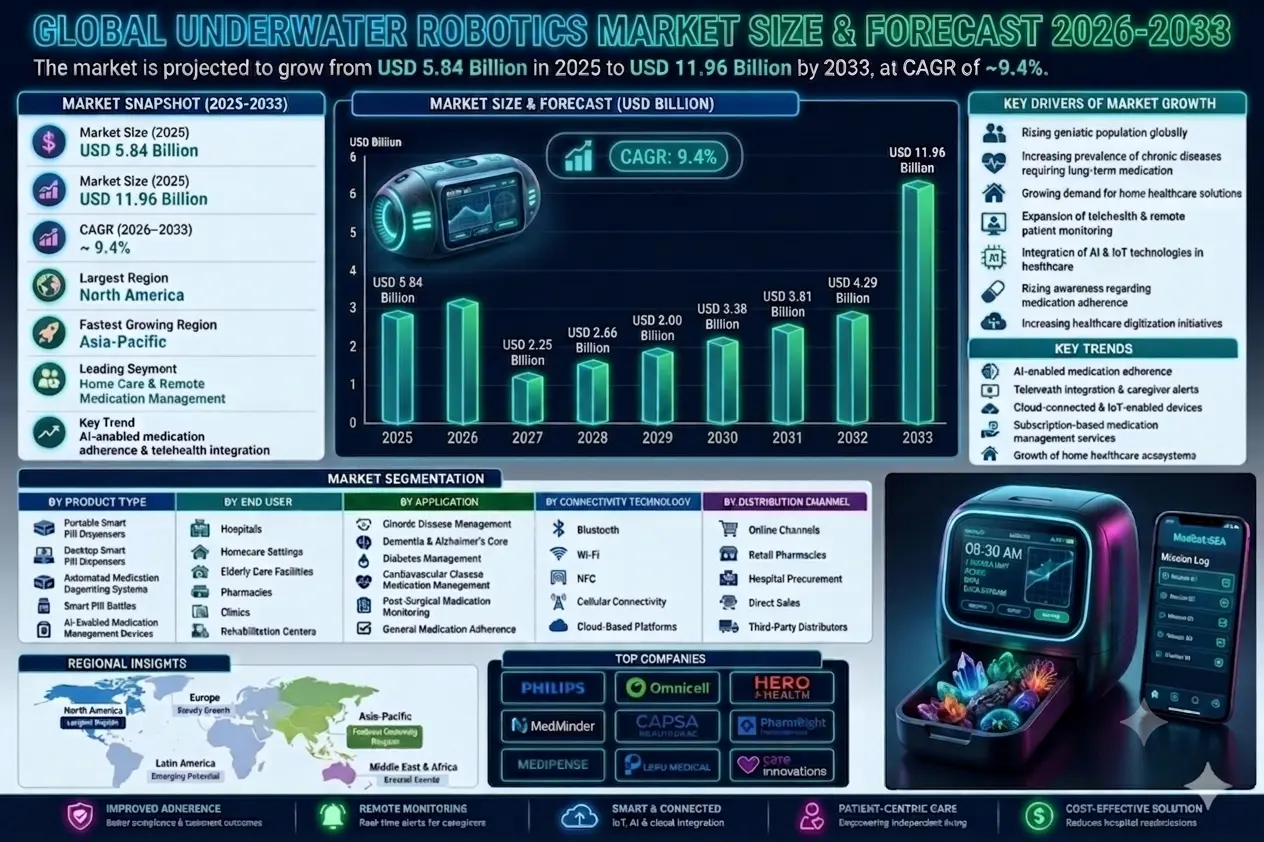
The global underwater robotics market is projected to witness substantial growth during the forecast period from 2026 to 2033. The market was valued at approximately USD 5.84 billion in 2025 and is expected to reach nearly USD 11.96 billion by 2033, expanding at a CAGR of around 9.4%.
The market growth is driven by increasing offshore oil and gas exploration activities, rising defense and maritime security investments, growing adoption of autonomous underwater vehicles for scientific research, and rapid technological advancements in marine robotics and subsea automation systems. Underwater robotics involves the development and deployment of remotely operated vehicles (ROVs), autonomous underwater vehicles (AUVs), hybrid robotic systems, and intelligent subsea platforms designed for underwater exploration, inspection, intervention, surveillance, maintenance, and data collection applications. The market is undergoing significant transformation through the integration of artificial intelligence, machine learning-based navigation, advanced underwater imaging systems, real-time communication technologies, and enhanced battery performance. Additionally, increasing focus on offshore renewable energy projects, deep-sea mineral exploration, marine environmental monitoring, and underwater infrastructure inspection is accelerating market expansion globally.Global Underwater Robotics Market Overview
The underwater robotics market represents a critical segment of the global marine technology, offshore automation, and defense robotics industry. These robotic systems enable efficient and safe underwater operations across challenging marine environments where human intervention is difficult, costly, or hazardous. The market includes remotely operated vehicles (ROVs), autonomous underwater vehicles (AUVs), hybrid underwater robotic systems, unmanned underwater vehicles (UUVs), underwater gliders, and intelligent subsea inspection platforms. Underwater robotics are increasingly deployed across offshore energy operations, naval defense missions, marine scientific research, environmental monitoring, underwater archaeology, and subsea infrastructure maintenance. Technological advancements in sonar imaging, underwater navigation algorithms, pressure-resistant materials, autonomous control systems, and sensor integration are significantly improving robotic performance and operational efficiency. Major market participants include Saab AB, Oceaneering International, Kongsberg Gruppen, Teledyne Marine, Fugro N.V., ECA Group, Forum Energy Technologies, Bluefin Robotics, Lockheed Martin Corporation, and Deep Trekker Inc.Key Drivers of Global Underwater Robotics Market Growth
Growing Offshore Oil and Gas Exploration Activities
The increasing need for subsea inspection, maintenance, and intervention in offshore oil and gas fields is driving strong demand for underwater robotic systems. ROVs and AUVs are becoming essential for improving operational safety and reducing inspection costs.Rising Defense and Maritime Security Investments
Naval forces worldwide are increasingly adopting underwater robotic systems for mine detection, surveillance, reconnaissance, and anti-submarine operations. This is significantly strengthening market growth.Expansion of Offshore Renewable Energy Projects
The rapid growth of offshore wind farms and marine renewable energy infrastructure is increasing demand for robotic inspection and maintenance solutions. This creates substantial long-term market opportunities.Technological Advancements in Autonomous Navigation
Artificial intelligence, machine learning, and advanced sonar-based navigation systems are enabling greater underwater autonomy and operational precision. These advancements are improving mission efficiency and expanding application scope.Increasing Marine Research and Environmental Monitoring
Scientific institutions and environmental agencies are increasingly deploying underwater robotics for oceanographic research, biodiversity assessment, and marine ecosystem monitoring. This is accelerating adoption across research-focused applications.Global Underwater Robotics Market Segmentation
By Product Type
The market is segmented into remotely operated vehicles (ROVs), autonomous underwater vehicles (AUVs), hybrid underwater robots, and underwater gliders. ROVs account for the largest market share due to extensive offshore industrial applications.By Application
Applications include offshore oil and gas operations, defense and security, marine scientific research, underwater inspection and maintenance, environmental monitoring, and underwater exploration. Offshore oil and gas remains the dominant application segment globally.By Depth Capacity
The market includes shallow-water robotics, medium-depth systems, and deep-water underwater robotic platforms. Deep-water systems are witnessing increasing demand due to expanding subsea exploration activities.By End User
End users include energy companies, defense agencies, marine research institutions, environmental organizations, and commercial underwater service providers. Energy and defense sectors represent the largest end-user segments.Regional Market Dynamics
North America
North America dominates the global underwater robotics market due to extensive offshore energy operations, strong naval defense investments, and advanced marine technology development. The United States remains the leading regional market.Europe
Europe holds a significant market share driven by offshore wind energy development, marine research investments, and advanced underwater robotics innovation. Norway, the United Kingdom, Germany, and France are key regional contributors.Asia-Pacific
Asia-Pacific is the fastest-growing region due to expanding offshore exploration activities, increasing naval modernization, and growing marine research programs. China, Japan, South Korea, India, and Australia are major regional markets.Middle East & Africa
The Middle East is witnessing strong demand driven by offshore oil and gas field expansion and increasing subsea inspection requirements. Gulf countries are major contributors.Latin America
Latin America is gradually expanding due to offshore oil exploration projects and increasing marine infrastructure development. Brazil remains the leading regional market.Competitive Landscape
The global underwater robotics market is highly competitive and technology-intensive, with companies competing through innovation, autonomy capabilities, mission reliability, and operational efficiency. Key players include Saab AB, Oceaneering International, Kongsberg Gruppen, Teledyne Marine, Fugro N.V., ECA Group, Forum Energy Technologies, Bluefin Robotics, Lockheed Martin Corporation, and Deep Trekker Inc. Companies are increasingly investing in AI-enabled autonomy, advanced sonar imaging, modular robotic platforms, and long-endurance battery systems. Strategic collaborations with defense agencies, offshore energy companies, and marine research institutions are strengthening market positioning.Strategic Outlook
The strategic outlook for the global underwater robotics market remains highly positive due to increasing subsea automation requirements and growing marine infrastructure investments. Future growth opportunities include fully autonomous subsea missions, AI-powered swarm robotics, underwater wireless communication systems, and robotic solutions for deep-sea mining. Growing focus on sustainable marine exploration and offshore renewable energy maintenance will significantly shape future market development. Manufacturers investing in autonomy, durability, sensor intelligence, and energy-efficient systems are expected to strengthen competitive advantage.Final Market Perspective
The global underwater robotics market continues to play a transformative role in advancing offshore operations, marine exploration, and subsea intelligence worldwide. Rising demand for autonomous underwater systems, technological innovation, and expanding marine industrial applications will continue driving strong market growth throughout the forecast period. Organizations that successfully combine engineering innovation, operational reliability, and intelligent autonomy will remain strongly positioned in the evolving global underwater robotics market.Table of Contents
Table of Contents
- 1. Executive Summary
- 1.1 Global Underwater Robotics Market Snapshot (2026???2033)
- 1.2 Market Size & CAGR Analysis
- 1.3 Largest & Fastest-Growing Segments
- 1.4 Key Regional Insights
- 1.5 Major Market Growth Drivers
- 1.6 Competitive Landscape Overview
- 1.7 Strategic Outlook Through 2033
- 2. Introduction & Market Overview
- 2.1 Definition of Underwater Robotics
- 2.2 Scope of the Study
- 2.3 Evolution of Marine Robotic Systems
- 2.4 Value Chain & Ecosystem Analysis
- 2.5 Regulatory and Maritime Compliance Framework
- 2.6 Offshore Automation Trends
- 2.7 Technology Innovation Landscape
- 3. Research Methodology
- 3.1 Primary Research
- 3.2 Secondary Research
- 3.3 Market Size Estimation Model
- 3.4 Forecast Assumptions (2026???2033)
- 3.5 Data Validation & Market Triangulation
- 4. Market Dynamics
- 4.1 Drivers
- 4.1.1 Growing Offshore Oil and Gas Exploration Activities
- 4.1.2 Rising Defense and Maritime Security Investments
- 4.1.3 Expansion of Offshore Renewable Energy Projects
- 4.1.4 Technological Advancements in Autonomous Navigation
- 4.1.5 Increasing Marine Research and Environmental Monitoring
- 4.2 Restraints
- 4.2.1 High Capital and Operational Costs
- 4.2.2 Complex Maintenance Requirements
- 4.2.3 Communication Limitations in Deep-Water Environments
- 4.2.4 Limited Battery Endurance
- 4.3 Opportunities
- 4.3.1 AI-Powered Swarm Robotics
- 4.3.2 Deep-Sea Mining Applications
- 4.3.3 Underwater Wireless Communication Systems
- 4.3.4 Autonomous Renewable Energy Infrastructure Inspection
- 4.4 Challenges
- 4.4.1 Extreme Underwater Environmental Conditions
- 4.4.2 Navigation Accuracy in Low-Visibility Conditions
- 4.4.3 Data Transmission Constraints
- 4.4.4 Regulatory and Operational Standardization Gaps
- 4.1 Drivers
- 5. Global Underwater Robotics Market Analysis (USD Billion), 2026???2033
- 5.1 Market Size Overview
- 5.2 CAGR Analysis
- 5.3 Regional Revenue Distribution
- 5.4 Technology Adoption Analysis
- 5.5 Deployment Trends
- 5.6 Future Growth Projections
- 6. Market Segmentation (USD Billion), 2026???2033
- 6.1 By Product Type
- 6.1.1 Remotely Operated Vehicles (ROVs)
- 6.1.2 Autonomous Underwater Vehicles (AUVs)
- 6.1.3 Hybrid Underwater Robots
- 6.1.4 Underwater Gliders
- 6.2 By Application
- 6.2.1 Offshore Oil and Gas Operations
- 6.2.2 Defense and Security
- 6.2.3 Marine Scientific Research
- 6.2.4 Underwater Inspection and Maintenance
- 6.2.5 Environmental Monitoring
- 6.2.6 Underwater Exploration
- 6.3 By Depth Capacity
- 6.3.1 Shallow-Water Robotics
- 6.3.2 Medium-Depth Systems
- 6.3.3 Deep-Water Robotic Platforms
- 6.4 By End User
- 6.4.1 Energy Companies
- 6.4.2 Defense Agencies
- 6.4.3 Marine Research Institutions
- 6.4.4 Environmental Organizations
- 6.4.5 Commercial Underwater Service Providers
- 6.1 By Product Type
- 7. Market Segmentation by Geography
- 7.1 North America
- 7.2 Europe
- 7.3 Asia-Pacific
- 7.4 Middle East & Africa
- 7.5 Latin America
- 8. Competitive Landscape
- 8.1 Market Share Analysis
- 8.2 Technology Benchmarking
- 8.3 Product Portfolio Analysis
- 8.4 Strategic Partnerships & Collaborations
- 8.5 Innovation & Deployment Strategies
- 9. Company Profiles
- 9.1 Saab AB
- 9.2 Oceaneering International
- 9.3 Kongsberg Gruppen
- 9.4 Teledyne Marine
- 9.5 Fugro N.V.
- 9.6 ECA Group
- 9.7 Forum Energy Technologies
- 9.8 Bluefin Robotics
- 9.9 Lockheed Martin Corporation
- 9.10 Deep Trekker Inc.
- 10. Strategic Intelligence & Pheonix AI Insights
- 10.1 Subsea Robotics Forecast Engine
- 10.2 Mission Analytics Dashboard
- 10.3 Offshore Infrastructure Monitoring Tracker
- 10.4 Autonomous Navigation Intelligence Analyzer
- 10.5 Automated Porter???s Five Forces Analysis
- 11. Future Outlook & Strategic Recommendations
- 11.1 Expansion of Fully Autonomous Underwater Missions
- 11.2 Investment in AI-Enabled Navigation Systems
- 11.3 Development of Long-Endurance Energy Systems
- 11.4 Strengthening Applications in Offshore Renewables
- 11.5 Long-Term Market Outlook (2033+)
- 12. Appendix
- 13. About Pheonix Research
- 14. Disclaimer
Competitive Landscape
Global Underwater Robotics Market Competitive Intensity & Market Structure Overview
The global underwater robotics market is highly competitive and moderately consolidated, characterized by strong competition among marine robotics manufacturers, defense technology providers, offshore engineering companies, and specialized subsea automation solution developers. Competitive intensity is driven by technological sophistication, autonomous operational capability, mission reliability, subsea endurance, sensor integration, and system adaptability across complex marine environments.
The market structure consists of large multinational marine technology firms, defense-focused robotics developers, offshore service providers, research-driven robotics innovators, and niche underwater vehicle manufacturers. Competition is shaped by depth capability, navigation precision, payload flexibility, real-time communication systems, and long-term operational performance.
Growing offshore energy exploration, increasing naval modernization programs, rising demand for subsea inspection automation, and rapid advancements in AI-powered underwater autonomy are intensifying competition across the global underwater robotics market.
Global Underwater Robotics Market Competitive Intensity & Market Structure Current Scenario
Leading Global Underwater Robotics Companies
Saab AB: Leading defense and marine technology company with advanced autonomous underwater vehicle platforms and subsea mission systems.
Oceaneering International: Major offshore engineering and subsea robotics provider with strong remotely operated vehicle deployment capabilities.
Kongsberg Gruppen: Global marine technology leader recognized for advanced autonomous underwater systems, subsea navigation technologies, and integrated robotics solutions.
Teledyne Marine: Prominent underwater technology company offering comprehensive subsea robotics, imaging, and sonar-based mission systems.
Fugro N.V.: Leading geo-data and offshore robotics company focused on autonomous subsea inspection and marine survey technologies.
ECA Group: Specialized defense and industrial robotics provider with strong capabilities in autonomous underwater and mine countermeasure systems.
Forum Energy Technologies: Significant offshore robotics supplier focused on advanced remotely operated vehicle systems for subsea intervention.
Bluefin Robotics: Advanced autonomous underwater vehicle developer recognized for high-performance subsea surveillance and exploration systems.
Lockheed Martin Corporation: Major defense technology participant with advanced underwater autonomous systems for naval applications.
Deep Trekker Inc.: Innovative compact underwater robotics manufacturer focused on portable inspection and commercial subsea monitoring systems.
Key Competitive Intensity & Market Structure Drivers
The increasing complexity of offshore oil and gas exploration activities is significantly intensifying demand for advanced underwater robotic inspection and maintenance systems.
Rising defense and maritime security investments are accelerating competition around autonomous surveillance, mine detection, and underwater reconnaissance technologies.
Technological advancements in AI-driven underwater navigation, sonar imaging, and autonomous decision-making are creating strong product differentiation opportunities.
The rapid expansion of offshore renewable energy infrastructure is increasing demand for reliable robotic inspection and subsea maintenance platforms.
Growing marine scientific research and environmental monitoring initiatives are broadening application opportunities for specialized underwater robotic systems.
Strategic Implications of Competitive Intensity & Market Structure
Manufacturers are increasingly investing in modular robotic platforms and intelligent autonomy systems to support diverse mission requirements.
Strategic collaborations with defense agencies, offshore energy operators, and marine research institutions are becoming essential for long-term market expansion.
Battery endurance enhancement, pressure-resistant materials, and energy-efficient propulsion technologies are emerging as critical competitive differentiators.
Advanced sonar imaging integration, machine learning-based navigation systems, and real-time underwater data analytics are reshaping competitive positioning.
Companies are prioritizing software-defined mission flexibility and scalable platform architecture to improve deployment efficiency and customer adaptability.
Global Underwater Robotics Market Competitive Intensity & Market Structure Forward Outlook
The global underwater robotics market is expected to remain highly competitive as subsea automation and autonomous marine operations continue to expand globally.
Future competition will increasingly focus on fully autonomous subsea missions, underwater swarm robotics, wireless subsea communication, and AI-powered predictive mission intelligence.
North America and Asia-Pacific are expected to remain major competitive growth regions due to strong naval investments, offshore energy expansion, and marine technology innovation.
Advancements in deep-sea robotics, long-endurance autonomous systems, and intelligent subsea data processing are expected to significantly reshape market dynamics.
Overall, companies that successfully combine engineering durability, intelligent autonomy, mission adaptability, and advanced subsea analytics will remain strongly positioned in the evolving global underwater robotics market.
Value Chain
Global Underwater Robotics Market Value Chain & Supply Chain Evolution Overview
The global underwater robotics market value chain is undergoing significant transformation as advancements in subsea automation, artificial intelligence, marine sensing technologies, autonomous navigation systems, and deep-sea operational intelligence reshape the broader marine robotics ecosystem. Underwater robotics has become a critical technology enabling efficient, safe, and cost-effective underwater operations across offshore energy, naval defense, scientific exploration, environmental monitoring, and subsea infrastructure maintenance.
The underwater robotics value chain spans advanced component manufacturing, subsea sensor integration, robotic platform engineering, autonomy software development, pressure-resistant system design, communication infrastructure deployment, mission analytics integration, operational field deployment, and long-term subsea service optimization. This interconnected ecosystem includes marine electronics manufacturers, battery developers, sonar and imaging technology providers, robotics software developers, subsea engineering firms, offshore service operators, defense contractors, research institutions, and end-user industrial operators.
Major companies including Saab AB, Oceaneering International, Kongsberg Gruppen, Teledyne Marine, Fugro N.V., ECA Group, Forum Energy Technologies, Bluefin Robotics, Lockheed Martin Corporation, and Deep Trekker Inc. are actively investing in AI-powered autonomous navigation, modular subsea robotic architectures, advanced sonar imaging systems, long-endurance energy storage, and real-time underwater communication technologies to strengthen market leadership.
Upstream supply chain operations depend on pressure-resistant materials manufacturing, subsea-grade semiconductors, sonar transducer fabrication, battery cell production, underwater camera systems, propulsion component engineering, and communication module manufacturing. Midstream activities focus on robotic system assembly, autonomy software integration, mission control engineering, calibration, testing, environmental simulation validation, and platform customization. Downstream operations include offshore deployment, mission execution services, maintenance support, fleet management, operational analytics delivery, and long-term subsea performance optimization.
Operational priorities across the underwater robotics value chain increasingly emphasize mission reliability, navigation precision, endurance optimization, communication robustness, modular flexibility, operational safety, autonomous decision-making, and resilience under extreme subsea environmental conditions. However, the market continues to face challenges related to deep-water communication limitations, battery endurance constraints, high system development costs, environmental variability, and complex deployment logistics.
Global Underwater Robotics Market Value Chain & Supply Chain Evolution Current Scenario
The current underwater robotics market is being shaped by expanding offshore energy activities, increasing naval modernization programs, growing scientific exploration missions, and rising investments in subsea automation technologies. Organizations are increasingly replacing conventional diver-intensive operations with robotic systems capable of performing complex underwater tasks with greater efficiency and safety.
North America currently dominates the global underwater robotics market due to advanced offshore oil and gas operations, strong defense spending, and substantial investments in marine technology innovation. The United States remains the leading regional market supported by naval defense modernization and offshore infrastructure development.
Europe maintains a strong market position driven by offshore renewable energy deployment, advanced marine research initiatives, and strong subsea engineering capabilities. Asia-Pacific is emerging as the fastest-growing region due to expanding offshore exploration, increasing maritime security investments, and growing oceanographic research activity.
Remotely operated vehicles (ROVs) remain the dominant product segment due to their widespread use across offshore industrial inspection and intervention applications.
Autonomous underwater vehicles are experiencing rapid adoption as improvements in AI-driven autonomy and energy efficiency expand operational capabilities across defense and scientific missions.
Key Value Chain & Supply Chain Evolution Signals in Global Underwater Robotics Market
One of the most significant transformation signals is the rapid shift toward autonomous underwater systems. AI-powered navigation and mission planning capabilities are reducing dependency on tethered operator control and expanding mission complexity.
Battery technology innovation is significantly reshaping the supply chain by enabling longer mission endurance, improved operational flexibility, and greater deployment range for autonomous platforms.
Advanced sonar imaging and sensor fusion technologies are becoming increasingly critical, improving underwater situational awareness, target detection accuracy, and environmental mapping precision.
Real-time underwater communication systems are emerging as a key area of innovation, enabling more responsive mission control and enhanced data transmission capabilities.
Modular robotic architectures are becoming increasingly important, allowing operators to customize systems for inspection, intervention, exploration, surveillance, and research-specific missions.
Swarm robotics and coordinated multi-vehicle subsea operations are emerging as next-generation capabilities that will significantly enhance operational scalability.
Strategic Implications of Value Chain & Supply Chain Evolution in Global Underwater Robotics Market
Leading underwater robotics companies are increasingly prioritizing autonomy software differentiation, modular engineering, endurance optimization, and advanced sensing capabilities to maintain competitive advantage. Competitive differentiation increasingly depends on mission flexibility, reliability, navigation intelligence, and lifecycle operational efficiency.
Companies capable of delivering integrated end-to-end subsea robotics ecosystems combining hardware, mission software, operational analytics, and long-term service support are expected to capture premium market opportunities.
Strategic collaborations between underwater robotics developers, offshore energy operators, naval defense agencies, marine research institutions, and sensor technology providers are becoming essential for accelerating deployment and expanding mission applications.
Service-based robotic mission deployment models are emerging as important recurring revenue streams, shifting market focus from hardware-centric sales toward operational robotics-as-a-service offerings.
Mission data analytics and predictive maintenance capabilities are becoming strategic differentiators as operators increasingly seek intelligent lifecycle optimization solutions.
Manufacturers are increasingly localizing service support and regional deployment capabilities to improve mission readiness and strengthen long-term customer relationships across offshore operating regions.
Global Underwater Robotics Market Value Chain & Supply Chain Evolution Forward Outlook
Between 2026 and 2033, the underwater robotics value chain is expected to become significantly more autonomous, intelligent, interconnected, and mission-adaptive. Underwater robotic systems will increasingly evolve from remotely managed tools toward self-directed subsea operational ecosystems.
Advanced AI models will continue improving autonomous navigation, adaptive mission decision-making, obstacle avoidance, and predictive operational intelligence.
Long-endurance battery systems and next-generation subsea energy solutions will enable extended-duration missions with reduced operational interruption.
Underwater wireless communication technologies will substantially improve multi-platform coordination, real-time analytics transfer, and mission responsiveness.
Swarm robotics and coordinated autonomous subsea fleets will become increasingly important for large-scale marine inspection, environmental monitoring, and defense surveillance applications.
Digital twin integration will enable simulation-based mission planning, predictive maintenance forecasting, and optimized subsea asset management.
Ultimately, the future underwater robotics value chain will evolve into a highly autonomous, connected, and intelligent subsea operational ecosystem capable of enabling persistent underwater monitoring, exploration, and intervention across global marine industries.
Market-Specific Value Chain
- Component & Subsea Hardware Manufacturing: Pressure-resistant materials, sonar systems, underwater cameras, batteries, propulsion modules, embedded electronics, and subsea communication component production.
- Autonomy Software & Navigation Engineering: AI algorithm development, autonomous mission software, sonar processing, navigation intelligence, and control system programming.
- Robotic Platform Assembly & Systems Integration: Vehicle assembly, subsystem integration, environmental sealing, calibration, testing, and mission-specific customization.
- Deployment & Offshore Mission Integration: Offshore deployment engineering, mission planning, operator support, field integration, and subsea operational execution.
- Mission Analytics & Operational Intelligence: Data collection, real-time mission analytics, predictive maintenance diagnostics, fleet monitoring, and subsea performance reporting.
- Long-Term Autonomous Subsea Operations: Swarm coordination, autonomous infrastructure monitoring, predictive asset management, and intelligent subsea lifecycle optimization.
Company-to-Stage Mapping
- Component & Subsea Hardware Manufacturing: Teledyne Marine, sonar system suppliers, subsea battery developers, marine electronics manufacturers.
- Autonomy Software & Navigation Engineering: Kongsberg Gruppen, Bluefin Robotics, AI marine navigation software developers.
- Robotic Platform Assembly & Systems Integration: Saab AB, ECA Group, Deep Trekker Inc.
- Deployment & Offshore Mission Integration: Oceaneering International, Fugro N.V., offshore subsea engineering service providers.
- Mission Analytics & Operational Intelligence: Forum Energy Technologies, subsea analytics platform providers.
- Long-Term Autonomous Subsea Operations: Lockheed Martin Corporation, advanced autonomous marine systems developers, defense subsea robotics integrators.
Investment Activity
Global Underwater Robotics Market Investment & Funding Dynamics Overview
The global underwater robotics market is witnessing robust investment momentum driven by increasing offshore energy exploration, rising naval modernization programs, growing marine research initiatives, and rapid advancements in autonomous subsea technologies. Between 2026 and 2033, capital deployment is expected to accelerate significantly across autonomous underwater vehicles, remotely operated systems, AI-enabled navigation platforms, advanced subsea sensing systems, and next-generation underwater communication infrastructure.
The underwater robotics market represents a strategically critical segment within the broader marine technology, defense automation, offshore industrial robotics, and subsea digital infrastructure ecosystem. Institutional investors, defense-focused venture funds, offshore technology investors, sovereign investment entities, and marine innovation accelerators are increasingly allocating capital toward underwater robotics developers to capitalize on growing demand for intelligent subsea operational systems.
A major structural transformation shaping funding activity is the transition from manually operated subsea systems toward highly autonomous, AI-enabled, intelligent robotic platforms capable of real-time decision-making, adaptive mission planning, and long-duration underwater operations. This shift is driving substantial investment into autonomous control software, machine learning-enabled navigation, sensor fusion technologies, and advanced subsea analytics systems.
Growing convergence between underwater robotics, offshore renewable energy infrastructure, marine defense systems, deep-sea exploration technologies, and digital ocean intelligence platforms is creating significant cross-sector investment opportunities. Strategic capital deployment is increasingly focused on mission autonomy, operational resilience, modular robotics architecture, and underwater data intelligence capabilities.
Current Investment & Funding Landscape
Current investment activity in the underwater robotics market is concentrated around autonomous subsea mobility systems, advanced sonar imaging platforms, underwater communication technologies, battery endurance optimization, and AI-powered mission control software.
- North America: Leads global investment activity due to strong naval defense spending, advanced offshore oil and gas infrastructure, and deep marine robotics innovation ecosystems.
- Europe: Attracting substantial funding through offshore renewable energy expansion, marine technology innovation, and strong government-supported ocean robotics research programs.
- Asia-Pacific: Emerging as the fastest-growing investment region due to increasing naval modernization, expanding offshore exploration, and rising marine technology investments.
- Middle East: Witnessing increasing strategic investments driven by offshore hydrocarbon exploration and subsea asset monitoring requirements.
- Latin America: Gradually attracting investment due to offshore oilfield development and subsea inspection infrastructure modernization.
Key Investment & Funding Drivers
- Expansion of offshore oil and gas exploration activities globally.
- Rising defense investments in autonomous maritime surveillance systems.
- Growth of offshore renewable energy infrastructure and subsea maintenance requirements.
- Rapid advancements in AI-enabled underwater navigation systems.
- Increasing deep-sea exploration and mineral resource assessment projects.
- Growing demand for underwater environmental monitoring solutions.
- Expansion of marine scientific research initiatives.
- Increasing adoption of long-endurance autonomous subsea platforms.
Strategic Investment Areas
- Autonomous Underwater Vehicles (AUVs): Funding for advanced mission autonomy and intelligent navigation systems.
- AI & Navigation Algorithms: Investment in adaptive route optimization, obstacle avoidance, and autonomous mission control.
- Advanced Sonar & Imaging Systems: Capital allocation toward high-resolution subsea sensing and real-time underwater imaging technologies.
- Battery & Energy Systems: Funding for long-endurance power solutions and energy-efficient propulsion systems.
- Underwater Communication Technologies: Strategic investments in acoustic communication and real-time subsea data transmission.
- Modular Robotic Platforms: Investment in scalable robotic architectures supporting multi-mission deployment.
Strategic Investment Implications
- Companies with strong autonomy and AI-driven mission intelligence capabilities are attracting premium investor valuations.
- Technological differentiation in endurance, reliability, and subsea sensing precision is becoming a major capital allocation determinant.
- Defense-grade operational resilience is increasingly influencing investor confidence.
- Cross-sector deployment flexibility significantly enhances long-term funding attractiveness.
- Strategic partnerships with defense agencies, offshore operators, and research institutions strengthen investment positioning.
- Scalable modular platform design is becoming a critical valuation driver.
Forward Investment Outlook
The global underwater robotics market is expected to remain one of the most attractive advanced robotics investment sectors throughout the forecast period due to increasing subsea automation requirements, marine digitalization, and growing offshore industrial intelligence needs.
Future funding activity is expected to prioritize fully autonomous underwater mission platforms, AI-powered robotic swarms, deep-sea mining robotics, intelligent subsea infrastructure monitoring systems, and autonomous marine data intelligence platforms.
- North America: Will continue dominating capital inflows through defense innovation and offshore subsea technology commercialization.
- Europe: Will maintain strong investment activity centered on offshore renewable energy robotics and marine sustainability innovation.
- Asia-Pacific: Will experience accelerating investment due to naval modernization and expanding ocean exploration programs.
- Emerging Offshore Regions: Will attract strategic investments linked to subsea infrastructure development.
Long-term innovation investments will increasingly focus on robotic swarm intelligence, underwater wireless networking, digital twin-enabled subsea asset management, and autonomous ocean intelligence ecosystems.
Overall, the underwater robotics market is positioned as a high-growth marine technology investment opportunity driven by offshore automation transformation, defense modernization, intelligent exploration systems, and next-generation subsea autonomy innovation.
Technology & Innovation
Global Underwater Robotics Market Technology & Innovation Landscape Overview
The Global Underwater Robotics Market is undergoing rapid technological transformation driven by advancements in autonomous navigation systems, artificial intelligence, high-resolution underwater imaging, advanced sonar technologies, and energy-efficient subsea propulsion systems. Innovation is increasingly focused on improving operational autonomy, mission endurance, real-time decision-making, and robotic adaptability across complex underwater environments.
Modern underwater robotic systems are evolving into intelligent subsea platforms capable of autonomous exploration, precision inspection, adaptive navigation, and real-time environmental analysis. These technological developments are significantly enhancing underwater operational efficiency, reducing human intervention requirements, and expanding deployment capabilities across offshore energy, defense, scientific research, and environmental monitoring applications.
The integration of machine learning, sensor fusion, edge computing, underwater communication technologies, and modular robotic architectures is reshaping the underwater robotics ecosystem by enabling smarter, more resilient, and highly capable subsea operations.
Global Underwater Robotics Market Technology & Innovation Current Scenario
Currently, the underwater robotics market is witnessing strong innovation through AI-powered autonomous navigation systems capable of obstacle avoidance, route optimization, and adaptive mission execution in dynamic subsea environments.
Advanced sonar imaging technologies, including multibeam sonar, side-scan sonar, and synthetic aperture sonar, are significantly improving underwater mapping accuracy and target identification capabilities.
Battery technology advancements are enabling longer operational endurance, improved mission range, and greater energy efficiency for autonomous underwater vehicles and hybrid subsea systems.
Real-time sensor fusion systems are increasingly being integrated to combine sonar, optical imaging, inertial navigation, pressure sensing, and environmental data for enhanced situational awareness and mission precision.
Underwater wireless communication systems are also gaining traction, improving data transmission reliability and enabling better coordination between robotic platforms and surface control systems.
Additionally, modular robotic platform designs are allowing operators to customize underwater systems for specific missions, improving deployment flexibility and operational cost efficiency.
Key Technology & Innovation Trends in Global Underwater Robotics Market
- AI-Powered Autonomous Navigation: Intelligent systems enabling adaptive route planning and real-time decision-making.
- Advanced Sonar Imaging Systems: High-resolution subsea mapping and target detection technologies.\
- Sensor Fusion Integration: Multi-sensor data processing for enhanced situational awareness and precision control.
- Long-Endurance Battery Systems: Energy-efficient power technologies extending underwater mission duration.
- Underwater Wireless Communication: Acoustic and optical communication systems enabling improved subsea connectivity.
- Edge Computing Platforms: Localized onboard processing for real-time mission analytics and autonomous decision execution.
- Modular Robotic Architectures: Configurable subsea systems supporting mission-specific adaptability.
- Machine Learning-Based Object Recognition: Automated underwater target detection and classification capabilities.
- Swarm Robotics Technology: Coordinated multi-robot underwater mission execution for large-scale exploration.
- Digital Twin Simulation Platforms: Virtual subsea mission modeling for predictive performance optimization.
Strategic Implications of Technology & Innovation
Technological innovation is fundamentally reshaping competitive dynamics in the underwater robotics market by shifting competition toward intelligent autonomy, extended operational endurance, advanced sensing precision, and mission adaptability.
Companies investing in AI-driven navigation, energy-efficient propulsion systems, and high-resolution sensing technologies are achieving stronger differentiation through improved mission reliability, reduced operational costs, and expanded deployment versatility.
The increasing adoption of autonomous systems is enabling operators to reduce human intervention in hazardous underwater environments while improving operational safety and inspection efficiency.
The emergence of modular robotic platforms is creating strategic opportunities for mission customization across defense, energy, and research applications.
However, challenges including high development costs, extreme environmental constraints, underwater communication limitations, system reliability requirements, and integration complexity remain significant barriers to widespread technology deployment.
Global Underwater Robotics Market Technology & Innovation Forward Outlook
Looking ahead, the underwater robotics market is expected to evolve toward fully autonomous, intelligent, and interconnected subsea ecosystems capable of self-directed mission execution and adaptive environmental response.
Future innovation is likely to focus on self-learning robotic systems capable of autonomous mission optimization based on real-time environmental analysis and operational feedback.
Swarm robotics is expected to emerge as a major advancement area, enabling coordinated fleets of underwater robots to perform large-scale mapping, inspection, and surveillance missions with greater efficiency.
Quantum sensing technologies and next-generation underwater imaging systems may significantly improve navigation precision and subsea detection capabilities in challenging deep-water conditions.
Advanced energy harvesting systems and next-generation battery chemistries are expected to further extend operational endurance for long-duration autonomous missions.
Overall, the Global Underwater Robotics Market is entering a new era of intelligent subsea automation characterized by autonomous decision-making, enhanced sensing intelligence, real-time connectivity, and adaptive robotic collaboration, positioning the market for sustained technological advancement and strategic growth across global marine industries.
Market Risk
Global Underwater Robotics Market Risk Factors & Disruption Threats Overview
The global underwater robotics market is experiencing strong growth driven by rising offshore energy exploration, expanding maritime defense modernization, increasing demand for marine scientific research, and rapid advancements in autonomous subsea technologies. Despite robust long-term growth potential, the market faces several risks and disruption threats related to high capital intensity, technological complexity, operational reliability challenges, regulatory restrictions, and evolving geopolitical uncertainties.
One of the most significant risks affecting the underwater robotics market is the high development and deployment cost associated with advanced subsea robotic systems. Designing pressure-resistant platforms, high-end navigation systems, specialized sensors, and long-endurance power systems requires substantial capital investment, which can limit adoption among smaller operators and research institutions.
Operational reliability in harsh underwater environments presents another major challenge. Extreme pressure conditions, corrosion, biofouling, limited visibility, unpredictable currents, and communication latency can significantly impact mission performance and increase system failure risks.
Regulatory restrictions and permitting complexities surrounding offshore operations, defense deployments, environmental monitoring, and deep-sea exploration activities may create barriers to market expansion across certain regions.
Cybersecurity and autonomous system integrity risks are becoming increasingly important as underwater robotic platforms adopt AI-based navigation, wireless communication protocols, and cloud-connected mission management systems.
Geopolitical tensions affecting offshore territorial waters, defense procurement priorities, and international subsea infrastructure access may also create uncertainty for market participants.
Additionally, technological obsolescence and rapid innovation cycles are placing continuous pressure on manufacturers to maintain product competitiveness.
Global Underwater Robotics Market Risk Factors & Disruption Threats Current Scenario
The current underwater robotics market is benefiting from strong investments in offshore wind infrastructure, subsea oilfield maintenance, naval modernization programs, and marine environmental research initiatives.
However, offshore project delays caused by energy price fluctuations and economic uncertainty can impact procurement cycles for underwater robotic systems.
Autonomous underwater vehicle adoption is increasing rapidly, but reliability validation for fully autonomous missions remains a critical challenge.
Manufacturers are under increasing pressure to improve battery endurance, underwater communication capabilities, and real-time decision-making reliability.
Supply chain disruptions affecting advanced semiconductors, subsea-grade materials, propulsion systems, and sonar components are creating production bottlenecks.
Competitive intensity is rising as defense contractors, marine technology firms, and AI robotics developers expand into underwater automation.
Global Underwater Robotics Market Key Risk Factors & Disruption Threat Signals
- High Capital Investment Requirements: Significant development and deployment costs limiting market accessibility.
- Operational Reliability Challenges: Extreme underwater conditions affecting system performance and durability.
- Battery and Power Limitations: Restricted mission endurance for autonomous systems.
- Communication Constraints: Underwater signal latency and limited real-time data transmission capability.
- Regulatory and Permitting Complexity: Restrictions related to offshore deployment and marine operations.
- Cybersecurity Risks: Vulnerabilities in autonomous navigation and connected control systems.
- Supply Chain Disruptions: Delays in specialized subsea electronics and component sourcing.
- Geopolitical Uncertainty: Offshore territorial disputes and defense spending volatility.
- Technology Obsolescence: Rapid innovation cycles shortening product lifecycle competitiveness.
- Skilled Workforce Shortages: Limited availability of subsea robotics engineering expertise.
Strategic Implications of Risk Factors
Underwater robotics manufacturers must prioritize modular system architectures and scalable platform designs to reduce development costs and improve deployment flexibility.
Investment in advanced corrosion resistance, battery innovation, and fault-tolerant autonomous systems will be critical for improving operational reliability.
Strengthening cybersecurity protections and autonomous decision validation frameworks will become increasingly important as intelligent underwater missions expand.
Manufacturers should diversify supply chains and establish strategic sourcing partnerships to reduce component dependency risks.
Collaboration with defense agencies, offshore energy operators, and marine research institutions will remain essential for technology validation and commercial scalability.
Global Underwater Robotics Market Forward Risk Outlook
Looking ahead to 2026???2033, the underwater robotics market will continue expanding as subsea automation becomes increasingly essential across energy, defense, and marine exploration sectors.
Future disruption will likely emerge from AI-powered autonomous swarm robotics, underwater wireless communication breakthroughs, and next-generation energy storage systems.
Companies unable to deliver reliability, autonomy, and mission adaptability in extreme subsea conditions may face declining competitiveness.
The strongest opportunities will emerge for manufacturers delivering highly intelligent, durable, energy-efficient, and interoperable underwater robotic ecosystems.
Overall, sustained market leadership will depend on engineering resilience, autonomy innovation, regulatory adaptability, and operational performance excellence.
Regulatory Landscape
Global Underwater Robotics Market Regulatory & Policy Environment Overview
The regulatory and policy environment governing the global underwater robotics market is shaped by maritime safety regulations, naval defense compliance frameworks, offshore energy operational standards, environmental protection laws, subsea exploration policies, and autonomous systems governance. As underwater robotic technologies become increasingly essential for offshore industrial operations, defense surveillance, marine scientific research, and deep-sea exploration, regulatory oversight is expanding to ensure operational safety, environmental stewardship, and responsible deployment.
Regulatory agencies and maritime authorities oversee underwater robotic systems depending on their intended use, deployment depth, operational autonomy, communication systems, and application across defense, commercial, and scientific sectors. Autonomous underwater vehicles (AUVs), remotely operated vehicles (ROVs), and hybrid subsea robotic systems are subject to distinct compliance requirements based on mission-critical functionality and operational environments.
The increasing integration of artificial intelligence, autonomous navigation systems, sonar imaging, underwater wireless communication, and deep-sea operational capabilities is accelerating policy development surrounding autonomy validation, data security, subsea navigation rights, and environmental impact mitigation.
Global Underwater Robotics Market Regulatory & Policy Environment Current Scenario
The current regulatory framework for underwater robotics combines maritime operational governance, offshore industrial safety compliance, defense technology regulations, and environmental protection mandates.
In the United States, underwater robotic systems used for offshore energy and scientific applications are regulated by agencies including the National Oceanic and Atmospheric Administration (NOAA), the U.S. Coast Guard, the Bureau of Safety and Environmental Enforcement (BSEE), and defense-related authorities depending on operational use. Autonomous systems used for national security applications are subject to stringent defense procurement and cybersecurity compliance standards.
In Europe, underwater robotic deployments are governed by maritime safety regulations, offshore energy operational directives, and environmental monitoring requirements established by regional marine authorities and EU environmental compliance frameworks.
Asia-Pacific nations including Japan, China, South Korea, India, and Australia are strengthening underwater robotics regulations as regional investments in offshore energy, naval modernization, and marine exploration expand.
Emerging offshore markets across Latin America, the Middle East, and Africa are increasingly adopting international subsea operational standards to support offshore oil and gas development and underwater infrastructure inspection.
Key Regulatory & Policy Environment Signals in Global Underwater Robotics Market
- Maritime Safety Compliance: Underwater robotic systems must comply with strict subsea operational safety and navigation standards.
- Autonomous Systems Governance: Increasing autonomy in underwater robotics is driving new validation and mission reliability regulations.
- Environmental Protection Standards: Marine ecosystem preservation laws are influencing deployment protocols and subsea operational practices.
- Defense and Security Regulations: Military underwater robotic platforms are subject to advanced security, export control, and defense technology compliance requirements.
- Data Security and Communication Integrity: Growing use of connected subsea systems is increasing focus on encrypted communication and operational cybersecurity.
- Deep-Sea Resource Exploration Policy Development: Emerging international frameworks are shaping robotic deployment for seabed exploration and resource extraction activities.
Strategic Implications of Regulatory & Policy Environment
The evolving regulatory environment is encouraging underwater robotics manufacturers to invest heavily in compliance-focused engineering, mission validation testing, cybersecurity architecture, and environmentally responsible operational design.
Regulatory oversight is driving increased development of certified autonomous navigation systems, fault-tolerant subsea communication networks, and enhanced system redundancy for critical underwater missions.
Environmental compliance requirements are accelerating investment in low-impact robotic deployment methods and improved monitoring systems for marine biodiversity protection.
Defense-related regulations are increasing demand for secure software frameworks, encrypted control systems, and domestically compliant manufacturing capabilities for national security applications.
International policy harmonization across offshore energy and marine scientific operations is also encouraging greater standardization of underwater robotic performance benchmarks.
Global Underwater Robotics Market Regulatory & Policy Environment Forward Outlook
Between 2026 and 2033, the regulatory environment for the global underwater robotics market is expected to become increasingly structured, technologically adaptive, and internationally standardized.
Regulators are likely to introduce clearer frameworks governing autonomous subsea navigation, AI-based mission decision-making, and long-duration underwater operations.
Environmental regulations are expected to tighten further, particularly for robotic deployments associated with offshore energy operations, seabed exploration, and marine ecological monitoring.
International maritime organizations may establish expanded operational standards for autonomous underwater vehicles operating across shared marine territories.
Cybersecurity and mission integrity requirements are expected to strengthen significantly as connected underwater systems become more prevalent across defense and industrial infrastructure applications.
Overall, regulatory and policy developments will remain a critical market influence, with companies investing in certified autonomy, environmental compliance, operational reliability, and secure subsea intelligence systems expected to maintain long-term competitive advantage.