
Global Insect Protein Market Report, Size & Forecast 2026-2033
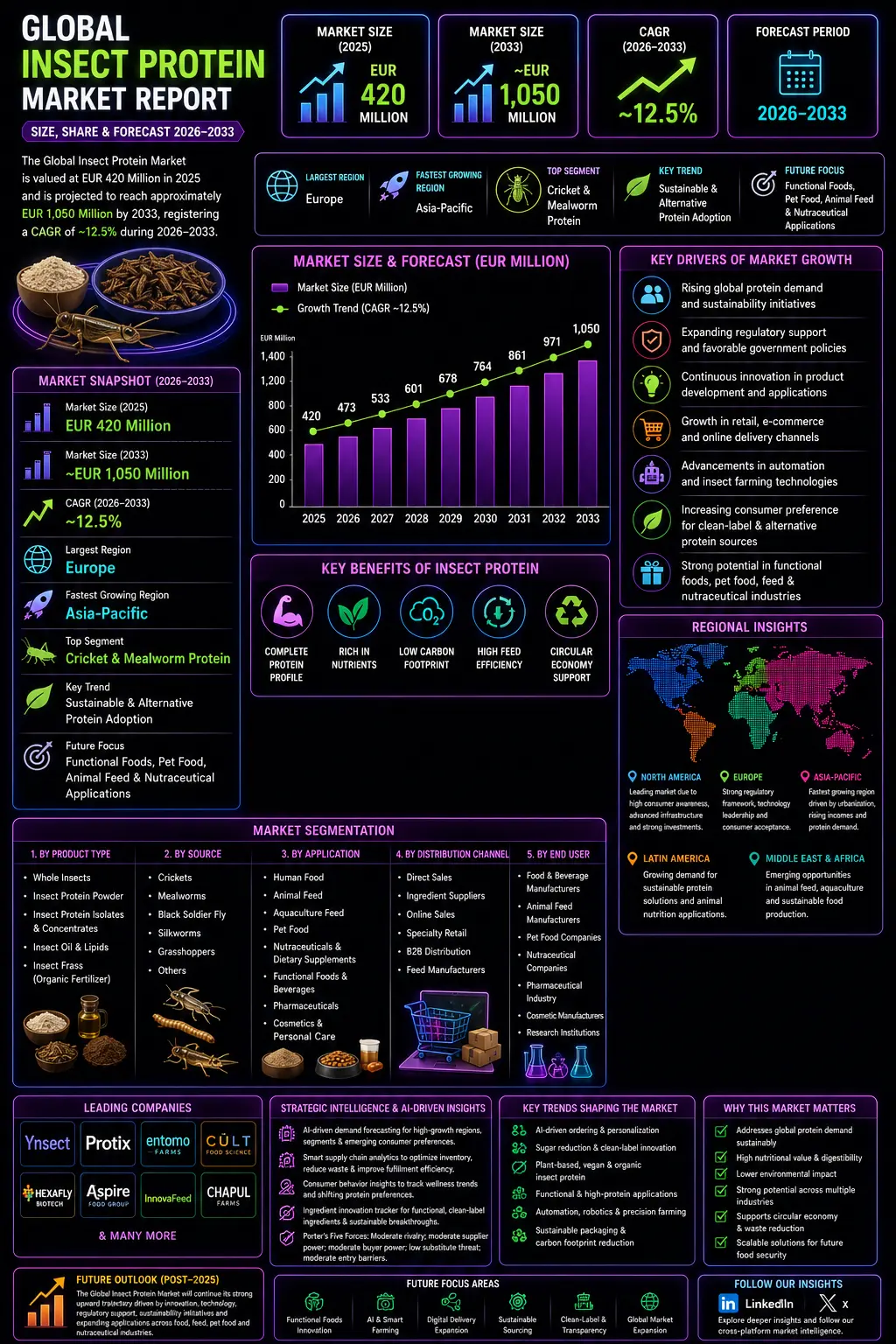
Global Insect Protein Market Forecast Snapshot: 2026???2033
| Metric | Value |
|---|---|
| 2025 Market Size | EUR 420 Million |
| 2033 Market Size | ~EUR 1,050 Million |
| CAGR (2026???2033) | ~12.5% |
| Largest Region | Europe |
| Fastest Growing Region | Asia-Pacific |
| Top Segment | Cricket & Mealworm Protein |
| Key Trend | Sustainable & Alternative Protein Adoption |
| Future Focus | Functional Foods, Pet Food, Animal Feed & Nutraceutical Applications |
Global Insect Protein Market
The Global Insect Protein Market is witnessing remarkable growth as sustainability, food security, and alternative protein innovation reshape the global food ecosystem. Growing consumer awareness regarding environmentally responsible protein sources, coupled with increasing demand for high-quality nutrition, has positioned insect protein as one of the fastest-emerging protein categories worldwide. Rich in essential amino acids, vitamins, minerals, healthy fats, and micronutrients, insect protein is increasingly being incorporated into food products, dietary supplements, animal nutrition, aquaculture feed, pet food, and functional beverages. According to Pheonix Research, the Global Insect Protein Market is valued at EUR 420 million in 2025 and is projected to reach approximately EUR 1,050 million by 2033, registering a CAGR of approximately 12.5% during 2026???2033. Market expansion is primarily driven by increasing investments in commercial insect farming, favorable regulatory developments across several countries, growing commercialization of insect-derived ingredients, and rising consumer acceptance of sustainable protein alternatives. Europe currently represents the largest regional market owing to its advanced regulatory framework, technological leadership, and strong consumer awareness. Meanwhile, Asia-Pacific is expected to record the fastest growth throughout the forecast period, supported by rising investments in sustainable food production, expanding middle-class populations, increasing demand for protein-rich foods, and growing adoption of insect farming technologies. Looking beyond 2025, insect protein is expected to become increasingly integrated into functional nutrition, sports supplements, bakery products, ready-to-eat meals, premium pet food, aquaculture feed, poultry nutrition, livestock feed, and nutraceutical formulations. Continuous innovation in automation, biotechnology, precision farming, and processing technologies is expected to significantly improve production efficiency, scalability, and commercial viability worldwide.Key Drivers of Global Insect Protein Market Growth
1. Rising Global Protein Demand and Sustainability Initiatives
Rapid population growth, changing dietary preferences, urbanization, and increasing global protein consumption are placing significant pressure on conventional livestock production systems. Traditional animal agriculture requires substantial land, water, and feed resources while contributing significantly to greenhouse gas emissions. Insect protein provides a sustainable alternative by requiring considerably fewer natural resources, producing lower carbon emissions, and demonstrating superior feed conversion efficiency. Governments, food manufacturers, and consumers increasingly recognize insect protein as a practical solution to future food security challenges and climate change mitigation.2. Expanding Regulatory Support Across Global Markets
Regulatory agencies across Europe, North America, Asia-Pacific, and several emerging economies continue to establish clearer approval pathways for insect-based food and feed products. Regulatory progress has significantly improved industry confidence, encouraging greater investments in commercial production facilities, product development, and international trade. As food safety standards mature and regulatory harmonization improves, manufacturers are expected to accelerate commercialization efforts while expanding their product portfolios across human food, pet nutrition, livestock feed, aquaculture, and specialty nutrition applications.3. Continuous Innovation in Product Development
Manufacturers are rapidly diversifying insect protein applications beyond traditional edible insect products. Innovation now includes:- Protein powders
- Functional beverages
- Energy bars
- Sports nutrition products
- High-protein pasta
- Bakery ingredients
- Snack foods
- Ready-to-eat meals
- Nutritional supplements
- Meat alternatives
4. Rapid Growth of Pet Food and Animal Feed Applications
Animal nutrition continues to represent one of the largest commercial opportunities within the insect protein industry. High digestibility, excellent amino acid profiles, and sustainable sourcing make insect protein an attractive replacement for fishmeal and soybean meal. Growing demand is particularly evident across:- Premium dog food
- Premium cat food
- Aquaculture feed
- Poultry nutrition
- Livestock feed
- Swine nutrition
- Specialty animal diets
5. Increasing Investments in Commercial Insect Farming
Global investment activity has accelerated substantially as venture capital firms, multinational food companies, agricultural technology providers, and sustainability-focused investors recognize the industry's long-term potential. Modern insect farming increasingly incorporates:- Artificial Intelligence (AI)
- Machine Learning
- Robotics
- IoT-enabled monitoring systems
- Climate-controlled vertical farming
- Automated feeding systems
- Precision breeding technologies
- Biotechnology-based nutrition optimization
6. Growing Consumer Preference for Functional and Clean-Label Nutrition
Consumers are increasingly prioritizing foods that combine nutritional value with environmental responsibility. High-protein diets, sports nutrition, functional foods, and clean-label ingredients continue gaining popularity among:- Fitness enthusiasts
- Health-conscious consumers
- Millennials
- Generation Z
- Flexitarian consumers
- Environmentally conscious buyers
7. Expansion of Circular Economy and Waste Reduction Practices
One of the industry's strongest sustainability advantages lies in its ability to contribute to circular food systems. Many commercial insect farms utilize agricultural by-products and food processing residues as feed substrates, converting low-value organic materials into high-value protein ingredients. This circular production model supports:- Food waste reduction
- Resource efficiency
- Lower greenhouse gas emissions
- Sustainable agriculture
- Organic fertilizer production through insect frass
- Improved environmental performance
Executive Summary
The Global Insect Protein Market is entering a transformative growth phase driven by sustainability objectives, rising global protein demand, technological innovation, and increasing commercialization across food, feed, pet nutrition, and nutraceutical industries. While insect protein was historically viewed as a niche alternative protein source, it is rapidly evolving into a mainstream ingredient supported by favorable consumer trends, scientific validation, and expanding industrial applications. Europe continues to lead the market through regulatory maturity, established production infrastructure, and advanced research capabilities. However, Asia-Pacific is expected to emerge as the fastest-growing regional market due to increasing investments in sustainable food systems, expanding aquaculture production, and growing awareness of alternative protein solutions. North America is also witnessing accelerating adoption supported by innovation in functional foods, sports nutrition, and premium pet food. Continuous investment in automated insect farming, biotechnology, advanced ingredient processing, and product innovation is improving scalability while reducing production costs. Manufacturers are increasingly developing diversified portfolios spanning protein powders, nutritional supplements, bakery products, ready-to-eat meals, animal feed, aquaculture nutrition, and premium pet food formulations. Over the forecast period, strategic collaborations, technological advancements, regulatory harmonization, and sustainability-driven consumer preferences are expected to strengthen the competitive landscape and position insect protein as a key contributor to the future of global food security and sustainable nutrition.Part 1 completed. Next: Part 2 ??? Complete Global Insect Protein Market Segmentation (all 6 segmentation categories with the same hierarchy and formatting as your original report).
Table of Contents
1. Executive Summary
1.1 Market Snapshot (2026???2033)
1.2 Key Growth Highlights
1.3 Market Attractiveness Analysis
1.4 Analyst Perspective
1.5 Strategic Recommendations
2. Market Introduction
2.1 Definition & Scope of Study
2.2 Research Methodology
2.3 Assumptions & Limitations
2.4 Market Dynamics Overview
3. Europe Insect Protein Market Overview
3.1 Market Size & Forecast (EUR Million), 2025???2033
3.2 CAGR Analysis (2026???2033)
3.3 Value Chain Analysis
3.4 Supply Chain & Production Landscape
3.5 Pricing Analysis
3.6 Regulatory Framework (EU Novel Food Regulation, Feed Authorization)
4. Market Dynamics
4.1 Market Drivers
4.1.1 Rising Protein Demand & Sustainability Focus
4.1.2 Regulatory Approvals & Safety Standards
4.1.3 Product Innovation & Diversification
4.1.4 Expansion in Pet Food & Aquaculture Feed
4.1.5 Investment in Automated Insect Farming
4.2 Market Restraints
4.2.1 Consumer Perception Barriers
4.2.2 High Initial Capital Investment
4.2.3 Regulatory Complexity Across Countries
4.3 Market Opportunities
4.3.1 Functional & Fortified Food Integration
4.3.2 Expansion in Southern & Eastern Europe
4.3.3 Strategic Partnerships with FMCG & Feed Giants
4.4 Market Challenges
4.4.1 Scalability Constraints
4.4.2 Cost Competitiveness vs Traditional Proteins
5. Market Segmentation by Insect Type (EUR Million), 2026???2033
5.1 Crickets
5.1.1 Powder & Flour
5.1.1.1 Whole Cricket Flour
5.1.1.2 Defatted Cricket Powder
5.1.1.3 Protein-Enriched Cricket Powder
5.1.2 Snacks & Energy Bars
5.1.2.1 Cricket Protein Bars
5.1.2.2 Roasted Cricket Snacks
5.1.2.3 Cricket Chips & Crackers
5.1.3 Functional Beverages
5.1.3.1 Cricket Protein Shakes
5.1.3.2 Ready-to-Drink Smoothies
5.1.3.3 Fortified Functional Drinks
5.2 Mealworms
5.2.1 Protein Concentrates
5.2.1.1 Defatted Mealworm Powder
5.2.1.2 Mealworm Protein Isolate
5.2.1.3 Functional Protein Blends
5.2.2 Animal Feed
5.2.2.1 Poultry Feed
5.2.2.2 Aquaculture Feed
5.2.2.3 Livestock Feed
5.2.3 Edible Snacks
5.2.3.1 Roasted Mealworms
5.2.3.2 Mealworm Chips
5.2.3.3 Energy Snack Mixes
5.3 Black Soldier Fly (BSF)
5.3.1 Livestock Feed
5.3.1.1 Poultry Feed
5.3.1.2 Swine Feed
5.3.1.3 Cattle Feed
5.3.2 Aquafeed
5.3.2.1 Fish Feed
5.3.2.2 Shrimp & Prawn Feed
5.3.2.3 Specialty Blends
5.3.3 Fertilizers / Byproducts
5.3.3.1 BSF Frass Fertilizer
5.3.3.2 Organic Soil Enhancers
5.3.3.3 Bioactive Nutrient Additives
5.4 Grasshoppers & Locusts
5.4.1 Roasted Snacks
5.4.1.1 Spiced Variants
5.4.1.2 Flavored Snacks
5.4.2 Protein Ingredients
5.4.2.1 Protein Powder
5.4.2.2 Functional Extracts
5.5 Others (Silkworms, Ants, etc.)
5.5.1 Niche Edible Products
5.5.1.1 Silkworm Pupae Snacks
5.5.1.2 Ant Protein Snacks
5.5.1.3 Specialty Treats
5.5.2 Research & Functional Applications
5.5.2.1 Bioactive Extracts
5.5.2.2 Supplement Ingredients
6. Market Segmentation by Application (EUR Million), 2026???2033
6.1 Food & Beverages
6.1.1 Protein Bars & Snacks
6.1.1.1 Cricket Protein Bars
6.1.1.2 Mealworm Energy Bars
6.1.1.3 Grasshopper Snack Bars
6.1.1.4 Roasted Insect Snack Packs
6.1.1.5 Insect-Based Trail Mixes
6.1.1.6 Protein Chips & Crackers
6.1.1.7 High-Protein Extruded Snacks
6.1.2 Pasta & Bakery Products
6.1.2.1 Insect-Enriched Pasta
6.1.2.2 Protein Breads & Rolls
6.1.2.3 Biscuits & Cookies
6.1.2.4 Cakes & Muffins
6.1.3 Functional Foods & Supplements
6.1.3.1 Protein Powders & Mixes
6.1.3.2 Amino Acid Fortified Products
6.1.3.3 Meal Replacement Products
6.1.3.4 Fortified Functional Foods
6.1.4 Ready-to-Eat Meals
6.1.4.1 Insect-Enriched Pasta Meals
6.1.4.2 Protein Snack Bowls
6.1.4.3 Wraps & Sandwich Fillings
6.1.4.4 Frozen Ready Meals
6.1.4.5 High-Protein Convenience Foods
6.2 Animal Feed
6.2.1 Aquaculture Feed
6.2.1.1 Fish Feed Pellets
6.2.1.2 Shrimp & Prawn Feed
6.2.1.2.1 Larval Feed
6.2.1.3 Specialty Aquaculture Blends
6.2.2 Poultry Feed
6.2.2.1 Layer Feed
6.2.2.2 Broiler Feed
6.2.2.3 Organic & Specialty Poultry Feed
6.2.3 Livestock Feed
6.2.3.1 Cattle Feed
6.2.3.2 Swine Feed
6.2.3.3 Specialty Livestock Diets
6.2.4 Pet Food
6.2.4.1 Dog Food
6.2.4.2 Cat Food
6.2.4.3 Exotic & Specialty Pet Feed
6.3 Pharmaceutical & Nutraceuticals
6.3.1 Protein Supplements
6.3.1.1 Insect Protein Powder
6.3.1.2 Protein Capsules & Tablets
6.3.1.3 Functional Protein Blends
6.3.1.4 Clinical Nutrition Formulations
6.3.2 Collagen & Amino Acid Ingredients
6.3.2.1 Collagen Supplements
6.3.2.2 Amino Acid Powders
6.3.2.3 Bioactive Peptides
6.4 Cosmetics & Personal Care
6.4.1 Bioactive Extracts
6.4.1.1 Anti-Aging Compounds
6.4.1.2 Antioxidant-Rich Extracts
6.4.1.3 Collagen-Stimulating Ingredients
6.4.1.4 Skin Barrier Support Ingredients
6.4.2 Functional Skincare Products
6.4.2.1 Moisturizers & Creams
6.4.2.2 Serums & Essences
6.4.2.3 Hair Care Products
7. Market Segmentation by Form (EUR Million), 2026???2033
7.1 Powder / Flour
7.1.1 Cricket Powder
7.1.1.1 Whole Cricket Flour
7.1.1.2 Defatted Cricket Powder
7.1.1.3 Protein-Enriched Cricket Powder
7.1.1.4 Organic Certified Cricket Flour
7.1.1.5 Functional Blended Cricket Protein
7.1.2 Mealworm Powder
7.1.2.1 Defatted Mealworm Powder
7.1.2.2 Mealworm Protein Isolate
7.1.2.3 High-Protein Mealworm Concentrate
7.1.2.4 Functional Protein Blends
7.1.2.5 Fortified Mealworm Ingredient Mixes
7.1.3 Black Soldier Fly (BSF) Powder
7.1.3.1 Protein Powder for Animal Feed
7.1.3.2 Aquafeed-Grade BSF Powder
7.1.3.3 Organic BSF Protein Meal
7.1.3.4 Bioactive Nutrient Powder
7.1.3.5 High-Fat BSF Meal
7.1.4 Grasshopper Powder
7.1.4.1 Roasted Grasshopper Powder
7.1.4.2 Protein-Enriched Powder
7.1.4.3 Functional Extract Powder
7.1.4.4 Specialty Gourmet Ingredient Powder
7.1.4.5 Supplement-Grade Powder
7.2 Whole Dried Insects
7.2.1 Whole Crickets
7.2.1.1 Roasted & Salted Crickets
7.2.1.2 Spiced / Flavored Crickets
7.2.1.3 Organic Whole Crickets
7.2.1.4 Bulk Industrial Supply
7.2.2 Whole Mealworms
7.2.2.1 Roasted Mealworms
7.2.2.2 Snack Mix Blends
7.2.2.3 Feed-Grade Dried Mealworms
7.2.2.4 Organic Certified Mealworms
7.2.3 Whole Grasshoppers & Locusts
7.2.3.1 Roasted Snacks
7.2.3.2 Gourmet Flavored Variants
7.2.3.3 Foodservice Bulk Packs
7.2.4 Silkworms / Ants / Other Insects
7.2.4.1 Specialty Roasted Insects
7.2.4.2 Ethnic & Traditional Food Applications
7.2.4.3 Research & Laboratory Supply
7.3 Extracts & Oils
7.3.1 Cricket Extracts & Oils
7.3.1.1 Protein Concentrates
7.3.1.2 Cricket Oil for Functional Beverages
7.3.1.3 Amino Acid Extracts
7.3.1.4 Nutraceutical-Grade Extracts
7.3.2 Mealworm Extracts & Oils
7.3.2.1 Amino Acid Rich Extracts
7.3.2.2 Functional Food Ingredients
7.3.2.3 High-Lipid Mealworm Oil
7.3.2.4 Supplement-Grade Ingredients
7.3.3 Black Soldier Fly Extracts & Oils
7.3.3.1 BSF Oil for Feed
7.3.3.2 Lauric Acid-Rich Extracts
7.3.3.3 Bioactive Nutrient Concentrates
7.3.3.4 Industrial-Grade Lipid Applications
7.3.4 Grasshopper / Locust Extracts
7.3.4.1 Protein-Enriched Extracts
7.3.4.2 Functional Supplement Ingredients
7.3.4.3 Cosmetic-Grade Extracts
7.4 Ready-to-Eat Products
7.4.1 Cricket-Based Products
7.4.1.1 Protein Bars
7.4.1.2 Roasted Crickets
7.4.1.3 Cricket Chips & Crackers
7.4.1.4 Cricket Snack Mixes
7.4.2 Mealworm Ready-to-Eat Items
7.4.2.1 Roasted Snack Mixes
7.4.2.2 Energy & Functional Bars
7.4.2.3 Seasoned Mealworm Packs
7.4.2.4 Gourmet Culinary Packs
7.4.3 Grasshopper & Locust Snacks
7.4.3.1 Spiced Roasted Snacks
7.4.3.2 Snack Packs & Trail Mixes
7.4.3.3 Premium Retail Packs
7.4.4 Silkworms / Ants / Other Insect Snacks
7.4.4.1 Specialty Snack Foods
7.4.4.2 Functional Ready-to-Eat Treats
7.4.4.3 Limited Edition / Niche Products
8. Market Segmentation by Distribution Channel (EUR Million), 2026???2033
8.1 Retail
8.1.1 Supermarkets & Hypermarkets
8.1.2 Specialty Health Stores
8.1.3 Organic Stores
8.2 Online
8.2.1 E-commerce Marketplaces
8.2.2 Brand-Owned Websites
8.3 Foodservice & HoReCa
8.3.1 Restaurants & Caf??s
8.3.2 Hotels & Catering
8.4 Institutional
8.4.1 Schools & Universities
8.4.2 Research Institutions
9. Market Segmentation by End-User (EUR Million), 2026???2033
9.1 Individual Consumers
9.1.1 Health-Conscious Adults
9.1.2 Fitness Enthusiasts
9.1.3 Flexitarians & Vegans
9.2 Pet Owners
9.2.1 Dogs & Cats
9.2.2 Exotic Pets
9.3 Farmers & Feed Manufacturers
9.3.1 Poultry & Livestock
9.3.2 Aquaculture Producers
9.4 Food Manufacturers
9.4.1 Bakery & Confectionery
9.4.2 Functional Food Producers
9.4.3 Beverage Companies
10. Regional Analysis (EUR Million), 2026???2033
10.1 Western Europe
10.2 Southern Europe
10.3 Northern Europe
10.4 Eastern Europe
11. Competitive Landscape
11.1 Market Share Analysis
11.2 Competitive Benchmarking
11.3 Strategic Developments
11.4 Investment & Funding Analysis
12. Company Profiles
12.1 Protix B.V.
12.2 Ynsect SAS
12.3 InnovaFeed
12.4 Entomo Farms
12.5 AgriProtein
12.6 Better Origin
12.7 Enterra Feed Corporation
12.8 NextProtein
12.9 Hexafly
12.10 Bugsolutely
13. Strategic Intelligence & AI-Backed Insights
13.1 Pheonix Demand Forecast Engine Analysis
13.2 Consumer Behavior Analyzer Insights
13.3 Innovation Tracker Assessment
13.4 Porter???s Five Forces Analysis
14. Future Outlook (2026???2033)
14.1 Emerging Trends
14.2 Investment Hotspots
14.3 Technology & Automation Impact
14.4 Sustainability & ESG Alignment
15. Appendix
15.1 Abbreviations
15.2 Currency Conversion Rates
15.3 Glossary of Terms
15.4 Research Methodology Framework
15.5 List of Tables
15.6 List of Figures
16. About Pheonix Research
16.1 Company Overview
16.2 Research Capabilities
16.3 Industry Coverage
16.4 Contact Information
17. Disclaimer
Competitive Landscape
Competitive Landscape of the Europe Insect Protein Market
Executive Framing
The Europe Insect Protein Market is characterized by a fragmented yet rapidly consolidating structure, led by innovative players such as Protix B.V., Ynsect SAS, InnovaFeed, and AgriProtein. These companies compete alongside a growing ecosystem of startups and niche innovators focusing on sustainable protein solutions across food, feed, and pet nutrition segments.
Current Market Reality
The market is innovation-driven, with companies heavily investing in automated insect farming, vertical integration, and advanced processing technologies. Western Europe leads in both production and consumption, while Southern Europe is emerging as a high-growth innovation hub for insect-based food applications.
While B2B segments such as animal feed and pet food dominate revenue, B2C applications including protein bars, snacks, and functional foods are gaining traction with increasing consumer acceptance.
Key Signals and Evidence
- Rapid scale-up of insect farming facilities using automation and AI-driven systems.
- Strong growth in insect protein adoption for aquaculture, poultry feed, and pet nutrition.
- Increasing product innovation in protein bars, snacks, and functional food categories.
- Rising regulatory approvals under EU Novel Food frameworks.
- Growing investment and strategic partnerships across the alternative protein ecosystem.
Strategic Implications
- Scale & Automation: Invest in large-scale, tech-enabled insect farming infrastructure.
- Portfolio Diversification: Expand across food, feed, pet nutrition, and nutraceutical applications.
- Regulatory Alignment: Leverage EU approvals to accelerate commercialization.
- Consumer Education: Build awareness and acceptance for insect-based food products.
- Sustainability Positioning: Highlight low environmental impact and circular economy benefits.
Forward Outlook
The Europe Insect Protein Market is projected to grow from EUR 420 million in 2025 to ~EUR 1,050 million by 2033, at a CAGR of ~12.5%. Western Europe will continue to lead, while Southern Europe will emerge as the fastest-growing region driven by innovation and increasing consumer acceptance.
Future competition will be defined by scalability, regulatory advantage, technological innovation, and sustainability leadership, with companies focusing on multi-application strategies to capture long-term growth in this high-potential alternative protein market.
Value Chain
Europe Insect Protein Market: Value Chain & Market Dynamics
Executive Framing
The Europe Insect Protein Market operates within a sustainability-driven, innovation-led, and resource-efficient value chain, supported by increasing demand for alternative protein sources across food, feed, and nutraceutical applications. Insect protein is emerging as a highly efficient, nutrient-dense, and environmentally sustainable solution to address global protein shortages and climate concerns.
The market follows an integrated operational model, where key players manage insect farming, processing, R&D, and distribution within a controlled ecosystem to ensure quality, scalability, and regulatory compliance. At the same time, emerging startups focus on product innovation, niche applications, and direct-to-consumer (DTC) expansion.
Key challenges include regulatory complexities under EU Novel Food laws, consumer acceptance barriers, high initial investment in farming infrastructure, and supply chain standardization.
Current Market Reality
The insect protein value chain exhibits high complexity, driven by specialized farming processes, technological requirements, and multi-industry applications. Leading companies such as Protix, Ynsect, and InnovaFeed operate with vertically integrated production systems and advanced automation technologies.
Upstream operations include insect breeding, organic feed sourcing, and controlled farming environments, supported by AI-driven monitoring and climate-controlled systems. Midstream processes involve harvesting, drying, protein extraction, oil separation, and formulation into powders, concentrates, and functional ingredients.
Downstream distribution spans food manufacturers, animal feed producers, pet food companies, nutraceutical brands, and e-commerce platforms, reflecting both B2B and B2C market penetration.
Key Signals and Evidence
- Market growth from EUR 420 million (2025) to ~EUR 1,050 million (2033) at a CAGR of ~12.5%.
- Strong adoption of sustainable and alternative protein sources across Europe.
- Expansion of insect-based food products, protein powders, and functional snacks.
- Rising demand in pet food, aquaculture, and livestock feed applications.
- Increasing investments in automated insect farming and biotechnology innovations.
Buyer power is moderate, driven by emerging product choices and evolving consumer acceptance, while supplier power remains moderate due to controlled farming ecosystems and input standardization.
Strategic Implications
Market leaders are focusing on scaling production capacity, strengthening vertical integration, and expanding B2B partnerships across food, feed, and nutraceutical industries. Established companies leverage automation, AI-driven farm management, and regulatory compliance expertise to maintain competitive advantage.
Emerging players are differentiating through innovative product formats, clean-label positioning, functional nutrition applications, and digital-first distribution strategies.
Technology adoption, including AI-based farm optimization, precision feeding systems, and advanced protein extraction techniques, is enhancing operational efficiency and yield optimization.
Sustainability remains central, with focus on low carbon footprint production, circular economy models, organic waste utilization, and eco-friendly processing systems.
Strategic Implications & Forward Outlook
The Europe Insect Protein Market is transitioning into a mainstream, scalable, and sustainability-centric protein ecosystem, supported by regulatory advancements and growing consumer acceptance.
Key future developments include:
- Expansion of functional food applications and protein-enriched consumer products
- Growth in premium pet food and aquaculture feed segments
- Advancements in automated insect farming and vertical production systems
- Increased adoption of circular economy and waste-to-protein models
Companies that integrate technology, sustainability, and diversified application strategies will be best positioned for long-term growth. The market represents a high-growth, innovation-driven, and environmentally critical segment within the global alternative protein industry.
Investment Activity
Investment & Funding Dynamics ??? Europe Insect Protein Market
Executive Framing
Current Market Reality
Valued at EUR 420 million in 2025 and projected to reach ~EUR 1,050 million by 2033 (CAGR ~12.5%), the market is led by Western Europe, particularly Germany, France, and the Netherlands, while Southern Europe is emerging as the fastest-growing region. Key players such as Protix B.V., Ynsect, InnovaFeed, and Entomo Farms are heavily investing in automated insect farming, functional food applications, and sustainable feed solutions to scale production and expand market presence.
Key Signals and Evidence
- Insect Farming Infrastructure Expansion: Significant investments in automated, AI-driven vertical farming systems to scale production efficiency.
- Functional Food & Product Innovation: Development of protein powders, energy bars, snacks, and fortified food products.
- Feed & Pet Food Applications: Growing capital allocation toward aquaculture feed, poultry feed, and premium pet nutrition.
- Regulatory Advancements: EU Novel Food approvals accelerating commercialization and market entry.
- Sustainability & ESG Focus: Investments aligned with low-emission, resource-efficient protein production systems.
- M&A & Strategic Partnerships: Increasing consolidation, partnerships, and funding rounds among startups and established players.
- Technology & Automation Integration: Adoption of robotics, AI, and biotechnology to enhance yield and operational scalability.
Strategic Implications
Companies investing in scalable insect farming, automation technologies, and diversified product applications across food, feed, and pet nutrition are best positioned to capture long-term value. Investors are prioritizing firms with strong ESG positioning, regulatory compliance, and innovation capabilities to capitalize on the rapidly evolving alternative protein ecosystem.
Forward Outlook
Between 2026 and 2033, investment activity is expected to accelerate, focusing on large-scale production, functional food innovation, and expansion into pet food and feed segments. Growth opportunities will be driven by increasing consumer acceptance, sustainability regulations, and technological advancements in insect protein processing and farming.
Technology & Innovation
Europe Insect Protein Market: Technology & Innovation
Executive Framing
The Europe Insect Protein Market is undergoing rapid transformation, driven by sustainability imperatives, alternative protein demand, and technological advancements in insect farming and processing. Innovation is centered on scalable production systems, functional food integration, and high-efficiency protein extraction technologies. As consumers shift toward eco-friendly and nutrient-dense diets, insect protein is emerging as a viable mainstream solution across food, feed, and nutraceutical applications.
Current Market Reality
The Europe Insect Protein Market was valued at EUR 420 million in 2025 and is projected to reach ~EUR 1,050 million by 2033, growing at a CAGR of ~12.5%. Western Europe, particularly Germany, France, and the Netherlands, dominates due to strong regulatory support, infrastructure, and awareness. Southern Europe is the fastest-growing region, driven by increasing acceptance and startup innovation. The market is witnessing strong momentum in functional foods, protein snacks, and premium pet food applications.
Key Signals and Evidence
- Advanced Insect Farming Technologies: Automation, AI-driven farm management, and vertical farming systems enhance scalability and efficiency.
- Functional Food Integration: Expansion of insect protein into protein bars, pasta, snacks, and dietary supplements.
- Sustainable Protein Adoption: Low environmental footprint compared to traditional livestock supports regulatory and consumer alignment.
- Pet Food & Feed Expansion: Growing use in aquaculture, poultry feed, and premium pet nutrition segments.
- Regulatory Advancements: EU Novel Food approvals and feed regulations enabling commercialization and cross-border trade.
Strategic Implications
Companies investing in automation, biotechnology, and scalable insect farming infrastructure will gain a competitive edge. Integration into diverse applications such as food, feed, and nutraceuticals allows revenue diversification. Strategic alignment with EU sustainability goals, combined with strong R&D and regulatory compliance, will be critical for long-term market leadership. Partnerships across food-tech, agri-tech, and biotech ecosystems will accelerate innovation and commercialization.
Forward Outlook
The Europe Insect Protein Market is expected to witness sustained high growth through 2033, driven by increasing consumer acceptance and technological advancements. Future innovation will focus on precision farming, improved protein extraction, bioactive ingredient development, and expanded applications in functional foods and pet nutrition. As sustainability becomes central to food systems, insect protein will play a key role in reshaping Europe???s alternative protein landscape.
Market Risk
Risk Factors and Disruption Threats in the Europe Insect Protein Market
Executive Framing
The Europe Insect Protein Market is projected to grow from EUR 420 Million in 2025 to ~EUR 1,050 Million by 2033, at a CAGR of ~12.5%. This strong growth is driven by rising demand for sustainable protein sources, increasing environmental concerns linked to traditional livestock farming, and growing adoption of alternative proteins across food, feed, and nutraceutical applications. Insect protein is gaining strategic importance due to its high nutritional value, low carbon footprint, and scalability within circular economy models.
Current Market Reality
Western Europe, particularly Germany, France, and the Netherlands, dominates the market due to advanced regulatory frameworks, established insect farming infrastructure, and high consumer awareness. Southern Europe, including Italy and Spain, is the fastest-growing region, supported by rising acceptance of insect-based foods and increasing startup activity. Cricket and mealworm protein lead the market, with strong demand across protein powders, snacks, pet food, and aquaculture feed applications.
Key Signals and Evidence
Key market signals include increasing regulatory approvals under the EU Novel Food framework, rising investments in automated insect farming, and expanding commercialization of insect-based food products such as protein bars, pasta, and functional snacks. Growing adoption in premium pet food and aquafeed segments further validates scalability. Consumer trends indicate a shift toward flexitarian diets, sustainable consumption, and high-protein functional foods, reinforcing long-term market potential.
Strategic Implications
Market players should prioritize scalable insect farming technologies, automation, and vertical integration to achieve cost efficiency and supply stability. Expanding product portfolios in functional foods, pet nutrition, and feed applications will be critical. Companies must also invest in consumer education, branding, and clean-label positioning to overcome adoption barriers. Strategic partnerships with food manufacturers, retailers, and feed producers, along with alignment to EU sustainability goals, will strengthen competitive positioning.
Forward Outlook
The Europe Insect Protein Market is expected to transition from a niche segment to a mainstream protein alternative across food and feed ecosystems. Continued innovation in product development, increasing regulatory clarity, and technological advancements in farming will drive adoption. Companies focusing on functional nutrition, sustainable production, and diversified applications across human food, animal feed, and nutraceuticals will be best positioned to capture long-term growth opportunities in the evolving European protein landscape.
Regulatory Landscape
Regulatory & Policy Landscape: Europe Insect Protein Market
Executive Framing
The Europe Insect Protein Market operates under a highly structured regulatory framework governed primarily by the European Food Safety Authority (EFSA) and the European Commission. Insect-based products for human consumption fall under the EU Novel Food Regulation, requiring pre-market authorization, safety assessments, and strict documentation before commercialization.
Applications across food, animal feed, pet food, and nutraceuticals are regulated under separate frameworks, increasing compliance complexity. Emerging product categories such as insect-based protein powders, snacks, functional foods, and supplements are subject to additional scrutiny regarding labeling, allergen disclosure, and health claims.
Current Market Reality
Europe represents one of the most regulated markets for insect protein globally. Countries such as France, the Netherlands, and Germany have established advanced compliance ecosystems, supporting commercialization while maintaining strict food safety and traceability standards.
Despite regulatory support, approval timelines for new insect species and applications remain lengthy. Cross-border trade within the EU requires harmonized compliance, while evolving consumer safety concerns???such as allergen cross-reactivity with shellfish???add additional regulatory layers.
Key Signals and Evidence
- Mandatory EFSA approval under EU Novel Food Regulation for edible insect products.
- Strict hygiene, traceability, and food safety compliance across production and processing.
- Allergen labeling requirements, especially related to shellfish cross-reactivity.
- Separate regulatory pathways for food, feed, pet food, and nutraceutical applications.
- Certification and documentation requirements for sustainability and environmental impact.
- Ongoing expansion of approved insect species for commercial use in Europe.
Strategic Implications
High regulatory complexity significantly impacts market entry timelines, production scalability, and operational costs. Companies must invest in regulatory expertise, scientific validation, and documentation processes to secure approvals and expand product portfolios.
Firms that align with EU safety standards, adopt transparent labeling practices, and integrate sustainable production models can build strong consumer trust and gain a competitive advantage in this emerging alternative protein market.
Forward Outlook
The regulatory environment is expected to evolve with broader approvals of insect species, clearer labeling frameworks, and stronger sustainability mandates. Regulatory bodies are likely to enhance guidelines for environmental impact, circular economy practices, and resource efficiency in insect farming.
Technological integration such as blockchain traceability, AI-driven compliance monitoring, and automated farming systems will support adherence to regulatory standards. Companies that proactively adapt to regulatory changes will be best positioned to scale across food, feed, and nutraceutical applications.