
Global Industrial Software Market Report, Size, Share and Forecast 2026–2033: €28bn Bought the Data Model, and Four Fifths of the Revenue Now Arrives Before the Machine Is Built
The €28 billion answer to a hardware problem
Siemens spent eighteen years and roughly €28 billion assembling an industrial software business. In fiscal 2025 that business — Digital Industries Software — booked €6.2 billion of revenue. The segment it sits inside, Digital Industries, booked €17.8 billion and fell 4% on a comparable basis. Software was 34.8% of the segment's revenue and, on the evidence of the last five years, the only part of it with a defensible growth rate.
That is the story this report prices. Not "software is eating the factory" — that has been true and commercially unhelpful for a decade — but something narrower: the industrial software market has finished converting from a licence attached to a machine into a subscription attached to a data model, and it is the conversion, not new factories, that now produces the growth.
The disclosures make the point better than any argument. Siemens' software ARR went from €2.6 billion in FY2020 to €5.3 billion in FY2025, a 15.31% reported CAGR (13% comparable, excluding Altair and Dotmatics). Cloud's share of that ARR went from 4% to 49%. Recurring revenue went from roughly 70% of the software line to roughly 80%. And 87% of new SaaS customers are small and mid-sized manufacturers — buyers who could never have justified a perpetual licence, a server and an implementation partner, and who can justify a monthly subscription.
| Siemens Digital Industries Software | FY2020 | FY2025 |
|---|---|---|
| Software revenue | €4.1bn | €6.2bn |
| Annual recurring revenue (ARR) | €2.6bn | €5.3bn |
| ARR CAGR, five years | 15.31% reported; 13% comparable excluding Altair and Dotmatics | |
| Cloud share of ARR | 4% | 49% |
| Recurring share of software revenue | ~70% (FY2021) | ~80% |
| New SaaS customers that are SMEs | — | 87% |
| Revenue mix inside the software line | 67% PLM / 33% EDA | 67% PLM / 33% EDA (simulation above €1bn) |
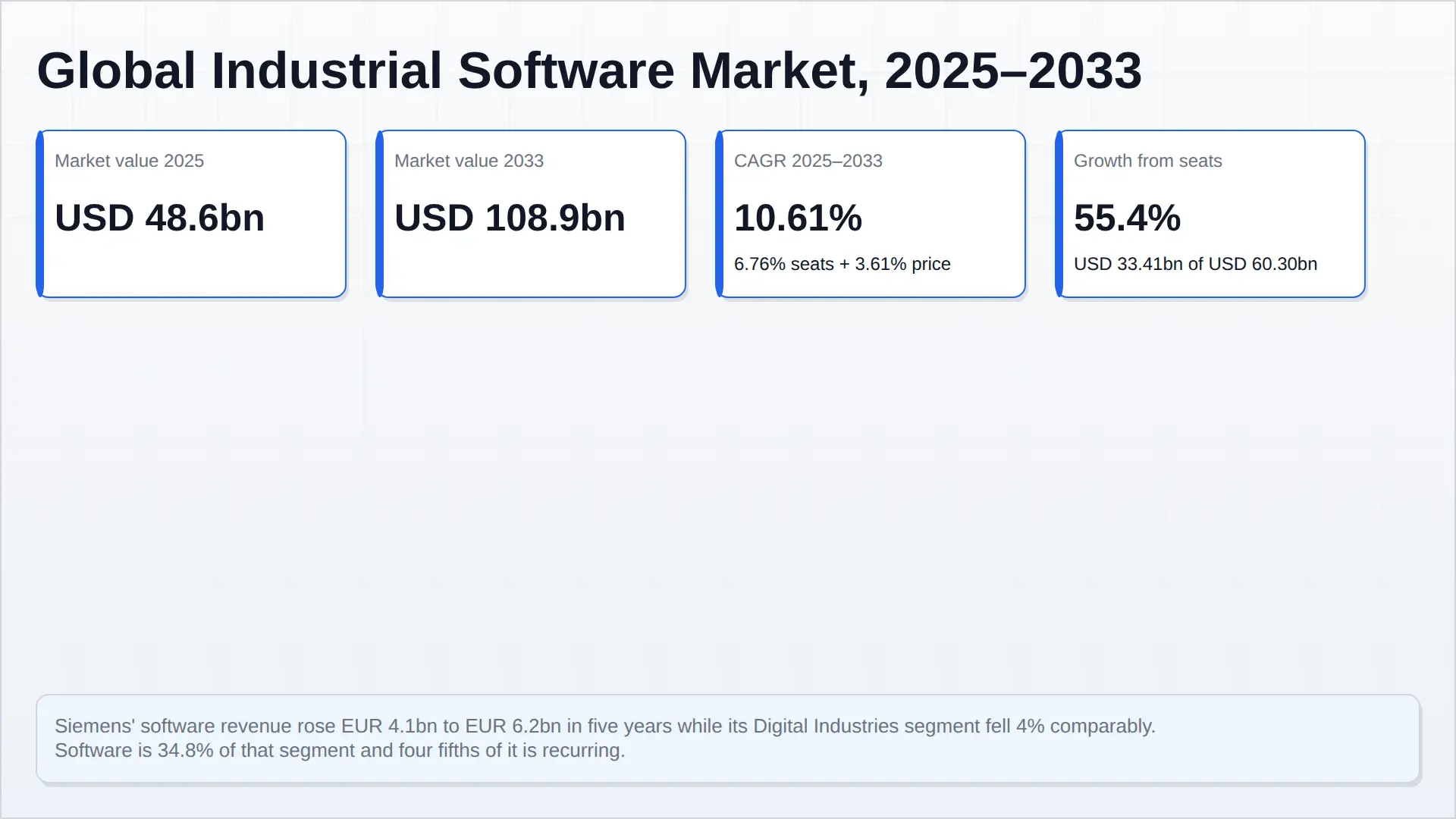
Four fifths of that €6.2 billion now arrives before a machine is built. That inversion is the market. An engineering seat is subscribed to describe a product that does not yet exist; the factory that eventually makes it buys a licence of a different shape, on a different renewal date, from a different budget line. The commercial consequence is that industrial software has decoupled from industrial capex — it is now driven by engineering headcount and model count, and only secondarily by whether anyone is buying machines.
The rebuilt series: USD 48.6bn to USD 108.9bn, and where the growth comes from
The series in this edition is rebuilt rather than inherited. Value is USD 48,600 million in 2025 rising to USD 108,900 million in 2033, a 10.61% CAGR. The unit this market actually trades in is the paid engineering seat — a named user of CAD, PLM, simulation, MES or industrial analytics — and on a Pheonix bottom-up build those seats move from 9.6 million to 16.2 million over the same period, a 6.76% CAGR. Revenue per seat rises from USD 5,062.50 to USD 6,722.20, a 3.61% CAGR.
| 2025 | 2033 | CAGR | |
|---|---|---|---|
| Market value | USD 48.60bn | USD 108.90bn | 10.61% |
| Paid engineering seats | 9.60m | 16.20m | 6.76% |
| Revenue per seat | USD 5,062.50 | USD 6,722.20 | 3.61% |
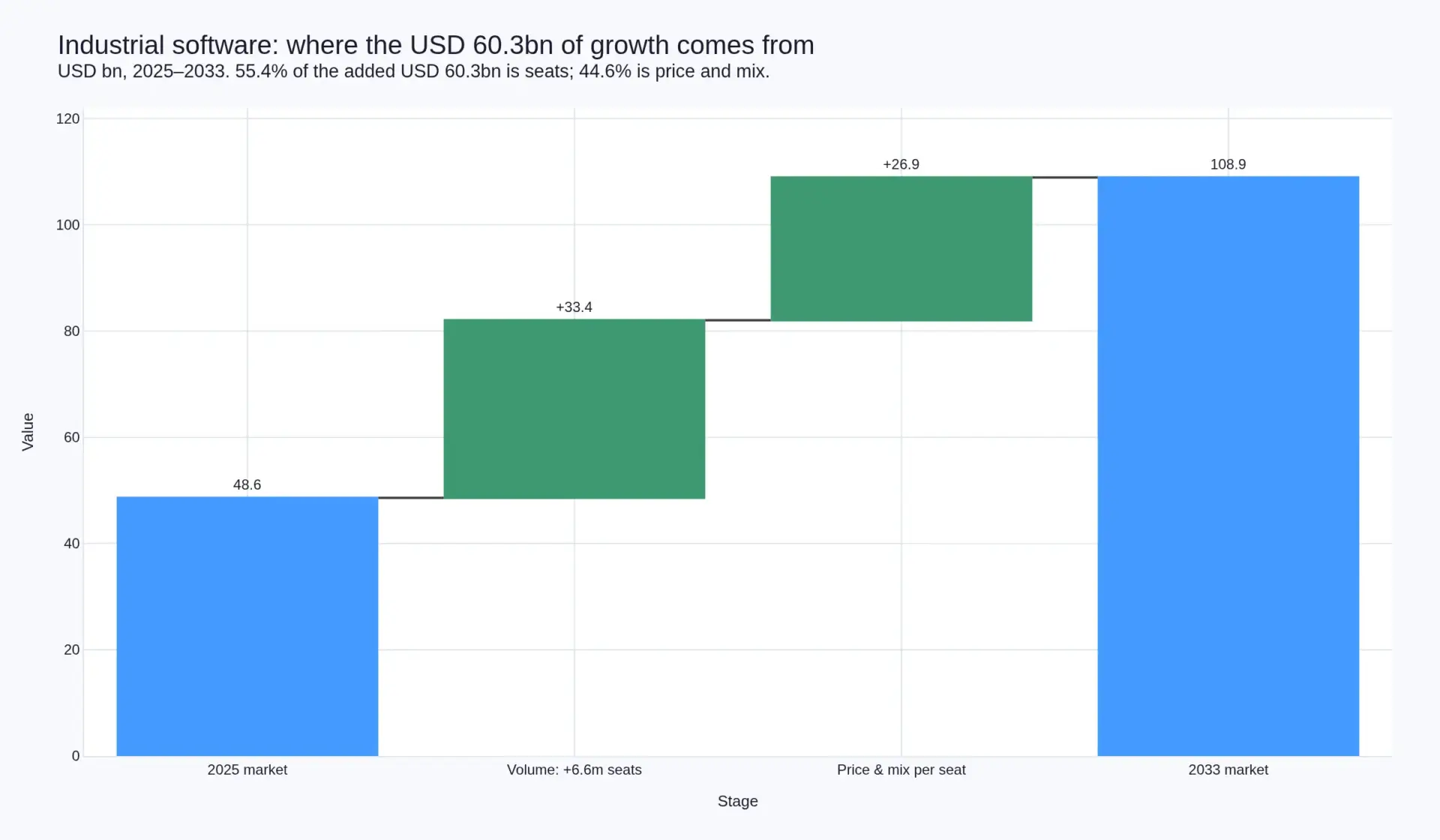
Decomposed, 55.4% of the added USD 60.30 billion is seats (USD 33.41 billion) and 44.6% is price and mix (USD 26.89 billion). The two effects add to exactly the total, which is the test the split has to pass.
| Growth effect, 2025–2033 | USD bn | Share |
|---|---|---|
| Volume — 6.60m additional seats at the 2025 revenue per seat | 33.41 | 55.4% |
| Price and mix — USD 1,659.70 additional revenue per seat on 16.20m seats | 26.89 | 44.6% |
| Total added value | 60.30 | 100.0% |
A 55/45 split is the signature of a market mid-migration. A pure seat-expansion market would be 80/20 and would be a headcount derivative. A pure price market would be 20/80 and would be a tax on incumbency. Industrial software is neither, because the same seat is being repriced as it moves to cloud and as simulation, data management and analytics are bundled into it. USD 1,659.70 of additional revenue per seat per year is not inflation. It is a different product being sold to the same engineer.
What the market is, in three layers
Treating "industrial software" as one category hides the fact that three different businesses with three different margin structures are being sold to the same plant. On a Pheonix segmentation of the 2025 base:
- Model of record — approximately 58% of value. PLM, CAD and CAE/simulation: the systems in which the product is defined, simulated and configured before metal is cut. This is where switching costs are structural, because the model is the asset history.
- Execution layer — approximately 24%. MES/MOM, quality management, track-and-trace, scheduling: the systems that tell the plant what to make next. Stickier than it looks, cheaper to replace than it feels.
- Control and analytics — approximately 18%. SCADA, HMI, historians, industrial analytics: the layer closest to the machine, the most hardware-attached, and the one most exposed to the automation cycle.
The layers are growing at different rates and for different reasons. Model-of-record growth is seat-plus-price, which is why it is the most predictable and the most expensive to enter. Control-and-analytics growth is tied to installed automation — the subject of our industrial automation report, where the segment fell 4% comparably in the same year industrial software ARR grew 13% — and that divergence is the cleanest evidence in this dataset that the two markets have separated.
The comparability problem nobody states
Siemens' software line is 67% PLM and 33% EDA, and that mix has been stable for five years. Electronic design automation is bought by the same industrial customer, but it is a different market with a different competitive set, different cycles and a different regulatory exposure. Strip EDA out and Siemens' PLM-plus-simulation business is roughly €4.2 billion of the €6.2 billion headline. Dassault Systèmes reported €6.21 billion of total revenue in 2024 with software revenue up 6% and a 31.9% operating margin, of which a material slice is life-sciences software.
Which means the widely repeated claim that one vendor "leads PLM" depends entirely on which lines the claimant chooses to count. On like-for-like industrial lines the two are within roughly €1 billion of each other. That ambiguity is itself a market fact: this is not a market with a share leader, it is a market with two or three near-equals and a long tail of specialists, which is why competitive behaviour here is priced on switching costs rather than on share.
Why this report exists separately from the automation series
Every automation purchase now carries a software decision inside it. A robotic cell is not commissioned without a simulation of the cell; an automated warehouse is not run without a WMS and a control layer — the constraint we documented in our warehouse automation report, where the buyers discovered after the fact that the robot came with a software obligation. And the plant's data is increasingly the input to models that predict failure, which is where the AI in manufacturing market meets this one.
The software decision is also the decision that outlives the machine. A robot arm is replaced on a seven-to-ten-year cycle. The PLM model that specified it is not replaced at all; it is migrated, at cost, or it is kept. That asymmetry — the machine is a purchase, the model is a record — is why the value in this market sits where it does, and why it is being repriced on a subscription rather than on a licence.
Method
This edition follows the Pheonix house method: approximately 70% secondary and 30% primary. The secondary base is company disclosures and filings — Siemens' fiscal 2025 annual financial report and its November 2025 software deep dive, Dassault Systèmes' 2024 universal registration document and results releases, PTC's fiscal 2025 results — plus European regulatory texts and standards. The primary component is Pheonix's own programme of practitioner conversations, conference and trade-fair material, and direct product and technical verification, used to test the disclosures rather than to replace them. Where a figure is a Pheonix estimate rather than a disclosed number, the page says so at the point of use.
No third-party market-research publisher is cited anywhere in this report.
Table of Contents
- Executive summary and rebuilt series — USD 48.6bn to USD 108.9bn, the 55/45 volume-against-price split, and why four fifths of Siemens’ software revenue now arrives before a machine exists
- Competitive landscape — Siemens at 34.8% of Digital Industries, Dassault at a 31.9% operating margin, PTC narrowing to CAD and PLM, and the EDA problem inside every share claim
- Value chain and margin — the geometry kernel as a toll booth, who captures margin between the kernel and the plant, and why services never scale
- Investment activity — EUR 28bn over eighteen years, Altair at roughly USD 10bn, Dotmatics at USD 5.1bn, and Synopsys paying USD 34.9bn for Ansys
- Technology and innovation — cloud ARR from 4% to 49%, simulation above EUR 1bn, and why industrial AI is a data-model problem before it is a model problem
- Market risk — the seat multiplier, SME churn at 87% of new SaaS logos, the hardware drag from a segment down 4%, and what happens if the model writes itself
- Regulatory landscape — Regulation (EU) 2023/1230 from 20 January 2027, the Cyber Resilience Act, IEC 62443, NIS2 and export control
Competitive Landscape
A moderately consolidated market that consolidates by acquisition, not by share
Pheonix puts the top five vendors at approximately 44% of 2025 market value — enough to call the market moderately consolidated, not enough for any one of them to set a price. The consolidation that has happened over the last five years was bought, not won: Siemens spent roughly €28 billion on software assets between 2007 and 2025, and Synopsys paid USD 34.9 billion for Ansys in a transaction that completed on 17 July 2025. Neither deal moved a share number so much as it moved a boundary.
That is the defining competitive fact of this market. Nobody is winning share; everybody is buying adjacency. The reason is structural: an engineering seat is won at the point a product is designed, and that decision is made once per product line per decade. Share in model-of-record software is a slow sedimentary process, and the only fast route to it is to acquire the seats.
What the four largest vendors actually disclosed
| Vendor | Most recent disclosure | What it tells you |
|---|---|---|
| Siemens — Digital Industries Software | EUR 6.2bn software revenue FY2025; ARR EUR 5.3bn; cloud 49% of ARR; 67% PLM / 33% EDA | The largest disclosed software line in the market, and the only one that publishes the recurring-versus-cloud transition in detail |
| Dassault Systèmes | EUR 6.21bn total revenue 2024; software revenue +6%; operating margin 31.9%; diluted EPS EUR 1.28, +9% | The margin benchmark. A 31.9% operating margin is what a pure software model looks like at scale |
| PTC | ARR USD 2.478bn, +8.5% constant currency, fiscal 2025; fourth-quarter revenue USD 894m; divesting Kepware and ThingWorx | The strategic retreat. PTC is narrowing to CAD, PLM, ALM and service lifecycle — the model of record — and selling the platform layer |
| Autodesk | Subscription-only model across design and make | The seat-multiplier argument in its purest form, but with a large architecture and media exposure that dilutes the industrial read |
Two things in that table matter more than the revenue rankings.
First, Siemens’ software line is 33% EDA and has been for five years. Electronic design automation sells to the same industrial customer but competes in a market whose real opponents are Synopsys and Cadence, not Dassault. Any comparison of Siemens to a PLM pure-play has to strip a third out of the headline first. Strip it out and Siemens’ PLM-and-simulation business is approximately €4.2 billion — which puts it within roughly €1 billion of Dassault on like-for-like industrial lines, and removes any claim to a decisive lead in either direction.
Second, PTC is selling its platform layer and keeping its model layer. Kepware is industrial connectivity; ThingWorx is an IIoT application platform. Divesting both is not a retreat from industrial software — it is a judgment that the money in this market is in owning the product definition, not in owning the middleware that reads the plant. A challenger with USD 2.478 billion of ARR and an 8.5% constant-currency growth rate has looked at the same evidence as Siemens and drawn the opposite conclusion about where to spend. Siemens bought the simulation layer (Altair) and the research-data layer (Dotmatics). PTC sold the connectivity layer. Both are consistent with the same view: the model is the asset; the pipe is a commodity.
The second tier is where the competitive intensity actually sits
Below the four, the market splits into two groups with very different behaviour.
The automation groups with a software asset — Schneider Electric owning AVEVA, Emerson owning AspenTech, Rockwell Automation with FactoryTalk, and Hexagon across manufacturing intelligence and sensing. These businesses are sold by an installed base rather than by an engineering standard. Their software revenue grows with the installed hardware, which is a comfortable position in a good automation year and an uncomfortable one in a year like FY2025, when the automation cycle turned and Digital Industries fell 4%.
The specialists — simulation, quality, MES, scheduling, industrial analytics — where the product is excellent and the distribution is the constraint. These are the acquisition targets. The pattern of the last three years is that a specialist with a defensible method and a few hundred customers gets bought at a revenue multiple the specialist could never earn in the market.
The competitive behaviour you can actually observe
Because share is sedimentary, competition happens at three specific points rather than across the market:
- The renewal. This is where price is made. A multi-year renewal with a cloud migration attached is the moment a vendor can reprice a seat, and it is why revenue per seat in this market rises at 3.61% a year while seat count rises at 6.76%.
- The bundling decision. Simulation, data management and analytics are increasingly sold as tiers of one subscription rather than as separate products. That raises revenue per seat without raising the number of seats, and it is the mechanism behind the 44.6% price-and-mix share of growth in this forecast.
- The standards committee. Model exchange, safety-software conformity and security certification are all being written now — see the regulatory chapter — and a vendor that sits on the drafting committee gets a compliance cost its competitors have to buy their way out of.
The competitive intensity score for this market is high, but the intensity is concentrated in the second tier and in the specialist tail. Among the top four, competition is better described as positional: each is defending a different set of seats, and each is buying the adjacency that makes its own seats more expensive to leave.
Value Chain
The kernel is the toll booth, and there are only three of them
Every industrial software product in this market sits on a geometry kernel — the mathematical engine that constructs, intersects and modifies solid bodies. There are effectively three: Parasolid, owned by Siemens; ACIS and CGM, owned by Dassault Systèmes; and OpenCascade, open source and materially weaker for high-complexity work. This is the least discussed and most consequential fact in the value chain.
It means the two largest vendors in this market sell the engine to their own competitors. A mid-sized CAM vendor, a metrology application, a simulation start-up: most of them licence a kernel from Siemens or Dassault, which means the number-two and number-one players in model-of-record software collect a royalty on a substantial part of the rest of the market’s product development. It is a structurally advantaged position that does not appear in any revenue ranking, and it explains why the kernel layer has never been commoditised despite forty years of trying.
Five layers, and the margin moves upward
| Layer | What it does | Who sits there | Margin characteristic |
|---|---|---|---|
| Kernel and solver | Geometry construction, meshing, physics solvers | Siemens (Parasolid, NX Nastran), Dassault (ACIS, CGM, Abaqus) | Highest. Licensed per seat and per application, with almost no marginal delivery cost |
| Data model / PLM | The record of the product: structure, configuration, change, revision | Teamcenter, 3DEXPERIENCE, Windchill | Very high, and the stickiest layer in the chain — the record cannot be abandoned, only migrated |
| Authoring and simulation | CAD, CAE, CAM, requirement and systems engineering | The named products, plus a long specialist tail | High, but price-sensitive at the seat level and increasingly bundled |
| Execution | MES/MOM, quality, track-and-trace, scheduling | Opcenter, DELMIA, Apriso and a fragmented regional tier | Moderate and services-heavy. Every deployment is a project |
| Control and analytics | SCADA, HMI, historians, industrial analytics | WinCC, FactoryTalk, AVEVA, Inductive Automation | Lowest of the software layers, and the most hardware-attached |
The gradient is unmistakable. Dassault Systèmes reported a 31.9% operating margin in 2024 on a business built almost entirely in the top three layers. Siemens’ Digital Industries segment — the same company, but carrying automation hardware, drives, motors and the field-service organisation that goes with them — reported a 15.9% margin in FY2025 on €17.8 billion of revenue. Same customer, same geography, same industrial cycle. The software layer earns roughly twice the operating margin of the hardware layer that delivers it.
That single comparison is the whole strategic logic of the last eighteen years of Siemens acquisitions. A €1 billion of software revenue is worth more than a €1 billion of drive revenue, it renews instead of being re-tendered, and it does not need a factory.
Where the value leaks: services
The one part of this value chain that does not scale is the part that implementation requires. A PLM deployment at a large manufacturer is measured in years and in consultant headcount. A mid-market cloud PLM deployment is measured in weeks — but only because the product has been configured to be deployable that way, which is a development cost carried by the vendor, not a services revenue line.
This is where the cloud transition changes the chain rather than just the billing. In the perpetual model, a systems integrator took 0.8 to 1.5 times the licence value in implementation and then earned an annuity on customisation. In the subscription model, the integrator’s annuity is the thing the vendor is trying to eliminate, because customisation is what makes a cloud upgrade expensive. The migration to 49% cloud ARR at Siemens is, read from the channel side, a five-year programme to take the integrator’s margin out of the renewal.
The 87% SME share of new SaaS customers is the proof that this worked. Those customers never had an integrator, could never have paid one, and are now buying a seat at USD 5,062.50 a year with a credit card and a trial. That is new demand created by a change in the shape of the value chain, not by growth in the number of factories.
Where the value is migrating next
Three movements are visible in the disclosures and worth pricing over the forecast period:
- From seat to consumption. Cloud credits and compute-based simulation pricing move revenue from a fixed annual number to a variable one. This raises revenue per seat but transfers utilisation risk to the vendor — the reason revenue per seat grows at 3.61% rather than faster.
- From the model to the telemetry. The installed base of connected machines generates operating data. Whoever holds the data model also holds the schema in which that telemetry becomes useful, which is why the automation vendors keep buying software companies and why the software vendors keep buying simulation.
- From the document to the graph. Requirement, configuration and change data are increasingly held as a connected graph rather than as documents. That is a re-platforming event, and re-platforming events are when share actually moves in this market.
The margin consequence is that the top of the chain keeps its pricing power and the bottom of the chain keeps losing it. A vendor with a kernel, a data model and a simulation method can raise revenue per seat by 3.61% a year and still be worth buying at a revenue multiple. A vendor with a SCADA licence and an installed base cannot.
For buyers, the practical implication is in the contract, not the product. The layer you are buying determines who can hold you to a renewal — and the difference between a seat of model-of-record software and a seat of plant analytics is the difference between a record you own and a subscription you rent.
Investment Activity
Eighteen years, EUR 28 billion, and an average of EUR 1.5 billion a year
Siemens has invested roughly €28 billion in software between 2007 and 2025 — an average of approximately €1.5 billion a year for eighteen consecutive years. That is not a portfolio of opportunistic purchases. It is a capital-allocation programme with a thesis, and the thesis is the one this report is about: buy the layers that own the model of the product, and keep buying them until the model is the company.
The programme reads as a sequence of specific bets. UGS brought the PLM and CAD core. Mentor Graphics brought EDA and, with it, a third of the current software line. CD-adapco brought CFD. Mendix brought low-code application development. Camstar brought manufacturing execution. Supplyframe brought the component-intelligence layer that sits upstream of design. The two most recent are the largest and the most revealing.
The two anchors of this cycle
| Transaction | Value | What was actually bought | Status |
|---|---|---|---|
| Siemens / Altair Engineering | Approximately USD 10bn enterprise value | Simulation across structures, fluids, electromagnetics and multibody dynamics, plus HPC orchestration and a data-science layer — against a business that disclosed revenue below USD 700m | Completed 26 March 2025 |
| Siemens / Dotmatics | Approximately USD 5.1bn | Research data management for life-sciences R&D: the same model-of-record argument applied to a laboratory rather than a factory | Completed 2025 |
| Synopsys / Ansys | USD 34.9bn total consideration — USD 199.91 in cash plus 0.3399 Synopsys shares per Ansys share | The dissolution of the boundary between electronic design and physical simulation | Completed 17 July 2025 |
| PTC / Kepware and ThingWorx | Divestiture | Exit from industrial connectivity and the IIoT application platform; retention of CAD, PLM, ALM and service lifecycle | Announced fiscal 2025 |
Two of these are acquisitions at roughly fifteen times revenue and one is a divestiture of the platform layer. Read together, they describe a market that has agreed on where value sits and is now trading assets to get to the right side of it. Siemens paid approximately fifteen times revenue for Altair — a multiple that only works if the acquired revenue compounds at double digits for a decade with very low churn, which is exactly the behaviour of a simulation seat inside a PLM data model. PTC, holding a platform whose revenue grew more slowly, sold it.
Neither decision is irrational. They are the same decision viewed from different balance sheets.
Why the multiples are what they are
The valuation logic in this market is unusually legible because the assets are unusually legible. Three properties drive the multiple:
- Recurring revenue with low gross churn. Four fifths of Siemens’ software revenue is recurring and its ARR grew 15.31% over five years. A renewal book of that shape is valued on the durability of the renewal, not on the growth rate.
- Negative working capital in the cloud model. Subscription revenue is collected in advance; the cost of delivery is compute, which scales with usage. The cash conversion is materially better than the reported margin suggests.
- Switching cost that is technical rather than contractual. A manufacturer can leave a CAD vendor. It cannot leave the twenty years of product definition held in that vendor’s data model without a migration project that costs more than the next decade of licences.
That third property is what makes a software asset in this market worth a hardware multiple’s inverse. A robot cell is bought on a seven-to-ten-year replacement cycle and re-tendered each time. A PLM data model is bought once and then inherited by every subsequent engineering hire. The acquirer is not buying revenue. It is buying the length of the customer’s memory.
The investment that does not appear in the deal table
Siemens has committed €1 billion to scale AI across the business over three years, and has stated an ambition to double digital business revenue by 2030. Both are capital-allocation statements as much as technology statements, and the second one is the harder of the two: doubling from a software base of €6.2 billion by 2030 requires the acquired revenue to compound at the same rate as the organic business, not to sit still while the core grows around it.
The capital intensity of this market is medium — asset-light in plant and equipment, capital-hungry in M&A and research. The scarce input is not capacity; it is the engineering organisation that can absorb an acquisition without breaking the product. That is the real constraint on consolidation in this market, and it is why the number of credible acquirers is small even though the number of targets is large.
What to watch over the forecast period
Three signals will tell you whether this cycle is continuing or turning:
- Whether the acquired ARR holds its growth rate. Altair’s revenue inside Siemens’ FY2025 software line is the first test; a deceleration in the comparable growth rate would say the acquisition premium was a channel purchase rather than a demand purchase.
- Whether anyone buys the specialists. Simulation, quality and MES specialists are the obvious targets. A year with no material transaction in that tail would suggest the acquirers have concluded that the model layer is already owned.
- Whether the automation groups keep buying. Schneider with AVEVA, Emerson with AspenTech and Rockwell with FactoryTalk represent the hardware side of the chain trying to buy its way up the margin gradient. The interesting question is not whether they buy again but whether they can hold a software multiple on a hardware balance sheet.
Technology & Innovation
The most important number in this market is 4% to 49%
Between FY2020 and FY2025, the cloud share of Siemens’ software ARR went from 4% to 49%. That is the single largest technical change in this market in the period, and it is a change in architecture rather than in capability — the same solvers, the same data model, delivered differently.
It matters commercially because it changes three things at once. It removes the customer’s server estate, which removes the strongest argument for deferring an upgrade. It makes the version a vendor-controlled variable, which ends the era of bespoke customisation as a retention strategy. And it makes compute a variable cost, which is why simulation — the most compute-hungry application in the chain — can now be sold to a company that could never have bought a cluster.
Siemens’ simulation business crossed €1 billion inside a €6.2 billion software line. On a Pheonix read, a large part of that growth is not new simulation demand; it is the same demand, now purchasable at a size the mid-market can afford. Cloud did not create simulation capability. It created simulation customers.
Industrial AI is a data-model problem before it is a model problem
Siemens has committed €1 billion over three years to scale AI across the business, and the same claim appears in every competitor’s investor material. The technological reality is more constrained than the marketing, and the constraint is worth stating precisely because it determines which vendors can actually ship.
An AI model that predicts a machine failure, proposes a design change or generates a manufacturable geometry needs three inputs: a maintained description of the asset, a history of its behaviour, and a schema that lets the two be joined. In this market, the first and third are the industrial software vendor’s own products. That is why the AI race in industrial software is being run inside the data model rather than in a foundation-model lab: the scarce asset is not the model, it is a customer base whose products are already described in a machine-readable way.
This is also why the acquisition pattern looks the way it does. Altair brought data-science tooling and HPC orchestration into a portfolio that already held the product definition; the combination is what makes a generated design testable. A vendor that owns only the authoring tool and a vendor that owns only the plant historian can each build a model. Neither can close the loop.
What is being patented, and what is being standardised
Patent activity in this market is high and concentrated in three areas: solver methods, geometry and mesh manipulation, and the configuration and change-management logic of the data model. None of these is where the marketing sits, and all of them are where the defensive value is.
Standardisation is where the competitive dynamic gets interesting:
- Model exchange — ISO 10303 (STEP) and the quality information framework for inspection data. Exchange standards weaken the lock-in of the authoring tool while leaving the data model intact, which is precisely why vendors support them and precisely why they do not solve the switching problem.
- Plant connectivity — OPC UA is now the default, and its maturity is a large part of why PTC could sell Kepware: connectivity became a standard rather than a product.
- Security — IEC 62443 defines the zones-and-conduits model under which industrial software is specified and audited. It is the technical basis for the regulatory obligations in the next chapter.
The pattern across all three is the same: standards commoditise the interfaces and leave the model proprietary. That is a stable equilibrium, and it is why the 3.61% annual revenue-per-seat growth in this forecast is defensible — the vendor can raise the price of the thing that cannot be exported.
Three technical questions that decide the forecast
Does the model writing itself reduce seat count? Generative design and AI-assisted authoring reduce the labour per design. If one engineer with an assistant does the work of two, the seat multiplier that carries 55.4% of this forecast is under threat. The counter-argument is that lower cost per design increases the number of designs, which has been the pattern in every previous authoring transition — more drawings, more variants, more simulation. On the evidence available, variants grow faster than productivity, and the seat count rises. But this is the exposure to watch, and it is scored as moderate substitution risk rather than low.
Does cloud consumption pricing transfer too much risk to the vendor? Simulation sold on credits moves revenue from a fixed to a variable base. It raises revenue per seat when utilisation is high and lowers it when a customer’s project pipeline thins. It is one reason the price component of this forecast is 3.61% and not 6%.
Does the EDA and simulation boundary keep dissolving? Synopsys paid USD 34.9 billion for Ansys to test exactly that. If electromagnetic and thermal simulation converge on the same engine as chip design, the competitive set for the top of this value chain changes from three industrial vendors to three electronic-design vendors plus two industrial ones. That would not shrink the market, but it would change who owns its most profitable layer.
What the technology does not fix
No part of this innovation stack addresses the two things that actually determine whether a deployment succeeds: whether the customer’s existing product data is clean enough to migrate, and whether anyone in the plant will maintain the model after the implementation team leaves. Both are organisational. Both are the reason services revenue exists. And both are the reason the cloud transition — which forces a one-time data migration as part of the move — has been the most effective product-development programme of the period.
Market Risk
The risk is in the multiplier, not in the demand
This forecast is not a demand forecast. Demand for engineering seats is not the binding constraint — the number of manufacturers is stable, and the number of engineers who need a design tool is roughly a function of industrial employment. The forecast is a multiplier forecast: 9.6 million seats at USD 5,062.50 each, becoming 16.2 million at USD 6,722.20. Any risk that matters is a risk to one of those two numbers.
| Scenario to 2033 | Paid seats | Revenue per seat | Market value | CAGR |
|---|---|---|---|---|
| Base case | 16.20m | USD 6,722.20 | USD 108.90bn | 10.61% |
| Seat growth two points lower (4.76%) | 13.93m | USD 6,722.20 | USD 93.64bn | 8.54% |
The sensitivity is close to one-for-one. A two-point miss on seat growth removes 2.07 points of value CAGR, because price and mix are held at 3.61% and cannot be accelerated to compensate — repricing an existing seat faster than the cost of the alternative rises is the one thing this market has repeatedly failed to do.
Risk one: the SME cohort is the growth and the churn
Eighty-seven per cent of Siemens’ new SaaS customers are small and mid-sized. That is the most commercially important number in the disclosures and the least discussed. It says the cloud transition did not mainly convert existing large customers to a new billing model — it opened a segment that had never bought industrial software as a subscription product.
It also means the growth cohort is the one with the highest gross churn. An SME that adopts a cloud PLM seat because the entry cost collapsed can leave on the same terms. The large enterprise that migrated to cloud did so on a multi-year contract with a migration project attached; it will not leave. The portfolio’s durability therefore declines as its growth accelerates, and a market that reports ARR growth of 13% comparable is not reporting the churn that sits behind it.
This is scored as the primary structural risk in the forecast period, and it is the reason the model applies a deceleration in the later years rather than extrapolating the FY2020–FY2025 ARR rate to 2033.
Risk two: the hardware drag is real and it is on the same balance sheet
Siemens’ Digital Industries segment fell 4% on a comparable basis in FY2025 while its software ARR grew 13% comparably. Those two numbers live in one segment, one management team and one set of investor expectations. In a weak automation year, the software line is the only thing holding the segment’s narrative together — which creates an incentive to bundle software into hardware deals to protect the hardware price.
Bundling is good for reported software revenue and bad for software pricing power. A seat given away inside a drive-and-controls package does not appear in a renewal negotiation at USD 5,062.50, and it does not establish the independent price the forecast depends on. The same dynamic applies at Rockwell Automation, Schneider Electric and Emerson, each of which owns a software asset inside a hardware business.
Risk three: if the model writes itself, the seat multiplier inverts
Generative design and AI-assisted authoring reduce the engineering labour per design. The base case assumes the number of designs, variants and simulations rises faster than labour productivity — which is what happened through the last three authoring transitions, from drafting board to 2D CAD, 2D to 3D, and 3D to simulation-driven design. Each transition reduced cost per design and increased the number of designs.
There is no guarantee the pattern holds. If AI compresses the number of named users required per product programme rather than expanding the number of programmes, the 55.4% of value growth that comes from seats reverses. This is scored as moderate rather than low substitution risk specifically because the mechanism is plausible and the evidence is not yet in: the FY2025 disclosures still show seat-led growth, but they precede the current generation of AI-assisted authoring being deployed at scale.
Risk four: geopolitics, and the specific exposure of a German software business
Geopolitical exposure is high. Three channels matter:
- Export control on simulation. Software capable of modelling controlled items is itself a controlled item in several jurisdictions. A simulation portfolio is therefore not a purely commercial asset; its addressable market can be restricted by regulation in a way a CAD seat cannot.
- The China revenue question. Industrial software is a strategic category for Chinese industrial policy, and domestic alternatives are being funded. A vendor with a substantial China installed base has to price a substitution policy that is not being run by a competitor but by a state.
- Currency. Siemens reports in euros, sells in dollars, renminbi and yen, and competes with dollar-reporting vendors on a dollar-denominated cost base for cloud compute. A move in EUR/USD changes the disclosed software growth rate without changing a single contract.
Risk five: the switching cost is being legislated down
The central defence in this market is that a customer cannot leave the data model. The EU Data Act, applicable since 12 September 2025, is designed precisely to make leaving cheaper: it establishes switching rights for cloud services and phases out switching charges by 12 January 2027. Read narrowly it is a cloud-regulation issue; read in the context of this market it is an attack on the retention mechanism, and it is the risk most likely to be underweighted by anyone modelling this market from the vendor disclosures alone.
The offset is that the data model is not the cloud service. A customer can port its compute and still cannot port twenty years of configuration and change history. That is why the regulatory risk is real but second-order — and why the competitive risk from the SME cohort is first-order.
Regulatory Landscape
On 20 January 2027, the software becomes part of the machine
Regulation (EU) 2023/1230 replaces Directive 2006/42/EC and applies from 20 January 2027. It is the most consequential regulatory change in this market through the forecast period, and its significance is not the date — it is a definitional move.
The Regulation brings software performing safety functions within the concept of a safety component. That single change converts industrial software from a product that supported a conformity assessment into a product that is inside the assessment. A safety function implemented in software must now be assessed together with the machine it protects, its behaviour must be documented as part of the technical file, and the software’s version and configuration become part of what is placed on the market.
Two further provisions matter commercially:
- Digital instructions are permitted. The Regulation allows instructions for use to be supplied digitally, which removes a long-standing argument for shipping paper with every machine and legitimises the documentation layer as a software product.
- Partly completed machinery carries its own obligations. An assembly placed on the market for incorporation into a final machine has a defined conformity path, which is the regulatory mirror of the commercial split between a component vendor and an integrator.
For vendors, the practical consequence is that regulatory complexity in this market is high and rising, and the approval pathway is compliance-driven rather than a formal licensing gate. There is no regulator that grants a licence to sell industrial software in Europe. There is instead a conformity assessment the customer must pass, in which the software is now a named input — which means the vendor’s documentation quality becomes a purchase criterion, and a vendor that cannot supply the evidence delays its customer’s machine launch.
The cybersecurity stack arrives at the same time
Three instruments land on industrial software within a two-year window:
| Instrument | What it requires | Timing |
|---|---|---|
| Regulation (EU) 2023/1230 (Machinery) | Software performing safety functions assessed as a safety component; digital instructions; corruption-resistance requirements for connected machinery | Applies 20 January 2027 |
| Cyber Resilience Act (Regulation (EU) 2024/2847) | Security-by-design, vulnerability handling and reporting obligations for products with digital elements placed on the EU market | In force December 2024; reporting obligations from September 2026; main obligations from 11 December 2027 |
| NIS2 — Directive (EU) 2022/2555 | Cyber risk management and incident reporting for in-scope entities, including machinery manufacturers | Transposition due October 2024; applied through national law |
The technical standard that ties these together is IEC 62443, whose zones-and-conduits model is how industrial software is specified, segmented and audited in practice. A vendor whose product maps cleanly onto 62443 turns a compliance obligation into a sales artefact; a vendor that does not inherits its customer’s audit finding.
This is the least glamorous and most durable competitive advantage in the market. It is also the reason the regulatory chapter of this report is longer than the technology chapter’s standards section: in industrial software, compliance is a product feature that ships on a deadline nobody controls.
The AI Act adds a second conformity assessment to the same product
Where an AI system is a safety component of machinery, it falls into the high-risk category under the EU AI Act — and the obligations for product-embedded high-risk systems apply from 2 August 2027, seven months after the machinery deadline. That sequencing is deliberate and it is unforgiving: a vendor shipping AI-assisted safety software has to be ready for the machinery assessment first and the AI assessment second, on the same product, within the same year.
The practical effect on this market is a widening gap between vendors that can carry two conformity files and vendors that cannot. Small specialists with excellent methods and no regulatory function become more attractive as acquisitions and less viable as independents. That is a consolidation force that does not appear in any demand forecast.
Data portability, and the one regulation that cuts the other way
The EU Data Act, applicable since 12 September 2025, gives cloud customers a right to switch providers and phases out switching charges by 12 January 2027. For a market whose retention logic rests on data gravity, this is the one instrument that works against the vendor. It does not dissolve the switching cost — the configuration history remains proprietary — but it removes the contractual and commercial friction that sits on top of it, and it establishes a legal expectation that a customer can leave.
Export control is the regulatory risk nobody prices
Simulation software capable of modelling controlled items is itself treated as a controlled item in several jurisdictions, and the direction of travel in both the United States and the EU has been toward tighter treatment of software and technical assistance rather than looser. For a vendor whose simulation portfolio is the fastest-growing part of the software line, this creates a market that can be closed by administrative act. Geopolitical exposure for this market is scored high for that reason and not for the more commonly cited supply-chain reasons — there is no factory to relocate and no component to source; there is a licence that can be refused.
What to do with this, commercially
Three regulatory facts should change how a buyer contracts in this market between now and 2028:
- Write the compliance evidence into the software contract. From January 2027 the customer’s machine conformity depends on the vendor’s documentation. That is leverage and it should be exercised at renewal, not after a failed assessment.
- Ask for the 62443 mapping before the pilot, not after. Security architecture is not retrofittable in an industrial deployment, and a zones-and-conduits design decided after commissioning is a rebuild.
- Price the Data Act switching right into the renewal. The ability to leave is worth money even if it is never used, and from January 2027 the cost of leaving is substantially lower than the multi-year contract you may be asked to sign now.