
Global Private Health Insurance Market Report, Size, Share and Forecast 2026–2033
Global Private Health Insurance Market Forecast Snapshot (2026???2033)
| Metric | Value |
|---|---|
| Market Size (2025) | USD 1,985.60 Billion |
| Market Size (2033) | USD 3,482.75 Billion |
| CAGR (2026???2033) | 7.28% |
| Largest Segment | Individual & Family Health Insurance Plans |
| Fastest Growing Segment | Digital & Personalized Health Insurance Solutions |
| Leading End-Use Segment | Working-Age Population |
| Key Trend | Digital Health Integration, Personalized Coverage & Telehealth Benefits |
| Regulatory Influence | Healthcare Insurance Regulations, Data Privacy Laws & Consumer Protection Policies |
| Future Outlook | Growth Driven by Rising Healthcare Costs, Preventive Care Adoption & Digital Insurance Platforms |
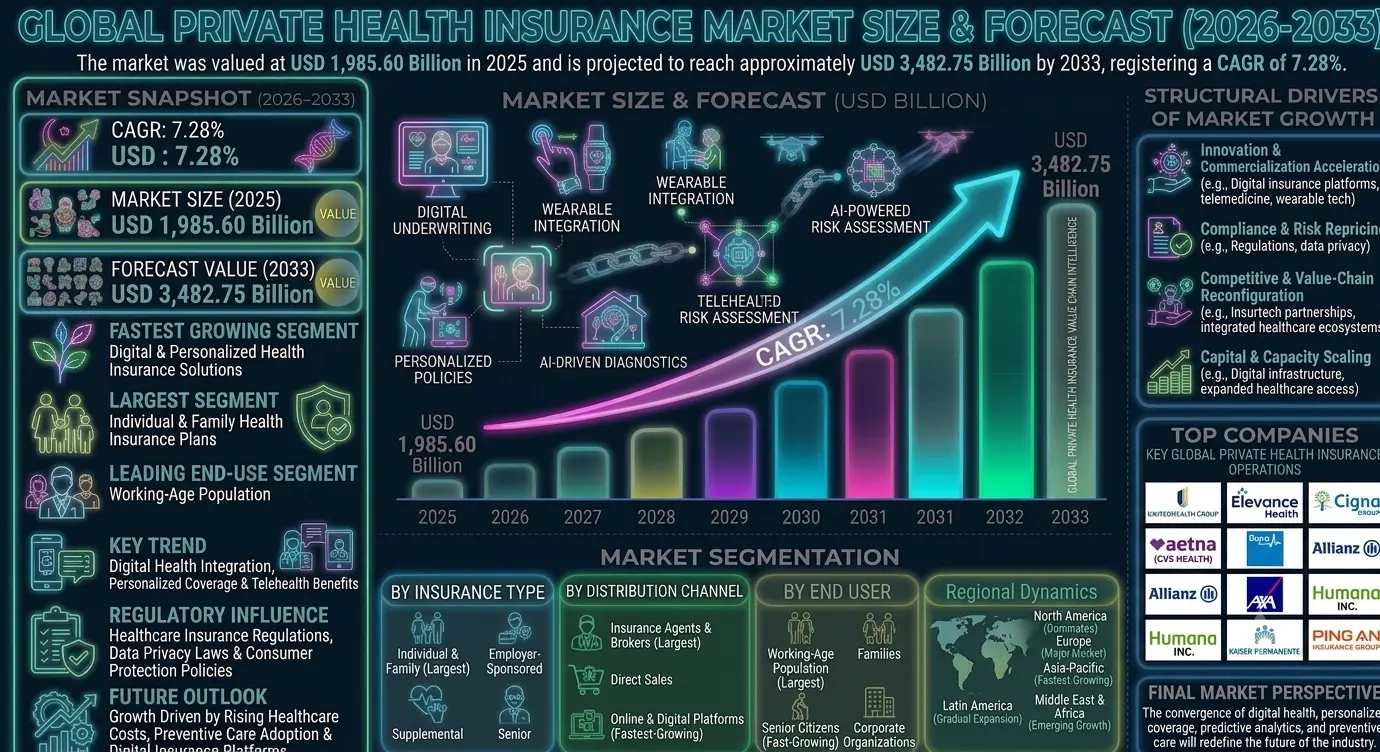
Global Private Health Insurance Market Size & Forecast
The Global Private Health Insurance Market is expected to witness strong growth during the forecast period from 2026 to 2033. The market was valued at USD 1,985.60 billion in 2025 and is projected to reach approximately USD 3,482.75 billion by 2033, registering a CAGR of 7.28%. The market growth is primarily driven by rising healthcare expenditure, increasing prevalence of chronic diseases, growing demand for quality healthcare services, and expanding awareness regarding financial protection against medical expenses. Private health insurance plays a critical role in providing access to advanced healthcare services, specialist treatments, hospitalization coverage, preventive care programs, and wellness benefits. In addition, increasing digitalization of insurance services, personalized policy offerings, and employer-sponsored healthcare plans are supporting long-term market expansion.Global Private Health Insurance Market Overview
Private health insurance refers to insurance policies provided by private insurers that offer financial coverage for medical expenses, healthcare services, hospitalization, and related treatments. The market includes individual health insurance plans, family health insurance policies, employer-sponsored insurance programs, critical illness coverage, supplemental insurance, and specialized healthcare protection plans. Private health insurance products are widely utilized by individuals, families, employers, healthcare providers, and corporate organizations. The market is rapidly evolving toward digital policy management, AI-driven underwriting, personalized healthcare plans, telehealth integration, and preventive care-focused insurance solutions.Structural Drivers of Market Growth
1. Innovation and Commercialization Acceleration
Rapid innovation in digital insurance platforms, telemedicine integration, wearable health monitoring, AI-powered risk assessment, and personalized healthcare benefits is transforming the insurance landscape. Insurers are increasingly leveraging data analytics and digital tools to improve customer experience and operational efficiency.Market Implications
Companies investing in digital health ecosystems, personalized insurance products, and advanced analytics capabilities are expected to strengthen market leadership.2. Compliance and Risk Repricing
Healthcare insurance regulations, consumer protection requirements, data privacy laws, solvency standards, and reimbursement policies are influencing market dynamics. Governments and regulatory authorities continue strengthening oversight to ensure transparency, affordability, and consumer protection.Market Implications
Firms offering compliant, transparent, and secure insurance products are likely to gain stronger customer trust and regulatory approval.3. Competitive and Value-Chain Reconfiguration
The market is highly competitive as insurance providers, healthcare organizations, insurtech companies, and digital health platforms expand service offerings. Strategic partnerships between insurers, hospitals, healthcare providers, and technology companies are reshaping industry value chains.Market Implications
Companies focusing on integrated healthcare ecosystems, digital innovation, and customer-centric insurance solutions may achieve stronger market positioning.4. Capital and Capacity Scaling
Rising investments in digital infrastructure, health technology platforms, insurance automation, and customer engagement systems are supporting market growth. Expanding healthcare access and increasing insurance penetration rates are further driving demand.Market Implications
Organizations scaling digital capabilities, healthcare partnerships, and product portfolios are expected to capture future opportunities.Market Segmentation Analysis
By Insurance Type
1. Individual & Family Health Insurance Plans
This remains the largest segment due to increasing healthcare awareness and demand for comprehensive medical coverage.2. Employer-Sponsored Health Insurance
Strong demand driven by employee benefits programs and workforce healthcare protection initiatives.3. Critical Illness Insurance
Growing adoption due to rising prevalence of chronic and life-threatening diseases.4. Supplemental Health Insurance
Widely utilized to cover medical expenses not included in standard insurance policies.5. Senior Health Insurance
Fast-growing segment supported by aging populations and increasing healthcare needs.By Distribution Channel
1. Insurance Agents & Brokers
Largest segment due to established advisory networks and personalized policy assistance.2. Direct Sales
Strong demand through insurer-operated channels and customer service platforms.3. Online & Digital Platforms
Fastest-growing segment driven by convenience, digital adoption, and insurtech innovation.By End User
1. Working-Age Population
Largest segment due to employer-sponsored plans and increasing healthcare awareness.2. Families
Strong demand for comprehensive household healthcare protection.3. Senior Citizens
Fast-growing segment due to increasing healthcare utilization and longevity.4. Corporate Organizations
Significant adoption through employee welfare and benefits programs.Regional Market Dynamics
North America
North America dominates the global private health insurance market due to high healthcare expenditure, strong insurance penetration, advanced healthcare systems, and widespread employer-sponsored coverage.Europe
Europe remains a major market supported by complementary private insurance demand, aging populations, and increasing healthcare service utilization.Asia-Pacific
Asia-Pacific is the fastest-growing region due to expanding middle-class populations, rising healthcare awareness, increasing disposable incomes, and growing insurance adoption.Latin America
Latin America is witnessing gradual expansion driven by improving healthcare access and growing demand for private healthcare services.Middle East & Africa
The region is experiencing emerging growth supported by healthcare infrastructure investments and increasing insurance penetration initiatives.Competitive Landscape
The Global Private Health Insurance Market is highly competitive with multinational insurance providers, regional insurers, healthcare organizations, and insurtech companies competing across diverse healthcare markets.Key Companies Operating in the Market Include:
- UnitedHealth Group Incorporated
- Elevance Health, Inc.
- Cigna Group
- Aetna Inc. (CVS Health)
- Bupa Group
- Allianz SE
- AXA S.A.
- Humana Inc.
- Kaiser Permanente
- Ping An Insurance Group
Strategic Outlook
The future of the private health insurance market will be shaped by digital health integration, AI-powered underwriting, preventive healthcare models, and personalized insurance products. Telehealth services, wearable health monitoring, predictive analytics, and value-based healthcare partnerships will significantly improve customer engagement and healthcare outcomes. The rise of digital insurance ecosystems, health technology innovation, and consumer-centric coverage models is expected to create strong long-term growth opportunities.Final Market Perspective
The Global Private Health Insurance Market remains a critical component of the healthcare financing ecosystem. Rising medical costs, growing healthcare awareness, and digital transformation continue driving long-term market growth. Companies capable of delivering scalable, technology-enabled, customer-focused, and value-driven insurance solutions will be best positioned to capture future opportunities. The convergence of digital health, personalized coverage, predictive analytics, and preventive care is expected to redefine the future of the global private health insurance industry.Table of Contents
Table of Contents
- Executive Summary
- Global Private Health Insurance Market Snapshot (2026???2033)
- Market Size & Growth Overview
- Key Market Highlights
- Largest & Fastest-Growing Segments
- Leading End-Use Segment Overview
- Key Market Trends & Digital Insurance Transformation
- Strategic Outlook Through 2033
- Market Introduction & Overview
- Definition of Private Health Insurance
- Scope of the Global Private Health Insurance Market
- Evolution of Healthcare Financing & Insurance Models
- Role of Private Health Insurance in Healthcare Access & Financial Protection
- Value Chain Analysis of Private Health Insurance Services
- Regulatory Influence (Healthcare Insurance Regulations, Data Privacy Laws & Consumer Protection Policies)
- Transition Toward Digital Health Integration & Personalized Coverage Models
- Research Methodology
- Primary Research Approach
- Secondary Research Sources
- Market Size Estimation Methodology
- Forecasting Assumptions (2026???2033)
- Data Validation & Triangulation Process
- Market Dynamics
- Structural Drivers of Market Growth
- Innovation and Commercialization Acceleration in Digital Insurance Platforms
- Compliance and Risk Repricing in Healthcare Insurance Markets
- Competitive and Value-Chain Reconfiguration Across Insurance Ecosystems
- Capital and Capacity Scaling in Digital Health & Insurance Infrastructure
- Market Restraints
- Rising Premium Costs and Affordability Concerns
- Complex Regulatory Compliance Requirements
- Coverage Limitations and Claim Settlement Challenges
- Market Opportunities
- Expansion of Telehealth-Integrated Insurance Products
- Growth in Personalized & Preventive Healthcare Coverage
- Increasing Adoption of Digital Insurance Platforms
- Development of AI-Powered Underwriting & Risk Assessment Solutions
- Market Challenges
- Managing Healthcare Cost Inflation
- Data Privacy & Cybersecurity Risks
- Balancing Customer Experience with Regulatory Compliance
- Structural Drivers of Market Growth
- Global Private Health Insurance Market Size & Forecast (2026???2033)
- Market Revenue Analysis
- CAGR Analysis
- Demand-Supply Trends
- Premium Pricing Analysis
- Investment Trends
- Future Market Outlook
- Market Segmentation Analysis (2026???2033)
- By Insurance Type
- Individual & Family Health Insurance Plans (Largest Segment)
- Employer-Sponsored Health Insurance
- Critical Illness Insurance
- Supplemental Health Insurance
- Senior Health Insurance (Fastest-Growing Segment)
- By Distribution Channel
- Insurance Agents & Brokers (Largest Segment)
- Direct Sales
- Online & Digital Platforms (Fastest-Growing Segment)
- By End User
- Working-Age Population (Largest Segment)
- Families
- Senior Citizens (Fastest-Growing Segment)
- Corporate Organizations
- By Insurance Type
- Regional Market Analysis
- North America (Largest Market)
- Europe
- Asia-Pacific (Fastest-Growing Region)
- Latin America
- Middle East & Africa
- Competitive Landscape
- Market Structure & Competitive Intensity Analysis
- Key Player Benchmarking
- Strategic Developments
- Digital Health & Insurtech Innovation Strategies
- Partnerships, Expansion & Healthcare Ecosystem Development Trends
- Company Profiles
- UnitedHealth Group Incorporated
- Elevance Health, Inc.
- Cigna Group
- Aetna Inc. (CVS Health)
- Bupa Group
- Allianz SE
- AXA S.A.
- Humana Inc.
- Kaiser Permanente
- Ping An Insurance Group
- Strategic Outlook
- Future of Digital Health Integration & Insurance Ecosystems
- AI-Powered Underwriting & Predictive Risk Analytics
- Expansion of Personalized & Preventive Healthcare Coverage
- Growth of Telehealth-Enabled Insurance Services
- Long-Term Market Outlook (2033+)
- Final Market Perspective
- Appendix
- About Pheonix Market Research
- Disclaimer
Competitive Landscape
Global Private Health Insurance Market Competitive Intensity & Market Structure Overview
The Global Private Health Insurance Market is highly competitive and moderately consolidated, characterized by the presence of multinational insurance providers, regional health insurers, healthcare organizations, managed care companies, and emerging insurtech firms. Competitive intensity is primarily driven by product innovation, pricing strategies, network coverage, digital capabilities, customer experience, and regulatory compliance.
Companies compete across individual health insurance, family plans, employer-sponsored coverage, critical illness insurance, supplemental health insurance, and senior healthcare plans. Rising healthcare costs, increasing demand for comprehensive medical coverage, and growing consumer expectations for personalized healthcare services are intensifying competition across global markets.
The market structure is evolving from traditional reimbursement-based insurance models toward integrated digital health ecosystems that combine telehealth services, preventive care programs, AI-powered underwriting, and personalized wellness benefits. Strategic partnerships between insurers, healthcare providers, technology companies, and pharmacy networks are reshaping industry dynamics.
Global Private Health Insurance Market Competitive Intensity & Market Structure Current Scenario
Leading Global Private Health Insurance Companies
UnitedHealth Group Incorporated: One of the world’s largest healthcare and insurance organizations, offering comprehensive health coverage, healthcare services, and digital health solutions.
Elevance Health, Inc.: A major health benefits provider focused on medical insurance, wellness programs, and value-based healthcare services.
Cigna Group: A global healthcare company providing health insurance, employee benefits, healthcare management, and international medical coverage solutions.
Aetna Inc. (CVS Health): A leading health insurer offering individual, employer-sponsored, Medicare, and integrated healthcare plans through a broad healthcare network.
Bupa Group: An international healthcare and insurance company specializing in private medical insurance, healthcare services, and senior care solutions.
Allianz SE: A global insurance provider offering health insurance products, international healthcare plans, and wellness-focused coverage solutions.
AXA S.A.: A multinational insurance company providing comprehensive health insurance products, digital healthcare services, and international coverage programs.
Humana Inc.: A major healthcare insurer focusing on health plans, preventive care services, Medicare products, and value-based healthcare initiatives.
Kaiser Permanente: An integrated healthcare and insurance organization known for combining healthcare delivery with health insurance coverage.
Ping An Insurance Group: A leading financial and insurance services company leveraging digital health technologies, AI-driven services, and healthcare ecosystem integration.
Key Competitive Intensity & Market Structure Drivers
Rising healthcare expenditures and increasing demand for financial protection against medical costs are intensifying competition among insurers seeking to expand customer bases and coverage offerings.
The growing adoption of telehealth services, digital insurance platforms, AI-powered claims processing, and personalized healthcare solutions is driving innovation and market differentiation.
Healthcare insurance regulations, consumer protection requirements, solvency standards, and data privacy laws are encouraging companies to strengthen compliance and operational transparency.
Increasing consumer demand for preventive healthcare, wellness programs, and value-added insurance benefits is reshaping product development strategies across the industry.
Strategic collaborations between insurers, hospitals, healthcare providers, pharmacies, and digital health platforms are creating integrated healthcare ecosystems and enhancing customer engagement.
Strategic Implications of Competitive Intensity & Market Structure
Companies with strong brand recognition, extensive provider networks, diversified product portfolios, and advanced digital capabilities are expected to maintain significant competitive advantages.
Investment in AI-driven underwriting, predictive analytics, telemedicine integration, and digital customer engagement platforms is becoming a critical factor for long-term market differentiation.
Insurers focusing on personalized healthcare plans, preventive care incentives, and value-based insurance models are likely to strengthen customer retention and market positioning.
Strategic expansion into emerging markets, senior healthcare coverage, and digital insurance distribution channels is enabling organizations to diversify revenue streams and capture new growth opportunities.
Organizations capable of balancing affordability, service quality, innovation, regulatory compliance, and healthcare accessibility will be better positioned to compete effectively across diverse customer segments.
Global Private Health Insurance Market Competitive Intensity & Market Structure Forward Outlook
The competitive landscape of the global private health insurance market is expected to become increasingly technology-driven as digital health ecosystems, personalized healthcare services, and predictive analytics gain broader adoption worldwide.
Future competition will be shaped by advancements in AI-powered underwriting, telehealth integration, wearable health monitoring, automated claims management, and data-driven healthcare decision-making.
Insurance providers are expected to increase investments in digital transformation, healthcare partnerships, preventive care programs, and customer-centric service models to strengthen competitive positioning.
Over the forecast period, companies that successfully balance innovation, healthcare accessibility, regulatory compliance, operational efficiency, and personalized customer experiences will be best positioned to lead the evolving global private health insurance market.
Value Chain
Global Private Health Insurance Market Value Chain & Supply Chain Evolution Overview
The Global Private Health Insurance Market is undergoing substantial transformation driven by rising healthcare costs, increasing demand for quality healthcare access, growing chronic disease prevalence, and rapid digitalization across healthcare and insurance ecosystems. The market value chain encompasses policy design, underwriting, distribution, healthcare network management, claims administration, digital health integration, and customer care services.
A defining characteristic of the private health insurance value chain is the increasing convergence of insurance services, healthcare delivery, digital health technologies, data analytics, and preventive care programs. Insurers are increasingly leveraging artificial intelligence, predictive analytics, telehealth platforms, wearable health devices, and personalized healthcare solutions to enhance customer engagement and operational efficiency.
Supply chain complexity continues to increase as insurers coordinate with hospitals, healthcare providers, pharmaceutical companies, technology vendors, regulatory agencies, and distribution partners. The growing importance of real-time data exchange, personalized coverage solutions, and value-based healthcare models is reshaping traditional insurance operating frameworks.
The value chain is evolving into a highly connected, technology-enabled, and customer-centric ecosystem where digital platforms, healthcare partnerships, risk management capabilities, and data-driven decision-making play critical roles in long-term competitiveness and growth.
Global Private Health Insurance Market Value Chain & Supply Chain Evolution Current Scenario
Market-Specific Value Chain
- Product Development & Risk Assessment: Policy design, actuarial analysis, underwriting, pricing strategies, risk modeling, and healthcare coverage planning.
- Technology & Digital Platform Integration: Development of digital insurance platforms, customer portals, mobile applications, AI-powered underwriting systems, and healthcare analytics tools.
- Distribution & Customer Acquisition: Insurance agents, brokers, bancassurance channels, employer partnerships, direct sales operations, and online insurance marketplaces.
- Healthcare Network Management: Partnerships with hospitals, clinics, healthcare providers, diagnostic centers, pharmacies, and telehealth service providers.
- Claims Processing & Care Management: Claims administration, reimbursement management, fraud detection, customer support, care coordination, and wellness program administration.
- End User Coverage & Healthcare Utilization: Individuals, families, corporate employees, senior citizens, and policyholders utilizing healthcare coverage and wellness services.
Company-to-Stage Mapping
- Product Development & Risk Assessment: UnitedHealth Group Incorporated, Allianz SE, AXA S.A., Cigna Group, and Ping An Insurance Group.
- Technology & Digital Platform Integration: Insurtech providers, digital health companies, AI solution providers, and healthcare technology partners.
- Distribution & Customer Acquisition: Insurance agents, brokers, bancassurance providers, online insurance platforms, and corporate benefits consultants.
- Healthcare Network Management: Kaiser Permanente, Aetna Inc. (CVS Health), Bupa Group, healthcare providers, hospitals, and telehealth service operators.
- Claims Processing & Care Management: Elevance Health, Inc., Humana Inc., third-party administrators, claims management providers, and customer service organizations.
- End User Coverage & Healthcare Utilization: Working-age populations, families, senior citizens, employers, and corporate organizations.
Key Value Chain & Supply Chain Evolution Signals in Global Private Health Insurance Market
Expansion of Digital Insurance Ecosystems
Insurers are increasingly adopting digital platforms, mobile applications, and self-service tools to streamline policy management, claims processing, and customer engagement.
Growth of Telehealth and Virtual Care Integration
The integration of telemedicine services into health insurance plans is improving healthcare accessibility while reducing treatment costs and administrative burdens.
Increasing Adoption of AI-Powered Underwriting
Artificial intelligence and predictive analytics are enhancing risk assessment, fraud detection, pricing accuracy, and personalized policy offerings.
Rise of Preventive and Wellness-Oriented Insurance Models
Insurers are expanding wellness programs, health monitoring services, and preventive care benefits to improve long-term healthcare outcomes.
Strengthening Healthcare Provider Partnerships
Strategic collaborations with hospitals, clinics, pharmacies, and healthcare networks are improving service quality and expanding coverage options.
Growth of Personalized Health Insurance Solutions
Data-driven policy customization is enabling insurers to offer tailored healthcare coverage aligned with individual health profiles and lifestyle preferences.
Strategic Implications of Value Chain & Supply Chain Evolution
Investment in Digital Transformation Initiatives
Insurers investing in automation, digital customer experiences, and AI-enabled operations can improve efficiency and strengthen market competitiveness.
Expansion of Integrated Healthcare Ecosystems
Partnerships between insurers, healthcare providers, and digital health platforms can improve patient outcomes while reducing healthcare costs.
Strengthening Data Analytics Capabilities
Advanced analytics and predictive modeling can enhance underwriting precision, risk management, and customer retention strategies.
Development of Preventive Care Programs
Preventive healthcare initiatives and wellness-focused insurance offerings can reduce long-term claims costs and improve customer engagement.
Enhancement of Customer-Centric Distribution Models
Digital distribution channels and personalized customer experiences can accelerate policy adoption and market penetration.
Expansion of Telehealth and Remote Care Coverage
Comprehensive coverage for virtual care services can improve healthcare accessibility and strengthen value propositions for policyholders.
Global Private Health Insurance Market Value Chain & Supply Chain Evolution Forward Outlook
Looking ahead, the private health insurance value chain is expected to become increasingly digital, predictive, and healthcare-integrated as insurers embrace technology-enabled service delivery and personalized care models.
Key Future Developments Include:
- Expansion of AI-powered underwriting and automated claims management systems.
- Increased integration of telehealth, virtual care, and remote patient monitoring services.
- Growth of personalized insurance products based on health analytics and behavioral data.
- Strengthening of insurer-provider partnerships supporting value-based healthcare models.
- Expansion of preventive care programs and wellness-focused insurance ecosystems.
- Greater adoption of digital platforms for policy administration, customer engagement, and healthcare navigation.
As the market evolves, competitive advantage will increasingly depend on the ability to combine healthcare expertise, digital innovation, customer-centric service delivery, and advanced risk management within a fully integrated insurance ecosystem.
Companies that successfully integrate digital health platforms, predictive analytics, personalized coverage solutions, and strong healthcare partnerships will achieve stronger market positioning, improved customer outcomes, and sustainable long-term growth in the Global Private Health Insurance Market.
Investment Activity
Global Private Health Insurance Market Investment & Funding Dynamics Overview
The Global Private Health Insurance Market is witnessing substantial investment activity driven by rising healthcare costs, increasing insurance penetration, growing demand for personalized healthcare coverage, and accelerating digital transformation across the insurance sector. Insurance providers, insurtech companies, private equity firms, institutional investors, healthcare organizations, and technology providers are actively investing in digital insurance platforms, AI-powered underwriting systems, health analytics solutions, telehealth integration, and customer engagement technologies.
Investment momentum is accelerating as insurers seek to improve operational efficiency, enhance customer experience, and expand access to healthcare services. Capital allocation is increasingly focused on digital policy management, predictive analytics, automated claims processing, personalized health insurance products, and integrated healthcare ecosystems.
Additionally, growing investments in preventive healthcare programs, wearable health technologies, remote patient monitoring, value-based care partnerships, and digital wellness platforms are creating significant long-term opportunities across the global private health insurance industry.
Global Private Health Insurance Market Investment & Funding Dynamics Current Scenario
Currently, the market is experiencing robust capital deployment as insurers modernize legacy systems and strengthen digital capabilities to meet evolving consumer expectations. Industry participants are investing heavily in cloud-based insurance platforms, AI-driven risk assessment tools, customer experience technologies, and healthcare data management infrastructure.
The market is benefiting from increasing investments in healthcare technology, digital health startups, and insurtech innovation aimed at improving accessibility, affordability, and efficiency. Significant funding is being directed toward telemedicine integration, automated claims management, fraud detection systems, and personalized coverage solutions.
Furthermore, strategic partnerships among insurance providers, healthcare networks, technology companies, digital health platforms, and wellness service providers are reshaping investment flows and accelerating innovation throughout the healthcare financing ecosystem.
Key Investment & Funding Dynamics Signals in Global Private Health Insurance Market
- Growing demand for digital health insurance platforms and online policy management solutions is driving technology-focused investments.
- Expansion of telehealth services and virtual healthcare delivery models is increasing capital deployment across integrated insurance ecosystems.
- Rising adoption of AI-powered underwriting, predictive analytics, and automated claims processing is supporting innovation-led funding.
- Increasing focus on preventive healthcare and wellness-based insurance products is creating new investment opportunities.
- Strategic investments in wearable health technologies and real-time health monitoring platforms are enhancing personalized coverage capabilities.
- Growing insurance demand among aging populations, middle-income households, and emerging markets is strengthening long-term investment confidence.
- Expansion of insurtech partnerships and digital healthcare collaborations is accelerating market modernization and service innovation.
Strategic Implications of Investment & Funding Dynamics in Global Private Health Insurance Market
- Continuous investment in digital infrastructure, analytics platforms, and customer-centric technologies is essential for maintaining competitive leadership.
- Capital allocation toward AI-enabled underwriting, automation, and personalized insurance offerings will strengthen market positioning.
- Companies developing integrated healthcare and insurance ecosystems are expected to secure stronger long-term growth opportunities.
- Strategic partnerships between insurers, healthcare providers, digital health companies, and technology firms will accelerate innovation and service expansion.
- Investments in preventive care programs, wellness incentives, and health engagement platforms will remain key growth priorities.
- Compliance with healthcare insurance regulations, data privacy laws, consumer protection policies, and solvency requirements will continue influencing investment decisions.
- Organizations building end-to-end capabilities across insurance distribution, healthcare delivery, analytics, and digital engagement are expected to capture substantial future value.
Global Private Health Insurance Market Investment & Funding Dynamics Forward Outlook
Looking ahead, the Global Private Health Insurance Market is expected to maintain strong investment momentum driven by rising healthcare expenditures, increasing demand for personalized coverage, expanding digital health adoption, and growing emphasis on preventive care.
Future capital deployment will increasingly focus on AI-powered insurance platforms, digital health ecosystems, telehealth integration, predictive healthcare analytics, and personalized insurance products.
As insurers and healthcare providers continue prioritizing customer engagement, healthcare accessibility, and operational efficiency, investment activity is expected to expand across insurtech innovation, digital healthcare partnerships, wellness technologies, and data-driven healthcare management solutions.
In conclusion, the Global Private Health Insurance Market represents a strategically important investment landscape where digital transformation, personalized coverage, preventive healthcare, AI-driven analytics, and integrated healthcare ecosystems will define future funding priorities, competitive differentiation, and long-term market growth.
Technology & Innovation
Global Private Health Insurance Market Technology & Innovation Landscape Overview
The Global Private Health Insurance Market is undergoing rapid technological transformation driven by advancements in artificial intelligence, digital health ecosystems, telehealth integration, predictive analytics, wearable health monitoring, blockchain-enabled claims processing, and personalized insurance platforms. The market exhibits a high innovation intensity level as insurers increasingly focus on enhancing customer experience, improving operational efficiency, optimizing risk assessment, and supporting preventive healthcare models.
At the center of this transformation is the shift from traditional policy-based insurance models toward data-driven, personalized, and digitally connected healthcare coverage solutions that provide continuous engagement between insurers, healthcare providers, and policyholders.
A major innovation area is AI-powered underwriting and risk assessment, where machine learning algorithms are improving pricing accuracy, fraud detection, claims management, and customer segmentation.
The market is also witnessing significant adoption of digital health platforms that integrate telemedicine services, virtual consultations, electronic health records, wellness programs, and healthcare provider networks into insurance offerings.
Insurers are increasingly investing in wearable device integration, enabling real-time health monitoring, wellness tracking, preventive care incentives, and personalized policy benefits based on individual health behavior.
Product innovation further includes automated claims processing, mobile insurance applications, chatbot-based customer support, digital onboarding systems, and personalized health management solutions.
Additionally, blockchain technology and secure cloud-based platforms are improving data transparency, claims verification, policy administration, and regulatory compliance across the insurance value chain.
The convergence of digital healthcare, artificial intelligence, advanced analytics, connected health technologies, and personalized insurance products is redefining the future technology landscape of the global private health insurance market.
Global Private Health Insurance Market Technology & Innovation Landscape Current Scenario
Currently, the Global Private Health Insurance Market is witnessing increasing deployment of digital technologies that improve customer engagement, healthcare accessibility, risk management, and policy administration.
1. AI-Powered Underwriting & Risk Analytics
Artificial intelligence is being utilized to enhance risk assessment, automate underwriting processes, improve pricing accuracy, and detect fraudulent activities.
2. Digital Health & Telehealth Integration
Insurance providers are incorporating virtual healthcare services, telemedicine consultations, and digital wellness platforms into policy offerings.
3. Wearable Health Monitoring Ecosystems
Connected devices are enabling insurers to monitor health metrics, encourage preventive care, and develop personalized insurance plans.
4. Automated Claims Management Systems
Advanced automation technologies are reducing claims processing times, improving operational efficiency, and enhancing customer satisfaction.
5. Mobile Insurance Applications
Digital platforms allow policyholders to manage coverage, access healthcare services, submit claims, and track benefits through mobile devices.
6. Data-Driven Personalized Coverage Models
Advanced analytics are supporting customized insurance products tailored to individual health profiles and healthcare needs.
Key Technology & Innovation Landscape Signals in Global Private Health Insurance Market
Several technology and innovation trends are shaping the future development of the market:
1. Growing Adoption of Digital Insurance Platforms
Consumers increasingly prefer online policy management, digital claims processing, and mobile-first insurance experiences.
2. Expansion of Telehealth-Based Coverage
Virtual healthcare services are becoming an integral component of modern insurance products.
3. Increasing Use of Artificial Intelligence
AI is improving underwriting, customer engagement, claims management, and healthcare cost optimization.
4. Rising Demand for Personalized Health Insurance
Data-driven products are enabling customized benefits and individualized coverage structures.
5. Growth of Wearable Device Integration
Health monitoring technologies are supporting wellness programs, preventive care initiatives, and behavior-based insurance models.
6. Adoption of Blockchain & Secure Data Platforms
Distributed ledger technologies are improving transparency, security, and trust across insurance operations.
7. Development of Preventive Healthcare Ecosystems
Insurance providers are increasingly focusing on proactive health management rather than solely financing medical treatment.
Strategic Implications of Technology & Innovation Landscape in Global Private Health Insurance Market
The evolving innovation landscape is reshaping competition throughout the private health insurance industry. Insurers are increasingly competing through digital capabilities, customer experience optimization, personalized coverage solutions, and integrated healthcare ecosystems.
Organizations investing in AI-driven underwriting, telehealth platforms, predictive analytics, digital claims automation, and wearable health integration are expected to strengthen long-term market positioning.
Strategic collaborations among insurers, healthcare providers, technology firms, digital health platforms, and wellness service providers are accelerating innovation and expanding value-added service offerings.
The growing convergence of healthcare technology, preventive care programs, digital engagement tools, and personalized insurance models is creating significant differentiation opportunities across the market.
Additionally, compliance with healthcare regulations, data privacy laws, cybersecurity requirements, and consumer protection standards is driving continuous modernization of insurance technology infrastructure.
Global Private Health Insurance Market Technology & Innovation Landscape Forward Outlook
Looking ahead to 2026???2033, the Global Private Health Insurance Market is expected to evolve toward fully digital, predictive, and personalized insurance ecosystems supported by artificial intelligence, connected healthcare platforms, and advanced analytics technologies.
Future technological developments are likely to include:
1. AI-Driven Personalized Insurance Models
Advanced algorithms will deliver highly customized coverage plans, dynamic pricing structures, and predictive health risk management.
2. Integrated Digital Health Ecosystems
Insurance platforms will seamlessly connect healthcare providers, telemedicine services, pharmacies, and wellness programs.
3. Real-Time Health Monitoring & Incentive Programs
Wearable technologies will enable continuous health tracking and reward-based preventive healthcare initiatives.
4. Intelligent Claims Automation
Next-generation claims systems will provide near-instant verification, processing, and reimbursement capabilities.
5. Blockchain-Based Healthcare Insurance Infrastructure
Secure decentralized systems will improve transparency, fraud prevention, and data integrity across insurance operations.
6. Predictive Preventive Healthcare Platforms
Advanced analytics will identify emerging health risks and support early intervention strategies that reduce long-term healthcare costs.
7. Value-Based & Outcome-Oriented Insurance Solutions
Future insurance products will increasingly align coverage models with healthcare outcomes, wellness improvement, and patient engagement metrics.
In conclusion, companies capable of combining AI-powered insurance operations, digital health integration, predictive analytics, wearable health technologies, and personalized coverage models will be best positioned to lead the future evolution of the Global Private Health Insurance Market.
Market Risk
Global Private Health Insurance Market Risk Factors & Disruption Threats Overview
The Global Private Health Insurance Market operates within a highly regulated healthcare financing ecosystem where insurers, healthcare providers, employers, digital health platforms, and government agencies interact to manage healthcare access and financial protection. While the market benefits from rising healthcare expenditure, increasing insurance penetration, and digital transformation, it faces significant structural risks related to medical cost inflation, regulatory intervention, cybersecurity concerns, and evolving consumer expectations.
A major structural risk is escalating healthcare costs. Rising hospitalization expenses, specialist treatment costs, pharmaceutical spending, and chronic disease prevalence continue increasing claim payouts, placing pressure on insurer profitability and premium affordability.
Another significant disruption factor is regulatory uncertainty. Governments frequently introduce healthcare reforms, pricing controls, consumer protection measures, coverage mandates, and solvency requirements that can materially impact insurance product structures, underwriting practices, and operating margins.
The market is also increasingly dependent on digital infrastructure, data analytics, and connected healthcare ecosystems. As insurers adopt digital platforms, telehealth services, and AI-powered underwriting systems, exposure to cybersecurity threats, data breaches, and privacy compliance risks continues to rise.
Additionally, changing consumer expectations regarding personalized coverage, transparent pricing, digital accessibility, and preventive healthcare services are reshaping competitive dynamics and increasing pressure on insurers to continuously innovate.
Global Private Health Insurance Market Risk Factors & Disruption Threats Current Scenario
The current market is characterized by growing healthcare utilization, increasing demand for private insurance coverage, and rapid digitalization of insurance distribution and policy management processes.
Digital insurance platforms, mobile applications, telehealth services, and AI-enabled customer engagement tools are improving accessibility, operational efficiency, and customer experience.
Healthcare inflation remains a key industry challenge as insurers balance premium affordability with rising claims costs associated with chronic diseases, aging populations, and advanced medical treatments.
At the same time, regulatory authorities are strengthening oversight related to consumer protection, data privacy, transparency requirements, and healthcare affordability across major markets.
Competition is intensifying as traditional insurers, insurtech firms, healthcare providers, and technology companies increasingly compete for customer acquisition, retention, and healthcare ecosystem integration.
Key Risk Factors & Disruption Threats Signals in Global Private Health Insurance Market
A major disruption signal is the rapid adoption of AI-driven underwriting and predictive analytics, enabling more personalized pricing models, risk assessment capabilities, and proactive healthcare management strategies.
Another important signal is the increasing integration of telehealth, remote patient monitoring, and digital healthcare services into insurance plans, transforming traditional coverage models.
The expansion of wearable health devices and health-tracking technologies is generating new opportunities for behavior-based insurance products while creating additional data governance and privacy challenges.
Growing consumer demand for preventive care, wellness incentives, and personalized healthcare experiences is shifting market focus from reactive claims management toward proactive health outcomes.
Cybersecurity risks continue to rise as insurers collect, process, and store increasing volumes of sensitive health and personal information across digital platforms.
Strategic Implications of Risk Factors & Disruption Threats in Global Private Health Insurance Market
Insurance providers must strengthen actuarial capabilities, cost management frameworks, and healthcare provider partnerships to effectively address ongoing medical cost inflation and claims volatility.
Investment in AI, predictive analytics, digital customer engagement platforms, and integrated healthcare ecosystems will be critical for maintaining long-term competitiveness and operational efficiency.
Companies should diversify product portfolios across individual, family, employer-sponsored, supplemental, and senior health insurance segments to reduce concentration risks and capture broader market opportunities.
Robust cybersecurity infrastructure, privacy protection mechanisms, and regulatory compliance frameworks will become increasingly important as digital health integration expands.
Strategic collaborations with healthcare providers, telemedicine platforms, wellness service providers, and insurtech innovators will play a crucial role in improving customer outcomes and strengthening market positioning.
Global Private Health Insurance Market Risk Factors & Disruption Threats Forward Outlook
Looking ahead to 2026???2033, the Global Private Health Insurance Market is expected to evolve into a more personalized, technology-driven, and healthcare-integrated ecosystem.
Digital health services, telemedicine, wearable monitoring technologies, and AI-powered healthcare management systems will become increasingly embedded within insurance offerings.
Regulatory frameworks are expected to continue evolving to address healthcare affordability, consumer protection, data privacy, and digital health governance requirements.
Value-based healthcare models, preventive care programs, and outcome-focused insurance strategies are likely to gain greater importance as insurers seek to improve long-term healthcare efficiency and customer health outcomes.
Overall, the market will remain highly attractive but operationally complex, with long-term success determined by the ability to manage healthcare costs, maintain regulatory compliance, leverage digital innovation, protect sensitive data, and deliver personalized, customer-centric insurance solutions within an increasingly connected healthcare ecosystem.
Regulatory Landscape
Global Private Health Insurance Market Regulatory & Policy Environment Overview
The regulatory and policy environment governing the Global Private Health Insurance Market is evolving rapidly as governments, healthcare regulators, insurance authorities, and consumer protection agencies seek to improve healthcare accessibility, strengthen financial protection mechanisms, and enhance transparency within insurance systems. Regulatory frameworks are increasingly focused on balancing affordability, consumer rights, insurer solvency, and healthcare quality while supporting innovation in digital insurance services.
Private health insurance providers, insurtech companies, healthcare networks, brokers, and policy administrators must comply with a broad range of regulations covering insurance licensing, solvency requirements, claims management, consumer protection, data privacy, cybersecurity, and healthcare reimbursement practices. As digital insurance ecosystems expand, regulators are also paying greater attention to AI-driven underwriting, digital policy administration, and electronic health data management.
The growing integration of telehealth services, personalized healthcare coverage, and digital health platforms is encouraging policymakers to modernize regulatory frameworks that support innovation while ensuring fairness, transparency, and consumer trust across insurance markets.
Global Private Health Insurance Market Regulatory & Policy Environment Current Scenario
The current regulatory environment is characterized by increasing oversight aimed at protecting policyholders and ensuring the financial stability of insurance providers. Regulatory authorities across major markets continue to strengthen rules governing pricing transparency, coverage disclosures, claims processing, and customer rights.
Healthcare insurance regulations play a central role in market operations by establishing requirements related to policy benefits, premium structures, reimbursement mechanisms, and insurer solvency standards. These regulations are designed to ensure that insurers maintain adequate financial resources to meet policyholder obligations.
Consumer protection policies remain a key regulatory priority. Governments are implementing measures to improve transparency in policy terms, reduce unfair practices, strengthen grievance resolution systems, and enhance access to essential healthcare services.
Data privacy and cybersecurity regulations are becoming increasingly important as insurers adopt digital platforms, mobile applications, telehealth integrations, wearable technologies, and AI-driven analytics. Compliance with healthcare information security standards is critical to maintaining customer trust and regulatory approval.
In addition, healthcare reforms, reimbursement policies, and public-private healthcare partnerships continue influencing insurance product development, market accessibility, and competitive dynamics across regions.
Key Regulatory & Policy Environment Signals in Global Private Health Insurance Market
- Healthcare Insurance Regulations: Frameworks governing policy structures, coverage requirements, premium practices, insurer licensing, and reimbursement standards.
- Consumer Protection Policies: Regulations designed to improve transparency, policyholder rights, fair treatment practices, dispute resolution mechanisms, and access to healthcare coverage.
- Solvency & Capital Adequacy Requirements: Standards ensuring insurers maintain sufficient financial reserves and risk management systems to protect policyholders.
- Data Privacy & Cybersecurity Laws: Requirements governing the collection, storage, processing, and protection of healthcare and personal information within digital insurance ecosystems.
- Digital Insurance & Insurtech Governance: Emerging regulations addressing online policy sales, AI-powered underwriting, automated claims processing, and digital customer engagement platforms.
- Healthcare Reimbursement & Coverage Policies: Rules influencing benefit design, provider reimbursement frameworks, healthcare access, and preventive care incentives.
Strategic Implications of Regulatory & Policy Environment
The evolving regulatory landscape is encouraging insurers to strengthen compliance frameworks, improve transparency, and invest in customer-centric products. Regulatory compliance is increasingly becoming a critical factor influencing market reputation, customer acquisition, and long-term competitiveness.
Healthcare insurance regulations are driving insurers to enhance policy clarity, optimize risk management practices, and improve claims processing efficiency. Companies capable of maintaining strong compliance standards are expected to gain greater consumer confidence.
Consumer protection requirements are encouraging the development of simplified insurance products, transparent pricing models, and enhanced customer support systems that improve policyholder satisfaction and retention.
The expansion of digital health services and online insurance platforms is increasing the importance of cybersecurity, privacy protection, and responsible data management practices. Insurers investing in secure digital infrastructure are likely to strengthen their market position.
Regulatory support for preventive healthcare, telehealth services, and value-based care models is also creating opportunities for insurers to develop innovative products that improve healthcare outcomes while controlling long-term costs.
Global Private Health Insurance Market Regulatory & Policy Environment Forward Outlook
Between 2026 and 2033, the regulatory environment for the global private health insurance market is expected to become more sophisticated as healthcare systems continue to evolve and digital transformation accelerates. Governments and regulatory authorities are likely to strengthen oversight related to consumer protection, affordability, healthcare access, and insurer accountability.
Regulators are expected to place greater emphasis on transparency in pricing, policy disclosures, and claims settlement processes, ensuring improved customer experiences and stronger market trust.
Digital insurance regulations will likely expand to address artificial intelligence, predictive analytics, automated underwriting, telehealth integration, and digital healthcare ecosystems. Greater attention to cybersecurity, ethical data usage, and cross-platform interoperability is anticipated.
Healthcare reform initiatives and preventive care policies may encourage insurers to develop more personalized, wellness-oriented, and outcome-based insurance products that support long-term population health management.
Overall, the future regulatory landscape will be shaped by the convergence of healthcare insurance regulations, consumer protection policies, solvency standards, data privacy laws, and digital health governance frameworks. Companies capable of delivering compliant, transparent, technology-enabled, and customer-focused insurance solutions will be best positioned to capitalize on long-term opportunities within the evolving global private health insurance market.