
Global Military Drones Market Report, Size & Forecast 2026 -2033
Global Military Drones Market Forecast Snapshot: 2026–2033
| Metric | Value |
|---|---|
| 2025 Market Size | USD 17.84 Billion |
| 2033 Market Size | ~USD 35.90 Billion |
| CAGR (2026–2033) | ~9.15% |
| Largest Region | North America |
| Fastest Growing Region | Asia-Pacific |
| Top Segment | Intelligence, Surveillance & Reconnaissance (ISR) Drones |
| Key Trend | AI-Enabled Autonomous Combat Systems & Swarm Drone Technology |
| Future Focus | Loyal Wingman Programs, Counter-UAS Systems, Edge AI, Autonomous Warfare & Multi-Domain Operations |
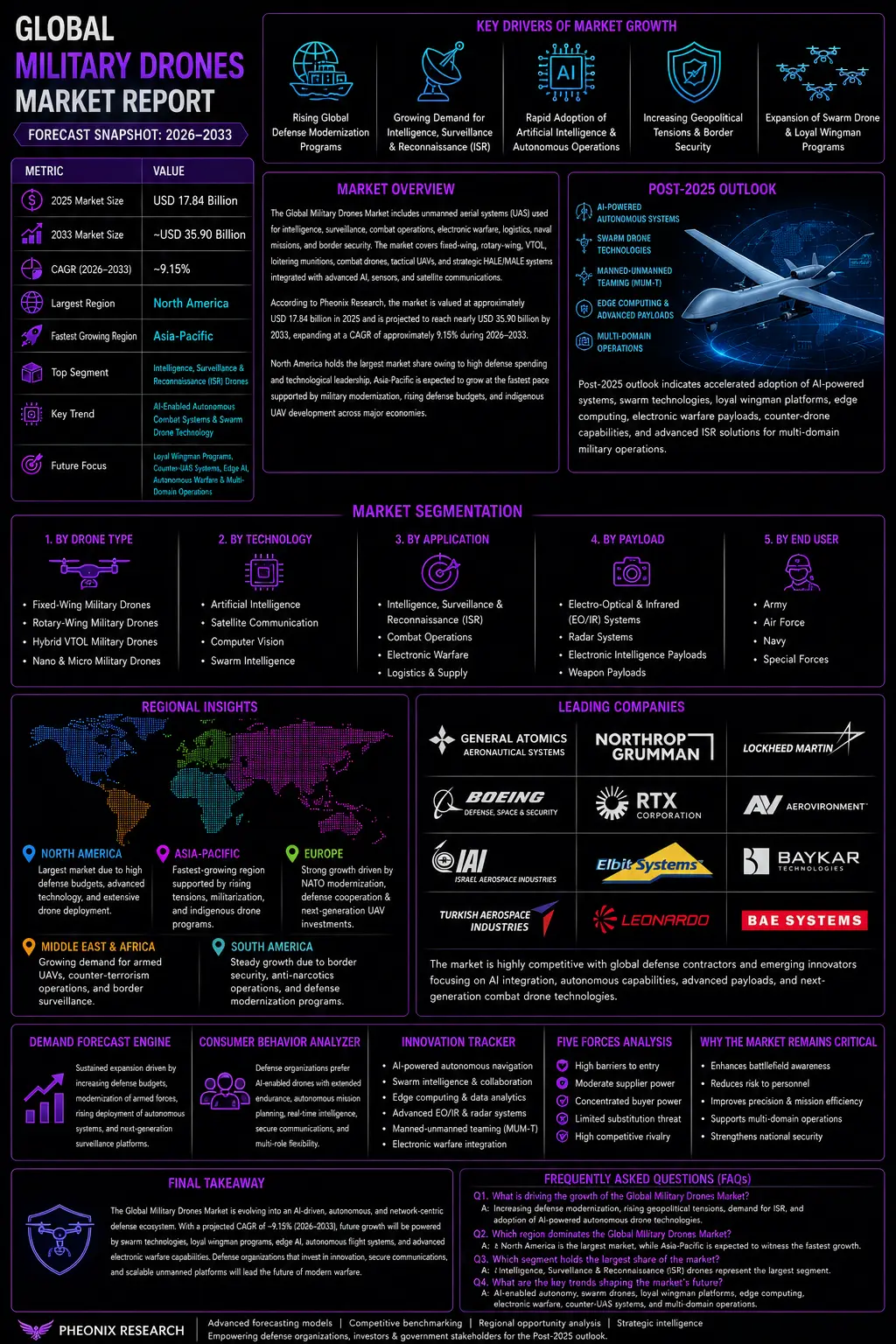
Global Military Drones Market Overview
The Global Military Drones Market comprises unmanned aerial systems (UAS) developed for defense, intelligence gathering, combat operations, surveillance, border security, reconnaissance, electronic warfare, target acquisition, logistics support, and naval missions. The market includes fixed-wing drones, rotary-wing UAVs, hybrid VTOL platforms, loitering munitions, combat drones, tactical UAVs, strategic HALE/MALE systems, and autonomous swarm drones integrated with advanced artificial intelligence technologies. Military drones have become a critical component of modern defense strategies. Armed forces worldwide are increasingly deploying unmanned platforms to improve battlefield awareness, reduce operational risks to personnel, conduct long-endurance surveillance, and execute precision strike missions. The integration of artificial intelligence, autonomous navigation, satellite communications, advanced sensors, and electronic warfare capabilities continues to redefine next-generation military operations. According to Pheonix Research, the Global Military Drones Market is valued at approximately USD 17.84 billion in 2025 and is projected to reach nearly USD 35.90 billion by 2033, expanding at a CAGR of approximately 9.15% during 2026–2033. North America accounts for the largest market share owing to significant defense spending, continuous modernization programs, strong government investments in autonomous military systems, and the presence of leading drone manufacturers. Asia-Pacific is expected to witness the fastest growth due to increasing geopolitical tensions, rising defense budgets, indigenous UAV development programs, and expanding military modernization initiatives across China, India, Japan, South Korea, and Australia. The Post-2025 outlook indicates accelerated adoption of AI-powered autonomous flight systems, swarm drone technologies, manned-unmanned teaming (MUM-T), edge computing, electronic warfare payloads, counter-drone capabilities, and next-generation loyal wingman platforms designed to enhance multi-domain military operations.Global Military Drones Market
Key Drivers of Global Military Drones Market Growth
1. Rising Global Defense Modernization Programs
Governments across major economies continue to increase investments in next-generation unmanned aerial systems as part of broader military modernization strategies. Defense agencies are prioritizing advanced drones to improve operational flexibility, precision targeting, intelligence collection, and force multiplication capabilities.2. Growing Demand for Intelligence, Surveillance & Reconnaissance (ISR)
Military drones provide persistent real-time surveillance across land, sea, and air operations. Increasing border security requirements, maritime monitoring, counter-terrorism missions, and battlefield intelligence continue to drive procurement of ISR platforms globally.3. Rapid Adoption of Artificial Intelligence & Autonomous Operations
Artificial intelligence enables autonomous navigation, target recognition, threat assessment, mission planning, and collaborative swarm operations. These technologies significantly improve mission efficiency while reducing operator workload and response times.4. Increasing Geopolitical Tensions & Border Security
Rising territorial disputes, cross-border conflicts, maritime security challenges, and asymmetric warfare are encouraging nations to strengthen drone fleets capable of continuous surveillance, rapid deployment, and precision engagement.5. Expansion of Swarm Drone & Loyal Wingman Programs
Defense organizations are increasingly investing in collaborative autonomous systems where multiple drones operate together or alongside fighter aircraft. Swarm intelligence and loyal wingman technologies are expected to become key force multipliers in future military operations.Global Military Drones Market Segmentation
1. By Drone Type
1.1 Fixed-Wing Military Drones 1.1.1 Tactical Fixed-Wing UAVs 1.1.1.1 Short-Endurance UAVs 1.1.1.2 Medium-Endurance UAVs 1.1.1.3 Long-Endurance UAVs 1.1.2 Strategic Fixed-Wing UAVs 1.1.2.1 MALE (Medium Altitude Long Endurance) 1.1.2.2 HALE (High Altitude Long Endurance) 1.1.2.3 Persistent Surveillance UAVs 1.2 Rotary-Wing Military Drones 1.2.1 Single Rotor UAVs 1.2.1.1 Tactical Helicopter UAVs 1.2.1.2 Naval Rotary UAVs 1.2.2 Multi-Rotor UAVs 1.2.2.1 Quadcopters 1.2.2.2 Hexacopters 1.2.2.3 Octocopters 1.3 Hybrid VTOL Military Drones 1.3.1 Fixed-Wing VTOL 1.3.1.1 Long Range VTOL 1.3.1.2 ISR VTOL Platforms 1.3.2 Tactical Hybrid UAVs 1.3.2.1 Border Surveillance 1.3.2.2 Special Operations 1.4 Nano & Micro Military Drones 1.4.1 Hand-Launched UAVs 1.4.1.1 Indoor Reconnaissance 1.4.1.2 Urban Combat Missions 1.4.2 Soldier Portable Drones 1.4.2.1 Squad-Level ISR 1.4.2.2 Battlefield Reconnaissance2. By Technology
2.1 Artificial Intelligence 2.1.1 Autonomous Navigation 2.1.1.1 Path Planning 2.1.1.2 Obstacle Avoidance 2.1.2 AI Target Recognition 2.1.2.1 Object Detection 2.1.2.2 Threat Classification 2.2 Satellite Communication 2.2.1 Beyond Line-of-Sight Communication 2.2.1.1 Military SATCOM 2.2.1.2 Secure Data Links 2.3 Computer Vision 2.3.1 Image Intelligence 2.3.1.1 Battlefield Monitoring 2.3.1.2 Facial & Object Recognition 2.4 Swarm Intelligence 2.4.1 Collaborative UAV Operations 2.4.1.1 Autonomous Swarming 2.4.1.2 Multi-Agent Coordination3. By Application
3.1 Intelligence, Surveillance & Reconnaissance (ISR) 3.1.1 Border Surveillance 3.1.1.1 Land Borders 3.1.1.2 Maritime Borders 3.1.2 Battlefield Surveillance 3.1.2.1 Tactical ISR 3.1.2.2 Strategic ISR 3.2 Combat Operations 3.2.1 Precision Strike 3.2.1.1 Air-to-Ground Missions 3.2.1.2 Close Air Support 3.3 Electronic Warfare 3.3.1 Signal Intelligence 3.3.1.1 Electronic Intelligence (ELINT) 3.3.1.2 Communication Intelligence (COMINT) 3.4 Logistics & Supply 3.4.1 Military Cargo Delivery 3.4.1.1 Medical Supplies 3.4.1.2 Ammunition Transport4. By Payload
4.1 Electro-Optical & Infrared (EO/IR) Systems 4.1.1 Day & Night Surveillance 4.1.1.1 Thermal Imaging Cameras 4.1.1.2 High-Definition Electro-Optical Cameras 4.1.2 Target Tracking 4.1.2.1 Moving Target Tracking 4.1.2.2 Persistent Target Observation 4.2 Radar Systems 4.2.1 Synthetic Aperture Radar (SAR) 4.2.1.1 Ground Mapping 4.2.1.2 Maritime Surveillance 4.2.2 Ground Moving Target Indicator (GMTI) 4.2.2.1 Vehicle Detection 4.2.2.2 Battlefield Monitoring 4.3 Electronic Intelligence Payloads 4.3.1 SIGINT Systems 4.3.1.1 Electronic Intelligence (ELINT) 4.3.1.2 Communications Intelligence (COMINT) 4.3.2 Electronic Warfare Payloads 4.3.2.1 Jamming Systems 4.3.2.2 Electronic Countermeasures 4.4 Weapon Payloads 4.4.1 Precision Guided Munitions 4.4.1.1 Air-to-Ground Missiles 4.4.1.2 Guided Bombs 4.4.2 Loitering Munitions 4.4.2.1 Anti-Armor Systems 4.4.2.2 Tactical Strike Systems5. By End User
5.1 Army 5.1.1 Tactical Operations 5.1.1.1 Reconnaissance Missions 5.1.1.2 Combat Support 5.1.2 Border Security 5.1.2.1 Surveillance Operations 5.1.2.2 Counter-Insurgency 5.2 Air Force 5.2.1 Strategic Surveillance 5.2.1.1 High-Altitude ISR 5.2.1.2 Air Combat Support 5.2.2 Strike Missions 5.2.2.1 Precision Attack 5.2.2.2 Electronic Warfare 5.3 Navy 5.3.1 Maritime Surveillance 5.3.1.1 Coastal Security 5.3.1.2 Anti-Piracy Operations 5.3.2 Naval Combat 5.3.2.1 Carrier-Based UAVs 5.3.2.2 Ship-Launched UAVs 5.4 Special Forces 5.4.1 Intelligence Gathering 5.4.1.1 Urban Operations 5.4.1.2 Counter-Terrorism Missions 5.4.2 Tactical Support 5.4.2.1 Precision Reconnaissance 5.4.2.2 Mission PlanningRegional Insights of Global Military Drones Market
North America – Largest Market
North America dominates the Global Military Drones Market owing to substantial defense budgets, continuous investment in autonomous warfare capabilities, and the presence of leading defense contractors. The United States continues to lead procurement of combat UAVs, ISR platforms, loyal wingman programs, and AI-enabled drone technologies to strengthen multi-domain military operations.Asia-Pacific
Asia-Pacific is expected to register the fastest growth during the forecast period, supported by increasing geopolitical tensions, military modernization initiatives, expanding indigenous drone manufacturing, and rising defense expenditure across China, India, Japan, South Korea, and Australia. Governments are actively investing in surveillance drones, armed UAVs, and swarm technologies to strengthen national security.Europe
Europe represents a significant market driven by NATO modernization programs, cross-border defense cooperation, and increasing investments in next-generation unmanned combat aerial vehicles (UCAVs). Countries including the United Kingdom, France, Germany, and Italy continue to expand drone deployment for intelligence gathering, maritime surveillance, and border protection.Middle East & Africa
The Middle East & Africa market is witnessing strong growth due to regional security concerns, counter-terrorism operations, border surveillance requirements, and increasing procurement of armed UAVs. Defense agencies are investing in long-endurance surveillance platforms and precision strike capabilities to strengthen military preparedness.South America
South America is experiencing gradual market expansion supported by border security modernization, anti-narcotics operations, environmental surveillance, and defense modernization programs. Governments continue to deploy tactical UAVs for intelligence gathering, disaster response, and critical infrastructure monitoring.Leading Companies in the Global Military Drones Market
- General Atomics Aeronautical Systems
- Northrop Grumman Corporation
- Lockheed Martin Corporation
- Boeing Defense, Space & Security
- RTX Corporation
- AeroVironment, Inc.
- Israel Aerospace Industries (IAI)
- Elbit Systems Ltd.
- Baykar Technologies
- Turkish Aerospace Industries (TAI)
- Leonardo S.p.A.
- BAE Systems plc
Why the Global Military Drones Market Remains Critical
- Increasing defense modernization programs continue to accelerate global procurement of advanced military drones.
- AI-powered autonomous flight systems significantly enhance battlefield intelligence, mission efficiency, and operational safety.
- Rising geopolitical tensions and border security challenges are driving sustained investment in ISR and combat UAVs.
- Swarm drone technologies and loyal wingman programs are transforming next-generation military operations.
- Integration of advanced sensors, satellite communications, and electronic warfare capabilities strengthens multi-domain defense readiness.
Strategic Intelligence and AI-Backed Insights – Global Military Drones Market
Pheonix Demand Forecast Engine identifies sustained market expansion driven by increasing defense budgets, modernization of armed forces, rising deployment of autonomous combat systems, and growing investments in next-generation surveillance platforms. The Consumer Behavior Analyzer highlights increasing procurement preferences among defense organizations for AI-enabled drones offering extended endurance, autonomous mission planning, real-time battlefield intelligence, secure communications, and multi-role operational flexibility. The Innovation Tracker emphasizes AI-powered autonomous navigation, swarm intelligence, edge computing, satellite-enabled command and control, advanced EO/IR sensors, electronic warfare integration, and manned-unmanned teaming (MUM-T) as key competitive differentiators shaping the future military drone ecosystem. Five Forces Analysis indicates high barriers to entry due to advanced technological requirements, defense regulations, and capital-intensive manufacturing. Supplier power remains moderate owing to specialized aerospace components, while buyer power is concentrated among government defense agencies. Competitive rivalry remains high as leading defense contractors compete through innovation, strategic partnerships, and next-generation autonomous capabilities.Final Takeaway of Global Military Drones Market
The Global Military Drones Market is evolving into an AI-driven, autonomous, and network-centric defense ecosystem. The projected CAGR of approximately 9.15% during 2026–2033 reflects growing global demand for advanced unmanned systems capable of intelligence gathering, precision engagement, electronic warfare, and multi-domain military operations. Future market growth will be driven by autonomous swarm technologies, loyal wingman aircraft, AI-enabled mission planning, edge computing, satellite-based communications, and next-generation electronic warfare systems. As geopolitical tensions continue to rise and defense modernization accelerates worldwide, military organizations are expected to increase investments in highly capable unmanned platforms that enhance operational efficiency while reducing personnel risk. Defense manufacturers that successfully integrate artificial intelligence, autonomous flight technologies, advanced payload systems, cyber-secure communications, and scalable unmanned combat capabilities will be well positioned to achieve long-term competitive advantage in the evolving defense landscape. At Pheonix Research, our advanced forecasting models deliver comprehensive Global Military Drones Market revenue forecasts, competitive benchmarking, regional opportunity analysis, and strategic intelligence—enabling defense contractors, military organizations, investors, and government stakeholders to capitalize on the Post-2025 outlook with confidence and data-driven decision-making.Table of Contents
1. Executive Summary
1.1 Market Snapshot
1.2 Key Market Highlights
1.3 Market Size & Forecast (2026–2033)
1.4 Largest Regional Market Analysis
1.5 Fastest Growing Regional Market Analysis
1.6 Largest Segment Analysis
1.7 Competitive Landscape Snapshot
1.8 Future Market Outlook
2. Global Military Drones Market Introduction
2.1 Market Definition
2.2 Scope of Study
2.3 Research Assumptions
2.4 Research Methodology
2.5 Forecast Parameters
3. Global Military Drones Market Overview
3.1 Market Evolution
3.2 Industry Ecosystem Analysis
3.3 Value Chain Analysis
3.4 Pricing & Procurement Analysis
3.5 Defense UAV Infrastructure Overview
3.6 Drone Technology Landscape
3.6.1 Fixed-Wing Military Drones
3.6.1.1 Tactical UAVs
3.6.1.1.1 Strategic UAVs
3.6.1.1.1.1 MALE Platforms
3.6.1.1.1.2 HALE Platforms
3.6.2 Rotary-Wing Military Drones
3.6.2.1 Single-Rotor UAVs
3.6.2.1.1 Multi-Rotor UAVs
3.6.2.1.1.1 Naval UAVs
3.6.2.1.1.2 Tactical Helicopter UAVs
3.6.3 Hybrid VTOL Military Drones
3.6.3.1 Fixed-Wing VTOL Systems
3.6.3.1.1 Tactical Hybrid UAVs
3.6.3.1.1.1 ISR VTOL Platforms
3.6.3.1.1.2 Special Operations UAVs
3.6.4 Nano & Micro Military Drones
3.6.4.1 Hand-Launched UAVs
3.6.4.1.1 Soldier Portable Drones
3.6.4.1.1.1 Urban Reconnaissance
3.6.4.1.1.2 Battlefield Surveillance
4. Regulatory Landscape
4.1 Defense Procurement Regulations
4.2 Military Airspace & UAV Standards
4.3 Export Control & Defense Trade Compliance
4.4 Cybersecurity & Secure Communications Standards
4.5 AI Ethics & Autonomous Weapons Governance
5. Market Trends & Innovation Outlook
5.1 AI-Enabled Autonomous Flight Systems
5.2 Swarm Drone Technology
5.3 Loyal Wingman Programs
5.4 Edge AI & Real-Time Battlefield Intelligence
5.5 Counter-UAS Technologies
5.6 Autonomous Warfare Systems
5.7 Multi-Domain Operations Integration
5.8 Advanced Sensor & Electronic Warfare Payloads
6. Global Military Drones Market Dynamics
6.1 Market Drivers
6.1.1 Rising Global Defense Modernization Programs
6.1.2 Growing Demand for Intelligence, Surveillance & Reconnaissance (ISR)
6.1.3 Rapid Adoption of Artificial Intelligence & Autonomous Operations
6.1.4 Increasing Geopolitical Tensions & Border Security
6.1.5 Expansion of Swarm Drone & Loyal Wingman Programs
6.2 Market Restraints
6.2.1 High Development & Procurement Costs
6.2.2 Export Restrictions & Defense Regulations
6.2.3 Cybersecurity Vulnerabilities
6.2.4 Complex Integration with Legacy Defense Systems
6.3 Market Opportunities
6.3.1 AI-Driven Autonomous Combat Systems
6.3.2 Next-Generation ISR Platforms
6.3.3 Counter-UAS Solutions
6.3.4 Manned-Unmanned Teaming (MUM-T)
6.3.5 Defense Modernization in Emerging Economies
6.4 Market Challenges
6.4.1 Electronic Warfare Threats
6.4.2 GPS Jamming & Signal Interference
6.4.3 Ethical & Legal Challenges of Autonomous Weapons
6.4.4 Supply Chain & Advanced Component Availability
7. Global Military Drones Market Size Analysis (USD Billion), 2026–2033
7.1 Revenue Forecast Analysis
7.2 CAGR Analysis
7.3 Procurement Trend Analysis
7.4 Demand-Supply Assessment
7.5 Defense Spending Impact Analysis
8. Global Military Drones Market Segmentation Analysis
8.1 By Drone Type
8.1.1 Fixed-Wing Military Drones
8.1.2 Rotary-Wing Military Drones
8.1.3 Hybrid VTOL Military Drones
8.1.4 Nano & Micro Military Drones
8.2 By Technology
8.2.1 Artificial Intelligence
8.2.2 Satellite Communication
8.2.3 Computer Vision
8.2.4 Swarm Intelligence
8.3 By Application
8.3.1 Intelligence, Surveillance & Reconnaissance (ISR)
8.3.2 Combat Operations
8.3.3 Electronic Warfare
8.3.4 Logistics & Supply
8.4 By Payload
8.4.1 Electro-Optical & Infrared (EO/IR) Systems
8.4.2 Radar Systems
8.4.3 Electronic Intelligence Payloads
8.4.4 Weapon Payloads
8.5 By End User
8.5.1 Army
8.5.2 Air Force
8.5.3 Navy
8.5.4 Special Forces
9. Regional Market Analysis
9.1 North America
9.1.1 U.S.
9.1.2 Canada
9.1.3 Mexico
9.2 Europe
9.2.1 U.K.
9.2.2 Germany
9.2.3 France
9.2.4 Italy
9.2.5 Spain
9.2.6 Rest of Europe
9.3 Asia-Pacific
9.3.1 China
9.3.2 India
9.3.3 Japan
9.3.4 South Korea
9.3.5 Australia
9.3.6 Rest of Asia-Pacific
9.4 Middle East & Africa
9.4.1 GCC Countries
9.4.2 South Africa
9.4.3 Rest of Middle East & Africa
9.5 South America
9.5.1 Brazil
9.5.2 Argentina
9.5.3 Rest of South America
10. Competitive Landscape
10.1 Market Share Analysis
10.2 Competitive Intensity Overview
10.3 Strategic Developments
10.4 AI & Autonomous Systems Innovation
10.5 Partnerships, Mergers & Acquisitions
10.6 Defense Contractor Positioning Analysis
11. Company Profiles
11.1 General Atomics Aeronautical Systems
11.2 Northrop Grumman Corporation
11.3 Lockheed Martin Corporation
11.4 Boeing Defense, Space & Security
11.5 RTX Corporation
11.6 AeroVironment, Inc.
11.7 Israel Aerospace Industries (IAI)
11.8 Elbit Systems Ltd.
11.9 Baykar Technologies
11.10 Turkish Aerospace Industries (TAI)
11.11 Leonardo S.p.A.
11.12 BAE Systems plc
12. Strategic Intelligence & Pheonix AI Insights
12.1 Pheonix Demand Forecast Engine
12.2 Defense Procurement Analyzer
12.3 Innovation Tracker
12.4 Battlefield Technology Opportunity Mapping
12.5 Automated Porter’s Five Forces Analysis
13. Future Outlook & Strategic Recommendations
13.1 AI-Enabled Autonomous Warfare Strategies
13.2 Swarm Drone Deployment Roadmap
13.3 Loyal Wingman Program Expansion
13.4 Counter-UAS Technology Adoption
13.5 Long-Term Market Outlook (2033+)
14. About Pheonix Market Research
15. Disclaimer
Competitive Landscape
Global Military Drones Market Competitive Intensity & Market Structure Overview
The Global Military Drones Market is highly competitive and characterized by the presence of defense contractors, aerospace manufacturers, unmanned aerial system (UAS) developers, artificial intelligence companies, autonomous systems providers, electronic warfare specialists, and defense technology firms. Competitive intensity is driven by AI-enabled autonomous flight, advanced intelligence, surveillance & reconnaissance (ISR) capabilities, swarm drone technology, satellite communications, edge computing, electronic warfare integration, and multi-domain battlefield operations.
Companies compete across multiple military drone segments including intelligence, surveillance & reconnaissance (ISR) drones, combat UAVs, loitering munitions, tactical drones, strategic HALE/MALE UAVs, naval drones, rotary-wing UAVs, hybrid VTOL platforms, autonomous swarm drones, and loyal wingman systems. Rising geopolitical tensions, increasing defense modernization programs, expanding border security requirements, and growing investment in autonomous warfare technologies are intensifying competition while encouraging continuous innovation in unmanned defense capabilities.
The market structure is evolving toward AI-powered autonomous operations, machine learning-enabled mission planning, edge AI processing, digital battlefield connectivity, secure satellite communications, swarm intelligence, human-machine teaming, and integrated command-and-control ecosystems. Market participants are investing heavily in advanced sensors, computer vision, secure communications, cyber-resilient systems, electronic warfare payloads, and strategic defense partnerships to strengthen market positioning while enhancing operational effectiveness and mission readiness.
Global Military Drones Market Competitive Intensity & Market Structure Current Scenario
Leading Global Military Drone Companies
General Atomics Aeronautical Systems: A leading defense aerospace company providing MALE UAVs, ISR platforms, precision strike drones, autonomous mission systems, and long-endurance military drone solutions.
Northrop Grumman Corporation: A global defense contractor offering high-altitude surveillance UAVs, autonomous combat systems, AI-enabled mission technologies, and integrated multi-domain defense platforms.
Lockheed Martin Corporation: A major aerospace and defense company delivering autonomous unmanned systems, ISR technologies, advanced military aviation platforms, and next-generation combat drone capabilities.
Boeing Defense, Space & Security: A defense technology provider developing autonomous military aircraft, loyal wingman programs, unmanned combat systems, and advanced aerospace defense solutions.
RTX Corporation: A global defense company supplying advanced sensors, secure communications, electronic warfare technologies, precision-guided systems, and integrated payload solutions for military drones.
AeroVironment, Inc.: A leading manufacturer of tactical UAVs, loitering munitions, soldier-portable drones, autonomous reconnaissance platforms, and precision battlefield intelligence systems.
Israel Aerospace Industries (IAI): A defense aerospace company providing combat-proven UAVs, strategic surveillance systems, maritime drones, and advanced autonomous defense technologies.
Elbit Systems Ltd.: A defense electronics company offering tactical UAVs, ISR solutions, electronic warfare payloads, autonomous mission systems, and integrated battlefield intelligence platforms.
Baykar Technologies: A leading UAV manufacturer specializing in armed combat drones, autonomous flight systems, AI-enabled UAV platforms, and long-endurance surveillance solutions.
Turkish Aerospace Industries (TAI): A defense aerospace organization developing indigenous military UAVs, autonomous aerial systems, ISR platforms, and advanced unmanned combat technologies.
Leonardo S.p.A.: A global aerospace and defense company delivering military UAV systems, electronic warfare capabilities, surveillance technologies, and integrated defense solutions.
BAE Systems plc: A multinational defense company providing autonomous combat technologies, advanced military electronics, drone mission systems, and AI-enabled battlefield solutions.
Key Competitive Intensity & Market Structure Drivers
Increasing defense modernization programs, rising procurement of autonomous military systems, and expanding investment in next-generation unmanned aerial capabilities are intensifying competition among military drone manufacturers worldwide.
Advancements in artificial intelligence, machine learning, autonomous navigation, computer vision, satellite communications, edge computing, and electronic warfare technologies are becoming major competitive differentiators across the market.
Growing demand for intelligence, surveillance & reconnaissance (ISR), precision strike capabilities, border security, maritime surveillance, electronic warfare, and multi-domain operations is strengthening market competitiveness while improving operational effectiveness.
Strategic collaborations among defense contractors, aerospace manufacturers, AI technology companies, government defense agencies, semiconductor providers, and military research organizations are accelerating innovation, expanding autonomous capabilities, and enhancing mission performance.
Continuous investment in AI-powered autonomous flight systems, swarm drone technologies, loyal wingman platforms, secure communication networks, digital battlefield integration, and cyber-secure defense architectures is enabling companies to improve operational efficiency and long-term competitiveness.
Strategic Implications of Competitive Intensity & Market Structure
Companies with comprehensive military drone portfolios, advanced autonomous technologies, and integrated defense ecosystems are expected to maintain significant competitive advantages.
Investment in artificial intelligence, swarm intelligence, electronic warfare, secure satellite communications, edge AI, autonomous mission planning, and multi-domain command-and-control systems is becoming increasingly important for long-term market leadership.
Organizations focusing on expanding ISR capabilities, improving autonomous decision-making, strengthening cyber resilience, enhancing electronic warfare performance, and increasing operational endurance are likely to increase defense contracts and global market share.
Strategic partnerships with defense ministries, armed forces, aerospace companies, AI developers, satellite communication providers, and military research institutions are supporting technological innovation, operational readiness, and international defense market expansion.
Businesses capable of combining aerospace engineering expertise, autonomous technologies, artificial intelligence, defense-grade cybersecurity, operational scalability, and integrated unmanned combat solutions will be best positioned to compete effectively in the evolving global military drones market.
Global Military Drones Market Competitive Intensity & Market Structure Forward Outlook
The competitive landscape of the global military drones market is expected to become increasingly AI-driven, autonomous, and network-centric as defense organizations continue to accelerate investments in intelligent unmanned warfare systems.
Future competition will be shaped by AI-powered autonomous combat platforms, swarm drone technologies, loyal wingman aircraft, edge AI processing, electronic warfare integration, secure satellite communications, counter-UAS systems, and multi-domain operational capabilities.
Market participants are expected to increase investments in intelligent autonomous platforms, next-generation ISR systems, advanced payload technologies, AI-enabled mission software, cyber-secure communications, and integrated defense ecosystems to strengthen competitive positioning.
Over the forecast period, companies that successfully combine technological innovation, autonomous intelligence, aerospace engineering, advanced defense electronics, operational scalability, and comprehensive unmanned combat solutions will be best positioned to lead the evolving global military drones market.
Value Chain
Global Military Drones Market Value Chain Analysis
1. Research, Defense Innovation & Core Technology Development
The value chain begins with defense research organizations, military laboratories, aerospace companies, and technology firms developing next-generation unmanned aerial systems (UAS). This stage focuses on artificial intelligence (AI), autonomous flight control, swarm intelligence, advanced avionics, secure communications, stealth technologies, propulsion systems, electronic warfare capabilities, and high-performance sensor technologies. Governments and defense agencies provide significant funding for R&D programs aimed at enhancing battlefield effectiveness and multi-domain operational capabilities.
2. Component & Subsystem Manufacturing
Specialized suppliers manufacture critical drone components including airframes, propulsion engines, electric motors, batteries, flight controllers, navigation systems, satellite communication modules, EO/IR cameras, synthetic aperture radar (SAR), electronic intelligence (ELINT) payloads, GPS receivers, cybersecurity modules, onboard processors, and mission computers. Strict defense-grade quality assurance, cybersecurity standards, and export control regulations govern component manufacturing.
3. Drone Manufacturing & System Integration
Defense contractors and aerospace manufacturers assemble military drones by integrating structural platforms, propulsion systems, avionics, mission payloads, AI software, autonomous navigation systems, encrypted communication networks, and weapon integration where applicable. Extensive system testing, flight validation, environmental qualification, cybersecurity verification, and military certification ensure operational readiness before deployment.
4. Defense Procurement, Certification & Program Management
Military drones undergo procurement through government defense ministries, armed forces, and authorized acquisition agencies. This stage includes regulatory approvals, export licensing, military qualification, contract negotiations, acceptance testing, compliance with national defense standards, and lifecycle program management. Long-term procurement contracts and strategic defense partnerships play a critical role in market expansion.
5. Deployment, Operations & Lifecycle Support
Certified military drone systems are deployed across army, navy, air force, border security, intelligence agencies, and special operations units for intelligence, surveillance, reconnaissance (ISR), combat missions, electronic warfare, logistics support, maritime surveillance, and border protection. Continuous maintenance, software upgrades, predictive diagnostics, spare parts supply, operator training, mission planning support, cybersecurity updates, and modernization programs ensure long-term operational effectiveness throughout the platform lifecycle.
Key Value Chain Participants
- Defense research organizations and military laboratories
- Aerospace component and electronics suppliers
- AI, avionics, and sensor technology developers
- Military drone manufacturers and system integrators
- Defense ministries and government procurement agencies
- Armed forces and intelligence organizations
- Maintenance, repair, overhaul (MRO), training, and lifecycle support providers
Value Chain Optimization Opportunities
- AI-enabled autonomous mission planning and swarm coordination
- Indigenous manufacturing and defense supply chain localization
- Advanced secure communication and cyber-resilient architectures
- Digital twins and predictive maintenance for fleet management
- Edge AI integration for real-time battlefield decision-making
- Modular payload architectures for rapid mission reconfiguration
- Sustainable production, additive manufacturing, and lifecycle modernization programs
Investment Activity
Investment Activity in the Global Military Drones Market
Investment activity in the Global Military Drones Market is accelerating as governments, defense agencies, aerospace manufacturers, and defense technology companies significantly increase funding for autonomous unmanned systems, AI-enabled combat platforms, advanced ISR capabilities, and next-generation battlefield technologies. Rising geopolitical tensions, defense modernization initiatives, and the growing importance of multi-domain operations are driving long-term capital investment across the military drone ecosystem.
Defense organizations are making substantial investments in autonomous flight technologies, artificial intelligence, swarm drone systems, edge computing, secure satellite communications, and electronic warfare capabilities to improve mission effectiveness while reducing operational risks. Procurement programs increasingly prioritize long-endurance ISR platforms, combat UAVs, loyal wingman aircraft, loitering munitions, and tactical drones capable of operating in highly contested environments.
Major defense contractors are expanding research and development spending on advanced sensors, electro-optical and infrared (EO/IR) payloads, synthetic aperture radar (SAR), secure data links, AI-assisted target recognition, and autonomous mission planning software. These investments are enhancing battlefield intelligence, precision targeting, and collaborative human-machine operations across air, land, and maritime domains.
Strategic partnerships, defense contracts, mergers, acquisitions, and joint development programs between aerospace companies, AI software developers, semiconductor firms, and government research organizations are reshaping the competitive landscape. Companies are collaborating to accelerate innovation in autonomous systems, counter-UAS technologies, digital battlefield integration, and next-generation command-and-control networks.
Governments across North America, Europe, and Asia-Pacific are allocating higher defense budgets toward indigenous UAV manufacturing, domestic supply chain development, advanced propulsion technologies, and military electronics to strengthen national security and reduce dependence on foreign defense suppliers. Investments in resilient manufacturing capabilities and secure component sourcing are becoming increasingly important amid evolving geopolitical challenges.
Key Investment Trends
- Rising defense expenditure on AI-enabled autonomous drones, ISR platforms, and unmanned combat aerial vehicles (UCAVs).
- Growing investment in swarm drone technologies, loyal wingman programs, and manned-unmanned teaming (MUM-T) capabilities.
- Expansion of funding for edge AI, autonomous navigation, computer vision, and real-time battlefield analytics.
- Increasing capital allocation toward electronic warfare payloads, counter-UAS systems, secure satellite communications, and cyber-resilient drone networks.
- Strategic partnerships between defense contractors, aerospace manufacturers, AI companies, semiconductor suppliers, and government defense agencies to accelerate next-generation UAV development.
- Higher investment in indigenous drone manufacturing, advanced propulsion systems, modular payload architectures, and resilient defense supply chains.
- Continued spending on digital engineering, simulation environments, predictive maintenance platforms, and autonomous mission planning software to improve operational readiness and lifecycle efficiency.
Strategic Investment Outlook
Investment activity is expected to remain robust throughout the forecast period as nations continue modernizing their armed forces and integrating autonomous capabilities into future defense strategies. Capital deployment will increasingly focus on AI-powered combat systems, collaborative autonomous operations, next-generation ISR technologies, electronic warfare integration, resilient communications, and advanced drone manufacturing ecosystems.
Defense manufacturers and technology providers that invest in scalable autonomous platforms, secure AI architectures, advanced sensing technologies, and integrated multi-domain operational capabilities will be well positioned to capitalize on the long-term growth opportunities emerging across the Global Military Drones Market.
Technology & Innovation
Global Military Drones Market Technology & Innovation Landscape Overview
The Global Military Drones Market is experiencing rapid technological evolution driven by artificial intelligence (AI), autonomous flight systems, swarm intelligence, edge computing, advanced sensor fusion, secure satellite communications, and next-generation electronic warfare technologies. Modern military forces are increasingly integrating intelligent unmanned aerial systems (UAS) capable of autonomous decision-making, collaborative operations, and real-time battlefield intelligence to enhance operational effectiveness across multi-domain missions.
Technological innovation is shifting military drone capabilities beyond traditional surveillance toward AI-enabled combat support, autonomous target recognition, precision strike coordination, loyal wingman operations, and network-centric warfare. The convergence of machine learning, computer vision, quantum-resistant communications, advanced propulsion, and modular payload architectures is enabling highly adaptive and mission-flexible drone platforms for modern defense environments.
Growing investments in autonomous combat systems, counter-UAS technologies, AI-assisted mission planning, and digital battlefield integration are accelerating innovation across defense manufacturers, government agencies, and military research organizations.
Global Military Drones Market Technology & Innovation Landscape Current Scenario
The current military drone ecosystem is characterized by widespread deployment of AI-powered navigation systems, electro-optical and infrared (EO/IR) sensor fusion, satellite-enabled beyond-line-of-sight (BLOS) communications, electronic warfare payloads, and autonomous mission management software. Defense organizations are increasingly adopting edge AI processors capable of executing target detection, object classification, route optimization, and threat analysis directly onboard unmanned platforms.
Swarm drone technologies are advancing rapidly, enabling multiple UAVs to coordinate autonomously for surveillance, electronic attack, reconnaissance, and precision strike missions. Simultaneously, digital twin technology, predictive maintenance platforms, secure cloud-based command systems, and cybersecurity-enhanced communication networks are improving fleet readiness, mission reliability, and operational resilience.
Key Technology & Innovation Landscape Trends in the Global Military Drones Market
- AI-powered autonomous flight control systems are enabling intelligent navigation, obstacle avoidance, mission planning, and adaptive battlefield decision-making.
- Swarm intelligence algorithms are supporting coordinated multi-drone operations for reconnaissance, electronic warfare, and collaborative strike missions.
- Loyal Wingman programs are integrating autonomous drones with manned fighter aircraft to enhance combat effectiveness and reduce pilot risk.
- Edge AI computing enables real-time onboard data processing, target recognition, and threat assessment without relying solely on remote command centers.
- Advanced sensor fusion combining EO/IR cameras, Synthetic Aperture Radar (SAR), LiDAR, SIGINT, and multispectral imaging is improving situational awareness.
- Secure satellite communication systems and resilient mesh networking are expanding beyond-line-of-sight operations in contested environments.
- Electronic warfare payloads incorporating jamming, signal intelligence (SIGINT), communications intelligence (COMINT), and cyber-defense capabilities are becoming increasingly sophisticated.
- Counter-UAS technologies utilizing AI-powered radar, RF detection, directed energy systems, and electronic countermeasures are expanding rapidly.
- Modular open-system architectures are enabling rapid payload integration, software upgrades, and mission-specific drone customization.
- Digital twins, predictive maintenance, and AI-driven fleet management platforms are improving operational readiness while reducing lifecycle costs.
Strategic Implications of Technology & Innovation in the Global Military Drones Market
Continuous investment in autonomous AI systems, swarm technologies, edge computing, secure communications, advanced sensing, and electronic warfare capabilities has become critical for maintaining military superiority and operational flexibility.
Integration of intelligent mission planning, predictive analytics, and multi-domain battlefield networking is enabling faster decision-making, enhanced threat response, and greater mission success while reducing operational risk to personnel.
Defense manufacturers investing in AI-enabled combat autonomy, modular drone architectures, loyal wingman programs, counter-drone systems, and cyber-resilient communication technologies are expected to strengthen their long-term competitive positioning.
Strategic collaboration among defense contractors, AI software developers, semiconductor companies, satellite communication providers, and military research agencies is accelerating innovation and supporting next-generation unmanned defense ecosystems.
Growing investment in autonomous warfare technologies, advanced propulsion systems, resilient navigation, and secure battlefield connectivity is expected to generate substantial long-term opportunities across global defense modernization programs.
Global Military Drones Market Technology & Innovation Landscape Forward Outlook
Future innovation in the Global Military Drones Market will increasingly focus on fully autonomous combat operations, cognitive AI mission commanders, quantum-resistant communications, sixth-generation loyal wingman aircraft, hypersonic unmanned platforms, advanced human-machine teaming, and multi-domain autonomous warfare networks. AI-enabled swarming, distributed battlefield intelligence, autonomous logistics drones, and integrated cyber-electronic warfare capabilities are expected to redefine modern military operations.
Emerging technologies including quantum sensing, neuromorphic AI processors, next-generation propulsion systems, resilient GPS-denied navigation, directed energy payloads, and autonomous battlefield coordination platforms will further transform defense capabilities. As military organizations continue prioritizing digital transformation and autonomous warfare, technology-driven innovation will remain the foundation of future unmanned defense strategies.
Market Risk
Global Military Drones Market Risk & Disruption Analysis
The Global Military Drones Market is undergoing rapid transformation as geopolitical tensions, autonomous warfare, artificial intelligence, electronic warfare, and next-generation defense modernization reshape global military strategies. While increasing defense budgets and the growing importance of unmanned systems continue to support long-term market expansion, the industry faces evolving risks related to export controls, cybersecurity, supply chain resilience, regulatory restrictions, and rapidly advancing counter-drone technologies.
Military drone manufacturers are increasingly investing in AI-enabled autonomy, secure communications, swarm intelligence, edge computing, advanced sensors, and cyber-resilient mission systems to address modern battlefield requirements. At the same time, governments are strengthening procurement regulations, technology protection policies, and export licensing frameworks, making compliance and innovation equally important for sustained competitiveness.
Global Military Drones Market Current Risk Environment
The military drone industry is currently operating in a highly dynamic geopolitical and technological environment. Rising regional conflicts, border disputes, and asymmetric warfare continue to accelerate procurement; however, these same factors increase uncertainty surrounding defense budgets, export restrictions, and international collaboration.
Rapid advances in autonomous technologies are shortening product development cycles, requiring manufacturers to continuously invest in AI, sensor fusion, secure communications, and electronic warfare capabilities.
Cybersecurity has become a major operational concern as military drones increasingly rely on network-centric communications, satellite links, cloud-enabled mission planning, and AI-driven autonomy. Protecting unmanned systems from hacking, GPS spoofing, electronic jamming, and cyber intrusion is becoming a strategic priority.
The market also faces growing supply chain risks associated with semiconductor availability, advanced electronics, propulsion systems, rare earth materials, and export-controlled defense components.
Key Market Risk & Disruption Signals
1. Rising Geopolitical Conflicts & Defense Spending Volatility
Regional conflicts, border disputes, and changing defense priorities continue influencing procurement cycles, export opportunities, and military modernization programs worldwide.
2. Rapid Evolution of AI & Autonomous Warfare
Continuous advancements in artificial intelligence, autonomous mission planning, swarm coordination, and battlefield analytics are accelerating technology disruption across military drone platforms.
3. Increasing Cybersecurity & Electronic Warfare Threats
Growing threats from cyberattacks, GPS spoofing, signal jamming, electronic interference, and communication disruption require stronger cyber-resilient drone architectures.
4. Expansion of Counter-UAS Technologies
The rapid deployment of radar systems, directed-energy weapons, electronic countermeasures, kinetic interceptors, and AI-powered counter-drone solutions is reshaping operational effectiveness and future drone design.
5. Export Controls & Defense Procurement Regulations
Governments continue tightening export licensing, defense technology transfer restrictions, national security regulations, and procurement compliance for advanced military drone technologies.
6. Supply Chain & Critical Component Risks
Dependence on semiconductors, advanced sensors, propulsion systems, batteries, and aerospace-grade electronics creates supply chain vulnerabilities and production risks.
7. Accelerating Innovation in Swarm & Loyal Wingman Systems
Growing investments in collaborative autonomous drones, manned-unmanned teaming (MUM-T), and loyal wingman aircraft are transforming defense procurement priorities.
8. Integration of Multi-Domain Combat Systems
Military drones are increasingly integrated with satellite networks, command-and-control systems, cyber operations, naval platforms, and ground forces, increasing both operational capability and system complexity.
Strategic Implications of Market Risk & Disruption
1. Investment in AI-Driven Autonomous Systems
Defense manufacturers are prioritizing AI-enabled navigation, autonomous decision-making, swarm intelligence, and real-time mission adaptation to improve battlefield effectiveness.
2. Expansion of Cyber-Resilient Drone Platforms
Companies are strengthening encrypted communications, anti-jamming technologies, secure satellite links, and resilient command-and-control systems to counter evolving cyber threats.
3. Diversification of Defense Supply Chains
Manufacturers are localizing production, expanding supplier networks, and securing access to strategic components to improve supply chain resilience.
4. Development of Integrated Defense Ecosystems
Strategic partnerships between defense contractors, AI developers, satellite providers, cybersecurity firms, and military organizations are accelerating the development of next-generation unmanned combat ecosystems.
Global Military Drones Market Risk & Disruption Forward Outlook
1. AI Will Become the Core of Military Drone Operations
Future military drones will increasingly utilize autonomous navigation, AI-assisted target recognition, adaptive mission planning, and collaborative swarm intelligence.
2. Counter-UAS Systems Will Drive Continuous Innovation
As counter-drone technologies advance, manufacturers will develop stealthier, faster, and more electronically resilient drone platforms.
3. Cybersecurity Will Become a Primary Procurement Criterion
Defense agencies will prioritize drones equipped with advanced encryption, cyber resilience, secure communications, and anti-spoofing technologies.
4. Swarm Drone Deployment Will Expand
Autonomous swarm systems capable of coordinated intelligence gathering, electronic warfare, and precision strike missions will become increasingly important.
5. Loyal Wingman Programs Will Accelerate
Manned-unmanned teaming solutions supporting fighter aircraft, bombers, and future combat air systems will witness significant investment.
6. Edge AI & Real-Time Battlefield Analytics Will Expand
Onboard AI processing, sensor fusion, and decentralized decision-making will reduce communication latency and improve operational autonomy.
7. Indigenous Manufacturing Will Increase
Governments are expected to expand domestic drone production programs to reduce dependence on foreign suppliers and strengthen national defense capabilities.
8. Multi-Domain Integration Will Define Future Combat
Military drones will become increasingly integrated with land, naval, air, space, and cyber operations, enabling coordinated multi-domain warfare capabilities.
Regulatory Landscape
Global Military Drones Market Regulatory & Policy Environment Overview
The regulatory and policy environment plays a decisive role in shaping the Global Military Drones Market by governing the development, procurement, deployment, export, and operational use of unmanned military systems. Governments and defense agencies regulate military drones through national defense acquisition policies, export control regimes, airworthiness certification, cybersecurity requirements, autonomous weapons governance, and international humanitarian law. As autonomous and AI-enabled military capabilities expand, regulatory oversight is increasingly focused on operational safety, interoperability, ethical deployment, and secure communications.
The market is primarily influenced by defense procurement regulations, International Traffic in Arms Regulations (ITAR), the Wassenaar Arrangement, Missile Technology Control Regime (MTCR), NATO interoperability standards, military airworthiness certification frameworks, cybersecurity requirements, and international laws governing armed conflict. These frameworks support secure technology transfer, responsible defense exports, operational readiness, and standardized military integration.
Global Military Drones Market Regulatory & Policy Environment Current Scenario
The current regulatory landscape emphasizes national security, defense modernization, secure autonomous operations, AI governance, and export compliance. Governments are strengthening procurement standards for AI-enabled unmanned systems while implementing stricter cybersecurity requirements for military communications, command-and-control networks, and autonomous mission systems.
Defense organizations are also introducing policies governing human oversight of autonomous capabilities, electronic warfare resilience, data security, secure satellite communications, and interoperability across multi-domain military operations. Regulatory attention is increasing around responsible deployment of autonomous combat technologies and compliance with international humanitarian law.
Key Regulatory & Policy Environment Signals in the Global Military Drones Market
1. Defense Procurement & Military Certification
Governments continue strengthening procurement regulations, military airworthiness certification, and qualification standards to ensure operational safety, mission reliability, and interoperability.
2. Export Control & Technology Transfer Regulations
International export control frameworks such as ITAR, MTCR, and the Wassenaar Arrangement continue governing cross-border transfers of military drone technologies, sensors, and related defense systems.
3. AI Governance & Autonomous Weapons Policies
Regulators are increasing oversight of AI-enabled autonomous systems, emphasizing human oversight, accountability, ethical deployment, and secure autonomous mission execution.
4. Cybersecurity & Secure Communications Requirements
Growing cyber threats are driving stricter requirements for encrypted communications, cyber-resilient command-and-control systems, secure software architectures, and protection against electronic warfare.
5. International Humanitarian Law & Operational Compliance
Military drone deployment continues to be governed by international humanitarian law, rules of engagement, and defense policies addressing lawful operational use, civilian protection, and proportionality during military operations.
Strategic Implications of Regulatory & Policy Environment
The evolving regulatory landscape is encouraging defense manufacturers to develop secure, AI-enabled, cyber-resilient, and standards-compliant unmanned systems that support military interoperability and mission effectiveness. Companies are increasing investment in autonomous navigation, secure communications, electronic warfare resilience, export-compliant product design, and certification-ready defense platforms to meet evolving procurement requirements.
Manufacturers capable of delivering compliant, interoperable, cyber-secure, and technologically advanced military drone systems are expected to strengthen their competitive position as governments accelerate defense modernization and autonomous capability development.
Global Military Drones Market Regulatory & Policy Environment Forward Outlook
Between 2026 and 2033, regulatory frameworks are expected to place greater emphasis on AI governance, autonomous systems certification, cyber resilience, secure defense supply chains, export control modernization, and responsible deployment of unmanned military technologies. Governments are likely to strengthen defense acquisition standards while expanding policies governing autonomous operations, human-machine teaming, and multi-domain interoperability.
Future policy developments are also expected to promote greater international coordination on military AI governance, secure defense technologies, and ethical autonomous warfare, supporting the continued evolution of advanced unmanned defense ecosystems.