
Global Rice Seed Market Report, Size, Share and Forecast 2026–2033
Global Rice Seed Market, 2026–2033
Rice is the only major seed market in the world where the buyer is frequently not the customer. Most of the world’s rice seed is saved from the previous harvest, exchanged inside a village, or bought as grain and sown. The competitor to a commercial bag is not another company’s hybrid — it is a public variety, released free or nearly free by a national breeding programme and multiplied by farmers who have done it for generations.
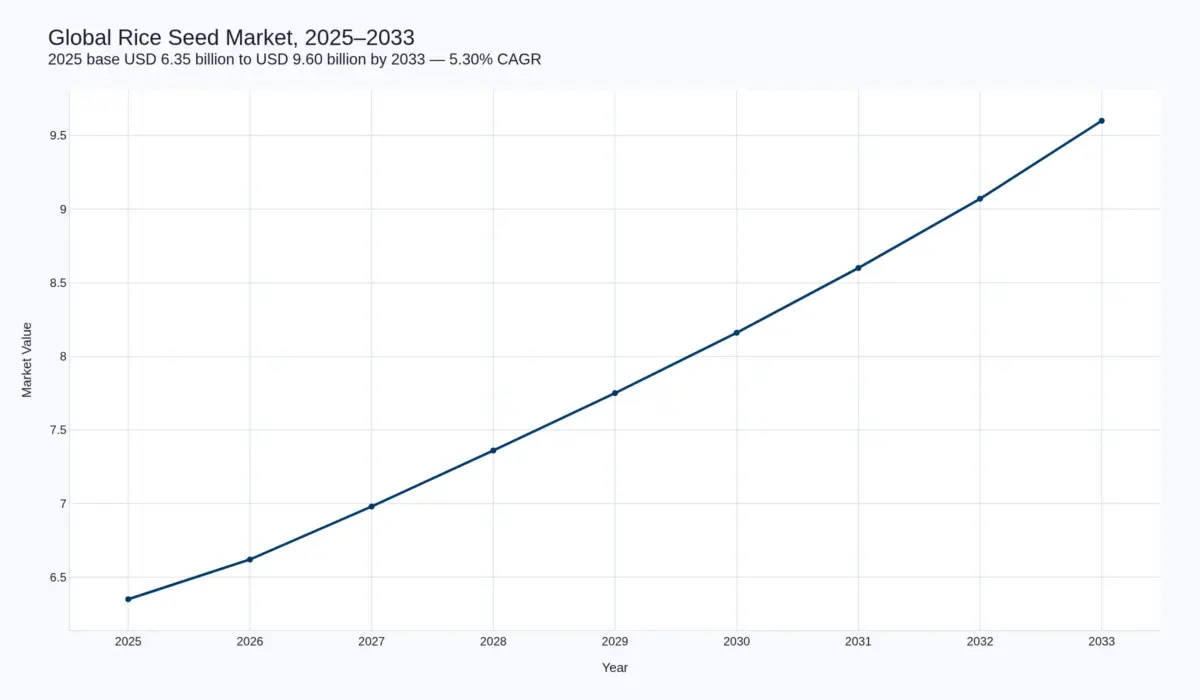
We size the global rice seed market at USD 6.35 billion in 2025, rising to USD 9.60 billion by 2033 — a 5.30% CAGR. That base year is 8.10% of the USD 78.40 billion global seed market our seed report establishes for the same year, which makes rice one of the three largest crop markets in the industry and, by a wide margin, the least monetised per hectare.
The growth is not a technology story in the way corn seed is. Corn grows because a hectare can absorb more trait value every year. Rice grows because the farmer stops saving seed. Commercial seed volume rises at 1.90% a year against 5.30% for value, and the gap between the two is the conversion of on-farm retention and public variety into a bought, branded bag.
Two facts sit awkwardly against that forecast, and both are in this report. The first is that the world has rarely been better supplied with rice. World milled production reached a record 545.65 million tonnes in 2025/26; India alone produced a record 154.02 million tonnes and finished the year holding 59 million tonnes in stocks, on USDA Foreign Agricultural Service data published in October 2026. Soft paddy prices are the worst possible backdrop for selling a more expensive bag of seed.
The second is that hybrid rice — the technology this market was built on — is retreating in the country that invented it. China’s hybrid rice area has fallen by roughly 5 million hectares, or 25%, since 1995 (Food Security, 2022), and Yuan Longping High-Tech’s rice seed revenue fell 1.69% to RMB 1.974 billion in 2025 even as group net profit rose 45.63% on Brazilian corn.
Both facts point the same way. Hybrid rice’s growth is no longer Chinese and no longer a yield story at the frontier. It is a conversion story in South Asia and Africa, priced against a public variety and delivered through a dealer network — a slower, lower-margin, considerably more durable business than the one the technology promised thirty years ago.
The market at a glance
| Indicator | 2025 / period |
|---|---|
| Global market value, 2025 | USD 6.35 billion |
| Forecast value, 2033 | USD 9.60 billion |
| CAGR, 2026–2033 | 5.30% |
| Share of global seed value, 2025 | 8.10% |
| Commercial seed volume, 2025 | 3.20 million tonnes (1.90% CAGR to 2033) |
| Value per tonne of commercial seed, 2025 → 2033 | USD 1,984 → USD 2,580 |
| Largest segment | Certified inbred (varietal) seed, 43.9% of 2025 value |
| Fastest-growing segment | Premium quality & specialty seed, 7.1% CAGR |
| Largest region | Asia-Pacific, 78.0% (USD 4.95 billion) |
| Largest single market | China, USD 2.35 billion, 37.0% of global value |
| Fastest-growing region | Middle East & Africa, 6.4% CAGR |
| Hybrid share of Indian rice area | ~6% of 43 million hectares; ~15% in the eastern core |
| Risk on seed consumption, 2025/26 | World milled production 545.65 million tonnes, a record |
| Largest supplier’s global share | 4.3% — there is no tier-1 position in this market |
Market size and forecast
The path is unremarkable in the near term and that is the point. Rice seed does not have a technology cycle to recover from or an area shock to absorb; it has a conversion rate that moves with paddy prices, rural wages and government seed programmes. We model 4.3% in 2026, the softest year, on record world output and a forecast 2.3% fall in 2026/27 milled production as growers respond to low prices — a sequence that squeezes the seed budget before it restores the paddy price. Growth then settles into the mid-fives as South Asian hybrid conversion, direct-seeding adoption and quality premiums do the work.
| Year | Value (USD billion) | Growth |
|---|---|---|
| 2025 | 6.35 | — |
| 2026 | 6.62 | 4.3% |
| 2027 | 6.98 | 5.4% |
| 2028 | 7.36 | 5.4% |
| 2029 | 7.75 | 5.3% |
| 2030 | 8.16 | 5.3% |
| 2031 | 8.60 | 5.4% |
| 2032 | 9.07 | 5.5% |
| 2033 | 9.60 | 5.8% |
Decomposed, commercial seed volume grows from 3.20 to 3.72 million tonnes, or 1.90% a year, and value per tonne of seed rises from USD 1,984 to about USD 2,580. Volume contributes roughly 36% of the growth and price, mix and conversion contribute 64%. That is a materially different engine from corn, where volume contributes 24% and price and technology 76%: rice still has volume to win, because two-thirds of the world’s rice area is still sown with seed that never enters a commercial channel.
Three Structural Shifts Defining 2026–2033
1. Hybrid rice changed address
China commercialised hybrid rice in the 1970s and dominated the technology for four decades. It is now the only large rice market in the world where hybrid penetration is going backwards. The area under hybrid rice has fallen by about 5 million hectares since 1995 — a 25% decline — as inbred varieties closed much of the yield gap, as labour left the Yangtze basin, and as consumers began paying for eating quality that the early hybrids did not deliver.
The share is still high — the hybrid seed report in this cluster puts hybrids on 62–63% of China’s rice area, the most heavily hybridised large market in the world — but it is a high share on a falling base. Penetration and growth are not the same variable, and in China they now point in opposite directions: hybrid share stays above 60% while absolute hybrid area and seed revenue both fall.
Yuan Longping High-Tech’s 2025 results are the cleanest evidence available that the Chinese hybrid rice business has stopped growing. Rice seed revenue fell 1.69% to RMB 1.974 billion while gross margin actually improved 1.98 percentage points to 39.58%. The company made its money elsewhere: group net profit rose 45.63% on a Brazilian corn business that grew 16.51% to RMB 3.661 billion. The hybrid rice specialist is now, financially, a corn company.
The growth moved south and west. India cultivates hybrid rice on only about 6% of its 43 million hectares, though adoption in the core eastern markets runs closer to 15%, and Bayer’s India management put kharif 2025 hybrid acreage 6–8% higher year on year on improved procurement prices and return on investment. Hybrids carry a 10–25% yield advantage on Bayer’s estimate and 15–20% on SeedWorks’. A 6% penetration rate on the world’s largest rice area is the single largest conversion pool in this market, and it is being won state by state in Bihar, Jharkhand, Chhattisgarh and Odisha rather than nationally.
2. Direct seeding rewrote the seed rate and the traits that sell
Rice was transplanted by hand for the entire green revolution. It increasingly is not. Dry direct seeding removes the nursery, the puddling and the transplanting labour, and it changes the seed economics completely: broadcast direct seeding can use two to three times the seed of a transplanted hybrid crop, and mechanised precision direct seeding can cut seed rate by a quarter against broadcast. On IRRI’s 2025–26 winter–spring pilot in Dong Nai, mechanised dry direct seeding with fertiliser deep placement reduced seed rates by about 25%, equivalent to 20 kg per hectare, while cutting irrigation water use by more than 20%, greenhouse gas emissions by up to 30% and raising yields 15–20% against conventional establishment.
The consequence for this market is that establishment method now sets seed volume per hectare more than variety does — and that the commercially valuable traits have changed. What a direct-seeded field needs is anaerobic germination tolerance, early seedling vigour, herbicide tolerance, lodging resistance and a short duration that fits a two- or three-crop rotation. Those are establishment traits, not yield genes, and the breeding programmes that have them are the ones gaining share as labour scarcity pushes Asia out of transplanting.
3. The competitor is a public variety, not another company
There is no tier-1 position in rice seed. The largest private supplier in the world, Yuan Longping High-Tech, earned about USD 275 million from rice seed in 2025 — 4.3% of global value, in a group ranked seventh among world seed companies. Compare corn, where Bayer alone holds roughly 32%. We estimate the five largest private rice seed suppliers together hold under 15% of this market.
The reason is structural rather than commercial. Rice germplasm is a public good almost everywhere it is grown: IRRI and the national programmes release varieties, governments multiply them, and subsidy programmes distribute them. That caps both price and share, and it means returns in this market accrue to seed production, distribution and certification rather than to royalties. It also explains why the one technology that could change the structure — gene editing — matters so much: it is the first route to defensible intellectual property in a crop where the public sector already owns the yield. Japan has cleared nine genome-edited products and has four in domestic production and distribution (USDA FAS, December 2025). None of them has yet reset a market. The question for the forecast window is whether one does.
Market drivers
The conversion of saved seed into bought seed. This is the driver that matters and the others are secondary. Every percentage point of rice area that moves from farm-saved or public variety to a purchased bag adds roughly USD 60 million of value at current prices. In parts of Sub-Saharan Africa the purchased share is under 20%; in the Philippines, Indonesia and Vietnam it is rising with government distribution programmes; in China and the United States it is already high.
Labour scarcity, which raises seed rate per hectare. As transplanting labour becomes unavailable, growers switch to direct seeding, and direct seeding uses more seed per hectare even when mechanised precision cuts the rate against broadcast. Volume therefore grows for a reason that has nothing to do with area: the same hectares, sown differently, need more seed.
Hybrid yield advantage where paddy prices are supported. A 10–25% yield advantage only converts if the grower keeps the incremental grain. That is why Indian hybrid adoption tracks procurement prices and why kharif 2025 was a better season than 2024. Where the state buys at a floor, hybrid economics work; where it does not, the seed premium has to be earned every season.
Quality and export-grade premiums. Basmati, fragrant long-grain, japonica and specialty lines carry contractual premiums that are not commodity-linked. Premium quality and specialty seed is our fastest-growing segment at 7.1% and the only part of this market where a mid-sized breeder can earn tier-1 margins, because the buyer is a miller or exporter with a specification rather than a subsistence household.
Climate stress and varietal replacement. Salinity in the coastal deltas, submergence in the Ganges and Mekong floodplains, heat at flowering and night-time temperature rise are retiring varieties faster than breeders can replace them. Every flood or saline intrusion event forces a variety decision on growers who would otherwise have saved seed — a demand shock that works in the seed trade’s favour.
Segmentation
| Segment | Share of 2025 value | USD billion | CAGR 2026–2033 |
|---|---|---|---|
| Hybrid rice seed | 38.4% | 2.44 | 6.3% |
| Certified inbred (varietal) seed | 43.9% | 2.79 | 4.4% |
| Public-sector and subsidised seed | 11.3% | 0.72 | 3.6% |
| Premium quality & specialty seed | 6.4% | 0.40 | 7.1% |
| Transplanted paddy (by establishment) | 66.5% | 4.22 | 4.3% |
| Dry direct-seeded | 24.7% | 1.57 | 8.1% |
| Water-seeded, aerobic & mechanised systems | 8.8% | 0.56 | 6.5% |
The seed-class split reconciles to the cluster. Our hybrid seed report puts hybrid rice germplasm at USD 2.44 billion, which is the hybrid line above; the remaining 62% of the market is varietal seed, most of it certified inbred multiplied by private and cooperative producers, plus the public-sector volume that is priced at cost recovery rather than at value. The establishment split is the one to watch. Dry direct-seeded rice is 24.7% of value today and grows at 8.1% — nearly twice the market rate — because it is the segment where seed rate per hectare, purchased-seed share and trait requirements all move in the same direction.
Regional analysis
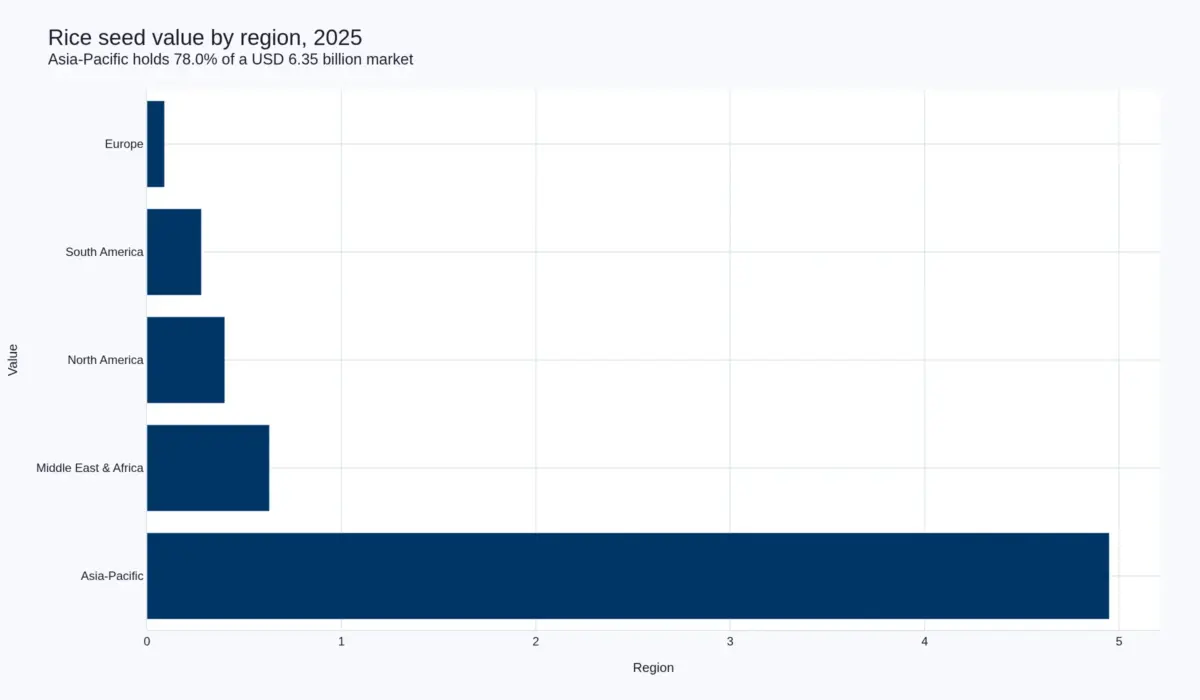
Asia-Pacific is USD 4.95 billion, or 78.0% of the world market, and grows at 5.45% — in line with the global rate rather than above it, because the two giants pull in opposite directions. China is roughly USD 2.35 billion (37.0%) and grows at 4.2%: a mature, largely purchased-seed market in which the hybrid share is shrinking, prices are administratively influenced and the national programme is investing in quality rather than in hybrid vigour. India is roughly USD 0.68 billion (10.7%) and grows at 7.4% from a hybrid base of just 6% on 43 million hectares. Those two numbers — a third of world value growing at four, and a tenth growing at seven — are the entire regional story.
Middle East & Africa is USD 0.63 billion (9.9%) and the fastest-growing region at 6.4%. Nigeria, Egypt, Madagascar and Tanzania dominate, and the mechanism is the same conversion: purchased seed, formal certification and a private dealer network replacing retained seed and informal exchange. Egypt is the outlier, with a fully formal, high-yielding and tightly managed seed system; most of the rest of the continent is a penetration story measured in single-digit percentages.
North America is USD 0.40 billion (6.3%) and grows at 3.4%. It is a small, fully commercial, fully certified market: high seed rates under drill seeding, a narrow varietal set in the southern belt and California, and no meaningful hybrid penetration in the United States. Its value is concentrated in a handful of public and private breeding programmes.
South America is USD 0.28 billion (4.4%) at 4.8%, led by Brazil and Uruguay, where irrigated rice is drill-seeded at high rates and seed is almost entirely purchased. Europe is USD 0.09 billion (1.4%) and the slowest market at 2.6%, dominated by Italian and Spanish japonica and by a regulatory environment that has effectively closed the door on gene-edited rice production for the forecast window.
Competitive landscape
| Company | Rice seed position, FY2025 |
|---|---|
| Yuan Longping High-Tech | Rice seed revenue RMB 1,974m (USD 275m), −1.69%; gross margin 39.58%, +1.98pp; group revenue RMB 8,477m; annual seed production above 200,000 tonnes; ranked seventh among world seed companies |
| Bayer CropScience | Arize hybrid rice; Indian hybrid acreage +6–8% in kharif 2025; hybrids 10–25% above varietal yield; Crop Science EUR 21,622m group-wide |
| Syngenta Group | Seeds USD 4.8bn group-wide, with rice across South and Southeast Asia; strongest in Indonesia, the Philippines and Vietnam |
| SeedWorks International | India-focused hybrid rice; kharif 2025 in line to slightly ahead outside Uttar Pradesh and Bihar; 15–20% yield advantage claimed |
| Chinese provincial tier | Hunan Jinjian, Anhui Quanyin, Jiangsu Dahu, Guangxi Hengmao; domestic hybrid and conventional breeding at provincial scale |
| Indian private tier | Nuziveedu, Kaveri, Mahyco, Rasi; hybrid rice alongside cotton, maize and vegetables |
| Public sector | IRRI and the national programmes supply the varietal base, most of the germplasm and much of the certified seed |
We estimate the five largest private suppliers hold under 15% of global rice seed value between them, against 60% for the top two in corn. There is no consolidation event waiting in this market, because there is nothing to consolidate: the germplasm is public, the customer is dispersed and the price ceiling is set by a subsidised alternative. What concentration exists is national — Longping in Chinese hybrid rice, Bayer and SeedWorks in Indian hybrids, Syngenta in Indonesian and Philippine rice — and it is defended by dealer networks and seed-production contracts rather than by patents.
The most consequential competitive question of the window is not who gains share but whether anyone can build a defensible position at all. Two routes exist. The first is seed production capacity: hybrid rice multiplication is capital-intensive, isolation-sensitive and geographically constrained, and control of multiplication land is the least contestable asset in the chain. The second is gene editing, where Japan’s consultation pathway has already cleared nine products and where a lodging-resistant, anaerobic-germination-competent, direct-seeding-adapted variety would be genuinely proprietary in a way that no conventional rice variety has been.
Strategic outlook
Price the bag against the public variety, not against a competitor. In most of Asia the alternative to a commercial bag is free seed with a known yield. That sets a hard ceiling on what a hybrid premium can be, and it is why gross margins in this market sit in the high thirties rather than the fifties. The winning proposition is not superior genetics in the abstract; it is a documented, field-level return above the public variety in the specific district where it is sold.
Follow the direct-seeding transition, not the yield race. Direct seeding is growing at 8.1% against 4.3% for transplanted rice, and it changes what a grower needs: establishment vigour, herbicide tolerance, lodging resistance and short duration. A breeder with a direct-seeding-adapted portfolio is selling into the only part of this market that is structurally expanding, and selling a different product from the one the transplanting era rewarded.
Treat seed production as the moat. Hybrid rice seed production is technically harder than maize multiplication, yields are vulnerable to flowering-time heat and typhoons, and the isolation requirements are strict. In a market where germplasm is not defensible, multiplication capacity and the grower relationships that come with it are.
Do not model China as a growth market. A 25% decline in hybrid area since 1995, a shrinking rice seed revenue line at the national champion and active policy promotion of quality over vigour together describe a market that will grow with price and mix, at four per cent, for a decade. It remains the largest single market in the world and the largest pool of breeding capability; it is not where the incremental dollars are.
Watch quality premiums as the second engine. Premium and specialty seed at 7.1% is small today at USD 0.40 billion, but it is the segment where a miller or exporter, rather than a subsistence household, sets the price. In a market with a hard ceiling on commodity seed, that is where the margin is.
What we are watching
- India’s hybrid penetration at the end of kharif 2026 — whether the 6–8% acreage gain of 2025 becomes a trend or a procurement-price artefact.
- Whether Longping’s rice seed revenue turns positive in 2026, and whether the company continues to look like a corn business with a rice heritage.
- The 2026/27 fall in world milled production to 533.08 million tonnes, and whether tighter paddy prices restore grower spending power in 2027.
- Direct-seeding adoption rates in Vietnam, Thailand and the Indian east, and the seed-rate effect of mechanised precision drilling against broadcast.
- The first commercial gene-edited rice variety outside Japan’s consultation pathway, and whether it creates enforceable IP in a crop that has never had any.
- Sub-Saharan African purchased-seed penetration, where a single percentage point of area is worth more to this market than a year of Chinese price recovery.
Conclusion
Rice seed is the largest under-monetised agricultural input market in the world. It is USD 6.35 billion growing at 5.30%, on 43 million hectares in India where hybrids hold 6% and a Chinese market where the hybrid share is falling. The forecast rests on conversion rather than on technology: commercial volume grows at 1.90% while value grows at 5.30%, and the gap is the difference between a farmer who saves seed and a farmer who buys it. The risks are equally clear — record world output, soft paddy prices, a public variety that costs nothing, and a fragmentation so complete that the largest supplier in the world holds 4.3% of the market. This is not a market that rewards a technology bet. It rewards distribution, multiplication capacity and a documented yield difference in a district where the alternative is free.
Further reading: Rice and Corn Are Sown on Almost the Same Area and Corn's Seed Market Is Nearly Four Times the Size, which derives the 19 to 47 per cent purchased-seed coverage from this report's volume series, and Hybrid Rice Is a Chinese Market in Managed Decline and That Is the Entire Forecast, on the five million hectares China has given back since 1995.
Further reading: No Commercial GM Rice Exists Anywhere, and That Is an Export Story — why China converted corn and soybean to routine commercial planting while leaving its cleared GM rice events unplanted, and what the USD 10.1 billion option on 61.6 million hectares would be worth if a government ever accepted the export risk.
Table of Contents
- Executive Summary
- Research Methodology & Scope
- Market Overview & Definitions
- 3.1 Why Rice Seed Is Priced Like a Service, Not a Technology
- 3.2 Hybrid, Certified Inbred and Public Variety: A Working Boundary
- 3.3 Segmentation Framework
- 3.4 Forecasting Assumptions (2026–2033)
- Market Dynamics
- 4.1 Market Drivers
- 4.1.1 The Conversion of Farm-Saved Seed
- 4.1.2 Labour Scarcity and Direct Seeding
- 4.1.3 Hybrid Yield Advantage Under Support Prices
- 4.1.4 Quality and Export-Grade Premiums
- 4.1.5 Climate Stress and Varietal Replacement
- 4.2 Market Restraints
- 4.2.1 Record Paddy Supply and Soft Prices
- 4.2.2 The Public Variety as a Free Substitute
- 4.2.3 Hybrid Retreat in China
- 4.3 Market Opportunities
- 4.1 Market Drivers
- 5. Global Rice Seed Market Size & Forecast (USD Million), 2026–2033
- 5.1 Market Revenue Analysis
- 5.2 CAGR Analysis
- 5.3 Demand-Supply Trends
- 5.4 Pricing Analysis
- 5.5 Investment Trends
- 5.6 Future Market Outlook
- 6. Market Segmentation Analysis (USD Million), 2026–2033
- 6.1 By Seed Class
- 6.1.1 Hybrid Rice Seed
- 6.1.2 Certified Inbred (Varietal) Seed
- 6.1.3 Premium Quality & Specialty Seed (Fastest-Growing)
- 6.2 By Establishment Method
- 6.2.1 Transplanted Paddy
- 6.2.2 Dry Direct-Seeded Rice (Fastest-Growing)
- 6.2.3 Water-Seeded, Aerobic & Mechanised Systems
- 6.3 By Distribution Channel
- 6.3.1 Dealer and Retailer Networks
- 6.3.2 Cooperatives, Government and Development Programmes
- 6.3.3 Contract, Seed Multiplication and Direct Supply
- 6.1 By Seed Class
- 7. Regional Market Analysis
- 7.1 Asia-Pacific (Largest Market)
- 7.2 Middle East & Africa (Fastest-Growing Market)
- 7.3 North America
- 7.4 South America
- 7.5 Europe
- 8. Competitive Landscape
- 8.1 Market Share Analysis
- 8.2 Competitive Benchmarking
- 8.3 Strategic Developments
- 8.4 Germplasm Depth and Breeding Pipeline
- 8.5 Seed Production Capacity and Licensing
- 9. Company Profiles
- 9.1 Yuan Longping High-Tech Agriculture
- 9.2 Bayer CropScience AG (Arize)
- 9.3 Syngenta Group
- 9.4 SeedWorks International
- 9.5 Nuziveedu Seeds
- 9.6 Kaveri Seed Company
- 9.7 Hunan Jinjian Cereals Industry
- 9.8 Anhui Quanyin and the Chinese Provincial Tier
- 9.9 Southeast Asian Seed Houses
- 9.10 IRRI and the Public Breeding System
- 10. Strategic Intelligence & Phoenix AI Insights
- 10.1 Rice Seed Demand Forecast Model
- 10.2 Hybrid Penetration Tracker by State and Country
- 10.3 Direct-Seeding Transition and Seed-Rate Model
- 10.4 Gene-Editing Pipeline and Intellectual Property Assessment
- 10.5 Automated Porter’s Five Forces Analysis
- 11. Future Outlook & Strategic Recommendations
- 11.1 Pricing Against the Public Variety
- 11.2 Building a Direct-Seeding Portfolio
- 11.3 Seed Production Capacity as the Only Moat
- 11.4 African Purchased-Seed Penetration
- 11.5 Long-Term Market Outlook (2033+)
- 12. Appendix
- 13. About Phoenix Market Research
- 14. Disclaimer
Competitive Landscape
Overview
Rice seed is the least concentrated major seed market in the world, and the concentration that exists is national rather than global. There is no company with a tier-1 position: the largest private supplier, Yuan Longping High-Tech, earned about USD 275 million from rice seed in 2025, or 4.3% of a USD 6.35 billion market. In corn, two companies hold roughly 60% of world value. The comparison is the single most important structural fact in this report, because it determines what competition in rice seed actually is.
Current Scenario
China. Longping is the anchor of the Chinese hybrid rice business, with rice seed revenue of RMB 1.974 billion at a 39.58% gross margin, a group ranked seventh among world seed companies, more than 200,000 tonnes of annual seed production and a breeding network of over sixty trial stations. Its 2025 performance describes a mature franchise: revenue down 1.69%, margin up, and group profit driven by Brazilian corn. Beneath it sits a provincial tier — Hunan Jinjian, Anhui Quanyin, Jiangsu Dahu, Guangxi Hengmao and dozens of regional breeders — which competes on local adaptation and on relationships with county-level dealers rather than on technology.
India. The Indian market is the most contested private battleground in rice. Bayer sells hybrid rice under the Arize brand and reported kharif 2025 hybrid acreage 6–8% higher year on year, with hybrids claimed at 10–25% above varietal yield. SeedWorks International reported a season in line to slightly ahead outside Uttar Pradesh and Bihar, on a 15–20% yield claim. Nuziveedu, Kaveri, Mahyco and Rasi compete in hybrids alongside their cotton, maize and vegetable portfolios. Public varieties still dominate the 43 million hectares, and hybrid penetration of roughly 6% nationally — closer to 15% in the eastern core — is the share that all of them are fighting over.
Southeast Asia. Syngenta is the strongest private presence in Indonesian, Philippine and Vietnamese rice, where government seed programmes and dealer networks overlap heavily. Domestic seed houses, state enterprises and IRRI-derived varieties set the base of the market. Thailand’s seed trade is export-quality led; Vietnam’s is moving quickly toward direct-seeded, short-duration, low-emission systems under a national programme that explicitly targets them.
The public sector as a competitor. IRRI and the national programmes are not a background institution in this market; they are the price setter. A public variety released at cost recovery constitutes the outside option for the majority of the world’s rice growers, and no private strategy in rice seed can be evaluated without reference to it.
Signals
- Longping’s rice seed revenue fell in a year when its gross margin improved and its corn business grew double digits — a classic pattern of a cash-generative but non-growing franchise.
- Bayer’s Indian hybrid acreage gain coincided with improved procurement prices, which confirms that hybrid demand is policy-elastic rather than purely agronomic.
- SeedWorks’ difficulties in Uttar Pradesh and Bihar, against gains in Jharkhand, Chhattisgarh, Madhya Pradesh, Odisha, Gujarat and Nepal, show that hybrid share is won district by district and is highly sensitive to local variety performance.
- Japan’s genome-editing consultation pathway has cleared nine products with four in domestic production — the only route to proprietary rice genetics currently visible anywhere in the world.
Strategic Implications
Competitive advantage is distributional. With under 15% of global value held by the five largest private suppliers, the winner in any given district is the supplier whose dealer has credit, agronomic advice and a variety that visibly out-yields the public alternative on the road where it is sold. Brand alone will not carry a premium in a market where the alternative is free.
Portfolio breadth matters more than scale. A rice-only company has no way to smooth the paddy price cycle. Longping’s 2025 result is the demonstration: rice seed was flat to down while Brazilian corn paid for the dividend. Expect the strongest rice seed competitors to be diversified seed businesses rather than specialists.
Watch for the first defensible IP position. Gene editing is the only technology in view that could create enforceable rights in a crop whose germplasm is largely public. A lodging-resistant, anaerobic-germination-competent, direct-seeding-adapted gene-edited variety, approved in a permissive jurisdiction, would be the first genuinely proprietary rice product in the market’s history — and the first basis for a royalty. Whoever gets there first will set a precedent for pricing across the category.
Forward Outlook
We do not expect consolidation at the global level. There is nothing to buy that confers scale: no company holds a share worth acquiring for its market position, and the germplasm that matters is public. What will happen is consolidation at the national and sub-national level — Chinese provincial breeders merging under policy pressure, Indian hybrid players absorbing smaller regional brands, and seed multiplication contracting into fewer, larger hands. By 2033 the largest private supplier might hold 6–7% of global value rather than 4.3%. That is the realistic ceiling in a market structured around a free public alternative.
Value Chain
Overview
The rice seed chain has six links, and the economics of the market are decided at the fourth. Breeding and parent-line maintenance sit at the front; commercial seed production, conditioning and certification sit in the middle; distribution and the grower sit at the back. In most seed businesses value concentrates at the front, where the genetics are owned. In rice it concentrates in the middle, because the genetics are frequently public and the multiplication is frequently the hard part.
Breeding and parent-line maintenance. Two systems operate in parallel. The public system — IRRI, the Chinese national programme, ICAR and the Indian state agricultural universities, IRAT and the West African rice centres — releases finished varieties into the public domain and supplies most of the varietal base grown in Asia and Africa. The private system develops hybrids, premium quality lines and, increasingly, direct-seeding-adapted material. A hybrid programme carries a permanent cost the varietal breeder does not: it must maintain three lines in a three-line system (a cytoplasmic male sterile A line, its maintainer B and a restorer R) or two in a two-line system, and it must keep those lines genetically pure across generations.
Commercial seed production. This is where rice differs from every other seed crop at scale. Inbred multiplication is a straightforward increase — one hectare of foundation seed produces roughly eighty to a hundred hectares of commercial crop. Hybrid seed production is an inter-planting operation: the male sterile female rows must be pollinated by restorer rows, flowering must be synchronised, and the field must be isolated from other rice flowering at the same time. Supplementary pollination is manual or mechanical, gibberellic acid is used to raise stigma exsertion and plant height, and yields swing with rainfall, wind and temperature at flowering. A good hybrid seed crop returns two to three tonnes per hectare; at a sowing rate of 15–20 kilograms per hectare, one hectare of hybrid seed production supports something on the order of 130 to 180 hectares of commercial crop. Those are our arithmetic from disclosed seed yields and rates, not a published factor, but the order of magnitude explains why hybrid seed is expensive and why capacity is scarce.
The production base is geographically narrow. Chinese hybrid rice seed is multiplied in Hunan, Jiangsu, Jiangxi, Fujian and Sichuan and, for winter generation, in Hainan. Indian hybrid rice seed is concentrated in Telangana, Andhra Pradesh, Karnataka and parts of Maharashtra and eastern India. Thai and Vietnamese production is largely domestic and seasonal. A typhoon at flowering in one of those belts removes a season’s supply of a variety and cannot be substituted from elsewhere.
Conditioning and certification. Paddy seed must be dried to a safe moisture, cleaned, graded, tested for germination and purity, treated and bagged. In rice the quality parameters are unusually demanding because sowing rates are low for hybrids and the seed is often sown into water or into soil that will be flooded — germination percentage and seedling vigour matter directly to the grower’s plant stand. Certification regimes vary: field inspection and lab testing under national law in India and most of Asia, a formal variety registration and seed licence system in China, and ISTA-certified testing for any seed that crosses a border.
Distribution. Rice seed moves through three channels that behave completely differently. Dealer and retailer networks dominate China, India and Southeast Asia, sell on credit or against a deposit, and carry agronomic advice. Cooperatives and government programmes move large volumes at subsidised prices and set the effective price ceiling for everything sold beside them. Contract and direct supply serves seed multiplication growers, large mechanised farms in the Americas and export-grade quality programmes.
Current Scenario
Yuan Longping High-Tech’s 2025 report is the most complete disclosure of rice seed chain economics available in this market. The company produced more than 200,000 tonnes of seed across rice and corn, earned RMB 1.974 billion from rice seed at a 39.58% gross margin, and ran three multiplication models side by side: a contracted model in which agents and large growers carry the production risk for a fixed price, a self-managed model with village and farm organisations where weather risk sits with farmers and technical error sits with the company, and a smaller self-operated base model where the company carries everything. That three-way split is a precise statement of where the risk in this chain actually lives.
The pressures at each link are now visible. At the front, public breeding continues to release varieties that match hybrid yields in favourable environments, which compresses what a private programme can charge. In the middle, seed production costs are rising with rural wages in exactly the countries where multiplication is concentrated. At the back, record paddy output — 545.65 million tonnes milled worldwide in 2025/26, with India at a record 154.02 million tonnes and holding 59 million tonnes of stocks — has weakened the paddy price and therefore the grower’s willingness to pay a premium.
Signals
- Longping’s rice seed gross margin rose 1.98 percentage points to 39.58% while revenue fell 1.69%, which indicates cost discipline and mix improvement rather than pricing power.
- Group net profit rose 45.63% on a Brazilian corn business that grew 16.51%, confirming that capital in the world’s leading rice seed company is currently being allocated away from rice.
- IRRI’s mechanised dry direct-seeding pilot cut seed rates by about 25% against broadcast and raised yields 15–20%, which changes the specification the chain must deliver: fewer kilograms, higher vigour.
- Bayer’s India management reported hybrid acreage up 6–8% in kharif 2025 on better procurement prices — evidence that the chain expands or contracts with the support price, not with the breeding calendar.
Strategic Implications
Own the multiplication, not the catalogue. Where germplasm cannot be defended, the defensible assets are isolation-grade multiplication land, drying and conditioning capacity near the production belt, and the grower relationships that secure both. These are unglamorous and slow to replicate, which is precisely why they are worth owning.
Design the chain for lower sowing rates. The direction of travel in establishment is toward precision drilling at 20 kilograms per hectare or below. That rewards seed with high germination, uniform grading and strong early vigour, and it penalises cheap seed sold on weight. A conditioning line that cannot deliver a tight, high-vigour lot will lose the direct-seeding segment even with good genetics.
Treat the government channel as a price setter, not a competitor. Subsidised seed programmes move volume but they anchor the reference price. A commercial supplier should plan to sit a defined premium above the programme variety and to justify it with a documented yield difference in the district, because that is the only argument a grower buying against a free alternative will accept.
Forward Outlook
By 2033 the chain will look more industrial at the front and more concentrated in the middle. Hybrid seed production will consolidate around fewer, larger multiplication contractors as purity and traceability requirements tighten; conditioning will move closer to the production belt as seed quality specifications rise with direct seeding; and distribution will digitise at the retailer level in India and Southeast Asia, which is the first point at which a supplier can see real sell-through rather than warehouse replenishment. The value pool will not shift dramatically — the chain is not going to be re-intermediated the way some input markets have been — but the penalty for owning the wrong assets will widen, because a market growing at 5.30% with a 4.3% leader has no room for a participant whose only advantage is a variety catalogue.
Investment Activity
Overview
Investment in rice seed is small relative to the size of the crop and unusually concentrated in one company. Rice is grown on a large share of the world’s arable land and feeds more people than any other grain, but it attracts a fraction of the venture, corporate and private equity capital that flows into corn, soybean and, more recently, gene editing platforms in row crops. The reason is the one that runs through this report: the germplasm is largely public, the price is capped by a subsidised alternative, and intellectual property is weak.
Current Scenario
The Longping complex is the centre of gravity. In 2025 the company completed a RMB 1.2 billion private placement to its controlling shareholder CITIC Agriculture, which lifted CITIC’s stake from 17.36% to 25.93% and reduced the debt ratio to 59.50%. It simultaneously brought external capital into its corn subsidiary, with Lianchuang Seeds raising RMB 1 billion from a group of state-linked investors including CITIC Financial Asset Management, the Modern Seed Industry Development Fund and Agricultural Bank of China’s investment arm. It spent RMB 763 million on research and development, equal to 9.00% of revenue and up 10.18%, and it divested non-core assets: a 25.38% stake in Huazhi Biotech for RMB 146.98 million, and 34% of its vegetable seed subsidiary Derit to Mitsui for RMB 489.6 million.
Read together, those transactions describe a company reallocating capital toward corn and away from rice, while being recapitalised by the state to do it. Rice seed was not the recipient of new money in 2025; it was the stable cash generator that made the corn expansion financeable.
Corporate investment elsewhere is thin. Bayer and Syngenta fund rice breeding and hybrid development inside broader seed budgets and do not disclose rice-specific figures. Their rice investment is opportunistic: it follows hybrid conversion in India and government programmes in Southeast Asia rather than a global rice strategy. Indian hybrid seed companies — Nuziveedu, Kaveri, Mahyco, Rasi and SeedWorks — invest in breeding and in dealer networks at a scale that is significant nationally and small globally.
Public money does the heavy lifting. IRRI, the Chinese national programme, ICAR and the state agricultural universities, and the West African rice centres are the largest investors in rice genetics by a wide margin. Their output is released publicly, which is excellent for growers and structurally deflationary for private seed value. Any assessment of investment attractiveness in this market has to start from the fact that the main competitor is funded by donors and governments.
Where new capital is going. Three areas are attracting money. Direct-seeding-adapted germplasm and seed technology — priming, pelleting, coating and establishment traits — because it serves the fastest-growing segment. Quality and aroma breeding for export markets, where premiums are contractual. And gene editing platforms, where investor interest is high and commercial rice products remain almost entirely absent outside Japan’s consultation pathway.
Signals
- Longping’s R&D intensity of 9.00% of revenue is high for a seed business and would be higher still if measured against rice alone, since a large part of the spend now serves corn.
- The RMB 1 billion external raise at Lianchuang valued a corn business at a scale no rice seed asset in the world could currently attract.
- Divestment of the Huazhi Biotech and Derit stakes — a molecular technology platform and a vegetable seed unit — shows a company narrowing to two crops rather than broadening.
- State-linked capital, not private capital, is funding the largest single investment in the sector, which tells you what the private market thinks of seed as an asset class in China.
Strategic Implications
Do not underwrite rice seed as a technology investment. The returns in this market come from distribution, multiplication capacity and working capital management, not from a breeding pipeline that can be protected. An investor applying row-crop logic — fund the pipeline, capture the royalty — will fund the wrong thing and wait too long for a return.
Consolidation is the most likely use of capital. With under 15% of the market held by the five largest private suppliers, the cheapest route to growth is acquiring regional seed businesses with a dealer network and a multiplication base, not building a breeding programme. Expect Chinese provincial consolidation under policy pressure, Indian hybrid roll-ups, and opportunistic acquisitions in Southeast Asia.
Gene editing is where a genuine venture case exists. It is the only route to a defensible rice product, and the first approved edited variety in a large market will command a licence value that no conventional variety can. It is also a binary regulatory bet, which is why it should be financed as an option rather than as a plan.
Forward Outlook
Investment through the forecast window will be steady and unspectacular. We expect R&D intensity across the leading private suppliers to hold in the 6–9% range, capital to continue moving toward corn and toward gene editing platforms, and the number of meaningful rice-specific transactions to remain in single digits per year. The one scenario that changes this is Chinese commercial release of genetically modified rice, which would justify a step change in investment across the entire Asian seed chain within a single season. On the current policy record it does not arrive before 2033.
Technology & Innovation
Overview
Rice breeding is technically mature and commercially under-rewarded. The yield frontier has moved slowly for two decades, the major disease and stress tolerances are widely available in public germplasm, and the traits that would justify a premium are increasingly about how rice is established and harvested rather than how much grain it makes. The innovation that matters in this market is not a bigger yield gene; it is a package that lets a grower stop transplanting.
Current Scenario
Hybrid technology has plateaued on yield and is being re-engineered for establishment. Three-line hybrid systems dominate commercial production, with two-line systems — using thermo- or photoperiod-sensitive genic male sterility — offering wider parent choice at the cost of environmental sensitivity during seed production. The heterotic gain over modern inbreds has narrowed to roughly 10–25% depending on environment, which is why the hybrid value proposition now leans on stress tolerance, uniformity, shorter duration and establishment vigour as much as on yield. Bayer’s Indian claim of 10–25% over varietal rice and SeedWorks’ 15–20% both describe an advantage that is real but not large enough to carry a premium without local evidence.
Direct seeding is the innovation frontier. A dry direct-seeded field has different requirements from a transplanted one: the seed germinates in soil rather than in a nursery, so anaerobic germination tolerance and rapid early root growth become decisive; weeds compete from day one, so herbicide-tolerant systems and competitive canopy architecture matter; and heavier seeding at depth requires stronger coleoptile growth. Lodging resistance and short duration complete the package. IRRI’s mechanised dry direct-seeding pilot in Vietnam, which cut seed rates 25% against broadcast while raising yields 15–20% and cutting water use above 20%, is the clearest demonstration that the gain comes from the system and not from a single gene.
Genomic tools are used, but they are not differentiating. Marker-assisted selection for blast resistance, bacterial blight resistance, submergence tolerance and fragrance is routine in public and private programmes, and genomic selection is being adopted in the larger Chinese and Indian programmes. These tools raise the rate of genetic gain, but because they are available to public breeders as well as private ones they do not create a defensible position.
Gene editing is the one genuinely disruptive technology in view. The targets are well understood and commercially meaningful: semi-dwarf and lodging architecture, anaerobic germination, herbicide tolerance for direct seeding, blast susceptibility genes, cadmium accumulation and grain quality. Longping’s 2025 report notes breeding work on low-cadmium accumulation, pest and disease resistance and premium quality grain, which describes the direction of travel even where the technique is conventional. Japan’s regulatory pathway has cleared nine genome-edited products with four in domestic production, and that is where the first commercial edited rice is most likely to appear.
Seed technology is underused. Priming, coating, pelleting and film treatment can improve establishment in direct-seeded systems substantially, and they are standard in vegetable and maize seed but far from standard in rice. As sowing rates fall under precision drilling, the value of a uniform, high-vigour, treated lot rises sharply against the cost of the treatment — which makes seed technology one of the few immediately available margin levers in this market.
Signals
- The yield advantage claimed for hybrids, at 10–25%, is now smaller than the establishment advantage available from direct seeding, which changes what a breeding programme should optimise.
- IRRI’s pilot measured seed-rate reduction and water savings alongside yield, which is the first time an establishment technology has been specified in seed terms.
- Japan’s nine cleared genome-edited products give the technology a regulatory precedent without a commercial rice product, meaning the science is ahead of the market.
- The near-absence of commercial seed treatment in rice, relative to maize and vegetables, is a visible gap in a market growing at 5.30%.
Strategic Implications
Breed for the system, not for the yield trial. A variety that wins a yield trial under transplanted management and lodges under direct seeding is a commercial failure in the segment that is growing at 8.1%. Programme objectives should be written in establishment terms — emergence under anaerobic conditions, days to canopy closure, lodging score at high nitrogen, herbicide tolerance.
Treat seed technology as product, not packaging. In a market with a hard price ceiling and high substitution risk, a treatment or priming step that reliably improves stand establishment is one of the few defensible increments a supplier can charge for, and it is far cheaper to develop than a new hybrid.
Position for editing, but do not build a base case on it. Gene editing will eventually produce a proprietary rice variety. Until a major market operates a working pathway and a product clears it, the technology should sit outside the forecast and inside the strategic plan.
Forward Outlook
By 2033 the winning technology package will look mundane: a short-duration, lodging-resistant hybrid or improved inbred with anaerobic germination tolerance, herbicide tolerance, blast resistance and a treated, high-vigour seed lot, sold with an agronomy service for direct seeding. The genuinely novel technology — edited rice with a proprietary trait — will exist in at least one market and will not yet have changed the global structure of the industry. The risk to this outlook is not that the technology fails; it is that public breeding delivers the same package for free, which is precisely what has happened to every previous generation of rice innovation.
Market Risk
Overview
Rice seed carries an unusual risk profile: low technology risk, high policy and substitution risk, and a biological production risk that is concentrated in a small number of geographic belts. The market is unlikely to be disrupted by a technology it fails to adopt; it is quite capable of being compressed by a procurement decision made in New Delhi, Beijing or Jakarta.
Current Scenario
Price and procurement policy is the dominant risk. Paddy support prices set grower incomes in India, a minimum purchase price regime operates in China, and procurement and subsidy programmes dominate Indonesia, the Philippines and much of West Africa. Where the support price rises, hybrid adoption and seed spend rise with it — as in Indian kharif 2025, when hybrid acreage gained 6–8%. Where it falls or is held flat, the seed premium is the first line item a grower cuts, because farm-saved seed is always available at zero marginal cost.
Soft paddy markets. World milled production reached a record 545.65 million tonnes in 2025/26, with India producing a record 154.02 million tonnes and holding 59 million tonnes of ending stocks. That is a supply overhang that depresses prices through the first years of the forecast and is the reason we model only 4.3% growth in 2026. The offset is that USDA forecasts 2026/27 world output 2.3% lower at 533.08 million tonnes, which should tighten the market into 2027.
Substitution by farm-saved and public seed. This is the structural risk that never goes away. Roughly two-thirds of world rice area is sown with seed that never enters a commercial channel, and a public variety is available at cost recovery in most producing countries. Any price increase that a grower judges disproportionate to the yield difference is met with a reversion to saved seed within one season. We score substitution risk as high, and it is the main reason gross margins in this market sit in the high thirties rather than the fifties.
Biological and production risk. Hybrid seed production is an inter-planted, flowering-synchronised operation that depends on wind, temperature and rainfall at a specific moment. A typhoon or a heat event at flowering in Hunan, Jiangsu, Telangana or Andhra Pradesh can remove a large share of a season’s supply of a variety, and supply cannot be recovered from another region because the multiplication windows are seasonal. Cytoplasmic male sterility systems also carry a systemic risk: a pathogen or temperature event that affects the sterile line affects every hybrid built on it.
Counterfeit and low-quality seed. In markets where certification is weak — parts of South Asia, much of Sub-Saharan Africa — counterfeit and mislabelled seed is a persistent problem that damages both grower trust and the legitimate premium. It is also a risk that scales with price: the more expensive hybrid seed becomes relative to grain, the stronger the incentive to adulterate it.
Regulatory and trade risk. Variety registration requirements, phytosanitary rules and import restrictions on unregistered varieties limit cross-border expansion. Biosafety decisions — on GM rice in China, on gene-edited rice in the Philippines and elsewhere — can open or close whole markets. India’s use of export restrictions on rice in 2023–24 demonstrated how quickly trade policy can move the paddy price and, with it, seed demand.
Signals
- Record Indian stocks of 59 million tonnes are a direct threat to the paddy price through 2026 and therefore to seed affordability in the market with the largest conversion pool.
- The 6–8% hybrid acreage gain in Indian kharif 2025 tracked improved procurement prices, confirming policy elasticity rather than a secular shift in grower preference.
- Longping’s 1.69% revenue decline in a year of record Chinese rice output is the clearest available evidence that volume risk in this market is real and already materialising.
- Japan’s nine cleared genome-edited products contrast with the absence of any commercial GM rice anywhere, which shows that regulatory risk in rice is concentrated in one technology rather than spread across all of them.
Strategic Implications
Manage this market as a policy exposure. A rice seed business should model support-price scenarios as its primary demand driver, not variety adoption curves. In practical terms that means holding less inventory through a support-price review, hedging the geographic mix toward markets with rising procurement prices, and treating the year after a record harvest as a demand risk rather than a supply opportunity.
Diversify away from single-origin seed production. The concentration of hybrid seed multiplication in a handful of belts is the one operational risk that can eliminate a season outright. Contracting across two or three production geographies, and holding buffer stock of parental lines, is expensive and rational in equal measure.
Price defensively against substitution. The correct response to high substitution risk is not to discount but to document. A supplier that can show a measured yield and income difference against the local public variety in the district where it sells is protected against reversion; one that sells on brand and a national average claim is not.
Forward Outlook
The risk profile improves modestly through the window. Tightening world supply into 2027 restores the paddy price, the Indian hybrid conversion continues from a 6% base, and direct seeding raises seed rate per hectare. Against that, substitution risk does not fall, Chinese hybrid area continues to shrink, and the possibility of a sharp regulatory shock — a GM rice release in China, or an adverse biosafety ruling in an Asian market — remains live throughout. We assess overall market risk as moderate, with geopolitical exposure moderate and substitution risk high, and we would move the overall assessment to high if Indian support prices were held flat for two consecutive seasons while world stocks stayed above 55 million tonnes.
Regulatory Landscape
Overview
Rice seed is regulated at three separate layers, and the layers are not coordinated across countries. Variety registration and seed certification decide whether a variety can be sold and by whom. Biosafety law decides whether a genetically modified or gene-edited rice can be grown at all. Price and procurement policy decides what the grower can afford, which in practice regulates the seed price more tightly than any seed law. In rice the third layer is often the binding one.
Current Scenario
India. Seed is governed by the Seeds Act 1966 and the Seeds (Control) Order 1983, with variety notification through the Central Variety Release Committee and state-level release for some crops. A comprehensive Seeds Bill has been drafted repeatedly and has not passed; in its absence, the practical regulator of value is procurement. Minimum support prices for paddy anchor grower incomes, and the precedent of direct price control on Bt cotton seed technology fees shows that the state is willing to cap seed pricing when it judges the technology to be essential. Hybrid rice has so far avoided that treatment, but the exposure is real: Indian hybrid penetration is a policy variable, not a market one.
China. The revised Seed Law, effective in 2022, tightened variety registration, introduced an essentially derived variety regime and raised penalties for infringement, in a deliberate attempt to move a highly fragmented breeding sector toward something closer to a proprietary model. Rice remains subject to national and provincial variety approval, and hybrid seed production is licensed. Genetically modified rice has held biosafety certificates without commercial release for many years; the commercialisation pathway that has opened for corn and soybean has not been extended to rice, which is the single most consequential unresolved regulatory question in this market.
Japan. Japan has established a notification and consultation pathway for genome-edited food and agricultural products, under which nine products have completed consultation and four are in domestic production and distribution, on USDA Foreign Agricultural Service reporting from December 2025. This is the most permissive operating regime for edited crops anywhere in Asia and the template that other jurisdictions are watching.
Southeast Asia. The Philippines was the first country to approve Golden Rice for commercial propagation and has since been through prolonged legal challenge over biosafety permits; the practical lesson for any participant is that approval and acceptance are different hurdles. Indonesia, Vietnam and Thailand operate conventional varietal release systems with national certification, and Vietnam’s policy framework now explicitly supports low-emission, direct-seeded rice, which is a regulatory tailwind for seed with establishment traits.
Europe. Regulation (EU) 2026/1388, adopted on 17 June 2026 and in force from 16 July 2026, applies from 17 July 2028 and creates a separate pathway for plants obtained by certain new genomic techniques. It matters little to rice directly — European rice area is small and japonica-focused — but it establishes the precedent that edited crops can be separated from genetically modified ones in the world’s most restrictive market.
Certification and trade. Any seed crossing a border requires ISTA testing and phytosanitary certification, and most countries restrict imports to registered varieties. That is a significant constraint on the one strategy that would otherwise be obvious in a fragmented market: exporting a winning hybrid from India or the Philippines into a neighbouring country at scale.
Signals
- China’s Seed Law revision has not been followed by commercial GM rice release, which implies the bottleneck is food-security politics rather than the regulatory machinery.
- Japan’s nine cleared genome-edited products are the first evidence that an Asian regulator will separate editing from genetic modification in practice.
- India’s willingness to cap Bt cotton technology fees is the precedent that constrains hybrid rice pricing headroom, even though it has not been applied.
- Vietnam’s policy support for low-emission direct seeding links an environmental regulation to a seed specification for the first time in the region.
Strategic Implications
Regulatory strategy is market-entry strategy. In rice, the difference between a variety that can be sold in one Indian state and the same variety in a neighbouring country is a registration file, not a breeding achievement. Companies that build regulatory capability across multiple jurisdictions will convert genetics into revenue faster than companies that breed better and register slowly.
Gene editing is a commercial decision before it is a technical one. The technology exists; the question is which jurisdiction to launch in. Japan is the permissive test case, the Philippines has demonstrated both the possibility and the fragility of approval, and India has no dedicated pathway. A company planning an edited rice launch should plan a country sequence, not a product launch.
The GM rice question should be modelled as an option, not a base case. Chinese commercialisation of insect-resistant or herbicide-tolerant rice would be transformative for seed value per hectare, but it has been one policy decision away for more than fifteen years. Our base case assumes no commercial GM rice in China through 2033.
Forward Outlook
By 2033 the most likely regulatory landscape is a widening gap between jurisdictions. China and India will continue to regulate rice seed primarily through variety approval, certification and price policy rather than through biotechnology. Japan, the Philippines and possibly one or two other Asian markets will operate functioning gene-editing pathways with real commercial products. Africa will remain split between early adopters with functioning biosafety law and markets with no enforceable framework, which is where seed quality problems are worst. The regulatory variable that would move this market most is not any seed law: it is a decision to allow GM rice in China, and nothing in the current policy record suggests it arrives before the end of the forecast window.