
Global Autonomous Airside Vehicles & Driverless Ground Support Equipment Market Report, Size, Share and Forecast 2026–2033: Two Driverless Tractors at Changi Today, Twenty-Four by 2027 — and a Federal Bulletin That Leaves the Driver in the Vehicle
The market in one paragraph
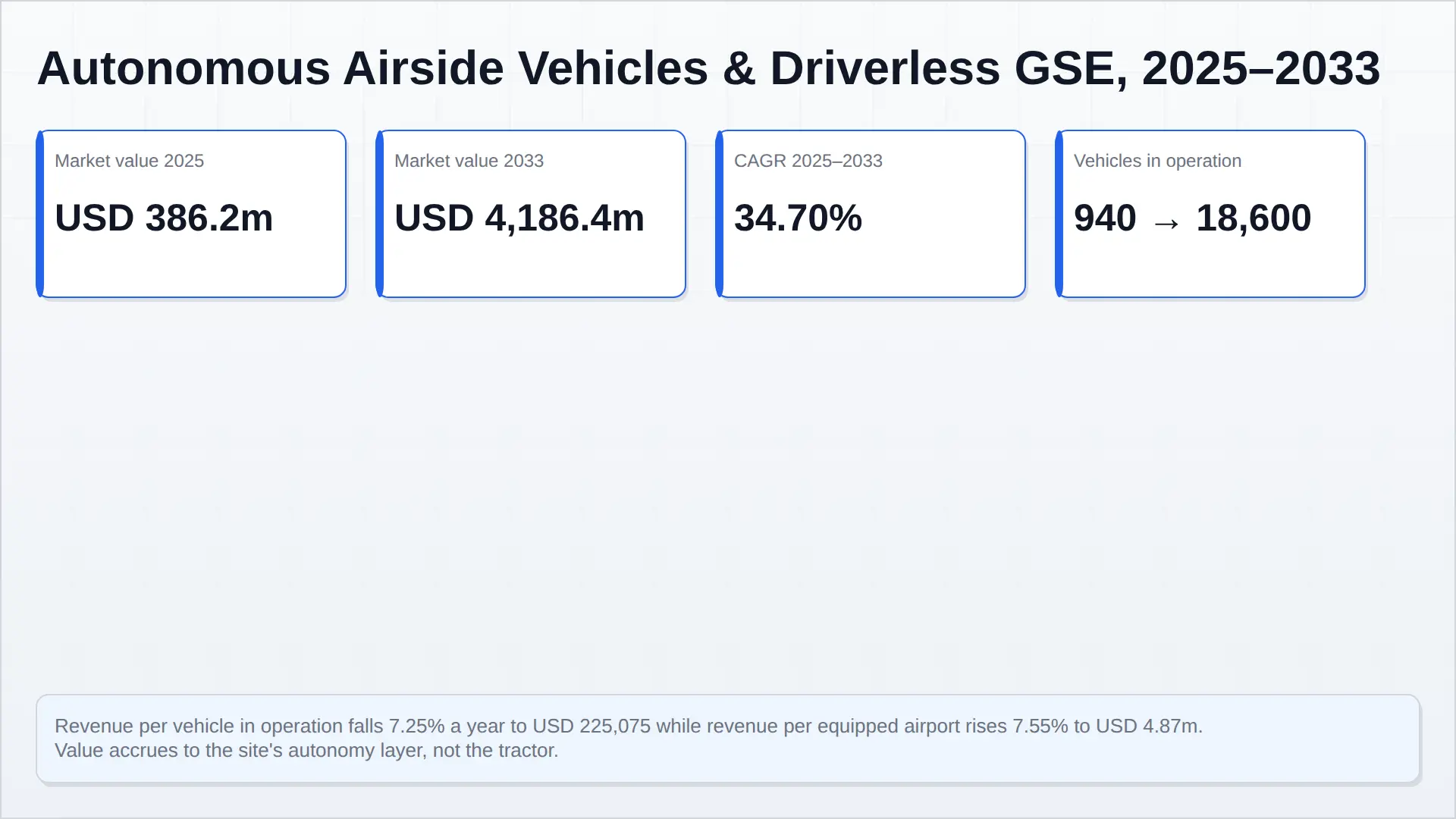
Airports spent USD 386.2 million in 2025 on vehicles that drive themselves on the apron and on the systems that make that legal, observable and insurable. We expect that to reach USD 4,186.4 million by 2033, a compound annual growth rate of 34.70%. Over the same period the installed fleet of autonomous airside vehicles grows from 940 units to 18,600 (45.23% a year) across 142 airports in 2025 rising to 860 (25.25%). Those two series do not move together, and the gap between them is the most useful thing in this report: revenue per vehicle in operation falls from USD 410,851 to USD 225,075 (−7.25% a year) while revenue per equipped airport rises from USD 2.72 million to USD 4.87 million (7.55%). The average site carries 6.62 vehicles in 2025 and 21.63 in 2033. Autonomy gets cheaper per machine and more valuable per airport, and any supplier whose business model is priced per unit is on the wrong side of that arithmetic.
What this report counts, and what it deliberately does not
The value base is airside only: autonomous and remote-supervised vehicles working inside the airport boundary — baggage and cargo tractors, dolly trains, robotic unit load device (ULD) movers, autonomous passenger coaches, robotic de-icing rigs, automated passenger boarding bridge docking, and the smaller fleet of mowers, sweepers, foreign object debris collectors and perimeter patrol robots that airports buy as vehicles. Four revenue streams are counted: autonomous vehicles and retrofit autonomy kits; site infrastructure, positioning and integration; software, fleet orchestration and remote supervision; and managed autonomy operations and maintenance. Landside people movers, road vehicles in the public sense, aircraft-side modifications such as onboard electric taxi systems, and conventional manually driven ground support equipment are excluded even where they share a chassis with something in scope.
Table 1 — Value, fleet and unit economics
| Measure | 2025 | 2033 | CAGR |
|---|---|---|---|
| Market value (USD m) | 386.2 | 4,186.4 | 34.70% |
| Autonomous airside vehicles in operation (units) | 940 | 18,600 | 45.23% |
| Airports with autonomous vehicles in service | 142 | 860 | 25.25% |
| Vehicles per equipped airport | 6.62 | 21.63 | 15.95% |
| Revenue per equipped airport (USD m) | 2.72 | 4.87 | 7.55% |
| Revenue per vehicle in operation (USD) | 410,851 | 225,075 | −7.25% |
Revenue per vehicle is not a vehicle price. It is the whole annual programme — amortised hardware, shared site infrastructure, subscription, supervision and services — divided by the fleet that programme supports. It falls because a site's fixed autonomy cost is spread over 3.3 times more machines by 2033, and because the hardware itself gets cheaper. That is the mechanism by which this market becomes ordinary infrastructure rather than a demonstration.
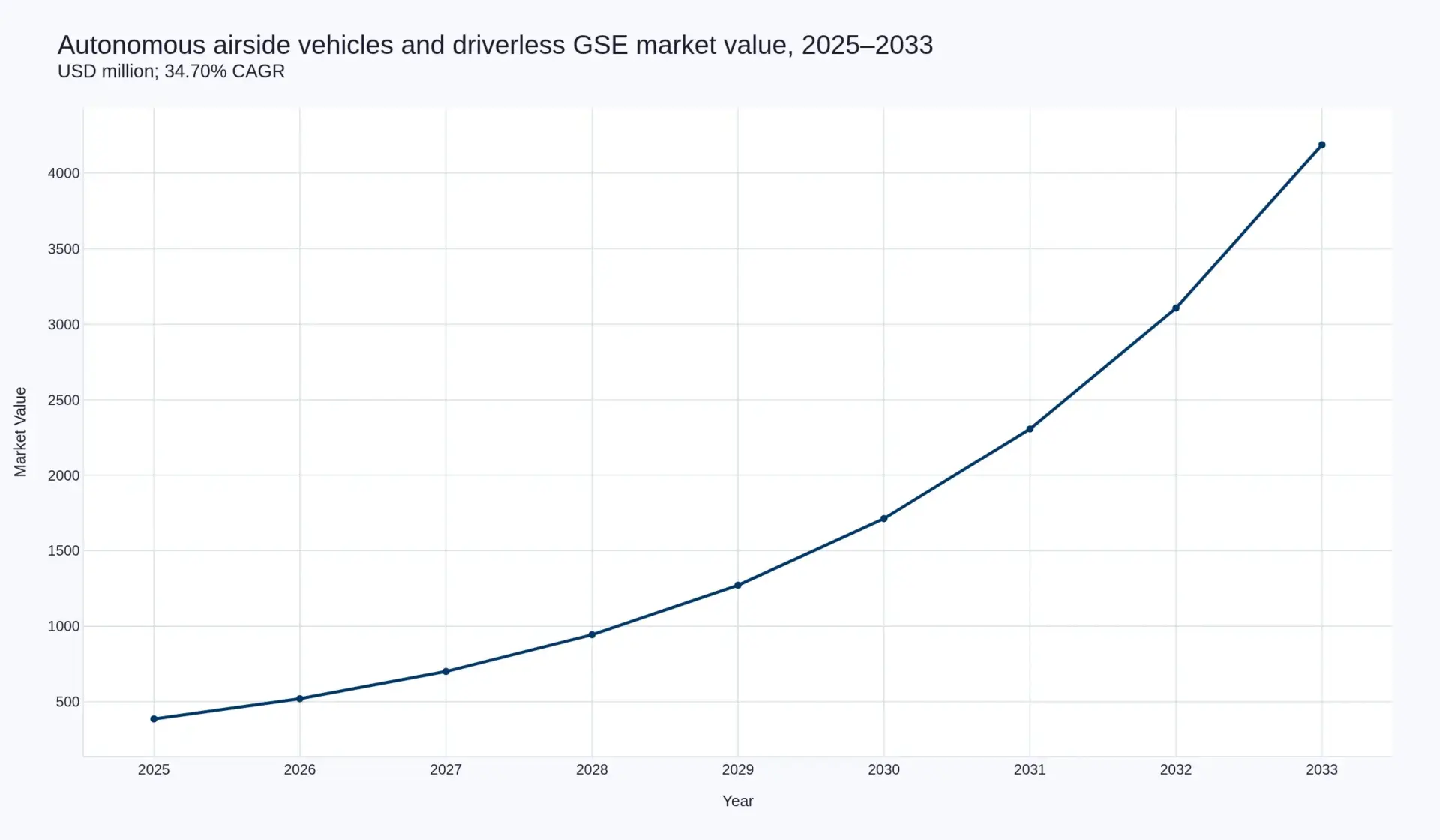
Table 2 — Four revenue streams (USD m)
| Stream | 2025 | 2033 | Share 2025 | Share 2033 | CAGR |
|---|---|---|---|---|---|
| Autonomous vehicles and retrofit autonomy kits | 162.4 | 1,742.6 | 42.05% | 41.63% | 34.53% |
| Site infrastructure, positioning and integration | 104.6 | 486.4 | 27.08% | 11.62% | 21.18% |
| Software, orchestration and remote supervision | 63.2 | 1,196.5 | 16.36% | 28.58% | 44.43% |
| Managed autonomy operations and maintenance | 56.0 | 760.9 | 14.50% | 18.18% | 38.56% |
| Total | 386.2 | 4,186.4 | 100% | 100% | 34.70% |
The composition moves harder than the total. Site infrastructure — the painted autonomy zones, the reference positioning, the sensor masts, the network — falls from 27.08% to 11.62% of the market because the second and third site in a region reuse what the first one proved. Software and remote supervision nearly doubles its share, from 16.36% to 28.58%. In plain terms: the first generation of this business was a construction project with robots attached, and the second generation is a control room with a subscription attached.
Two asymmetries that set the growth rate
The regulator, not the robot. Every vehicle in commercial service in 2025 is doing work a person used to do, at walking pace, inside a geofence, with a supervision layer watching it. What differs between countries is not capability but the legal status of the driver. Singapore's Changi Airport Group put two driverless baggage tractors into service on 20 January 2026 after roughly a year of testing and 5,000-plus trial runs; it plans six more during 2026 and twenty-four by 2027. Japan's regulator installed shared infrastructure — signalling equipment and cameras — so that Level 4 towing could operate at Haneda, and JAL Group and Toyota Industries announced in October 2026 that they would trial an expansion of those routes. dnata worked with Dubai Airports and the UAE General Civil Aviation Authority to build a framework that did not previously exist, then put six autonomous tractors to work at Dubai World Central. In the United States, the FAA's Emerging Entrants Bulletin 25-02 states that autonomous ground vehicle systems should be used only for testing and demonstration in non-movement areas and certain remote and landside areas; that around moving aircraft a human monitor should be physically located in or near the vehicle; and that such systems cannot be a sole means of compliance with federal regulations. A driverless vehicle in America is, in the regulator's own language, a test article with a passenger in it.
The labour bill. In the United States the median annual wage for aircraft service attendants — the occupation that pushes baggage carts and loads ULDs — was USD 41,540 across 27,310 jobs in May 2024, on BLS data. That is roughly USD 20 an hour for a role that runs nights, weekends and in all weather, in a labour market that has been short of ramp staff since 2022. It is also the number that decides whether a USD 266,667 vehicle pays back: against a single shift it does not, and against three shifts on a constrained stand it can.
Where the money actually is
IATA's Airport Handling Manual for 2027, released in September 2026, carries advanced provisions for autonomous GSE activities near aircraft — the first time the industry's operating manual has had to describe what a driverless vehicle may do in the presence of a live turnaround. IATA reports autonomy trials in more than fifteen countries and estimates ground damage at about USD 5 billion a year, potentially doubling to USD 10 billion by 2035, with up to 40% of aircraft ground damage arising from GSE operations. Those numbers matter more than any efficiency claim, because they are the side of the ledger where autonomy is not competing with a wage but with an insurance claim.
How to read what follows
Chapter one establishes what is genuinely driverless today and what is marketing. Chapter two follows the chain from the handler's purchase order to the airport's permit. Chapter three does the unit economics with published contract values rather than assumptions. Chapter four measures the supplier pool — and finds that the entire autonomous aviation revenue of the most visible listed pure-play was £2.6 million in its last financial year. Chapter five maps five regulatory regimes and identifies the single clause that decides where value can be earned. Chapter six states what would have to be true for the forecast to hold, and which of its inputs would break it first.
Sources and primary documents
- FAA, Part 139 CertAlert 24-02, Autonomous Ground Vehicle Systems (AGVS) Technology on Airports, 15 February 2024.
- FAA, Emerging Entrants Bulletin 25-02, Autonomous Ground Vehicle Systems, 21 May 2025 (testing-only allowance, instantaneous-control and human-monitor requirements, no sole means of compliance).
- FAA, Advisory Circular 150/5210-20A, Ground Vehicle Operations on Airports, 1 September 2015 (movement-area permit, training and radio requirements premised on a human operator).
- US Department of Transportation and FAA, State-of-Technology Review: Autonomous Ground Vehicle Systems in Airport Environments, 2026.
- EASA, Explanatory Note to ED Decisions 2025/006/R, 2025/007/R, 2025/008/R and 2025/009/R — AMC and guidance material under Delegated Regulation (EU) 2025/20, Implementing Regulation (EU) 2025/23 and Delegated Regulation (EU) 2025/21, 7 July 2025.
- EASA, NPA 2026-01(D), amending CS-ADR-DSN so that apron design criteria take account of new technologies including autonomous vehicles, 2026.
- ICAO, State Letter 25/23, Amendment 18 to Annex 14, Volume I, 2025.
- Changi Airport Group, Changi Airport rolls out autonomous tractors in major step towards airside automation, 20 January 2026.
- UISEE, Singapore Changi Airport Partners with UISEE to Launch First Fully Autonomous Tractor Fleet, 28 January 2026 (Terminal 1 to Terminal 4 baggage transfer, ISO 21434, ISO 27001, TR68 compliance, more than 20,000 km accident-free).
- dnata, dnata rolls out autonomous vehicles in airport operations, 15 July 2025 (six EZTow tractors, Level 3, Dubai World Central, regulatory framework developed with Dubai Airports and the UAE GCAA).
- Aurrigo, Aurrigo to introduce four new autonomous baggage handling vehicles at Changi Airport, 14 May 2024.
- Aurrigo International plc, Full Year Results and Notice of AGM, 4 June 2026 (FY2025 revenue, autonomous division revenue, adjusted EBITDA loss, net cash, largest autonomous vehicle order, hub strategy, Swissport and Schiphol partnerships).
- IATA, IATA Releases 2027 Cargo and Ground Operations Manuals, 7 September 2026 (advanced provisions for autonomous GSE activities near aircraft; autonomy trials in more than 15 countries).
- IATA, Enhanced GSE Recognition Program (ground damage cost, GSE exposure, and the expected damage reduction from fleet conversion).
- JAL Group, JAL and Toyota Industries to Begin Trials to Expand Level 4 Autonomous Towing Routes at Haneda Airport, 30 October 2026.
- Fraport Ground Services, Innovations for Enhanced Performance (autonomous driving tests for freight and baggage, trailer fleet scale, Terminal 3 baggage logistics).
- ICF, Evaluating GSE pooling for success in airport ground handling operations, 2026 (global ground support equipment fleet of about 500,000 units).
- US Bureau of Labor Statistics, Occupational Employment and Wage Statistics, May 2024, SOC 53-6032 Aircraft Service Attendants.
- ISO 3691-4:2023, Industrial trucks — Safety requirements and verification — Part 4: Driverless industrial trucks and their systems; ANSI/ITSDF B56.5-2019, Safety Standard for Driverless, Automatic Guided Industrial Vehicles. These are the machinery standards the vehicles are built to, because no airside vehicle type approval exists in any jurisdiction.
- Pheonix Research bottom-up model and contract benchmarking (the site and fleet series, four-stream decomposition, per-vehicle and per-site arithmetic, including the conversion of the dnata AED 6 million programme at the pegged rate of 3.6725).
Note on the primary research layer. No interviews, surveys or conference fieldwork were conducted for this edition. The 70/30 split stated in the methodology is 70% primary documents of the kind listed above and 30% Pheonix's own modelling and contract benchmarking. Where a figure could not be traced to a primary document it is labelled as an estimate or omitted rather than filled.
Measurement note. No aviation authority publishes a count of autonomous airside vehicles in service. The 2025 figures of 940 vehicles at 142 airports are a construction from disclosed deployments, supplier delivery records and airport announcements, and they are the forecast's most fragile input. The dnata programme figure is converted from dirhams at the pegged rate; the Aurrigo contract value is in sterling and is not converted.
Table of Contents
| Section | What it answers | Length |
|---|---|---|
| Market overview and sizing | Value, fleet, site count, four revenue streams, and why value per vehicle falls while value per airport rises | 1,400 words |
| Chapter 1 — What is actually driverless on an apron today | The vehicle classes in service, the technology stack, and the difference between autonomy, teleoperation and automation | 1,000–1,200 words |
| Chapter 2 — The value chain: who buys, who permits, who carries the liability | Handler, airline, airport and supplier roles; where the purchase order and the permit sit | 1,000–1,200 words |
| Chapter 3 — Unit economics | Cost per deployed vehicle from published contract values; payback against ramp labour and ground damage | 1,000–1,200 words |
| Chapter 4 — Competition | The supplier pool, the size of the revenue actually booked, consolidation and price pressure | 1,000–1,200 words |
| Chapter 5 — Regulation | Five regimes — United States, European Union, Singapore, Japan, UAE — and the clause that decides the market | 1,000–1,200 words |
| Chapter 6 — Measurement risk | What has to be true by 2033, which input breaks first, and how to falsify the forecast | 1,000–1,200 words |
Competitive Landscape
Chapter 4 — Competition: a market smaller than one baggage system
The competitive landscape of autonomous airside vehicles has an unusual feature: the leading listed pure-play booked GBP 2.6 million of autonomous revenue in its most recent financial year. That is smaller than the value of a single large baggage handling system. Any narrative that treats this as an established equipment market with an incumbent structure is measuring the wrong thing. What exists is a set of technology positions competing for the right to define a standard.
Five kinds of competitor, with different reasons to win
Autonomy specialists. Aurrigo in the United Kingdom, EasyMile and its TractEasy subsidiary in France, UISEE in China, and a longer list of national champions with domestic airport references. Their asset is the driving stack and the safety case; their weakness is balance sheet. Aurrigo’s FY2025 numbers — GBP 8.0 million of group revenue, a GBP 3.0 million adjusted EBITDA loss, GBP 11.5 million of net cash — describe a company that must partner to scale.
Ground support equipment manufacturers. JBT AeroTech, Goldhofer, Toyota Industries and their peers already own the customer relationship, the service network and the certification file for the manually driven equipment being replaced. Toyota Industries’ work with JAL Group on Level 4 towing at Haneda is the template: an OEM with a hundred-year relationship supplies the autonomy as a feature of a product it already sells. This is the most dangerous competitive position in the market, because it can absorb autonomy without needing to win a new budget line.
Airport and baggage automation integrators. Vanderlande and its peers own the baggage hall and increasingly the interface between the hall and the apron. They sell the orchestration layer — the part of the market growing fastest at 44.43% a year — and they can bundle autonomy into a terminal programme where the vehicle is a rounding error.
Handlers as integrators. dnata, Swissport and SATS are not manufacturers, but they are the ones who convert a technology into an operating procedure and, in Dubai’s case, into a regulatory framework. A handler that has approved procedures at forty airports is a distribution channel that no startup can replicate, which is precisely why the specialist-OEM-handler triangle is where the partnerships are forming.
Airport operators as infrastructure owners. Fraport, Changi Airport Group and their equivalents in Japan are competitors in a real sense: if the airport buys the control room, the orchestration layer and the painted zones, the supplier becomes a component vendor and the margin moves to the ground.
The China question
The most commercially significant single fact in this market is that Singapore Changi — the most scrutinised airport deployment in the world, with ISO 21434 cyber compliance and a national technical reference behind it — selected a Chinese autonomy supplier, UISEE, for its first driverless baggage tractors. That is not a detail about one procurement. It tells you that the buying criterion is proven capability at a price, that airport operators are willing to procure outside their political bloc, and that a European or American supplier cannot assume a home advantage in a market where the airport’s own regulator has already done the risk assessment.
The consequence for pricing is straightforward and is already visible in the forecast: revenue per vehicle in operation falls 7.25% a year. Part of that is scale economics on site infrastructure; part of it is the presence of Chinese supply in the reference set of every procurement from Jakarta to Riyadh.
What is actually defensible
Three positions look durable, and none of them is the vehicle.
The safety case and its evidence. Proving that a vehicle will not touch an aircraft, to the satisfaction of an airport’s safety management system, takes documents, incident data and operating history. Changi’s twenty-four vehicles by 2027 are a reference file that cannot be bought. The 20,000-plus kilometres and 5,000-plus trial runs accumulated before the first commercial trip are the real asset, not the lidar.
The supervision and orchestration layer. One remote operator watching many vehicles across multiple handlers is an airport-level function, and it is where the subscription revenue sits. It also has the property that it gets stickier as fleets grow — the opposite of hardware.
The permit and identity layer. A driverless vehicle needs to authenticate at gates, cross controlled boundaries and be attributable in an incident log. That connects directly to how airports already manage who and what may enter the airside — the same credentialing architecture described in our airport badging and tenant access control analysis, where the badge is the audit trail. Expect autonomous vehicle identity to be folded into that system rather than run separately.
Structure and consolidation
We classify the market as fragmented with high competitive intensity, and we expect consolidation to begin once any single supplier passes a few hundred vehicles in service. The logic is service coverage, not technology: an airport in the Gulf will not buy a fleet from a company with no engineer within eight hours’ flying time. That favours the OEMs and the integrators over the specialists, and it favours the specialist that has already sold its stack to an OEM.
The observable evidence points the same way. Aurrigo’s regional hub strategy, its Swissport and Schiphol partnerships and its OEM-style cargo product are all moves toward distribution rather than toward product differentiation. The competitive question by 2030 will not be whose vehicle drives best. It will be whose control room is already installed, whose safety case is already accepted, and whose service engineer is already on the airport.
Value Chain
Chapter 2 — The value chain: who buys, who permits, who carries the liability
An autonomous airside vehicle is bought by one company, permitted by a second, operated by a third and insured against damage to a fourth. That is not a figure of speech; it is the structural reason this market grows at 34.70% instead of at the speed of the technology. The technology is not the bottleneck. The purchase order is.
Four parties and four different incentives
The handler employs the driver, owns most of the ground support equipment and is paid per turn under a contract that is usually priced to a few percent of margin. It buys autonomy if the payback is inside the contract term and if the labour it displaces is genuinely recoverable — which, in a market where staff are redeployed rather than dismissed, is a harder case than a spreadsheet suggests. dnata, Swissport and SATS are the three handlers visibly doing this work, and all three are doing it as a capability purchase rather than a headcount reduction.
The airline pays for the turn, owns the aircraft and carries the damage claim. It has almost no direct interest in who drives the tractor and a very direct interest in whether the tractor touches the fuselage. This is why IATA’s Airport Handling Manual for 2027 had to add provisions for autonomous GSE activities near aircraft: the manual is the document that tells a handler what it may do around a live aircraft, and it previously had nothing to say about a vehicle with nobody in it.
The airport operator owns the apron, issues vehicle permits, runs the safety management system and carries the aerodrome certificate. It is, in effect, the regulator of last resort for anything that moves airside. Every deployment in this report has an airport operator somewhere in the approval chain, and in two of them — Dubai and Tokyo — the airport or the civil aviation authority had to build infrastructure or a framework that did not exist.
The supplier sells either a vehicle, a kit, or an operating service. Which one it sells determines its margin: hardware is a one-off with a warranty tail; a subscription compounds; a managed service carries the labour risk the handler was trying to shed.
Table 3 — Documented deployments and the route each one took
| Airport | Fleet and status | How it was permitted |
|---|---|---|
| Singapore Changi | 2 driverless baggage tractors in service from 20 January 2026 after about a year and 5,000-plus trial runs; 6 more during 2026; 24 by 2027; more than 20 planned in the programme | Singapore’s TR68 technical reference, ISO 21434 cybersecurity compliance, painted autonomy zones and labelled vehicles, remote supervision from a control centre |
| Dubai World Central | 6 autonomous tractors, Level 3, towing four ULDs at 15 km/h; Level 4 targeted for early 2026 | A framework built from scratch with Dubai Airports and the UAE General Civil Aviation Authority |
| Tokyo Haneda | Level 4 autonomous towing in operation; routes under expansion from October 2026 | Regulator-installed shared signalling equipment and cameras — wayside infrastructure rather than vehicle autonomy alone |
| Kansai | Level 4 tractor trial from 5 May 2025 | Japan’s first Level 4 autonomous GSE trial, run with the airline, the airport operator and industrial partners |
| Frankfurt | Autonomous freight and baggage vehicles in test; Terminal 3 logistics designed around automation, opened 22 April 2026 | EU aerodrome and ground handling rules; the operator’s own innovation programme |
| Zurich and Amsterdam Schiphol | Handler-led trials; dolly and simulation deployments recommended into operations | National aerodrome oversight plus the operator’s vehicle permit scheme |
| United States (multiple) | Trials inside non-movement areas | The FAA testing allowance — not an operating approval |
Where the purchase order actually sits
Two models, and the difference is worth more than the technology difference between them. In the handler-funded model the vehicle arrives on the handler’s balance sheet, is depreciated against a ground handling contract and is justified on the wage line. That is the Dubai World Central deployment: dnata spent about USD 1.6 million on six vehicles and a framework. In the airport-funded model the airport buys the fleet, the control room and the painted zones and then either operates it or leases capacity to the handlers who use it. That is closer to what Fraport is building at Frankfurt — an operator with about 10,000 trailers to move, designing the terminal around automation rather than retrofitting the automation into the terminal.
The handler-funded model grows faster in the next four years because it needs no capital programme and no procurement cycle; the airport-funded model wins after 2030 because it is the only one that can make a mixed-handler apron work. A site with three handlers, four airlines and forty vehicles cannot run four separate supervision systems over the same painted zones, which is why the orchestration layer becomes an airport asset even where the vehicles are not.
The liability question nobody has priced yet
Ground damage is the largest number in this market and the least discussed. IATA puts it at roughly USD 5 billion a year, potentially USD 10 billion by 2035, with up to 40% arising from GSE operations. The Standard Ground Handling Agreement allocates that liability between handler and airline; it was not written with a driverless vehicle in mind. Three questions follow, and they are answered differently in each jurisdiction. Who is the "operator" for the purposes of a damage claim when the vehicle is supervised remotely by one person watching six machines? Does the remote supervisor’s presence satisfy the same duty of care as a driver in the cab? And does a retrofit kit that was installed by the handler but approved by the airport shift liability to the airport?
These are not abstract. They determine the insurance premium, and the premium is a recurring cost that competes directly with the capex. The reason deployments talk about telematics, incident logging and provable geofencing is not safety theatre — it is the evidence base for a claim. It is also why autonomy and airside vehicle telematics are commercially inseparable: the telematics layer is the audit trail that makes a driverless vehicle insurable, and the market for it is already being priced by insurers rather than by airports.
The coupling to electrification
Almost every autonomous airside vehicle being deployed in 2025 is electric, and not because autonomy requires it. It is because the electrification mandate has already replaced the drivetrain, and a vehicle with an electric drivetrain, a battery management system and a data bus is a far easier thing to automate than a diesel with a mechanical linkage. The two transitions are being funded by different arguments — emissions rules for one, labour and damage for the other — but they arrive on the same chassis and, increasingly, on the same purchase order. The vehicles in this report are the second use of capital that has already been justified once.
What the chain implies for the forecast
Because the buyer varies by site and the permit sits with the airport, the market does not scale like equipment. It scales like infrastructure: one decision per airport, then a fleet. That is exactly what the series in table 1 shows — 142 airports in 2025 to 860 in 2033, with the vehicles per site rising from 6.62 to 21.63. It also explains why the cargo terminal is the fastest-adopting environment: fewer people, longer distances between shed and stand, and a cargo operator that already thinks in throughput rather than in turns.
Investment Activity
Chapter 3 — Unit economics: what one vehicle costs and what it has to replace
This market is unusual in that its unit economics can be read off published numbers rather than modelled. Two contract values dominate, and they agree closely enough to be used as a benchmark.
Dubai World Central. dnata disclosed an investment of AED 6 million — about USD 1.6 million — for six autonomous tractors. That is USD 266,667 per vehicle deployed: not the list price of the metal, but the whole programme divided by six, including the site work, the integration, the supervision software and the training that went with a regulatory framework built from nothing.
The largest disclosed autonomous order in the sector. Aurrigo reported a GBP 6.28 million order for 25 autonomous vehicles, which is GBP 251,200 per vehicle. That vehicle is a self-loading mover with robotic handling, so on the face of it the two figures bracket the range: a plain tractor and a robotic mover land in the same band once deployment is included.
The arithmetic that decides everything
Take USD 266,667 and write it off over five years. The capital charge is USD 53,333 per vehicle per year before a single maintenance invoice, licence fee, mapping update or supervision seat. Now take the US Bureau of Labor Statistics figure for the occupation being displaced: aircraft service attendants, median annual wage USD 41,540 across 27,310 jobs in May 2024. Loaded at a conventional 1.3 times for payroll taxes, benefits and protective equipment, that job costs an employer about USD 54,002.
The two numbers are almost identical, and that is the whole commercial problem. The capital charge on one autonomous vehicle roughly equals one loaded US ramp job per year. Add the operating costs of autonomy — maintenance, subscription, a supervision seat, network — and a single-shift US deployment cannot pay back on wages alone. It pays back in exactly three situations: where the site runs three shifts so that one vehicle displaces three shift-equivalents rather than one; where the local wage is materially above the US median, as in Northern Europe and the Gulf; or where the value is not the wage at all but the damage that does not happen.
Why damage, not wages, is the real business case
IATA estimates ground damage at about USD 5 billion a year, potentially USD 10 billion by 2035, and attributes up to 40% of aircraft ground damage to GSE operations. If 40% of USD 5 billion is exposed to vehicle behaviour, then a technology that removes the distraction, the fatigue and the blind spot from the apron is not competing with a wage — it is competing with an insurance loss and with the operational disruption of a damaged aircraft.
That is why IATA’s own numbers on Enhanced GSE matter so much to this forecast. IATA states that transitioning 75% of the global GSE fleet to Enhanced GSE could reduce expected ground damage costs by 42%. Whether or not autonomy is part of that package at most airports, the direction of travel is established: the industry has accepted that the vehicle, not the driver, is where damage is prevented. Autonomy is the last increment of that argument, and it is the one that is hardest to approve.
Utilisation is the hidden variable
dnata’s description of its Dubai operations is the most useful operational datum in the sector: each vehicle handles three to four simultaneous operations within a shift, towing four ULDs at 15 km/h. A tractor that does three jobs per shift rather than one changes the payback calculation by a factor, which is why the same vehicle is uneconomic at a seasonal airport and compelling at a hub running a continuous wave structure.
This is also why the retrofit kit is strategically important and under-reported. A kit that gives an existing tractor geofenced route following, obstacle stopping and remote supervision is a fraction of USD 266,667, applied to an asset that is already depreciated, and it can be justified against a single shift. If the volume case for the 2030s is right — 18,600 vehicles in operation — a substantial share of them will be retrofits rather than new-build machines, which is one reason the vehicle stream grows at 34.53% while the total grows at 34.70% and software grows at 44.43%.
Where the capital is actually coming from
Not from venture funding, and this is the most under-appreciated fact about the sector. It is coming from operators’ modernisation budgets.
Aurrigo’s audited FY2025 results show the shape of a pure-play: group revenue GBP 8.0 million, of which the autonomous division contributed GBP 2.6 million, an adjusted EBITDA loss of GBP 3.0 million and net cash of GBP 11.5 million. The company is building regional hubs — Coventry, Cincinnati, Singapore and Malaysia, Dubai, Amsterdam — and struck partnerships with Swissport for a six-month trial at Zurich and with Aviation Solutions B.V. at Amsterdam Schiphol. That is a company with roughly two years of runway building a market it cannot fund alone.
The scale of the capital that will actually build this market sits elsewhere: at Fraport, with about 10,000 trailers to move and a Terminal 3 whose logistics were designed around automation before the building opened on 22 April 2026; at Changi, sequencing from two vehicles to twenty-four by 2027 to a Terminal 5 designed for the mid-2030s; at Dubai, where a handler spent USD 1.6 million partly to create a regulatory category; and in Japan, where the state installed the wayside infrastructure. Every one of those is an infrastructure budget, not an equipment budget.
The investment conclusion
Capital intensity in this segment is high and capital availability is narrow. The companies that will capture the 2033 market are not the ones with the best autonomy stack today; they are the ones whose product can be bought out of a capital programme already approved for another reason — electrification, terminal expansion, damage reduction, or a regulator’s requirement to modernise the apron. That is a reason to expect the sector’s growth to arrive in steps at site level rather than as a smooth curve, and it is why the forecast is built on airports rather than on units.
Technology & Innovation
Chapter 1 — What is actually driverless on an apron today
The first thing to establish, before any number, is what is genuinely driving itself on an airport in 2025 and what is a manually driven vehicle with a screen in it. The distinction is not pedantic. It decides which suppliers can sell into which country, and it explains why a market with 940 vehicles in operation books only USD 386.2 million.
Six vehicle classes, five of which have a person somewhere in the loop
Baggage and cargo tractors. The workhorse class. A tractor tows a train of dollies between the baggage make-up area and the stand, or across a terminal campus. dnata’s fleet at Dubai World Central tows four unit load devices at 15 km per hour and, in its own description, handles three to four simultaneous operations within a shift. Changi’s two Singapore tractors move baggage between Terminal 1 and Terminal 4.
Robotic dolly trains and self-loading movers. The harder half of the same problem: not moving the train, but loading and unloading it. Aurrigo’s Auto-DollyTug adds powered, omnidirectional wheels and robotic arms so the vehicle can pick a ULD up off the stand and place it without a person touching it — the reason its unit price sits above a plain tractor’s rather than below it.
Autonomous passenger coaches. Airside buses on fixed, low-speed routes between satellites. These are the closest class to road-going autonomy and, awkwardly for the sector, the one with the most accumulated safety evidence — because a bus route is a repeated loop, not a variable apron.
Robotic de-icing rigs and automated boarding-bridge docking. Both are automation attached to a large machine rather than a free-driving vehicle, and both are already commercially normal at some airports. They should be counted in the value base, not in the fleet, and this report treats them that way.
The small fleet. Mowers, sweepers, foreign object debris collectors and perimeter patrol robots. The US Department of Transportation’s state-of-technology review of autonomous ground vehicle systems in airport environments lists exactly this set alongside tugs, baggage carts and jet bridges — a useful corrective to the assumption that the market is only about bags.
Retrofit kits. The class that will decide the 2030s. A kit that gives an existing diesel or electric tractor geofenced following, obstacle stopping and remote supervision costs a fraction of a new vehicle and can be bought by a handler without rebuilding a stand. It is also the class most exposed to the regulatory clause discussed in chapter five, because a retrofitted tractor with a human supervisor aboard is legally a training exercise in the United States and a commercial operation in Singapore.
Two architectures, two cost curves
The technology decisions inside these vehicles matter less than one architectural fork: does the intelligence live on the vehicle, or in the airport?
Vehicle-centric autonomy — onboard lidar, cameras and radar, a prior map, RTK-corrected positioning, a geofence, and a remote supervisor watching several machines at once. Changi’s implementation is of this type: multiple sensor modalities, remote supervision from a control centre, painted autonomy zones on the apron and labels on every autonomous vehicle, compliance to Singapore’s TR68 technical reference and to ISO 21434 for automotive cybersecurity.
Infrastructure-centric control — wayside sensors, signalling equipment and cameras installed by the airport or the regulator, with vehicles that are simpler and cheaper because the intelligence is in the ground. Japan’s Haneda deployment is the clearest case: the regulator installed shared signalling equipment and cameras so that Level 4 towing could operate, and JAL Group and Toyota Industries announced in October 2026 that they would trial an expansion of the routes on which it runs.
This fork is why the infrastructure line in table 2 behaves as it does. Infrastructure-centric control front-loads cost into the airport and makes the vehicle cheap and the site expensive; vehicle-centric control does the opposite. The forecast assumes the second architecture wins outside Japan, which is why site infrastructure falls from 27.08% of the market to 11.62% while the software and supervision layer nearly doubles. If Japan’s model spreads — and there are procurement reasons why it might, since it puts the bill on the party that owns the ground — the infrastructure stream would hold its share and the vehicle stream would shrink.
What the vehicles cannot yet do
Three limits are real and are visible in the published deployments. Weather. Snow, standing water and low visibility degrade every sensing modality differently, which is why de-icing automation has advanced faster than general apron driving: the vehicle is doing a defined task in a defined place. Congestion. A driverless tractor shares space with aircraft, fuel bowsers, catering trucks and pedestrians. Changi’s answer — painted autonomy zones and marked vehicles — is an operational segregation strategy, not a technical one, and it costs apron space that congested airports do not have. The last metre. Getting to a ULD on a stand, alongside an aircraft being serviced, with an aircraft marshaller and a wing-walker in the loop, remains the part that needs the most human scaffolding and produces most of the residual risk.
The honest summary of the technology in 2025: everything in scope works, at low speed, in good weather, inside a painted box, with a human watching. That is not a criticism — it is a description of a technology that has crossed from demonstration to operations without yet crossing to general purpose. The forecast in this report does not require it to cross.
Why the technology list matters commercially
Because it determines who the buyer is. A vehicle that replaces a driver-hour is bought by whoever employs the driver — the handler. A vehicle that requires painted zones, wayside sensors and a control room is bought by whoever owns the apron — the airport. And a retrofit kit is bought by whoever is trying to keep a ten-year-old tractor in service for another five years, which in a low-margin handling business is everybody. Chapter two follows those three purchase orders, because they lead to three different companies, three different approval routes and three different margins.
Market Risk
Chapter 6 — Measurement risk, and what has to be true by 2033
A forecast for a market this young is mostly a statement about its inputs. This chapter states the inputs, says which one breaks first, and describes how a reader could falsify the whole thing within two years.
Table 4 — The five assumptions that carry the forecast
| Assumption | Value used | If it is wrong |
|---|---|---|
| Installed fleet in 2025 | 940 vehicles at 142 airports | The most fragile input. No authority publishes an autonomous airside vehicle count; the total is assembled from disclosures, supplier delivery records and airport announcements. If the true figure is 500, revenue per vehicle roughly doubles and the per-unit economics in chapter 3 change entirely |
| United States opening | No unsupervised driverless authorisation before 2029 | An FAA rule permitting driverless operation without an aboard human would add a market larger than the rest of the world combined within four years, and would move the forecast from 34.70% to something unrecognisable |
| Per-vehicle revenue decline | −7.25% a year | Faster decline from Chinese price competition deflates value even while unit growth accelerates; the unit series and the value series would diverge further than table 1 shows |
| Site infrastructure share | 27.08% falling to 11.62% | If Japan’s wayside model spreads, infrastructure holds its share, the total is unchanged but the value migrates to airports and integrators and away from vehicle suppliers |
| Labour cost | USD 41,540 median US wage, sector-wide escalation in line with inflation | Faster wage growth is the single most powerful accelerant in the model: the payback test in chapter 3 is a ratio, and every percentage point of wage inflation shortens it |
Named measurement risks
Programme value is not vehicle price. dnata’s AED 6 million covers six vehicles and the deployment around them, and the dirham is pegged, so the USD 1.6 million conversion is not a currency estimate. Aurrigo’s GBP 6.28 million for 25 vehicles is a sterling contract in a market reported in dollars; readers comparing the two should treat the comparison as indicative and the currency difference as real.
Retrofit kits are systematically under-reported. A kit fitted by a handler to an existing tractor appears in no procurement disclosure. If retrofits are already a material share of the 940 vehicles in operation, the fleet figure is overstated and the vehicle stream is understated, and the composition of table 2 is more software-heavy than the market appears.
Dual counting at site level. A terminal programme that includes autonomous vehicles — Frankfurt’s Terminal 3 is the obvious case — does not disaggregate the autonomy component. We allocate only the identifiable vehicle, infrastructure, software and service value, which means the value series is, if anything, conservative at the top of the cycle.
Disclosure asymmetry by supplier type. A listed company must report numbers that a private one can describe qualitatively. Aurrigo’s GBP 2.6 million of autonomous revenue is verifiable because it is audited; the autonomous revenue of a Chinese supplier deploying at scale in its home market is not. This makes the sector look more Western-led and smaller than it is.
Substitution risk: the unglamorous competitor
The most serious commercial risk to this forecast is not a competing autonomy platform. It is a staffed vehicle with good telematics, geofencing and driver-assistance. That combination captures much of the damage-reduction benefit — the 40% of ground damage arising from GSE operations — without requiring any regulatory change at all, and it can be bought today by any handler in any jurisdiction. Our forecast assumes autonomy wins the damage argument because the evidence from supervised fleets accumulates; if assistance technology keeps improving at its current rate, a meaningful part of the value in table 2 could be delivered by vehicles that never claim to be driverless.
What would falsify the forecast within two years
One: the FAA issues guidance that permits driverless operation around aircraft without an aboard human, or a US airport receives written approval to do so — the regulatory asymmetry in chapter 5 collapses and the value series is far too low. Two: a serious incident involving an autonomous airside vehicle and an aircraft, anywhere in the world, which would freeze approvals across jurisdictions for a period we cannot predict and would be worst in the market that permitted the most. Three: Changi does not reach twenty-four vehicles by 2027, which would signal that the scaling constraint is operational rather than regulatory and would discredit the site-based growth path. Four: a major handler withdraws from autonomy after a full contract cycle, which would mean the payback arithmetic in chapter 3 fails in real operations rather than on paper.
The shape of the answer
None of these risks changes the direction of travel; two of them would change its speed by a factor. What the market is betting on is narrow and specific: that airports which already own the apron will install the supervision layer, that regulators will permit unsupervised operation where the safety evidence exists, and that the cost of a driverless vehicle keeps falling faster than the value of a driver keeps rising. Every one of those is observable. By 2028 it will be observable in the data — and the airports that matter will be the ones already counting their vehicles, not the ones announcing pilots.
There is a parallel worth watching for readers of our wider airport coverage: the off-airport parking and shuttle market shows what happens when a low-margin operator is asked to fund automation against a labour line — the capital arrives only when someone else’s balance sheet carries it. And the eVTOL ground handling market shows the opposite failure mode, where infrastructure is built for a fleet that has not yet arrived. Airside autonomy is the rare case where the fleet exists, the cost is known, and only the permission is missing.
Regulatory Landscape
Chapter 5 — Five regimes and one clause that decides the market
There is no such thing as an approved autonomous airside vehicle. No aviation authority in the world issues a type certificate for one. What exists, in five jurisdictions, is a set of arrangements by which an airport, or a state, permits a specific vehicle to operate inside a specific boundary under specific supervision. The arrangements differ so much that the same machine is a commercial product in Singapore and a test article in the United States. Understanding that difference is the whole of the regulatory chapter.
The United States: the driver has not left the vehicle
Two FAA documents define the American position, and they are unusually explicit.
Part 139 CertAlert 24-02 (February 2024) addresses autonomous ground vehicle systems on airports and limits their use to controlled environments — non-movement areas such as aprons, gate areas, parking areas and remote or landside locations — as distinct from movement areas, safety areas and object free areas. In practice that means the technology may be demonstrated where no aircraft is taxiing.
Emerging Entrants Bulletin 25-02 (21 May 2025) goes further, and its language is the single most consequential sentence in this report. Autonomous ground vehicle systems, it states, should only be used for testing and demonstration purposes in non-movement areas and certain remote and landside areas. Day-to-day use — the bulletin’s own example is a baggage tow tractor — may be considered a testing activity only where a human remains capable of regaining instantaneous control. When operating around moving aircraft and uninvolved people or vehicles, a human monitor should be physically located in or near the vehicle. And the systems cannot be used as a sole means of compliance with federal regulations; traditional methods must supplement them. The bulletin also ties the arrangement to the airport’s federal obligations, including the assurances attached to federal grant funding and the operating requirements of Part 139.
The commercial consequence is precise. In the United States, a driverless baggage tractor must carry a person who can take the wheel, in or beside the vehicle, whenever it works near an aircraft. The labour being displaced is therefore not the driver but the driver’s hands — and the product that makes sense is a supervision console and a retrofit kit, not a fleet of robots. The FAA’s underlying vehicle-operations framework, AC 150/5210-20A, assumes a human operator with a movement-area permit, two-way radio contact and a training record; nothing in it has been replaced. The Department of Transportation’s 2026 state-of-technology review of autonomous ground vehicle systems in airport environments is candid about the remaining technical obstacles, naming radio-frequency interference and interoperability among them.
The European Union: regulating the apron rather than the vehicle
Europe has taken the opposite route. It has not authorised driverless vehicles; it has started writing them into the design standard of the airport.
The ground handling package adopted in December 2024 and published in March 2025 — Delegated Regulation (EU) 2025/20, with Implementing Regulation (EU) 2025/23 for authorities and Delegated Regulation (EU) 2025/21 amending the aerodrome regulation (EU) 139/2014 — establishes a certification and oversight regime for ground handling organisations. The associated acceptable means of compliance and guidance material, issued by EASA in July 2025 as ED Decisions 2025/006/R to 2025/009/R under rulemaking task RMT.0728, require a ground handling organisation to run a management system that includes a maintenance programme for its ground support equipment, and state explicitly that the rules are intended to facilitate the smooth adoption of new and green technologies.
More importantly for the forecast, EASA’s proposed amendment to the aerodrome design rules — NPA 2026-01(D), amending CS-ADR-DSN and following ICAO’s Amendment 18 to Annex 14 Volume I — would require apron design criteria to take account of new technologies including autonomous vehicles and electric charging points. That is a design obligation, not an operating approval, and it is why the infrastructure stream in this report behaves as it does: European money will flow into stands and aprons that are built ready, and the vehicles will follow the concrete.
Singapore: the standard that made twenty-four possible
Changi’s scale-up is the clearest evidence that the constraint is regulatory rather than technical. Singapore had a national technical reference — TR68 — for autonomous vehicles, and the airport deployment was built to it, alongside ISO 21434 for automotive cybersecurity and ISO 27001 for information security. The operating model includes painted autonomy zones, labels on every autonomous vehicle, a control centre with remote supervision, and a documented transition of labour from driving to last-mile handling, which Changi has described as the harder part to automate. Two vehicles in service on 20 January 2026, six more during the year, twenty-four by 2027. The published programme path is what a working approval looks like.
Japan and the UAE: two ways to buy a rule
Japan solved the problem with public infrastructure. At Haneda the regulator installed shared signalling equipment and cameras so that Level 4 towing could operate, and JAL Group with Toyota Industries announced in October 2026 that it would trial an expansion of the routes. Kansai ran Japan’s first Level 4 autonomous GSE trial from May 2025. The Japanese model puts the cost of permission on the state and the airport, and makes the vehicle cheaper and simpler.
The UAE solved it by writing the rule. dnata’s own account of the Dubai World Central programme is that the framework for autonomous vehicle operations airside was largely undefined globally and had to be developed with Dubai Airports and the UAE General Civil Aviation Authority — starting, in its words, from zero understanding to approval for Level 3, with Level 4 targeted for early 2026. That is a bespoke, negotiated approval. It works for a Gulf hub with a single dominant operator and a motivated regulator; it is not a template that exports.
The industry layer, and what it is really doing
IATA’s Airport Handling Manual for 2027, released in September 2026, carries advanced provisions for autonomous GSE activities near aircraft. This matters because the manual is what a handler is audited against, and it now contains language about a vehicle with no driver in it. IATA reports autonomy trials in more than fifteen countries. The industry layer cannot authorise anything — only a state can — but it sets the procedure that an airport’s safety management system will adopt, and in practice a documented procedure is most of what an approval requires.
The clause, and what it does to value
Read the five regimes together and the market splits cleanly. Where the state requires a human aboard around aircraft, the value of autonomy is a supervision and telematics product — which is why that layer grows at 44.43% a year in this forecast and why the curb and kerbside precedent of slowly-priced access rights is a better analogy than the automotive one. Where the state installs the infrastructure, the value is a capital programme at the airport. Where the state writes a technical reference, the value is a fleet. The forecast’s central regulatory assumption is that no major authority authorises unsupervised driverless operation around live aircraft before 2029 — and that when one does, its first movers will be the airports already running supervised fleets, because their safety evidence is already on file.
The same logic explains why the airport’s permit, not the manufacturer’s certificate, is the product. A vehicle that cannot be permitted has no market, and permission is granted by whoever owns the ground. That is the hinge on which the intermodal interchange model turns as well: the platform is priced by who owns it, and on the apron the owner of the painted box owns the terms.