
Global party balloon market Size and Share Analysis 2026-2033
Global Party Balloon Market Forecast Snapshot (2026???2033)
| Metric | Value |
|---|---|
| Market Size (2025) | USD 2.4 Billion |
| Market Size (2033) | USD 4.1 Billion |
| CAGR (2026???2033) | 6.8% |
| Largest Segment | Latex Balloons |
| Fastest-Growing Segment | Customized & Printed Balloons |
| Largest Application | Birthday Celebrations |
| Fastest-Growing Application | Corporate Events & Promotional Campaigns |
| Dominant Distribution Channel | Party Supply Stores |
| Fastest-Growing Distribution Channel | Online Retail Platforms |
| Dominant Region | North America |
| Fastest-Growing Region | Asia-Pacific |
| Key Growth Driver | Rising Demand for Themed Celebrations and Personalized Event Decorations |
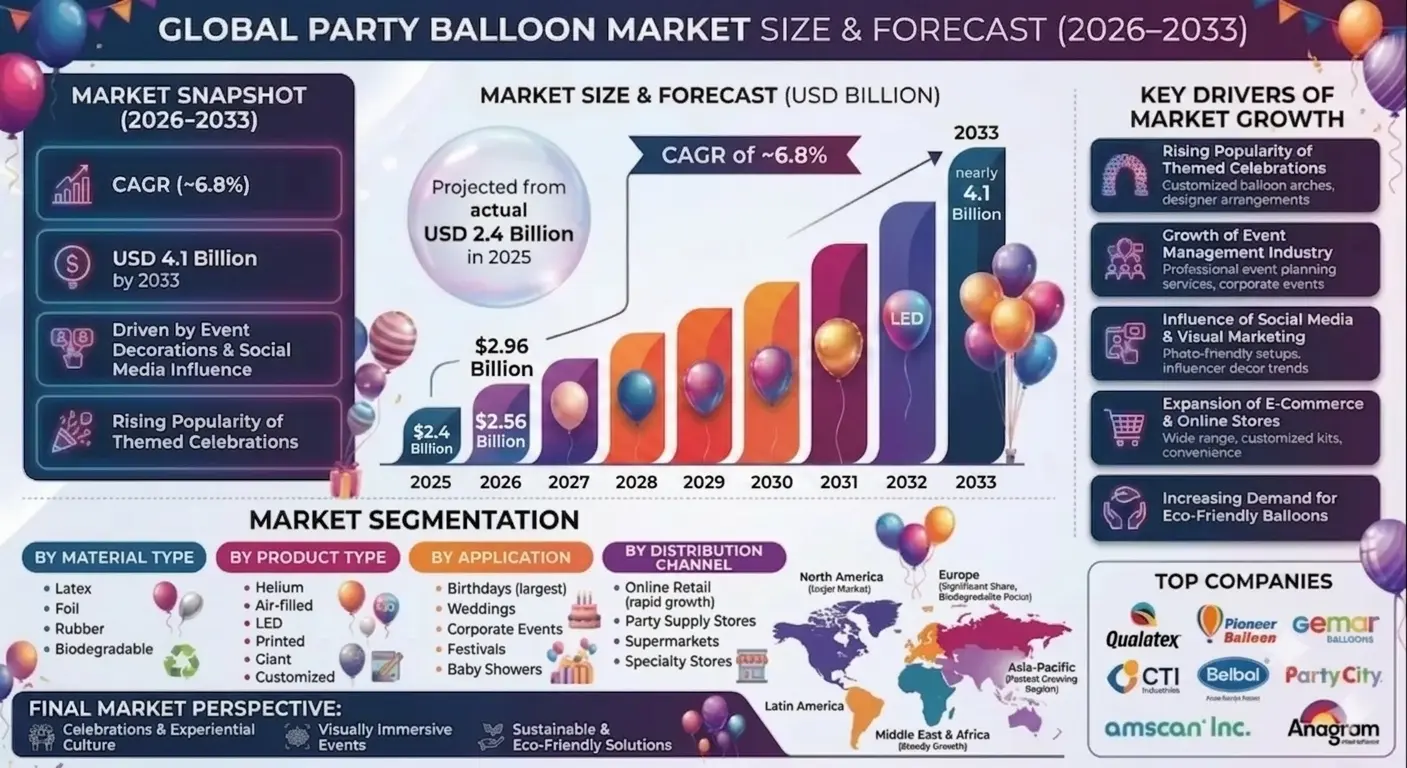
Global Party Balloon Market Size & Forecast
The global party balloon market is projected to witness steady growth during the forecast period from 2026 to 2033. The market was valued at approximately USD 2.4 billion in 2025 and is expected to reach nearly USD 4.1 billion by 2033, expanding at a CAGR of around 6.8%. The market???s growth is driven by increasing demand for event decorations, rising popularity of themed celebrations, expanding social media influence on party aesthetics, and growing consumer spending on birthdays, weddings, corporate events, and festive occasions. Party balloons are widely used decorative products made from latex, foil, rubber, or biodegradable materials, designed for entertainment, celebrations, branding, and event enhancement. These balloons are available in multiple shapes, colors, customized prints, LED-integrated designs, and character-themed formats to suit various consumer preferences and event themes. The increasing popularity of personalized celebrations, luxury event planning, and social media-driven d??cor trends is significantly contributing to market expansion. Consumers are increasingly seeking visually appealing and customizable balloon arrangements for both personal and commercial events. Additionally, the rapid expansion of online party supply stores, balloon decoration services, and event management businesses is improving product accessibility and market penetration globally.Global Party Balloon Market Overview
The party balloon market forms a key segment of the global party supplies and event decoration industry. Balloons are widely used across birthdays, weddings, baby showers, anniversaries, graduation parties, festivals, promotional events, and corporate celebrations. The market includes latex balloons, foil balloons, helium balloons, LED balloons, printed balloons, giant balloons, biodegradable balloons, and customized balloon d??cor solutions. Technological advancements in printing technologies, eco-friendly materials, and LED integration are transforming the product landscape. Manufacturers are increasingly focusing on sustainable and biodegradable balloon solutions to address environmental concerns associated with traditional latex and plastic waste. Social media platforms such as Instagram, Pinterest, and TikTok are playing a significant role in shaping modern event decoration trends, driving demand for premium and aesthetically designed balloon installations. Major market participants include Qualatex, Pioneer Balloon Company, Gemar Balloons, CTI Industries Corporation, Belbal, Party City Holdings, Anagram International, and Amscan Inc.Key Drivers of Global Party Balloon Market Growth
Rising Popularity of Themed Celebrations
Consumers are increasingly investing in personalized and themed event decorations for birthdays, weddings, baby showers, and social gatherings. Balloon arches, customized balloon backdrops, and designer balloon arrangements are becoming central elements in modern event d??cor.Growth of Event Management Industry
The rapid expansion of professional event planning and decoration services is significantly increasing demand for premium balloon products. Corporate events, brand promotions, exhibitions, and large-scale celebrations are driving commercial consumption of decorative balloons.Influence of Social Media and Visual Marketing
Social media platforms are strongly influencing consumer preferences toward visually attractive and photo-friendly event setups. Event d??cor trends promoted by influencers and digital content creators are boosting demand for luxury and customized balloon designs.Expansion of E-Commerce and Online Party Supply Stores
Online retail channels are improving global accessibility to party balloon products and customized decoration kits. E-commerce platforms offer consumers a wide range of color combinations, personalized designs, and home delivery convenience.Increasing Demand for Eco-Friendly Balloons
Environmental awareness is encouraging manufacturers to develop biodegradable and sustainable balloon materials. Consumers and event organizers are increasingly preferring eco-conscious decoration products to reduce environmental impact.Global Party Balloon Market Segmentation
By Material Type
The market is segmented into latex balloons, foil balloons, rubber balloons, and biodegradable balloons. Latex balloons account for a major market share due to affordability, versatility, and widespread use across multiple event categories.By Product Type
The market includes helium balloons, air-filled balloons, LED balloons, printed balloons, giant balloons, and customized balloons. Customized and printed balloons are witnessing strong growth due to rising demand for personalized event experiences.By Application
Applications include birthdays, weddings, corporate events, festivals, baby showers, anniversaries, promotional campaigns, and educational events. Birthday celebrations remain the largest application segment due to high global frequency and increasing expenditure on party decorations.By Distribution Channel
The market includes online retail platforms, party supply stores, supermarkets & hypermarkets, specialty decoration stores, and wholesale distributors. Online channels are experiencing rapid growth due to expanding digital commerce and increasing consumer preference for convenient event planning solutions.Regional Market Dynamics
North America
North America represents a major market for party balloons due to high consumer spending on celebrations, strong event management infrastructure, and widespread adoption of themed party trends. The United States remains the largest regional market supported by growing demand for customized event decorations and corporate promotional events.Europe
Europe holds a significant market share driven by strong cultural celebration traditions, expanding wedding industry activities, and increasing popularity of luxury event d??cor. Countries such as Germany, the United Kingdom, France, Italy, and Spain are key contributors to regional demand. European consumers are increasingly favoring biodegradable and environmentally friendly balloon products.Asia-Pacific
Asia-Pacific is the fastest-growing region due to rising disposable incomes, expanding urban populations, and increasing celebration culture across emerging economies. China, India, Japan, and Southeast Asian countries are witnessing growing demand for event decoration products and customized party supplies. The rapid growth of social media usage and digital retail platforms is further supporting regional market expansion.Latin America
Latin America is witnessing gradual growth due to increasing urbanization, expanding entertainment industries, and rising expenditure on social events and celebrations. Brazil and Mexico remain key regional markets for party supplies and decorative products.Middle East & Africa
The Middle East & Africa region is experiencing steady growth supported by increasing tourism events, luxury weddings, hospitality sector expansion, and rising adoption of modern event decoration trends.Competitive Landscape
The global party balloon market is highly competitive and fragmented, consisting of international manufacturers, regional decoration brands, and local party supply providers. Key players include Qualatex, Pioneer Balloon Company, Gemar Balloons, CTI Industries Corporation, Belbal, Party City Holdings, Amscan Inc., and Anagram International. Companies are increasingly focusing on product customization, eco-friendly materials, innovative balloon designs, and digital marketing strategies to strengthen market presence. Strategic collaborations with event planners, party decorators, and online retail platforms are becoming common growth strategies within the industry. Competition is driven by product quality, customization capabilities, pricing, material sustainability, brand recognition, and distribution reach.Strategic Outlook
The strategic outlook for the global party balloon market remains positive due to growing consumer demand for personalized celebrations and visually immersive event experiences. Future opportunities include biodegradable balloons, smart LED-integrated balloon systems, luxury event d??cor solutions, AI-based customized printing technologies, and reusable decorative balloon products. Sustainability initiatives and environmentally friendly production methods are expected to become increasingly important competitive differentiators. Manufacturers and retailers investing in digital customization tools, premium product offerings, and global e-commerce expansion are likely to strengthen long-term market positioning.Final Market Perspective
The global party balloon market continues to evolve as celebrations, social gatherings, and experiential event culture become increasingly important across global consumer lifestyles. Growing influence of social media aesthetics, rising event management activities, and increasing demand for customized d??cor solutions will continue driving market expansion throughout the forecast period. Companies that successfully combine product innovation, sustainable materials, strong digital engagement, and creative event-focused solutions will remain strongly positioned in the evolving global party balloon market.Table of Contents
Table of Contents
- 1. Executive Summary
- 1.1 Global Party Balloon Market Snapshot (2026-2033)
- 1.2 Market Size & CAGR Analysis
- 1.3 Largest & Fastest-Growing Segments
- 1.4 Key Regional Insights
- 1.5 Major Market Growth Drivers
- 1.6 Competitive Landscape Overview
- 1.7 Strategic Outlook Through 2033
- 2. Introduction & Market Overview
- 2.1 Definition of Party Balloons
- 2.2 Scope of the Study
- 2.3 Evolution of Event Decoration Trends
- 2.4 Party Balloon Value Chain Analysis
- 2.5 Product Categories & Material Landscape
- 2.6 Regulatory & Environmental Compliance Framework
- 2.7 Technology & Product Innovation Trends
- 3. Research Methodology
- 3.1 Primary Research
- 3.2 Secondary Research
- 3.3 Market Size Estimation Model
- 3.4 Forecast Assumptions (2026-2033)
- 3.5 Data Validation & Market Triangulation
- 4. Market Dynamics
- 4.1 Drivers
- 4.1.1 Rising Popularity of Themed Celebrations
- 4.1.2 Growth of Event Management Industry
- 4.1.3 Influence of Social Media & Visual Marketing
- 4.1.4 Expansion of E-Commerce & Online Party Supply Stores
- 4.1.5 Increasing Demand for Eco-Friendly Balloons
- 4.2 Restraints
- 4.2.1 Environmental Concerns Related to Balloon Waste
- 4.2.2 Volatility in Raw Material Prices
- 4.2.3 Seasonal Demand Fluctuations
- 4.2.4 Competition from Alternative Decoration Products
- 4.3 Opportunities
- 4.3.1 Expansion of Biodegradable Balloon Solutions
- 4.3.2 Growth of Premium & Luxury Event Decorations
- 4.3.3 AI-Based Balloon Customization & Printing Technologies
- 4.3.4 Rising Demand for Smart LED Balloon Installations
- 4.4 Challenges
- 4.4.1 Regulatory Restrictions on Single-Use Plastics
- 4.4.2 Supply Chain & Distribution Complexity
- 4.4.3 Product Durability & Helium Availability Issues
- 4.4.4 Intense Competition from Local Manufacturers
- 4.1 Drivers
- 5. Global Party Balloon Market Analysis (USD Billion), 2026-2033
- 5.1 Market Size Overview
- 5.2 CAGR Analysis
- 5.3 Regional Revenue Distribution
- 5.4 Segment Revenue Analysis
- 5.5 Product Innovation & Material Trends
- 5.6 Consumer Buying Behavior & Demand Trends
- 6. Market Segmentation (USD Billion), 2026-2033
- 6.1 By Material Type
- 6.1.1 Latex Balloons
- 6.1.1.1 Decorative Latex Solutions
- 6.1.1.1.1 Customized Party Applications
- 6.1.1.1.1.1 High-Volume Celebration Events
- 6.1.1.1.1 Customized Party Applications
- 6.1.1.1 Decorative Latex Solutions
- 6.1.2 Foil Balloons
- 6.1.2.1 Metallic & Printed Designs
- 6.1.2.1.1 Premium Decorative Applications
- 6.1.2.1.1.1 Luxury Event Decorations
- 6.1.2.1.1 Premium Decorative Applications
- 6.1.2.1 Metallic & Printed Designs
- 6.1.3 Rubber Balloons
- 6.1.3.1 Commercial Promotional Applications
- 6.1.4 Biodegradable Balloons
- 6.1.4.1 Eco-Friendly Event Solutions
- 6.1.4.2 Sustainable Decorative Applications
- 6.1.1 Latex Balloons
- 6.2 By Product Type
- 6.2.1 Helium Balloons
- 6.2.2 Air-Filled Balloons
- 6.2.3 LED Balloons
- 6.2.4 Printed Balloons
- 6.2.5 Giant Balloons
- 6.2.6 Customized Balloons
- 6.3 By Application
- 6.3.1 Birthdays
- 6.3.2 Weddings
- 6.3.3 Corporate Events
- 6.3.4 Festivals
- 6.3.5 Baby Showers
- 6.3.6 Anniversaries
- 6.3.7 Promotional Campaigns
- 6.3.8 Educational Events
- 6.4 By Distribution Channel
- 6.4.1 Online Retail Platforms
- 6.4.2 Party Supply Stores
- 6.4.3 Supermarkets & Hypermarkets
- 6.4.4 Specialty Decoration Stores
- 6.4.5 Wholesale Distributors
- 6.1 By Material Type
- 7. Market Segmentation by Geography
- 7.1 North America
- 7.2 Europe
- 7.3 Asia-Pacific
- 7.4 Latin America
- 7.5 Middle East & Africa
- 8. Competitive Landscape
- 8.1 Market Share Analysis
- 8.2 Product Innovation & Customization Benchmarking
- 8.3 Sustainability & Eco-Friendly Product Analysis
- 8.4 Strategic Partnerships & Distribution Collaborations
- 8.5 Branding & Digital Marketing Strategies
- 9. Company Profiles
- 9.1 Qualatex
- 9.2 Pioneer Balloon Company
- 9.3 Gemar Balloons
- 9.4 CTI Industries Corporation
- 9.5 Belbal
- 9.6 Party City Holdings
- 9.7 Anagram International
- 9.8 Amscan Inc.
- 9.9 Sempertex
- 9.10 Tuf-Tex Balloons
- 10. Strategic Intelligence & Pheonix AI Insights
- 10.1 Pheonix Event Decoration Demand Forecast Engine
- 10.2 Consumer Trend & Social Media Analytics Platform
- 10.3 Balloon Material Sustainability Tracker
- 10.4 Digital Customization & Product Innovation Monitor
- 10.5 Automated Porter???s Five Forces Analysis
- 11. Future Outlook & Strategic Recommendations
- 11.1 Expansion of Biodegradable & Sustainable Balloon Products
- 11.2 Investment in Smart LED & Interactive Balloon Technologies
- 11.3 Growth of Premium Customized Event D??cor Solutions
- 11.4 Strengthening E-Commerce & Global Distribution Networks
- 11.5 Long-Term Market Outlook (2033+)
- 12. Appendix
- 13. About Pheonix Research
- 14. Disclaimer
Competitive Landscape
Global Party Balloon Market Competitive Intensity & Market Structure Overview
The Global Party Balloon Market is highly fragmented and moderately competitive, characterized by the presence of international balloon manufacturers, regional decorative product suppliers, party supply retailers, and specialized event d??cor companies. Competition is primarily driven by product customization, pricing strategies, material innovation, visual aesthetics, and distribution network strength.
The market structure includes large-scale balloon manufacturers supplying standardized products globally, alongside numerous local and regional players offering customized balloon decoration services and event-specific designs. Consumer demand for visually appealing celebrations and themed events has intensified competition across both premium and economy product segments.
The rise of e-commerce platforms and social media-driven marketing has significantly reshaped market dynamics, enabling smaller brands and independent decorators to compete directly with established manufacturers through digital retail channels and personalized product offerings.
Global Party Balloon Market Competitive Intensity & Market Structure Current Scenario
Leading Balloon Manufacturers & Party Supply Companies
Qualatex (Pioneer Balloon Company): One of the leading global balloon brands known for premium latex balloons, professional event d??cor products, and strong partnerships with event planners.
Gemar Balloons: Major European balloon manufacturer focusing on sustainable latex balloons and high-quality decorative products for commercial events.
CTI Industries Corporation: Strong player in foil balloons, licensed character balloons, and customized party decoration products.
Belbal: Well-established international balloon producer offering a wide portfolio of latex balloons and custom printing solutions.
Party City Holdings: Major retail-driven party supply company with extensive balloon product offerings across physical stores and digital channels.
Anagram International: Leading manufacturer specializing in foil balloons, licensed entertainment-themed products, and premium event d??cor solutions.
Amscan Inc.: Global party supplies company offering balloons, themed decorations, and event accessories across multiple celebration categories.
Regional Event Decoration Brands: Thousands of regional decorators and party supply businesses across Asia-Pacific, Europe, and Latin America contribute significantly to market fragmentation and local competition.
Key Competitive Intensity & Market Structure Signals in Global Party Balloon Market
One of the strongest competitive signals in the market is the rapid growth of customization and personalized balloon d??cor solutions. Consumers increasingly prefer customized prints, personalized messages, themed installations, and luxury balloon arrangements, forcing manufacturers and decorators to expand design capabilities.
Social media influence has become a major competitive factor, with platforms such as Instagram, TikTok, and Pinterest driving visual event decoration trends globally. Companies with strong digital branding, influencer partnerships, and visually appealing product portfolios are gaining higher consumer engagement.
Another important market signal is the growing demand for environmentally sustainable balloon materials. Manufacturers are increasingly investing in biodegradable latex balloons, recyclable packaging, and eco-friendly production processes to address environmental concerns and strengthen brand positioning.
E-commerce expansion is intensifying competition by lowering market entry barriers for independent brands and enabling direct-to-consumer sales globally. Online marketplaces and digital customization platforms are reshaping purchasing behavior and distribution strategies.
Price competition remains strong in mass-market balloon categories, particularly in emerging economies where local manufacturers compete aggressively on affordability and bulk supply capabilities.
Strategic Implications of Competitive Intensity & Market Structure in Global Party Balloon Market
Manufacturers are increasingly focusing on premiumization strategies by introducing luxury event d??cor products, LED-integrated balloons, designer collections, and customized balloon installations for weddings, corporate events, and influencer-driven celebrations.
Strategic collaborations between balloon manufacturers, event planners, hospitality companies, and e-commerce platforms are becoming increasingly important for expanding distribution reach and improving consumer visibility.
Digital transformation is reshaping the market through online customization tools, AI-based print design systems, and virtual event planning platforms that allow consumers to personalize decorations more efficiently.
Sustainability initiatives are becoming central to long-term competitive positioning, with companies investing in biodegradable materials, reduced plastic usage, and environmentally responsible sourcing practices.
Emerging markets in Asia-Pacific, Latin America, and the Middle East are witnessing increasing competition as rising disposable incomes and expanding celebration culture create strong demand for decorative event products.
Global Party Balloon Market Competitive Intensity & Market Structure Forward Outlook
The Global Party Balloon Market is expected to remain highly fragmented but increasingly innovation-driven as consumer demand shifts toward personalized, premium, and eco-friendly event decoration solutions.
Smart balloons with integrated LED lighting, programmable visual effects, and interactive digital features are expected to create new premium product opportunities within the market.
Sustainability will become a critical competitive requirement, with biodegradable balloons and recyclable packaging likely to gain significant market share as environmental regulations strengthen globally.
E-commerce and direct-to-consumer retail channels are expected to continue expanding rapidly, enabling global brands and local businesses to compete more aggressively through digital engagement and customized product offerings.
Overall, the market will continue evolving alongside changing consumer lifestyles, experiential celebrations, and social media-driven aesthetics. Companies that successfully combine creativity, sustainability, digital retail capabilities, and product customization will remain strongly positioned in the Global Party Balloon Market through 2033.
Value Chain
Global Party Balloon Market Value Chain & Supply Chain Evolution Overview
The Global Party Balloon Market value chain is evolving from a traditional low-cost decorative products industry into a more design-driven, customization-focused, digitally connected, and sustainability-oriented consumer goods ecosystem. This transformation is being driven by increasing demand for personalized celebrations, rapid expansion of event management services, rising influence of social media aesthetics, growth of e-commerce platforms, and increasing consumer preference for eco-friendly decorative products.
The party balloon value chain begins with upstream raw material sourcing, which includes latex, foil films, rubber compounds, biodegradable polymers, printing inks, adhesives, LED components, helium gas supplies, and packaging materials used in balloon production. Raw material suppliers play a critical role in ensuring product durability, elasticity, color consistency, safety standards, and environmental compliance. Increasing environmental concerns regarding plastic waste and non-biodegradable materials are encouraging manufacturers to shift toward sustainable raw material sourcing and biodegradable alternatives.
The manufacturing layer forms the operational core of the party balloon value chain and includes balloon molding, latex dipping, foil sealing, digital printing, shape customization, LED integration, inflation system development, packaging, and quality inspection processes. Manufacturers are increasingly adopting automated printing systems, advanced color technologies, AI-assisted customization tools, and eco-friendly production techniques to improve efficiency and support large-scale personalized product demand. Premium and customized balloon products are becoming increasingly important due to rising consumer demand for visually distinctive event decorations.
Contract manufacturing and private-label production are becoming increasingly common within the party balloon ecosystem as retailers, event decoration companies, and online brands seek scalable sourcing solutions and product diversification strategies. Asian manufacturing hubs, particularly China and parts of Southeast Asia, continue to dominate large-scale balloon production due to cost-efficient manufacturing capabilities, flexible production infrastructure, and strong export networks.
The distribution structure of the party balloon market is highly diversified and consumer-oriented, involving wholesalers, party supply distributors, e-commerce platforms, supermarkets, specialty party stores, event planners, and direct-to-consumer online retail channels. E-commerce has become a major distribution driver, enabling global accessibility to customized balloon kits, designer decoration products, and themed celebration packages. Social commerce platforms and influencer-driven digital marketing are also significantly reshaping product discovery and purchasing behavior.
Quality assurance and product safety remain important aspects of the party balloon value chain. Manufacturers must comply with consumer safety standards related to material toxicity, child safety, product durability, and environmental regulations. Increasing global focus on sustainability is encouraging investment in biodegradable materials, recyclable packaging systems, and low-emission manufacturing processes.
Overall, the party balloon market value chain is evolving into a more digitally integrated, customization-focused, sustainability-driven, and globally connected decorative products ecosystem centered around consumer experience, creative design, and event personalization.
Global Party Balloon Market Value Chain & Supply Chain Evolution Current Scenario
The current party balloon market supply chain is characterized by strong globalization, rapid product customization trends, growing digital retail influence, and increasing demand for environmentally responsible decorative solutions. Manufacturers are expanding product portfolios to include customized prints, premium foil designs, LED-integrated balloons, and biodegradable alternatives to address evolving consumer preferences.
Asia-Pacific remains the dominant manufacturing hub for party balloons due to cost-efficient production capabilities, large-scale export infrastructure, and strong raw material supply networks. China continues to play a particularly important role in global balloon manufacturing and international wholesale distribution.
North America and Europe remain major consumer markets supported by high spending on celebrations, event planning services, and premium decorative products. Demand for luxury event d??cor and customized balloon installations is growing rapidly within these regions.
E-commerce platforms are increasingly reshaping the distribution landscape by improving accessibility to customized products, enabling small businesses to reach global audiences, and supporting direct-to-consumer sales models. Online party supply marketplaces and digital decoration services are becoming central growth channels within the industry.
Digital printing technologies and automated customization systems are also becoming increasingly important as consumers seek personalized event decorations for birthdays, weddings, baby showers, corporate events, and social gatherings.
At the same time, environmental concerns surrounding balloon waste are influencing production strategies and consumer purchasing behavior. Manufacturers are increasingly investing in biodegradable balloon materials, recyclable packaging solutions, and environmentally sustainable product lines to align with changing regulatory and consumer expectations.
Key Value Chain & Supply Chain Evolution Signals in Global Party Balloon Market
One of the strongest transformation signals in the party balloon market is the rapid growth of personalized and premium event decoration products. Consumers are increasingly demanding customized balloon arrangements, branded designs, luxury event d??cor solutions, and visually immersive celebration experiences.
Another major evolution signal is the increasing role of social media platforms in influencing product demand and event decoration trends. Instagram, TikTok, Pinterest, and influencer-driven content are significantly shaping consumer preferences for themed celebrations and decorative aesthetics.
The growing importance of sustainability is also reshaping the market value chain. Manufacturers are accelerating investment in biodegradable latex balloons, eco-friendly packaging materials, and low-waste production systems to address environmental concerns and strengthen brand positioning.
Digital transformation is becoming increasingly important within the industry, with AI-assisted customization tools, automated digital printing technologies, and online event planning platforms improving operational efficiency and consumer engagement.
Additionally, the expansion of e-commerce and direct-to-consumer distribution models is creating a more globally connected and highly competitive market environment where small and regional brands can reach international consumer bases more efficiently.
Strategic Implications of Value Chain & Supply Chain Evolution in Global Party Balloon Market
The evolving party balloon value chain presents significant strategic implications for manufacturers, event decoration companies, retailers, distributors, and e-commerce platforms. Companies that successfully combine product innovation, customization capabilities, sustainability initiatives, and digital marketing strategies are expected to strengthen their competitive positioning within the global decorative products industry.
Investment in biodegradable materials and environmentally responsible production systems is becoming increasingly important as sustainability concerns influence both consumer behavior and regulatory frameworks. Manufacturers lacking sustainable product offerings may face growing competitive pressure in premium consumer markets.
Digital transformation is creating major competitive advantages across the value chain. AI-powered design customization, automated printing technologies, social commerce integration, and digital retail platforms are helping companies improve customer engagement, reduce operational complexity, and accelerate product personalization.
Supply chain diversification and regional warehousing strategies are also becoming important operational priorities as companies seek to improve delivery speed, reduce transportation costs, and support global e-commerce growth.
Long-term industry success will increasingly depend on the ability to balance affordability, product quality, creative design innovation, environmental responsibility, and omnichannel distribution capabilities within an increasingly trend-driven consumer market.
Global Party Balloon Market Value Chain & Supply Chain Evolution Forward Outlook
Between 2026 and 2033, the party balloon value chain is expected to become increasingly digitalized, sustainability-focused, customization-oriented, and globally integrated as consumer demand for personalized celebrations and immersive event experiences continues expanding worldwide.
Biodegradable balloons, reusable decorative systems, AI-driven design customization tools, and smart LED-integrated balloon technologies are expected to become major future growth segments within the industry.
Manufacturers are expected to continue investing in automated production systems, advanced printing technologies, and scalable e-commerce infrastructure to improve operational efficiency and support growing customization demand.
Digital retail ecosystems and social commerce platforms are expected to play an even larger role in shaping consumer purchasing behavior, enabling faster product discovery, personalized marketing, and direct consumer engagement.
Sustainability will continue becoming a major strategic focus across the industry, with increasing adoption of recyclable materials, biodegradable compounds, and environmentally responsible packaging solutions.
Ultimately, the future party balloon value chain will evolve into a highly creative, digitally connected, sustainability-driven, and consumer-centric decorative products ecosystem where design innovation, customization capabilities, social media influence, and global distribution efficiency collectively define long-term market competitiveness.
Market-Specific Value Chain
- Raw Material & Component Supply: Latex suppliers, foil material manufacturers, biodegradable polymer producers, helium gas providers, LED component suppliers
- Balloon Manufacturing & Product Development: Balloon molding facilities, foil balloon production plants, digital printing units, LED integration manufacturers, customized decoration product developers
- Customization & Design Services: Event design studios, personalized printing providers, AI-assisted customization platforms, branding and decorative solution companies
- Packaging & Wholesale Distribution: Packaging solution providers, wholesale distributors, export suppliers, regional inventory and warehousing operators
- Retail & E-Commerce Channels: Online party supply platforms, supermarkets, specialty party stores, direct-to-consumer retail brands, social commerce sellers
- Event Planning & Decoration Services: Event management companies, wedding decorators, corporate event planners, balloon installation specialists, celebration service providers
Investment Activity
Global Party Balloon Market Investment & Funding Dynamics Overview
Investment and funding activity in the Global Party Balloon Market is steadily increasing due to rising consumer spending on celebrations, expanding event management industries, and growing demand for visually appealing decorative products. Between 2026 and 2033, investments are expected to focus on customized balloon manufacturing, biodegradable materials, digital printing technologies, premium event d??cor solutions, and e-commerce-driven distribution expansion.
The market is evolving beyond traditional decorative products into a highly personalized and experience-driven event decoration segment supported by social media trends, influencer marketing, and luxury celebration culture. Major companies including Qualatex, Pioneer Balloon Company, Gemar Balloons, CTI Industries Corporation, Belbal, Party City Holdings, and Amscan Inc. are increasing investments in innovative balloon designs, eco-friendly production technologies, and digital customization capabilities.
A major investment trend shaping the industry is the growing consumer preference for sustainable and biodegradable balloon products. Environmental concerns surrounding plastic waste and latex disposal are encouraging manufacturers to allocate capital toward recyclable materials, natural latex alternatives, and environmentally compliant production systems.
Additionally, rapid expansion of online party supply platforms, event decoration businesses, and direct-to-consumer customization services is attracting investment into digital retail infrastructure, AI-based product personalization tools, and global logistics capabilities. The increasing popularity of themed celebrations and premium d??cor experiences is further strengthening long-term funding opportunities across the market.
Global Party Balloon Market Investment & Funding Dynamics Current Scenario
- North America: Continues attracting strong investments due to high consumer spending on celebrations, advanced event management industries, and rising demand for customized decorative products across the United States and Canada.
- Europe: Witnessing increasing funding activity driven by sustainability regulations, luxury wedding industries, and growing adoption of eco-friendly balloon materials across Germany, France, Italy, Spain, and the United Kingdom.
- Asia-Pacific: Emerging as the fastest-growing investment region due to rising disposable incomes, expanding urban populations, increasing celebration culture, and rapid growth of digital retail platforms in China, India, Japan, and Southeast Asia.
- Latin America & Middle East & Africa: Gradually expanding investment opportunities supported by tourism growth, hospitality sector expansion, increasing social event activities, and rising adoption of modern event decoration trends.
Key Investment & Funding Dynamics Signals in Global Party Balloon Market
- Growing investments in biodegradable and eco-friendly balloon materials to address sustainability concerns and evolving environmental regulations.
- Rising funding activity in customized balloon printing technologies and AI-driven design personalization platforms.
- Expansion of e-commerce and online party supply platforms is encouraging investment in digital retail infrastructure and direct-to-consumer distribution models.
- Luxury event d??cor and premium balloon installations are attracting higher-margin investments from event planners and decoration service providers.
- Social media-driven celebration culture is increasing funding for visually immersive balloon products and influencer-focused marketing campaigns.
- LED-integrated balloons, smart decorative systems, and reusable balloon products are emerging as innovation-focused investment areas.
- Strategic collaborations between manufacturers, event planners, hospitality providers, and online marketplaces are supporting market expansion and customer reach.
Strategic Implications of Investment & Funding Dynamics in Global Party Balloon Market
- The investment landscape increasingly favors companies capable of combining sustainability, product customization, and digital engagement strategies.
- Eco-friendly product innovation is becoming a major competitive differentiator as environmental awareness continues influencing purchasing decisions.
- Digital transformation and online customization platforms are reshaping distribution strategies and consumer purchasing behavior globally.
- Manufacturers investing in advanced printing technologies and premium decorative solutions are expected to strengthen profitability and brand positioning.
- Social media integration and influencer-driven marketing campaigns are becoming increasingly important for driving consumer engagement and product visibility.
- Companies with strong omnichannel retail capabilities and scalable supply chain infrastructure are expected to maintain stronger competitive positioning.
- Premium celebration experiences and luxury event d??cor solutions are creating attractive long-term investment opportunities across high-income consumer segments.
Global Party Balloon Market Investment & Funding Dynamics Forward Outlook
The Global Party Balloon Market is expected to maintain stable long-term investment momentum through 2033, supported by rising global celebration culture, growing demand for customized event experiences, and continued expansion of digital retail ecosystems.
Future capital allocation will increasingly prioritize biodegradable balloon technologies, luxury decorative products, AI-enabled customization systems, reusable event d??cor solutions, and automated online ordering platforms designed to improve personalization and operational efficiency.
- Asia-Pacific: Will remain the fastest-growing investment region due to expanding middle-class populations, increasing celebration spending, and rapid e-commerce adoption.
- North America: Will continue leading premium event d??cor innovation and customized balloon product development.
- Europe: Will increasingly focus on sustainable balloon manufacturing technologies and environmentally compliant decorative solutions.
Future funding activity is also expected to accelerate across smart decorative lighting systems, digital event planning integration, personalized party kits, and sustainable packaging solutions. Companies investing in environmentally responsible manufacturing, premium customization capabilities, and strong online retail ecosystems are expected to achieve stronger long-term market positioning.
Overall, the market is expected to benefit from continued growth in global celebrations, experiential event culture, and social media-driven d??cor trends. Businesses that successfully combine creativity, sustainability, digital accessibility, and consumer-focused innovation will remain strongly positioned in the evolving Global Party Balloon Market through 2033.
Technology & Innovation
Global Party Balloon Market Technology & Innovation Landscape Overview
The technology and innovation landscape of the Global Party Balloon Market is evolving rapidly as manufacturers, event decorators, and party supply companies increasingly adopt advanced materials, digital customization technologies, sustainable production methods, and smart decorative solutions to enhance product appeal and consumer engagement. Innovation within the market is centered around biodegradable balloon materials, LED-integrated balloons, AI-based customization platforms, advanced printing technologies, and digitally connected event decoration ecosystems designed to support modern celebration trends globally.
The increasing influence of social media-driven event aesthetics is significantly reshaping product innovation across the party balloon industry. Consumers are increasingly seeking visually immersive, personalized, and premium-quality balloon decorations for birthdays, weddings, corporate events, festivals, and luxury celebrations. This trend is encouraging manufacturers to invest in advanced color technologies, high-definition printing systems, custom shape engineering, and large-scale balloon installation capabilities.
Technological advancements in balloon manufacturing processes are improving product durability, elasticity, inflation retention, and environmental sustainability. Manufacturers are increasingly utilizing precision molding technologies, automated latex processing systems, and advanced foil sealing techniques to improve product consistency and performance across commercial and retail applications.
Digital customization platforms are also becoming increasingly important within the market. Online party supply providers and balloon printing companies are leveraging AI-powered design tools, cloud-based customization systems, and digital preview technologies that allow consumers to create personalized balloon decorations, branded promotional balloons, and event-specific themes in real time.
In addition, sustainable innovation is becoming a major focus area within the party balloon industry. Manufacturers are increasingly investing in biodegradable latex materials, recyclable packaging, non-toxic dyes, and environmentally friendly production processes to address growing environmental concerns associated with traditional balloon waste and plastic pollution.
Global Party Balloon Market Technology & Innovation Landscape Current Scenario
Currently, the global party balloon market is experiencing accelerated innovation driven by increasing demand for personalized celebrations, luxury event decoration services, and eco-friendly party supplies. Major manufacturers and event d??cor companies are increasingly adopting advanced printing technologies, smart decoration systems, and digital retail platforms to improve customer experience and product differentiation.
Customized balloon printing technologies have become one of the fastest-growing innovation areas within the market. Digital printing systems now support high-resolution graphics, personalized messages, branded event promotions, and complex multi-color designs across latex and foil balloon formats. These technologies are significantly improving product customization capabilities while reducing production lead times.
LED-integrated balloons and illuminated decorative systems are gaining strong popularity across premium events, weddings, concerts, and entertainment venues. Advanced LED balloon technologies now include remote-controlled lighting systems, programmable color-changing effects, and battery-efficient illumination designs that enhance visual appeal and interactive event experiences.
Manufacturers are also increasingly deploying biodegradable and eco-friendly balloon technologies to comply with environmental regulations and evolving consumer sustainability preferences. Biodegradable latex balloons produced from natural rubber materials are becoming increasingly common across retail and commercial event decoration markets.
E-commerce integration and digital event planning platforms are transforming product accessibility and customization processes. Consumers can now design balloon arrangements online, preview event decoration layouts through digital visualization tools, and order customized products through mobile applications and online party supply marketplaces.
Automation technologies are also improving manufacturing scalability and operational efficiency within the industry. Robotic inflation systems, automated packaging lines, and precision balloon shaping technologies are helping manufacturers increase production output while maintaining consistent product quality standards.
Key Technology & Innovation Trends in Global Party Balloon Market
- Biodegradable Balloon Materials: Eco-friendly latex and sustainable balloon solutions designed to reduce environmental impact and improve biodegradability.
- Advanced Digital Printing Technologies: High-resolution customization systems supporting personalized graphics, branding, and themed event decorations.
- LED-Integrated Balloon Systems: Illuminated balloons featuring programmable lighting effects and interactive visual enhancements.
- AI-Based Customization Platforms: Intelligent design tools enabling personalized balloon arrangements and event-specific d??cor customization.
- Automated Balloon Manufacturing: Precision molding, robotic packaging, and automated inflation technologies improving production efficiency and product consistency.
- Smart Event Decoration Solutions: Digitally coordinated balloon installations integrated with lighting, event themes, and immersive d??cor systems.
- Cloud-Based Event Planning Integration: Online platforms supporting balloon visualization, digital ordering, and customized event decoration management.
- Reusable Decorative Balloon Products: Long-lasting and refillable balloon systems supporting sustainable event decoration strategies.
- Non-Toxic Dye & Material Innovations: Safer color technologies and environmentally compliant production materials improving product sustainability.
- Interactive Promotional Balloon Technologies: QR-enabled and digitally branded balloon systems supporting marketing campaigns and consumer engagement.
Strategic Implications of Technology & Innovation
Technological innovation is fundamentally reshaping the global party balloon market by improving product customization, manufacturing scalability, sustainability, and consumer engagement across modern event decoration ecosystems. Digital transformation is enabling manufacturers and event planners to create highly personalized and visually immersive celebration experiences aligned with evolving social media trends and premium consumer preferences.
For manufacturers and retailers, investment in digital customization platforms, eco-friendly materials, automated production technologies, and smart event d??cor systems has become a critical competitive differentiator. Companies leveraging advanced design technologies and sustainable production methods are strengthening brand positioning while expanding market reach across premium and commercial event segments.
The growing integration of AI-driven design systems and cloud-based event planning tools is also helping businesses improve operational efficiency and customer satisfaction. Consumers increasingly expect fast customization, online visualization capabilities, and seamless digital purchasing experiences when selecting event decoration products.
Sustainability innovation is becoming increasingly important within the competitive landscape. Manufacturers investing in biodegradable materials, recyclable packaging solutions, and environmentally responsible production processes are gaining stronger acceptance among environmentally conscious consumers and event organizers.
However, challenges such as raw material price volatility, environmental regulations regarding balloon disposal, competition from alternative decoration products, and rising manufacturing costs remain significant factors influencing market dynamics. Companies must continue investing in sustainable innovation, efficient supply chains, and digital customer engagement strategies to maintain long-term competitiveness.
Global Party Balloon Market Technology & Innovation Forward Outlook
Looking ahead, the global party balloon market is expected to evolve toward highly customized, digitally integrated, and environmentally sustainable decoration ecosystems powered by AI-driven personalization technologies, smart event planning platforms, and advanced material innovations. Future balloon solutions will increasingly combine visual aesthetics, interactive technologies, and sustainability-focused product designs to support evolving consumer expectations.
Artificial intelligence is expected to play a growing role in event decoration customization, consumer trend analysis, and automated design generation. AI-supported platforms will increasingly provide personalized decoration recommendations, event theme optimization, and predictive purchasing suggestions based on consumer preferences and celebration patterns.
Advanced LED technologies and smart interactive balloon systems are likely to become major innovation areas within premium event decoration markets. Future balloon products may integrate synchronized lighting systems, motion-sensitive effects, app-controlled illumination, and immersive digital entertainment features for large-scale events and commercial installations.
The continued expansion of e-commerce and digital event planning ecosystems will further strengthen online customization and direct-to-consumer sales channels. Cloud-connected platforms and virtual event visualization tools are expected to significantly improve customer interaction, design flexibility, and purchasing convenience across the global party decoration industry.
Sustainability will remain one of the most important long-term innovation priorities. Manufacturers are expected to accelerate development of compostable balloon materials, reusable decorative systems, eco-friendly inks, and low-emission production technologies to align with evolving environmental standards and consumer sustainability expectations.
In conclusion, the Global Party Balloon Market is undergoing significant technological and product innovation transformation driven by digital customization, sustainable material development, smart decorative technologies, and evolving event aesthetics. Companies that successfully combine creative design innovation, environmentally responsible manufacturing, advanced digital engagement, and premium event solutions will remain strongly positioned within the future global party balloon industry.
Market Risk
Global Party Balloon Market Risk Factors & Disruption Threats Overview
The global party balloon market is experiencing steady growth driven by increasing demand for event decorations, rising popularity of themed celebrations, and expanding influence of social media-driven event aesthetics. Despite positive market expansion, the industry remains exposed to several operational, environmental, regulatory, and economic risks that may impact long-term growth and profitability. The market???s dependence on discretionary consumer spending, raw material availability, environmental compliance, and evolving consumer preferences creates a dynamic and competitive business environment.
One of the primary risk factors affecting the party balloon market is growing environmental concern regarding balloon waste and plastic pollution. Traditional latex, foil, and plastic-based balloons have faced increasing criticism from environmental organizations and regulatory authorities due to their contribution to littering, marine pollution, and wildlife hazards. Governments across several countries are introducing stricter environmental regulations and restrictions on single-use plastics, which may negatively affect conventional balloon product demand.
Raw material price volatility also represents a major challenge for manufacturers. The production of latex balloons depends heavily on natural rubber availability, while foil balloons require aluminum-based materials and synthetic films. Fluctuations in raw material costs, supply shortages, and global trade disruptions can significantly impact manufacturing margins and pricing stability across the market.
Seasonal demand fluctuations create additional business uncertainty within the party balloon industry. Sales volumes are highly dependent on festive seasons, wedding periods, birthdays, holiday events, and promotional campaigns. Economic slowdowns or reduced consumer spending on discretionary celebrations may directly affect product demand and inventory turnover rates.
The market also faces increasing competition from alternative event decoration products such as reusable d??cor items, digital projection technologies, floral installations, LED displays, and eco-friendly decorative solutions. Consumers seeking sustainable or premium event experiences may gradually reduce dependence on disposable balloon products.
Global Party Balloon Market Risk Factors & Disruption Threats Current Scenario
The current party balloon market environment reflects strong consumer demand for customized and visually appealing event decorations alongside rising pressure for sustainable product innovation. Social media platforms continue influencing celebration trends globally, encouraging consumers to invest in aesthetically designed balloon arrangements and personalized d??cor solutions.
At the same time, environmental sustainability concerns are intensifying across the industry. Several regions are witnessing increased scrutiny regarding balloon releases at public events, environmental disposal practices, and use of non-biodegradable materials. Manufacturers are under growing pressure to transition toward biodegradable, recyclable, and eco-friendly balloon alternatives.
Supply chain disruptions and rising logistics costs are also affecting the market. Inflationary pressures, transportation bottlenecks, labor shortages, and fluctuations in petroleum-based material pricing are increasing production and distribution expenses for balloon manufacturers and retailers.
The expansion of e-commerce and online party supply platforms is transforming market dynamics by increasing competition and price transparency. Consumers now have access to a wide variety of low-cost imported balloon products, which may intensify pricing pressure for established manufacturers and regional suppliers.
Additionally, counterfeit and low-quality balloon products entering online marketplaces pose reputational and safety risks within the market. Inferior-quality balloons may increase incidents of product failure, choking hazards, or latex allergy concerns, potentially affecting consumer confidence and regulatory oversight.
Global Party Balloon Market Key Risk Factors & Disruption Threat Signals
One of the most significant disruption signals in the party balloon market is the accelerating shift toward environmentally sustainable event decoration alternatives. Consumer awareness regarding waste reduction and eco-conscious celebrations is increasing demand for reusable decorations, paper-based d??cor products, and biodegradable materials.
Another major disruption trend involves stricter environmental regulations targeting single-use plastics and non-recyclable products. Regulatory restrictions on balloon releases, plastic usage, and waste disposal practices may directly impact traditional balloon manufacturing and distribution models.
Technological disruption through AI-powered customization platforms and digital event planning tools is also reshaping the competitive landscape. Companies investing in online customization systems, personalized printing technologies, and virtual decoration planning services may gain competitive advantages over traditional suppliers.
Climate-related disruptions and natural rubber supply instability represent emerging operational risks. Extreme weather events, agricultural disease outbreaks, and environmental factors affecting rubber plantations may impact latex availability and production costs.
Economic uncertainty and changing consumer spending behavior may further affect demand patterns, particularly in premium and luxury event decoration segments. During periods of financial instability, consumers may reduce spending on non-essential celebration products and event services.
Global Party Balloon Market Strategic Implications of Risk Factors
Manufacturers and suppliers operating in the party balloon market must increasingly prioritize sustainability initiatives and environmentally responsible product development. Investment in biodegradable balloons, recyclable packaging, and eco-friendly manufacturing processes will become essential for long-term market competitiveness and regulatory compliance.
Supply chain diversification and raw material sourcing strategies will also remain critical for reducing exposure to price volatility and procurement disruptions. Companies should strengthen supplier networks and improve inventory management capabilities to maintain operational stability.
Digital transformation strategies involving e-commerce expansion, online customization tools, and social media marketing integration will become increasingly important for customer engagement and brand differentiation. Consumers are increasingly seeking personalized event experiences supported by convenient online purchasing platforms.
Product quality assurance and compliance with international safety standards will remain essential for maintaining brand reputation and reducing regulatory risks associated with low-quality or counterfeit products.
Strategic partnerships with event planners, hospitality providers, wedding organizers, and digital retail platforms may further strengthen market reach and support long-term revenue growth opportunities.
Global Party Balloon Market Forward Risk Outlook
Looking ahead to 2026???2033, the global party balloon market is expected to continue growing steadily due to rising celebration culture, increasing event management activities, and expanding demand for customized decorative solutions. However, long-term market resilience will increasingly depend on sustainability integration, product innovation, regulatory adaptability, and digital retail expansion.
Future market dynamics will be shaped by growing environmental awareness, stricter waste management regulations, evolving consumer preferences for eco-friendly celebrations, and increased competition from alternative decoration technologies and reusable d??cor products.
Manufacturers investing in biodegradable materials, advanced customization technologies, sustainable production systems, and premium decorative solutions are expected to strengthen their competitive positioning within the evolving event decoration landscape.
Overall, while the global party balloon market presents stable long-term growth opportunities, sustainable success will depend on balancing affordability, product creativity, environmental responsibility, operational efficiency, and evolving consumer lifestyle trends across increasingly competitive global celebration markets.
Regulatory Landscape
Global Party Balloon Market Regulatory & Policy Environment Overview
The regulatory and policy environment governing the global party balloon market is increasingly influenced by environmental sustainability concerns, consumer product safety standards, chemical usage regulations, and waste management policies. Party balloons, widely used for celebrations, events, advertising, and entertainment purposes, are subject to multiple regulations related to material composition, product labeling, packaging, environmental impact, and child safety compliance.
Governments and environmental agencies worldwide are strengthening regulations on single-use plastics, non-biodegradable materials, and waste disposal practices, which is significantly impacting the production and distribution of traditional latex and foil balloons. Manufacturers are increasingly required to comply with sustainability-focused policies encouraging biodegradable materials, recyclable packaging, and environmentally responsible production methods.
In addition, consumer protection regulations covering choking hazards, toxic material restrictions, and helium gas handling are becoming more prominent, particularly for products targeted toward children and public events. Regulatory oversight is also expanding in relation to imported party products and low-cost decorative items to ensure quality and safety standards are maintained across international supply chains.
Global Party Balloon Market Regulatory & Policy Environment Current Scenario
The current regulatory landscape for the party balloon market is characterized by growing environmental scrutiny, stricter chemical safety requirements, and increased focus on sustainable consumer goods manufacturing. Regulatory authorities in developed economies are actively introducing policies aimed at reducing plastic waste and promoting eco-friendly alternatives within the party supplies industry.
In North America, party balloons are regulated under consumer product safety standards enforced by agencies such as the U.S. Consumer Product Safety Commission (CPSC). Regulations focus on labeling requirements, choking hazard warnings, latex allergy disclosures, and restrictions on harmful chemical substances used in balloon manufacturing.
Europe maintains stringent environmental and chemical regulations under frameworks such as REACH (Registration, Evaluation, Authorisation and Restriction of Chemicals) and EU packaging waste directives. European authorities are increasingly encouraging biodegradable balloon materials and sustainable packaging solutions to reduce environmental pollution.
Asia-Pacific remains a major manufacturing hub for party balloons, particularly in China and India. Governments in the region are gradually strengthening quality control systems, export compliance standards, and environmental regulations related to plastic production and industrial emissions.
Several countries are also implementing restrictions on balloon releases during public events due to concerns regarding marine pollution, wildlife harm, and littering. These policies are influencing event organizers and manufacturers to adopt environmentally safer alternatives.
Key Regulatory & Policy Environment Signals in Global Party Balloon Market
- Environmental Sustainability Regulations: Governments are increasing restrictions on single-use plastics and encouraging biodegradable balloon materials and recyclable packaging.
- Chemical Safety & Material Compliance: Balloon manufacturers must comply with regulations limiting hazardous chemicals, dyes, and toxic additives in consumer products.
- Child Safety & Consumer Protection Standards: Strict labeling requirements regarding choking hazards, latex allergies, and safe usage instructions are mandatory in many markets.
- Packaging Waste & Recycling Policies: Authorities are implementing packaging reduction initiatives and promoting sustainable packaging materials for party products.
- Import & Product Quality Regulations: Imported party balloons are increasingly subject to customs inspections, quality certification requirements, and safety compliance checks.
- Helium Usage & Transportation Guidelines: Regulations governing compressed gas handling, helium storage, and transportation safety are influencing supply chain operations.
Strategic Implications of Regulatory & Policy Environment
The evolving regulatory environment is significantly influencing manufacturing strategies, material innovation, and supply chain management within the global party balloon industry. Manufacturers are increasingly investing in biodegradable latex technologies, eco-friendly inks, and recyclable packaging solutions to align with sustainability-focused regulations.
Environmental policies are encouraging companies to reduce dependence on plastic-based foil balloons and adopt greener production methods with lower emissions and waste generation. Sustainability certifications and environmentally responsible branding are becoming important competitive differentiators in mature consumer markets.
Child safety regulations are also influencing product design, packaging transparency, and warning label implementation. Companies must ensure compliance with international consumer safety standards to maintain access to key retail markets.
The growing focus on product quality inspections and import compliance is prompting global suppliers to improve quality assurance systems, supplier audits, and manufacturing traceability across international distribution networks.
In parallel, increasing restrictions on public balloon releases may encourage greater innovation in reusable event decoration products, air-filled balloon systems, and sustainable celebration alternatives that minimize environmental impact.
Global Party Balloon Market Regulatory & Policy Environment Forward Outlook
Between 2026 and 2033, the regulatory environment for the global party balloon market is expected to become increasingly sustainability-driven and environmentally restrictive. Governments are likely to implement stricter controls on non-biodegradable decorative products, plastic waste generation, and event-related environmental pollution.
Biodegradable material standards and eco-certification programs are expected to expand globally, encouraging wider adoption of sustainable balloon manufacturing technologies and recyclable product designs.
Chemical safety regulations may also tighten further, particularly regarding synthetic dyes, additives, and materials used in children’s products. Manufacturers will likely face greater compliance requirements related to product testing and certification.
Digital commerce regulations affecting online party supply sales, consumer product traceability, and import compliance may also strengthen as global e-commerce continues expanding.
International sustainability initiatives and corporate ESG commitments are expected to accelerate industry-wide adoption of environmentally responsible practices. Companies that proactively invest in sustainable materials, regulatory compliance systems, and eco-friendly product innovation will remain better positioned in the evolving global party balloon market.