
Editorial Article
A Tenth of the Price Is Fibre and Two-Thirds Is the Machine. That Is the Whole Moulded-Fibre Business.
There is a line item in Hartmann Packaging’s 2025 accounts that explains the entire moulded-fibre industry, and it is not revenue. It is production costs: DKK 2,798.3 million against revenue of DKK 4,145.0 million. Two-thirds of what a moulded-fibre product sells for is spent making it, and the great majority of that two-thirds is not the fibre.
Set the other numbers beside it and the shape of the business appears. Operating profit DKK 665.9 million, a 16.1 per cent margin. Return on invested capital 30.3 per cent. Property, plant and equipment investment DKK 521.5 million, 12.6 per cent of revenue. Seventeen factories across Europe, the Americas and Asia. 3,296 employees. Ninety-seven per cent of fibre input from recycled paper.
A 30 per cent return on capital in a business that has been described as a commodity for eighty years is not an anomaly to be explained away. It is the output of a cost structure that almost nobody in this sector’s commentary gets right. Moulded fibre is described as a paper business. It is a manufacturing business that happens to consume paper, and the difference between those two descriptions is where the margin lives.
What the fibre actually costs
Recovered paper delivered to German mills traded at EUR 125 to 150 per tonne in June 2026, with EUWID contract settlements between EUR 132 and 145 and mixed paper at EUR 115 to 128. Moulded-fibre production consumes roughly 1.1 to 1.2 tonnes of recovered paper per tonne of finished product once forming losses are counted. At EUR 140 a tonne, that is EUR 161 of fibre per tonne of product.
Now set it against price. Our sizing of this market puts egg packaging at USD 1,850 of realisation per tonne in 2025 and foodservice containers at USD 3,356. Fibre is therefore about 8.7 per cent of the price of an egg tray and under 5 per cent of a foodservice container. Even if the realisation estimate were wrong by a third in either direction, fibre would still be under a fifth of the price.
That single ratio disposes of a lot of received wisdom. It is why the industry’s fortunes are not a function of waste-paper prices. It is why a converter with no access to cheap fibre can out-earn one with a captive supply. And it is why the recovered-paper market’s occasional spikes — which dominate trade coverage of this sector — show up as a margin event rather than a demand event.
What the drying costs
Moulded pulp leaves the forming press wet. Work published by researchers at the Technical University of Denmark measured final dryness after pressing at 40 to 65 per cent, across press cycles of up to 15 seconds at 80 to 120 degrees Celsius.
Take the midpoint and follow it through. One tonne of product leaves the press carrying roughly one tonne of water that has to be evaporated. The latent heat of that alone is about 2.3 gigajoules per tonne. A dryer at realistic thermal efficiency takes perhaps 4 gigajoules. A plant making 5,000 tonnes a year therefore evaporates 5,000 tonnes of water and spends something like 20,000 gigajoules doing it — and at EUR 40 per megawatt-hour that is EUR 44 a tonne, about 2.8 per cent of the price.
Two point eight per cent is not much as a share of price. It is a great deal as a share of fixed cost, and it is a gas contract. A moulded-fibre plant is, physically, a machine for removing water from paper, sited within a few hundred kilometres of its customers because the finished product is mostly air.
The stack, reconciled
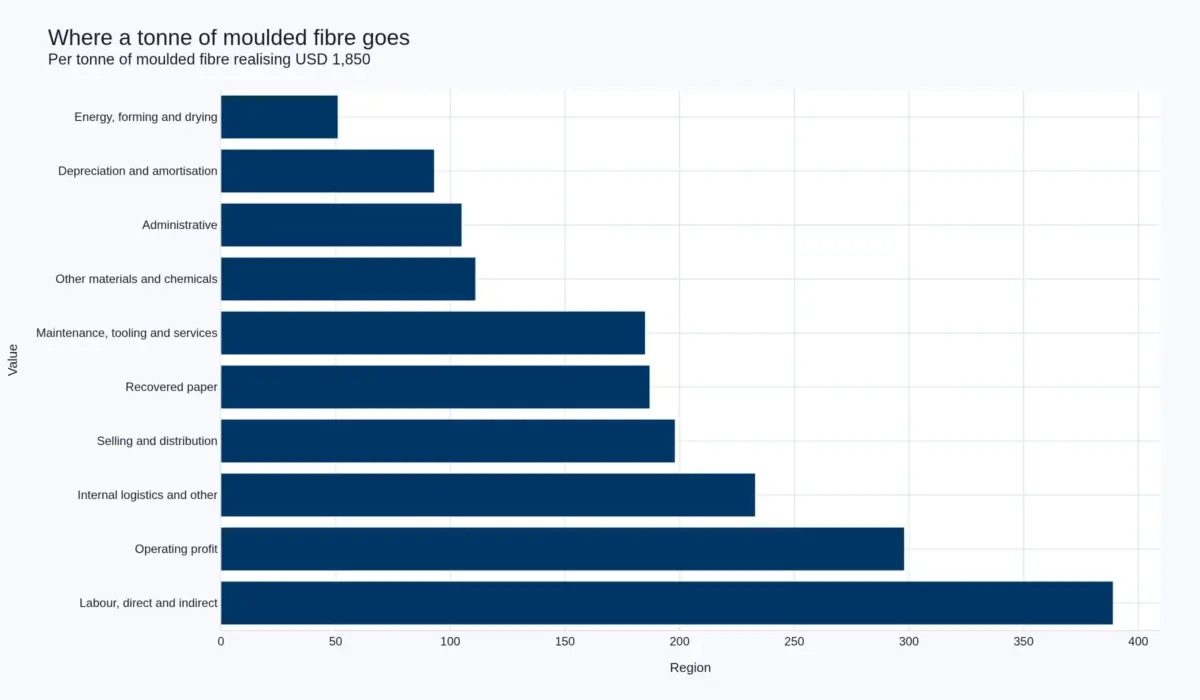
You can rebuild the whole thing. Calibrate to Hartmann’s disclosed ratios — production costs at 67.5 per cent of revenue, selling and distribution at 10.7, administrative at 5.7, operating profit at 16.1 — and allocate the production-cost block with our own input prices. The result, per tonne realising USD 1,850:
| Line | USD | % of price |
|---|---|---|
| Recovered paper, 1.15 t at EUR 140 | 187 | 10.1% |
| Energy, forming and drying, ~4 GJ | 51 | 2.8% |
| Other materials, chemicals and packaging | 111 | 6.0% |
| Labour, direct and indirect | 389 | 21.0% |
| Depreciation and amortisation | 93 | 5.0% |
| Maintenance, tooling and external services | 185 | 10.0% |
| Internal logistics and other production cost | 233 | 12.6% |
| Production costs | 1,249 | 67.5% |
| Selling and distribution | 198 | 10.7% |
| Administrative | 105 | 5.7% |
| Operating profit | 298 | 16.1% |
The totals are disclosed. The allocation inside the production-cost block is ours, and it is shown so that it can be argued with — which is more than most cost commentary on this industry offers.
Fibre and fuel together are 12.9 per cent of the price. The other 87.1 per cent is the machine, the hall, the people, the tooling and the truck.
Why that produces a 30 per cent return
When 87 per cent of the price is conversion, four levers decide profitability and none of them is procurement: uptime, cycle time, tooling life and transport distance. The operators who win are the ones who keep a line running on one product family for weeks rather than days, inside a radius short enough that freight does not eat the margin.
That is precisely the shape of egg packaging. A small number of standard formats, run for months, sold to packers and retailers who specify tray weight to within a five-gramme band, in a market where the same tray serves a continent. Hartmann’s own description of its position — leading in Europe, leading in North America, market-leading in Brazil and Argentina, with Asia still fragmented and commodity-driven — is a description of a business organised by catchment area rather than by global share.
Foodservice is the inverse and it is where the growth is. Every cup diameter, bowl depth and lid fit needs its own tool. Our primary interviews kept returning the same constraint, and it was not fibre supply or drying capacity: it was tooling changeover. A line that changes tools three times a day loses the economics that made the substitution look attractive in the first place. That is the mechanism behind the profit split we set out in the full report, where egg packaging — 46.4 per cent of the tonnage — grows 2.6 per cent a year at the best margins in the format, while the container segment growing 8.0 per cent runs on a thinner one.
The check that nearly breaks the argument
If conversion is everything and fibre is nothing, then a regional capacity glut should be the most damaging thing that can happen to a converter — and it was. Hartmann’s 2025 narrative is explicit: in Brazil, intense competition and excess capacity reduced capacity utilisation across its plants, with pressure on selling prices. It also records that in North America, avian flu tightened egg supply, prices surged, promotional activity was curtailed and consumption fell. Two forces, neither of them a rival’s technology, moving the same P&L in the same year.
That is what an 87-per-cent-conversion business looks like in a bad year: it is not undercut on material, it is undercut on someone else’s idle machine, and it is short of cartons because a hen flock was culled.
What would change the arithmetic
One thing, and it is not a cheaper fibre. Dry forming — air-laid fibre consolidated in an isostatic hot press, commercialised by PulPac with machinery partners including Kiefel — removes the drying step entirely. That deletes the largest single capital item and the largest fixed energy cost in a wet plant, which is why it matters far more than the water-saving claim that usually leads the coverage.
The 2026 evidence is that it has reached industrial speed without reaching market share. In July 2026 a Kiefel Natureformer KFD 75 was reported converting paperboard reels at above 150 metres a minute, with a single line quoted at a potential more than 80 million packaging inserts a year. In April 2026, Future Materials Sweden ordered two PulPac Scala machines for a fibre-based snus can. Against 8.84 million tonnes of installed wet capacity, those are demonstrations.
Three things to watch
One. Fibre’s share of price. If recovered paper doubles and converter margins do not move, our weighting is wrong and this whole argument needs re-cutting.
Two. Tooling changeover times in foodservice. If they fall far enough, the fast segment stops being the thin one and the profit split closes from the other direction.
Three. Gas. Drying is 2.8 per cent of price and a much larger share of fixed cost. An energy shock compresses the converter before it reaches the customer, and moulded fibre has no light-weighting escape route — the tonnage is the product.
The one number to take away
Twelve point nine per cent. That is what fibre and fuel together are worth in the price of a moulded-fibre product. Everything else in this industry — the fragmentation, the plant radius, the 30 per cent returns, the entry price of roughly EUR 6 million to double a plant — follows from the other 87.1.
Sources and methodology
Company disclosures: Hartmann Packaging A/S, Annual Report 2025; Huhtamäki Oyj, Half-yearly Report January–June 2026. Input prices: IMtrade, IMpress recovered paper market expectation, June 2026. Process physics: Didone et al., On the drying process of molded pulp products, Drying Technology 38(12), 2020. Industry process description: International Molded Fiber Association, Molded Fiber 101. Technology: Fiberdom and Kiefel industrial-scale dry-forming trials, July 2026; PulPac, Future Materials Sweden order, April 2026. Capital: Rondo doubles capacity with new moulded fibre plant, August 2026.
Research basis: 70 per cent secondary, 30 per cent primary. The cost stack is calibrated to disclosed ratios with the internal allocation built by Pheonix from our own input-price work and from structured interviews with moulded-fibre converters, tooling suppliers and egg-packers, conference-floor interviews at packaging-technology exhibitions, and open-ended interviews with procurement staff at egg integrators. The primary layer establishes mechanism — that tooling changeover, not fibre supply, binds foodservice conversion — and carries no magnitude. No third-party market-research estimate is used as an input or cited. Market figures are from the Pheonix model in the full moulded fibre packaging report, with a level band of plus or minus 12 per cent.
Frequently Asked Questions
What share of a moulded-fibre product's price is the raw material?
About 10.1 per cent of the price. Recovered paper delivered to German mills traded at EUR 132 to 145 per tonne on EUWID contract settlements in June 2026, and moulded-fibre production uses 1.1 to 1.2 tonnes of recovered paper per tonne of product. That puts fibre at roughly EUR 161 per tonne of product against a realisation of USD 1,850 for egg packaging.
How much energy does drying moulded fibre consume?
About 2.8 per cent of the price, but a much larger share of fixed cost. Moulded pulp leaves the press at 40 to 65 per cent dryness, so roughly one tonne of water must be evaporated per tonne of product — around 2.3 gigajoules of latent heat, and perhaps 4 gigajoules through a real dryer.
Why does moulded fibre earn 30 per cent returns on capital if it is a commodity?
Because 87.1 per cent of the price is conversion — labour, depreciation, maintenance, tooling and freight — so profitability is decided by uptime, cycle time, tooling life and transport distance rather than by procurement. Hartmann Packaging earned a 16.1 per cent operating margin and a 30.3 per cent return on invested capital in 2025, in the segment most often described as a commodity.
Does dry forming change the cost structure?
It removes the drying step, which is the largest single capital item and the largest fixed energy cost in a wet plant. Industrial speed has been demonstrated — a Kiefel Natureformer KFD 75 converting paperboard above 150 metres a minute, with a single line quoted at more than 80 million inserts a year — but against 8.84 million tonnes of installed wet capacity the dry base is still measured in individual machine orders.