
Editorial Article
The Same Tonne of Fibre Is Worth USD 3,356 in Foodservice and USD 1,850 in Eggs
Two tonnes of moulded fibre leave two different plants on the same day. Both were made from recovered paper bought on the same market, in the same week, at the same price. One of them sells for USD 1,850. The other sells for USD 3,356.
That ratio — 1.8 times, for the same material at the same input cost — is the most useful number in this industry. It tells you where the growth is, where the money is, and why those two things are not in the same place. It also explains why the segment with the best margins is the one that is barely growing.
The realisation ladder
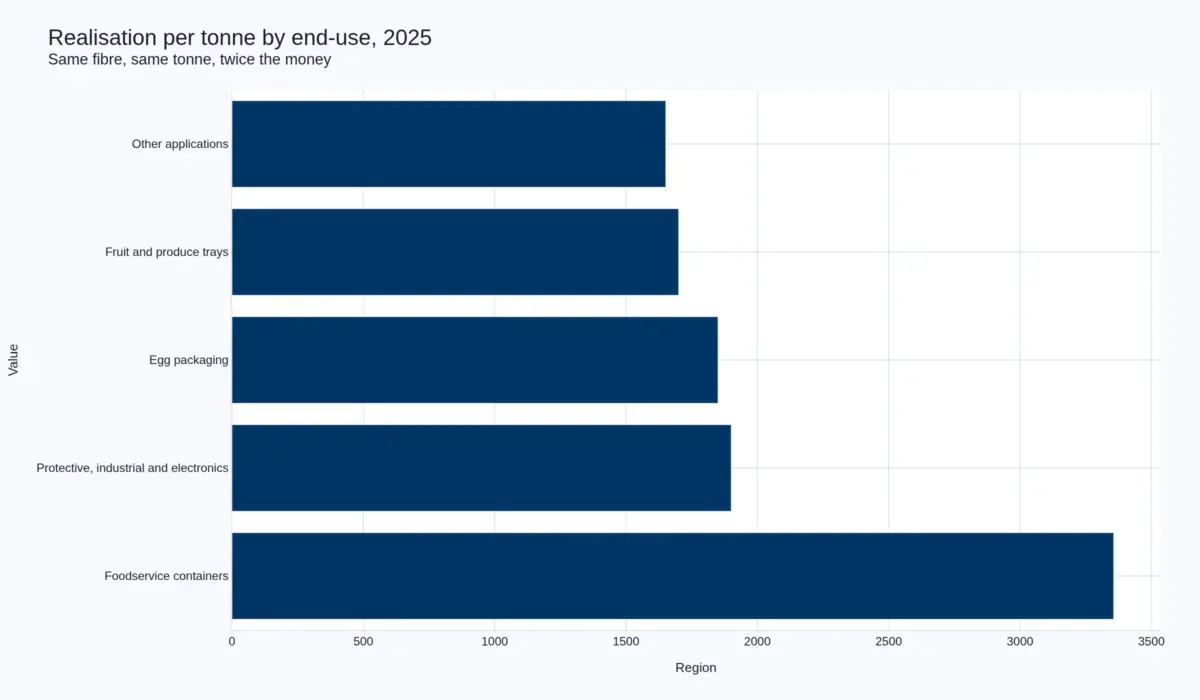
| End-use | 2025 value, USD m | 2025 tonnes, m | Realisation USD/t | Value CAGR to 2033 |
|---|---|---|---|---|
| Foodservice containers | 5,896 | 1.76 | 3,356 | 8.0% |
| Protective, industrial and electronics | 2,090 | 1.10 | 1,900 | 6.5% |
| Egg packaging | 7,594 | 4.11 | 1,850 | 2.6% |
| Fruit and produce trays | 1,921 | 1.13 | 1,700 | 3.0% |
| Other applications | 1,238 | 0.75 | 1,651 | 3.5% |
| Total | 18,739 | 8.84 | 2,119 | 5.04% |
Read the tonnage column against the price column and the market rearranges itself. Egg packaging is 46.4 per cent of the fibre and 40.5 per cent of the value. Foodservice is 19.9 per cent of the fibre and 31.5 per cent of the value. By 2033 foodservice carries 39.3 per cent of the value on 26.5 per cent of the tonnage, and the egg share of value falls below 34 per cent while its share of the fibre stays near 40.
The fibre is not what is being sold at different prices. Something else is.
What the premium actually is
Three things, and none of them is material.
Barrier chemistry. An egg tray has no barrier requirement at all — it holds a shelled egg, dry, for a few weeks, and its job is stack strength and ventilation. A foodservice container holds hot, greasy food, and for thirty years the industry solved that with fluorochemistry that is now being removed. The replacement is either a dispersion coating applied at low coat weight, or a substrate engineered to carry no coating at all. Both cost more than doing nothing, and both are decided by regulation rather than by the customer.
Tooling. Egg cartons are a small family of standard formats, run for months. Foodservice is cups, bowls, lids, clamshells and trays, in every diameter and depth a chain operates, each needing its own tool. Our primary interviews kept returning the same constraint on foodservice conversion, and it was never fibre supply: it was tooling changeover.
Tolerance. An electronics insert has to locate a device to a fraction of a millimetre and survive a drop test. That is where the protective segment’s USD 1,900 a tonne comes from, and it is why dry forming has commercialised there first — complex geometry, low barrier requirement, high value per gramme.
Note what is absent from that list: the price of recovered paper. Recovered paper delivered to German mills traded at EUR 125 to 150 a tonne in June 2026. At 1.1 to 1.2 tonnes of fibre per tonne of product, the input is worth about EUR 161 — roughly 10 per cent of an egg tray’s price and under 5 per cent of a foodservice container’s. A market in which the raw material is a tenth of the price cannot explain an 81 per cent price difference by reference to the raw material.
The profit sits at the bottom of the ladder
Now add the margin, and the inversion completes. Hartmann Packaging, the world’s leading moulded-fibre egg packaging maker, reported 2025 revenue of DKK 4,145.0 million, operating profit of DKK 665.9 million — 16.1 per cent — and a 30.3 per cent return on invested capital.
Huhtamäki, whose portfolio spans fibre and foodservice formats including the fast segments, reported first-half 2026 net sales of EUR 1,955.8 million and adjusted EBIT of EUR 198.2 million — 10.1 per cent. That is a group figure across several formats, not a moulded-fibre segment margin, and the comparison should be read with that caveat. It is still the best disclosed read on what the fast segments earn, and the direction is consistent with the physical logic: the higher the price per tonne, the more of it is spent earning it.
The mechanism is in the cost stack. Fibre and fuel together are 12.9 per cent of a moulded-fibre product’s price; the other 87.1 per cent is conversion and distribution. So a business that runs one format for months, in a plant with a defined catchment, converts at a lower cost per tonne than a business that changes tools three times a day to serve a chain that wants a new lid fit. The first sells at USD 1,850 and keeps more of it.
The regulatory point that cuts the other way
There is a catch, and it is arithmetic. A moulded-fibre foodservice container weighs about 42 grammes. The EPS foam clamshell it typically replaces weighs 13. Polypropylene is 31. So the substitution that regulation is driving adds mass to the system: converting the entire US EPS pool of roughly 36.9 billion containers a year to fibre would remove about 480,000 tonnes of plastic and add about 1.07 million tonnes of packaging mass.
Two instruments are therefore pulling the same object in opposite directions. Extended producer responsibility fees are levied per tonne, which penalises the heavier compliant substitute. Recyclability and recycled-content rules reward the fibre. A converter who has moved from foam to moulded fibre for compliance reasons is now paying a fee on three times the mass, and documenting a recycled content of 97 per cent to justify it.
That is not a contradiction in the regulation so much as a transition the regulation has not yet priced. It is also the reason the foodservice premium is not simply a margin waiting to be competed away: part of it is the cost of compliance, and it moves when the rules move.
What would close the gap
Dry forming, if it scales. Air-laid fibre consolidated in an isostatic hot press removes the drying step — the largest single capital item and the largest fixed energy cost in a wet plant — which is the only change that could lift the low-realisation segments’ economics rather than just their volume.
The 2026 milestones are real and modest at once. In July 2026, Fiberdom and Kiefel reported converting paperboard reels into three-dimensional moulded packaging at full production speed, above 150 metres a minute, with a single Natureformer KFD 75 line quoted at a potential more than 80 million packaging inserts a year. In April 2026, Future Materials Sweden ordered two PulPac Scala machines for a fibre-based snus can at Ljungby — a demanding, high-volume category that tests whether fibre can hold a lid fit at speed.
At 20 to 30 grammes per insert, 80 million inserts is 1,600 to 2,400 tonnes a year. Against 8.84 million tonnes of installed wet capacity, the technology is a demonstration. What it will take first is the protective and electronics segment, where realisation is already USD 1,900 a tonne and complex geometry is the product — not foodservice, where the barrier is the problem.
Three falsifiers
If foodservice moulded-fibre realisation per tonne falls below USD 2,600 by 2029 while tonnage keeps growing, the premium is a temporary regulatory artefact and this ladder collapses into a volume business.
If a listed converter discloses a moulded-fibre segment operating margin above 16.1 per cent inside a foodservice-heavy portfolio, then the profit split is about portfolio mix, not about the format, and the argument here is wrong.
If EPR fee schedules shift from per-tonne to per-item, the mass penalty on fibre disappears and the foodservice premium should widen rather than compress.
What to do with this
Two practical consequences. If you are buying moulded fibre, the price you pay is set by the tooling and the barrier, not by the paper — so a specification conversation about coat weight and tooling commonality is worth more than a raw-material index clause. If you are evaluating a converter, the realisation per tonne tells you which business they are actually in, and the margin tells you whether they know it.
Sources and methodology
Company disclosures: Hartmann Packaging A/S, Annual Report 2025; Huhtamäki Oyj, Half-yearly Report January–June 2026. Agricultural demand: FAOSTAT, Agricultural production statistics 2010–2024, which puts world egg production at 100 million tonnes in 2024. Input prices: IMtrade, IMpress recovered paper market expectation, June 2026. Process physics: Didone et al., On the drying process of molded pulp products, Drying Technology 38(12), 2020. Industry process description: International Molded Fiber Association, Molded Fiber 101. Technology: Fiberdom and Kiefel, July 2026; PulPac, Future Materials Sweden order, April 2026. The 42-gramme fibre container, 13-gramme EPS clamshell and 31-gramme polypropylene container are the substrate assumptions carried in our foodservice rigid container report; the regulatory instruments are set out in our European PFAS-free food contact report.
Research basis: 70 per cent secondary, 30 per cent primary. The primary layer consists of structured interviews with moulded-fibre converters, tooling suppliers and egg-packers; conference-floor interviews at packaging-technology exhibitions; open-ended interviews with procurement staff at egg integrators; and a small converter survey on cycle time, tooling changeover and utilisation through 2025 and 2026. It establishes mechanism and carries no magnitude. No third-party market-research estimate is used as an input or cited. Market figures are from the Pheonix model in the full moulded fibre packaging report, with a level band of plus or minus 12 per cent.
Frequently Asked Questions
Why is a tonne of moulded fibre worth twice as much in foodservice as in eggs?
USD 3,356 a tonne in foodservice containers against USD 1,850 in egg packaging, with a market blended realisation of USD 2,119. The difference is not the fibre — it is the barrier chemistry, the tooling and the tolerance the application demands.
What share of the market does each segment hold?
Egg packaging is 46.4 per cent of the tonnage and 40.5 per cent of the value, growing 2.6 per cent a year. Foodservice is 19.9 per cent of the tonnage and 31.5 per cent of the value, growing 8.0 per cent. By 2033 foodservice carries 39.3 per cent of the value on 26.5 per cent of the tonnage.
Does regulation always favour moulded fibre over plastic?
The mass penalty does. A moulded-fibre foodservice container weighs about 42 grammes against 13 for the EPS clamshell it replaces, so converting the US EPS pool to fibre removes roughly 480,000 tonnes of plastic and adds about 1.07 million tonnes of packaging mass. EPR fees levied per tonne therefore penalise the compliant substitute while recyclability rules reward it.
Will dry forming close the price gap?
Dry forming removes the drying step, which is the largest capital item and largest fixed energy cost in a wet plant. It has reached industrial speed — above 150 metres a minute on a Kiefel Natureformer KFD 75, with a single line quoted at more than 80 million inserts a year — but production is still measured in individual machine orders against 8.84 million tonnes of installed wet capacity.