
Global Aesthetic Market Report, Size & Forecast 2026-2033
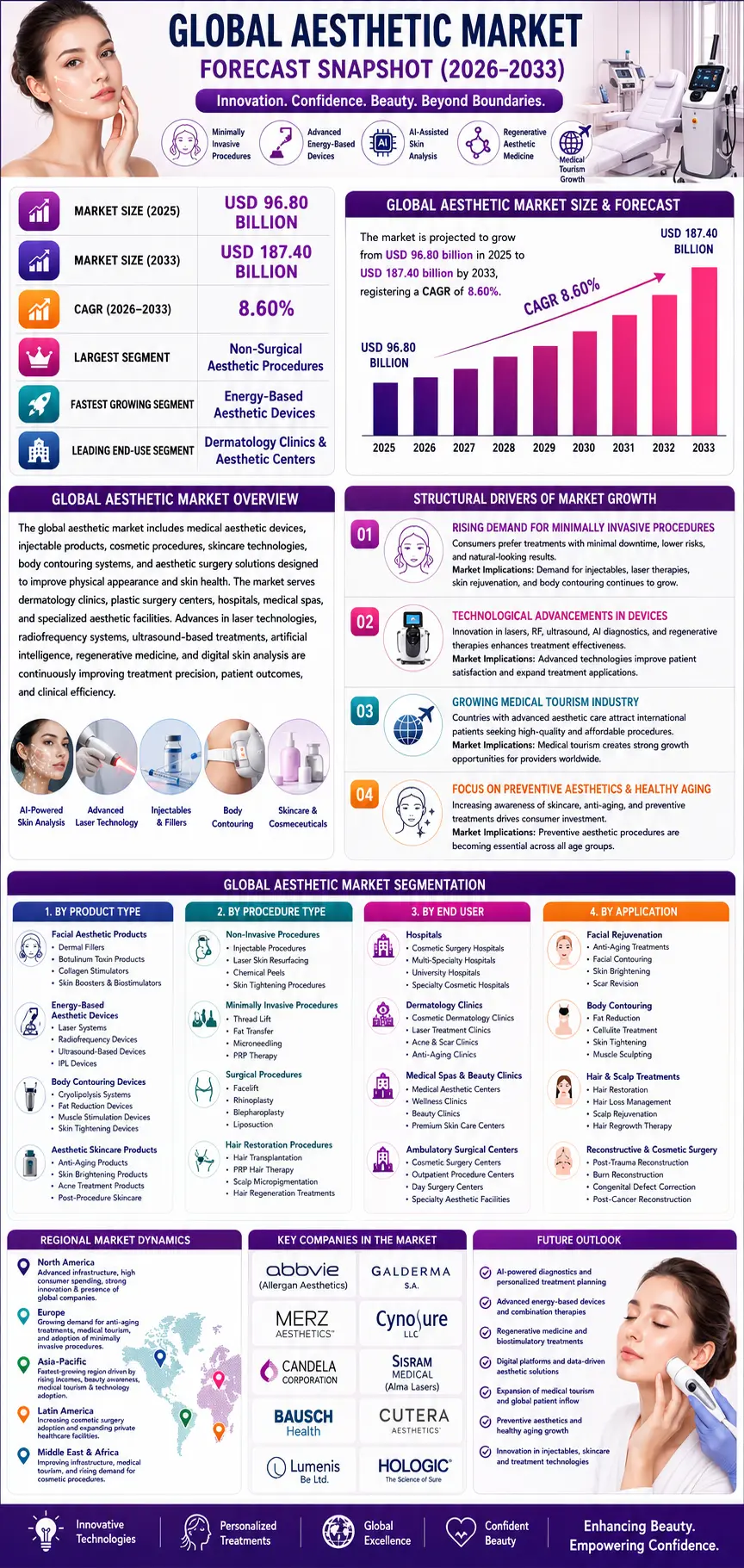
Global Aesthetic Market Forecast Snapshot (2026–2033)
| Metric | Value |
|---|---|
| Market Size (2025) | USD 96.80 Billion |
| Market Size (2033) | USD 187.40 Billion |
| CAGR (2026–2033) | 8.60% |
| Largest Segment | Non-Surgical Aesthetic Procedures |
| Fastest Growing Segment | Energy-Based Aesthetic Devices |
| Leading End-Use Segment | Dermatology Clinics & Aesthetic Centers |
| Key Trend | AI-Assisted Skin Analysis, Personalized Aesthetic Treatments, Advanced Energy-Based Devices & Regenerative Aesthetic Medicine |
| Regulatory Influence | Medical Device Regulations, Cosmetic Product Safety Standards, Clinical Guidelines & Healthcare Quality Compliance |
| Future Outlook | Growth Driven by Minimally Invasive Procedures, Medical Tourism, Technological Innovation & Rising Beauty Consciousness |
Global Aesthetic Market Size & Forecast
The Global Aesthetic Market is expected to witness strong growth during the forecast period from 2026 to 2033. The market was valued at USD 96.80 billion in 2025 and is projected to reach approximately USD 187.40 billion by 2033, registering a CAGR of 8.60%. Market growth is primarily driven by increasing consumer preference for minimally invasive cosmetic procedures, rising disposable incomes, growing awareness of aesthetic treatments, expanding medical tourism, and continuous innovation in aesthetic devices, injectables, and regenerative medicine. The increasing focus on healthy aging and personalized cosmetic solutions is further supporting market expansion.Global Aesthetic Market Overview
The global aesthetic market comprises medical aesthetic devices, injectable products, cosmetic procedures, skincare technologies, body contouring systems, and aesthetic surgery solutions designed to improve physical appearance and skin health. The market serves dermatology clinics, plastic surgery centers, hospitals, medical spas, and specialized aesthetic facilities. Advances in laser technologies, radiofrequency systems, ultrasound-based treatments, artificial intelligence, regenerative medicine, and digital skin analysis are continuously improving treatment precision, patient outcomes, and clinical efficiency.Structural Drivers of Market Growth
1. Rising Demand for Minimally Invasive Procedures
Consumers increasingly prefer aesthetic treatments offering minimal downtime, reduced risks, and natural-looking results. Market Implications: Demand for injectables, laser treatments, skin rejuvenation, and body contouring procedures continues to expand worldwide.2. Technological Advancements in Aesthetic Devices
Continuous innovation in laser systems, radiofrequency, ultrasound, AI-assisted diagnostics, and regenerative therapies is enhancing treatment effectiveness. Market Implications: Advanced technologies are improving patient satisfaction while expanding treatment applications.3. Growing Medical Tourism Industry
Countries with advanced cosmetic healthcare infrastructure continue attracting international patients seeking affordable, high-quality aesthetic procedures. Market Implications: Medical tourism is creating significant growth opportunities for aesthetic service providers globally.4. Increasing Focus on Preventive Aesthetics and Healthy Aging
Consumers are increasingly investing in preventive skincare, anti-aging treatments, and long-term aesthetic maintenance. Market Implications: Preventive aesthetic procedures are becoming an integral part of modern healthcare and wellness.Global Aesthetic Market Segmentation
1. By Product Type
1.1 Facial Aesthetic Products
1.1.1 Dermal Fillers 1.1.1.1 Hyaluronic Acid Fillers 1.1.1.1.1 Cross-Linked Hyaluronic Acid Fillers 1.1.1.1.2 Biphasic Fillers 1.1.1.1.3 Monophasic Fillers 1.1.1.1.4 Long-Lasting Dermal Fillers 1.1.2 Botulinum Toxin Products 1.1.3 Collagen Stimulators 1.1.4 Skin Boosters & Biostimulators1.2 Energy-Based Aesthetic Devices
1.2.1 Laser Systems 1.2.2 Radiofrequency Devices 1.2.3 Ultrasound-Based Devices 1.2.4 Intense Pulsed Light (IPL) Devices1.3 Body Contouring Devices
1.3.1 Cryolipolysis Systems 1.3.2 Fat Reduction Devices 1.3.3 Muscle Stimulation Devices 1.3.4 Skin Tightening Devices1.4 Aesthetic Skincare Products
1.4.1 Anti-Aging Products 1.4.2 Skin Brightening Products 1.4.3 Acne Treatment Products 1.4.4 Post-Procedure Skincare Products2. By Procedure Type
2.1 Non-Invasive Procedures
2.1.1 Injectable Procedures 2.1.1.1 Facial Rejuvenation Treatments 2.1.1.1.1 Wrinkle Reduction 2.1.1.1.2 Lip Enhancement 2.1.1.1.3 Cheek Augmentation 2.1.1.1.4 Chin Contouring 2.1.2 Laser Skin Resurfacing 2.1.3 Chemical Peels 2.1.4 Skin Tightening Procedures2.2 Minimally Invasive Procedures
2.2.1 Thread Lift 2.2.2 Fat Transfer 2.2.3 Microneedling 2.2.4 Platelet-Rich Plasma (PRP) Therapy2.3 Surgical Procedures
2.3.1 Facelift 2.3.2 Rhinoplasty 2.3.3 Blepharoplasty 2.3.4 Liposuction2.4 Hair Restoration Procedures
2.4.1 Hair Transplantation 2.4.2 PRP Hair Therapy 2.4.3 Scalp Micropigmentation 2.4.4 Hair Regeneration Treatments3. By End User
3.1 Hospitals
3.1.1 Cosmetic Surgery Hospitals 3.1.1.1 Plastic Surgery Departments 3.1.1.1.1 Facial Plastic Surgery 3.1.1.1.2 Reconstructive Surgery 3.1.1.1.3 Cosmetic Dermatology 3.1.1.1.4 Medical Aesthetic Centers 3.1.2 Multi-Specialty Hospitals 3.1.3 University Hospitals 3.1.4 Specialty Cosmetic Hospitals3.2 Dermatology Clinics
3.2.1 Cosmetic Dermatology Clinics 3.2.2 Laser Treatment Clinics 3.2.3 Acne & Scar Clinics 3.2.4 Anti-Aging Clinics3.3 Medical Spas & Beauty Clinics
3.3.1 Medical Aesthetic Centers 3.3.2 Wellness Clinics 3.3.3 Beauty Clinics 3.3.4 Premium Skin Care Centers3.4 Ambulatory Surgical Centers
3.4.1 Cosmetic Surgery Centers 3.4.2 Outpatient Procedure Centers 3.4.3 Day Surgery Centers 3.4.4 Specialty Aesthetic Facilities4. By Application
4.1 Facial Rejuvenation
4.1.1 Anti-Aging Treatments 4.1.1.1 Skin Revitalization 4.1.1.1.1 Wrinkle Reduction 4.1.1.1.2 Pigmentation Treatment 4.1.1.1.3 Skin Tightening 4.1.1.1.4 Acne Scar Reduction 4.1.2 Facial Contouring 4.1.3 Skin Brightening 4.1.4 Scar Revision4.2 Body Contouring
4.2.1 Fat Reduction 4.2.2 Cellulite Treatment 4.2.3 Skin Tightening 4.2.4 Muscle Sculpting4.3 Hair & Scalp Treatments
4.3.1 Hair Restoration 4.3.2 Hair Loss Management 4.3.3 Scalp Rejuvenation 4.3.4 Hair Regrowth Therapy4.4 Reconstructive & Cosmetic Surgery
4.4.1 Post-Trauma Reconstruction 4.4.2 Burn Reconstruction 4.4.3 Congenital Defect Correction 4.4.4 Post-Cancer ReconstructionRegional Market Dynamics
North America
Leading region supported by advanced healthcare infrastructure, high consumer spending on cosmetic procedures, technological innovation, and strong presence of global aesthetic companies.Europe
Driven by growing demand for anti-aging treatments, favorable healthcare infrastructure, increasing medical tourism, and widespread adoption of minimally invasive procedures.Asia-Pacific
Fastest-growing region supported by rising disposable incomes, expanding beauty-conscious population, increasing medical tourism, rapid technological adoption, and growing investments in cosmetic healthcare.Latin America
Growing market driven by increasing cosmetic surgery adoption, expanding private healthcare facilities, and rising awareness of aesthetic treatments.Middle East & Africa
Emerging market supported by improving healthcare infrastructure, increasing medical tourism, rising luxury healthcare investments, and growing demand for cosmetic procedures.Competitive Landscape
The Global Aesthetic Market is highly competitive with multinational medical device manufacturers, pharmaceutical companies, cosmetic product developers, and specialized aesthetic technology providers focusing on minimally invasive procedures, advanced energy-based devices, injectable products, regenerative medicine, and AI-enabled treatment platforms. Key Companies Operating in the Market Include:- AbbVie Inc. (Allergan Aesthetics)
- Galderma S.A.
- Merz Aesthetics
- Cynosure LLC
- Candela Corporation
- Sisram Medical Ltd. (Alma Lasers)
- Bausch Health Companies Inc. (Solta Medical)
- Cutera, Inc.
- Lumenis Be Ltd.
- Hologic, Inc.
Strategic Outlook
The future of the global aesthetic market will be shaped by artificial intelligence, regenerative medicine, personalized treatment planning, advanced energy-based technologies, robotic-assisted procedures, and digital patient management platforms. Healthcare providers are increasingly investing in AI-assisted skin diagnostics, combination therapies, precision aesthetic treatments, and minimally invasive technologies to improve patient outcomes and treatment efficiency. Integration of data analytics, digital imaging, and personalized medicine will continue transforming aesthetic healthcare worldwide. Growing emphasis on healthy aging, preventive aesthetics, sustainable cosmetic products, personalized skincare, and global medical tourism will continue creating substantial market opportunities. Companies focusing on technological innovation, clinical research, product diversification, and international market expansion will strengthen their competitive position in the global aesthetic industry.Final Market Perspective
The Global Aesthetic Market continues to evolve through rapid technological innovation, increasing consumer awareness, and expanding adoption of minimally invasive cosmetic procedures. Rising demand for personalized aesthetic solutions, regenerative therapies, advanced medical devices, and digital treatment technologies is expected to support sustained market growth throughout the forecast period. Organizations delivering safe, effective, and innovative aesthetic solutions will be well-positioned to capitalize on long-term opportunities across the global cosmetic healthcare ecosystem.Table of Contents
1. Executive Summary
1.1 Market Snapshot (2026–2033)
1.2 Key Growth Highlights
1.3 Demand-Supply Overview
1.4 Key Strategic Insights
1.5 Analyst Viewpoint
2. Market Overview
2.1 Introduction to Global Aesthetic Market
2.2 Industry Value Chain Analysis
2.3 Market Evolution & Historical Trends
2.4 Macro-Economic Impact Analysis
2.5 Global Aesthetic Healthcare Ecosystem & Patient Care Value Chain
2.6 AI-Assisted Skin Analysis, Energy-Based Devices, Regenerative Medicine & Personalized Aesthetic Treatment Trends
3. Global Aesthetic Market Forecast Snapshot (USD Billion), 2026–2033
3.1 2025 Market Size
3.2 2033 Market Size
3.3 CAGR (2026–2033)
3.4 Largest Region
3.5 Fastest Growing Region
3.6 Largest Segment
3.7 Key Trend
3.8 Future Outlook
4. Key Drivers of Market Growth
4.1 Rising Demand for Minimally Invasive Cosmetic Procedures
4.2 Technological Advancements in Aesthetic Devices
4.3 Growing Medical Tourism Industry
4.4 Increasing Focus on Preventive Aesthetics & Healthy Aging
4.5 Rising Consumer Demand for Personalized Aesthetic Treatments
5. Market Challenges
5.1 High Cost of Advanced Aesthetic Procedures
5.2 Stringent Regulatory Compliance for Medical Devices & Injectables
5.3 Shortage of Skilled Aesthetic Professionals
5.4 Safety Concerns & Procedure-Related Risks
6. Market Segmentation by Product Type (USD Billion), 2026–2033
6.1 Facial Aesthetic Products
6.1.1 Dermal Fillers
6.1.1.1 Hyaluronic Acid Fillers
6.1.1.1.1 Cross-Linked Hyaluronic Acid Fillers
6.1.1.1.2 Biphasic Fillers
6.1.1.1.3 Monophasic Fillers
6.1.1.1.4 Long-Lasting Dermal Fillers
6.1.2 Botulinum Toxin Products
6.1.3 Collagen Stimulators
6.1.4 Skin Boosters & Biostimulators
6.2 Energy-Based Aesthetic Devices
6.2.1 Laser Systems
6.2.2 Radiofrequency Devices
6.2.3 Ultrasound-Based Devices
6.2.4 Intense Pulsed Light (IPL) Devices
6.3 Body Contouring Devices
6.3.1 Cryolipolysis Systems
6.3.2 Fat Reduction Devices
6.3.3 Muscle Stimulation Devices
6.3.4 Skin Tightening Devices
6.4 Aesthetic Skincare Products
6.4.1 Anti-Aging Products
6.4.2 Skin Brightening Products
6.4.3 Acne Treatment Products
6.4.4 Post-Procedure Skincare Products
7. Market Segmentation by Procedure Type (USD Billion), 2026–2033
7.1 Non-Invasive Procedures
7.1.1 Injectable Procedures
7.1.1.1 Facial Rejuvenation Treatments
7.1.1.1.1 Wrinkle Reduction
7.1.1.1.2 Lip Enhancement
7.1.1.1.3 Cheek Augmentation
7.1.1.1.4 Chin Contouring
7.1.2 Laser Skin Resurfacing
7.1.3 Chemical Peels
7.1.4 Skin Tightening Procedures
7.2 Minimally Invasive Procedures
7.2.1 Thread Lift
7.2.2 Fat Transfer
7.2.3 Microneedling
7.2.4 Platelet-Rich Plasma (PRP) Therapy
7.3 Surgical Procedures
7.3.1 Facelift
7.3.2 Rhinoplasty
7.3.3 Blepharoplasty
7.3.4 Liposuction
7.4 Hair Restoration Procedures
7.4.1 Hair Transplantation
7.4.2 PRP Hair Therapy
7.4.3 Scalp Micropigmentation
7.4.4 Hair Regeneration Treatments
8. Market Segmentation by End User (USD Billion), 2026–2033
8.1 Hospitals
8.2 Dermatology Clinics
8.3 Medical Spas & Beauty Clinics
8.4 Ambulatory Surgical Centers
9. Market Segmentation by Application (USD Billion), 2026–2033
9.1 Facial Rejuvenation
9.2 Body Contouring
9.3 Hair & Scalp Treatments
9.4 Reconstructive & Cosmetic Surgery
10. Market Segmentation by Region (USD Billion), 2026–2033
10.1 North America
10.2 Europe
10.3 Asia-Pacific
10.4 Latin America
10.5 Middle East & Africa
11. Regional Market Analysis
11.1 North America – Market Leader
11.2 Asia-Pacific – Fastest Growing Region
11.3 Europe – Advanced Aesthetic Innovation Hub
11.4 Latin America – Expanding Cosmetic Procedure Market
11.5 Middle East & Africa – Emerging Aesthetic Healthcare Market
12. Competitive Landscape
12.1 Market Share Analysis
12.2 Competitive Positioning Matrix
12.3 Strategic Developments (M&A, Product Launches, Partnerships)
12.4 Innovation Benchmarking
12.5 AI-Driven Aesthetic Technology & Treatment Innovation Assessment
13. Company Profiles
13.1 AbbVie Inc. (Allergan Aesthetics)
13.2 Galderma S.A.
13.3 Merz Aesthetics
13.4 Cynosure LLC
13.5 Candela Corporation
13.6 Sisram Medical Ltd. (Alma Lasers)
13.7 Bausch Health Companies Inc. (Solta Medical)
13.8 Cutera, Inc.
13.9 Lumenis Be Ltd.
13.10 Hologic, Inc.
14. Strategic Intelligence & AI-Driven Insights
14.1 Pheonix Demand Forecast Engine
14.2 Global Aesthetic Market Dashboard
14.3 AI-Powered Skin Analysis & Clinical Decision Intelligence
14.4 Personalized Aesthetic Treatment & Regenerative Medicine Intelligence
14.5 Medical Tourism & Digital Patient Engagement Analytics
15. Investment & Growth Opportunities
15.1 Energy-Based Aesthetic Devices
15.2 Injectable Aesthetic Products
15.3 AI-Assisted Diagnostic Technologies
15.4 Regenerative Aesthetic Medicine
15.5 Medical Tourism & Personalized Aesthetic Care
16. Why the Global Aesthetic Market Remains Critical
16.1 Rising Demand for Minimally Invasive Cosmetic Procedures
16.2 Continuous Innovation in Aesthetic Technologies
16.3 Growing Medical Tourism & Beauty Consciousness
16.4 Expanding Adoption of Personalized & Preventive Aesthetic Care
16.5 Long-Term Growth Across Medical Aesthetics, Skincare & Cosmetic Healthcare
17. Appendix
18. About Pheonix Research
19. Disclaimer
Competitive Landscape
Global Aesthetic Market Competitive Intensity & Market Structure Overview
The Global Aesthetic Market is highly competitive and characterized by the presence of multinational medical aesthetic companies, aesthetic device manufacturers, cosmetic pharmaceutical companies, dermatology solution providers, plastic surgery technology developers, and regenerative medicine innovators. Competitive intensity is driven by minimally invasive aesthetic procedures, AI-assisted skin analysis, energy-based aesthetic technologies, personalized treatment solutions, regenerative medicine, and continuous product innovation.
Companies compete across multiple aesthetic segments including facial aesthetic products, energy-based aesthetic devices, body contouring devices, aesthetic skincare products, non-invasive procedures, minimally invasive procedures, surgical procedures, and hair restoration treatments. Growing consumer demand for minimally invasive cosmetic treatments, expanding medical tourism, increasing beauty consciousness, rising healthy aging trends, and continuous technological advancements are intensifying competition while encouraging innovation in aesthetic devices and treatment platforms.
The market structure is evolving toward AI-powered skin diagnostics, advanced laser technologies, regenerative medicine, precision treatment planning, personalized aesthetic therapies, robotic-assisted procedures, digital patient management platforms, and minimally invasive treatment ecosystems. Market participants are investing heavily in next-generation aesthetic devices, injectable innovations, combination therapies, clinical research, and strategic partnerships to strengthen market positioning and improve patient outcomes.
Global Aesthetic Market Competitive Intensity & Market Structure Current Scenario
Leading Global Aesthetic Companies
- AbbVie Inc. (Allergan Aesthetics): A global leader in facial aesthetics providing botulinum toxin products, dermal fillers, body contouring technologies, and comprehensive aesthetic treatment portfolios supported by continuous product innovation.
- Galderma S.A.: A global dermatology company offering injectable aesthetics, skincare products, and regenerative treatment solutions focused on personalized patient care and clinical excellence.
- Merz Aesthetics: An international aesthetics company providing injectable products, medical devices, and comprehensive aesthetic treatment solutions supported by ongoing clinical innovation.
- Cynosure LLC: A leading manufacturer of energy-based aesthetic devices specializing in laser treatments, body contouring systems, skin rejuvenation technologies, and advanced aesthetic platforms.
- Candela Corporation: A global provider of medical aesthetic laser technologies delivering advanced treatment systems for dermatology, skin resurfacing, hair removal, vascular therapies, and aesthetic medicine.
- Sisram Medical Ltd. (Alma Lasers): A global medical aesthetics company offering energy-based treatment platforms, laser technologies, radiofrequency systems, and minimally invasive aesthetic solutions.
- Bausch Health Companies Inc. (Solta Medical): A medical aesthetics company specializing in radiofrequency technologies, skin tightening platforms, body contouring systems, and minimally invasive cosmetic treatment solutions.
- Cutera, Inc.: A leading developer of aesthetic and dermatology technologies providing laser systems, body sculpting devices, and skin rejuvenation solutions for healthcare professionals.
- Lumenis Be Ltd.: A global medical technology company delivering advanced laser, intense pulsed light (IPL), and energy-based aesthetic solutions across multiple cosmetic applications.
- Hologic, Inc.: A healthcare technology company expanding its medical aesthetics portfolio through advanced energy-based treatment systems, women’s health technologies, and innovative clinical solutions.
Key Competitive Intensity & Market Structure Drivers
Increasing consumer demand for minimally invasive aesthetic procedures, advanced skincare treatments, personalized cosmetic solutions, and healthy aging is intensifying competition among aesthetic companies worldwide.
Advancements in AI-assisted skin analysis, energy-based aesthetic devices, regenerative medicine, laser technologies, radiofrequency systems, ultrasound-based treatments, and precision treatment planning are becoming major competitive differentiators across the market.
Growing demand for medical tourism, natural-looking aesthetic outcomes, preventive aesthetics, and innovative treatment technologies is strengthening market competitiveness while accelerating innovation across aesthetic care.
Strategic collaborations among medical device manufacturers, dermatology clinics, plastic surgery centers, hospitals, research institutions, and healthcare technology companies are accelerating product innovation, expanding treatment capabilities, and improving patient experiences.
Continuous investment in AI-powered diagnostics, advanced injectables, regenerative therapies, digital patient management platforms, minimally invasive technologies, and international clinical expansion is enabling companies to improve operational efficiency and long-term competitiveness.
Strategic Implications of Competitive Intensity & Market Structure
Companies with comprehensive aesthetic portfolios, advanced medical technologies, strong clinical expertise, and personalized treatment capabilities are expected to maintain significant competitive advantages.
Investment in AI-powered diagnostics, energy-based treatment platforms, regenerative medicine, minimally invasive procedures, digital healthcare technologies, and clinical innovation is becoming increasingly important for long-term market leadership.
Organizations focusing on expanding aesthetic treatment offerings, strengthening global medical tourism capabilities, improving patient outcomes, and enhancing personalized treatment experiences are likely to increase revenue growth and market share.
Strategic partnerships with hospitals, dermatology clinics, plastic surgery centers, healthcare providers, research organizations, and technology companies are supporting innovation, operational efficiency, and international market expansion.
Businesses capable of combining technological innovation, clinical excellence, personalized treatment planning, operational scalability, and comprehensive aesthetic solution portfolios will be best positioned to compete effectively in the evolving global aesthetic market.
Global Aesthetic Market Competitive Intensity & Market Structure Forward Outlook
The competitive landscape of the global aesthetic market is expected to become increasingly technology-driven, AI-enabled, and personalized as demand for advanced cosmetic procedures continues to expand worldwide.
Future competition will be shaped by AI-assisted skin diagnostics, regenerative aesthetic medicine, advanced energy-based technologies, personalized treatment planning, robotic-assisted procedures, digital patient management platforms, and precision aesthetic medicine.
Market participants are expected to increase investments in next-generation aesthetic devices, regenerative therapies, AI-powered treatment planning, innovative injectable products, digital healthcare infrastructure, and international market expansion to strengthen competitive positioning.
Over the forecast period, companies that successfully combine technological innovation, clinical excellence, personalized aesthetic solutions, operational scalability, and comprehensive treatment capabilities will be best positioned to lead the evolving global aesthetic market.
Value Chain
Global Aesthetic Market Value Chain & Supply Chain Evolution Overview
The Global Aesthetic Market operates through a highly integrated value chain comprising raw material sourcing, pharmaceutical and medical-grade material manufacturing, aesthetic device production, injectable formulation, product development, clinical validation, regulatory compliance, distribution, healthcare service delivery, and post-treatment patient care. The ecosystem includes raw material suppliers, medical device manufacturers, pharmaceutical companies, biotechnology firms, dermatology clinics, plastic surgery centers, hospitals, medical spas, distributors, digital health providers, and regulatory agencies working together to deliver safe, effective, and innovative aesthetic solutions across facial aesthetics, body contouring, skin rejuvenation, hair restoration, and reconstructive procedures.
The market is being driven by increasing consumer preference for minimally invasive cosmetic procedures, rising disposable incomes, growing awareness of aesthetic treatments, expanding medical tourism, and continuous technological advancements in aesthetic devices, injectables, regenerative medicine, and AI-assisted diagnostics. Manufacturers are increasingly investing in advanced laser systems, radiofrequency devices, ultrasound technologies, digital imaging platforms, regenerative therapies, and personalized treatment solutions to improve clinical outcomes, patient satisfaction, and operational efficiency.
The integration of artificial intelligence, digital skin analysis, regenerative medicine, robotic-assisted procedures, cloud-based patient management systems, advanced imaging technologies, and precision treatment planning has significantly strengthened the aesthetic market value chain. Organizations are enhancing collaboration between pharmaceutical companies, medical device manufacturers, healthcare providers, research institutions, distributors, and digital technology providers while expanding personalized treatment ecosystems and improving patient experiences.
Advancements in minimally invasive procedures, energy-based aesthetic devices, regenerative therapies, precision injectables, AI-powered diagnostics, personalized skincare, and digital healthcare technologies are transforming the aesthetic industry while improving treatment precision, patient safety, regulatory compliance, workflow efficiency, and long-term clinical outcomes across global healthcare markets.
Global Aesthetic Market Value Chain & Supply Chain Evolution Current Scenario
Market-Specific Value Chain
- Raw Material Sourcing & Pharmaceutical Manufacturing: Production of pharmaceutical ingredients, biomaterials, hyaluronic acid, botulinum toxin formulations, collagen stimulators, medical-grade polymers, specialty chemicals, biologics, packaging materials, and regenerative medicine components.
- Aesthetic Device Development & Technology Integration: Design, engineering, and manufacturing of laser systems, radiofrequency devices, ultrasound-based equipment, intense pulsed light (IPL) systems, body contouring technologies, AI-assisted diagnostic platforms, digital imaging systems, and robotic-assisted treatment technologies.
- Product Manufacturing & Clinical Validation: Injectable formulation, device assembly, software integration, quality testing, clinical trials, treatment validation, packaging, sterilization, and commercialization of aesthetic products and technologies.
- Quality Assurance & Regulatory Compliance: Product testing, manufacturing quality control, medical device certification, cosmetic safety compliance, pharmaceutical regulations, clinical practice guidelines, healthcare quality assurance, and international regulatory approvals.
- Distribution & Healthcare Supply Chain: Global distribution, medical equipment logistics, pharmaceutical supply, inventory management, distributor partnerships, hospital procurement, clinic deployment, and digital supply chain coordination.
- Clinical Services & Patient Management: Patient consultation, AI-assisted skin analysis, treatment planning, procedure delivery, digital health records, post-treatment monitoring, patient education, and long-term aesthetic maintenance programs.
- End User Applications: Deployment across dermatology clinics, aesthetic centers, hospitals, plastic surgery facilities, medical spas, ambulatory surgical centers, cosmetic clinics, and specialized healthcare providers.
Company-to-Stage Mapping
- Raw Material Sourcing & Pharmaceutical Manufacturing: Biopharmaceutical companies, specialty chemical manufacturers, biomaterial suppliers, medical-grade polymer producers, injectable ingredient suppliers, regenerative medicine developers, and pharmaceutical raw material manufacturers.
- Aesthetic Device Development & Technology Integration: Cynosure LLC, Candela Corporation, Sisram Medical Ltd. (Alma Lasers), Cutera, Inc., Lumenis Be Ltd., Hologic, Inc., AI technology developers, medical imaging companies, and healthcare software providers.
- Product Manufacturing & Clinical Validation: AbbVie Inc. (Allergan Aesthetics), Galderma S.A., Merz Aesthetics, Bausch Health Companies Inc. (Solta Medical), contract manufacturers, clinical research organizations, and medical device manufacturers.
- Distribution & Healthcare Supply Chain: Medical distributors, pharmaceutical wholesalers, healthcare logistics providers, hospital procurement organizations, specialty distributors, digital supply chain providers, and international healthcare networks.
- Clinical Services & Patient Management: Dermatology clinics, plastic surgery centers, hospitals, medical spas, aesthetic physicians, cosmetic surgeons, telehealth providers, and digital patient engagement platforms.
- Quality Assurance & Regulatory Compliance: Medical device regulatory authorities, pharmaceutical regulatory agencies, healthcare accreditation organizations, quality assurance laboratories, clinical guideline bodies, and healthcare compliance organizations.
- End User Applications: Dermatology clinics, aesthetic centers, hospitals, plastic surgery facilities, ambulatory surgical centers, medical spas, wellness clinics, and specialized cosmetic healthcare providers.
Key Value Chain & Supply Chain Evolution Signals in Global Aesthetic Market
Growing Adoption of Minimally Invasive Aesthetic Procedures
Healthcare providers are expanding injectable therapies, laser treatments, skin rejuvenation, body contouring, and non-surgical cosmetic procedures to meet growing consumer demand for effective treatments with minimal downtime.
Expansion of AI-Assisted Aesthetic Technologies
Artificial intelligence, digital skin analysis, advanced imaging, and personalized treatment planning are improving diagnostic accuracy, treatment precision, workflow efficiency, and patient outcomes.
Increasing Investment in Energy-Based Aesthetic Devices
Manufacturers continue investing in advanced laser systems, radiofrequency technologies, ultrasound-based devices, and body contouring platforms to enhance treatment effectiveness and expand clinical applications.
Growth of Regenerative Aesthetic Medicine
Platelet-rich plasma (PRP), collagen stimulators, skin boosters, biostimulators, regenerative therapies, and personalized biologic treatments are expanding treatment options while supporting healthy aging and long-term aesthetic maintenance.
Expansion of Digital Healthcare Integration
Cloud-based patient management systems, teleconsultation platforms, electronic health records, and digital imaging technologies are improving clinical coordination, patient engagement, and treatment monitoring.
Growing Medical Tourism and Global Clinical Networks
Expanding international healthcare infrastructure, specialized cosmetic clinics, and cross-border medical tourism continue strengthening global access to advanced aesthetic treatments and specialized expertise.
Strategic Implications of Value Chain & Supply Chain Evolution
Investment in Advanced Aesthetic Technologies
AI-assisted diagnostics, energy-based devices, regenerative therapies, and precision treatment platforms improve clinical performance, patient satisfaction, and long-term competitiveness.
Expansion of Personalized Aesthetic Medicine
Personalized skincare, digital treatment planning, regenerative medicine, and customized cosmetic procedures strengthen treatment effectiveness and patient-centered care.
Strengthening Healthcare Supply Chain Efficiency
Integrated logistics, pharmaceutical distribution, medical device deployment, digital inventory management, and healthcare partnerships improve product availability and operational resilience.
Optimization of Clinical Workflow and Patient Experience
Digital consultation platforms, AI-assisted diagnostics, electronic patient records, and post-treatment monitoring enhance healthcare efficiency while improving patient engagement and treatment continuity.
Enhancement of Regulatory Compliance and Patient Safety
Medical device regulations, cosmetic product safety standards, clinical practice guidelines, healthcare quality assurance, and international compliance frameworks strengthen patient safety and industry credibility.
Leveraging Innovation for Sustainable Growth
Continuous investment in research and development, digital healthcare, regenerative medicine, advanced devices, and minimally invasive procedures enables organizations to maintain innovation leadership and long-term market growth.
Global Aesthetic Market Value Chain & Supply Chain Evolution Forward Outlook
Looking ahead, the aesthetic market value chain is expected to become increasingly intelligent, personalized, digitally connected, and innovation-driven. Continued advancements in artificial intelligence, regenerative medicine, minimally invasive procedures, robotic-assisted technologies, digital imaging, advanced energy-based devices, and personalized treatment planning will further improve clinical outcomes, operational efficiency, patient safety, and long-term healthcare value.
Key Future Developments Include:
- Expansion of AI-assisted skin analysis and personalized aesthetic treatment platforms.
- Increasing adoption of regenerative medicine, biologics, and advanced injectable therapies.
- Greater deployment of energy-based devices including laser, radiofrequency, ultrasound, and body contouring technologies.
- Broader integration of digital healthcare platforms, cloud-based patient management, and advanced clinical imaging systems.
- Growing investment in minimally invasive procedures, preventive aesthetics, healthy aging solutions, and precision cosmetic medicine.
- Strengthening collaborations between pharmaceutical companies, medical device manufacturers, healthcare providers, research institutions, and digital technology developers.
As the market evolves, competitive advantage will increasingly depend on technological innovation, personalized medicine, regenerative therapies, AI-powered diagnostics, minimally invasive procedures, digital healthcare integration, regulatory excellence, and global clinical collaboration.
Companies that successfully integrate advanced aesthetic technologies, regenerative medicine, AI-assisted diagnostics, personalized treatment planning, digital healthcare platforms, and patient-centered clinical solutions will be well-positioned to achieve long-term growth in the Global Aesthetic Market.
Investment Activity
Global Aesthetic Market Investment & Funding Dynamics Overview (2026–2033)
The Global Aesthetic Market is witnessing strong investment momentum driven by increasing demand for minimally invasive cosmetic procedures, expanding medical tourism, rising beauty consciousness, continuous technological innovation, and growing adoption of advanced aesthetic treatment platforms. Medical aesthetic device manufacturers, pharmaceutical companies, cosmetic product developers, venture capital firms, private equity investors, healthcare providers, dermatology clinics, and plastic surgery centers are actively investing in AI-assisted skin analysis, energy-based aesthetic devices, injectable products, regenerative aesthetic medicine, advanced laser technologies, personalized treatment platforms, and digital healthcare solutions.
Investment activity is accelerating as organizations focus on improving treatment precision, expanding clinical capabilities, enhancing patient experiences, strengthening global healthcare infrastructure, and advancing aesthetic innovation. Capital allocation is increasingly directed toward non-surgical aesthetic procedures, energy-based treatment systems, regenerative medicine, radiofrequency and ultrasound technologies, AI-powered diagnostics, robotic-assisted aesthetic platforms, and minimally invasive cosmetic solutions.
Additionally, growing investments in clinical research, physician training, digital consultation platforms, precision medicine, sustainable aesthetic products, smart diagnostic technologies, and international healthcare partnerships are creating substantial long-term opportunities across the global aesthetic ecosystem.
Current Investment & Funding Landscape
The current investment landscape reflects active participation from multinational medical device manufacturers, pharmaceutical companies, cosmetic product developers, dermatology clinics, hospitals, plastic surgery centers, institutional investors, venture capital firms, and healthcare technology providers. Industry participants are investing heavily in energy-based aesthetic devices, injectable products, regenerative therapies, AI-powered skin diagnostics, advanced skincare technologies, digital patient management systems, and premium aesthetic treatment facilities.
Significant funding is being directed toward advanced laser systems, radiofrequency technologies, ultrasound-based devices, regenerative medicine platforms, AI-assisted diagnostic tools, digital healthcare infrastructure, and next-generation aesthetic treatment solutions to improve clinical performance, strengthen regulatory compliance, and enhance long-term competitive positioning.
Strategic collaborations among medical device manufacturers, pharmaceutical companies, dermatology clinics, hospitals, research institutions, healthcare technology providers, and medical tourism organizations are accelerating innovation, expanding treatment capabilities, and strengthening the global aesthetic healthcare ecosystem.
Key Investment & Funding Dynamics Signals
- Growing investment in AI-assisted skin analysis, personalized aesthetic treatments, and advanced diagnostic technologies is improving treatment precision and patient outcomes.
- Expansion of energy-based aesthetic devices, laser systems, radiofrequency platforms, ultrasound technologies, and minimally invasive treatment solutions is attracting substantial funding across the aesthetic healthcare industry.
- Increasing capital allocation toward injectable products, regenerative medicine, skin rejuvenation technologies, body contouring systems, and anti-aging treatment innovations is strengthening product development and expanding clinical applications.
- Rising investment in medical tourism infrastructure, premium aesthetic centers, physician education, and digital healthcare platforms is supporting international patient demand and healthcare excellence.
- Strategic funding for clinical research, AI-powered treatment planning, digital consultation systems, robotic-assisted procedures, and precision aesthetic technologies is supporting long-term market innovation.
- Growing collaboration between medical aesthetic companies, hospitals, dermatology clinics, research organizations, healthcare technology providers, and cosmetic product manufacturers is accelerating product development and global market expansion.
- Expansion of advanced aesthetic treatment centers, regenerative medicine facilities, specialized cosmetic healthcare infrastructure, and digital patient management systems is creating attractive long-term investment opportunities worldwide.
Strategic Implications of Investment & Funding Dynamics
- Continuous investment in AI-assisted diagnostics, advanced energy-based technologies, regenerative medicine, and minimally invasive treatment platforms will be essential for sustaining long-term competitive advantage.
- Capital allocation toward digital healthcare infrastructure, personalized treatment planning, physician education, advanced aesthetic devices, and clinical innovation will strengthen operational efficiency and treatment quality.
- Companies developing integrated aesthetic treatment ecosystems, innovative injectable products, advanced medical devices, and AI-powered clinical solutions are expected to secure stronger competitive positions.
- Strategic partnerships among medical device manufacturers, pharmaceutical companies, hospitals, dermatology clinics, research institutions, healthcare providers, and technology companies will accelerate innovation and international market expansion.
- Investments in artificial intelligence, regenerative medicine, laser technologies, digital patient engagement, clinical research, and precision aesthetic healthcare solutions will enhance treatment outcomes and operational performance.
- Compliance with medical device regulations, cosmetic product safety standards, clinical guidelines, healthcare quality compliance, and patient safety requirements will continue influencing investment decisions.
- Organizations building integrated capabilities across aesthetic technologies, regenerative medicine, digital healthcare, clinical excellence, regulatory compliance, and medical tourism infrastructure are expected to capture significant long-term value.
Forward Outlook
Looking ahead, the Global Aesthetic Market is expected to maintain strong investment momentum driven by increasing demand for minimally invasive procedures, expanding medical tourism, rapid technological innovation, and growing consumer preference for personalized aesthetic treatments.
Future capital deployment will increasingly focus on AI-assisted skin analysis, energy-based aesthetic devices, regenerative medicine, advanced laser technologies, injectable innovations, robotic-assisted procedures, and precision aesthetic treatment platforms.
As healthcare providers and manufacturers continue investing in aesthetic innovation and clinical excellence, investment activity is expected to expand across advanced treatment centers, AI-enabled diagnostic platforms, regenerative therapy technologies, digital healthcare ecosystems, premium aesthetic clinics, and integrated patient management solutions.
In conclusion, the Global Aesthetic Market represents a highly attractive investment landscape where AI-assisted skin analysis, personalized aesthetic treatments, advanced energy-based devices, regenerative aesthetic medicine, minimally invasive procedures, and medical tourism will define future funding priorities, competitive differentiation, and long-term market growth.
Technology & Innovation
Global Aesthetic Market Technology & Innovation Landscape Overview
The Global Aesthetic Market is undergoing rapid technological transformation as advancements in artificial intelligence, energy-based aesthetic devices, regenerative medicine, advanced laser systems, radiofrequency technologies, ultrasound-based treatments, and digital skin diagnostics continue to redefine aesthetic healthcare. Medical aesthetic device manufacturers, pharmaceutical companies, cosmetic product developers, dermatology clinics, and plastic surgery centers are making substantial investments in next-generation treatment platforms to improve clinical precision, patient safety, treatment personalization, and procedural efficiency. These innovations are accelerating the adoption of minimally invasive procedures while delivering enhanced aesthetic outcomes, shorter recovery periods, and improved patient satisfaction.
The market is also benefiting from breakthroughs in AI-assisted skin analysis, 3D facial imaging, robotic-assisted aesthetic procedures, regenerative therapies, biostimulators, advanced injectable formulations, and cloud-based patient management platforms. These technological developments are enhancing treatment planning, personalized care, workflow optimization, and long-term patient monitoring while supporting continuous innovation across cosmetic healthcare. As global demand for personalized aesthetic treatments, healthy aging solutions, and minimally invasive cosmetic procedures continues to rise, technology remains a major driver of industry competitiveness and long-term market expansion.
Global Aesthetic Market Technology & Innovation Current Scenario
Current innovation within the global aesthetic market is primarily focused on AI-assisted skin diagnostics, energy-based treatment platforms, regenerative medicine, advanced laser technologies, precision injectables, and personalized treatment planning. Healthcare providers are increasingly utilizing artificial intelligence, digital imaging systems, high-resolution facial analysis, and cloud-based consultation platforms to improve diagnostic accuracy, optimize treatment selection, and enhance clinical outcomes. AI is playing an expanding role in skin assessment, facial mapping, predictive treatment planning, and customized aesthetic recommendations.
Advanced radiofrequency systems, ultrasound-based lifting technologies, fractional laser platforms, regenerative biologics, platelet-rich plasma (PRP) therapies, stem cell-based treatments, and combination aesthetic procedures are expanding therapeutic capabilities across facial rejuvenation, body contouring, skin resurfacing, hair restoration, and anti-aging applications. In addition, digital patient engagement platforms, integrated practice management systems, and connected aesthetic devices are improving operational efficiency while supporting personalized patient care throughout the rapidly evolving global aesthetic healthcare ecosystem.
Key Technology & Innovation Trends in Global Aesthetic Market
- AI-Assisted Skin Analysis: Improving diagnostic accuracy, facial assessment, personalized treatment planning, and patient-specific aesthetic recommendations using artificial intelligence.
- Advanced Energy-Based Devices: Expanding minimally invasive treatments through laser systems, radiofrequency, ultrasound, and IPL technologies for skin rejuvenation and body contouring.
- Regenerative Aesthetic Medicine: Advancing tissue regeneration through PRP therapies, biostimulators, stem cell applications, and collagen-stimulating treatments.
- 3D Facial Imaging & Digital Consultation: Supporting precise facial analysis, treatment simulation, patient education, and improved clinical decision-making.
- Personalized Injectable Technologies: Enhancing dermal fillers, botulinum toxin products, and combination injectable therapies tailored to individual patient needs.
- Robotic-Assisted Aesthetic Procedures: Improving procedural precision, treatment consistency, and clinical efficiency through advanced robotic technologies.
- Cloud-Based Clinical Management Platforms: Streamlining patient records, treatment monitoring, workflow optimization, and long-term aesthetic care management.
- Smart Skin Imaging Technologies: Utilizing AI-powered imaging, digital photography, and advanced visualization tools for comprehensive skin evaluation and treatment monitoring.
- Combination Aesthetic Therapies: Integrating injectables, regenerative medicine, laser systems, and energy-based devices to achieve superior treatment outcomes.
- Digital Patient Engagement Solutions: Enabling virtual consultations, treatment planning, follow-up monitoring, and personalized patient experiences through connected digital platforms.
Strategic Implications of Technology & Innovation
Technological advancements are enabling aesthetic healthcare providers to improve treatment precision, patient outcomes, operational efficiency, and competitive differentiation. Organizations investing in artificial intelligence, regenerative medicine, advanced imaging systems, energy-based treatment platforms, and digital healthcare technologies are strengthening clinical capabilities while delivering safer, faster, and more personalized aesthetic procedures. Innovation is supporting wider adoption of minimally invasive treatments, expanding therapeutic applications, and improving overall patient satisfaction across global cosmetic healthcare markets.
As aesthetic applications continue expanding across dermatology clinics, hospitals, plastic surgery centers, ambulatory surgical centers, and medical spas, companies are increasingly focusing on integrated digital ecosystems and continuous product innovation. Businesses successfully combining AI diagnostics, regenerative therapies, advanced medical devices, personalized injectables, and digital patient management technologies are expected to gain significant competitive advantages. However, medical device regulations, cosmetic product safety standards, clinical guidelines, and healthcare quality compliance will remain critical factors influencing technology adoption and commercialization.
Global Aesthetic Market Technology & Innovation Forward Outlook
The future of the Global Aesthetic Market is expected to be shaped by continued advancements in AI-powered diagnostics, regenerative medicine, advanced energy-based technologies, robotic-assisted procedures, precision injectables, and personalized treatment planning. Emerging innovations such as AI-driven predictive aesthetics, digital twins for treatment simulation, smart aesthetic devices, advanced regenerative biologics, and automated clinical workflow systems are expected to redefine cosmetic healthcare. Healthcare providers are likely to increase investments in scalable digital platforms that improve treatment precision, patient engagement, operational efficiency, and long-term clinical outcomes.
As demand for minimally invasive procedures, personalized skincare, preventive aesthetics, healthy aging, and medical tourism continues to grow, technology will play an increasingly important role in shaping market development. The convergence of artificial intelligence, regenerative medicine, digital imaging, advanced medical devices, cloud-based healthcare platforms, and precision aesthetic technologies is expected to create substantial growth opportunities while strengthening the long-term evolution of the Global Aesthetic Market.
Market Risk
Global Aesthetic Market Risk Factors & Disruption Threats Overview
The global aesthetic market continues to expand as demand for minimally invasive procedures, energy-based aesthetic devices, injectable treatments, regenerative medicine, and AI-assisted skin analysis accelerates across developed and emerging healthcare markets. Despite strong long-term growth prospects, aesthetic device manufacturers, pharmaceutical companies, dermatology clinics, and cosmetic healthcare providers face a variety of regulatory, technological, operational, economic, and competitive risks that may influence market expansion. Rapid technological innovation, evolving medical device regulations, increasing pricing pressure, changing consumer preferences, reimbursement limitations in selected procedures, and supply chain disruptions continue to reshape the competitive landscape. Companies are increasingly investing in advanced laser platforms, radiofrequency systems, regenerative aesthetic technologies, digital treatment planning, personalized skincare solutions, and AI-enabled diagnostic platforms to strengthen market resilience and sustain long-term growth.
Global Aesthetic Market Risk Factors & Disruption Threats Current Scenario
The current market environment is characterized by increasing adoption of non-surgical aesthetic procedures, expanding medical tourism, rising consumer awareness regarding healthy aging, and continuous innovation in minimally invasive treatment technologies. However, market participants continue to face challenges related to stringent medical device approval processes, evolving cosmetic product safety regulations, high equipment acquisition costs, shortage of skilled aesthetic professionals, and increasing competition among global and regional manufacturers. Compliance with medical device regulations, cosmetic safety standards, clinical practice guidelines, patient safety requirements, and healthcare quality regulations requires continuous investment in clinical validation, regulatory compliance, product innovation, and practitioner training.
Key Risk Factors & Disruption Threat Signals in Global Aesthetic Market
Major risk factors include supply chain disruptions affecting medical-grade components, injectables, lasers, semiconductors, and precision optical systems, potentially increasing manufacturing costs and delaying product launches. Rapid technological advancements in AI-assisted diagnostics, regenerative medicine, robotic-assisted procedures, and advanced energy-based devices may shorten product life cycles and require continuous research and development investments. Regulatory changes involving medical devices, biologics, cosmetic ingredients, data privacy, and clinical evidence requirements may increase compliance complexity and commercialization timelines. Additionally, economic uncertainty, changing discretionary consumer spending, growing price competition, counterfeit aesthetic products, and increasing cybersecurity risks associated with digital treatment management platforms represent significant disruption signals capable of influencing market dynamics.
Strategic Implications of Risk Factors & Disruption Threats in Global Aesthetic Market
Aesthetic solution providers are strengthening business resilience by investing in next-generation energy-based technologies, regenerative medicine, AI-powered skin diagnostics, digital patient management systems, and personalized treatment platforms to improve clinical outcomes and operational efficiency. Organizations are expanding research collaborations, strengthening regulatory compliance capabilities, diversifying manufacturing operations, and enhancing global distribution networks to minimize supply chain risks and improve market responsiveness. Strategic investments in minimally invasive procedures, combination therapies, advanced injectables, cloud-enabled clinical platforms, and practitioner education programs are enabling companies to improve patient safety, treatment precision, and customer satisfaction while supporting sustainable business growth.
Global Aesthetic Market Risk Factors & Disruption Threats Forward Outlook
Looking ahead, the global aesthetic market is expected to maintain strong growth despite evolving regulatory, technological, economic, and operational challenges. Continued innovation in artificial intelligence, regenerative medicine, robotic-assisted aesthetic procedures, personalized skincare, advanced energy-based devices, and digital healthcare platforms will create significant opportunities across dermatology clinics, hospitals, medical spas, and specialized aesthetic centers. However, market participants must continuously monitor changing regulatory frameworks, healthcare quality standards, cybersecurity risks, supply chain resilience, and technological advancements to minimize operational disruptions. Organizations that prioritize clinical innovation, regulatory excellence, sustainable product development, secure digital integration, and patient-centered treatment solutions will be well positioned to navigate future disruptions and capitalize on long-term opportunities across the global aesthetic healthcare ecosystem.
Regulatory Landscape
Global Aesthetic Market Regulatory Landscape Overview
The Global Aesthetic Market operates within a comprehensive regulatory framework shaped by medical device regulations, cosmetic product safety standards, clinical guidelines, and healthcare quality compliance. As aesthetic technologies continue to advance through AI-assisted skin analysis, energy-based devices, injectable products, regenerative medicine, and minimally invasive procedures, regulatory compliance is becoming increasingly important for ensuring patient safety, product quality, clinical effectiveness, and ethical aesthetic practice.
Governments and healthcare regulatory authorities worldwide are implementing policies that promote medical device safety, cosmetic product quality, clinical excellence, healthcare innovation, medical tourism, and responsible adoption of advanced aesthetic technologies. These regulatory frameworks encourage innovation while supporting consumer protection, treatment standardization, professional competency, and sustainable growth across the global aesthetic healthcare industry.
Key Regulatory Areas Influencing the Market
- Medical Device Regulations: Regulatory requirements governing the approval, manufacturing, quality assurance, commercialization, and post-market surveillance of aesthetic medical devices.
- Cosmetic Product Safety Standards: Regulations ensuring the safety, quality, labeling, formulation, and marketing of cosmetic products, injectables, skincare solutions, and aesthetic consumables.
- Clinical Guidelines: Standards establishing best practices for aesthetic procedures, patient assessment, treatment protocols, practitioner qualifications, and clinical outcomes.
- Healthcare Quality Compliance: Requirements supporting quality management, patient safety, infection prevention, healthcare facility accreditation, and continuous clinical improvement.
- Medical Tourism Regulations: Government policies supporting international patient services, accredited healthcare facilities, cross-border medical care, and high-quality aesthetic treatment delivery.
- Data Privacy & Digital Healthcare Standards: Regulations governing secure management of patient information, AI-assisted diagnostics, digital imaging systems, and electronic healthcare records.
- Advertising & Consumer Protection Regulations: Guidelines ensuring responsible marketing, transparent communication, ethical promotion of aesthetic procedures, and consumer rights protection.
Regional Regulatory Landscape
North America maintains comprehensive regulatory frameworks supporting medical device approvals, cosmetic safety, clinical quality standards, digital healthcare innovation, and patient protection.
Europe emphasizes stringent medical device regulations, cosmetic product safety, healthcare quality compliance, sustainability initiatives, and responsible aesthetic practice.
Asia-Pacific is strengthening regulatory oversight through expanding medical device approvals, healthcare modernization initiatives, cosmetic safety regulations, and growing medical tourism policies.
Latin America continues improving regulatory support through modernization of healthcare systems, increasing adoption of international quality standards, and expanding oversight of aesthetic procedures.
Middle East & Africa is advancing regulatory development through healthcare infrastructure investments, medical tourism initiatives, quality assurance programs, and strengthened cosmetic healthcare regulations.
Regulatory Impact on Market Growth
- Medical device regulations are accelerating adoption of safe and technologically advanced aesthetic equipment across healthcare facilities.
- Cosmetic product safety standards are strengthening consumer confidence while supporting continuous innovation in injectables and skincare products.
- Clinical guidelines are improving treatment consistency, patient safety, and overall quality of aesthetic procedures.
- Healthcare quality compliance is encouraging investments in accredited facilities, certified professionals, and advanced clinical infrastructure.
- Medical tourism regulations are supporting international patient inflows and expanding demand for premium aesthetic services.
- Digital healthcare and data privacy standards are enabling secure AI-assisted diagnostics, digital patient management, and personalized treatment planning.
- Consumer protection regulations are promoting transparent marketing practices and responsible delivery of aesthetic healthcare services.
Future Regulatory Outlook
The regulatory environment for the Global Aesthetic Market is expected to increasingly focus on AI-assisted diagnostics, advanced medical device governance, cosmetic product safety, digital healthcare integration, patient protection, and clinical quality compliance. Regulatory authorities will continue strengthening policies that encourage innovation while ensuring safe, effective, and ethical aesthetic treatments.
Future regulatory developments are expected to expand support for personalized aesthetic treatments, regenerative medicine, advanced energy-based devices, minimally invasive procedures, AI-enabled clinical decision support, and sustainable cosmetic innovation. Companies delivering compliant, high-quality, and technologically advanced aesthetic solutions will be well positioned to address evolving regulatory requirements and support the continued transformation of the global aesthetic healthcare industry.