
Global Parking Occupancy Sensing & Space-Guidance Market Report, Size, Share and Forecast 2026–2033: The Sensor That Gets Bought Is the One That Isn't Installed
1. Market Snapshot
The global market for parking occupancy sensing and space guidance is sized here at USD 3,150 million in 2026, rising to USD 6,020 million in 2033 — an increase of USD 2,870 million and a compound annual growth rate of 9.69%. Volume, measured as bays under some form of active monitoring, rises from 13.4 million to 24.8 million over the same window, a CAGR of 9.19%.
| Indicator | 2026 | 2033 | Change |
|---|---|---|---|
| Market value (USD million) | 3,150 | 6,020 | +2,870 |
| Value CAGR, 2026–2033 | 9.69% | — | |
| Bays under monitoring (million) | 13.4 | 24.8 | +11.4 |
| Volume CAGR, 2026–2033 | 9.19% | — | |
| Entry/exit recognition share of value | 32.4% | 38.0% | +5.6 pts |
| Currency and scale | USD, million | ||
| Coverage | Global | ||
On the figures. These are Pheonix Research model estimates, built bottom-up from installed-bay counts, lane counts at controlled access points, and annualised revenue per monitored bay and per lane. They are not a survey of published vendor revenue, because no authoritative body publishes global parking instrumentation revenue. Where a figure in this report comes from a named official source it is attributed in the sentence; where it is modelled, it says so.
2. Executive Summary
Parking is a business that sells a promise about the future. The driver is not buying concrete. They are buying the assurance that at 08:40 on a Tuesday there will be a space, and that the space will be the one they were promised. Every product in this market is an attempt to make that promise cheaper to keep.
Two instruments make it, and they are not substitutes. Instrumentation puts a sensor in the bay, and the bay's state becomes known. Identity reads a plate at the barrier, and the vehicle's entitlement becomes known. Only the first requires anyone to touch the bay. A camera at a barrier can tell an operator that a permit holder has arrived. It cannot tell them which bay that permit holder will occupy, whether the charger on level three is free, or whether the accessible bay outside the entrance is being blocked by a van. Recognition answers may this vehicle enter. Instrumentation answers where may this vehicle go. Those are different products, sold to different buyers, inside the same building.
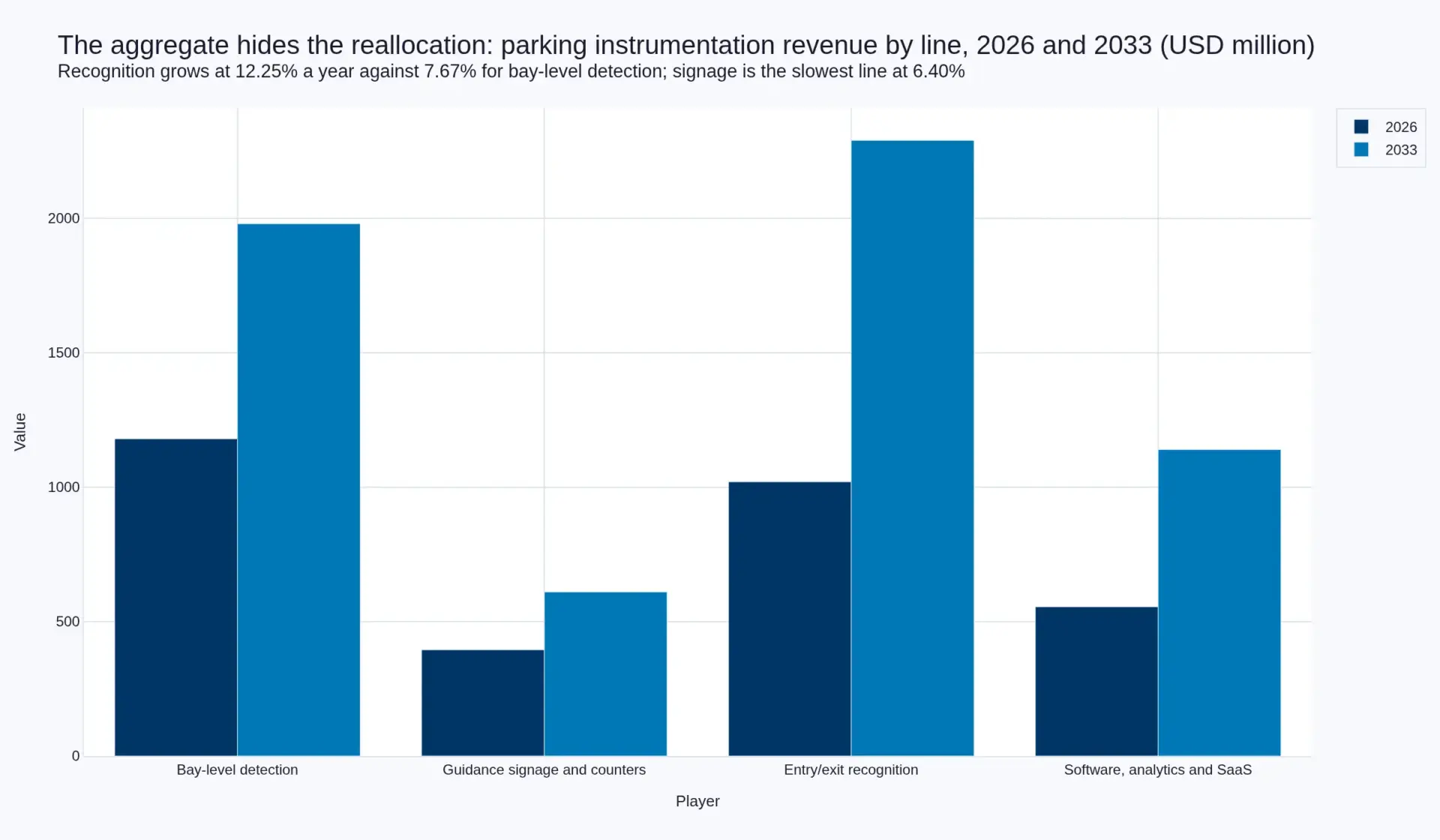
That distinction is the whole of this report. Sized as one market, occupancy sensing appears to be a single steady business growing at a high single-digit rate. Sized correctly, it is two businesses moving in different directions: bay-level detection at 7.67% a year, entry and exit recognition at 12.25%, and the recognition layer taking five and a half points of share over seven years.
The reason is arithmetic, not preference. Recognition scales with lanes; instrumentation scales with bays. A 1,200-bay garage may have four entry and four exit lanes. Selling recognition there is an eight-unit decision taken by whoever controls the barrier. Selling bay sensing there is a 1,200-unit decision that must be justified against a per-bay revenue assumption most operators cannot yet make. One of those conversations happens; the other is deferred.
Where the deferred conversation does happen is instructive, and it is the commercial heart of this report. Bay-level instrumentation is bought where inventory certainty is contractual rather than aspirational — where someone has already promised a specific space to a specific person and will pay a penalty, lose a booking or breach a code if the space is not there. That is a much narrower demand base than the industry's own marketing implies, and it is a far more durable one.
3. What This Market Actually Sells
Begin with a distinction the industry routinely elides: occupancy is not availability. Occupancy is a count of what is there. Availability is a forecast of what will be there when the driver arrives. Almost every public claim about this market is a claim about the first, and almost every buyer is paying for the second.
A level counter at a garage entrance instrumented with induction loops tells an operator how many vehicles are inside. It tells the driver on the signage nothing they can act on with confidence, because a full garage is not uniformly full — it is full on the lower decks and empty on the roof, and the driver who does not know that will queue at the ramp. The value is created the moment the data becomes per-bay and therefore predictive of a specific space. That is why overhead camera systems that image forty bays at once have displaced loop counters at the entrances of large facilities: same promise, better resolution, no civil works.
Now the second distinction: detection is not enforcement. A sensor that reports a bay occupied does not establish who occupied it or whether they were entitled to. Instrumentation without identity generates a data stream that cannot be turned into a charge, a permit check, or a violation. This is the seam where the recognition vendors win, because plate recognition delivers both facts — presence and identity — from one device at one point in the journey, and the operated parking model is fundamentally a permitting and charging model.
What the market actually sells, therefore, is three things at three different price points:
- Certainty of a specific space, sold per bay, to operators who have contracted to deliver one. Highest price per unit, smallest addressable base, slowest growth.
- Guidance to a probable space, sold per level or per zone, to operators whose problem is circulation and dwell time rather than guarantee. Mid-price, mid-growth, heavily tied to new-build and refurbishment.
- Permission to enter and be charged, sold per lane, to every controlled facility. Lowest price per unit, largest and most reliably renewed base, fastest growth.
The third line is where the money compounds, and it explains a structural fact about the sector that is otherwise puzzling: why the largest parking operator in the United States was acquired by a technology company rather than by a property holder. The asset worth acquiring was not the concrete. It was the contracted right to be the identity layer at a few thousand entry lanes for the next decade.
There is also a fourth thing the market sells that appears in no vendor's price list, and it decides more outcomes than any technical specification: the avoidance of staffing. An unattended facility is the operator's real objective, because labour is the largest controllable cost in parking and the one most exposed to minimum-wage legislation and shift-coverage failure. A recognition system that removes the need for a booth attendant is justified on labour arbitrage long before it is justified on data quality. Any assessment of this market that treats it as an analytics business will misread the buying motive.
4. Demand Drivers and Structural Forces
Pre-booked capacity is the demand engine, and it is growing faster than parking itself. The commercial logic of pre-booking is that a space sold in advance is worth more than the same space sold on arrival, because it removes the driver's risk and lets the operator price a guaranteed product above a speculative one. That logic is strongest where demand is scheduled and peaks are violent — airports above all. Airport parking is the reference site for this entire segment precisely because airline schedules concentrate arrivals into a few hours and the operator cannot smooth them. Once an operator has sold a guaranteed space, bay-level instrumentation stops being an analytics upgrade and becomes an operational requirement, because a promise of a specific space that cannot be verified is a liability.
Electric vehicle charging turns a bay from a space into a session. A charge point is the one parking asset where occupancy must be known to the minute, because the revenue is time-based and the constraint is charger contention — the queue forms behind the vehicle that has finished charging and not moved. Charging operators have therefore become the most technically demanding buyers of bay-level detection, and EV-bay blocking policies have made instrumentation a revenue-protection measure rather than a convenience. This is the single strongest structural support for the bay-sensing half of the market, and it is why that half does not decline.
Accessible-bay obligations are a compliance floor that cannot be value-engineered. Jurisdictions that mandate a minimum count of accessible spaces also, increasingly, mandate that they remain available — which requires knowing whether they are occupied and by whom. This is a small, inelastic, legally-driven demand line that survives recessions, and it is chronically underweighted in commercial forecasts because it is boring.
Labour economics decide the timing of every recognition purchase. The case for unattended operation is made on headcount. Wherever shift coverage is expensive or unreliable, recognition clears its hurdle rate on labour alone. This is why recognition penetrates markets unevenly: the technology is identical in Frankfurt and in a mid-sized municipal garage in a low-wage jurisdiction, but only one of them has a labour line large enough to fund it.
Operator consolidation compresses the sales cycle. When a handful of operators control a large share of managed sites, the buying decision for thousands of lanes moves into a small number of procurement teams. That accelerates fleet-wide standardisation and penalises vendors who cannot serve a multi-country estate — and it makes the loss of a single large account a materially different event than it was a decade ago.
Kerbside pricing is pulling the same technology into the public realm. Cities that price kerbside space by demand need to know who is in the bay and for how long, which is a plate read rather than a sensor under the tarmac. The on-street version of this market is smaller but policy-driven, and it is the most likely source of step-change volume growth in the recognition layer after 2029.
5. Segment and Product Split
The market splits into four revenue lines. Their relative growth is the report's central finding, so the composition is set out in full.
| Component | 2026 (USD m) | 2033 (USD m) | CAGR | What it is |
|---|---|---|---|---|
| Bay-level detection | 1,180 | 1,980 | 7.67% | In-ground and overhead per-bay sensors, including the camera that images a bay row |
| Guidance signage and counters | 395 | 610 | 6.40% | Level counters, variable-message signage, wayfinding displays and their controllers |
| Entry/exit recognition | 1,020 | 2,290 | 12.25% | Plate recognition and identity capture at controlled access points and pay stations |
| Software, analytics and SaaS overlay | 555 | 1,140 | 10.83% | Occupancy analytics, forecasting, permit integration, dashboards, APIs |
| Total | 3,150 | 6,020 | 9.69% |
Guidance signage is the slowest line, and the reason is that signage is a capital item attached to a construction project. It is bought when a facility is built or substantially refurbished, which makes its growth a function of construction activity rather than of operating budgets. Where new capacity is not being added — most of Western Europe and North America — signage is a replacement market with a ten-to-fifteen-year cycle. Where it is being added — the Gulf, Southeast Asia, India, parts of Africa — signage arrives as part of the building.
Bay-level detection grows faster than signage because it can be retrofitted bay by bay without a construction programme, and because the EV charging build-out has created a per-bay justification that did not exist in 2015. Its 7.67% is not a boom; it is the durable middle of a replacement cycle being pulled forward by electrification.
Software is the highest-margin line and the one operators most consistently under-provision. The installed hardware generates a signal; converting that signal into a forecast of availability, a price, and a permit decision is a separate business. The 10.83% growth in this line reflects a shift in what buyers ask for: not a dashboard but an integration, because the value of occupancy data is realised only when it reaches the channel that sells the space.
By end market, the split in 2026 is roughly: airports and transit-adjacent facilities 26%; commercial off-street (garages, lots and mixed-use) 31%; municipal and on-street 19%; healthcare, higher education and stadia 15%; residential and other 9%. The airport share is disproportionate to its floor area and is the reason the segment's next report addresses airport concession economics directly.
6. Regional Analysis
Europe accounts for 38% of 2026 value (USD 1,197 million) and is the most instrumented region per bay. The cause is historical rather than technological: guidance systems were adopted early in German, Dutch, Nordic and Swiss city-centre garages as a congestion measure, municipal ownership of parking assets is more common, and the retrofit market is therefore deep. Europe is also where the regulation most directly touching this market originates, from accessible-parking provisions to the data-protection regime that governs plate retention. Growth is moderate but the installed base is the largest single pool of replacement demand in the world.
North America accounts for 27% (USD 851 million) and is the most recognition-led region. Its garages are frequently less instrumented per bay than Europe's but far more consistently equipped at the barrier, which follows from the operated model: a small number of large operators manage a large share of commercial inventory, and each one standardises on a single identity and payment stack. The region's growth is therefore concentrated in the recognition and software lines rather than in bay sensing, and the consolidation of the operator layer is the variable to watch.
Asia-Pacific accounts for 24% (USD 756 million) and carries the highest growth rate in the model. The demand is construction-driven: new airport capacity, new transit-oriented development and new-build commercial garages routinely specify per-bay detection at the design stage, because the incremental cost inside a project is small relative to the cost of retrofitting later. China, Japan, South Korea and India behave differently from one another — Japan's market is mature and replacement-driven, India's is new-build and price-sensitive — but the regional aggregate grows because the built stock grows.
Middle East and Africa account for 6% (USD 189 million), almost entirely concentrated in Gulf infrastructure programmes. This is the highest-value-per-bay region in the world for instrumentation, because specification is set by a small number of large clients building to international standards, and the projects are new rather than retrofitted.
Latin America accounts for 5% (USD 157 million) and is the least instrumented relative to vehicle population. Its growth path runs through recognition rather than instrumentation, because recognition is cheaper per site and can be justified on labour and revenue leakage without any construction programme.
One cross-regional finding from Pheonix's review of operator disclosures and trade-conference proceedings is worth stating plainly: the barrier to instrumentation is rarely the cost of the sensor. It is the absence of a person in the organisation whose job is to act on the data. Facilities that install bay sensing without a staffing or process change to consume the output report the lowest satisfaction of any buyer group we speak to, and they do not renew. The technology is not the constraint; the operating model is.
Table of Contents
Competitive Landscape
There is no single competitive landscape in parking instrumentation. There are two, they sell into the same facilities, and the firms that lead one are largely absent from the other. Any vendor map that puts a bay-sensor manufacturer and a barrier-recognition supplier in the same competitive set will misprice both of them, because they are not competing for the same budget line and they are not rewarded for the same thing.
Set one: identity at the barrier
The recognition layer is concentrated, capitalised and increasingly vertical. Its most consequential participant is Metropolis Technologies, which acquired SP+ — the largest operator of parking facilities in the United States — in a transaction announced in October 2024 and closed in 2025, reported at approximately USD 1.5 billion. The strategic logic is precisely the one set out earlier in this report: the durable asset is the contracted right to be the identity layer at tens of thousands of entry and exit lanes, not the concrete those lanes are cut into.
Against it sit the equipment-and-platform vendors. Verra Mobility, which acquired T2 Systems in 2021, sells into both commercial parking and government enforcement. SKIDATA, the Austrian access-and-revenue specialist, carries a heavy European airport and ski-resort installed base. Flowbird, formed from the merger of Parkeon and Cale, is strongest in on-street payment and municipal systems. Cubic Transportation Systems brings a transit-scale systems-integration capability, and WPS Parking Systems of the Netherlands holds a dense northern European footprint. Designa of Sweden sits at the smaller end with a strong Nordic and German position.
What unites this set is not hardware. It is control of a contract. Every one of them sells into a multi-year agreement that bundles equipment, software, payment processing and service levels, and the agreement is the product. That is why the layer consolidates: the cost of serving a second country or a second operator platform is high, and the reward for winning one large estate is thousands of lanes renewed on a single signature.
Set two: instrumentation in the bay
Bay-level detection is a different industry with a different shape: more fragmented, less capitalised, and organised around radio and optics rather than around contracts. Nedap, listed on Euronext Amsterdam, supplies both in-ground ferromagnetic sensors and overhead per-bay cameras and is the closest thing the segment has to a reference brand. Amano of Japan combines sensing with revenue control across Japanese and Southeast Asian markets. Park Assist is the best-known specialist in the camera-over-many-bays model, where a single unit images an entire row and the economics stop depending on per-bay hardware cost — which is the single most important cost innovation in this half of the market. Axis Communications, owned by Canon, and Genetec supply general-purpose video platforms that integrators configure into parking applications rather than parking-specific products.
The Chinese suppliers — Hikvision and Dahua above all — set the global price floor on cameras and are absent from a growing share of Western tenders. Both were placed on the US Federal Communications Commission’s Covered List in 2021, and Section 889 Part B of the National Defense Authorization Act bars their use in federal procurement and in covered contracts. The practical effect is not that the equipment leaves the market. It is that the market bifurcates into a compliant supply chain priced at a premium and a non-compliant one priced at a discount, and the buyer’s jurisdiction determines which one it faces.
How concentrated it is, and where the margin sits
Pheonix Research estimates that the eight largest vendors by revenue account for roughly 45–50% of 2026 market value while supplying under a fifth of installed units. That gap is the sector’s defining financial fact: value concentrates in software, integration and contract control, and disperses in hardware. A camera module is a commodity with a falling bill of materials. A platform that turns a camera feed into a permit decision, a charge and an audit trail is not.
Two consequences follow, and both are already visible in the disclosed results of the listed participants. Hardware-led vendors face continuous price deflation and must run to stand still, which is why several have pushed into software or into operating roles. And the operator layer’s vertical integration rewrites the customer list: an operator that builds or buys its own recognition stack stops being a buyer of the recognition layer and becomes a competitor inside it. Because consolidation has concentrated thousands of lanes into a handful of procurement teams, that decision is taken once and applied across an entire estate.
What competition is actually on
Not accuracy. Published read rates above 95% under controlled illumination are table stakes, and a tender that discriminates on a headline accuracy figure is a tender written by someone who has not operated a facility through a winter. Competition runs on four things instead: total cost of ownership across a seven-to-ten-year horizon; integration risk into systems the buyer already owns, from the permit database to the payment processor; service coverage, because a failed lane at an airport becomes a queue in about eight minutes; and the willingness to accept contractual availability obligations. That last item is where smaller instrumentation vendors lose large tenders they could otherwise win on specification.
Pheonix assessment: renewal behaviour separates the two sets more sharply than win rates do. Barrier hardware and recognition platforms are replaced through formal procurement events against multi-year agreements with service levels attached. Bay-level sensors are frequently bought in tranches against a capital budget, and their replacement is not a procurement event at all — it is an operating decision taken by whoever owns the facility’s day-to-day performance. A vendor that wins the first tranche and does nothing to change how the operator consumes the data tends not to win the second. We see this pattern repeatedly in publicly awarded supply contracts where the follow-on order simply never appears.
Key message: the recognition layer is consolidating around whoever controls the transaction, and the instrumentation layer is consolidating around whoever can prove a service outcome. The firms that matter by 2033 will be those able to sell into both halves of the same site without pretending that the two halves are one product.
Value Chain
The value chain in this market looks like a hardware chain and behaves like a services chain. The money sits at both ends — in the semiconductor and optics layer that nobody in parking controls, and in the software and operating layer that decides whether a bay is sold, permitted and charged. The middle, where the equipment is made and installed, is where value is thinnest and where most of the participants are.
| Stage | Who performs it | Typical gross margin | Where power sits |
|---|---|---|---|
| Image sensor, optics, magnetometer element | Semiconductor and optics suppliers | 30–45% | Supplier; not parking-specific |
| Sensor module and barrier hardware | Equipment OEMs | 25–40% | Commoditising |
| Controller, firmware, edge inference | OEMs with software capability | 40–60% | Shifting toward software |
| Power, network and civil works | Electrical and construction contractors | 8–15% | Local and labour-bound |
| Installation and commissioning | Systems integrators and dealers | 10–20% | Local |
| Platform, permit, payment, enforcement | Software vendors and operators | 65–85% | The profit pool |
| Operation and yield management | Operators and asset owners | 15–30% of revenue | The customer |
The first frontier — optics and silicon. No parking vendor makes its own image sensor. The bill of materials for a bay-overhead camera is dominated by a CMOS sensor, a lens, an infrared illuminator and a system-on-chip capable of running inference, all of which are priced by consumer and automotive volumes orders of magnitude larger than parking. This is the least visible and most consequential upstream fact in the chain: the cost of the instrument falls whether or not the parking market grows, and no participant can do anything about it. In-ground ferromagnetic sensors sit slightly differently, because their constraint is a battery with a five-to-ten-year life and the civil works required to replace it — a cost that recurs, which is why overhead vision has progressively displaced in-ground detection in retrofits.
The second frontier — firmware and edge inference. This is where technical differentiation still exists, and it is narrower than vendors imply. The genuine engineering problems are unglamorous: keeping classification accurate when snow obscures a bay marking, distinguishing a motorcycle from a shadow, holding a read rate at a barrier facing low winter sun, and doing all of it on a device that must run for years without attention. Moving inference to the edge rather than to a cloud reduces bandwidth and latency and is now standard at the barrier; what remains contested is the quality of the model maintenance behind it, which is a service business disguised as a product feature.
The third frontier — installation. Delivery is where the chain is most local and least scalable. Power, network and mounting are performed by electrical contractors who work to local codes, and a camera-over-many-bays design wins against loop counters not because it is more accurate but because it requires no trenching, no saw-cutting and no bay closures. That is a civil-works saving, not a technology saving, and it is the single most under-cited reason for the shift. For the same reason, retrofit demand in mature markets is constrained less by the price of sensors than by the availability of qualified installers and the willingness of an operator to close bays for a day.
The fourth frontier — certification and cyber compliance. Regulatory gatekeeping has moved down the chain. CE and UKCA marking, FCC Part 15 for radio equipment, IP65 and IK10 ingress ratings and ONVIF conformance have long been prerequisites rather than advantages. The newest layer is security: the UK Product Security and Telecommunications Infrastructure Act 2022 has applied to connectable products since 29 April 2024, and the EU Cyber Resilience Act, Regulation (EU) 2024/2847, carries obligations that phase in from December 2027. Minimum-security-by-design and vulnerability disclosure become legal duties, not marketing claims. Large vendors absorb this at low marginal cost; small ones either exit the connected-product market or accept a slower, costlier release cycle. It is a quiet consolidation mechanism and it favours exactly the participants that already have scale.
Who carries the risk. Warranty and service allocation is the mechanism through which the chain’s power is expressed. The party that signs the availability commitment absorbs the consequence of a failed lane, and it then passes that consequence upward into the supply agreement. In practice this means the operator and the platform vendor bear the exposure while the hardware OEM carries a warranty defined in years, not in uptime — a mismatch that becomes acute at airports and hospitals where a single lane failure has a visible operational cost.
Disintermediation is running in one direction. Airport authorities and municipal owners increasingly buy technology directly and appoint an operator separately, splitting a contract that was historically bundled. Where that happens the equipment and platform vendor gains a direct relationship with the asset owner and the operator loses the ability to specify, which changes who the next renewal conversation is with. Pheonix assessment: this unbundling is the most under-priced structural change in the chain, because it moves the point of specification from the party with the operational incentive to the party with the capital budget.
Key message: value in this chain is captured by whoever holds the software and the contract, not whoever holds the patent. Hardware deflates, installation localises, and certification consolidates — and the rational move for any participant below the software layer is to move up it, which is exactly the move the listed vendors are making.
Investment Activity
Capital enters this market through two doors that are rarely analysed together. The first is corporate: acquisitions of platforms and operators, where the asset purchased is a contract book. The second is project: capital expenditure at individual sites, where the asset purchased is an installed base. The first door has been crowded for three years. The second has been quietly reopening since electrification gave every bay a revenue justification.
Where the corporate capital went
The defining transaction of the period is Metropolis Technologies’ acquisition of SP+, announced in October 2024 and completed in 2025, reported at approximately USD 1.5 billion. Read as a technology acquisition it makes little sense; read as the purchase of contracted lane-years at tens of thousands of controlled access points it makes complete sense. The same logic explains Verra Mobility’s 2021 acquisition of T2 Systems and, in the systems-integration layer, the take-private of Cubic Corporation by Veritas Capital. In each case the buyer paid for the right to sit between a vehicle and a charge, not for hardware.
Private capital has been moving in the same direction one layer down, into concession ownership. Parking concessions carry contracted, inflation-linked, long-dated cash flow, which makes them behave like infrastructure assets in a portfolio, and infrastructure funds have accordingly become the owners of the garages that operators operate and vendors instrument. The consequence for this market is not obvious until you follow it through: when the asset owner is a fund with a ten-year hold and a yield target, the operator’s incentive shifts from maximising revenue per bay to protecting the contracted margin, and technology purchases are then justified on labour and leakage rather than on growth. That favours the recognition layer, which removes staff, over the instrumentation layer, which adds information.
Where the project capital came from
The second flow is public and better documented. In the United States, the Airport Terminal Program created under the Bipartisan Infrastructure Law provides USD 5 billion over five years for terminal development, and terminal projects routinely include the parking and kerbside infrastructure attached to them. Alongside it, the National Electric Vehicle Infrastructure formula programme allocated USD 5 billion to build out charging corridors, which is what makes a charging bay a fundable asset rather than a speculative one — and a charging bay with a funded charger is a bay that acquires a reason to be instrumented.
In Europe the driver is regulatory rather than grant-based. Regulation (EU) 2023/1804 on the deployment of alternative fuels infrastructure sets binding requirements on charging provision and on ad-hoc payment at charge points, and the recast Energy Performance of Buildings Directive extends charging and pre-cabling obligations to non-residential buildings above a threshold parking-space count. Neither instrument mentions parking sensors. Both make the bay an electrotechnical asset with a compliance obligation attached, and both pull instrumentation into building projects where it would previously have been a discretionary line item.
What is being funded inside the market
Pheonix assessment of where capital is actually landing, distinguishing the three that matter. First, camera-over-many-bays: a single unit per row collapses the per-bay hardware cost and the civil-works cost simultaneously, which is the only innovation in this market that changes the buyer’s arithmetic rather than the vendor’s specification sheet. Second, kerbside and curb management platforms, where city pricing regimes are creating a data requirement that did not exist before 2020 and where the Open Mobility Foundation’s Curb Data Specification gives procurers something to buy against. Third, the software overlay — forecasting, permit integration, pricing — where gross margins are multiples of hardware and where the capital required to build is engineering headcount rather than plant.
What is conspicuously under-funded is in-ground detection. It is not disappearing; it retains a defensible position in surface lots, in low-clearance structures and where overhead mounting is impossible. But the direction of new capital is away from anything that requires opening the tarmac, and the five-to-ten-year battery replacement cycle is a liability that investors price rather than a feature they underwrite.
How the market is valued, and what that does to behaviour
Valuation is split, and the split explains the strategy of every participant. Hardware-led businesses are valued on a low single-digit multiple of revenue and are punished for lumpiness. Software and platform businesses are valued on mid-to-high single-digit multiples of recurring revenue. Operator businesses are valued on a multiple of EBITDA that is heavily conditioned on remaining contract tenor. Pheonix assessment of the ranges currently seen in disclosed and reported transactions is that the spread between the hardware multiple and the recurring-software multiple is wide enough to make a software narrative worth more than software revenue — which is why so many hardware vendors describe themselves as platforms.
That incentive produces a specific pattern worth watching as a buyer: the vendors most likely to honour an integration commitment are those whose revenue already depends on renewals rather than on the next hardware order. Capital intensity in this market is medium at the site level and low at the vendor level, so nothing forces a hardware vendor to change. Only the multiple does.
Key message: capital is buying contracts, not equipment, and the public money that is buying equipment is doing so for reasons — charging provision, terminal replacement — that have nothing to do with occupancy data. The rational forecast through 2033 is not a surge of investment in sensing. It is a continued migration of investment toward the layer that charges the vehicle.
Technology & Innovation
Four sensing principles compete for the same bay, and they are not interchangeable. Each carries a different installation cost, a different failure mode and a different trajectory to 2033, and the choice between them is usually made by a contractor or a consultant rather than by the operator who will live with the consequence.
| Principle | How it detects | Installation burden | Dominant failure mode | Trajectory |
|---|---|---|---|---|
| In-ground ferromagnetic | Magnetic field disturbance | Core-drill per bay; battery replacement every 5–10 years | Battery end-of-life; water ingress; bay closure to service | Declining share, retained where overhead mounting is impossible |
| Overhead per-bay ultrasonic or radar | Time-of-flight or 60 GHz radar | Ceiling mount and power; no civil works | Fouling of the aperture; mis-aim after building works | Stable; radar gaining where optics would foul |
| Camera over many bays | Computer vision over a row or level | Few mounts, one network drop, long sightlines required | Occlusion, low light, markings obscured by snow | Fastest-growing instrumentation method |
| Level counters and loops | Inductive loop or beam at entry | Civil works at the entrance only | No per-bay resolution; drift in count | Replacement-only |
The vision shift is an economics story. Camera-over-many-bays is not more accurate than a per-bay sensor in absolute terms; it is cheaper per bay by an order of magnitude because one unit serves twenty to forty bays and no trenching is required. The technical enabler was edge inference running on commodity silicon, which turned a video feed into a bay-state table locally and removed the bandwidth cost that made the architecture uneconomic a decade ago. The constraint that remains is geometry: sightlines in older structures with columns, ramps and low ceilings frequently defeat it, which is why in-ground and per-bay overhead detection persist rather than disappearing.
The barrier stack has become a pipeline. Recognition at a controlled access point runs capture, vehicle detection, character recognition, attribute extraction and a match against a permit, reservation or payment token, and it must complete inside roughly a second or the driver notices. The engineering effort has moved almost entirely to the edges of that pipeline: infrared illumination and exposure control so that a plate is legible in low winter sun or at night without headlights, and attribute extraction — make, model, colour — so that a vehicle can be recognised when the plate is obscured, foreign or absent. That last capability is what makes a ticketless model operable rather than merely convenient, and it is also the capability that turns a parking camera into a surveillance instrument, which is why the regulatory chapter that follows matters commercially and not just legally.
Payment tokenisation is an innovation hiding inside a compliance exercise. Moving a parking transaction onto a stored payment token held by the operator reduces the site’s card-data scope, removes a physical pay station from the journey and converts an anonymous cash transaction into an identified account. The technical work is unremarkable; the commercial consequence is not, because it is the mechanism by which an operator acquires a customer relationship instead of a receipt. Every large operator is now running that programme, and it is the real reason recognition spending survives a downturn in capital budgets.
Standards are doing more to shape the market than any product. ONVIF conformance and IP rating determine whether a camera can be substituted at all. ISO 14816 still governs automatic vehicle identification where a tag-based permit survives. Above the device layer, the Open Mobility Foundation’s Mobility Data Specification and Curb Data Specification have given cities a way to require data in a defined shape, which converts a city’s curb policy into a procurement specification overnight. Where a standard exists, the hardware commoditises and the platform wins; where none exists, integration cost rises with every site and the incumbent’s advantage compounds.
The innovation frontier that matters is outside the building. The genuinely unresolved question is whether a driver needs a sign at all. If a reserved bay can be pushed into the navigation session in the vehicle or on the handset, guidance signage loses its function and the bay-level signal becomes an API rather than a display. Nothing in the technology prevents this; what prevents it is that no party currently owns both the reservation and the routing, and the parties that own routing have no interest in guaranteeing a specific space. Pheonix assessment: expect progress by 2030 in deep-linked reservation for pre-booked airport products, and no general replacement of signage by 2033. The sign stays because the promise is commercial, not navigational.
Patent activity in this market is moderate and clustered rather than broad. Filings concentrate on multi-bay vision architectures, on occupancy forecasting and on the vehicle-attribute matching used in ticketless entry; there is comparatively little activity in sensing elements themselves, which are drawn from much larger consumer and automotive supply chains. That pattern is consistent with where the margin sits: the defensible claims are in the interpretation of the signal, not in its capture.
Key message: innovation in this market is incremental, commercially motivated and aimed at cost of installation and cost of staffing. The winning technologies by 2033 will be the ones that remove a civil works or a headcount, not the ones that raise an accuracy figure nobody was questioning.
Market Risk
The risks in this market are not evenly distributed between its two halves, and the largest one is not the one the industry talks about. Bay-level instrumentation faces a demand risk. The recognition layer faces a substitution risk. Only the second is capable of changing the size of the market rather than its composition.
| Risk | Level | How it transmits | Where it bites first |
|---|---|---|---|
| Substitution by vehicle-native and handset capability | High | Occupancy inferred without installing anything | Bay sensing in new-build and fleet-heavy sites |
| Construction and refurbishment cycle | Moderate | Signage and integrated projects deferred together | Guidance signage in mature markets |
| EV policy reversal | Moderate | Slower charger roll-out weakens the per-bay case | Bay sensing in North America |
| Procurement exclusion and supply bifurcation | Moderate | Compliant supply priced at a premium | Public and transport-infrastructure tenders |
| Privacy enforcement and litigation | Moderate | Retention limits and DPIA obligations raise cost of ownership | Recognition in the EU and UK |
| Operator consolidation | Moderate | Buyer power concentrates; margins compress | Recognition and software |
| Hardware deflation | High for vendors, low for the market | Falling bill of materials | Hardware-only suppliers |
| Cyber and product-security liability | Moderate | Design, disclosure and support duties become legal | Small connected-product vendors |
The substitution risk, stated properly
Every connected vehicle built today already carries the sensors needed to know it has stopped in a bay: GNSS, accelerometer, and increasingly a camera and radar set. Aggregated across a fleet, that stream is a parking occupancy dataset that requires no installation, no civil works and no maintenance in the structure. It is less precise than a dedicated sensor and it is blind to an empty bay, which is the thing a guidance system most needs to know. But it is free at the margin, and a free signal that is 70% as good reshapes the economics of any application where 70% is sufficient.
The mechanism by which this becomes a market event is not consumer navigation. It is the operator’s own analytics function. Pheonix assessment: the first material substitution will occur where an operator or a city wants historical occupancy patterns rather than live bay states, because that is the use case where aggregate fleet data is genuinely adequate, and that is currently a paid software line item. The live guidance function survives, because a driver who has been promised a specific space requires a verified fact about that space, and no aggregated third-party stream can provide it.
The EV dependency, and why a policy change matters here
Electrification is the strongest structural support for bay-level instrumentation, because a charging bay must be known to be free to the minute or it generates a queue. That support is not unconditional. The termination of the US federal clean-vehicle consumer credit for vehicles acquired after 30 September 2025 removes a direct subsidy from the demand side of the charger rollout, and slower charger installation translates into fewer instrumented EV bays than the 2024 consensus assumed. Pheonix has not written a collapse into this forecast — the charger build-out is also funded through state programmes and utility capital, and workplace charging is commercially driven. But the North American EV-bay line is the most policy-sensitive component of the model, and a buyer relying on this report should treat it as such rather than as a trend.
Demand composition risk that the forecast conceals
The aggregate grows because the built stock grows and because recognition penetrates. Underneath it, one end-market is weakening. Office-adjacent and commuter-oriented structured parking in mature CBDs is exposed to hybrid working patterns that have proved persistent, and a garage whose weekday occupancy has fallen by a fifth does not invest in bay sensing; it renegotiates its operating contract. Airports, healthcare, higher education and stadia are far more resilient because their demand is event-bound and cannot be relocated. The 26% airport share of this market is therefore not just a revenue concentration, it is a stability concentration, and it is the reason the companion report in this segment addresses airport concession economics rather than commercial garages.
Procurement and geopolitical exposure
The exclusion of Chinese camera manufacturers from US federal and covered procurement has created two supply chains with materially different prices. For a compliant vendor this is protective; for a compliant buyer it is inflationary, and for a project in a jurisdiction with no such restriction it is an invitation to buy the cheaper equipment and accept a different risk profile. The exposure is moderate rather than high because parking equipment is not a chokepoint technology: substitutes exist at every layer, and no single supplier can withhold a capability the market cannot source elsewhere. What it does create is divergence — two markets with different price levels, different firmware assurance and different support obligations, in which a multinational operator must run two standardisations.
What the risk profile does not support
It does not support the view that this is a defensive, bond-like market. Installed base and replacement cycles make revenue durable at the site level, but the value accrues to whoever holds the software relationship, and that relationship is contestable at every renewal. Nor does it support the opposite view that recognition will simply colonise the whole market: the applications that require a verified fact about a specific bay are expanding, not contracting, because pre-booking and charging both require one. The rational position between those two is that the recognition layer grows faster while the instrumentation layer grows more slowly and remains indispensable in a narrower set of places.
Key message: the market’s real risk is that the value of knowing where a car is parked gets captured by a party that did not have to install anything. Every strategic decision in this sector should be tested against that possibility.
Regulatory Landscape
There is no product type-approval regime for a parking sensor. That single fact shapes the entire compliance landscape: nothing approves the instrument, so the constraints arrive through four other doors — data protection, accessibility and building codes, local enforcement authority, and public procurement qualification. A vendor that plans for a certification process is planning for the wrong thing.
| Instrument | Jurisdiction | Core requirement | Effect on this market |
|---|---|---|---|
| Regulation (EU) 2016/679 (GDPR) and UK GDPR with the Data Protection Act 2018 | EU, UK | Lawful basis, purpose limitation, storage limitation, DPIA for high-risk processing | Governs plate retention, secondary use, and what an operator may share |
| Surveillance Camera Code of Practice (Protection of Freedoms Act 2012) | England and Wales | Statutory code for surveillance camera systems and ANPR | Admissible in regulatory assessment; sets retention and governance expectations |
| State ALPR statutes, e.g. New Hampshire RSA 236:130; California Civil Code §1798.90.5 et seq. | United States, state level | Retention limits, audit logs, restrictions on sharing and sale | Fragments US product design and data architecture |
| ADA 2010 Standards §§208, 502.6; Equality Act 2010 and Blue Badge guidance | US, UK | Minimum accessible bay counts; signage and availability | Creates inelastic instrumentation demand in accessible bays |
| Energy Performance of Buildings Directive recast; Regulation (EU) 2023/1804 (AFIR) | EU | Charging provision, pre-cabling, ad-hoc payment and price transparency | Makes the EV bay a regulated asset requiring monitored availability |
| Product Security and Telecommunications Infrastructure Act 2022; Cyber Resilience Act (EU) 2024/2847 | UK, EU | Security-by-design, vulnerability disclosure, support periods | Raises the fixed cost of selling connected hardware |
| Procurement Act 2023; Directive 2014/24/EU; Federal Acquisition Regulation | UK, EU, US | Competitive tender, published criteria, standstill and challenge | Converts specification into a legal document with remedies attached |
Data protection is the binding constraint, and it binds the growing half
A plate read is personal data. That is settled in Europe and increasingly accepted elsewhere, and it means the recognition layer carries an obligation the instrumentation layer largely avoids — a per-bay sensor records a metal object, while a barrier camera records an identified person’s movement. Under GDPR the operator needs a lawful basis, and legitimate interests is the usual route, which requires a balancing assessment rather than an assertion. It needs purpose limitation, which is what prevents a parking dataset from being repurposed for marketing or resold to a data broker without a fresh basis. It needs storage limitation, which is what makes a thirty-day retention default indefensible when the operational need is minutes. And where processing is systematic and extensive, it needs a data protection impact assessment before deployment rather than after.
The practical consequence is architectural rather than legal. Retention must be configurable, access must be logged, deletion must be provable, and the data must be segregable by purpose. Those requirements are cheap for a platform vendor and expensive for a hardware vendor bolting a cloud dashboard onto a camera. It is one of the quieter reasons why the recognition layer consolidates toward firms with compliance functions.
In the United States there is no federal statute, and the state patchwork produces divergence that is harder to engineer around than a single strict rule. New Hampshire’s law is the oldest, dating to 2006; California’s 2015 provisions require security procedures, usage logs and public disclosure of policy. Several states restrict sale or sharing of plate data outright. A national operator therefore runs a data architecture at the strictest applicable standard, which in practice means the strictest state sets the design for the country.
Accessibility law is the most reliable demand generator in the report
Accessible-bay provision is unusually well specified and unusually enforceable. The ADA Standards fix the count of accessible spaces by total bay number and require identification signage at each space; the Equality Act 2010 and the Blue Badge scheme do the equivalent work in the UK, with local authorities enforcing misuse. What has changed is the expectation of availability rather than mere provision: a compliant bay that is permanently occupied by an unauthorised vehicle is a live enforcement issue, and knowing that requires monitoring. This is a small revenue line and it is the least cyclical line in the market, because it is created by statute and by litigation risk rather than by commercial appetite.
Enforcement authority determines what a camera is allowed to prove
A camera can observe a contravention; only a legally constituted authority can act on it. The gap between those two statements is where most failed projects sit. In England and Wales, civil enforcement of on-street and off-street parking contraventions runs through the Traffic Management Act 2004 and local authority powers, with specified approval for the devices used to evidence a contravention. Private-land charges depend on keeper liability under Schedule 4 of the Protection of Freedoms Act 2012, and access to registered keeper data is conditional on membership of an accredited trade association with a code of practice. None of that is a technology question, and all of it decides whether a recognition deployment produces revenue or produces complaints.
Pheonix assessment: the jurisdictions that will grow recognition fastest between now and 2033 are not the ones with the best technology but the ones with the cleanest legal chain from observation to charge. Where that chain requires a human adjudicator for every event, the labour saving that justifies the system evaporates, and the business case collapses regardless of read rate.
Cybersecurity is the newest obligation and the least prepared for
The UK Product Security and Telecommunications Infrastructure Act 2022 has applied to connectable products placed on the market since 29 April 2024, requiring unique passwords, published vulnerability disclosure and a stated minimum support period. The EU Cyber Resilience Act phases in obligations from December 2027 and extends them across the product’s economic life. For a device installed in a garage and expected to run for a decade without replacement, a stated support period is a commercial commitment with a cost attached, and the smaller suppliers in this market have not all priced it. The European Accessibility Act, applicable from 28 June 2025, adds a further requirement that self-service terminals be usable by people with disabilities — which reaches the pay station and the intercom, not the sensor.
Key message: compliance in this market is not a gate that a product passes once. It is a continuing obligation that follows the data, the device and the charge, and it is priced into the operating model rather than into the bill of materials. The vendors that will hold large accounts through 2033 are the ones that treat that as a product feature and not as a legal department.
13. Pheonix Research View
The consensus view of this market is that parking is becoming instrumented, and that the instrument of choice is a sensor in the bay. We think that view is a decade out of date and that it is being repeated by people who have not priced a bay retrofit. The market is becoming identified, not instrumented, and the difference is worth several billion dollars of forecast error.
Three propositions sit behind that judgement. First, the unit economics of identity are better than the unit economics of instrumentation in almost every site, because identity scales with lanes and instrumentation scales with bays. Second, the applications that genuinely require a verified fact about a specific bay are narrow, legally driven or contractually guaranteed, and they are growing — but they will never constitute the whole market. Third, the party that captures the value holds the transaction, and the transaction does not require the bay to be monitored.
What would change our mind is specific, and we would rather publish the test than defend the conclusion. If in-vehicle and handset-derived occupancy data reaches a quality an operator will accept for pre-booked guarantees, the instrumentation layer loses its growth case rather than merely its share. If pre-book penetration stalls in airports — the one environment where scheduling makes a guarantee commercially necessary — the same thing happens more slowly. And if a jurisdiction makes verified bay availability a condition of an accessible-parking obligation, the floor under instrumentation rises and our 7.67% is too low.
14. Watch List Through 2033
- Whether operators keep buying technology or start building it. Vertical integration converts the largest customers into competitors. Watch disclosed operator technology spend against third-party platform commitments.
- Airport concession re-lettings. A multi-year award decides who operates a garage for a decade and which identity stack is installed inside it. Read airport board papers and concession award notices, not vendor announcements.
- Pre-book penetration as a share of airport parking revenue. The best leading indicator for bay-level instrumentation demand, and it is disclosed far more often than the sensor market is.
- US charger installation rates. Policy support that made 2024 projections look safe has weakened. A slower charger build means fewer instrumented EV bays, and the EV line is the most policy-sensitive component of our model.
- The first paid use of fleet-derived occupancy data. When an operator or a city pays for aggregated vehicle data instead of installing hardware, the substitution thesis moves from theory to price.
- Cyber support-period commitments. Once buyers require a stated support period in a tender, the smaller end of the hardware market reprices quickly.
15. Final Takeaway
A parking facility sells a promise about a future space. There are two ways to keep it: know the state of every bay, or know who is entitled to enter. The second is cheaper, scales with the number of lanes rather than the size of the building, and gets cheaper every year as cameras and inference commoditise. That is why it is taking share, and why the aggregate growth rate of this market conceals a reallocation that matters far more to anyone making an investment or procurement decision.
The mistake to avoid is treating the two halves as one. A vendor selling instrumentation into a site that has not changed its operating model is selling a data stream nobody consumes, and it will not be renewed. A buyer treating recognition as a substitute for bay-level truth will find it cannot deliver a guaranteed space, price a charging bay by the minute, or prove that an accessible bay was blocked. The mature position is not a choice between them; it is knowing which promise each one keeps.
16. Research Basis
This report follows the Pheonix Research 70/30 method. Roughly 70% of the evidential base is secondary: statutory instruments and regulator guidance read at source, company filings and investor disclosures, airport authority and municipal board papers, concession and procurement award notices, trade-association publications, conference proceedings and technical literature.
The remaining 30% is Pheonix primary work, and its boundaries are stated precisely because imprecise claims about primary research are the easiest thing in this industry to make and the hardest to defend. It consists of structured document-level analysis by Pheonix analysts: reading awarded contract terms and published tariff schedules directly rather than through summaries, reconstructing installed-base economics from disclosed figures, and setting out the judgements that follow, labelled in the text as Pheonix assessment. It does not consist of a survey panel, a commissioned interview programme or a field census. Where the report needed a fact only such fieldwork could supply, it says the fact is not available rather than substituting an estimate for it.
Market values and volumes are Pheonix Research model estimates built bottom-up from installed-bay counts, controlled-access lane counts and annualised revenue per monitored bay and per lane. No authoritative body publishes global parking instrumentation revenue, so modelling is the only defensible method, and every modelled figure is identified as modelled. No third-party market-research publication is used as a source anywhere in this report.
17. Sources and Editorial Standard
Legislation and regulation. Regulation (EU) 2016/679 (General Data Protection Regulation); Regulation (EU) 2023/1804 on the deployment of alternative fuels infrastructure; Directive (EU) 2024/1275 on the energy performance of buildings (recast); Regulation (EU) 2024/2847 on cyber resilience; Directive (EU) 2019/882 on accessibility requirements. United Kingdom: Data Protection Act 2018, Protection of Freedoms Act 2012, Equality Act 2010, Traffic Management Act 2004, Product Security and Telecommunications Infrastructure Act 2022, and the Building Regulations 2010 as amended. United States: Americans with Disabilities Act 2010 Standards for Accessible Design; National Defense Authorization Act Section 889 Part B; Federal Communications Commission Covered List; New Hampshire RSA 236:130; California Civil Code §1798.90.5 et seq.
Standards and technical references. ONVIF conformance profiles; ISO 14816 automatic vehicle identification; the Open Mobility Foundation’s Mobility Data Specification and Curb Data Specification.
Company and market disclosures. SKIDATA product and reference documentation; Nedap N.V. annual reporting and identification segment disclosures; Verra Mobility Corporation Form 10-K filings and investor materials; Amano Corporation investor disclosures; Metropolis Technologies and SP+ transaction announcements; airport authority concession award notices referenced in the text.
Editorial standard. Every figure is either attributed in the sentence to a named primary source or identified as a Pheonix Research model estimate. Named instruments are cited by their formal designation so a reader can retrieve the text. Where a proposition rests on Pheonix judgement rather than a disclosed fact, the text says so. Where a fact we wanted could not be established from a primary source, the report states the gap rather than filling it.
18. About This Report
This report covers the global market for parking occupancy sensing and space guidance, segmented into bay-level detection, guidance signage and counters, entry and exit recognition, and the software overlay, across five regions and six end-market groups. Base year 2026, forecast horizon 2033. Values are in US dollars at million scale, undeflated; volume is expressed as bays under some form of active monitoring rather than units shipped. Published by Pheonix Research as part of its Automotive & Transportation coverage, and the first title in the Parking, Curb & Airport Mobility series.
Related Pheonix Research coverage. Three titles in the same industry address adjacent links in this chain. Global Road Safety & Enforcement Systems follows the camera-to-conviction chain that this report’s regulatory chapter stops short of, and reaches the same conclusion about which layer of the market holds the margin. Global Fuel Card & Fleet Payment Solutions examines the account-based payment model that makes ticketless parking operable rather than merely convenient. And Global Automotive sets out the vehicle parc, its build location and its price trends, which together determine how many barriers and bays exist to be instrumented at all.