
Global Lighting Market Report, Size, Share and Forecast 2026–2033
Global Lighting Market Forecast Snapshot (2026???2033)
| Metric | Value |
|---|---|
| Market Size (2025) | USD 132.60 Billion |
| Market Size (2033) | USD 218.45 Billion |
| CAGR (2026???2033) | 6.48% |
| Largest Segment | LED Lighting |
| Fastest Growing Segment | Smart & Connected Lighting Systems |
| Leading End-Use Segment | Residential Lighting |
| Key Trend | Smart Lighting, Energy Efficiency & IoT Integration |
| Regulatory Influence | Energy Efficiency Standards, Carbon Emission Regulations & Lighting Quality Norms |
| Future Outlook | Growth Driven by Smart Cities, Infrastructure Development & Energy-Saving Technologies |
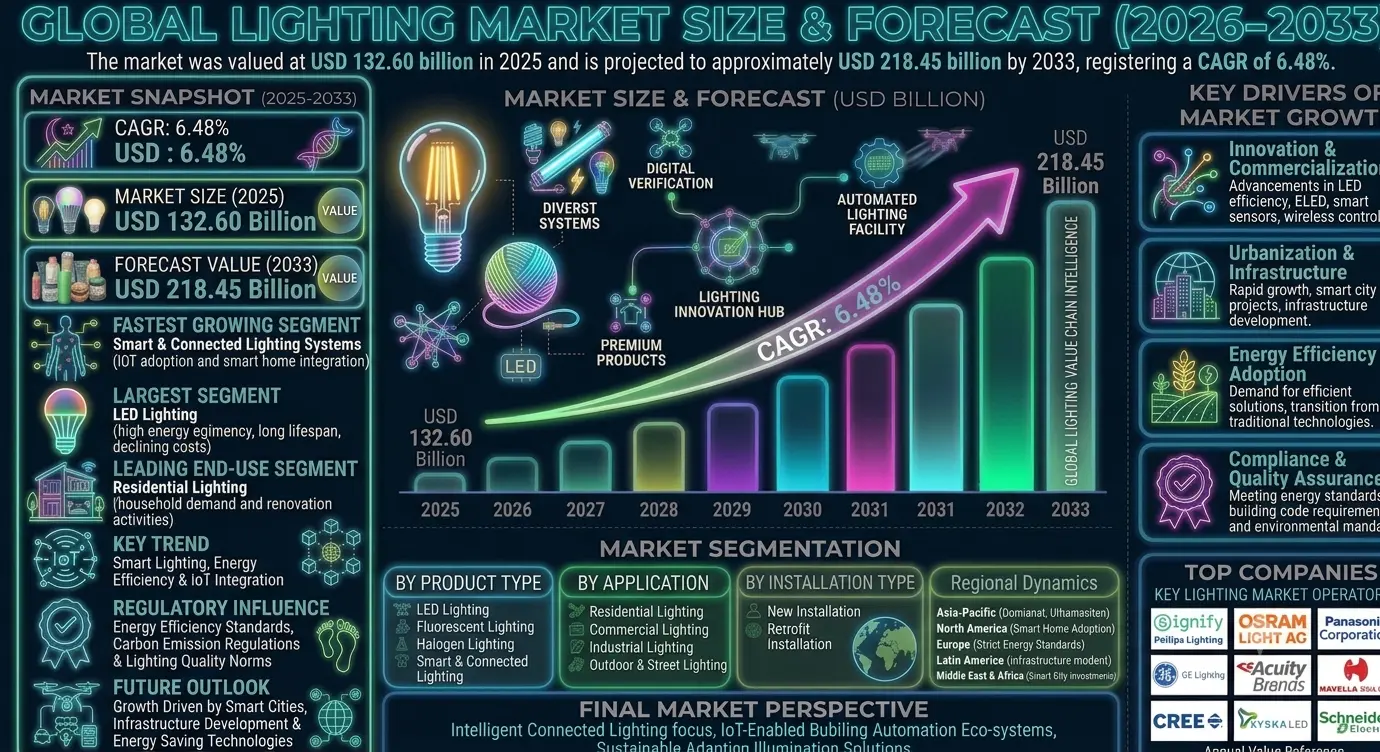
Global Lighting Market Size & Forecast
The Global Lighting Market is expected to witness steady growth during the forecast period from 2026 to 2033. The market was valued at USD 132.60 billion in 2025 and is projected to reach approximately USD 218.45 billion by 2033, registering a CAGR of 6.48%. The market growth is primarily driven by rising urbanization, infrastructure development, increasing demand for energy-efficient lighting solutions, and rapid adoption of LED and smart lighting technologies. Lighting systems play a crucial role across residential, commercial, industrial, and outdoor applications, enhancing visibility, safety, productivity, and aesthetic appeal. In addition, the transition from traditional incandescent and fluorescent lighting to LED and IoT-enabled smart lighting systems is significantly accelerating market expansion.Global Lighting Market Overview
The lighting market includes products and systems used for illumination across indoor and outdoor environments, incorporating both traditional and advanced lighting technologies. The market includes LED lamps, fluorescent lighting, halogen lamps, smart lighting systems, connected lighting controls, and industrial lighting solutions. Lighting solutions are widely used across residential buildings, commercial offices, retail spaces, industrial facilities, street lighting, and architectural applications. The industry is increasingly shifting toward energy-efficient, smart, and sustainable lighting solutions integrated with automation and IoT technologies.Structural Drivers of Market Growth
1. Innovation and Commercialization Acceleration
Advancements in LED efficiency, OLED lighting, smart sensors, wireless control systems, and IoT-based lighting automation are transforming the industry. Smart lighting systems are enabling remote control, adaptive brightness, and energy optimization across multiple applications.Market Implications
Companies investing in smart lighting technologies, IoT integration, and energy-efficient solutions are expected to strengthen competitive positioning.2. Compliance and Risk Repricing
Energy efficiency regulations, environmental standards, carbon reduction mandates, and building code requirements are influencing product innovation and adoption. Governments globally are promoting LED adoption and phasing out inefficient lighting technologies.Market Implications
Firms compliant with sustainability regulations and offering high-efficiency lighting solutions are likely to gain stronger market acceptance.3. Competitive and Value-Chain Reconfiguration
The market is highly competitive with global lighting manufacturers, smart home technology providers, and electrical solution companies competing across segments. Integration of lighting with smart home ecosystems and building automation systems is reshaping value chains.Market Implications
Companies focusing on smart ecosystems, energy management platforms, and integrated lighting solutions may achieve stronger growth.4. Capital and Capacity Scaling
Rising investments in smart city projects, infrastructure modernization, and energy-efficient building systems are supporting market expansion. Large-scale urban development projects are driving demand for advanced lighting solutions.Market Implications
Organizations scaling smart lighting production and global distribution networks are expected to capture future opportunities.Market Segmentation Analysis
By Product Type
1. LED Lighting
Largest segment due to high energy efficiency, long lifespan, and declining costs.2. Fluorescent Lighting
Gradually declining segment but still used in legacy infrastructure.3. Halogen Lighting
Used in specialty and automotive applications.4. Smart & Connected Lighting
Fastest-growing segment driven by IoT adoption and smart home integration.By Application
1. Residential Lighting
Largest segment due to household demand and renovation activities.2. Commercial Lighting
Strong demand from offices, retail stores, and hospitality sectors.3. Industrial Lighting
Used in manufacturing plants, warehouses, and logistics facilities.4. Outdoor & Street Lighting
Growing segment driven by smart city initiatives.By Installation Type
1. New Installation
Driven by infrastructure expansion and construction projects.2. Retrofit Installation
Fast-growing segment due to LED replacement demand.Regional Market Dynamics
Asia-Pacific
Asia-Pacific dominates the global lighting market due to rapid urbanization, infrastructure development, and strong LED manufacturing capabilities in China, India, and Southeast Asia.North America
North America is a major market driven by smart home adoption, energy efficiency regulations, and commercial infrastructure upgrades.Europe
Europe shows strong growth supported by sustainability initiatives, smart city projects, and strict energy standards.Latin America
Latin America is gradually expanding due to urban development and infrastructure modernization.Middle East & Africa
The region is witnessing growth driven by smart city investments, tourism infrastructure, and commercial development projects.Competitive Landscape
The Global Lighting Market is highly competitive with multinational corporations, LED manufacturers, and smart lighting solution providers competing globally.Key Companies Operating in the Market Include:
- Signify (Philips Lighting)
- Osram Licht AG
- Panasonic Corporation
- GE Lighting
- Acuity Brands
- Havells India Ltd.
- Zumtobel Group
- Cree Lighting
- Syska LED
- Schneider Electric
Strategic Outlook
The future of the lighting market will be shaped by smart lighting ecosystems, AI-driven energy management, and IoT-enabled building automation systems. Advancements in human-centric lighting, adaptive illumination, and sustainable design will significantly enhance user experience and energy efficiency. The rise of smart cities, green buildings, and connected infrastructure is expected to create strong long-term growth opportunities.Final Market Perspective
The Global Lighting Market remains a critical component of global infrastructure and energy systems. Rising demand for energy-efficient solutions, smart technologies, and sustainable urban development continues to drive long-term growth. Companies capable of delivering intelligent, energy-saving, and connected lighting solutions will be best positioned to capture future opportunities. The convergence of IoT, smart cities, and sustainable infrastructure is expected to redefine the future of the global lighting industry.Table of Contents
Table of Contents
- Executive Summary
- Global Lighting Market Snapshot (2026???2033)
- Market Size & Growth Overview
- Key Market Highlights
- Largest & Fastest-Growing Segments
- Leading End-Use Segment Overview
- Key Market Trends & Smart Lighting Transformation
- Strategic Outlook Through 2033
- Market Introduction & Overview
- Definition of Lighting Products & Systems
- Scope of the Global Lighting Market
- Evolution of Lighting Technologies
- Role of Lighting in Residential, Commercial & Industrial Infrastructure
- Value Chain Analysis of the Lighting Industry
- Regulatory Influence (Energy Efficiency Standards, Carbon Emission Regulations & Lighting Quality Norms)
- Transition Toward Smart, Connected & Energy-Efficient Lighting Solutions
- Research Methodology
- Primary Research Approach
- Secondary Research Sources
- Market Size Estimation Methodology
- Forecasting Assumptions (2026???2033)
- Data Validation & Triangulation Process
- Market Dynamics
- Structural Drivers of Market Growth
- Innovation and Commercialization Acceleration in LED & Smart Lighting Technologies
- Compliance and Risk Repricing in Energy Efficiency Regulations
- Competitive and Value-Chain Reconfiguration Across Lighting Ecosystems
- Capital and Capacity Scaling Through Smart City & Infrastructure Investments
- Market Restraints
- High Initial Cost of Advanced Smart Lighting Systems
- Price Pressure from Intense Market Competition
- Supply Chain Disruptions in Electronic Components
- Market Opportunities
- Expansion of Smart Cities & Connected Infrastructure
- Growth in Human-Centric & Adaptive Lighting Solutions
- Increasing Demand for Energy-Efficient Retrofit Installations
- Integration of AI, IoT & Building Automation Technologies
- Market Challenges
- Rapid Technological Obsolescence
- Interoperability Issues Across Smart Lighting Platforms
- Cybersecurity Risks in Connected Lighting Systems
- Structural Drivers of Market Growth
- Global Lighting Market Size & Forecast (2026???2033)
- Market Revenue Analysis
- CAGR Analysis
- Demand-Supply Trends
- Pricing Analysis
- Investment Trends
- Future Market Outlook
- Market Segmentation Analysis (2026???2033)
- By Product Type
- LED Lighting (Largest Segment)
- Fluorescent Lighting
- Halogen Lighting
- Smart & Connected Lighting Systems (Fastest-Growing Segment)
- By Application
- Residential Lighting (Largest Segment)
- Commercial Lighting
- Industrial Lighting
- Outdoor & Street Lighting
- By Installation Type
- New Installation
- Retrofit Installation (Fastest-Growing Segment)
- By Product Type
- Regional Market Analysis
- Asia-Pacific (Largest Market)
- North America
- Europe
- Latin America
- Middle East & Africa
- Competitive Landscape
- Market Structure & Competitive Intensity Analysis
- Key Player Benchmarking
- Strategic Developments
- Smart Lighting & IoT Integration Strategies
- Partnerships, Expansion & Distribution Network Trends
- Company Profiles
- Signify (Philips Lighting)
- Osram Licht AG
- Panasonic Corporation
- GE Lighting
- Acuity Brands
- Havells India Ltd.
- Zumtobel Group
- Cree Lighting
- Syska LED
- Schneider Electric
- Strategic Outlook
- Future of Smart Lighting Ecosystems
- AI-Driven Energy Management & Automation
- Expansion of Human-Centric & Sustainable Lighting Solutions
- Growth of IoT-Enabled Building Infrastructure
- Long-Term Market Outlook (2033+)
- Final Market Perspective
- Appendix
- About Phoenix Market Research
- Disclaimer
Competitive Landscape
Global Lighting Market Competitive Intensity & Market Structure Overview
The Global Lighting Market is highly competitive and moderately fragmented, characterized by the presence of multinational lighting manufacturers, LED technology providers, electrical equipment companies, and smart lighting solution developers. Competitive intensity is driven by technological innovation, energy efficiency performance, product quality, pricing strategies, brand recognition, and global distribution capabilities.
Companies compete across residential, commercial, industrial, and outdoor lighting applications by offering LED lighting products, smart lighting systems, connected controls, and energy management solutions. Growing demand for sustainable lighting technologies and intelligent building systems is intensifying competition across global markets.
The market structure is evolving from conventional lighting products toward integrated smart lighting ecosystems that combine IoT connectivity, automation, sensor technologies, and energy optimization capabilities. Strategic partnerships, digital platforms, and smart infrastructure initiatives are reshaping industry competition.
Global Lighting Market Competitive Intensity & Market Structure Current Scenario
Leading Global Lighting Market Participants
Signify (Philips Lighting): A global leader in professional and consumer lighting solutions, recognized for its extensive LED portfolio and connected lighting platforms.
Osram Licht AG: A major lighting technology company specializing in LED components, automotive lighting, smart lighting systems, and optical semiconductor solutions.
Panasonic Corporation: A diversified technology company offering energy-efficient lighting products, smart home solutions, and advanced lighting technologies.
GE Lighting: A prominent lighting brand providing residential, commercial, and connected lighting products with a strong global market presence.
Acuity Brands: A leading provider of intelligent lighting, building management systems, and smart infrastructure technologies for commercial applications.
Havells India Ltd.: A major electrical and lighting products manufacturer with a broad portfolio of LED lighting and consumer electrical solutions.
Zumtobel Group: A global lighting company focused on architectural, commercial, industrial, and sustainable lighting solutions.
Cree Lighting: A recognized innovator in LED lighting technologies known for high-performance and energy-efficient illumination products.
Syska LED: A fast-growing lighting company specializing in LED lamps, smart lighting products, and energy-efficient consumer solutions.
Schneider Electric: A leading energy management and automation company integrating smart lighting systems with building control and energy optimization platforms.
Key Competitive Intensity & Market Structure Drivers
The growing adoption of LED technology and the global transition away from conventional lighting systems are intensifying competition among manufacturers seeking market share expansion.
Increasing demand for smart homes, connected buildings, and IoT-enabled lighting solutions is driving innovation and creating opportunities for product differentiation.
Energy efficiency standards, carbon reduction initiatives, and environmental regulations are encouraging companies to invest in sustainable lighting technologies and advanced product development.
Smart city projects, infrastructure modernization programs, and commercial building upgrades are generating new opportunities for integrated lighting and automation solutions.
The expansion of digital sales channels, smart ecosystem partnerships, and building automation platforms is reshaping competitive strategies across the industry.
Strategic Implications of Competitive Intensity & Market Structure
Companies with strong research and development capabilities, diversified product portfolios, and extensive global distribution networks are expected to maintain significant competitive advantages.
Investment in smart lighting platforms, IoT integration, AI-driven energy management, and human-centric lighting solutions is becoming a critical factor for long-term market differentiation.
Manufacturers focusing on sustainability, energy efficiency, and compliance with global environmental regulations are likely to strengthen their market positioning.
Strategic collaborations between lighting manufacturers, smart home providers, construction firms, and technology companies are enabling broader ecosystem development and revenue growth.
Organizations capable of combining innovation, affordability, connectivity, and energy efficiency will be better positioned to compete effectively across diverse application segments.
Global Lighting Market Competitive Intensity & Market Structure Forward Outlook
The competitive landscape of the global lighting market is expected to become increasingly technology-driven as smart cities, connected infrastructure, and digital building ecosystems gain momentum worldwide.
Future competition will be shaped by advancements in AI-powered lighting controls, adaptive illumination systems, human-centric lighting technologies, and intelligent energy management platforms.
Manufacturers are expected to increase investments in IoT-enabled products, sustainable lighting technologies, and smart infrastructure integration to strengthen competitive positioning.
Over the forecast period, companies that successfully balance innovation, sustainability, manufacturing efficiency, digital connectivity, and global market reach will be best positioned to lead the evolving global lighting market.
Value Chain
Global Lighting Market Value Chain & Supply Chain Evolution Overview
The Global Lighting Market is undergoing significant transformation driven by rapid adoption of LED technologies, smart lighting systems, energy efficiency requirements, and the expansion of connected infrastructure. The market value chain spans raw material sourcing, component manufacturing, lighting system production, distribution, installation, maintenance, and end-user deployment across residential, commercial, industrial, and outdoor applications.
A defining characteristic of the lighting value chain is the growing integration of digital technologies, IoT connectivity, automation systems, and energy management platforms. Manufacturers are increasingly developing intelligent lighting solutions capable of delivering enhanced energy efficiency, remote monitoring, adaptive illumination, and seamless integration with smart buildings and smart city ecosystems.
Supply chain dynamics are evolving as companies seek to balance cost efficiency, technological innovation, regulatory compliance, and sustainability objectives. The growing importance of semiconductor components, sensors, controllers, and connectivity modules has expanded collaboration among lighting manufacturers, electronics suppliers, software developers, and infrastructure providers.
The value chain is becoming increasingly technology-driven, with investments in advanced LED manufacturing, smart controls, connected lighting platforms, and sustainable production processes supporting long-term industry growth and competitiveness.
Global Lighting Market Value Chain & Supply Chain Evolution Current Scenario
Market-Specific Value Chain
- Raw Material & Component Sourcing: Procurement of semiconductors, LED chips, drivers, optics, heat sinks, sensors, electronic components, metals, plastics, and specialty materials.
- Component Manufacturing: Production of LED modules, lighting drivers, control systems, sensors, connectivity devices, optics, and electrical subsystems.
- Lighting Equipment Manufacturing: Assembly and production of LED lamps, luminaires, smart lighting systems, industrial lighting products, street lighting solutions, and connected lighting platforms.
- System Integration & Installation: Integration of lighting systems with building automation platforms, smart home ecosystems, commercial facilities, industrial infrastructure, and municipal lighting networks.
- Distribution & Sales Channels: Delivery through wholesalers, distributors, electrical contractors, retailers, e-commerce platforms, and project-based procurement networks.
- Maintenance, Upgrades & End User Operations: Performance monitoring, software updates, maintenance services, retrofit projects, and ongoing lighting management for residential, commercial, industrial, and public-sector users.
Company-to-Stage Mapping
- Raw Material & Component Sourcing: LED chip manufacturers, semiconductor suppliers, optics providers, electronics component manufacturers, and materials suppliers.
- Component Manufacturing: Osram Licht AG, Cree Lighting, and specialized lighting component manufacturers.
- Lighting Equipment Manufacturing: Signify (Philips Lighting), Panasonic Corporation, GE Lighting, Havells India Ltd., Syska LED, and Zumtobel Group.
- System Integration & Installation: Schneider Electric, Acuity Brands, lighting contractors, smart building integrators, and infrastructure solution providers.
- Distribution & Sales Channels: Global distributors, electrical wholesalers, retailers, e-commerce platforms, and project procurement organizations.
- Maintenance, Upgrades & End User Operations: Facility management companies, lighting service providers, municipalities, commercial property operators, and residential consumers.
Key Value Chain & Supply Chain Evolution Signals in Global Lighting Market
Expansion of Smart & Connected Lighting Systems
The growing adoption of IoT-enabled lighting platforms is transforming traditional lighting infrastructure into intelligent and connected systems capable of real-time monitoring and control.
Rapid Shift Toward LED-Based Solutions
LED technology continues to replace conventional lighting systems due to superior energy efficiency, longer operational lifespan, and lower maintenance requirements.
Growth of Smart City Infrastructure Projects
Governments and municipalities are increasingly investing in intelligent street lighting systems integrated with urban connectivity and energy management platforms.
Integration with Building Automation Systems
Lighting solutions are becoming a core component of smart buildings through integration with HVAC systems, occupancy sensors, security systems, and centralized control platforms.
Increasing Focus on Sustainable Manufacturing
Manufacturers are investing in environmentally responsible production processes, recyclable materials, and energy-efficient product designs to comply with sustainability goals.
Advancement of Human-Centric Lighting Technologies
Adaptive lighting solutions designed to improve comfort, productivity, and well-being are creating new opportunities across residential, healthcare, and commercial environments.
Strategic Implications of Value Chain & Supply Chain Evolution
Investment in Smart Lighting Innovation
Companies developing connected lighting ecosystems, intelligent controls, and IoT-enabled products can strengthen long-term competitive positioning.
Expansion of Energy Management Capabilities
Integrated lighting and energy optimization solutions can deliver greater value to commercial, industrial, and municipal customers.
Strengthening Semiconductor Supply Networks
Reliable sourcing of LED chips, drivers, sensors, and electronic components is becoming increasingly important for operational continuity.
Development of Smart City Partnerships
Collaboration with governments, infrastructure developers, and technology providers can create significant project-based growth opportunities.
Growth of Retrofit and Modernization Services
Large-scale replacement of legacy lighting systems with LED and smart lighting solutions is generating recurring demand across global markets.
Enhancement of Digital Service Ecosystems
Software-enabled monitoring, predictive maintenance, and lighting-as-a-service models are creating new revenue streams for market participants.
Global Lighting Market Value Chain & Supply Chain Evolution Forward Outlook
Looking ahead, the lighting value chain is expected to become increasingly digital, connected, and sustainability-focused as smart infrastructure adoption accelerates worldwide.
Key Future Developments Include:
- Expansion of IoT-enabled smart lighting systems across residential, commercial, and public infrastructure applications.
- Increased integration of lighting with smart building and energy management platforms.
- Growth of AI-driven lighting optimization and predictive maintenance technologies.
- Expansion of smart city lighting deployments and connected urban infrastructure projects.
- Advancement of human-centric and adaptive lighting technologies.
- Greater focus on sustainable manufacturing, recyclable materials, and carbon reduction initiatives.
As the market evolves, competitive advantage will increasingly depend on the ability to combine lighting innovation, digital intelligence, energy efficiency, and ecosystem integration within a scalable and resilient value chain.
Companies that successfully integrate advanced LED technologies, smart connectivity solutions, software-enabled services, and sustainable manufacturing practices will achieve stronger market positioning and long-term growth in the Global Lighting Market.
Investment Activity
Global Lighting Market Investment & Funding Dynamics Overview
The Global Lighting Market is experiencing strong investment momentum driven by increasing demand for energy-efficient lighting solutions, rapid adoption of smart lighting technologies, urban infrastructure expansion, and growing smart city initiatives worldwide. Lighting manufacturers, technology companies, infrastructure developers, institutional investors, private equity firms, and government agencies are actively investing in LED production facilities, smart lighting ecosystems, IoT-enabled lighting controls, energy management platforms, and next-generation illumination technologies.
Investment activity is accelerating as governments and businesses prioritize energy conservation, carbon emission reduction, and intelligent building infrastructure. Capital allocation is increasingly focused on smart and connected lighting systems, advanced LED technologies, wireless lighting controls, sensor-based illumination solutions, and sustainable lighting manufacturing capabilities.
Additionally, growing investments in human-centric lighting, adaptive illumination systems, AI-powered lighting management, and smart city lighting infrastructure are creating significant long-term opportunities across the global lighting value chain.
Global Lighting Market Investment & Funding Dynamics Current Scenario
Currently, the market is witnessing substantial capital deployment as organizations modernize lighting infrastructure to improve energy efficiency and operational performance. Industry participants are investing heavily in LED manufacturing expansion, connected lighting technologies, intelligent control systems, and digital lighting platforms.
The market is benefiting from government-funded energy efficiency programs, smart city development initiatives, and sustainability-focused infrastructure investments. Significant funding is being directed toward public lighting upgrades, smart building projects, commercial retrofitting programs, and advanced lighting research and development.
Furthermore, strategic collaborations among lighting manufacturers, IoT technology providers, building automation companies, utility providers, and municipal authorities are accelerating innovation and reshaping investment flows throughout the industry.
Key Investment & Funding Dynamics Signals in Global Lighting Market
- Growing adoption of LED lighting technologies is driving large-scale investments in manufacturing and product innovation.
- Expansion of smart city and intelligent infrastructure projects is increasing funding for connected lighting systems.
- Government-backed energy efficiency and carbon reduction programs are accelerating capital deployment across lighting upgrades.
- Rising demand for IoT-enabled lighting controls and automation platforms is supporting technology-focused investments.
- Strategic investments in human-centric lighting and adaptive illumination technologies are creating new market opportunities.
- Growing focus on building automation and integrated energy management systems is strengthening long-term investment activity.
- Increasing adoption of AI-powered lighting optimization and predictive maintenance solutions is attracting innovation-led funding.
Strategic Implications of Investment & Funding Dynamics in Global Lighting Market
- Continuous investment in smart lighting innovation and LED efficiency improvements is essential for maintaining market competitiveness.
- Capital allocation toward connected lighting infrastructure, software platforms, and sensor technologies will strengthen market positioning.
- Companies developing next-generation intelligent lighting ecosystems are expected to secure stronger long-term growth opportunities.
- Strategic partnerships between lighting manufacturers, smart building providers, and IoT technology companies will accelerate innovation and commercialization.
- Investments in automation, energy management, and digital lighting services will remain key growth priorities.
- Compliance with energy efficiency standards, carbon emission regulations, and lighting quality requirements will continue influencing investment decisions.
- Organizations building integrated solutions across lighting hardware, software, controls, and analytics platforms are expected to capture substantial future value.
Global Lighting Market Investment & Funding Dynamics Forward Outlook
Looking ahead, the Global Lighting Market is expected to maintain strong investment momentum driven by smart city expansion, infrastructure modernization, increasing adoption of connected technologies, and global sustainability initiatives.
Future capital deployment will increasingly focus on AI-enabled lighting systems, advanced LED technologies, smart building integration, intelligent lighting controls, and sustainable manufacturing processes.
As governments, businesses, and consumers continue prioritizing energy efficiency and digital infrastructure, investment activity is expected to expand across smart lighting networks, urban infrastructure projects, connected buildings, and next-generation illumination technologies.
In conclusion, the Global Lighting Market represents a strategically attractive investment landscape where smart lighting innovation, energy efficiency, IoT integration, sustainable infrastructure development, and intelligent building ecosystems will define future funding priorities, competitive differentiation, and long-term industry growth.
Technology & Innovation
Global Lighting Market Technology & Innovation Landscape Overview
The Global Lighting Market is experiencing rapid technological advancement driven by innovations in LED technology, smart lighting systems, IoT-enabled controls, human-centric lighting, and energy-efficient illumination solutions. The market demonstrates a high level of innovation intensity as manufacturers increasingly focus on intelligent lighting ecosystems that enhance energy savings, user comfort, operational efficiency, and sustainability.
At the center of this transformation is the transition from conventional lighting technologies toward connected, adaptive, and digitally managed lighting systems capable of integrating with smart homes, commercial buildings, and urban infrastructure.
A major innovation area is smart and connected lighting, where IoT-enabled luminaires, wireless communication protocols, cloud-based management platforms, and sensor-driven automation are enabling real-time control and energy optimization.
The market is also witnessing significant advancements in LED and OLED technologies, improving luminous efficiency, color rendering performance, lifespan, and design flexibility while reducing energy consumption.
Manufacturers are increasingly investing in intelligent lighting controls, occupancy sensors, daylight harvesting systems, and AI-powered energy management solutions to improve operational efficiency across residential, commercial, and industrial environments.
Product innovation further includes human-centric lighting systems that dynamically adjust brightness and color temperature to support wellness, productivity, and circadian rhythm alignment.
Additionally, sustainable lighting technologies such as recyclable lighting components, low-carbon manufacturing processes, and energy-efficient infrastructure solutions are becoming key competitive differentiators.
The convergence of smart connectivity, advanced semiconductor technologies, AI-driven automation, and sustainability-focused innovation is redefining the future technology landscape of the global lighting market.
Global Lighting Market Technology & Innovation Landscape Current Scenario
Currently, the Global Lighting Market is witnessing increasing adoption of connected lighting solutions, advanced LEDs, and intelligent control systems across residential, commercial, industrial, and public infrastructure applications.
1. Smart & Connected Lighting Systems
IoT-enabled lighting solutions allow remote control, scheduling, energy monitoring, and integration with smart building and smart home ecosystems.
2. Advanced LED Technologies
Continuous improvements in LED efficiency, durability, and color quality are supporting widespread replacement of conventional lighting technologies.
3. Human-Centric Lighting Solutions
Adaptive lighting systems are being deployed to improve occupant comfort, health, and productivity through dynamic light management.
4. Wireless Lighting Controls
Wireless communication technologies such as Bluetooth, Zigbee, and Wi-Fi are simplifying installation and enabling intelligent lighting management.
5. AI-Powered Energy Optimization
Artificial intelligence is being utilized to analyze lighting usage patterns and optimize energy consumption across facilities.
6. Smart City Lighting Infrastructure
Municipalities are deploying connected street lighting systems that support energy efficiency, public safety, and urban management objectives.
Key Technology & Innovation Landscape Signals in Global Lighting Market
Several innovation signals are shaping the future development of the market:
1. Growing Adoption of Smart Homes
Integration of lighting systems with connected home platforms is accelerating demand for intelligent lighting solutions.
2. Expansion of Smart City Projects
Governments are investing in connected urban infrastructure that incorporates intelligent public lighting systems.
3. Increasing Focus on Energy Efficiency
Rising energy costs and environmental concerns are driving adoption of advanced LED and automation technologies.
4. Development of Human-Centric Lighting
Demand for wellness-focused lighting environments is encouraging innovation in adaptive illumination systems.
5. Integration of Artificial Intelligence
AI-powered analytics are improving lighting performance, predictive maintenance, and energy management capabilities.
6. Growth of Building Automation Systems
Lighting is increasingly integrated into broader building management and energy optimization platforms.
7. Sustainability-Driven Product Innovation
Manufacturers are developing environmentally responsible lighting products with improved lifecycle performance.
Strategic Implications of Technology & Innovation Landscape in Global Lighting Market
The evolving innovation landscape is reshaping competition across the lighting industry. Companies are increasingly competing on smart functionality, connectivity, energy efficiency, automation capabilities, and sustainability performance.
Manufacturers investing in IoT-enabled lighting systems, AI-powered control platforms, advanced LED technologies, and human-centric lighting solutions are expected to strengthen long-term market positioning.
Strategic collaborations among lighting manufacturers, semiconductor companies, smart home providers, software developers, and infrastructure operators are accelerating product development and commercialization.
The growing convergence of connected infrastructure, energy management, building automation, and digital urban ecosystems is creating strong differentiation opportunities across the market.
Additionally, compliance with energy efficiency standards, carbon reduction initiatives, and environmental regulations is encouraging continuous innovation and modernization throughout the industry.
Global Lighting Market Technology & Innovation Landscape Forward Outlook
Looking ahead to 2026???2033, the Global Lighting Market is expected to evolve toward fully connected, AI-enabled, and highly efficient lighting ecosystems integrated across residential, commercial, industrial, and urban environments.
Future technological developments are likely to include:
1. AI-Driven Intelligent Lighting Networks
Artificial intelligence will autonomously optimize illumination levels, energy usage, and maintenance schedules in real time.
2. Advanced Human-Centric Lighting Platforms
Lighting systems will become increasingly personalized to support health, wellness, and productivity objectives.
3. Fully Integrated Smart Building Lighting
Lighting infrastructure will operate seamlessly with HVAC, security, and energy management systems.
4. Next-Generation OLED & Micro-LED Technologies
Emerging lighting technologies will provide greater design flexibility, efficiency, and visual performance.
5. Smart City Illumination Ecosystems
Connected lighting networks will support traffic management, environmental monitoring, and public safety applications.
6. Predictive Maintenance & Digital Twin Solutions
Advanced analytics will improve asset management and operational reliability across lighting installations.
7. Sustainable Circular Lighting Models
Recyclable materials, modular product designs, and low-carbon manufacturing processes will become increasingly important industry standards.
In conclusion, companies capable of combining smart connectivity, AI-powered automation, advanced lighting technologies, human-centric design principles, and sustainable manufacturing practices will be best positioned to lead the future evolution of the Global Lighting Market.
Market Risk
Global Lighting Market Risk Factors & Disruption Threats Overview
The Global Lighting Market operates at the intersection of infrastructure development, energy management, smart building technologies, and consumer electronics. While the market benefits from strong demand for LED lighting, smart city investments, and energy-efficiency initiatives, it faces a range of structural risks related to technology commoditization, regulatory shifts, supply chain dependencies, semiconductor availability, and evolving digital ecosystem requirements.
A major structural risk is the increasing commoditization of LED lighting products. As LED technology matures and manufacturing capacity expands globally, pricing pressure continues to intensify, reducing profit margins and increasing competition among manufacturers.
Another significant disruption factor is the market’s growing dependence on electronic components and semiconductor supply chains. Smart lighting systems require sensors, wireless communication modules, microcontrollers, and connectivity technologies that are vulnerable to component shortages, geopolitical disruptions, and supply chain bottlenecks.
The industry is also exposed to regulatory risks related to energy efficiency standards, environmental compliance requirements, product safety regulations, and carbon reduction mandates. Changes in government policies can accelerate technology transitions while increasing compliance costs for manufacturers.
Additionally, rapid technological innovation in building automation, smart homes, and IoT ecosystems creates continuous pressure for product upgrades, software integration, and cybersecurity enhancements.
Global Lighting Market Risk Factors & Disruption Threats Current Scenario
The current market environment is characterized by widespread adoption of LED lighting solutions across residential, commercial, industrial, and public infrastructure applications.
Smart lighting systems are gaining momentum as consumers, businesses, and municipalities increasingly seek energy optimization, automation, and remote control capabilities.
Governments worldwide continue promoting energy-efficient lighting technologies through regulatory frameworks, incentive programs, and sustainability initiatives designed to reduce electricity consumption and carbon emissions.
At the same time, manufacturers are facing rising competition, fluctuating raw material costs, and increasing requirements for software-enabled lighting solutions integrated with broader smart building ecosystems.
The convergence of lighting with IoT platforms, building management systems, and smart city infrastructure is transforming traditional lighting products into connected digital assets.
Key Risk Factors & Disruption Threats Signals in Global Lighting Market
A major disruption signal is the rapid growth of smart and connected lighting systems, which are shifting market value from hardware sales toward software-enabled services and integrated energy management solutions.
Another important signal is the increasing adoption of human-centric lighting technologies designed to improve wellness, productivity, and user comfort through adaptive illumination systems.
The expansion of smart city projects globally is accelerating demand for intelligent street lighting networks capable of supporting data collection, monitoring, and urban management functions.
Growing emphasis on sustainability and carbon reduction is encouraging the replacement of legacy lighting infrastructure with highly efficient LED and connected lighting solutions.
Cybersecurity concerns are emerging as an important consideration as connected lighting systems become integrated with broader enterprise and municipal digital infrastructure.
Strategic Implications of Risk Factors & Disruption Threats in Global Lighting Market
Companies must strengthen supply chain resilience and diversify sourcing strategies to mitigate risks associated with semiconductor shortages, electronic component availability, and geopolitical disruptions.
Investment in smart lighting platforms, IoT integration, cloud connectivity, and software-based lighting management solutions will be essential for maintaining long-term competitiveness.
Manufacturers should focus on value-added services, intelligent controls, and energy management capabilities to reduce exposure to pricing pressures in commoditized hardware segments.
Compliance with evolving energy efficiency regulations, environmental standards, and cybersecurity requirements will become increasingly important across both residential and commercial markets.
Strategic partnerships with smart home providers, building automation companies, utility operators, and smart city developers will play a critical role in future market expansion.
Global Lighting Market Risk Factors & Disruption Threats Forward Outlook
Looking ahead to 2026???2033, the Global Lighting Market is expected to continue evolving toward intelligent, connected, and highly energy-efficient lighting ecosystems.
Smart lighting, AI-driven energy optimization, adaptive illumination systems, and integrated building management technologies will increasingly define industry growth and innovation.
Regulatory pressure to improve energy efficiency and reduce carbon emissions is expected to accelerate the replacement of conventional lighting technologies across global markets.
Infrastructure modernization, smart city development, and digital transformation initiatives will create significant opportunities for advanced lighting solutions and connected services.
Overall, the market will remain growth-oriented but increasingly technology-driven, with long-term success determined by innovation capability, digital ecosystem integration, energy-efficiency leadership, cybersecurity readiness, and the ability to deliver intelligent lighting solutions that support the future of connected infrastructure.
Regulatory Landscape
Global Lighting Market Regulatory & Policy Environment Overview
The regulatory and policy environment governing the Global Lighting Market is evolving rapidly as governments, energy agencies, environmental regulators, and standards organizations prioritize energy efficiency, carbon emission reduction, and sustainable infrastructure development. Lighting products are increasingly subject to stringent regulations designed to improve energy performance, reduce environmental impact, and enhance consumer safety across residential, commercial, industrial, and public-sector applications.
Lighting manufacturers, component suppliers, smart lighting solution providers, and building infrastructure developers must comply with a wide range of regulations governing energy consumption, product performance, environmental sustainability, electrical safety, electromagnetic compatibility, and smart connectivity standards. As lighting systems become more intelligent and interconnected, regulatory oversight is expanding beyond hardware efficiency to include digital interoperability and cybersecurity considerations.
The global transition toward smart cities, green buildings, and net-zero carbon initiatives is encouraging policymakers to strengthen regulations supporting the adoption of energy-efficient lighting technologies and intelligent lighting management systems.
Global Lighting Market Regulatory & Policy Environment Current Scenario
The current regulatory environment is characterized by widespread implementation of energy efficiency standards aimed at reducing electricity consumption and accelerating the replacement of traditional incandescent and fluorescent lighting technologies. Governments across major economies continue to promote LED adoption through efficiency mandates and sustainability programs.
Carbon emission reduction policies are increasingly influencing lighting product development and procurement decisions. Regulatory frameworks supporting climate action goals encourage the deployment of high-efficiency lighting systems that contribute to lower energy consumption and reduced greenhouse gas emissions.
Electrical safety regulations remain fundamental to market operations, requiring lighting products to meet established standards for product quality, operational safety, and performance reliability. Compliance with testing and certification requirements is essential for market access in most regions.
Building energy codes are also driving demand for advanced lighting technologies by requiring energy-efficient lighting installations in residential, commercial, and public infrastructure projects. Many green building certification programs incorporate lighting efficiency and intelligent control requirements.
At the same time, smart lighting systems and connected lighting networks are prompting greater attention to interoperability standards, communication protocols, data security, and system integration requirements within smart building ecosystems.
Key Regulatory & Policy Environment Signals in Global Lighting Market
- Energy Efficiency Standards: Regulations establishing minimum performance requirements and promoting adoption of energy-saving lighting technologies.
- Carbon Emission Reduction Policies: Climate-focused initiatives encouraging efficient lighting systems that support national and regional decarbonization objectives.
- Lighting Quality & Performance Standards: Requirements governing illumination levels, durability, color rendering, product lifespan, and operational efficiency.
- Electrical Safety & Certification Requirements: Standards ensuring safe operation, product reliability, and compliance with electrical equipment regulations.
- Building Energy Codes: Regulations requiring energy-efficient lighting systems and intelligent controls in residential, commercial, and institutional buildings.
- Smart Lighting & Connectivity Frameworks: Emerging standards supporting interoperability, communication protocols, cybersecurity, and IoT integration.
Strategic Implications of Regulatory & Policy Environment
The evolving regulatory landscape is encouraging manufacturers and solution providers to prioritize energy efficiency, sustainability, and compliance-driven product innovation. Regulatory compliance is increasingly becoming a key factor influencing purchasing decisions across both public and private sectors.
Energy efficiency regulations are accelerating the transition toward LED lighting, advanced control systems, and intelligent lighting management platforms. Companies capable of delivering high-performance, energy-saving solutions are expected to strengthen their competitive position.
Carbon reduction policies are creating opportunities for businesses offering low-energy consumption products and smart lighting technologies that support environmental sustainability goals. Energy performance is becoming a critical differentiator in infrastructure and building projects.
Building code requirements are driving demand for integrated lighting systems that combine illumination, automation, occupancy sensing, and energy optimization capabilities. This trend is supporting growth in connected lighting ecosystems.
As smart lighting adoption expands, compliance with connectivity, interoperability, and cybersecurity standards is becoming increasingly important, particularly for commercial buildings, industrial facilities, and smart city deployments.
Global Lighting Market Regulatory & Policy Environment Forward Outlook
Between 2026 and 2033, the regulatory environment for the global lighting market is expected to become more comprehensive as governments strengthen energy efficiency mandates, climate commitments, and smart infrastructure policies. Regulatory support for LED technologies and intelligent lighting systems is likely to continue expanding globally.
Energy performance requirements are expected to become increasingly stringent, encouraging broader adoption of ultra-efficient lighting products, advanced controls, and automated energy management systems.
Carbon reduction regulations will likely place greater emphasis on lifecycle sustainability, circular economy practices, recyclable materials, and environmentally responsible manufacturing processes throughout the lighting value chain.
Smart lighting regulations are anticipated to evolve alongside smart building and smart city initiatives, introducing stronger requirements related to interoperability, cybersecurity, data management, and connected infrastructure performance.
Overall, the future regulatory landscape will be defined by the convergence of energy efficiency standards, carbon reduction objectives, lighting quality requirements, smart infrastructure policies, and digital connectivity frameworks. Companies capable of delivering compliant, intelligent, sustainable, and high-efficiency lighting solutions will be best positioned to capitalize on long-term opportunities within the evolving global lighting ecosystem.