
Automotive & Transportation / Market Segment
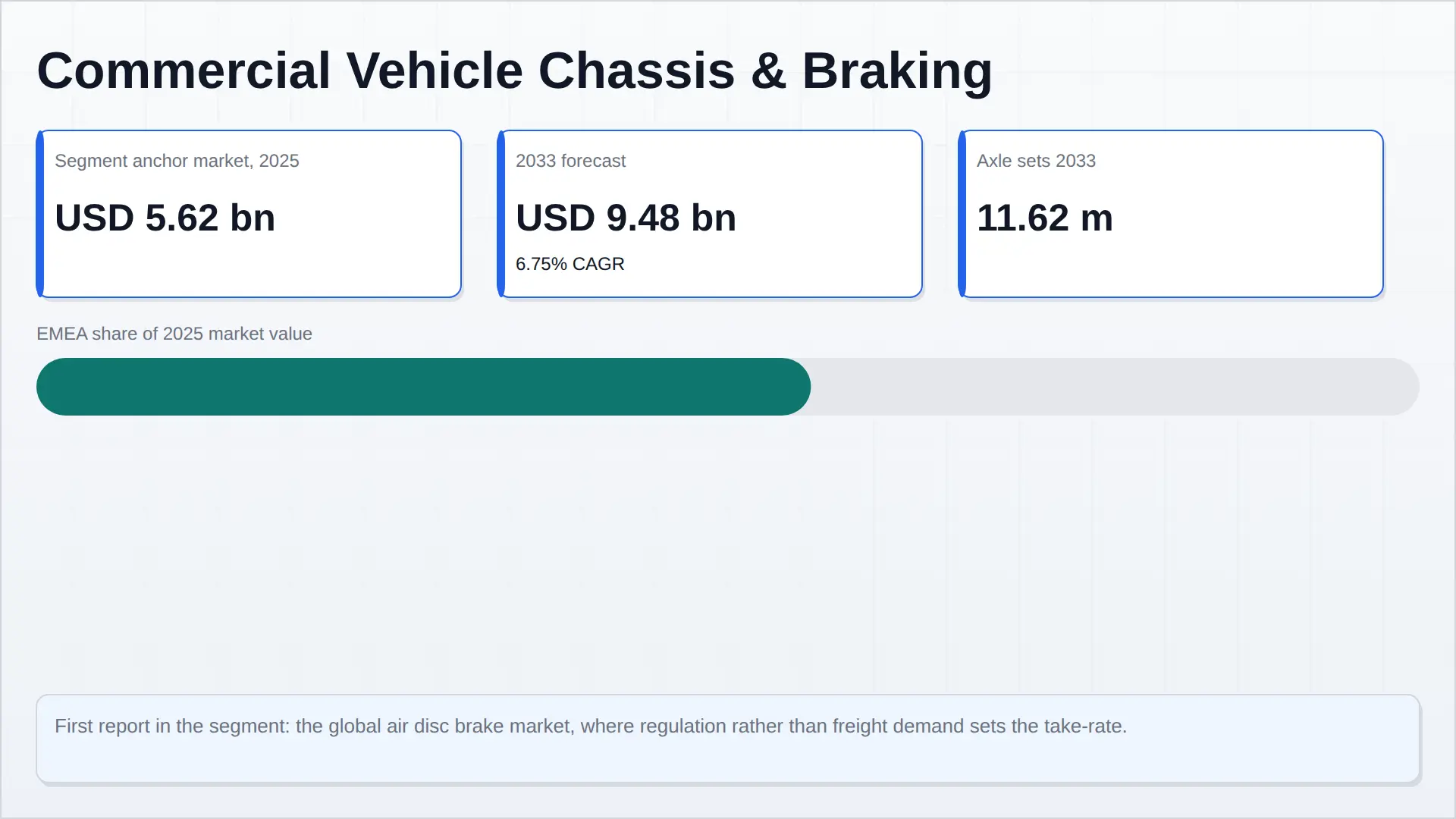
Commercial Vehicle Chassis & Braking
The commercial vehicle chassis and braking segment covers the safety-critical running gear of heavy and medium commercial vehicles — the systems that stop a vehicle, carry its load and connect it to a trailer. It is a component segment rather than a vehicle segment: its customers are the truck and bus OEMs on one side and the aftermarket distribution chain on the other, and its economics are governed by rules written by regulators rather than preferences expressed by consumers.
What the segment contains
Four product families sit inside it, and they behave differently enough that they should not be added together without care:
- Foundation brakes — air disc brakes (ADB) and air drum brakes (S-cam), the two competing architectures in heavy commercial vehicles. ADB is the conversion story of the segment: it stops shorter, weighs less, is easier to service and is the architecture regulation is drifting towards.
- Actuation and adjustment — brake chambers, slack adjusters, calipers, actuators and the electronic wear-sensing that increasingly rides on them. This is where the wear-item economics live, and where a foundation brake supplier earns after the OE sale.
- Friction couples — pads, linings, discs and drums. Sold to the same vehicle, but made by a largely different supplier set.
- Structural running gear — axles (drive, steer, trailer, lift, self-steering), suspension systems, fifth wheels and coupling devices. Characterised by very high concentration: in several of these lines the global number one holds a share no other commercial vehicle component category matches.
Why the segment behaves the way it does
It is regulation-timed, not demand-timed. Air disc brake take-up does not follow GDP. It follows braking-performance and particulate-emissions rules with dated compliance windows — Euro 7 for new truck platforms, UN Regulation No. 179 on brake particle emissions, and national standards such as China’s GB 7258 revisions. A conversion market has a clock, and the clock is set in Geneva, Brussels and Beijing.
It is a replacement market wearing an OE market’s clothes. A heavy tractor stays in service for a decade or more and its brake and running-gear components are replaced several times over that life. The installed parc — not the annual build rate — is what determines the addressable volume. This is why parc, age curve and replacement interval matter more in this segment than a market-share table does.
It is highly concentrated and consolidating. Axles, fifth wheels and foundation brakes are each dominated by a handful of suppliers, several of which are vertically integrated into the same OEM programmes. The segment has also been an active M&A theatre, with trailer and wheel-end portfolios changing hands repeatedly since 2018.
It is where electrification creates a new component, not just a new customer. Electric drivetrains change the axle — regeneration moves braking duty from friction to the motor, and the e-axle becomes a driveline component with its own competitive set.
How to read this segment
Component value in this segment is best decomposed rather than asserted: units multiplied by take-rate multiplied by price per axle set. The take-rate is almost always the story, because it is the variable that regulation and total cost of ownership move — and the variable that a supplier’s capacity investment is a bet on.
Reports in this segment are written from that decomposition outward, with the installed-parc layer treated as evidence rather than an assumption, and with the regulatory calendar treated as the timing mechanism rather than background colour.