
Editorial Article
The Next Brake Regulation Will Follow the Pad, Not the Truck
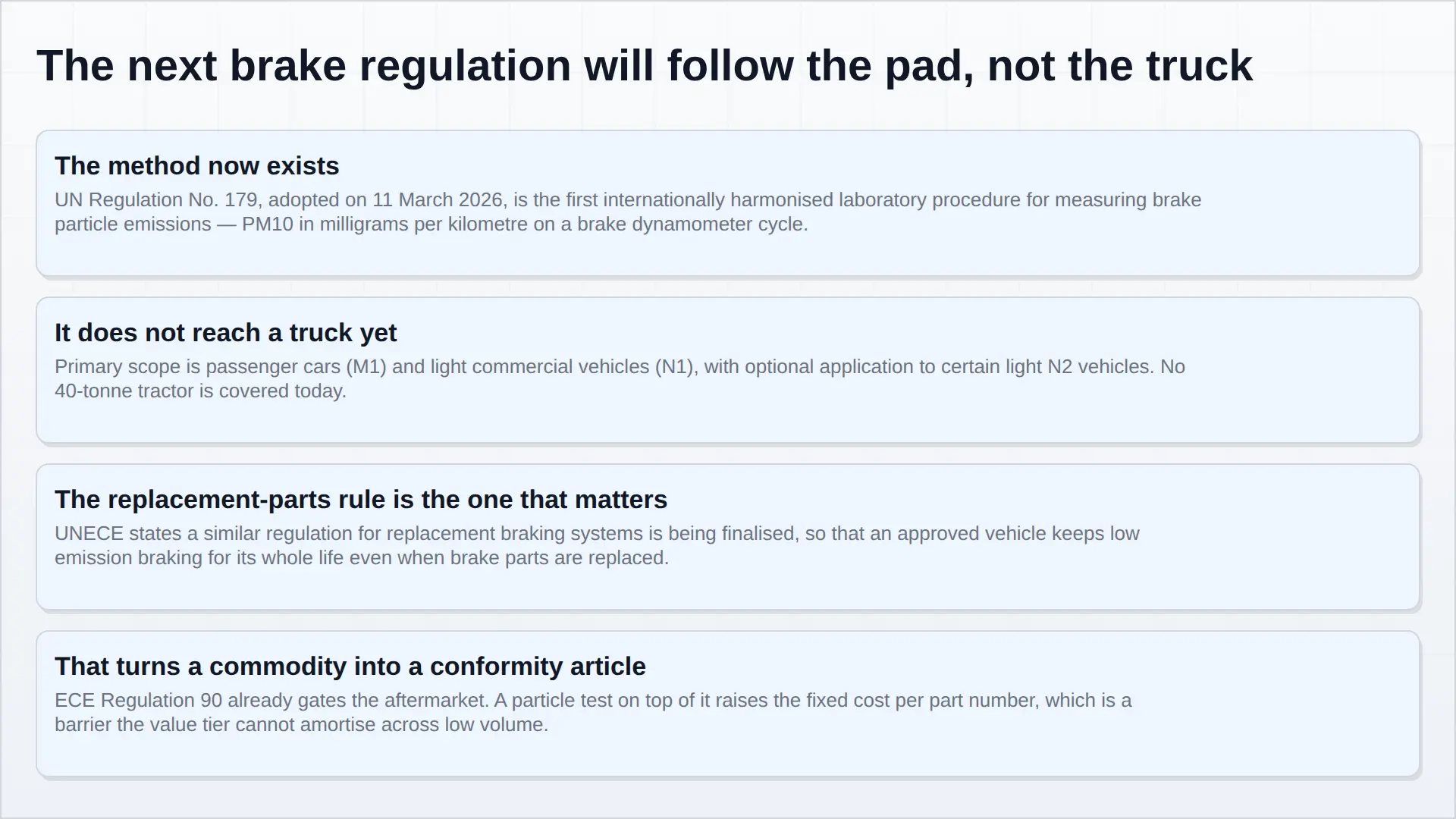
On 11 March 2026 the UNECE World Forum for Harmonization of Vehicle Regulations adopted the world’s first internationally harmonised laboratory procedure for measuring and limiting brake particle emissions. It is called UN Regulation No. 179. It is the most consequential piece of brake regulation in a decade, and for the commercial vehicle friction industry it does almost nothing — yet.
That “yet” is the whole story. Because the same announcement contains one sentence that does reach this market, and it is easy to read past: a similar UN regulation for replacement braking systems is being finalised, to ensure that approved vehicles with low-emission braking systems provide low emission levels for their whole lifetime, even when brake parts are replaced.
A vehicle is type-approved once. Its brake linings are replaced many times over its life. If the replacement part has to preserve the approved emission behaviour of the vehicle, then an aftermarket lining stops being a commodity and becomes a conformity article. That is a different business.
What Regulation 179 actually does
It sets a method before it sets a limit, and the distinction matters. The regulation specifies a brake dynamometer test using a dedicated cycle that reflects real-world braking patterns, and it sets limits for PM10 — particles 10 micrometres or less — expressed in milligrams per kilometre. Solid particle number measurement procedures are included in the framework, with numerical limits to be specified in future amendments.
| Element | What UN Regulation No. 179 specifies |
|---|---|
| Primary scope | Passenger cars (M1) and light commercial vehicles (N1); optional application to certain light N2 vehicles |
| Method | Brake dynamometer on a dedicated cycle reflecting real-world braking |
| Limit | PM10 in milligrams per kilometre |
| Particle number | Measurement procedures included; numerical limits deferred to future amendments |
| Electrified powertrains | A friction braking share coefficient, so the calculation reflects how much braking energy goes through friction rather than regenerative braking |
| Timing | Entering into force by the end of 2026; expected to be deployed in the EU as part of Euro 7, and in the UK |
So a reader should be clear about the negative: UN Regulation No. 179 does not apply to a 40-tonne tractor today. Nobody should tell a fleet engineer that truck brake pads are already regulated for particle emissions. They are not.
Two features of the regulation are more forward-looking than its scope suggests. The first is that it explicitly accounts for electrified powertrains — UNECE describes it as the first global brake emission regulation to do so — through a coefficient reflecting the share of braking energy actually handled by friction. The second is that particle number, not only particle mass, is inside the framework even though its limits are not yet set.
Why the replacement-parts rule is the one that matters
The commercial vehicle friction market is 79.6 per cent aftermarket by value — four dollars in five are spent after the truck is built — because friction is a wear item. A long-haul tractor consumes roughly one and a half axle sets a year, which is about fifteen relines over a ten-year life against one set of calipers.
That means the aftermarket, not the assembly line, is where friction is actually bought and where it is actually replaced. A rule that attaches emission performance to the replacement part therefore lands on the largest part of the market rather than the smallest.
And there is already a gate there. ECE Regulation 90 governs the approval of replacement brake lining assemblies and drum brake linings, requiring a replacement part to demonstrate performance equivalence to the original across a defined test programme. R90 is why a conforming aftermarket catalogue is expensive and slow to build, and why premium brands can hold a price differential against unbranded product.
The significance of the replacement-braking regulation is that it would arrive on top of R90 rather than instead of it. A fixed test cost per part number is trivial on a high-volume passenger car pad and punishing on a low-volume commercial vehicle pad that may ship a few thousand sets a year. Add a second conformity regime and the burden does not fall evenly — it falls hardest on the producers with the least volume to amortise it across.
Which is why the upside scenario in our forecast is not driven by more trucks. It is driven by a conformity requirement that removes cheap product from the market.
The copper statutes are narrower than the trade press implies — and asymmetric
The other regulatory pressure on friction formulation is at state level in the United States. California and Washington both restrict copper in brake friction material, with thresholds stepping down to 5 per cent and then 0.5 per cent by 2025, administered by the California Department of Toxic Substances Control and the Washington Department of Ecology.
The detail is more consequential than the headline, and one asymmetry is genuinely counter-intuitive. Under Washington’s Better Brakes law, tractor trailers are not considered motor vehicles and are therefore exempt. Under California’s law, all trailers — including tractor trailers — are included in the definition of a vehicle, subject to specific exemption provisions. Two states on the same coast, two different compliance answers for the identical trailer axle assembly.
The exemption schedules matter as much as the thresholds. California exempts vehicles manufactured before 1 January 2021 from the 2021 requirements, and vehicles manufactured before 1 January 2025 from the 2025 requirements, alongside military vehicles, small-volume manufacturers, closed oil-immersed brakes, parking brakes and motorcycles. Those manufacture-date exemptions are why the statutes have not removed copper from the entire North American aftermarket: a lining for a pre-2021 vehicle is a different regulatory object from a lining for a 2026 vehicle, and both are on the shelf.
The practical consequence is that the same trailer lining can be required in California, exempt in Washington, and sold nationally to a fleet whose trailers cross both states. In practice the industry has responded by reformulating broadly rather than running two catalogues, since dual inventory across thousands of part numbers is uneconomic. The statutes have therefore had a wider effect on product formulation than their strict legal scope implies.
One correction worth making
A claim circulates that China’s revision of GB 7258 mandates disc brakes on the front axle. It does not. The published revision plan, assigned in January 2025 on a sixteen-month cycle, widens mandatory fitment of automatic emergency braking, lane-keeping assistance, electronic stability control and tyre pressure monitoring, extends the scope of air suspension requirements, and adds event data recorder and software version requirements.
Front axles in China convert anyway, but for a technical reason rather than a legal one: the front axle carries the hardest thermal load case and is where a friction couple fails first under repeated heavy braking. That is an inference from engineering, not a requirement in a document, and it should be labelled as one.
What the roadside data already tells us
While type approval moves slowly, in-service inspection moves every year, and it is the more direct pressure on friction. At the Commercial Vehicle Safety Alliance’s 2026 Brake Safety Week, 2,369 of 15,528 inspections — 15.3 per cent — produced a brake-related out-of-service violation, and 1,176 of those, or 49.6 per cent, met the 20 per cent defective-brake criterion.
Inspectors recorded 141 drum and rotor violations: 97 on air disc brakes, 36 on S-cam drum brakes and 8 on hydraulic. Forty-five were rusted rotors, and every one of them was on a disc. There were no rusted drums at all.
That last figure deserves care rather than excitement. These are raw counts, not rates — nobody published how many disc-equipped vehicles were inspected, so no reader can infer that a disc is more likely to fail than a drum. Drums are also enclosed, so a rusted drum is not inspectable in the same way. But a rusted rotor is what happens to a friction surface that stops being used, and that is the least discussed relationship in this industry: electrification reduces friction consumption per kilometre while simultaneously degrading the friction couple that remains.
The answer is a pad formulated to clean and condition a rotor it rarely touches — a different product problem from making a pad last longer, and one that pulls in the opposite direction.
What to watch
Three documents and one number. The replacement braking system regulation, once published, is the single most important text for this market. The Euro 7 phase-in calendar sets the vehicle-level clock it will follow. Any amendment introducing numerical solid particle number limits turns a measurement framework into a design constraint. And the number is the electrified share of new heavy commercial vehicle registrations, because that is what quietly moves both the volume line and the friction couple underneath it.
A reader who wants the short version: no regulation anywhere yet mandates what a truck brake lining must be made of. What regulation does is progressively change the set of tests a friction product must pass to be sold and to keep a vehicle in service. Each of those changes has a cost, and the cost is not borne equally. That inequality, not the truck count, is what moves share in this market.
Read the full analysis in Global Commercial Vehicle Brake Friction Products Market Report, Size, Share and Forecast 2026–2033.
Frequently Asked Questions
Does UN Regulation No. 179 apply to truck brake pads?
No. UN Regulation No. 179 applies primarily to passenger cars (M1) and light commercial vehicles (N1), with optional application to certain light N2 vehicles. A heavy commercial vehicle is not in scope. What matters for truck friction is UNECE's statement that a similar regulation for replacement braking systems is being finalised, so that an approved vehicle keeps low emission braking even when parts are replaced.
Why does a replacement-braking regulation matter more than the vehicle regulation?
It would attach emission performance to the replacement part rather than only to the vehicle type approval. Because 79.6 per cent of the commercial vehicle friction market is aftermarket by value, a replacement-parts rule lands on the largest part of the market. It would arrive on top of ECE Regulation 90, which already requires replacement linings to demonstrate performance equivalence to the original.
Do the copper brake pad laws treat trailers the same in California and Washington?
They are not identical. Under Washington's Better Brakes law, tractor trailers are not considered motor vehicles and are therefore exempt. Under California's law, all trailers including tractor trailers are included in the definition of a vehicle. California also exempts vehicles manufactured before 1 January 2021 from the 2021 requirements and before 1 January 2025 from the 2025 requirements.