
Editorial Article
The Drum Lining Grew 2.71 Per Cent and the Disc Pad Grew 8.55 — Both on the Same Truck
A parts catalogue is not usually two markets. The one behind a commercial vehicle brake reline is, and the numbers inside it have now separated far enough that treating “brake friction” as a single line has become a forecasting error.
In the 2025 base year, drum brake linings were the larger business: USD 5,102 million, or 54.0 per cent of a USD 9,449 million market. Disc brake pads were USD 4,347 million, or 46.0 per cent. By 2033 those positions have swapped. Disc pads reach USD 8,379 million and 57.0 per cent; drum linings reach USD 6,321 million and 43.0 per cent. Across the eight years the disc line compounds at 8.55 per cent and the drum line at 2.71 per cent — a gap of nearly six points between components that are fitted to the same trucks, sold through the same distributors, and frequently manufactured by the same companies.
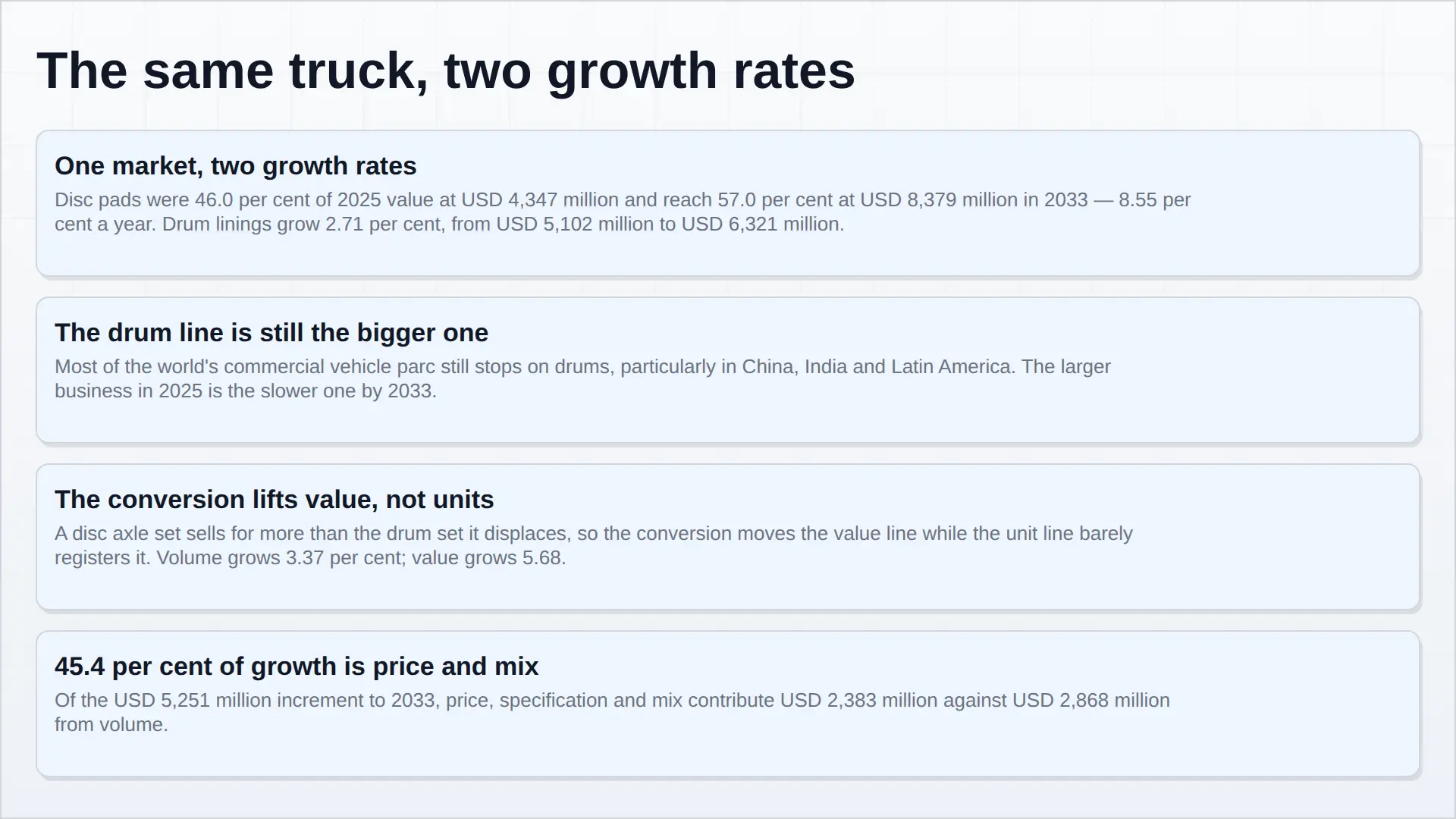
None of that gap is a statement about how many trucks will be built. Our report on this market puts total volume at 107.86 million axle sets in 2025 rising to 140.60 million in 2033 — 3.37 per cent a year. Value rises 5.68 per cent. The 2.3 point difference between those rates is realisation, which moves from USD 87.60 an axle set to USD 104.55.
One reason: a disc set is worth more than the drum set it replaces
A disc pad set carries more friction material, more processing and — increasingly — an embedded wear sensor and connector. When a fleet converts an axle from drum to disc, the number of stops that axle makes does not change. What changes is what each reline is worth. A disc axle set sells for materially more than the drum axle set it displaces, so every conversion lifts the value of the market without adding a single vehicle to it.
That is the honest description of what has happened here: the disc conversion is a revenue-mix event before it is a unit event. The market’s own arithmetic makes the point. Of the USD 5,251 million added between 2025 and 2033, USD 2,868 million comes from more axle sets and USD 2,383 million — 45.4 per cent — comes from price, specification and mix. A market where nearly half the growth never touches a vehicle build is a market whose forecast has to be built from the axle outward, not from the production line inward.
The conversion itself has a clock, and it is a regulatory one rather than a demand one. That story sits in the air disc brake report in this same cluster, and it explains why the take-rate responds to a calendar rather than to freight rates.
Two: most of the world still stops on drums, and that is not the contradiction it sounds like
The drum line is smaller by 2033 and it is still a USD 6.3 billion business. That is not a rounding error and it is not a legacy tail. Most of the world’s commercial vehicle parc still stops on drums — particularly in China, India and Latin America, where trailer and rigid-truck fleets are nowhere near converted, and where the economics of a drum reline are not obviously worse for the operator.
There is a second reason the drum line persists that is rarely modelled: a drum brake shoe is a durable steel part with a consumable lining. Relining a shoe rather than replacing an assembly is normal practice in North America, which means a meaningful share of drum friction volume arrives as a lining kit at a different price point, through a different buyer, with different margin. Any model that treats drum friction as a simple replace-the-part business overstates its value and misreads its resilience.
So the two lines are not a story about one product killing another. They are a story about two different rates of value growth in two different populations of vehicles, and the arithmetic signature of the slower one is easy to read: 2.71 per cent sits below the market’s 3.37 per cent volume growth, which is what a product form losing share to a substitute looks like in a table.
Three: the drum business is where the aftermarket fight actually is
The aftermarket is 79.6 per cent of this market’s value at USD 7,517 million in 2025, growing 6.00 per cent against 4.37 per cent for OE supply and reaching 81.5 per cent by 2033. That is a consequence of physics — a long-haul tractor consumes roughly one and a half axle sets of friction a year, so it is relined about fifteen times over a ten-year life against one set of calipers — and it is where the competition happens.
OE supply is nominated years in advance and bought in batches. The aftermarket is bought by a workshop quoting a repair this afternoon, from a distributor competing on availability. In that transaction, the purchase criterion is rarely price per set. It is whether the part is on the shelf and whether the fitter trusts it.
Which is why the most useful argument in this market is not about price at all. It is about interval. As TMD Friction’s own engineers have put it publicly, many fleets do not track their brake life cycles by vehicle type, load and route, and not every fleet recognises the value of a premium lining — their conclusion being that if a single reline can be eliminated across a vehicle’s brake life cycle, the small added cost of a premium kit is easily justified. A fleet buying on price per set relines more often. A fleet buying on cost per mile relines less. The premium tier of this market exists to move a buyer from the first frame to the second.
What it means if you are stocking the line
For a distributor, the practical consequence of a six-point growth gap is that catalogue decisions have a direction now. Disc coverage is the growth line and it is also the line where instrumentation is arriving — a pad with a wear sensor is not a commodity pad, and it carries a different conversation with the fleet. Drum coverage is a volume business with a long tail, a remanufacturing dimension and, in China, India and Latin America, most of the parc.
Carrying both is not indecision. It is the only position that matches the fleet mix of almost any real customer, and the report’s regional split makes the same point at a larger scale: China holds 27.5 per cent of 2025 value and 27.8 per cent of the increment. Europe holds 21.0 per cent of value but only 17.3 per cent of the growth, at 4.81 per cent, on the oldest parc and longest reline intervals. India holds 8.5 per cent of value and 13.3 per cent of the increment at 8.14 per cent.
Those three sentences describe three different businesses. A supplier that reads the global average and stops there will misjudge all of them — and will miss the larger fact sitting underneath the product-form split entirely, which is that in this market the trucks are not really the story. What is bolted to them is.
Read the full analysis in Global Commercial Vehicle Brake Friction Products Market Report, Size, Share and Forecast 2026–2033.
Frequently Asked Questions
Which is bigger today, disc pads or drum linings?
Drum linings held 54.0 per cent of 2025 value at USD 5,102 million against 46.0 per cent and USD 4,347 million for disc pads. By 2033 disc pads reach 57.0 per cent at USD 8,379 million while drum linings reach 43.0 per cent at USD 6,321 million. Over those eight years the disc line compounds at 8.55 per cent and the drum line at 2.71 per cent.
Why does the disc line grow three times faster than the drum line?
Because a disc axle set sells for more than the drum axle set it displaces — more friction material, more processing, and increasingly a wear sensor and connector. Every conversion lifts the value of the market without adding a vehicle to it, which is why 45.4 per cent of the market's growth to 2033 comes from price, specification and mix rather than volume.
Is the drum brake lining business in decline?
Not short term. The drum line is still a USD 6.3 billion business in 2033 because most of the world's commercial vehicle parc still stops on drums, particularly in China, India and Latin America. A drum brake shoe is also a durable steel part with a consumable lining, so relining rather than replacement keeps a substantial lining-kit business in place.