
Global Off-the-Road (OTR) Tyres Market Report, Size, Share and Forecast 2026–2033: 2.03% More Rubber and 4.06% More Money — the Gap Is the Business
1. Market Snapshot
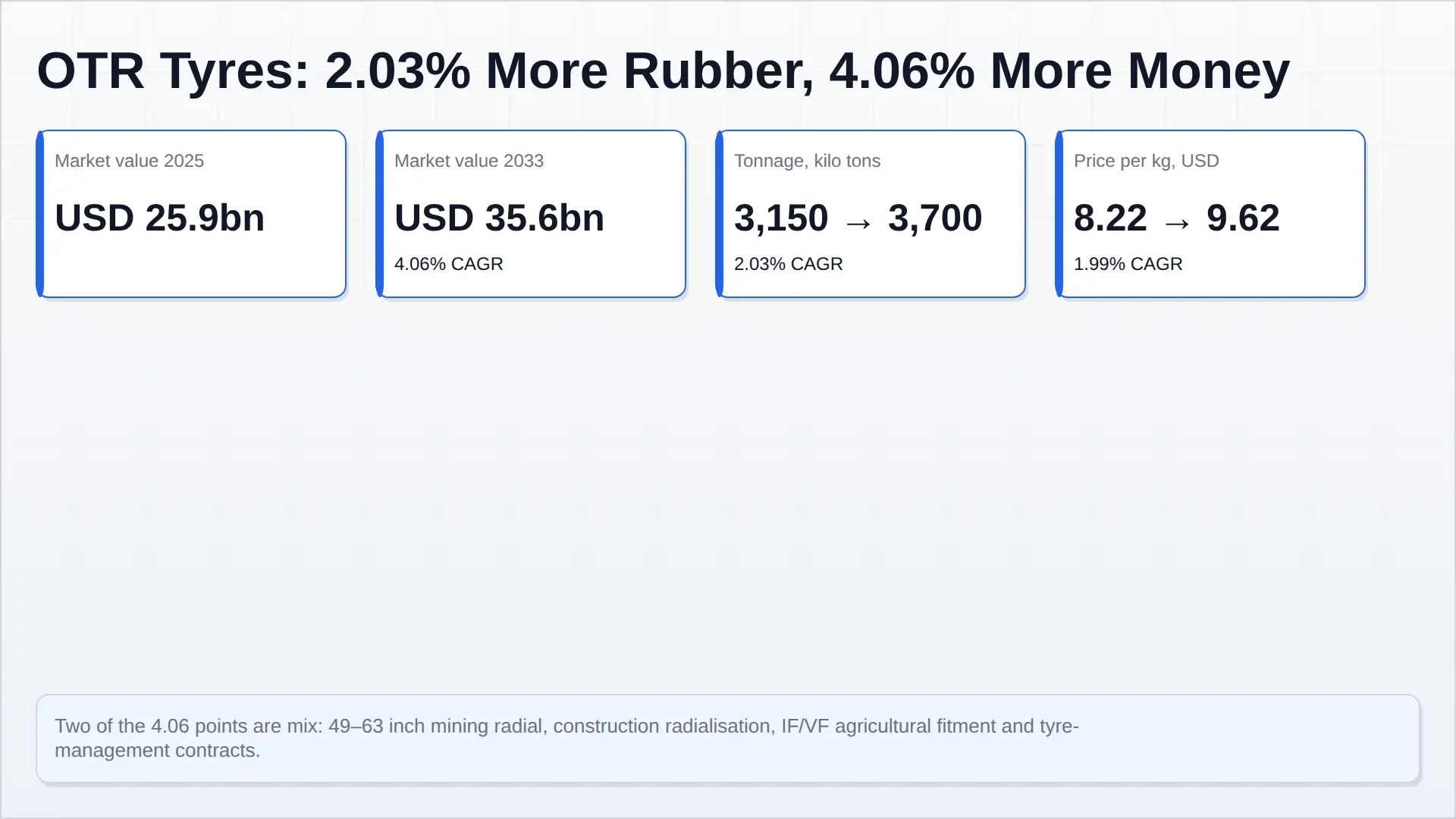
The off-the-road tyre market was worth USD 25,900 million in 2025 and will be worth USD 35,600 million in 2033 — a value CAGR of 4.06%. Over the same eight years the market's tonnage goes from 3,150 to 3,700 kilo tons, a CAGR of 2.03%. The distance between those two numbers is the report. Nothing about OTR demand is remarkable in weight terms. Everything about it is interesting in mix terms.
Realised revenue per kilogram goes from USD 8.22 in 2025 to USD 9.62 in 2033, 1.99% a year. That is not inflation. Tyre prices in the small bias sizes have gone sideways or down for a decade, and buyers in India and China pay less per kilogram today than they did in 2015. The 1.99% is what happens to a blended average when the tonnage mix moves toward 49- to 63-inch radial mining tyres, when agricultural fitment migrates to IF and VF radial constructions, when compact construction machines move from bias to radial, and when an increasing share of the tyre is sold with a monitoring service attached and a retread programme behind it. Every one of those four mechanisms is a decision a manufacturer makes. None of them is a macro variable.
| Headline metric | 2025 | 2033 | CAGR |
|---|---|---|---|
| Market value (USD million) | 25,900 | 35,600 | 4.06% |
| Volume (kilo tons) | 3,150 | 3,700 | 2.03% |
| Realised price (USD per kg) | 8.22 | 9.62 | 1.99% |
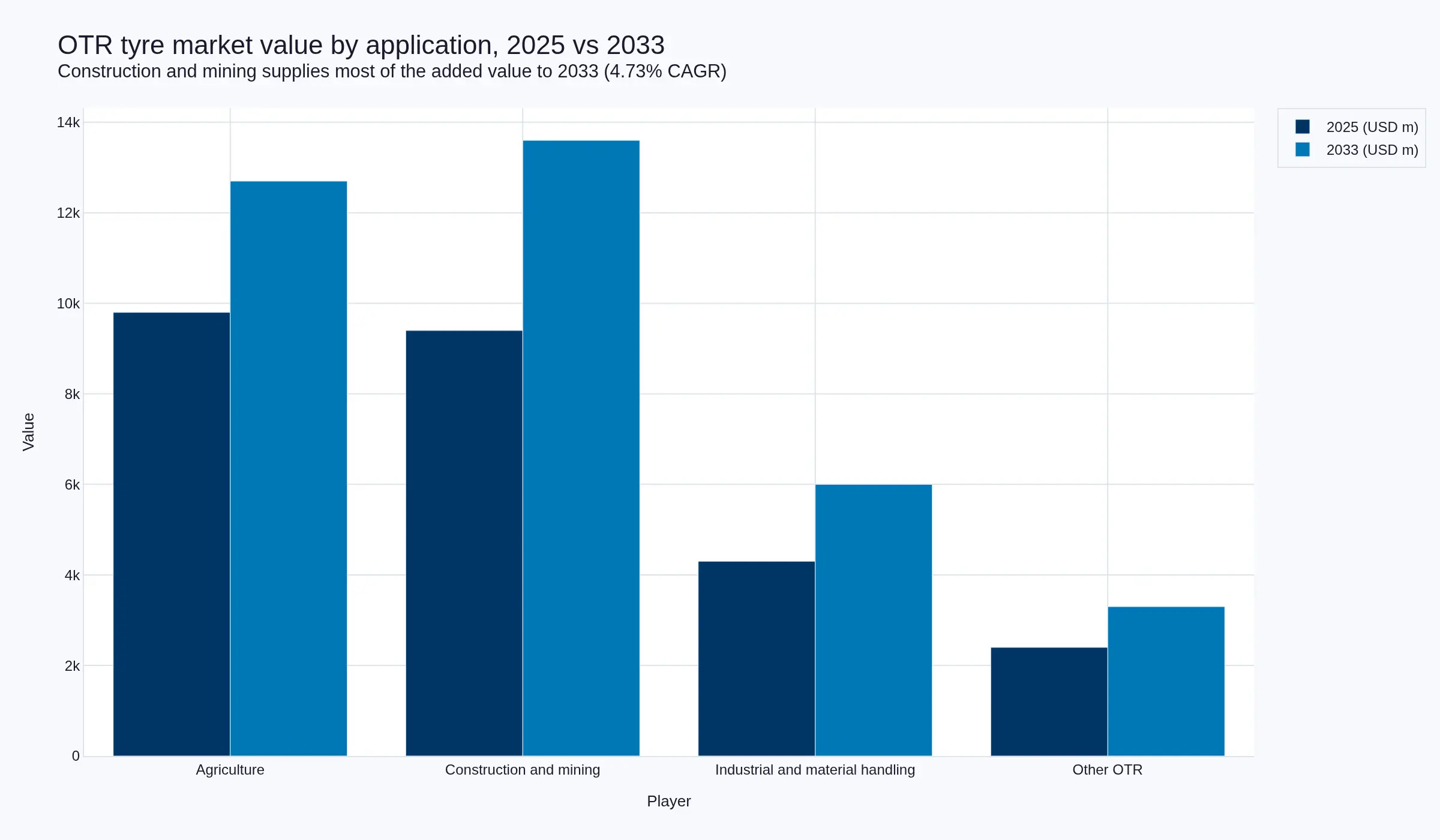
By application the market divides the way machine populations divide, not the way forecasts usually divide it. Agriculture is the largest single application at USD 9,800 million (37.8% of value), but it grows slowest at 3.29%, because the tyre content of a tractor is fixed and the tractor parc grows at roughly the rate of world arable area. Construction and mining is USD 9,400 million (36.3%) and grows 4.73%, and it supplies the majority of the absolute value added to 2033 because it is the only application where the tyre is getting structurally larger. Industrial and material handling — forklifts, port equipment, warehouse and yard machines — is USD 4,300 million (16.6%) at 4.25%. Everything else — forestry, military, airport ground support, speciality and utility machines — is USD 2,400 million (9.3%) at 4.06%.
| Application | 2025 (USD m) | Share | 2033 (USD m) | Share | CAGR |
|---|---|---|---|---|---|
| Agriculture | 9,800 | 37.8% | 12,700 | 35.7% | 3.29% |
| Construction and mining | 9,400 | 36.3% | 13,600 | 38.2% | 4.73% |
| Industrial and material handling | 4,300 | 16.6% | 6,000 | 16.9% | 4.25% |
| Other OTR (forestry, military, GSE, utility) | 2,400 | 9.3% | 3,300 | 9.3% | 4.06% |
| Total | 25,900 | 100% | 35,600 | 100% | 4.06% |
The construction and mining line carries an uncomfortable implication for anyone who forecasts this market from machine sales. Global construction equipment unit sales fell in 2024 and were flat-to-down in 2025 in most regions. The tyre market still grew, because a machine that is not being replaced still consumes tyres, and because the machines that are being replaced carry more tyre per machine. Replacement, not fitment, sets the cycle.
2. Market Definition and the Three Boundary Calls
Off-the-road tyres are pneumatic tyres designed for machines that are not intended primarily for highway use. The category is defined by exclusion and then subdivided by duty cycle, which means every published figure for this market rests on three boundary decisions. This report makes all three explicitly, because they are the reason OTR estimates differ by more than forty per cent from each other in public circulation.
2.1 Machine scope
Included: agricultural tractors, implements, trailers and harvesters; construction machines — excavators, wheel loaders, backhoes, dozers, graders, telehandlers, compact machines; mining equipment — rigid and articulated haul trucks, wheel loaders, LHDs, drills, draglines; industrial and material handling — forklifts, reach stackers, straddle carriers, terminal tractors, yard equipment; forestry, military, airport ground support, and speciality utility machines. Excluded: passenger car, light truck, and commercial highway tyres, including the C1, C2 and C3 categories that the European labelling regime governs. The exclusion matters because the highway tyre market is roughly eleven times larger by value and has entirely different economics — it is a consumer and fleet marketing business with high replacement frequency, while OTR is an engineered-goods business with national accounts, three-year approval cycles and single-transaction sizes that reach five figures.
2.2 Channel and point of valuation
Original equipment fitment and replacement are counted together, at the point of sale to the end user, with original equipment valued at the price the machine builder pays and replacement valued at the price the operator or its dealer pays. This inflates the blended average price relative to a manufacturer-revenue basis, which is why OTR market values are not comparable with the revenue lines of the companies that supply them. The top six suppliers together record revenue well below the market value they serve, because the value includes distribution margin, service and freight — and in this category freight is not a rounding error, because a 63-inch tyre does not ship in a container.
2.3 Retreading, tracks and wheel assemblies
Retreading is excluded from market value and treated instead as the main substitution mechanism against new-tyre volume; its economics are analysed in the value chain chapter. Rubber tracks are excluded, even where they compete directly with pneumatic tyres on compact construction machines, because they are a different product with a different supply chain. Tyre-and-wheel assemblies are included when sold as an assembly, which is how a material share of the compact, agricultural and industrial segments actually transacts.
3. Market Size and Forecast
3.1 The 2025 base was built from machines and kilograms, not from a value estimate
The 2025 base is built bottom-up. For each of the four applications we take the installed machine population and the annual new-machine flow, multiply by tyres per machine, apply a replacement ratio derived from duty cycle and typical service life, convert to tonnage using average tyre weight by size class, and price the tonnage at realised revenue per kilogram by size band. The tonnage result is 3,150 kilo tons and the value result is USD 25,900 million. Every coefficient in that chain is disclosed in the methodology section, and any of them can be replaced with a better one and the model re-run. The point of building it this way is that the argument survives the numbers: if you disagree with 4.06%, you can see precisely which coefficient you are disagreeing with — tyres per machine, replacement ratio, weight, or price per kilogram — and change it.
3.2 The regional allocation is the business model
Pheonix allocates 47% of 2025 value to Asia-Pacific, 22% to North America, 19% to Europe, 7% to South America and 5% to Africa and the Middle East. By 2033 Asia-Pacific reaches 49%, North America slips to 20% and Europe to 18%, with South America at 8% and Africa and the Middle East steady at 5%. The regional split matters less as a share contest than as a statement about what kind of tyre each region buys. Asia-Pacific consumes the most tonnage and the least value per kilogram: small agricultural and industrial sizes, bias-heavy, locally built, sold through distributors at prices that no European plant can match. North America and Europe consume less tonnage at roughly double the revenue per kilogram, because the mix is dominated by large radial earthmover and high-specification agricultural fitments, sold through national accounts with service attached. The same global average of USD 8.22 per kilogram is a blend of two markets that share a product name and almost nothing else.
3.3 The decomposition is the finding
Value growth of 4.06% decomposes into 2.03% of tonnage and 1.99% of realised price. The tonnage number is defensible and dull: it tracks machine populations, ore and aggregate moved, and arable area, all of which grow at one to two and a half per cent. The price number is where the decisions are, and it has four components of unequal size. Rim-size migration in mining is the largest — a share of new haul trucks that grows toward 63-inch fitments lifts the blended average because those tyres are worth several times a 49-inch tyre per unit of rubber. Radialisation of construction is second, because a radial earthmover tyre sells for more per kilogram than the bias tyre it replaces. Agricultural IF and VF fitment is third, sold on yield protection rather than on cost per hour. Service attach is fourth and smallest today, and it is the one we expect to compound, because it converts a consumable sale into a contract.
4. Four Structural Shifts Defining 2026–2033
4.1 The ceiling at 63 inches is a press, not a market
Giant OTR radial capacity is limited by the curing presses that can handle a 49- to 63-inch tyre, and by the skilled labour that builds one. A press for that size class is a multi-year order, and the building sequence is measured in operator-years, not machine-hours. The consequence is that supply in the largest sizes cannot respond to demand within a normal cycle, which is why the giant sizes have historically been the only part of this market with genuine pricing power, and why every serious player's capital allocation is a queue position rather than a marketing plan.
4.2 Consolidation was bought, not built
Between February 2024 and September 2025 the top of this market was reorganised by three transactions. Titan acquired Carlstar for approximately USD 296 million. Yokohama completed the acquisition of Goodyear's OTR business on 4 February 2025, a business with USD 678 million of annual sales. CEAT completed its acquisition of Michelin's Camso compact construction line on 1 September 2025. None of these was a capacity expansion. Each was a purchase of an approval position, a brand or a distribution footprint that would have taken a decade to replicate. The chapters that follow treat this as the defining competitive fact of the forecast period.
4.3 Bias capacity is migrating, and the compact line is the pivot
Michelin's exit from compact-line bias tyres and construction tracks is the clearest signal in the market: the most capable radial manufacturer in the world chose not to defend the bottom of the range. Bias capacity is not disappearing — it is relocating to India, Sri Lanka, China and South-East Asia, where the cost base supports it and where the demand for compact and agricultural machines is growing fastest. That relocation has a consequence for the trade-remedy chapter: the same shift that lowers cost for a Brazilian contractor raises the probability of another anti-dumping case for an Indian exporter.
4.4 The tyre became a contract
In mining and large construction fleets, the transaction increasingly is not a tyre. It is a tyre-management agreement — supply, inspection, pressure and temperature monitoring, rotation, retreading and casing disposal, priced per machine-hour or per tonne moved. Under that structure the manufacturer's interest shifts from selling kilograms to controlling the casing, because the casing is the asset that gets retreaded and the data is what prices the next contract. This is the mechanism by which a market growing 2.03% in weight can be described as growing 4.06% in value without anybody being accused of inflating a forecast.
5. Market Drivers
5.1 Ore tonnage is growing faster than metal production
Declining ore grades mean more rock moved per tonne of contained metal, and every additional tonne is carried on a tyre. This is the single most under-appreciated driver in the category: copper and gold output can be flat while haul-truck tyre consumption rises, because the ratio of waste to ore has been climbing for two decades.
5.2 Aggregates and public infrastructure
Construction and quarry demand is a policy variable in every large economy. Where infrastructure programmes are funded, the first consumable to move is the aggregate tyre — loaders, rigid trucks in quarries, and the compact machines that do roadwork. The 2024–2025 construction equipment downcycle reduced machine sales without reducing tyre consumption proportionally, because the installed fleet kept working.
5.3 Mechanisation in South Asia and Africa
Tractor populations in India, Pakistan, Bangladesh, Nigeria and East Africa are growing faster than arable area, which means tyre demand grows faster than crop output. The product sold there is small, bias and price-sensitive, and it is the reason Asia-Pacific's share of tonnage exceeds its share of value.
5.4 Uptime economics
On a large mining or construction site the tyre is a low single-digit percentage of the machine's hourly operating cost and effectively all of its availability. A failed haul-truck tyre costs far more in lost production and fitting labour than the tyre itself. This is why buyers in the large sizes do not shop primarily on price, and it is the commercial foundation under every tyre-management contract in the market.
5.5 Electrification of the machine
Battery-electric loaders, LHDs and drills change tyre duty: higher instant torque, different mass distribution, regenerative braking heat, and in underground operations a strong incentive to remove diesel ventilation load. The tyre consequence is not yet large in tonnage and is already material in specification, which is precisely the kind of mix shift this market rewards.
6. Market Restraints
6.1 Replacement is deferrable
The most important restraint in this market is that a tyre is a consumable the operator controls. In a commodity downturn, mines extend tyre life through monitoring, rotation, repair and retreading before they buy new. Volume can therefore fall faster than machine hours, and it recovers only when the casings are worn out — a lag of two to four quarters. Anyone forecasting OTR volume from commodity prices alone will be early on the way up and late on the way down.
6.2 Raw material volatility
Natural rubber, synthetic rubber, carbon black and steel cord together dominate the bill of materials, and pass-through to national-account customers lags one to two quarters. A sharp move in natural rubber compresses margin before it lifts price, and in the bias segments it cannot be passed through at all without losing volume to a local competitor.
6.3 Trade defence fragmentation
The United States has had countervailing duty orders on certain new pneumatic OTR tyres from India and Sri Lanka since 6 March 2017, alongside anti-dumping coverage of the same product class. Every new measure redirects trade rather than reducing it, and it forces exporters into a permanent sourcing-optimisation exercise that raises their cost of capital.
6.4 Capital intensity and lead time
A greenfield OTR plant is a multi-year, high-capital project with an OEM approval cycle of two to three years after that. Capacity cannot chase demand within a cycle, which restrains how fast the market can grow and simultaneously protects the incumbents who already have capacity.
6.5 Chinese bias overcapacity
In the small and medium bias sizes there is more capacity than demand and export disposition is structural. Prices in those sizes are set by the marginal Chinese container, not by cost, and that sets a ceiling on what a branded producer can charge for a comparable product.
7. Segmentation
7.1 By application
Agriculture, construction, mining, industrial and material handling, and other OTR. The commercial distinction that matters is not the machine but who signs: a farm buys on credit and price, a contractor on financing and availability, a mine on uptime and total cost per hour.
7.2 By construction
Radial, bias and solid. Radial dominates value in earthmover and large agricultural sizes and continues to take share; bias retains the majority of unit volume globally because it is cheap, repairable and adequate for low-speed, high-load-cycle work; solid tyres own the forklift and industrial segment where puncture risk is unacceptable.
7.3 By rim size
Below 25 inches (compact, agricultural, industrial), 25 to 49 inches (construction and smaller mining), 49 to 63 inches (large mining), above 63 inches (ultra-large, a handful of suppliers). Value per kilogram rises steeply across those bands and so does the barrier to entry.
7.4 By channel
Original equipment and replacement. Original equipment is a reference sale with thin margin and long cycles; replacement is where the profit is, and where distribution ownership decides share.
7.5 By region
Five regions, with the split described in section 3.2 and analysed in section 8.
8. Regional Analysis
8.1 Asia-Pacific
Largest by both tonnage and value, and the only region where the two rankings coincide. China dominates volume in construction and industrial sizes; India dominates the growth in agricultural and compact construction; Japan and Korea sit at the high end of radial specification. The region's internal trade is the most active in the world, and its export flows into North America and Europe are the trigger for most trade-remedy activity.
8.2 North America
Highest revenue per kilogram. Large mining and large agricultural dominate value; the aggregates and infrastructure cycle dominates volume. Replacement is a national-account business, which means share is sticky and price competition is concentrated at the dealer tier.
8.3 Europe
The most regulated and the most radialised. Agricultural IF and VF fitment is furthest advanced here, and the EUDR natural-rubber obligation lands on this region's importers first. European demand is the least cyclical in tonnage and the most exposed to compliance cost.
8.4 South America
Brazil is the story: large agricultural and construction demand, high trade barriers, and a domestic manufacturing base that makes it one of the few markets where local production is a condition of participation rather than a choice.
8.5 Africa and the Middle East
Mining-led value in South Africa, Ghana, the DRC and the Gulf, with construction-led volume in the Gulf's programme economies. Distribution is the constraint, and in several markets the tyre arrives on a truck that also carries the service technician.
8.6 What the geography says
Two markets share one product name. The first is a small number of very large radial sizes sold on uptime and contract to a hundred-odd institutional buyers. The second is a very large number of small bias sizes sold on price and credit to a few hundred thousand buyers. A strategy, a price list or a capacity plan that does not say which of the two it addresses is not a strategy.
16. Strategic Outlook
Base case (4.06% value, 2.03% volume): tonnage tracks machine populations, mix continues to move toward large radial and high-specification agricultural fitment, and tyre management extends its share of large-fleet transactions without yet changing the structure of the market.
Upside (5.2% value): a mining capex upcycle combined with faster radialisation in Indian and Chinese construction would lift the mix contribution above two and a half points. The binding constraint would be press capacity in the 49-inch-plus band, and the beneficiaries would be whoever holds the queue positions.
Downside (2.8% value): a construction-led downturn that triggers sustained replacement deferral, combined with a natural-rubber price spike that cannot be passed through in the bias tiers. Volume would fall before value did, and the small bias producers would absorb it first.
The asymmetry worth noting is that every mechanism that lifts the price line is a mechanism a manufacturer can act on, and every mechanism that moves the volume line is one they cannot. This market does not reward demand forecasting. It rewards mix management and casing control.
17. Watch List
- 30 December 2026 — EUDR applies to all operators. Natural rubber is in scope. Micro and small operators get a further six months. The Commission's simplification review, due 30 April 2026, is the next opportunity to reopen scope.
- Sunset reviews of the US countervailing and anti-dumping orders on OTR tyres from India and Sri Lanka. Any revocation resets export economics for two of the fastest-growing producer bases.
- Press capacity announcements in the 49-inch-plus band. The only credible signal that a competitor expects the mining mix to keep rising.
- Radialisation of Indian agricultural fitment. The moment Indian OEMs specify radial as standard, the value-per-kilogram curve for Asia-Pacific steepens and the bias tail starts to hollow.
- Non-pneumatic and track substitution in compact machines. Small in tonnage, decisive in the segments where bias margins live.
- Natural rubber pricing and traceability premiums. The spread between compliant and non-compliant rubber becomes a visible line in the bill of materials from 2027.
18. Methodology
This report is built as 70% secondary evidence and 30% Pheonix primary research. The secondary base is public: company filings and results releases, regulator and trade-remedy documents, official EU legal records, industry association data, and machine-builder disclosures. The primary base is the Pheonix programme for this category: structured interviews with tyre converters and product managers, open-ended interviews with distributors and fleet tyre managers in mining, construction and agriculture, conference-floor interviews across the off-highway equipment circuit, and a survey programme covering replacement buyers on specification, retreading and service attach. No quantitative claim in this report is attributed to a named individual, and no interview count is asserted as a survey statistic; the primary input is used to calibrate coefficients and to test whether a secondary figure describes what actually happens at a machine.
The market model runs as: machine population and new-machine flow by application and region, multiplied by tyres per machine, multiplied by a replacement ratio, converted to tonnage at average tyre weight by size class, and priced at realised revenue per kilogram by size band. The 2025 output is 3,150 kilo tons and USD 25,900 million. The 2033 output is 3,700 kilo tons and USD 35,600 million. Retreading is excluded from value and modelled as a substitution against new-tyre volume; rubber tracks, wheels sold separately, and services are excluded. Currency is USD at 2025 average rates. Any coefficient may be replaced and the model re-run; the decomposition into tonnage and realised price is deliberately exposed so that a reader can disagree with the forecast at a specific, testable point rather than with the conclusion as a whole.
About This Report
Coverage: global, with five regional breakdowns and four application breakdowns. Base year 2025, forecast to 2033. Currency USD. No third-party market estimate is used or reproduced in this report; every figure is either sourced to a primary document cited in the text or derived in the model described above.
Table of Contents
- Market Snapshot
- Market Definition and the Three Boundary Calls
- Market Size and Forecast
- 3.1 The 2025 Base Was Built From Machines and Kilograms, Not From a Value Estimate
- 3.2 The Regional Allocation Is the Business Model
- 3.3 The Decomposition Is the Finding
- Four Structural Shifts Defining 2026–2033
- 4.1 The Ceiling at 63 Inches Is a Press, Not a Market
- 4.2 Consolidation Was Bought, Not Built
- 4.3 Bias Capacity Is Migrating, and the Compact Line Is the Pivot
- 4.4 The Tyre Became a Contract
- Market Drivers
- 5.1 Ore Tonnage Is Growing Faster Than Metal Production
- 5.2 Aggregates and Public Infrastructure
- 5.3 Mechanisation in South Asia and Africa
- 5.4 Uptime Economics
- 5.5 Electrification of the Machine
- Market Restraints
- 6.1 Replacement Is Deferrable
- 6.2 Raw Material Volatility
- 6.3 Trade Defence Fragmentation
- 6.4 Capital Intensity and Lead Time
- 6.5 Chinese Bias Overcapacity
- Segmentation
- 7.1 By Application
- 7.2 By Construction
- 7.3 By Rim Size
- 7.4 By Channel
- 7.5 By Region
- Regional Analysis
- 8.1 Asia-Pacific
- 8.2 North America
- 8.3 Europe
- 8.4 South America
- 8.5 Africa and the Middle East
- 8.6 What the Geography Says
- Value Chain
- Technology and Innovation
- Competitive Landscape
- Regulatory Landscape
- Investment Activity
- Market Risk
- Strategic Outlook
- Watch List
- Methodology
- About This Report
Competitive Landscape
A Market Whose Top Was Reorganised in Twenty Months
The conventional description of this market — a handful of global majors above a long tail of regional producers — remains accurate and has stopped being useful, because between February 2024 and September 2025 the top of the table changed hands three times. None of those transactions added a kilogram of capacity. All three bought an approval position, a brand or a distribution footprint, which tells you what the scarce asset in this category actually is.
| Date | Transaction | Size | What was actually bought |
|---|---|---|---|
| 29 Feb 2024 | Titan International acquires Carlstar Group | ~USD 296m, ~4x FY2023 adjusted EBITDA of USD 73m | USD 615m of 2023 revenue, four plants and twelve distribution centres in specialty tyre and wheel assemblies |
| 4 Feb 2025 | Yokohama Rubber completes acquisition of Goodyear’s OTR business | Business with USD 678m of FY2023 sales, ~500 employees | Mining and construction tyre range from 25 inches or less up to 49–63 inch, plus the technology and service staff |
| 1 Sep 2025 | CEAT completes acquisition of Michelin’s Camso compact construction line | US$171m committed investment in Sri Lanka, 1,483 jobs | Midigama plant and Kotugoda casting plant, the Camso brand, and access to 40+ global OEMs |
What each deal says about strategy
Yokohama’s purchase is the largest statement. Goodyear’s OTR business carried USD 678 million of annual sales in fiscal 2023 and a product range that ran from compact sizes to 63-inch giant radial, and the company’s own completion notice of 4 February 2025 describes the acquisition as the route to a full off-highway line-up rather than as a bolt-on. Yokohama already owned the former Trelleborg wheel systems business; adding Goodyear’s OTR range puts it in a position to bid for a mine’s entire tyre requirement rather than a slice of it. That is a distribution argument dressed as a capacity argument.
Titan’s purchase of Carlstar is the opposite bet, and equally rational. At approximately USD 296 million, or about four times Carlstar’s fiscal 2023 adjusted EBITDA, Titan bought USD 615 million of revenue, three US plants and one Chinese plant, twelve distribution centres, and — critically — a wheel business. A tyre sold as a mounted assembly is a tyre the customer does not shop out to a third party. The multiple is the interesting number: four times EBITDA is a manufacturer’s multiple, not a services multiple, and it tells you how the market prices specialty tyre assets.
Michelin’s sale of the Camso compact construction line to CEAT is the cleanest strategic signal of the three. CEAT’s disclosure of 1 September 2025 records completion of the acquisition, including the Midigama plant and the Kotugoda casting plant in Sri Lanka, global ownership of the Camso brand after a three-year licensing period, and Michelin’s exit from compact-line bias tyres and construction tracks. The most capable radial manufacturer in the world chose to stop defending the bottom of the range and to concentrate on the sizes where the press is the barrier. That is not a retreat from OTR. It is a statement that the top and the bottom of this market are now different businesses with different owners.
The pure-play benchmark
Balkrishna Industries is the cleanest read on what a bias-weighted specialist can do in a soft year. Its audited results for the year ended 31 March 2025 show consolidated revenue from operations of ₹10,446.95 crore against ₹9,368.87 crore the prior year — an increase of 11.5% — and profit for the year of ₹1,654.96 crore. A portfolio built on agricultural, industrial and construction fitment, sold largely through distributors into export markets, grew double digits in a year when construction equipment sales fell. That is the strongest available evidence that replacement demand and mix, not machine sales, drive this market.
The challengers and the tail
Below the six sit two distinct groups. The Asian growth platforms — CEAT, Apollo, JK Tyre and MRF in India, and the Chinese bias specialists serving export markets — are consolidating the bottom of the range and moving up in size. The European and Japanese specialists — Pirelli, Magna, and the regional agro specialists — hold specification positions in premium agricultural and compact construction fitment. Below them are hundreds of producers of small bias tyres for agricultural, industrial and utility machines, competing almost entirely on price and local availability, and it is this tier that the 1.99% blended price gain does not reach at all.
How competition actually works
In the large sizes, competition is a sequence of approvals. A machine builder qualifies a tyre for a platform, and the qualification takes two to three years, involves field trials on customer sites, and is effectively a licence to supply that size for the life of the platform. In the small sizes, competition is a price list and a distributor relationship. In the service layer, competition is the contract: a tyre-management agreement that holds a mine’s casings is worth more than the tyres in it, and it is defended with monitoring data rather than with discounts. Any assessment of competitive position in this market that does not distinguish those three arenas will misprice every company in it.
Value Chain
The Material Bill Decides Who Can Compete
An off-the-road tyre is a low-technology product made with very high technology. The bill of materials has not changed in fifty years — natural rubber, synthetic rubber, carbon black, steel cord, bead wire, fabric and a long list of curing and protective chemicals — but the way those inputs are converted, and the size class in which they are converted, decides almost everything about the economics of the firms that make them. In a bias agricultural tyre, rubber hydrocarbon is the largest single cost line and the compound is a straightforward blend. In a 57-inch haul-truck radial, the steel cord, the heat history of the cure and the sheer mass of the article dominate, and the press that cures it is a strategic asset with a queue position measured in years.
Pheonix estimates that materials are 50–60% of the cost of goods in this category, with the balance split between conversion energy, labour and overhead. That headline range conceals the important variation: the material share falls as the tyre gets larger, because a giant radial consumes disproportionately more curing time, more press occupancy and more skilled building labour per kilogram. This is the first reason the value chain in the 49-inch-plus band looks nothing like the value chain in the 20-inch band.
Stage one: rubber and the traceability problem
Natural rubber is produced by smallholders across Thailand, Indonesia, Vietnam, India and West Africa, aggregated through trading houses into block and sheet grades. That aggregation is the point at which traceability is lost, and it is the reason the EU Deforestation Regulation matters commercially rather than merely legally: a manufacturer that can document plot-level origin for its natural rubber is selling into the European market after December 2026 and one that cannot is not. Synthetic rubber and carbon black track oil and feedstock prices, which is why a crude move reaches a tyre’s cost line within a quarter.
Stage two: conversion, and why the press is the moat
Conversion runs mixing, component preparation — calendering and extrusion — building, curing and finishing. Curing is the bottleneck. A large OTR tyre occupies a curing press for a period measured in hours, not minutes, and the press itself is a capital item with a long lead time and a size ceiling. Everything upstream of the press can be replicated with money. The press cannot be replicated with money inside a normal cycle. This is the structural reason why the large-size market has never been disrupted by a new entrant from below, and why every strategic move in this category is ultimately about access to large-size capacity rather than about brand.
Stage three: distribution, where the value actually settles
Replacement is roughly two-thirds of value globally and considerably more in mature markets, and it is where the profit is. Original equipment fitment is a reference sale: thin margin, long approval cycle, and worth doing only because a machine builder’s specification drives twenty years of replacement demand for that size. The replacement chain runs from manufacturer to national account — a mining house, a contractor, a large farm group — or through regional distributors and dealers who carry competing brands and add fitting, service and credit. In the small bias sizes the distributor holds most of the pricing power, because the product is interchangeable and the customer is local. In the large radial sizes the manufacturer holds it, because the customer is institutional and cannot switch on a machine that is standing still.
Stage four: the service layer, and the loop back into volume
Tyre management is the part of the chain that has changed most in the last decade. Supply, inspection, pressure and temperature monitoring, rotation, repair, retreading and casing disposal now transact as a contract priced per machine-hour or per tonne moved, and that contract captures recurring revenue at a margin above the hardware sale. It also creates a loop that suppresses the market’s tonnage: a managed casing that is retreaded twice displaces two new tyres. Retreading is therefore excluded from the value figures in this report and modelled instead as substitution — the more successful the service layer becomes, the slower the tonnage line grows and the richer the value line gets. That is not a paradox. It is the mechanism behind the 2.03 against 4.06.
Stage five: end of life
Off-the-road casings are large, durable and valuable as material. The European landfill prohibition on whole and shredded tyres closed the cheapest disposal route years ago and pushed the market toward crumb rubber, civil-engineering applications and energy recovery, while in mining the casing is more often repaired, retreaded or sold into a secondary market than scrapped. The disposal route matters to the buyer’s cost per hour and therefore, indirectly, to what the next tyre is worth. A supplier who takes the casing back is selling a service, not a product, and is paid accordingly.
Where the power sits
At the top of the size range, power sits with the press and with the OEM approval. At the bottom, it sits with the distributor and with the trade-remedy schedule that decides which factory’s container is economic this year. The two ends share a supply chain, a raw material index and a customer name, and nothing else. For the demand side, see our Global Agricultural Tyres and Global Industrial & Specialty Tyres reports; for the corporate structure of the converters, Titan International’s FY2024 Form 10-K sets out the segment economics of a specialty wheel-and-tyre assembler.
Investment Activity
The Capital Went Into Positions, Not Into Presses
Between February 2024 and September 2025, the three most significant transactions in this market bought existing positions rather than new capacity. That is the single most informative fact about how capital is being allocated in off-the-road tyres, and it is a deliberate choice rather than a shortage of ambition. A greenfield large-size plant takes years to permit and build, and a further two to three years to qualify with the machine builders whose platforms it would supply. Buying a business that already holds those qualifications is faster and cheaper, and the multiples confirm it.
The three transactions and the logic behind each
Titan International and Carlstar, 29 February 2024. Approximately USD 296 million in cash and stock, for a business with about USD 615 million of 2023 revenue and USD 73 million of adjusted EBITDA — roughly four times. Carlstar brought three US plants, one in China, twelve distribution centres, and verticals Titan did not serve: outdoor power equipment, power sports, trailers, and small-to-mid agricultural and construction. The strategic content is the wheel. Titan already sold tyres and wheels; Carlstar made it a one-stop assembly supplier, which raises the switching cost for a distributor and takes the mounting operation away from the customer.
Yokohama Rubber and Goodyear’s OTR business, completed 4 February 2025. The acquired business carried USD 678 million of annual sales in fiscal 2023 and about 500 employees, with a mining and construction range running from 25 inches and below to 49–63 inch giant sizes. Yokohama already held the former Trelleborg wheel systems business. The combination is the clearest example in the market of buying breadth: a single supplier that can cover a mine’s whole tyre requirement, from a light utility machine to a 63-inch haul truck, is a different commercial proposition from one that covers a slice of it. Note also what the seller was doing. Goodyear sold a profitable specialised business to reduce complexity and debt; the buyer paid for a position it could not build inside its own medium-term plan.
CEAT and Michelin’s Camso compact construction line, completed 1 September 2025. CEAT’s disclosure records the Midigama plant and Kotugoda casting plant in Sri Lanka, global ownership of the Camso brand after a three-year licensing period, access to more than 40 global OEMs, a committed US$171 million investment in Sri Lanka and 1,483 jobs. Michelin exits compact-line bias tyres and construction tracks entirely. This is the transaction that tells you where the industry believes each tier belongs: the radial leader concentrating on the sizes where the press is the barrier, and an Indian growth platform buying the bottom of the range together with the European and North American distribution that makes it saleable.
What the multiples say
Four times EBITDA for a USD 615 million specialty tyre business is not a growth multiple. It is the multiple a market applies to a cyclical manufacturer with real assets and unremarkable returns on capital. Two conclusions follow, and they are both actionable. First, the cheapest way to add capacity, brands and approvals in this category is to buy them, which is why the consolidation wave should be expected to continue rather than to have completed. Second, the market is not yet pricing the service layer: a business whose revenue is a tyre-management contract with monitoring data, retreading and casing control attached should command a higher multiple than four times, and the first acquirer to demonstrate that will reprice the sector.
Where the capital is actually going
Three destinations. The first is Indian and Sri Lankan capacity serving export markets, of which CEAT’s US$171 million commitment is the visible example. The second is Chinese and South-East Asian bias capacity aimed at the price-sensitive tiers of Asia, Africa and Latin America, where the investment case is scale and proximity to natural rubber rather than technology. The third is the service layer — retreading networks, monitoring platforms and distribution — where the capital required per dollar of recurring revenue is a fraction of a plant’s.
What is notably scarce is announced capacity in the 49-inch-plus band. That is a deliberate industry posture rather than an oversight: the incumbents hold queue positions on large curing presses, demand in that size class grows faster than the market, and no one has an incentive to add supply that would compete with their own pricing. Anyone forecasting faster value growth in this market has to assume that posture breaks, and there is no evidence yet that it will.
The investment question that matters
If the value line grows because of mix, the investments that matter are the ones that change mix — a large-size press, an IF/VF agricultural range, a radial compact construction line, a monitoring platform that converts hardware into a contract. If the volume line is the one an investor is underwriting, the relevant investments are distribution and trade-remedy positioning, because volume in this market is won at the dealer tier and lost at the customs border. A capital allocation plan that does not say which of those two it is funding is not a plan, and the last twenty months of transactions suggest that most of the industry has chosen mix.
Technology & Innovation
Innovation Is a Mix Lever, Not a Cost Lever
The technology story in this market is frequently told as a story about grip, durability and materials. Commercially it is a story about specification, because every meaningful technical step in off-the-road tyres changes the revenue per kilogram rather than the cost per kilogram. The 1.99% of annual realised-price growth in this report’s model is not invented; it is a weighted average of four specific specification shifts, each of which is a technology decision taken inside a manufacturer and specified by a machine builder.
Radialisation, and why it took so long below the largest sizes
A radial carcass runs its cords at roughly ninety degrees to the direction of travel, which stabilises the tread, spreads load more evenly and reduces the heat that destroys an off-the-road tyre in high-load-cycle work. The technology has been dominant in earthmover and large agricultural sizes for decades. It has been slow to reach compact construction and small agricultural fitment for an honest reason: a radial is more expensive to build, less tolerant of overload and sidewall damage, harder to repair in a field, and unnecessary on a machine that works at low speed for short periods. The shift now underway is driven by machine design rather than by tyre marketing — larger, heavier compact machines with higher hydraulic flow and more load per wheel end have reached the point where the bias tyre’s heat build-up becomes the limiting factor on the duty cycle.
IF and VF agricultural constructions
Increased Flexion and Very High Flexion tyres carry more load at lower inflation pressure, in a smaller envelope, than a conventional radial. The agronomic argument is soil compaction: a heavier load on a smaller footprint at higher pressure compresses the soil structure and costs yield in subsequent seasons. That argument converts a tyre purchase from a cost decision into an input decision, which is why IF and VF fitment is furthest advanced in Europe and in high-value row-crop operations, and why it commands a premium that a cost-per-hour calculation alone would not support.
Compounds, and the limits of formulation
Cut-and-heat-resistant compounds do the hardest work in mining, where a haul-truck tyre must survive both mechanical cutting from sharp rock and the internal heat generated by carrying a three-hundred-tonne load at sustained speed. Silica and modified carbon blacks trade rolling resistance against tear resistance and traction, and in agricultural applications against soil interaction. Recycled and recovered carbon black is entering the specification in response to customer carbon accounting rather than to performance, and alternative natural-rubber sources — guayule among them — remain a strategic hedge on supply rather than a commercial volume today. The honest assessment is that compound technology delivers incremental life, and life is worth real money per hour but does not in itself change the shape of this market.
The digital layer
Tyre-pressure and temperature monitoring on off-the-road machines has moved from a maintenance accessory to a contractual obligation. A monitoring system that detects a slow pressure loss before it becomes a heat failure pays for itself in one avoided event, and the data it produces — wear rate against load, speed, haul-road condition and ambient temperature — is what allows a supplier to price a tyre-management contract per hour with confidence. That data is also the entry ticket to the next negotiation, which is why the majors have been willing to give the hardware away to hold the contract. The second-order effect is on the market model itself: a monitored tyre is a managed asset, and a managed asset is replaced on prediction rather than on failure, which smooths volume and delays the replacement decision in a downturn.
Autonomy and electrification
Autonomous haulage is the most consequential machine change in the category. It does not remove the tyre, and it does not reduce tyre consumption per tonne moved; it standardises the duty cycle. A driver who is late accelerates harder and takes a wider line. A controlled haul cycle does neither, so wear becomes predictable, and predictable wear is the precondition for the per-hour contract described above. Battery-electric loaders, drills and underground loaders add a different set of specifications: higher instantaneous torque, regenerative braking heat, and a mass distribution that changes load per wheel end. Underground, the strongest economic argument for electrification is ventilation — removing diesel exhaust removes a large continuous energy load from the mine — and that argument is now strong enough to be changing machine fleets in jurisdictions that have no carbon price at all.
Substitution from outside the category
Two substitution threats sit at the bottom of the size range and both should be watched rather than feared. Non-pneumatic wheels have taken real share in skid-steer, utility and low-speed industrial applications, where puncture risk and downtime outweigh ride quality. Rubber tracks have taken share from wheels on compact construction machines, particularly in soft ground and on slopes. Neither threatens the mining or large agricultural tyre, and both erode exactly the bias volume pool where margins are thinnest — which is consistent with the direction of the mix in this report rather than a contradiction of it.
What all of this is worth
Add the four mechanisms together and the arithmetic is modest and reliable: rim-size migration contributes the largest share of the 1.99%, radialisation of construction the second, IF and VF agricultural fitment the third, and service attach the fourth and smallest. None of them requires a breakthrough. Each requires a specification decision, an approval cycle and a capital allocation — which is precisely why they are defensible. A competitor cannot copy a specification shift that a machine builder has already approved into a platform, and the approval cycle is two to three years long.
Market Risk
The Value Line Is Robust; the Volume Line Is Fragile
The risk profile of this market is asymmetric in a way that a single CAGR cannot express. The mechanisms that lift realised revenue per kilogram — rim-size migration, radialisation, specification premia, service attach — are slow-moving and largely under the industry’s own control. The mechanisms that move tonnage — commodity cycles, construction budgets, replacement deferral — are fast and entirely outside it. An investor who buys the value story is buying a fairly stable mix shift. An investor who buys the volume story is buying a cyclical.
| Risk | Mechanism | Exposure | What to watch |
|---|---|---|---|
| Replacement deferral | Operators extend tyre life via monitoring, rotation, repair and retreading before buying new | High on volume, low on value | Casing age in mining fleets; retread volumes |
| Raw material volatility | Natural rubber, carbon black and steel cost moves; pass-through lags one to two quarters | High on margin in bias tiers | Natural rubber price; feedstock spreads |
| Trade policy | Anti-dumping and countervailing duties redirect rather than reduce trade | High, regionally concentrated | Sunset reviews; new investigations; origin mix |
| Construction cycle | Public budgets and financing costs move machine demand and utilisation | Moderate to high on volume | Aggregate volumes; equipment sales |
| Substitution at the bottom | Non-pneumatic wheels and tracks in compact and industrial machines | Low overall, high in bias tiers | Compact machine specification trends |
| Customer concentration | National accounts and mine contracts are large relative to a regional P&L | High at company level | Contract renewals; fleet wins and losses |
Replacement deferral is the risk that actually bites
In every cyclical downturn this market shrinks faster than machine utilisation does, for a reason that is entirely rational at the operator level: a tyre is a consumable, and a monitored tyre with measurable remaining life is the easiest capital deferral a site manager has. Retreading and repair extend the interval, and both are cheaper than a new 63-inch radial by an order of magnitude. The deferral lasts two to four quarters and then unwinds in a rush when casings reach their limit, which produces the characteristic shape of this market’s volume history — flat, flat, sharp drop, sharp recovery. Any plan built on a smooth tonnage line is mis-specified, even if the eight-year average is right.
Input costs compress margin before they lift price
Natural rubber, synthetic rubber, carbon black and steel cord dominate the bill of materials, and in national-account contracts the price adjustment lags the cost by one to two quarters. In the bias tiers it never fully passes through at all, because the competing quote is from a producer whose cost base is lower and whose currency has moved. The result is that a raw material spike is a margin event for the top of the market and an existential event for the bottom, and the consolidation described in this report is partly a consequence of that asymmetry rather than a cause of it.
Trade policy risk is now structural, not episodic
The United States has maintained countervailing duty orders on certain new pneumatic off-the-road tyres from India and Sri Lanka since 6 March 2017, alongside anti-dumping coverage of the same product class, and the scope definitions have been contested repeatedly. For a producer, the risk is not one duty rate; it is that the duty changes the economics of an origin faster than capacity can be relocated. For a buyer, the risk is that a single-source strategy becomes a landed-cost problem with no product-level justification. Both are managed the same way — by modelling origin as a variable, not an assumption.
Substitution risk is real but confined
Non-pneumatic wheels and rubber tracks have taken genuine share in compact construction, skid-steer and low-speed industrial applications, where puncture risk and downtime cost more than the ride penalty. They are not a threat to a haul truck or a row-crop tractor, and no credible technology removes the pneumatic tyre from either in the forecast window. The exposure is concentrated precisely where margins are thinnest, which means substitution shows up as a slow erosion of the bias volume pool rather than as a shock to the market.
What is not a risk, and why that matters
There is no plausible demand-substitution risk at the top of this market, no regulatory prohibition on the product, and no technology that removes the tyre from the machine. The genuine risks are cyclicality, input cost, trade policy and concentration — all of them familiar, none of them structural to the existence of the market. That is an unusual profile for an industrial category and it is the reason this report’s base case stays in a narrow band: the value line is protected by mix and the volume line is protected by the fact that machines cannot run without tyres. The thing that can go wrong is the timing, not the direction.
Regulatory Landscape
Regulation Arrives Through the Supply Chain, Not the Product
The first thing to understand about the regulatory landscape for off-the-road tyres is what is absent from it. The European tyre labelling regime, which governs rolling resistance, wet grip and noise for C1, C2 and C3 tyres, does not reach this category. There is no consumer label on an OTR tyre, no comparative performance grade, and no regulator testing one against another. That absence shapes everything that follows: because the product itself is not regulated for performance, the regulatory pressure in this market arrives through two other doors — the raw material supply chain, and trade policy.
The EU Deforestation Regulation and natural rubber
Rubber is one of the seven commodities in scope of the EU Deforestation Regulation, alongside cattle, cocoa, coffee, oil palm, soya and wood. The regime requires an operator placing the commodity or a derived product on the EU market to run due diligence, submit a due diligence statement, and hold geolocation data for the plots of land where the commodity was produced, with a risk assessment against the country of origin. The timeline has moved twice. The regulation’s main provisions were due to apply from 30 December 2024; a one-year postponement pushed that to 30 December 2025; and the targeted revision formally adopted by the Council on 18 December 2025 postpones application for all operators until 30 December 2026, with a further six-month cushion for micro and small operators. The same revision simplified the due diligence requirements and removed certain printed products from scope, and it obliges the Commission to complete a simplification review by 30 April 2026.
The commercial consequences for this market are specific. Natural rubber is the largest single material in an off-the-road tyre by both mass and cost, and it is aggregated through trading houses from millions of smallholdings — which is exactly the structure that loses plot-level traceability. An EU importer of OTR tyres therefore has to build, or buy, a chain of custody that reaches the plot. The Commission’s own framing makes clear the obligation attaches to placing on the market, not to manufacturing, so the tyre can be built anywhere and the file is what crosses the border.
Two effects follow, and they pull in opposite directions for different companies. First, compliance is a fixed cost per unit of tonnage, so it falls hardest on the small bias producer selling through traders and least on the integrated manufacturer with audited plantation supply. Second, the six-month deferral for micro and small operators is a competitive subsidy that runs out in mid-2027, which means the pressure is postponed rather than avoided. The natural result is a widening of the gap between the top and the bottom of this market, and a new bill-of-materials line — the traceability premium — that did not exist in 2024.
Trade remedies: the American door
The United States has had countervailing duty orders on certain new pneumatic off-the-road tyres from India and Sri Lanka since 6 March 2017, issued under case numbers C-533-870 and C-542-801 following affirmative final determinations by the Department of Commerce and a material-injury determination by the International Trade Commission, as recorded in Federal Register 82 FR 12556. Those orders sit alongside anti-dumping coverage of the same product class, and the class itself is defined narrowly — by rim diameter and by use — which is why the scope definition has been litigated repeatedly over the life of the measures.
The strategic effect is not protection for domestic producers in any straightforward sense. It is the creation of a permanent sourcing-optimisation industry: exporters route through uncovered origins, adjust the size mix of what they ship to the United States, and carry a cost of capital premium for the uncertainty. For a buyer, the practical result is that landed cost depends on origin in a way that has nothing to do with the tyre’s performance, and for a planner it means North American supply should be modelled with a policy scenario rather than a single price.
End-of-life rules, and the size carve-out nobody notices
The EU landfill prohibition on whole tyres, in force since July 2003, and on shredded tyres since July 2006, closed the cheapest disposal route in the world’s most regulated tyre market and pushed end-of-life material into crumb rubber, civil engineering and energy recovery. The Directive’s original terms included a specific carve-out for tyres above 1,400 millimetres outside diameter — which is precisely the size class this market calls large off-the-road. That carve-out is the regulatory reason the casing is treated as an asset in mining rather than as waste: the largest tyres were never fully absorbed by the waste regime, so repair, retreading and resale became the default. Producer-responsibility schemes in several member states have since added reporting obligations, and each addition raises the value of a documented casing history.
Occupational safety: the rule that created a service industry
Servicing a large off-the-road wheel assembly is one of the more dangerous routine tasks in industrial maintenance, and the United States regulates it explicitly under OSHA 29 CFR 1910.177, which requires trained personnel, restraining devices and inflation protection for multi-piece rim wheels. Mining jurisdictions add their own site standards on top. The commercial consequence is that fitting a 63-inch tyre is a compliance event rather than a workshop task, and it must be performed by someone who can evidence training. This is the regulatory foundation of the tyre-management contract described in the value chain chapter: the service exists because the regulation makes unskilled fitting illegal, not merely unwise.
What regulation does not do
It does not improve a tyre. It does not set a performance floor, it does not price carbon, and in this category it does not label the product. What it does is decide who can prove where the rubber came from, who can ship into which market at what landed cost, and who is permitted to fit the wheel. In a market where the product itself is largely undifferentiated at the bottom and fiercely differentiated at the top, those three questions are worth more than any performance standard would be.