
Company Profile
LG Energy Solution Ltd.
Reference data
| Legal name | LG Energy Solution Ltd. |
|---|---|
| Listing / ticker | KRX: 373220 (KOSPI) |
| Headquarters | Parc.1 Tower, 108 Yeoui-daero, Yeongdeungpo-gu, Seoul, Republic of Korea |
| Business | Lithium-ion cells, modules and packs for electric vehicles, stationary energy storage, and IT / mobility applications |
| Wikidata | Q109464416 |
| Pheonix entity | MIEN-node_e0a14e9a |
| Official website | lgensol.com |
| Newsroom / disclosures | news.lgensol.com |
Executive summary
LG Energy Solution is the largest battery cell maker outside China and the third largest in the world. In January–September 2026 it installed 81.9 GWh of batteries into electric vehicles worldwide, an 8.2 per cent share, and 69.8 GWh into vehicles sold outside China, a 16.4 per cent share that ranks it second behind CATL. Its cells go into Tesla, General Motors, Hyundai Motor Group and Volkswagen vehicles.
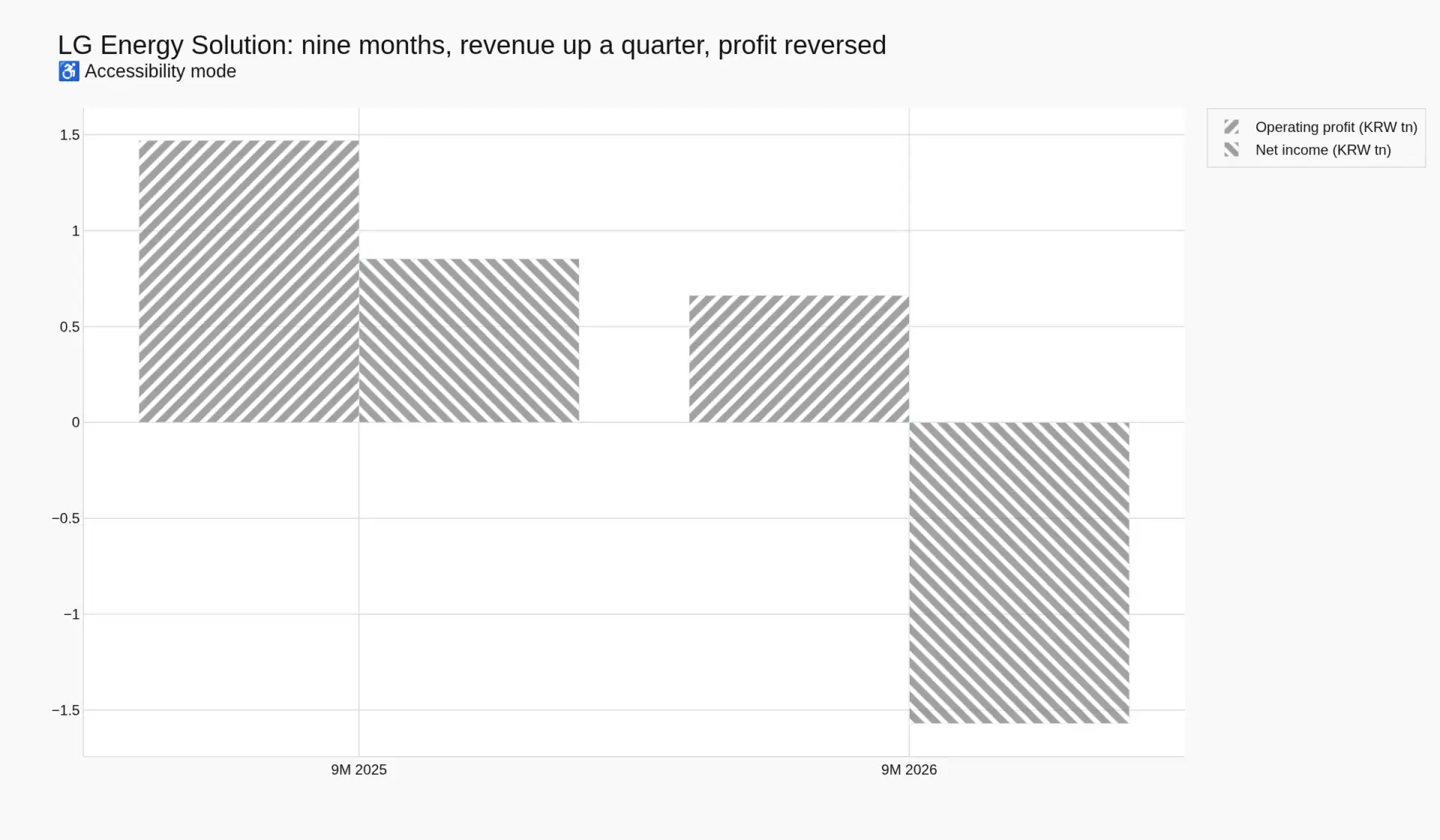
The commercial story of 2026 is not a volume story. The company sold more in nine months than it sold in the whole of 2025 — revenue of KRW 23.76 trillion against KRW 23.67 trillion for the full prior year — and that growth was bought at the bottom line. Operating profit for the nine months fell 54.9 per cent to KRW 661.6 billion, and net income swung from a KRW 853.3 billion profit to a KRW 1.57 trillion loss.
Two forces produced that divergence. The first is North America. LGES’s installations in the region fell 44.9 per cent to 16.5 GWh as US electric-vehicle demand weakened, and the company replaced the lost volume by converting electric-vehicle lines to stationary storage — its energy storage order backlog reached 160 GWh by the end of the third quarter. The second is the shape of the profit itself: of the KRW 756 billion operating profit reported in the third quarter, KRW 416.9 billion was a US production incentive. Strip it out and the operating margin is 3.7 per cent, not 7.8.
What LGES is selling in 2026 is therefore not growth. It is location. Its seven North American plants give it something Chinese competitors cannot buy quickly — cells made inside the market, from a supply chain that is being progressively closed to prohibited foreign entities.
Key highlights
| Metric | Period | Value |
|---|---|---|
| Revenue | 9M 2026 | KRW 23.76tn (+26.1% YoY) |
| Operating profit | 9M 2026 | KRW 661.6bn (−54.9% YoY) |
| Net income | 9M 2026 | KRW −1.57tn (from +0.85tn) |
| Operating margin | Q3 2026 | 7.8% reported; 3.7% excluding US production credit |
| Global EV battery share | Jan–Sep 2026 | 8.2% (81.9 GWh), third |
| Non-China share | Jan–Sep 2026 | 16.4% (69.8 GWh), second |
| ESS order backlog | End Q3 2026 | 160 GWh |
| 46-series cylindrical order book | End Q3 2026 | 440 GWh |
Company overview
Business description
LGES manufactures lithium-ion cells and assembles them into modules and packs. The product set spans three cell formats — pouch, prismatic and cylindrical — across several chemistries: high-nickel NCM for long-range vehicles, high-voltage mid-nickel for mid- and low-priced vehicles, and lithium iron phosphate (LFP) for both entry-level vehicles and stationary storage. Its 46-series cylindrical cells (46mm diameter) are the newest format, with mass production started at Ochang in Korea and a North American line due by the end of 2026. A tabless 2170 cell, aimed at hybrids, battery backup units and robotics, is scheduled for mass production in the first half of 2027.
The company reports across three divisions: automotive battery, energy storage system (ESS) battery, and small / mobility & IT battery. ESS was the fastest-moving of the three in 2026, expanding to the low-30 per cent range of total company revenue in the third quarter as shipments rose more than 60 per cent quarter-on-quarter.
Global footprint
| Region | Sites and capability | What it is for |
|---|---|---|
| North America | Seven battery plants — six in the United States and one in Canada (NextStar Energy, Ontario). Five make both ESS and EV cells; two make EV cells only. | Local, non-PFE-compliant supply. More than 50 GWh of LFP cell capacity by end-2026, spread across Michigan (Holland and Lansing), NextStar in Ontario, the Honda joint venture in Ohio and the GM joint venture in Tennessee. |
| Europe | Wrocław, Poland | Started as an EV pouch plant; some lines converted to ESS from 2025. Local 46-series production planned from 2029. |
| Korea | Ochang — the mother factory | Product development and launch. Sodium-ion ESS samples within 2026, with test shipments to North American customers in 2027; tabless 2170 mass production targeted for the first half of 2027. |
Financial performance
Key financial highlights
| KRW trillion | FY2024* | FY2025 | 9M 2025 | 9M 2026 | Q3 2025 | Q3 2026 |
|---|---|---|---|---|---|---|
| Revenue | 25.65 | 23.67 | 18.84 | 23.76 | 6.06 | 9.64 |
| Operating profit | 0.56 | 1.34 | 1.47 | 0.66 | 0.60 | 0.76 |
| Net income | 0.34 | 0.08 | 0.85 | −1.57 | 0.54 | −0.30 |
| Operating margin | 2.2% | 5.7% | 7.8% | 2.8% | 9.9% | 7.8% |
| Net margin | 1.3% | 0.3% | 4.5% | −6.6% | 8.8% | −3.1% |
*FY2024 figures are computed from the disclosed year-on-year changes of −7.6 per cent (revenue), +133.9 per cent (operating profit) and −76.1 per cent (net income) applied to the FY2025 results, which are rounded to one decimal place; they are therefore indicative, not separately disclosed. Margins are calculated from the reported figures.
Revenue breakdown
LGES does not publish divisional revenue in won. What it does disclose is directional and consistent across 2026: energy storage expanded its share of company revenue to the low-30 per cent range in the third quarter, automotive battery revenue grew by a double-digit percentage quarter-on-quarter on higher high-voltage mid-nickel shipments in Europe and the start of North American joint-venture volume, and the small battery division was broadly flat as the IT pouch business was scaled down.
Within revenue, the US production incentive is disclosed separately. It reached KRW 416.9 billion in the third quarter of 2026 — a 73 per cent increase on the prior quarter — against KRW 332.8 billion in the fourth quarter of 2025. Revenue excluding the credit was KRW 9.2265 trillion in Q3 2026.
Profitability analysis
The reported third-quarter operating margin of 7.8 per cent rests on the production credit. Excluding the KRW 416.9 billion incentive, operating profit was KRW 339.1 billion on KRW 9.2265 trillion of revenue, a margin of 3.7 per cent — and the credit accounted for 55.1 per cent of the reported operating profit. The company also booked a one-off volume compensation payment from a North American automaker in the quarter, which it did not quantify.
Below the operating line, the quarter was negative for reasons that have nothing to do with cell-making: a KRW 987.2 billion non-operating loss, driven by valuation losses on derivatives linked to foreign-currency bonds, interest expenses, and impairment of small IT pouch batteries. That produced a pre-tax loss of KRW 231.2 billion and a net loss of KRW 296.9 billion.
The balance sheet carries the cost of the build-out. At the end of the third quarter, total assets were KRW 70.3 trillion, liabilities KRW 44.3 trillion and equity KRW 26.0 trillion, giving a liabilities-to-equity ratio of 171 per cent, debt-to-equity of 98 per cent and net debt-to-equity of 82 per cent. Cash fell KRW 2.9 trillion in the quarter to KRW 4.3 trillion, against EBITDA of about KRW 2 trillion and capital expenditure of about KRW 1 trillion. LGES attributes part of the asset and liability decline to won translation effects on foreign-currency balances rather than to operating losses.
SWOT analysis
| Strengths | Weaknesses |
|---|---|
|
|
| Opportunities | Threats |
|
|
Recent developments
- November 2026 — Third-quarter results: revenue KRW 9.6434 trillion (+59.0 per cent year-on-year), operating profit KRW 756 billion (+25.7 per cent), net loss KRW 296.9 billion.
- 3 November 2026 — Full-year 2026 revenue growth guidance raised to 35–40 per cent including North American production credits, from a previous mid-teens to 20 per cent range. Fourth-quarter revenue guided to about 10 per cent quarter-on-quarter growth, with profitability expected to ease as one-off gains lapse and Honda joint-venture costs begin.
- November 2026 — SNE Research data for January–September places LGES third globally at 8.2 per cent and second outside China at 16.4 per cent, with European installations up 13.2 per cent and Asian up 49.4 per cent against a 44.9 per cent fall in North America.
- 8 October 2026 — Signed a four-year lithium concentrate agreement with Elevra Lithium covering 240,000 tonnes from the North American Lithium mine in Quebec, equivalent to roughly 30,000 tonnes of lithium hydroxide.
- September 2026 — Selected as an NVIDIA DSX Ready BESS partner, the only Korean battery company in the programme.
- Q3 2026 — Secured a first direct behind-the-meter BESS supply contract with a big-tech customer; ESS order backlog reached 160 GWh.
- August 2026 — Production resumed at the General Motors joint-venture plant in the United States.
- August 2026 — US executive order strengthening grid-equipment supply-chain standards, including BESS inverters, and signalling restrictions on designated foreign entities.
- September 2026 — EU revised Industrial Accelerator Act guidance narrows recognised local production to the 27 member states and raises the cost-gap exception threshold to 40 per cent.
- Q4 2026 — Honda joint-venture ESS capacity due to begin operation, with initial fixed costs expected in the quarter.
- By end-2026 — More than 50 GWh of LFP cell capacity in North America across five sites; US production of 46-series cylindrical cells to begin at Arizona.
Business strategy
Global strategy
LGES’s stated approach is a deliberate contraction of ambition: select and focus. Rather than pursue volume across every segment, the company is directing capital to the products and geographies where its existing capacity is hardest to substitute, and converting rather than constructing where it can. Capital expenditure has been held at about KRW 1 trillion a quarter, and the company has sold non-core assets, including a building at its North American joint-venture site, to protect the balance sheet.
| Pillar | The number behind it |
|---|---|
| Convert North American EV lines to storage | More than 70 GWh of ESS capacity in North America by end-2027, from more than 50 GWh of pouch capacity by end-2026. North American ESS line utilisation reached about 90 per cent in Q3 2026. |
| Build a non-PFE supply chain | Four or more non-PFE LFP cathode suppliers; 240,000 tonnes of North American lithium concentrate; localisation of key materials in Europe. The permitted prohibited-foreign-entity share of direct material cost falls from 40 per cent to 30 per cent and below in 2027. |
| Own the 46-series cylindrical standard | A 440 GWh order book. North American cylindrical capacity above 20 GWh by end-2027, including tabless 2170 lines for hybrids from 2027. |
| Hold the technology option set | Sodium-ion ESS samples within 2026 and test shipments to North American customers in 2027; LFP tabless 2170 mass production targeted for the first half of 2027. |
Focus-market strategy
North America is the profit centre and the policy bet. LGES has committed its order book through 2028, is now negotiating volumes beyond that period, and is positioning for two demand pools that are policy-supported rather than consumer-supported: utility-scale grid storage and behind-the-meter systems for data centres. The company describes expected demand as exceeding its available capacity.
Europe is the volume base that still works. European installations rose 13.2 per cent to 38.6 GWh in the first nine months of 2026, and the Wrocław plant’s utilisation improved on demand for high-voltage mid-nickel pouch cells aimed at mid- and low-priced vehicles — the segment where European automakers are now competing. Local 46-series production is planned from 2029 to serve the high-nickel end of the same market.
Korea is retained as the mother factory rather than as a volume site: the place where sodium-ion and tabless formats are proven before they are localised abroad.
Note on data availability
LGES does not disclose its own battery shipments in gigawatt-hours, nor divisional revenue in won. The volumetrics in this profile are third-party installation estimates compiled by SNE Research, which measure batteries fitted to vehicles sold and are not the same as cells shipped by the company. Company-level quarterly figures are taken from regulatory filings and the earnings presentation; figures are reported in won and are not restated for exchange-rate movements.
Sources
- LG Energy Solution, 2026 Third-Quarter Financial Results, 3 November 2026.
- LG Energy Solution, 2025 Financial Results, 29 January 2026.
- LG Energy Solution, Q3 2026 earnings conference call transcript, 3 November 2026.
- Yonhap News Agency, LG Energy swings to Q3 loss amid EV market slowdown, 3 November 2026.
- Yonhap News Agency, LG Energy Solution 2025 net income down 76.1 pct to 80.8 bln won, 29 January 2026.
- Seoul Economic Daily, LG Energy Solution Q3 Operating Profit Jumps 25% on ESS Boom, 3 November 2026.
- Seoul Economic Daily, LG Energy Solution Posts Record Q3 on EV, ESS Growth, 8 October 2026.
- Investing.com, LG Energy Solution swings to Q3 loss despite beating operating profit estimates, 3 November 2026.
- SNE Research, Global EV and Battery Monthly Tracker, October 2026, as reported by CnEVPost, Global EV battery market share in January-September 2026, 2 November 2026.
- SNE Research, January–September 2026 non-China market data, as reported by BatteryIndustry.net, SNE Research reports growing Chinese dominance in the global EV battery market, 8 November 2026.
- electrive, SNE Research: Chinese OEMs increasingly dominate global EV battery market, 6 November 2026.
Provenance: this profile is bound to Wikidata Q109464416 and Pheonix entity MIEN-node_e0a14e9a. Financial figures verified against company regulatory filings and the Q3 2026 earnings call; market-share figures cross-checked across three independent reports of the SNE Research dataset. Last verified 14 November 2026.