Company Profile
Essity
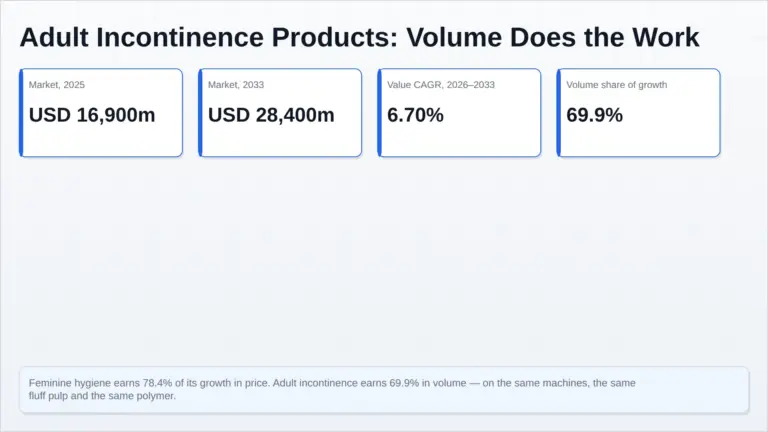
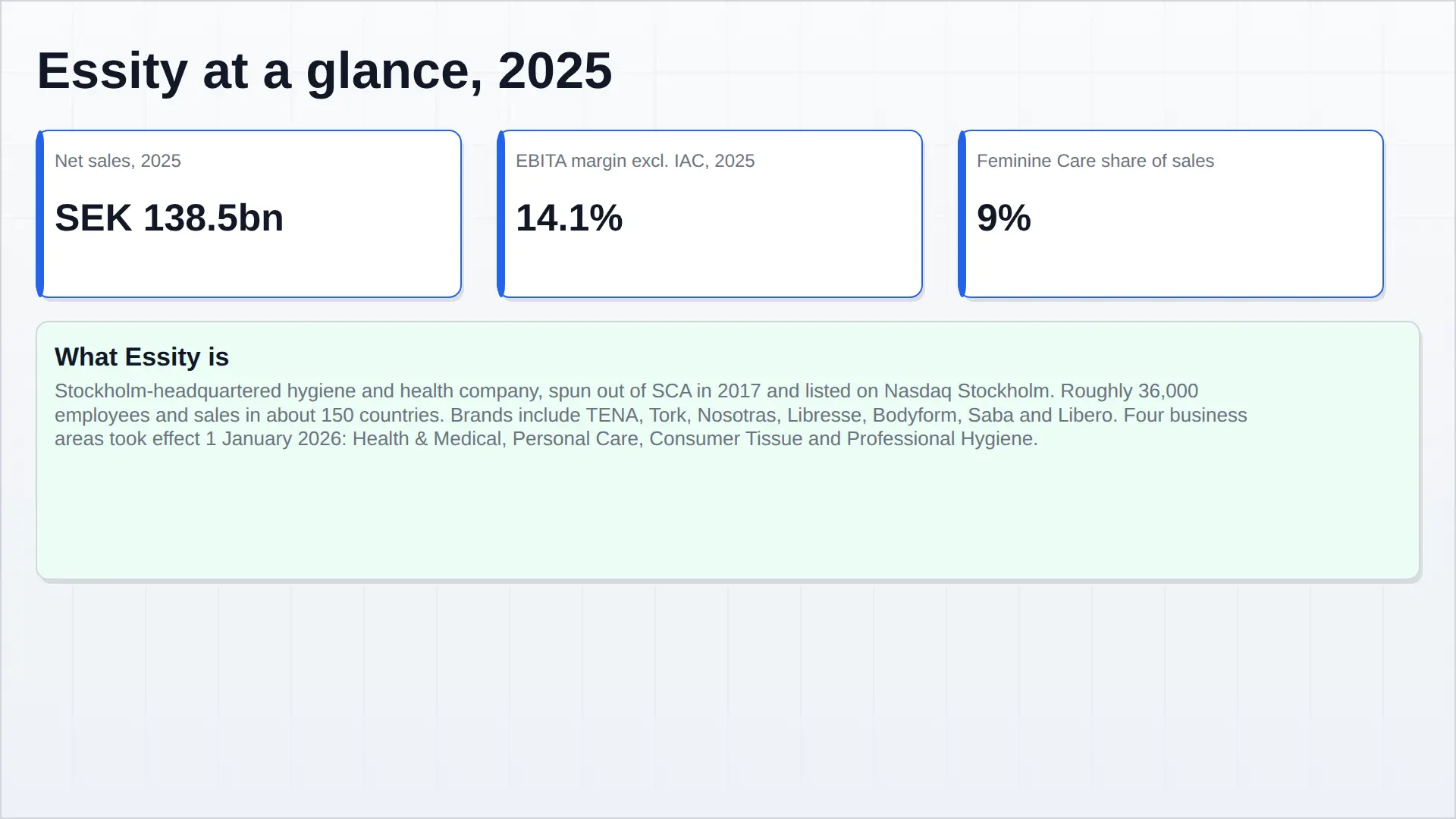
Essity Aktiebolag (publ) is a Stockholm-headquartered hygiene and health company listed on Nasdaq Stockholm with Class A and Class B shares. It was created in 2017 when Svenska Cellulosa Aktiebolaget separated its hygiene business from its forest products business. In 2025 Essity reported net sales of SEK 138,494m, organic sales growth of 0.9% and EBITA excluding items affecting comparability of SEK 19,572m, a margin of 14.1% — its highest in five years. Feminine Care is 9% of group net sales, and incontinence products a further 20% across the retail and health care channels.
Identifiers
| Legal name | Essity Aktiebolag (publ) |
|---|---|
| Listing | Nasdaq Stockholm Main Market, Large Cap — ESSITY A and ESSITY B (Bloomberg ESSITYA:SS, ESSITYB:SS) |
| Headquarters | Stockholm, Sweden |
| Formed | 2017, from the split of SCA’s hygiene and forest products businesses |
| Employees | Approximately 36,000, with sales in about 150 countries |
| Wikidata ID | Q30938280 — label “Essity”, alias “Essity AB”, described as a Swedish producer of tissue and hygiene products |
| Pheonix entity ID | MIEN-node_cd059c6e |
| Official website | essity.com |
| Investor relations | essity.com/investors |
| Ownership | AB Industrivärden is the largest shareholder with 11.4% of capital and 29.5% of votes; 45% of capital is foreign-owned |
| Pheonix coverage | Named against this Wikidata identifier on the Global Feminine Hygiene Products Market report |
Executive Summary
Essity sells tissue, incontinence products, feminine care, baby care, medical solutions and professional hygiene consumables. In 2025 it reported net sales of SEK 138,494m, up 0.9% organically, and EBITA excluding items affecting comparability of SEK 19,572m at a 14.1% margin. Both figures are below the company’s own financial targets — annual organic growth above 3% and an EBITA margin excluding items above 15% — and that gap is the frame for everything since: a new chief executive from June 2025, a reorganisation into four business areas from 1 January 2026, a SEK 1bn cost programme, and two acquisitions in feminine care.
|
SEK 138.5bn 2025 net sales, up 0.9% organically against a target above 3% |
14.1% EBITA margin excluding items affecting comparability, the highest in five years |
SEK 12.5bn Feminine Care net sales implied by its 9% share of 2025 group sales |
−0.3% Q3 2026 organic sales growth, with EBITA excluding items down 7% |
The 2026 record is weaker than the 2025 one. Over the first nine months of 2026 net sales were SEK 104,298m, effectively flat on SEK 103,799m, with organic growth of 0.1%. EBITA excluding items affecting comparability fell 3% to SEK 14,013m at a 13.4% margin. In the third quarter alone organic sales fell 0.3%, reported EBITA fell 29% to SEK 3,636m and EBITA excluding items fell 7% to SEK 4,725m, a 13.1% margin. Earnings per share excluding items and acquisition amortisation were SEK 14.44 for the nine months against SEK 14.37 a year earlier.
Key Highlights
| Period | Highlight |
|---|---|
| 2025 full year | Net sales SEK 138,494m, organic sales +0.9%. EBITA excluding items affecting comparability SEK 19,572m at a 14.1% margin, the highest in five years. Operating cash flow SEK 14,998m; ROCE excluding items 17.2%. All business areas grew organically. |
| Nine months 2026 | Net sales SEK 104,298m against SEK 103,799m, organic +0.1%. EBITA excluding items SEK 14,013m (−3%) at a 13.4% margin. Operating cash flow SEK 12,927m, up 22%. Net debt to EBITDA excluding items 0.98x. |
| Q3 2026 | Net sales SEK 36,060m (+4.1% reported), organic −0.3% — volume −0.1%, price and mix −0.2%. EBITA SEK 3,636m; EBITA excluding items SEK 4,725m at a 13.1% margin. Earnings per share SEK 3.47. |
| Feminine care, 2025 | 9% of group net sales, alongside incontinence products at 20% across retail and health care — the two categories the company identifies as high-yielding growth priorities. |
| Capital returns | Dividend proposed at SEK 8.75 per share for 2025, a 6% increase. A SEK 3bn buyback programme began on 24 April 2025; 11,895,826 Class B shares were repurchased in 2025 for SEK 3,160m. |
| Targets | Annual organic sales growth above 3% and an EBITA margin excluding items affecting comparability above 15%. Delivered in 2025: 0.9% and 14.1%. |
Company Overview
Business Description
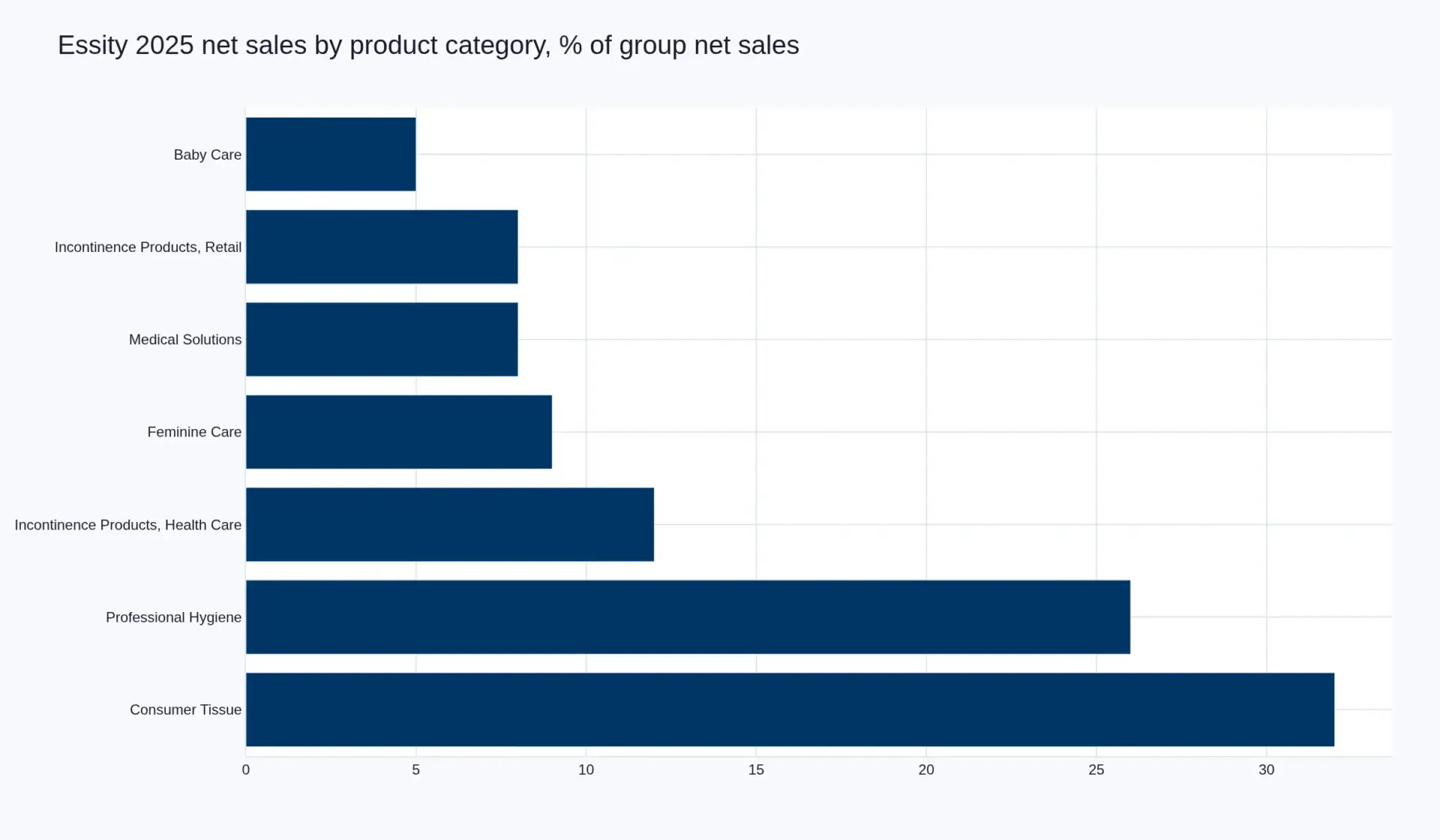
The portfolio runs across seven product categories. Consumer Tissue is the largest at 32% of 2025 net sales and Professional Hygiene the second at 26%. Incontinence products are split by channel — 12% sold through health care and 8% through retail — for 20% combined. Feminine Care is 9%, Medical Solutions 8% and Baby Care 5%. Two thirds of sales move through retail trade (54%), with business-to-business at 26% and the health care sector at 20%. The company states it holds leading market positions in 90% of branded sales.
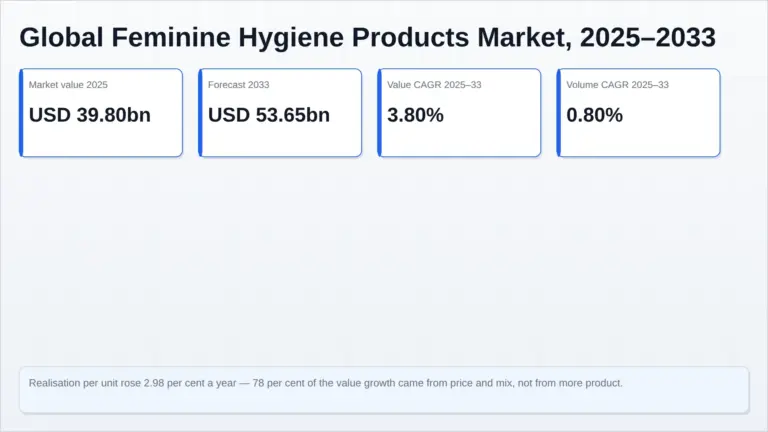
Feminine Care is the category most directly comparable with the global branded franchise Pheonix Research models in its feminine hygiene work, and it is where Essity has been buying scale. The company completed the acquisition of Edgewell’s feminine care business on 2 February 2026, adding Carefree, Stayfree, o.b. and Playtex; in the third quarter of 2026 it agreed to acquire Kenvue’s feminine care business in Brazil, expected to close in the second quarter of 2027. Against a 9% base in 2025, those two transactions materially raise the category’s weight in the group.
| Business area | Share of net sales | Share of EBITA excl. items | EBITA margin excl. items |
|---|---|---|---|
| Professional Hygiene | 26% | 30% | 31.9% |
| Health & Medical | 20% | 24% | 25.3% |
| Consumer Tissue | 31% | 46% combined | 25.9% |
| Personal Care | 23% | 46% combined | 23.7% |
| Health & Medical, Consumer Tissue and Professional Hygiene were the three reported business areas for 2025; Personal Care and Consumer Tissue were disclosed as a pro forma split of the Consumer Goods area, which was 54% of net sales and 46% of EBITA excluding items. The four-area structure took effect on 1 January 2026. Personal Care and Consumer Tissue EBITA shares are derived from the reported Consumer Goods aggregate. | |||
Organisational Structure and Footprint
Essity reorganized on 1 January 2026 into four business areas — Health & Medical, Personal Care, Consumer Tissue and Professional Hygiene — each with end-to-end responsibility for its value chain and with decision-making decentralised. The stated purpose was speed: the company said the change was intended to strengthen flexibility and customer focus and to intensify its attention on the most attractive segments. A cost programme, mainly in sales and administration, targets annual savings of about SEK 1bn with full effect by the end of 2026, with the savings largely reinvested to generate volume growth.
Geographically the company is European-weighted: Europe is 61% of net sales, Latin America 17%, North America 16%, Asia 2% and other markets 4%, with emerging markets at 26% of the total. The ten largest markets are the United States at 14%, Germany 12%, the United Kingdom 8%, Mexico 8%, France 7%, Spain 7%, and Colombia, the Netherlands, Italy and Sweden at 3% each. Manufacturing is correspondingly distributed; the company operates production in Europe, Latin America and North America, and cites its Emmerich facility in Germany as the site where JOBST medical compression garments are made.
Financial Performance
Key Financial Highlights
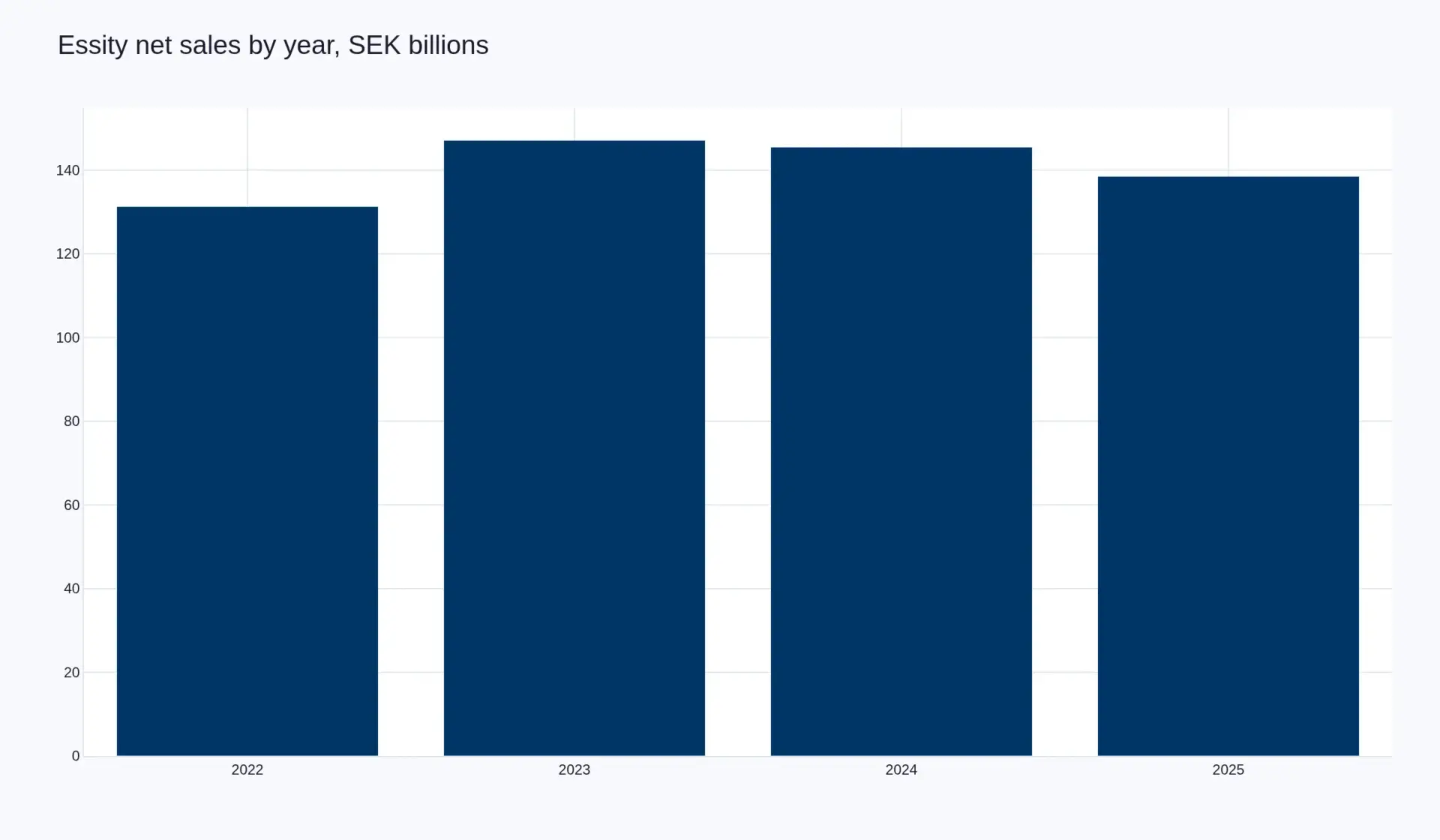
Net sales fell from SEK 147,100m in 2023 to SEK 138,494m in 2025, a consequence of divestments and currency rather than volume alone, while EBITA excluding items affecting comparability held close to its peak: SEK 18,900m, SEK 20,300m and SEK 19,572m across the three years. Earnings per share were SEK 18.37 in 2025 and SEK 19.44 excluding items; the 2024 figure of SEK 29.83 included the capital gain on the Vinda divestment.
| Measure | 2021 | 2022 | 2023 | 2024 | 2025 |
|---|---|---|---|---|---|
| Net sales | 101.5 | 131.3 | 147.1 | 145.5 | 138.5 |
| EBITA excluding items affecting comparability | 11.5 | 12.0 | 18.9 | 20.3 | 19.6 |
| EBITA margin excluding items | n/d | n/d | n/d | n/d | 14.1% |
| Operating cash flow | n/d | n/d | n/d | n/d | 15.0 |
| Earnings per share (SEK) | n/d | n/d | n/d | 29.83 | 18.37 |
| Dividend per share (SEK) | 7.25 | 7.75 | 8.25 | 8.25 | 8.75 |
| n/d = not disclosed in the sources used for this page. Net sales for 2021 to 2023 are on a continuing-operations basis following the Vinda divestment. The 2025 dividend is the Board’s proposal; 2024 earnings per share includes the Vinda capital gain and 2025 does not. | |||||
Profitability Analysis
Profitability improved sharply between 2022 and 2024 and then flattened. EBITA excluding items affecting comparability rose from SEK 12,000m in 2022 to SEK 20,300m in 2024 and eased to SEK 19,572m in 2025, a 14.1% margin that the company describes as its highest in five years. Return on capital employed excluding items was 17.2% in 2025 and 16.4% across the first nine months of 2026, against 17.1% a year earlier.
The pressure is in the gross margin and in cost inflation. Across the first nine months of 2026 the gross margin was 32.0% against 33.2% a year earlier, and in the third quarter it fell to 30.0% from 33.5%. Reported EBITA fell 29% in that quarter while EBITA excluding items fell 7% — the gap is items affecting comparability, which included the costs of the reorganisation and the acquisition programme. The company attributed the third-quarter result to intensifying cost headwinds partly offset by cost savings delivered to plan, higher sales prices than in the second quarter, and marketing investment that it says is producing results. Net debt to EBITDA excluding items was 0.98x at 30 September 2026 against 1.18x a year earlier.
SWOT Analysis
|
Strengths
|
Weaknesses
|
|
Opportunities
|
Threats
|
Recent Developments
| Date | Event |
|---|---|
| Q3 2026 | Reported net sales of SEK 36,060m (+4.1%) but organic sales of −0.3%, EBITA excluding items down 7% at a 13.1% margin, and agreement to acquire Kenvue’s feminine care business in Brazil, expected to close in the second quarter of 2027. |
| 2 February 2026 | Completed the acquisition of Edgewell’s feminine care business, adding the Carefree, Stayfree and o.b. brands in North America and Playtex globally, in line with the strategy of concentrating on high-yielding categories and strengthening North American positions. |
| 1 January 2026 | New organisational structure took effect: four business areas with end-to-end responsibility for their value chains and decentralised decision-making, alongside a cost programme targeting about SEK 1bn of annual savings by the end of 2026. |
| 1 June 2025 | Ulrika Kolsrud became President and CEO, succeeding Magnus Groth; she had previously been President of the Health & Medical business area. |
| 24 April 2025 | Launched a SEK 3bn share buyback programme for Class B shares, the second in the company’s history, running to the 2026 Annual General Meeting at the latest with repurchased shares expected to be cancelled. |
| Full year 2025 | Net sales SEK 138,494m, organic growth 0.9%, EBITA excluding items SEK 19,572m at 14.1%, the highest margin in five years; the Board proposed a 6% dividend increase to SEK 8.75 per share. |
Business Strategy
Global Strategy
Essity’s stated vision is to be the undisputed global leader in hygiene and health, and its financial targets are an annual organic sales growth rate above 3% and an EBITA margin excluding items affecting comparability above 15%. The strategy for reaching them has three parts: prioritising expansion in high-yielding categories, fast-growing sales channels and attractive geographies; funding that expansion through cost efficiency, including the SEK 1bn sales and administration programme; and buying position where organic growth is too slow — which is what the Edgewell and Kenvue feminine care transactions are.
| Pillar | What it means in practice |
|---|---|
| High-yielding categories | Incontinence products are 20% of sales and feminine care 9%; both grew organically in 2025 and both are where acquisitions have been concentrated. |
| Cost efficiency | About SEK 1bn of annual savings, mainly in sales and administration, in full effect by the end of 2026 and largely reinvested in volume growth; gross margin of 32.0% across nine months of 2026 against 33.2%. |
| Decentralisation | Four business areas with end-to-end value-chain responsibility from 1 January 2026, replacing the three-area structure in which Consumer Goods carried both Personal Care and Consumer Tissue. |
| Capital allocation | Dividend of SEK 8.75 proposed for 2025, a SEK 3bn buyback programme, and acquisition capacity supported by net debt to EBITDA excluding items of 0.98x. |
Focus-Market Strategy
Europe is 61% of sales and North America 16%, and the feminine care acquisitions are aimed squarely at the second. The Edgewell transaction gives Essity North American distribution for brands it did not own, and the Kenvue Brazil agreement extends the same logic to Latin America, which is already 17% of sales with Mexico among the ten largest markets. Elsewhere the company is managing for mix rather than volume: in Consumer Tissue it has been optimising its Latin American production footprint and absorbing price reductions taken in earlier quarters, and in Professional Hygiene it has been growing strategic products and sales to larger distributors while accepting decline in the base assortment and with smaller distributors.
The honest reading of the last two years is that Essity has moved its portfolio toward the categories with better structural growth faster than it has moved its growth rate. Organic growth was 0.9% in 2025 with every business area positive, then 0.1% across nine months of 2026, then negative in the third quarter. The acquisitions change the mix; they do not change the market growth rates the company sells into.
Sources
- Essity Aktiebolag (publ), Annual Report 2025 — full report (PDF)
- Essity, Facts and figures — 2025 key figures, category, channel and regional splits
- Essity, Interim Report, Quarter 3 2026 — quarterly and nine-month financials, Kenvue Brazil agreement
- Pheonix Research, Global Feminine Hygiene Products Market — market context for the feminine care category
- Wikidata, Q30938280
Provenance: this page is bound to Wikidata Q30938280 and to the Pheonix entity MIEN-node_cd059c6e. Financial figures are taken from Essity’s own reporting in Swedish kronor as reported, and are not restated or converted to another currency. EBITA excluding items affecting comparability is the company’s own non-GAAP measure and is used throughout in preference to reported EBITA where the source reports both. The SEK 12.5bn feminine care figure is derived from the company’s disclosed 9% share of 2025 group net sales, not from a separately reported segment. Last verified 18 November 2026.
Market Presence
Essity is mentioned across 2 market reports.