
Editorial Article
The Leader Shipped Flat Volume Into a Category Growing Five Per Cent
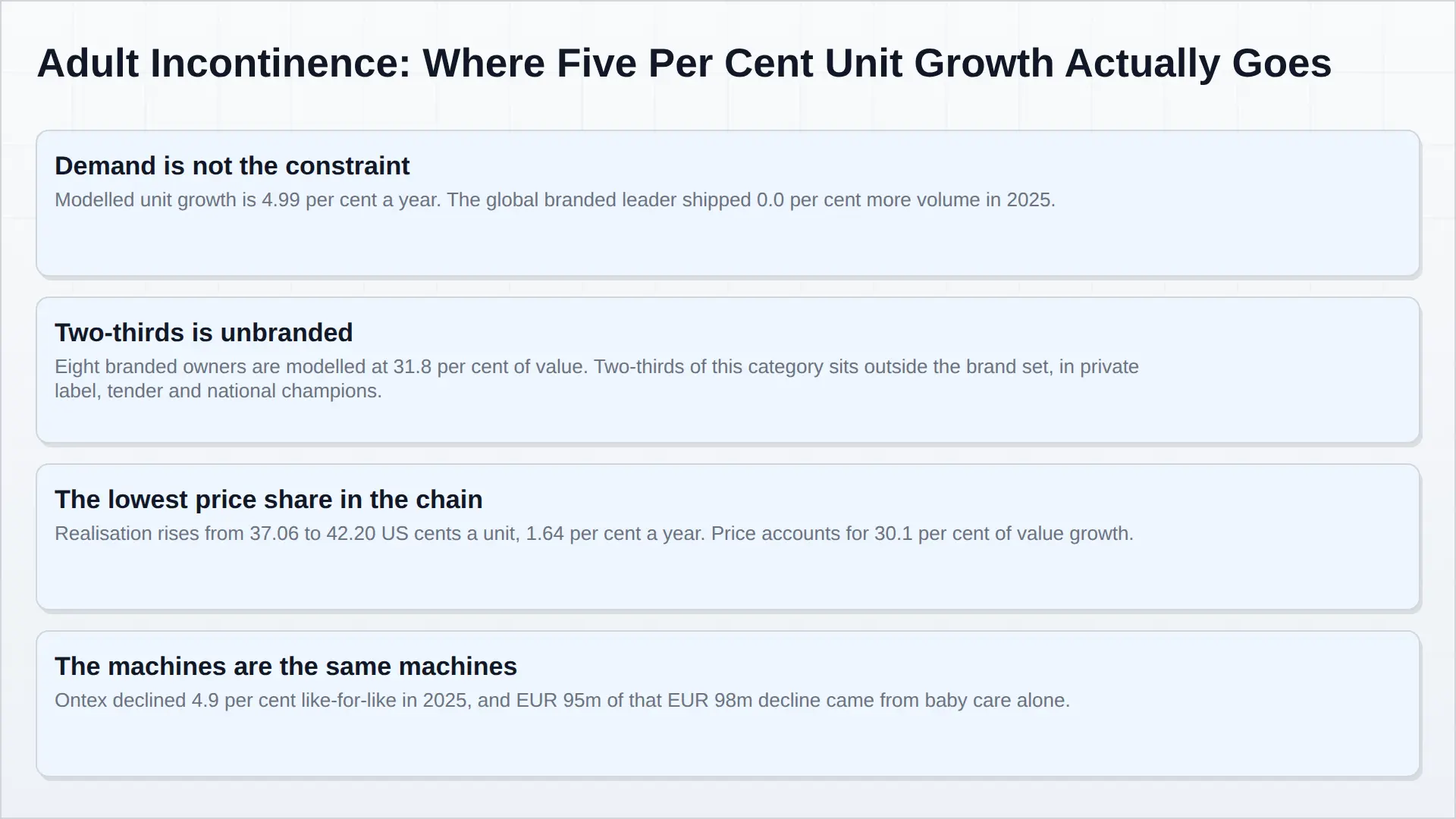
Essity sold exactly as many adult incontinence units in 2025 as it sold in 2024. Not roughly: the company’s own disclosure puts volume growth at 0.0 per cent, with the entire 0.9 per cent of organic growth coming from price and mix. The category it leads is modelled to add units at 4.99 per cent a year through 2033.
Those two sentences should not be able to sit next to each other in a healthy market. When the largest branded owner in a category ships a flat unit count while the category itself expands at five per cent a year, the growth is real but it is not going to the brand. It is going somewhere else, and the useful question is where.
The arithmetic of a volume-led market
The global adult incontinence products market is modelled at USD 16.90 billion in 2025 rising to USD 28.40 billion in 2033, a 6.70 per cent CAGR. Units rise from 45,600 million to 67,300 million, 4.99 per cent. Realisation per unit goes from 37.06 to 42.20 US cents — 1.64 per cent a year.
Run the decomposition and price accounts for 30.1 per cent of the USD 11.50 billion added to the market. That is the lowest price contribution of any node in this absorbent chain: fluff pulp earns 59.7 per cent of its growth from price, and superabsorbent polymer 28.5 per cent. Adult incontinence is the one category in the chain where the volume line is doing the work and the price line is nearly flat.
A market that adds eleven and a half billion dollars over eight years and gets less than a third of it from price is a market where somebody is selling substantially more product at close to the same price. That somebody is not the brand.
Where the units are going
Eight branded owners are modelled at 31.8 per cent of value. The rest of this market — roughly two-thirds of it — is private label, institutional tender business, and national champions that never appear in a brand tracker because they do not sell to a consumer at all.
Those two channels have a property in common: in neither of them does brand equity set the price. In a public tender, the buyer writes the absorbent-core specification and asks for a quote, and the branded owner’s twenty years of advertising are not in the room. In private label, the discounter sets the shelf price and the retailer sets the specification, and the manufacturer competes on a cost per unit it has to defend line by line. A category that grows through those channels grows in units and not in realisation, which is exactly the pattern the model shows.
Read the disclosures against each other
| Owner | Brand | What the disclosure actually shows |
|---|---|---|
| Essity | TENA, TENA ProSkin | FY2025 organic +0.9%, volume 0.0%, EBITA excl. items SEK 19,572m at 14.1% |
| Kimberly-Clark | Depend, Poise | North America consumer sales −2.4%: +1.8 organic, −3.9 private-label exit, −0.3 currency |
| Procter & Gamble | Always Discreet | FY2026 net sales USD 87,032m, +3% reported, +1% organic; core EPS USD 6.89 |
| Ontex | iD, Serenity | 2025 like-for-like −4.9%, of which €95m of the €98m decline was baby care |
| Unicharm | Lifree | Japan 36.2% of group sales and 61.9% of core operating income; China swung to a ¥5,364m core operating loss |
| Hengan International | Hengan adult care | Hygiene products 28.5% of revenue and 59.9% of segment profit |
Kimberly-Clark’s North American number is instructive in a different way. A 2.4 per cent decline decomposes into +1.8 per cent organic, −3.9 from exiting private label, and −0.3 from currency. The company chose to leave a channel rather than defend a share in it, and the sales line fell while operating profit held at about USD 2.6 billion. That is a portfolio decision about where volume is worth having, not evidence of a category in retreat.
The converter that is not really declining
Ontex is the cleanest read on the transition. Its 2025 like-for-like sales fell 4.9 per cent, and €95 million of that €98 million decline came from baby care. The adult book was broadly stable inside a company that was shrinking — and the 2026 guidance cut to €143–148 million of adjusted EBITDA was, read carefully, a baby-care problem reported as a company problem.
Every European converter running both lines is computing the same arithmetic. Baby volumes fall with the birth rate; adult volumes rise with the age structure; the machines are the same machines. The strategic question in that business is not whether to be in adult care. It is how fast a baby line can be re-tooled and re-qualified for an adult product before the baby volume disappears underneath it.
The threat is a trademark, not a product
Procter & Gamble’s Always Discreet is worth more attention than its share suggests, because it is not a brand built for a new need. It is a trademark extended across a category boundary — a feminine hygiene franchise carried into an incontinence purchase the same consumer has been making monthly for two decades. That is the cheapest customer acquisition available in this category, and it is why a dedicated incontinence specialist has to buy the same consumer through a pharmacy shelf instead, at a cost the specialist cannot amortise across any other category.
P&G’s FY2026 numbers — USD 87,032 million of net sales, USD 19,556 million of operating cash flow — are the balance sheet behind that extension. It does not need to win the category to change its price structure.
What would make this reading wrong
The model’s 4.99 per cent unit CAGR is a forecast, and a forecast with a specific failure mode worth naming. Unit counts are not users. If household penetration is flat and the growth instead comes from users switching from a pad to a pant and changing more often per day, then the unit line rises without the category acquiring a single new customer — and a market growing on changes-per-day is a different business from one growing on new users, with a different ceiling.
The test is in the primary work rather than the model: whether reported form-switching accounts for most of the unit growth. If it does, the volume line stays robust and the value line is weaker than modelled, because a pant substituted for a pad is a more expensive unit bought by an existing customer, not a new customer entering the category. The report states this exposure rather than resolving it, because the population data establishes the size of the pool and not the behaviour inside it.
How this was researched
Seventy per cent secondary, thirty per cent primary. The secondary side rests on company filings and disclosures from Essity, Kimberly-Clark, Procter & Gamble, Unicharm, Ontex and Hengan; supplier disclosure on absorbent-material capacity; price reporting for market pulp; United Nations World Population Prospects 2024 data; and EU instruments affecting fibre sourcing. The primary side comprises structured interviews with absorbent-hygiene converters and component suppliers, open-ended interviews with brand owners, institutional buyers and pharmacy-chain category managers, long-term-care procurement conversations, trade-show proceedings, and a structured buyer survey on form switching, channel of purchase and willingness to accept a pant over a pad. No market-research competitor data is used or cited.
Read next
- Seven cents of material in a thirty-seven cent product — the unit cost stack behind realisation.
- Global Fluff Pulp Market — the input that is repricing faster than this output.
- Global Superabsorbent Polymer Market — the material the core is substituting towards.
- Global Feminine Hygiene Products Market — the category P&G extended its franchise out of.
Companies in this analysis
- Essity — TENA and TENA ProSkin; FY2025 organic +0.9%, volume 0.0%, EBITA excl. items SEK 19,572m at 14.1%
- Kimberly-Clark — Depend and Poise; North America consumer sales −2.4%
- Procter & Gamble — Always Discreet; FY2026 net sales USD 87,032m and operating cash flow USD 19,556m
- Ontex — iD and Serenity; 2025 like-for-like −4.9%, of which €95m of €98m was baby care
- Unicharm — Lifree; Japan 36.2% of group sales and 61.9% of core operating income
- Hengan International — hygiene products 28.5% of revenue and 59.9% of segment profit
Frequently Asked Questions
How big is the global adult incontinence products market?
Pheonix Research models it at USD 16.90 billion in 2025 rising to USD 28.40 billion in 2033, a 6.70 per cent compound annual growth rate. Units rise from 45,600 million to 67,300 million over the same window, 4.99 per cent a year.
Why does Essity shipping flat volume matter?
Essity is the global branded leader through TENA. Its 2025 volume growth was 0.0 per cent, with organic growth of 0.9 per cent coming entirely from price and mix. In a category modelled to add units at 4.99 per cent a year, a flat leader means the incremental units are going to private label, institutional tender and national champions rather than to the brand.
Who owns the adult incontinence market?
Eight branded owners are modelled at 31.8 per cent of value. The remaining two-thirds is private label, public tender business and national champions that sell to institutions rather than to consumers.
Why is price growth lower here than in other absorbent categories?
Price accounts for 30.1 per cent of the value added to adult incontinence between 2025 and 2033, against 59.7 per cent for fluff pulp and 28.5 per cent for superabsorbent polymer. The channel mix is the reason: in tender and private label, price is set by specification and cost per unit rather than by brand.