
Editorial Article
Seven Cents of Material in a Thirty-Seven Cent Product
Take an adult incontinence unit apart and the fibre and polymer inside it are worth about seven US cents. The product realises 37.06 cents. Everything between those two numbers — converting, nonwoven, film, adhesive, packing, freight, tender overhead and retail margin — is where this market’s money actually sits, and understanding that goes a long way to explaining why its owners behave the way they do.
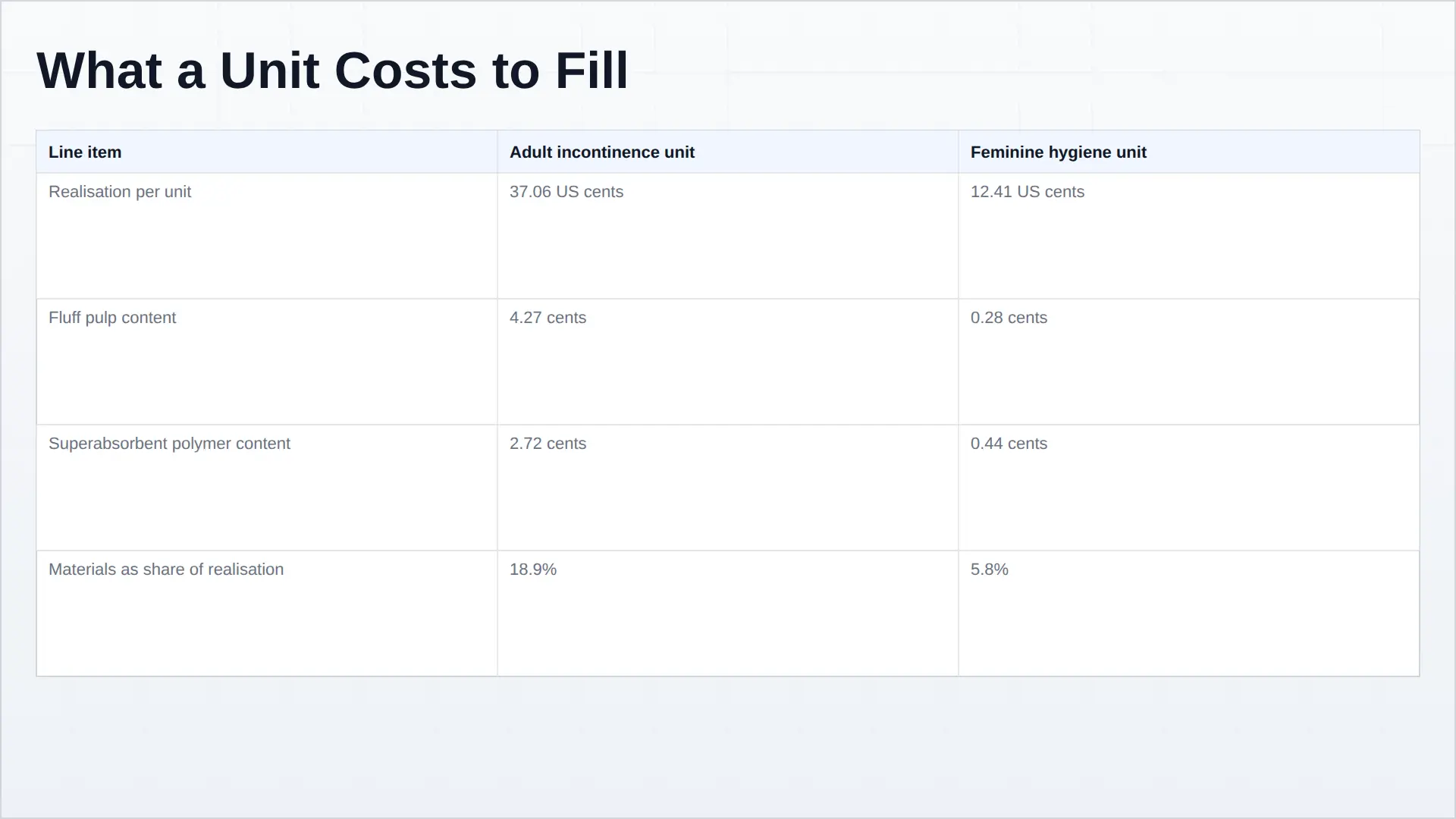
The figure is not an estimate. It is built from disclosed capacity prices and modelled material intensities: about 16 grammes of superabsorbent polymer at USD 1,700 a tonne is 2.72 cents, and the fluff pulp in the same core is 4.27 cents. Together, 6.99 cents against a 37.06-cent realisation — 18.9 per cent of the unit.
The two materials are moving in opposite directions
Here is the detail that matters more than the share. The material being removed from the core is getting more expensive, and the material being added to it is barely inflating at all. Fluff pulp price is modelled at 1.73 per cent a year to 2033; superabsorbent polymer at 1.13 per cent. The core is being redesigned away from the input that is repricing up and towards the input that is flat.
That is a favourable position for a converter and an unfavourable one for a pulp producer, and it is why the redesign programme keeps going even when the price signal would otherwise slow it. The substitution is not being driven by performance alone; it is being driven by the spread between two price lines.
Who can pass it on, and who cannot
The pass-through question is the whole structure of this industry, and there are only three answers.
The integrated polymer producer can. A producer that makes its own acrylic acid holds margin through a monomer rise, because the increase is a transfer inside its own books rather than a cost it has to recover from a customer. Nippon Shokubai holds 980,000 tonnes a year of acrylic acid against 710,000 tonnes of polymer capacity — it is a net seller of the feedstock, not a buyer of it.
The converter can. A 2.72-cent material inside a 37.06-cent product can be absorbed for a quarter and repriced at the next contract. It is not a pleasant conversation, but it is survivable.
The stand-alone polymer producer cannot. It buys acrylic acid at a propylene-linked price and sells polymer into a market where the marginal tonne is set by exported Chinese capacity. That spread is the entire business, and every point the monomer rises without a matching polymer increase comes straight out of its margin. This is the structural finding of the polymer report, and it is why the competitive set that survives is the integrated one.
Why the fibre line is the volatile one
In a finishing cost stack, this looks backwards: the largest material line is a small share of the unit, and the small material lines are the ones that swing. The fluff pulp report puts fibre at 10 of a 100-index shelf price in feminine hygiene. In absolute terms a feminine hygiene unit carries about 0.28 cents of fibre against a 12.41-cent realisation — 2.3 per cent of the unit — and materials together are 5.8 per cent.
Neither is a dominant cost. Both are the most volatile line in it, because polymer, nonwoven and converting costs move slowly and pulp reprices quarterly. When pulp fell in July 2025 the converter gained and the mill lost on every tonne in the chain; when it turns, the transfer reverses inside a quarter. That asymmetry, and not the level of price, is what makes the pulp line the most negotiated item in a hygiene supply agreement.
What the arithmetic implies for the owners
If materials are under a fifth of the unit and trending benign, then a branded owner’s margin is not a materials story. It is a distribution story: how the product reaches a consumer who is often buying through a pharmacy, a care home or a public tender rather than a supermarket shelf. That is consistent with everything in the disclosures. Essity’s 14.1 per cent EBITA margin sits on SEK 138 billion of sales; Ontex’s adjusted EBITDA margin is 9.97 per cent on a converter’s revenue; Kimberly-Clark held operating profit at about USD 2.6 billion through a 2.4 per cent North American sales decline by leaving a private-label channel rather than defending it.
It is also consistent with the category’s price line. Realisation rises from 37.06 to 42.20 cents over eight years, 1.64 per cent a year, and price contributes 30.1 per cent of the market’s value growth. You cannot run a materials-led pricing story on an input that is 18.9 per cent of the unit, in a channel where the buyer writes the specification.
What would break this
The argument fails if the material share rises materially — if polymer prices break out of their structural surplus, or if pulp’s swing-mill optionality tightens into a genuine shortage. Both are possible and neither is in the model. What the model does say is that the polymer line has been flat to gently rising for a decade because capacity exceeds demand, and that pulp’s price is anchored to a paper grade rather than to hygiene demand. Neither of those conditions is permanent; both are load-bearing for the conclusion.
How this was researched
Seventy per cent secondary, thirty per cent primary. Material intensities and realisation are modelled from disclosed producer capacity and pricing, company filings, and UN population data; the per-unit cost stack is derived rather than disclosed, and stated as derived. The primary programme comprises structured interviews with converters and component suppliers, open-ended interviews with core-design engineers and procurement teams, trade-show conversations and a converter survey on specification authority. No market-research competitor data is used or cited.
Read next
- The leader shipped flat volume into a category growing five per cent — where the units are actually going.
- Global Superabsorbent Polymer Market — capacity, integration and why the price cannot move.
- Global Fluff Pulp Market — the input that is repricing faster than the finished product.
Companies in this analysis
- Essity — FY2025 net sales SEK 138,494m, organic +0.9%, EBITA excl. items at a 14.1% margin
- Ontex — adjusted EBITDA margin 9.97%; 2026 guidance €143–148m
- Kimberly-Clark — operating profit held at about USD 2.6bn through a 2.4% North American sales decline
Frequently Asked Questions
How much material is in an adult incontinence unit?
About 2.72 US cents of superabsorbent polymer and 4.27 cents of fluff pulp, 6.99 cents together against a 37.06-cent realisation per unit — 18.9 per cent of the product's value. A feminine hygiene unit carries 0.28 cents of fibre and 0.44 cents of polymer against 12.41 cents, 5.8 per cent.
Who can pass a material price increase through?
The converter, because a 2.72-cent material inside a 37.06-cent product can be absorbed for a quarter and repriced at the next contract. An integrated polymer producer also can, because it makes its own acrylic acid. A stand-alone polymer producer cannot, because it buys monomer at a propylene-linked price and sells into a structural surplus.
Why is fluff pulp price rising faster than the product it goes into?
About 1.73 per cent a year to 2033, which is faster than the 1.64 per cent a year at which the finished adult incontinence unit's realisation rises. Over eight years that compounds into a structural transfer of roughly one percentage point of realisation from the converter to the mill.
What would break this analysis?
The argument fails if materials become a much larger share of the unit — if polymer prices break out of their structural surplus or pulp's swing-mill optionality tightens into a real shortage. Neither is in the model, but both are load-bearing for the conclusion.