
Global Adult Incontinence Products Market Report, Size, Share and Forecast 2026–2033: The Only Absorbent Category Where Volume Does the Work
Executive summary
| Market value, 2025 | USD 16,900 million |
|---|---|
| Market value, 2033 | USD 28,400 million |
| Value CAGR, 2026–2033 | 6.70% |
| Volume, 2025 → 2033 | 45,600m → 67,300m units (4.99% CAGR) |
| Realisation per unit | 37.06 → 42.20 US cents (1.64% CAGR) |
| Volume share of value growth | 69.9% |
| Largest product form, 2025 | Pull-up pants, 42.8% of value |
| Fastest-growing region | Asia Pacific, 8.59% CAGR |
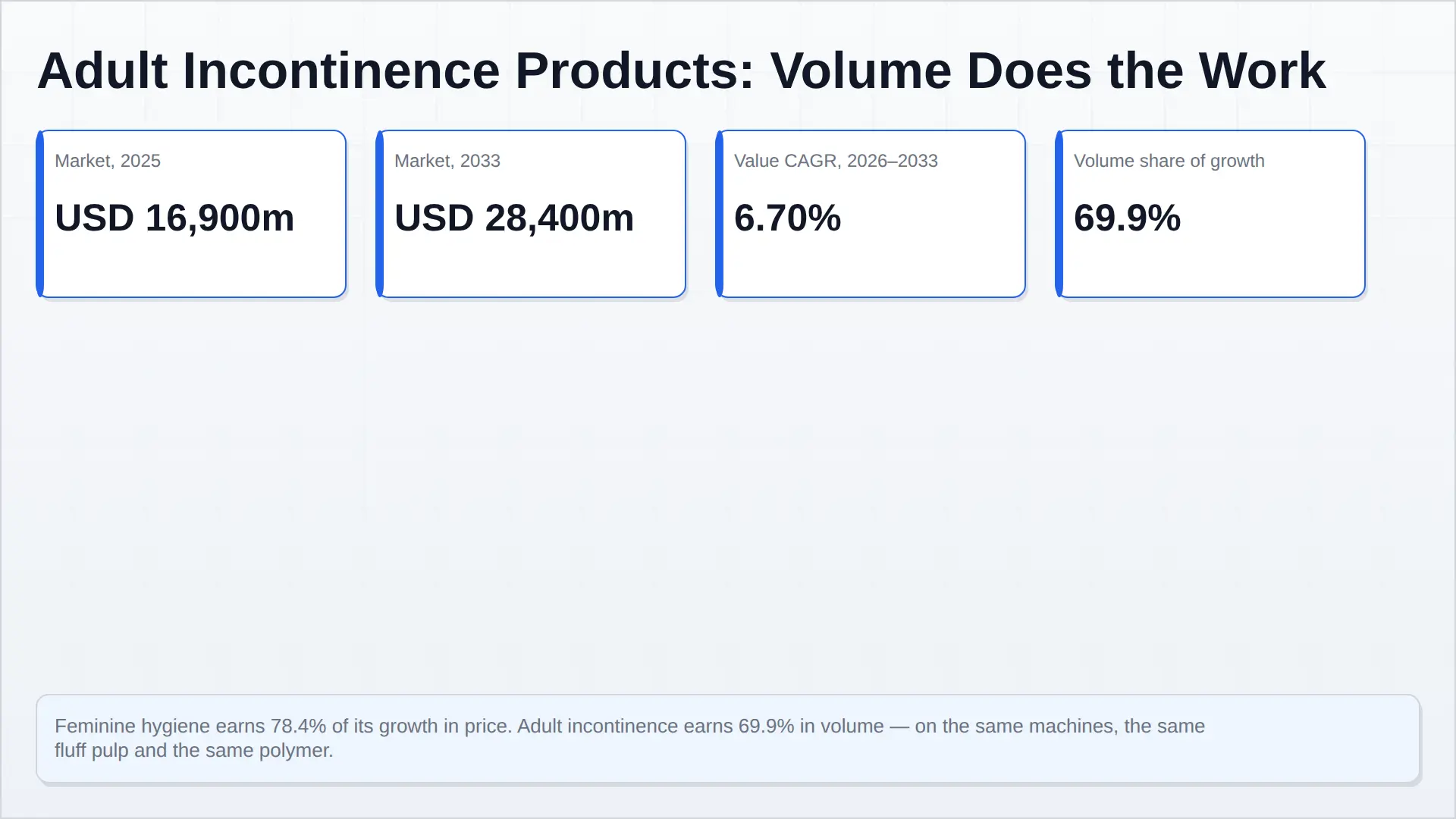
The global adult incontinence products market is USD 16,900 million in 2025 and reaches USD 28,400 million in 2033 — 6.70 per cent a year, a 1.68-fold expansion and USD 11,500 million of added value. Volume moves from 45,600 million units to 67,300 million, a compound annual growth rate of 4.99 per cent. Realisation per unit rises from 37.06 US cents to 42.20 cents, 1.64 per cent a year.
Those four numbers place this category alone on the absorbent shelf. Pheonix’s Global Feminine Hygiene Products Market Report measures a market of USD 39,800 million growing 3.80 per cent in value on 0.80 per cent volume growth, where 78.4 per cent of the increase in value is price and mix. Adult incontinence inverts the ratio. Of the USD 11,500 million added between 2025 and 2033, USD 8,041 million — 69.9 per cent — is volume shipped at today’s price. Only 30.1 per cent is the unit itself becoming more expensive.
One category grows by charging more for the same object. The other grows by putting a bigger object into more hands. Both run on the same three converting lines, the same fluff pulp, the same superabsorbent polymer, and both are sold by the same eight owners.
Three figures explain the difference, and all three are physical rather than commercial. An adult incontinence unit realises 37.06 US cents against 12.41 cents for a feminine hygiene unit — three times the value per piece. It carries 33.09 grammes of fluff pulp against 2.14 grammes. And it is the only absorbent category whose underlying demographic is guaranteed to grow: 10 per cent of the world’s population was aged 65 or over in 2025, against 5.5 per cent in 1975, and the United Nations projects 16 per cent by 2050.
The forecast is therefore not a bet on population. It is a bet on penetration — on how many of those people, in which countries, receive a product at all. Japan, Western Europe and North America are close to saturated at the institutional end and still growing at the retail end as the category normalises on a shelf that used to hide it. India, Indonesia, Nigeria and Brazil are not saturated, and the binding constraint there is distribution and stigma rather than demand. That is why Asia Pacific grows 8.59 per cent a year against 5.49 per cent in North America, and why the region’s share of value rises from 24.0 per cent to 27.6 per cent inside the forecast window.
One caution belongs in the summary rather than buried in risk. The category’s largest branded owner grew volume by zero in 2025: Essity reported full-year organic sales growth of 0.9 per cent, of which volume accounted for 0.0 per cent and price/mix for 0.9 per cent. A category growing 4.99 per cent in units in which the global leader ships flat units is a category where the growth is being captured somewhere else — by private label, by institutional tender, and by regional converters in exactly the markets where penetration is rising.
Market definition, size and forecast
Scope. Absorbent products for adult urinary and faecal incontinence: tape-on briefs, pull-up pants, shaped pads and inserts (including booster pads and male guards), and underpads and bed protection. Excluded: urinary catheters and external collection devices, ostomy products, skin-care preparations, and all paediatric products.
How the size is built. No participant discloses revenue for this category alone at global scale. The model is therefore built bottom-up and stated as modelled: a population frame from the United Nations World Population Prospects (medium variant) for the 65-and-over cohort by region; a product-use penetration rate applied to that cohort; a units-per-user-per-year consumption rate differentiated between institutional and community settings; and a realisation per unit reconciled against the disclosed group revenue of the eight largest listed participants. Where a disclosed figure exists it is used in preference to the model, and the text says so.
Value by product form
| Product form | 2025 (USD m) | 2033 (USD m) | CAGR | Share of 2025 value |
|---|---|---|---|---|
| Pull-up pants | 7,240 | 12,600 | 7.17% | 42.8% |
| Tape-on briefs | 5,980 | 9,300 | 5.68% | 35.4% |
| Shaped pads and inserts | 2,700 | 4,620 | 6.94% | 16.0% |
| Underpads and bed protection | 980 | 1,880 | 8.48% | 5.8% |
| Total | 16,900 | 28,400 | 6.70% | 100.0% |
The form mix is where the volume mechanism is visible. Pull-up pants are the largest form at 42.8 per cent of value and grow fastest among the two large ones at 7.17 per cent, because they are the form that converts a person who would otherwise buy nothing: a pant is discreet enough to wear outside the home, and the entire commercial argument of the category for fifteen years has been to move a user from a pad to a pant. Tape-on briefs grow slowest at 5.68 per cent for the opposite reason — they are the institutional workhorse, bought on tender, priced against a specification, and their growth tracks certified long-term-care populations rather than retail demand.
The two small forms both outgrow the market. Shaped pads and inserts at 6.94 per cent capture the light-incontinence user who will not accept a garment; underpads and bed protection at 8.48 per cent grow off institutional capacity expansion, where every additional certified bed is a recurring underpad order before it is anything else.
Value by region
| Region | 2025 (USD m) | 2033 (USD m) | CAGR | Share of 2025 value |
|---|---|---|---|---|
| North America | 5,640 | 8,650 | 5.49% | 33.4% |
| Europe | 5,190 | 8,220 | 5.92% | 30.7% |
| Asia Pacific | 4,050 | 7,830 | 8.59% | 24.0% |
| South America | 1,050 | 1,850 | 7.34% | 6.2% |
| Middle East & Africa | 970 | 1,850 | 8.41% | 5.7% |
| Total | 16,900 | 28,400 | 6.70% | 100.0% |
North America and Europe together are 64.1 per cent of 2025 value and 59.5 per cent of 2033 value. That four-and-a-half-point transfer is the whole regional story. It is not that the mature markets shrink — they add USD 6,040 million between them — but that they add it at 5.49 and 5.92 per cent while Asia Pacific adds USD 3,780 million at 8.59 per cent and the two smaller regions each nearly double.
The mature-market growth is a mix effect plus a reimbursement effect. Japan is the clearest case: the world’s oldest population, a long-term care insurance system that pays for specified disposable diapers, and therefore the highest institutional penetration on earth. Unicharm’s Japan business earned ¥67,350 million of core operating income in fiscal 2025 and is 36.2 per cent of group sales but 61.9 per cent of group core operating income — a profitability concentration that exists because the Japanese adult category is a mature, reimbursed, high-penetration market. Growth there comes from trading up within an existing user base, not from finding new users.
Where the USD 11,500 million comes from
| Component | Contribution to growth (USD m) | Share |
|---|---|---|
| Volume at constant 2025 realisation | 8,041 | 69.9% |
| Realisation per unit | 3,459 | 30.1% |
| Total value growth, 2025–2033 | 11,500 | 100.0% |
Run the same decomposition on feminine hygiene and the two categories are exact mirrors: 21.6 per cent volume, 78.4 per cent price. That difference is the most commercially useful thing in this report, because it tells a converter which half of the P&L to defend. In feminine hygiene the fight is over price realisation — the pad got shorter and the shelf price did not fall, and that is where the value came from. In adult incontinence the fight is over units, and price realisation is close to a residual: 1.64 per cent a year, roughly a third of the category’s own volume growth rate, and less than the 3.08 per cent that the fluff pulp inside the product is modelled to earn over the same period.
Read that last comparison again, because it is the structural warning in this report. The raw material is modelled to gain more price than the finished product. An adult incontinence unit carries 33.09 grammes of fluff pulp and roughly 16 grammes of superabsorbent polymer; at USD 1,290 a tonne for pulp and USD 1,700 a tonne for polymer those two inputs cost 4.27 and 2.72 US cents respectively, 6.99 cents of a 37.06-cent realisation, and that is before nonwoven, film, adhesive, packaging and converting. Every point of pulp price therefore arrives as a direct margin event at a converter who is competing on units rather than price.
Sources
- Essity Aktiebolag, Annual Report 2025, published 2 March 2026 — assets.www.essity.com/essity/Annual-Report-2025-digital.pdf
- Essity Aktiebolag, Report for quarter 4 and full-year 2025 — assets.www.essity.com/essity/Essity Report ENG-Q4-25.pdf
- Nippon Shokubai Co., Ltd., Report 2024 (integrated report), acrylic acid and superabsorbent polymer capacity by site — shokubai.co.jp/en/docs/ir/technoamenity_report_en.pdf
- Fastmarkets, PPI Europe, Vol. 40 No. 27, 10 July 2025 — market pulp price assessments for BEK and NBSK — fastmarkets.com/uploads/2025/07/PPIE_27_2025.pdf
- UNCTADstat, Population and inclusiveness — age structure series based on the United Nations World Population Prospects 2024 medium fertility variant, updated 21 May 2026 — unctadstat.unctad.org/insights/theme/257
- European Commission, Directorate-General for Environment, EU Deforestation Regulation (EUDR) — environment.ec.europa.eu/topics/forests/deforestation/eu-deforestation-regulation-eudr_en
- Nonwovens Industry, “Superabsorbent Polymer Makers in the World and Their Production Capacities”, 6 January 2021 — nonwovens-industry.com
- Essity Aktiebolag, Report for quarter 4 and full-year 2025 — business area structure as of 1 January 2026 and the acquisition of Kenvue’s feminine care business in Brazil.
- Kimberly-Clark Corporation, fiscal 2025 results and segment disclosures; Unicharm Corporation, fiscal 2025 consolidated results; Ontex Group, 2025 full-year results; Hengan International Group, 2025 annual results. Company filings, used for disclosed group and segment figures.
- Pheonix Research, Global Feminine Hygiene Products Market Report, Size, Share and Forecast 2026–2033 — pheonixresearch.com — used for the cross-category decomposition and for the pulp and polymer intensities.
- Pheonix Research, India Baby Care Products Market Report, Size & Forecast 2026–2033 — pheonixresearch.com — used for the South Asia penetration comparison.
- Pheonix Research company profiles for Essity, Kimberly-Clark, Ontex, Unicharm and Hengan International.
No market-research competitor data is used as an input to this report or cited anywhere in it. Population, price and company figures are drawn from the primary sources listed above; the market size, volume, realisation and segment splits are Pheonix modelled estimates, identified as such wherever they appear.
Press release and analysis on this market
- Press release: Adult Incontinence Grew 6.70 Per Cent Because 4.99 Per Cent More Product Was Used — and the Category Leader Shipped Flat Volume
- The Leader Shipped Flat Volume Into a Category Growing Five Per Cent — where the incremental units actually go.
- Seven Cents of Material in a Thirty-Seven Cent Product — the unit cost stack behind realisation.
Table of Contents
Competitive Landscape
Competitive landscape
The category is fragmented, and it is fragmented by design. Eight branded owners are modelled at 31.8 per cent of value; the remaining two-thirds is private label, institutional tender business and national champions who never appear in a brand tracker because they do not sell to a consumer.
| Owner | Principal brands | Position | What its disclosures actually show |
|---|---|---|---|
| Essity | TENA, TENA ProSkin | Global branded leader | FY2025 net sales SEK 138,494m, organic growth 0.9% — volume 0.0%, price/mix 0.9%. EBITA excl. items SEK 19,572m at a 14.1% margin. |
| Kimberly-Clark | Depend, Poise | North America retail leader | North America consumer sales −2.4%, decomposing into +1.8 organic, −3.9 from a private-label exit and −0.3 currency. Operating profit held at about USD 2.6bn. |
| Procter & Gamble | Always Discreet | Challenger, built off Always | FY2026 net sales USD 87,032m, +3% reported and +1% organic; core EPS USD 6.89; operating cash flow USD 19,556m. |
| Ontex | iD, Serenity | European converter | 2025 like-for-like sales −4.9%, of which €95m of the €98m decline came from baby care alone. Adjusted EBITDA margin 9.97%. |
| Unicharm | Lifree | Japan and Asia | Japan core operating income ¥67,350m — 36.2% of group sales but 61.9% of core operating income. China swung from ¥17,530m to a ¥5,364m core operating loss. |
| Hengan International | Hengan adult care | China | Hygiene products are 28.5% of revenue and 59.9% of segment profit; tissue is 61.4% of revenue and 26.8% of profit. |
| Hartmann, Abena, TZMO, Domtar-Attends, First Quality, Medline, Daio | MoliCare, Abri, Seni, Attends, Prevail | Institutional long tail | Largely undisclosed at category level; the group that wins public tender on specification price. |
The leader’s flat volume is the finding. A category modelled at 4.99 per cent unit growth in which the global branded leader ships exactly the same number of units it shipped the year before is not a category where demand is the constraint. It is a category where the incumbent is being out-distributed at the low end and out-priced at the institutional end simultaneously. Essity’s 0.9 per cent organic growth in 2025 came entirely from price and mix while its reported net sales fell 4.8 per cent on currency translation — the fourth quarter alone fell 8.2 per cent reported against −1.1 per cent organic, a 7.1-point gap that is pure translation exposure.
P&G is the structural threat. Always Discreet is not a new brand built for a new need; it is a trademark extended across a category boundary, carrying a feminine-hygiene consumer franchise into an incontinence purchase she has already made once a month for twenty years. That is the cheapest customer acquisition in the category and it is why P&G can grow at 4 per cent organic across ten categories while a dedicated incontinence specialist has to buy the same consumer through a pharmacy shelf.
Ontex is the purest read on the transition. Its like-for-like decline in 2025 was almost entirely baby care — €95m of a €98m decline — which means the adult book was broadly stable inside a shrinking company, and the guidance cut to €143–148m of adjusted EBITDA was a baby-care problem reported as a company problem. Every European converter with both lines is running the same arithmetic: baby volumes are falling with the birth rate and adult volumes are rising with the death rate, and the machines are the same machines.
Value Chain
Value chain and cost structure
Five stages, two globally priced inputs, and one contractual asymmetry that decides who carries the risk.
| Stage | What it does | Cost per adult incontinence unit | Pricing mechanism |
|---|---|---|---|
| Fluff pulp | Softwood kraft, defibrised into the absorbent core | 4.27 US cents (33.09 g at USD 1,290/t) | Global, quarterly, index-linked |
| Superabsorbent polymer | Polyacrylic acid gel, holds the liquid the fibre cannot | 2.72 US cents (about 16 g at USD 1,700/t) | Global, quarterly, contract |
| Nonwoven and acquisition layer | Topsheet, backsheet, distribution layer | Approximately 2–3 US cents | Regional, semi-annual |
| Converting | Core forming, folding, sealing, packing | Balance of cost | Line-hour economics |
| Distribution | Retail, pharmacy, home delivery, institutional tender | Channel-specific | Retail annual; tender 12–36 months |
The two inputs are 6.99 US cents of a 37.06-cent realisation, before nonwoven, film, adhesive, packaging and converting. On the face of it that is a modest exposure. It is not, because of the second column on the last row: institutional tenders in this category are commonly fixed for twelve to thirty-six months at a specification price, while pulp and polymer reprice quarterly against a global index. A converter who wins a twenty-four-month tender has written a two-year fixed-price contract on an input that reprices eight times inside its term. That is an unhedged short position in softwood kraft, and it is the single largest source of margin volatility in the category.
The asymmetry has a direction. The feminine hygiene report models fluff pulp earning 3.08 per cent a year in value against a finished-product realisation of 2.98 per cent — inputs and outputs moving together. Adult incontinence models the finished product at 1.64 per cent against the same 3.08 per cent pulp. The converter’s spread is being squeezed from above at roughly twice the rate the shelf is releasing it. Over eight years that compounds to a real transfer of margin up the chain, and it is the strongest argument in this report against treating volume growth as a proxy for earnings growth.
Why production stays regional. A finished adult brief is mostly air. Freight per unit is high relative to value, which is why converting is regional even though the two inputs are global. It also means the category reindustrialises as demand migrates: capacity built in Western Europe for a Western European birth cohort does not follow the demand to Asia, it is scrapped or converted. That is why Asia Pacific can grow 8.59 per cent a year while European converters run at low utilisation — they are not the same supply chain, and the pulp and polymer at the head of both are.
Who holds specification authority. In retail, the brand owner writes the specification and the retailer accepts it. In private label, the retailer writes it and the converter must meet a target absorbency at a target cost, which pushes the cheapest compliant design. In institutional tender, a clinical procurement specification governs, and it is the only channel where the buyer asks for performance rather than price — which is why the institutional end is where SAP loading stays highest and where the pulp-to-polymer substitution has the least room.
Investment Activity
Investment activity
Capital in this category is moving in two directions at once: owners are buying share in adjacent absorbent categories rather than building it, and the material suppliers at the head of the chain are still carrying capacity built for a demand forecast that did not arrive.
February 2026 — Essity acquires Edgewell’s feminine care business at 1.30 times revenue. The strategic logic is not feminine care; it is distribution. The acquired unit was 11.76 per cent of Edgewell’s sales and earned USD 15.6m, against a group whose profit fell 16.4 per cent on a 1.3 per cent sales decline. Essity paid USD 340m for a business that was losing a fifth of its sales a year, and what it bought was North American shelf access for a European-manufactured portfolio. The same reading applies to incontinence: in a category where the leader’s own volume is flat, buying a distribution position is faster than winning one.
Third quarter 2026 — Essity agrees to acquire Kenvue’s feminine care business in Brazil, expected to close in the second quarter of 2027. Two purchases of the same asset class inside twelve months, in two different regions, while organic growth in the category ran at 0.1 per cent across nine months and turned negative in the third quarter. The capital allocation statement is unambiguous: buy category share, do not try to grow it.
Kimberly-Clark reverses its portfolio. It divested 51 per cent of its international family care and professional business at approximately USD 1.7bn and agreed to acquire Kenvue at a USD 48.7bn enterprise value. Read against the North America number — sales down 2.4 per cent, of which 3.9 points was a deliberate private-label exit — the company is trading a low-margin volume position for a consumer-health margin position and keeping the absorbent franchise as the cash engine. For the adult incontinence category the consequence is specific: a competitor that has chosen to stop defending the value end of the shelf.
Ontex cuts guidance twice in 2026, to €143–148m of adjusted EBITDA from a base of €98m of baby-care-driven decline the year before. A converter without a branded franchise has no way to pass a pulp increase through a tender it has already signed. The guidance cut is that sentence expressed as a number.
Material capacity is still long. Chinese superabsorbent polymer capacity stood at a minimum of 1,260,000 tonnes a year by 2020 against a domestic market that could not absorb it, and producers responded by exporting — one at a 70 per cent export ratio, another at 40 per cent. That capacity has not been retired. It sets the ceiling on polymer price for the whole chain and it is why the supplier perspective in this report is structurally different from the converter’s.
Where the next investment goes. Three candidates, in order of certainty: adult converting capacity in India and Southeast Asia, where the growth rate is and the freight penalty is lowest; institutional supply contracts in ageing middle-income markets where certification is new; and bio-based or recycled-content absorbent material, which is currently a cost centre justified by tender specification rather than by consumer demand.
Technology & Innovation
Technology and innovation
The engineering problem in this category has been the same for thirty years — hold more liquid in less material — and the answer has been the same for thirty years: substitute polymer for fibre. What is new is that the substitution is close to its limit in baby care and nowhere near it in adult care.
| Innovation vector | Mechanism | Effect on the two inputs |
|---|---|---|
| Fluff-less and low-fluff cores | Core formed almost entirely from SAP with a minimal fibre matrix for wicking | Removes pulp per unit; raises SAP per unit |
| Higher SAP loading | Absorbency per gramme improved by gel-bed-strength and permeability gains | Same polymer tonnage per unit of performance sold |
| Pant as the default form | Elasticated waist replaces tape; product becomes wearable outside the home | Raises pulp and polymer per unit, raises realisation |
| Wetness sensing | Printed or RFID sensors flag a change in institutional settings | No material effect; large labour-cost effect for the buyer |
| Bio-based and recycled SAP | Bio-attributed acrylic acid; recycled absorbent fibre | Raises unit cost, meets tender specification |
The fluff-less core is the single most important technology in the chain, and this report treats it as the reason pulp demand behaves differently from product demand. Every gramme of fibre removed from a core is replaced by roughly a gramme and a half of polymer to hold the same liquid, so the design trend is bullish for SAP and bearish for pulp at the same unit volume. That is why the two material reports in this cluster point in opposite directions on identical end-market growth, and it is the mechanism a converter is actually buying when it specifies a next-generation core.
Where innovation cannot go. Absorbency is not the binding constraint in the institutional channel — cost per change is. A nursing home does not buy absorbency, it buys the number of changes per resident per day, and a product that is more absorbent than the change protocol requires is wasted money. This is why the highest-SAP products concentrate at the retail end, where the user is buying confidence and discretion, and why the institutional end resists the design trend that is reshaping the rest of the category.
Discretion is the commercial technology. The reason a pant converts a non-user is not that it absorbs more; it is that it is quiet, thin and indistinguishable under clothing. The industry’s real innovation programme has been noise reduction, thickness reduction and packaging that does not announce itself — a set of physical properties that carry no patent value and enormous market value. It is also the reason the category’s penetration curve in emerging markets tracks urbanisation and retail modernisation rather than income alone.
Recycling remains pre-commercial. Absorbent hygiene products are a mixed-material laminate of pulp, polymer, polypropylene and polyethylene, and separating them is mechanically possible and economically marginal. European collection pilots exist because regulation is pushing them, not because the recovered fibre competes with virgin fluff pulp at USD 1,290 a tonne. Treat recycled content as a specification requirement that adds cost, not as a supply source.
Market Risk
Market risk and scenarios
| Risk | Level | Transmission |
|---|---|---|
| Input price (pulp, polymer) | High | Quarterly repricing against 12–36-month fixed tender prices. 6.99 US cents of a 37.06-cent realisation is directly exposed. |
| Private-label and tender share gain | High | Already visible: the branded leader’s volume was flat in 2025 while the category grew. |
| Currency translation | Moderate–High | Essity’s fourth quarter fell 8.2% reported against −1.1% organic. Reported growth in this category is a currency story as much as a volume story. |
| Reimbursement policy | Moderate | A single coverage decision moves more volume than a decade of demographics. |
| Demand substitution | Low | No substitute exists for an absorbent product in moderate-to-heavy incontinence. Design substitution moves pulp to polymer, not product to product. |
| Reputational and environmental | Moderate | Disposability pressure is real in Northern Europe and largely absent in the growth markets. |
Base case — 6.70 per cent, USD 28,400m by 2033. Penetration rises where distribution is being built, the form mix continues to shift toward pants, and realisation grows 1.64 per cent a year, slightly below the rate at which the pulp inside the product is modelled to reprice.
Upside — 8.1 per cent. Requires faster conversion in India, Indonesia and Brazil than the base case assumes, plus at least one large market extending reimbursement to community-dwelling users rather than certified institutional ones. Under that scenario value reaches approximately USD 31,400m. The trigger to watch is not GDP; it is pharmacy and modern-trade store counts in the ten provinces or states that carry half the target cohort.
Downside — 5.4 per cent. Requires a squeeze in which private label and tender take share faster than penetration expands, so unit growth is real but realisation falls instead of rising. Value reaches approximately USD 25,740m. Under this case the category still grows volume — the demographic is not negotiable — and the branded participants earn less doing it. That is the scenario the leader’s flat 2025 volume is already pointing at.
What would change the model fastest. A Chinese reimbursement scheme for certified users would add more volume to this market by 2030 than any other single plausible event, because China combines a very large 65-plus cohort, domestic converting capacity already built, and no coverage today. It is also the least predictable variable in the report, and it is why the Asia Pacific growth rate carries the widest confidence interval in the forecast.
The honest caveat. Market size, volume and realisation are modelled, because no participant discloses this category at global scale. Every direction in this report rests on physical quantities that can be checked — grammes of fibre per unit, cents of input per unit, units per user — rather than on a top-down growth rate. Where the model and a disclosed figure conflict, the disclosure wins and is quoted in the text.
Regulatory Landscape
Regulatory landscape
This category is unusual on the absorbent shelf because in a large part of the world it is not a consumer product at all. It is a medical device, and in several of the markets that matter most it is a reimbursed one.
| Jurisdiction | Classification | Reimbursement | Commercial consequence |
|---|---|---|---|
| European Union | Medical device under the Medical Device Regulation, not a cosmetic or consumer good | Member-state specific; Germany’s statutory sickness funds and France’s LPPR list are the two largest | Technical file, clinical evidence and post-market surveillance costs sit on every SKU |
| United States | Consumer and home-health product; no premarket authorisation for absorbent garments | Excluded from Medicare Part B; Medicaid coverage varies by state waiver | Out-of-pocket purchase, so price elasticity is real and private label wins |
| Japan | Consumer product, with specified items eligible under long-term care insurance | Long-term care insurance reimburses specified disposable diapers for certified users | Highest institutional penetration in the world; a reimbursed volume base |
| China | Consumer product with national standards for absorbent hygiene | No national reimbursement | Pure out-of-pocket demand, highly price-sensitive, domestic brands dominant |
| India, Southeast Asia | Consumer product, increasingly standardised | None | Penetration constrained by distribution and stigma, not by regulation |
The classification split is a strategy split. A European manufacturer bears a technical file and clinical evaluation cost that a Chinese domestic producer does not, on the same physical product. That is a structural cost advantage for the emerging-market producer inside its home market and a structural moat for the European producer inside the EU — and it is why the two competitive sets barely overlap despite the inputs being identical.
Reimbursement is the swing factor in the forecast, not demographics. The United States has the third-largest 65-plus population in the world and no federal coverage for absorbent products; Japan has a far smaller one and near-universal coverage for certified users. That single policy difference is most of the reason North America grows 5.49 per cent while Japan operates as a mature, saturated, reimbursed market whose growth comes from trading up rather than from adding users. A change in either policy would move this model more than a decade of demographic drift.
Adjacent regulation reaches the category sideways. The EU Deforestation Regulation obliges operators placing wood-derived products on the EU market to prove the fibre is deforestation-free and legally produced, and it progressively replaces the EU Timber Regulation; for a category whose core is softwood kraft this is a documentation burden that falls on the pulp producer but is audited at the converter. Packaging and packaging-waste rules add recycled-content and labelling obligations. Single-use plastics rules bite hardest on wet wipes used alongside the absorbent product rather than on the absorbent product itself, but they shape the same retail fixture and the same consumer conversation about disposability.
Public procurement is a regulator by another name. In markets where the state or insurers are the buyer, tender specification is the effective product regulation. A specification that names a minimum SAP content or a biodegradability threshold changes the product more decisively than any consumer-facing rule, because it changes what is bought rather than what is marketed.