
Global Fluff Pulp Market Report, Size, Share and Forecast 2026–2033: The Only Material Whose Customers Are Paying to Use Less of It
Executive summary
| Market value, 2025 | USD 8,849 million |
|---|---|
| Market value, 2033 | USD 11,278 million |
| Value CAGR, 2026–2033 | 3.08% |
| Volume, 2025 → 2033 | 6,860 → 7,620 thousand air-dried tonnes (1.32% CAGR) |
| Realised price | USD 1,290 → 1,480 per tonne (1.73% CAGR) |
| Price share of value growth | 59.6% |
| Fastest-growing end use | Adult incontinence, 3.78% CAGR |
| Only declining end use in its own growth market | Feminine hygiene, −0.20% CAGR |
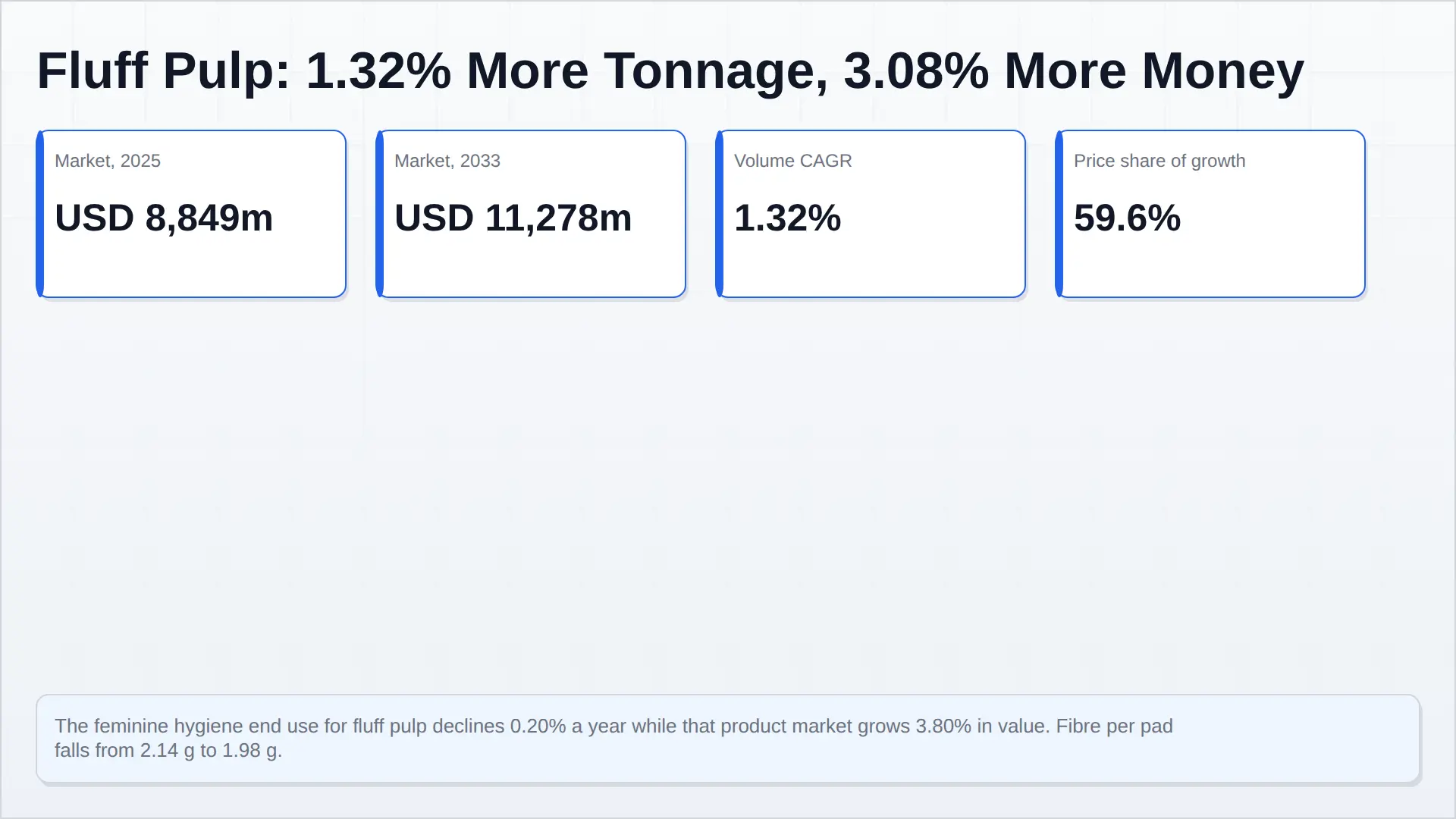
The global fluff pulp market is USD 8,849 million in 2025 and reaches USD 11,278 million in 2033 — 3.08 per cent a year. Volume moves from 6,860 thousand air-dried tonnes to 7,620 thousand, just 1.32 per cent a year. Realised price rises from USD 1,290 a tonne to USD 1,480, 1.73 per cent a year, and 59.6 per cent of the added value is price rather than tonnage.
That 1.32 per cent is the number to hold on to, because every market this material goes into grows faster than it does. Baby diapers, adult incontinence and feminine hygiene together are the reason fluff pulp exists, and all three are modelled at or above 1.32 per cent in value. The material is not tracking its customers. It is being engineered out of them.
Start with the sharpest case. Pheonix’s Global Feminine Hygiene Products Market Report models that category at 3.80 per cent value growth and 0.80 per cent volume growth, with 78.4 per cent of the value increase coming from price and mix. Inside it, the feminine hygiene end use for fluff pulp declines at 0.20 per cent a year. The finished product gets more expensive while the fibre inside it gets scarcer, because the average feminine hygiene unit goes from 2.14 grammes of fluff pulp in 2025 to 1.98 grammes in 2033 — a 7.5 per cent reduction in fibre per pad over eight years.
That is what “the pad got shorter” means in tonnes. The same substitution is running in every other end use: an adult incontinence unit falls from 33.09 to 30.16 grammes over the same period while its category grows 6.70 per cent in value, because higher superabsorbent polymer loading and low-fluff core designs replace fibre with gel. Fluff pulp is the only material on this shelf whose customers’ research and development budget is explicitly aimed at buying less of it.
So how does a material in structural decline by intensity grow 3.08 per cent a year in value? Price, and three specific mechanisms behind it. Supply is concentrated in a small number of named mills: Stora Enso’s Skutskär works in Sweden is Europe’s largest fluff pulp mill at 545,000 air-dried tonnes a year, and Domtar’s Plymouth mill in North Carolina runs 390,000 — those two assets alone are 935,000 tonnes, 13.6 per cent of a 6,860,000-tonne world market. Second, fluff pulp competes for the same softwood fibre as packaging grades, so capacity moves to whichever product pays more, and packaging has been paying more. Third, the documentation burden of proving where fibre came from — under the EU Deforestation Regulation and the fluff-pulp-specific EU Ecolabel criteria adopted in September 2023 — is a fixed cost that falls hardest on the smallest producers and supports the price of the compliant ones.
The result is a market that ships 1.32 per cent more tonnage and earns 3.08 per cent more money, and where the gap is a structural rent rather than a cycle. It is also the clearest illustration in this cluster of a rule that runs the other way from the finished-product side: the adult incontinence report models finished-product realisation at 1.64 per cent a year against this report’s 1.73 per cent for pulp. The input is repricing faster than the output, and every year of that gap is a margin transfer from the converter to the mill.
Market definition, size and forecast
Scope. Bleached and unbleached softwood kraft fluff pulp produced from coarse, long-fibre softwoods and sold in bales or reels for defibration — the absorbent-core grade. Includes untreated, softened, semi-treated, elemental-chlorine-free, totally-chlorine-free and non-bleached grades. Excluded: papermaking softwood kraft, bleached eucalyptus and hardwood kraft, chemi-thermomechanical pulp, recycled fibre, and airlaid nonwoven sold as a finished web.
Why this sits in Personal Care rather than in Forest Products. Because its demand does. Essentially all fluff pulp is consumed by absorbent hygiene and airlaid converting, and the specification is set by hygiene product designers rather than by papermakers. This report is placed in the segment where its customers are, so that it links to them.
Volume by end use
| End use | 2025 (thousand ADt) | 2033 (thousand ADt) | CAGR | Share of 2025 volume |
|---|---|---|---|---|
| Baby diapers | 3,773 | 4,140 | 1.17% | 55.0% |
| Adult incontinence | 1,509 | 2,030 | 3.78% | 22.0% |
| Feminine hygiene | 686 | 675 | −0.20% | 10.0% |
| Airlaid, wipes and other | 892 | 775 | −1.74% | 13.0% |
| Total | 6,860 | 7,620 | 1.32% | 100.0% |
Two of the four end uses shrink in absolute tonnage while their underlying product markets grow. That is not a modelling artefact; it is the arithmetic of core design. A fluff-less core is a commercial product, it performs, and it is cheaper per unit of absorbency once polymer prices are where they have been. The 892,000 tonnes in airlaid, wipes and other is the weakest book of the four, falling 1.74 per cent a year, because airlaid faces direct substitution from spunlace and because the wipes category is where single-use plastics regulation bites hardest in Europe.
Baby diapers are the base and the problem. At 3,773 thousand tonnes they are 55.0 per cent of the market and grow 1.17 per cent a year — below the market average — because global births are flat to falling while penetration rises in exactly the markets where a diaper contains the least fibre. A diaper sold in Lagos or Karachi is smaller, lighter and lower-specification than one sold in Osaka. The volume growth in diapers is real; the tonnage growth is thin.
Adult incontinence is the only end use that adds tonnage meaningfully, at 3.78 per cent, and it is the single reason this market grows at all above 1 per cent. Every thousand tonnes of growth in this report is, in the end, a function of how many adult briefs and pants the world wears.
Volume by region
| Region | 2025 (thousand ADt) | 2033 (thousand ADt) | CAGR | Share of 2025 volume |
|---|---|---|---|---|
| North America | 2,470 | 2,690 | 1.07% | 36.0% |
| Asia Pacific | 1,900 | 2,260 | 2.19% | 27.7% |
| Europe | 1,700 | 1,830 | 0.93% | 24.8% |
| South America | 480 | 520 | 1.01% | 7.0% |
| Middle East & Africa | 310 | 320 | 0.40% | 4.5% |
| Total | 6,860 | 7,620 | 1.32% | 100.0% |
The regional split is a map of where the mills are, not where the babies are. North America consumes 36.0 per cent of world fluff pulp with roughly 4 per cent of world births, because converting capacity sits close to the fibre — and because a finished diaper is mostly air, so the economics favour making it near the mill rather than shipping pulp to the customer. Asia Pacific is the only region growing above the market rate, at 2.19 per cent, and it is growing into its own converting capacity rather than into imported pulp.
Europe at 0.93 per cent is the slowest large region and the most exposed to regulation. It is also the region where the two forces in this report meet most visibly: the highest per-capita hygiene consumption, the most advanced fluff-reduction technology, the most demanding fibre-documentation regime, and the largest single fluff pulp mill on the continent.
Where the USD 2,428 million of growth comes from
| Component | Contribution (USD m) | Share |
|---|---|---|
| Volume at the 2025 realised price | 980.4 | 40.4% |
| Realised price per tonne | 1,447.8 | 59.6% |
| Total value growth, 2025–2033 | 2,428.2 | 100.0% |
Set that beside the finished-product reports and the sequence is complete. Feminine hygiene grows 78.4 per cent on price; adult incontinence grows 69.9 per cent on volume; fluff pulp grows 59.6 per cent on price on almost no volume. The three numbers describe the same chain from three positions, and they explain why a converter’s margin is squeezed from both ends in a category that is growing.
Sources
- Stora Enso Oyj, Skutskär Mill — largest producer of fluff pulp in Europe, annual capacity 545,000 Adt/a coniferous pulp — storaenso.com
- Stora Enso Oyj, NaturaFluff — fluff pulp for hygiene products, key benefits, grade range and end-use applications — storaenso.com
- Domtar Corporation, Plymouth Mill — softwood fluff pulp, 390,000 air dry metric tonnes annual pulp production capacity, used in adult incontinence and baby diapers — domtar.com
- Domtar Corporation, Fluff Pulp — untreated, softened and semi-treated grades produced at the Ashdown and Plymouth mills — domtar.com
- Nordic Swan Ecolabel, Pulp and fluff declaration portal — inspected fluff grades by company and mill, including SCA Östrand Star Fluff Pulp, Klabin Puma PineFluff, UPM RaumaCell, Södra Cell Värö, Mönsterås and Mörrum, ENCE Navia LEAFF, and GCF US Holdings Franklin, New Bern and Port Wentworth — nordic-swan-ecolabel.org
- EU Ecolabel, EU Pulps — pulps assessed under Commission Decision (EU) 2023/1809 of 14 September 2023 establishing EU Ecolabel criteria for fluff pulp — eupulps.net
- Fastmarkets, PPI Europe, Vol. 40 No. 27, 10 July 2025 — NBSK and BEK market pulp price assessments — fastmarkets.com
- European Commission, Directorate-General for Environment, EU Deforestation Regulation (EUDR) — environment.ec.europa.eu
- Pheonix Research, Global Feminine Hygiene Products Market Report, Size, Share and Forecast 2026–2033 — pheonixresearch.com — used for per-unit fibre intensity and for the price-versus-volume decomposition.
- Pheonix Research, Global Adult Incontinence Products Market Report, Size, Share and Forecast 2026–2033 — pheonixresearch.com — used for the incontinence fibre-intensity series.
- Pheonix Research company profiles for Essity and Kimberly-Clark, the two largest consumers-side owners of the finished products this material goes into.
No market-research competitor data is used as an input to this report or cited anywhere in it. Mill capacities, grade ranges and price assessments are taken from the producer and price-reporting sources listed above; the market size, volume by end use, regional split and realised price series are Pheonix modelled estimates, identified as such wherever they appear.
Press release and analysis on this market
- Press release: Fluff Pulp Earns 3.08 Per Cent a Year From Customers Who Want to Buy 1.32 Per Cent More of It
- The Only Material Whose Customer Is Paying to Use Less of It — why price does 59.7 per cent of the work.
- Two Mills, One Eighth of the World, and a Price Set Somewhere Else — concentration, optionality and the certification moat.
Table of Contents
Competitive Landscape
Competitive landscape
This is the most concentrated market in the cluster and the least visible one, because fluff pulp is sold to converters rather than to consumers and almost none of it carries a brand. What it does carry is a mill name, and the certification registers that verify those mills are the most reliable public map of who can actually make the grade.
| Producer | Fluff assets | Verified detail |
|---|---|---|
| Stora Enso | Skutskär, Sweden — NaturaFluff | Largest producer of fluff pulp in Europe. 545,000 Adt/a of coniferous pulp. ECF, TCF and non-bleached grades; reels available. |
| Domtar | Plymouth, North Carolina and Ashdown, Arkansas | Plymouth: softwood fluff pulp, 390,000 air dry metric tonnes annual capacity. Ashdown produces untreated, softened and semi-treated grades. |
| SCA | Östrand, Sweden | Star Fluff Pulp; separate CTMP and NBSK lines at the same site. |
| Klabin | Puma, Brazil | PineFluff bleached softwood kraft fluff, alongside PineCel NBSK. |
| UPM | RaumaCell, Finland | BioBright and BioBrown fluff and airlaid grades, including TCF and treated variants. |
| Södra | Värö, Mönsterås and Mörrum, Sweden | Multiple inspected fluff grades across three mills. |
| ENCE | Navia, Spain | LEAFF (ENCE Fluff) from the Navia mill. |
| GCF US Holdings | Franklin and New Bern, North Carolina; Port Wentworth, Georgia | SuperSoft fluff grades including treated and air variants across three US sites. |
Two assets are 13.6 per cent of the world. Skutskär at 545,000 tonnes and Plymouth at 390,000 tonnes together are 935,000 air-dried tonnes against a world market modelled at 6,860,000 tonnes. In most commodity pulp grades that would be unremarkable; in this one it is decisive, because the number of mills able to make a hygiene-grade fluff at specification is small and the capital required to convert a paper mill into one is a project rather than a tweak.
The concentration is not the pricing mechanism. The optionality is. Most fluff mills are swing mills — the same fibre line can produce paper-grade softwood kraft instead. A mill therefore does not compare the fluff price to its cost; it compares it to the price of the alternative it could be making. When packaging and board grades earn more per tonne of fibre, fluff supply tightens without a single tonne of capacity being closed, and the price required to keep a swing mill on fluff is set by a market that has nothing to do with hygiene.
The geography of supply and the geography of demand have diverged. Production is concentrated in Sweden, Finland, the southern United States, Brazil and Spain. Consumption growth is concentrated in Asia Pacific. That mismatch is why the freight cost of a low-density bale matters, why converters cluster near mills rather than near consumers, and why Asia Pacific’s 2.19 per cent volume growth is being met by new converting capacity built close to North American and Brazilian fibre rather than by a new Asian fluff mill.
Certification is a competitive moat for the compliant. The mills that appear on the Nordic Swan and EU Ecolabel registers have accepted an inspection regime that smaller producers have not. That is a fixed cost per grade and it advantages the large multi-mill producer with a technical team. It is also, incidentally, why the public record of who makes fluff pulp is better than for most commodity grades.
Value Chain
Value chain and cost structure
Softwood roundwood becomes fluff pulp at a kraft mill, becomes a core at a converter, and becomes a finished hygiene product on a converting line. The interesting part is what happens to the fibre at each step, because this is the one chain in the cluster where the customer is trying to remove the product.
| Stage | What happens | Economics |
|---|---|---|
| Fibre | Coarse, long-fibre softwood harvested for the mill | Stumpage and freight; competes with lumber and board for the same log |
| Kraft pulping | Sulphate process, bleaching to ECF or TCF or left unbleached | Capital and energy intensive; the mill is a swing asset |
| Fluff grade | Sheet formation to specification; bale or reel | Price set against NBSK and against the packaging alternative |
| Defibration | Fibre opened at the converter and formed into a core with SAP | Energy and pad-integrity trade-off; the reel-versus-bale choice lives here |
| Converting | Core, nonwoven, film, adhesive and pack | Line-hour economics; fibre is a minority of unit cost |
The anchor price is NBSK, not fluff pulp. In July 2025 European market pulp was oversupplied and prices were falling. Bleached eucalyptus kraft settled USD 60 a tonne lower at USD 1,060 a tonne. For northern bleached softwood kraft, buyers were targeting USD 1,500 a tonne while sellers held out for USD 1,520. That spread — softwood over hardwood at roughly 45 per cent — is the economic space in which fluff pulp prices itself, because a fluff grade is a softwood kraft grade with additional processing and a different customer.
Fibre is a small share of the finished unit and a large share of the converter’s margin swing. The feminine hygiene report puts fluff pulp at 10 of a 100-index shelf price. In absolute terms a feminine hygiene unit carries about 0.28 US cents of fibre against a 12.41-cent realisation, and an adult incontinence unit about 4.27 cents against 37.06. Neither is a dominant cost. Both are the most volatile line in it, because polymer, nonwoven and converting costs move slowly and pulp reprices quarterly.
That volatility has a direction that favours the mill. This report models fluff pulp price rising 1.73 per cent a year. The adult incontinence report models finished-product realisation at 1.64 per cent. The difference is small annually and compounds: over eight years it is a structural transfer of roughly one percentage point of realisation from the converter to the mill, on a product whose volume is growing. In feminine hygiene the same arithmetic does not apply: that report’s 2.98 per cent realisation is above this report’s 1.73 per cent pulp price, which is why the feminine hygiene value chain has been able to absorb pulp inflation and still expand margin. The two categories sit on opposite sides of the same input.
Who carries inventory risk. Pulp is bought on contract and consumed continuously, so converters hold weeks of stock and mills hold weeks of finished bales. When the price is falling, as in July 2025, the converter gains and the mill loses on every tonne in the chain. When it turns, the transfer reverses in a quarter. That asymmetry, not the level of price, is what makes the pulp line the most negotiated item in a hygiene supply agreement.
Investment Activity
Investment activity
Capital in this market is not going into new fluff capacity. It is going into three other things: keeping existing mills flexible, certifying grades, and converting fibre into products that earn more per tonne.
Flexibility is the investment thesis. A swing mill is worth more than a single-grade mill because it holds an option on whichever product pays best in a given quarter, and this market’s price is set at the point where that option is exercised. That is why the disclosed investment in this grade shows up as grade development rather than as tonnage: Stora Enso’s own product disclosure notes recent portfolio additions of non-bleached grades developed for hygiene and air-laid applications. A new grade on an existing line is a small capital item that opens a new customer specification; a new line is a nine-figure project that the volume forecast does not justify.
Consolidation has already happened at the ownership level. Domtar is a privately held North American forest products manufacturer, and the North American fluff position sits inside an ownership structure that also owns packaging and paper assets. That matters for this market because it means the same balance sheet that decides whether to make fluff pulp also decides whether to make board — and allocates fibre to whichever returns more. The decision that sets fluff pulp supply is frequently made by a manager who does not work in the hygiene business.
The competing investment is packaging. Fibre that could be fluff pulp can be bleached softwood kraft for packaging, liquid packaging board or specialty paper, and all three have had periods of stronger returns than hygiene pulp. That is the real capital competition, and it is why this report models price growth of 1.73 per cent a year on 1.32 per cent volume growth rather than the reverse: the constraint is fibre allocation, not demand.
Downstream, the investment is going the other way. The converters — Essity, Kimberly-Clark, Ontex, Unicharm, Hengan — are the buyers in this market, and their capital programmes are aimed at using less of the product sold here. A low-fluff core line is a capital project whose return is measured in pulp saved. Stora Enso, Domtar, SCA, Klabin, UPM and Södra are therefore investing to defend a grade whose customers are investing to shrink it, and the only defence available is price and specification.
What is not being built. No large greenfield fluff pulp capacity is evident in the disclosed record of any of the eight producers named in this report. The disclosed activity is grade extension, certification and site-level debottlenecking. In a market where the customers’ design intent is to consume less fibre per unit, an absence of new capacity is rational, and it is the structural support under the price line in the forecast.
Technology & Innovation
Technology and innovation
Two technologies face each other across this market, and they pull in opposite directions. One is the pulp mill trying to make a fibre that defibrises with less energy and holds more liquid; the other is the converter trying to design a core that needs less fibre at all.
| Vector | Side of the market | Effect on fluff pulp demand |
|---|---|---|
| Low-fluff and fluff-less cores | Converter | Removes fibre per unit and replaces it with polymer. The largest single force in this report. |
| Higher defibration efficiency | Mill | Lets a lower-cost fibre achieve the same pad integrity, opening cheaper furnish. |
| TCF and non-bleached grades | Mill | Grade extension for certification-led buyers; no volume effect, real price effect. |
| Reel instead of bale supply | Mill | Removes a defibration step at the converter and reduces fibre damage; a service differentiator. |
| Recycled absorbent fibre | Both | Currently a specification requirement with a cost, not a supply source. |
The reel versus bale distinction is small and commercially real. Stora Enso’s own product disclosure lists reel formats as a key benefit for efficient converting operations, and that is the right register for this market: the innovation that wins a contract is frequently a logistics and handling change rather than a fibre-science breakthrough, because the converter’s cost problem is not only grammes of pulp but the labour and energy of getting it into a core.
Grade range is the real product. A single mill now offers ECF, TCF and non-bleached variants, treated and untreated, softened and semi-treated, in bale and reel. That is not a marketing list; it is a response to the fact that a diaper core, an adult brief core and an airlaid napkin need genuinely different fibre properties — length, coarseness, brightness, sheet strength, moisture and defibreizing energy. The producer who can supply the whole range from one site keeps the customer; the producer with one grade competes on price alone.
Eucalyptus is the quiet substitute. Bleached eucalyptus kraft is hardwood, short-fibre and cheap, and it has been encroaching at the low-performance end of hygiene for years. It cannot match softwood fluff on pad integrity at low density, which is why it has not displaced the grade — but it explains why the softwood-to-hardwood price spread matters so much. In July 2025 that spread in Europe was roughly 45 per cent in softwood’s favour. Every point it narrows is a point of pressure on this market’s price line.
Recycling is not yet a supply source. Absorbent hygiene products are a laminate of pulp, polymer, polypropylene and polyethylene, and separating the fibre economically at scale has not been demonstrated against virgin fluff at USD 1,290 a tonne. European collection schemes are being built because regulation requires them, not because the recovered fibre competes. Treat recycled content as a cost line in a tender specification and nothing more.
Market Risk
Market risk and scenarios
| Risk | Level | Transmission |
|---|---|---|
| Design substitution (fluff-less cores) | High | The defining risk. Every gramme removed from a core is permanent demand destruction, and it compounds across every unit sold thereafter. |
| Swing capacity returning to fluff | Moderate–High | If packaging grades weaken, mills switch back and price falls without any new capacity being built. |
| Fibre cost and stumpage | Moderate | The mill buys softwood roundwood in a market that also supplies lumber and board. |
| Regulatory documentation (EUDR) | Moderate | Compliance cost is fixed per grade and per origin; it advantages large producers and raises the floor price. |
| Substitution by eucalyptus and recycled fibre | Moderate | Hardwood kraft and recycled fluff encroach at the low-performance end of the hygiene range. |
| Demand collapse in the category | Low | Hygiene is non-discretionary and the volume base is stable even where intensity falls. |
Base case — 3.08 per cent, USD 11,278 million by 2033. Volume grows 1.32 per cent, carried by adult incontinence and dampened by fibre-intensity decline everywhere else. Price grows 1.73 per cent as swing capacity stays largely on the packaging side and documentation costs raise the compliant floor.
Upside — 4.6 per cent, approximately USD 12,681 million. Requires packaging grades to stay strong enough to hold swing capacity away from fluff through most of the window, with adult incontinence volume at the top of its range. In this scenario the market earns its growth almost entirely in price while shipping barely more fibre.
Downside — 1.6 per cent, approximately USD 10,047 million. Requires a packaging downturn that returns swing capacity to fluff at the same time as core-design gains accelerate. In that case price falls even as volume rises, and the market grows more slowly than the global population.
What to watch. Three indicators, in order of usefulness. The spread between northern bleached softwood kraft and bleached eucalyptus kraft in Europe — in July 2025 NBSK was being negotiated at USD 1,500 to 1,520 a tonne against BEK at USD 1,060, a premium of roughly 45 per cent, and that premium is the price of the fibre this grade competes for. The announced fluff-reduction targets of the major converters, which are the leading indicator of intensity. And the trend of European packaging pulp prices, which tell you what a swing mill would rather be making.
The honest caveat. Market size, volume by end use, the regional split and the realised price series are modelled, because fluff pulp is not reported as a separately disclosed line by any of the producers named here. The physical quantities are anchored on disclosed mill capacities and on certification registers that name the mill and the grade. Where a disclosed figure exists it is preferred to the model and quoted in the text.
Regulatory Landscape
Regulatory landscape
Fluff pulp is the most heavily documented commodity in this cluster, and unusually the regulation is not aimed at the product at all. It is aimed at the forest the fibre came from, and at the mill that processed it.
| Instrument | Reach | Commercial consequence |
|---|---|---|
| EU Deforestation Regulation | Wood and wood-derived products placed on or exported from the EU market | Geolocation and due-diligence evidence per consignment; progressively replaces the EU Timber Regulation |
| EU Ecolabel criteria for fluff pulp | Commission Decision (EU) 2023/1809 of 14 September 2023 | A fluff-pulp-specific assessment route; listed pulps are named by mill in a public register |
| Nordic Swan Ecolabel | Pulp and fluff declaration portal | Grade-by-grade inspection; the de facto Nordic procurement standard |
| EU Packaging and Packaging Waste Regulation | Packaging placed on the EU market | Recycled content and labelling obligations that reach the hygiene pack, not the pulp |
| Single-use plastics rules | Wet wipes and certain single-use items | Bites on the adjacent wipes market and therefore on the airlaid end use |
| US and Asian regimes | Forest practice and chain-of-custody | Voluntary certification rather than statute; the disclosure gap with Europe is wide |
EUDR is the most consequential, and not for the reason usually given. The regulation requires that products placed on the EU market do not cause deforestation or forest degradation, and it applies to wood and products made from it. For a Nordic or North American mill drawing on long-established managed forest the substantive risk is low. The cost is in evidence: geolocation, legality proof and due diligence per consignment, auditable at the operator. That is a fixed cost per origin and per grade, and fixed costs per grade always fall hardest on the producer with the fewest grades.
The fluff-pulp-specific ecolabel is unusual and worth noting. Most commodity grades are covered by ecolabel criteria written for paper. Fluff pulp had criteria established separately, by Commission Decision (EU) 2023/1809 of 14 September 2023, and there is a public register of assessed pulps named by manufacturer and production site. That register is why the producer map in this report can be stated with mill-level precision rather than as an estimate, and it is also a competitive fact: a buyer who wants an ecolabelled hygiene product can only buy fibre from a mill that has been assessed.
Certification is now a market-access condition in Northern Europe. FSC and PEFC chain-of-custody is table stakes for retail own-brand; Nordic Swan and EU Ecolabel are procurement requirements for a growing share of public and institutional buyers. None of this changes how much fibre a pad contains. All of it changes which mills can sell into the most demanding market in the world, and it supports the price line in this forecast more than any demand variable.
What is not regulated, and matters. No jurisdiction regulates fibre intensity per hygiene product, and none is likely to. The pressure to use less pulp comes from cost and from polymer performance, not from statute. A reader looking for a regulatory driver of the fluff-reduction trend will not find one; it is an engineering and margin decision taken inside the converter.